Tag: Parliamentary Committee

  • Parliamentary panel to review OTT content amidst regulatory debate

    Parliamentary panel to review OTT content amidst regulatory debate

    MUMBAI: Imagine this: you’re unwinding with your favorite show, only to frantically fumble for the remote as a scene unfolds that you’d rather your child never see—graphic violence, explicit language, or worse, nudity. Frustrated by the glamorisation of crime and violence in thrillers that could inspire the impressionable? It’s a moment every parent dreads, and a dilemma households across the country face in today’s era of on-demand entertainment.

    But here’s the big news: relief might finally be on the way.

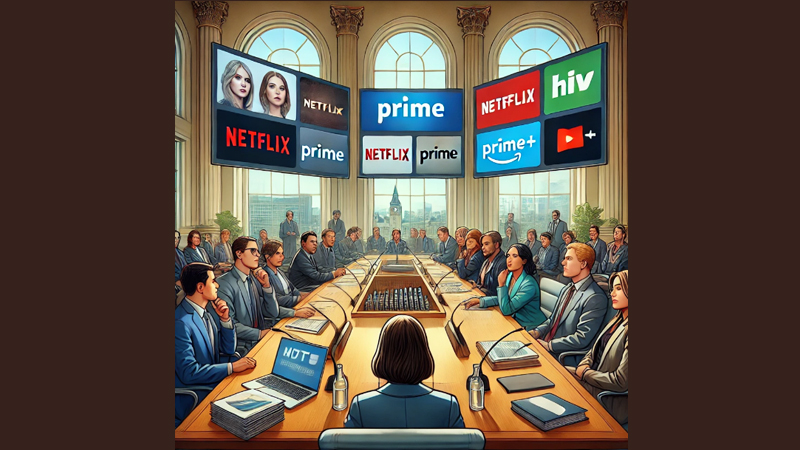
    In a move poised to reshape how we consume digital content, the Parliamentary Standing Committee on Communications and Information Technology is stepping in. Mark your calendars for 20 December, when the committee will meet with leading industry bodies to tackle the hot-button issue of content regulation on OTT platforms. As debates intensify between calls for stricter government oversight and advocates of self-regulation under the IT Rules, 2021, the stage is set for what could be a landmark decision in the OTT landscape.

    This is a moment of mixed emotions—hope for a more family-friendly streaming experience, but also trepidation over potential restrictions that might stifle creativity. One thing is certain: change is brewing, and all eyes are now on the committee’s crucial meeting.

    The committee, chaired by Lok Sabha member Nishikant Dubey, has invited organisations such as the Indian Motion Picture Producers’ Association and the Motion Picture Association of America (India office) to present their views. This dialogue follows Information and Broadcasting minister Ashwini Vaishnaw’s request to prioritise strengthening laws governing social media and OTT platforms.

    Dubey emphasised the urgency of addressing content concerns, particularly regarding portrayals of women, obscenity, and vulgarity. “OTT platforms often feature content unsuitable for family viewing. Our meeting with industry stakeholders will address these pressing issues,” he said.

    Last month, Vaishnaw highlighted cultural disparities between India and foreign regions housing platforms like Netflix and Prime Video. He stressed the need for stricter regulations, citing examples such as Netflix’s portrayal of the 1999 Indian Airlines hijacking in IC-814: The Kandahar Hijack. The series faced criticism for inaccuracies, prompting Netflix to update its disclaimers.

    Industry bodies such as the Indian Digital Media Industry Foundation (IDMIF) and the Internet and Mobile Association of India (IAMAI) have pushed for retaining the current self-regulatory framework. Both organisations argue that platform-level self-regulation under IT Rules ensures creative freedom while adhering to constitutional boundaries.

    In August, IDMIF and IAMAI assured MIB that their members comply with the code of ethics, avoiding content harmful to India’s sovereignty, security, and public order. They also highlighted caution in portraying racial or religious groups.

    As the government explores options like pre-certification for OTT content, industry bodies have urged against additional oversight. They advocate for maintaining the balance between creative expression and compliance.

    The 20 December meeting is poised to shape the future regulatory framework for OTT platforms in India, balancing creative freedom, cultural sensitivities, and legal accountability.

  • Twitter refuses to appear before Parliamentary Committee on IT

    Twitter refuses to appear before Parliamentary Committee on IT

    MUMBAI: Amid growing concern about data security, Twitter CEO and senior officials declined to appear before the Parliamentary Committee on Information Technology on 11 February. The global social media giant cited “short notice of the hearing” as reason for the refusal.

    Earlier the Parliamentary Committee headed by Anurag Thakur issued a summon to Twitter via official letter to discuss the issues concerning the use of social media. While 7 February was decided as the date for meeting, it was rescheduled to 11 February to provide more time to Twitter CEO and senior officials.

    "It may be noted that the head of the organisation has to appear before the committee," the letter clearly mentioned according to reports. "He/She may be accompanied by another representative," it further added.

    Twitter's legal, policy, trust and safety global lead Vijaya Gadde sent back a letter stating, "No one who engages publicly for Twitter India makes enforcement decisions with respect to our rules for content or accounts in India."

    The letter also added that deputing a junior employee to represent Twitter at the Indian Parliamentary IT Committee has not gone down well with Indian lawmakers especially since they have no decision making authority.

  • Final phase STB seeding is 35% even as deadline nears

    NEW DELHI: Even as the country has set a deadline of 31 March this year for full digitisation of cable TV, a Parliamentary Committee has been told that only 35 per cent seeding of set-top boxes (P-IV) has been achieved in rural India though the Parliament was told last week that 66.79 per cent (P III & IV) seeding had been achieved in the last two phases minus Tamil Nadu.

    Admitting that digitisation in the first phase is total minus Chennai, the Parliamentary Standing Committee on Information Technology which also examines issues relating to the information and broadcasting ministry has been told that digitisation has also not been done in one city – Coimbatore – of Phase II in view of court cases though the other 37 cities having more than one million population and spanning 14 states and one union territory had been covered.

    The committee recommended that the I and B Ministry follow up the issue of financial and technical viability in rural and remote areas, promote and increase share of iCAS (Indian Conditional Access System) to leverage ‘Make in India’ programme, popularise Doordarshan Free Dish in small town/cities/rural and remote areas, address the legitimate concerns of domestic STB producers and rigorously pursue interoperability of STB with the Telecom Regulatory Authority of India.

    The committee therefore expressed the hope that the I and B Ministry will be able to meet the targets of cable TV digitisation as almost all the pending cases have now been dismissed and there is no stay in any case except in case of Chennai and Coimbatore.

    Cable TV Digitisation in Phase III and Phase IV areas was to be achieved by 31 December 2015 and 31 December 2016 respectively, now extended to 31 January 2017 and 31 March 2017.

    Interoperability: TRAI working with IIT Bombay

    It was told that technical interoperability, as envisaged in the existing Direct to Home Guidelines has so far not proved to be effective due to various techno-commercial issues. The TRAI has decided to collaborate on the issue of technical interoperability with the Department of Electrical Engineering of Indian Institute of Technology, Bombay (IIT-B).

    To ensure commercial interoperability TRAI has notified tariff orders and this has been challenged by a couple of DTH operators in the Telecom Disputes Settlement and Arbitration Tribunal and the matter is sub judice.

    The Committee was given to understand that after the roll out of iCAS in January 2016, about 10 million STBs have been installed by multi-system operators out of which about 300,000 are with iCAS, which gives a market share of about 3%.

  • Give more funds to DAVP for empowering people: Parliamentary Committee

    Give more funds to DAVP for empowering people: Parliamentary Committee

    NEW DELHI: Noting that the then Information and Broadcasting ministry secretary had admitted that the budget availability for publicity purpose was not adequate enough, a Parliamentary Committee has recommended that the budgetary allocation for the Directorate of Advertising and Visual Publicity should be enhanced.

    The Parliamentary Standing Committee for Information Technology which goes into issues relating to I and B said this will help DAVP to broadbase and increase the outreach of the multimedia campaigns being carried out by it through various means such as television, print, social media or other outreach programmes for the welfare of the society.

    Noting that a reduced allocation of Rs 125.60 crore had been made during 2016-17 at the Budget Estimate stage for the ‘People’s Empowerment through Development Communication’ (PEDC) scheme,  the Committee felt this amount was‘grossly inadequate to meet the requirement under this important scheme. As a matter of fact, the allocation was about 69 percent of the total outlay for the information sector. 

    The Committee was told that during the first year of 12th the Plan 2012-13, utilization of funds for PEDC was to the tune of Rs.103.18 crore which was increased to Rs.189 crore in the year 2013-14 and Rs.155.2 crore in the year 2014-15. For the year 2015-16, an allocation of Rs.151 crore had been made at the Revised Estimate stage out of which the actual expenditure as on 30 March 2016 had been Rs.146.34 crore.

    The Committee was given to understand that the line ministries and departments carry their ministry-specific campaign for which they have their own budgetary allocations. However, the DAVP’s budget allocation obtained through the Development Communication and Information Dissemination (DCID) programme of I&B ministry is used to run integrated campaigns on all the flagship programmes of the government.

    The Committee observed that the government had been launching several initiatives and direct benefit schemes for the welfare of the people, and information regarding these schemes have to be disseminated to the people and the target groups.

    To achieve this objective, the scheme of PEDC had an important role to play. In order to facilitate integrated campaign on various flagship programmes of the government, the DAVP needs a much larger budget with matching fund allocation which requires more allocation for the information sector.

    The DAVP is the nodal multimedia advertising agency of the government catering to the communication needs of the ministries/departments, autonomous bodies and PSUs. In order to strengthen the publicity of various peoples’ welfare and participation oriented programmes in a holistic manner, and to enable efficient discharge of its services, the DAVP had sought and obtained increased funding for two of its Plan Schemes – PEDC implemented through the DCID scheme and ‘Media Infrastructure Development Programme’.

  • Give more funds to DAVP for empowering people: Parliamentary Committee

    Give more funds to DAVP for empowering people: Parliamentary Committee

    NEW DELHI: Noting that the then Information and Broadcasting ministry secretary had admitted that the budget availability for publicity purpose was not adequate enough, a Parliamentary Committee has recommended that the budgetary allocation for the Directorate of Advertising and Visual Publicity should be enhanced.

    The Parliamentary Standing Committee for Information Technology which goes into issues relating to I and B said this will help DAVP to broadbase and increase the outreach of the multimedia campaigns being carried out by it through various means such as television, print, social media or other outreach programmes for the welfare of the society.

    Noting that a reduced allocation of Rs 125.60 crore had been made during 2016-17 at the Budget Estimate stage for the ‘People’s Empowerment through Development Communication’ (PEDC) scheme,  the Committee felt this amount was‘grossly inadequate to meet the requirement under this important scheme. As a matter of fact, the allocation was about 69 percent of the total outlay for the information sector. 

    The Committee was told that during the first year of 12th the Plan 2012-13, utilization of funds for PEDC was to the tune of Rs.103.18 crore which was increased to Rs.189 crore in the year 2013-14 and Rs.155.2 crore in the year 2014-15. For the year 2015-16, an allocation of Rs.151 crore had been made at the Revised Estimate stage out of which the actual expenditure as on 30 March 2016 had been Rs.146.34 crore.

    The Committee was given to understand that the line ministries and departments carry their ministry-specific campaign for which they have their own budgetary allocations. However, the DAVP’s budget allocation obtained through the Development Communication and Information Dissemination (DCID) programme of I&B ministry is used to run integrated campaigns on all the flagship programmes of the government.

    The Committee observed that the government had been launching several initiatives and direct benefit schemes for the welfare of the people, and information regarding these schemes have to be disseminated to the people and the target groups.

    To achieve this objective, the scheme of PEDC had an important role to play. In order to facilitate integrated campaign on various flagship programmes of the government, the DAVP needs a much larger budget with matching fund allocation which requires more allocation for the information sector.

    The DAVP is the nodal multimedia advertising agency of the government catering to the communication needs of the ministries/departments, autonomous bodies and PSUs. In order to strengthen the publicity of various peoples’ welfare and participation oriented programmes in a holistic manner, and to enable efficient discharge of its services, the DAVP had sought and obtained increased funding for two of its Plan Schemes – PEDC implemented through the DCID scheme and ‘Media Infrastructure Development Programme’.

  • Govt moots long-term financing for Indian STB manufacturers

    Govt moots long-term financing for Indian STB manufacturers

    NEW DELHI: The government is working on a plan for long-term financing to Indian manufacturers of set top boxes to accelerate digitization of cable television. This information was given by the Information and Broadcasting ministry to the Parliamentary Standing Committee on Information Technology which examines issues relating to I and B.

    The Committee expressed the hope that the ministry will be able to meet the targets of cable TV digitization and recommend that the issues of long term financial support to domestic manufacturers to negate easy procurement of Chinese made STBs need to be looked into and addressed suitably by the Ministry.

    While informing the Committee that just around nineteen manufacturers were manufacturing indigenous STBs, the Consumer Electronics and Appliances Manufacturers Association (CEAMA) said it can scale up the capacity if there is a demand but for that there is need of government support in creating a level playing field for domestic STB manufacturers to compete with the Chinese imported STBs.

    The Committee was given to understand that as of now there is easy facility for obtaining long-term credit to procure the Chinese STBs and this option is not available in the Indian banking system.

    The ministry claimed that it had declared STBs as part of the telecommunications network equipment and reduction of Value Added Tax on domestically manufactured STBs. An indigenous Conditional Access System (CAS) had been developed which will give further impetus to the domestic STB manufacturers to produce and supply the indigenously manufactured STBs.

    However, the Committee said the ministry may also think in terms of increasing the allocation for Mission Digitization which at present is merely taking care of procedural requirement to support the needs of domestic manufacturers.

    This will not only give a further boost to the ‘Make in India’ initiative of the government but also help in employment generation in a big way, the Committee said.

    Noting that digitization of the Cable TV sector in the country is one of the thrust areas of the ministry of I&B during the 12th Five Year Plan, the Committee said a look at the budgetary allocation and utilization of funds during 2015-16 under the Scheme of Mission Digitization showed that the ministry had spent Rs 1.25 crore out of Rs 1.30 crore made available at the Revised Estimate stage. Another Rs 5 crore had been allocated at the Budget Estimate stage for the year 2016-17. 

  • Govt moots long-term financing for Indian STB manufacturers

    Govt moots long-term financing for Indian STB manufacturers

    NEW DELHI: The government is working on a plan for long-term financing to Indian manufacturers of set top boxes to accelerate digitization of cable television. This information was given by the Information and Broadcasting ministry to the Parliamentary Standing Committee on Information Technology which examines issues relating to I and B.

    The Committee expressed the hope that the ministry will be able to meet the targets of cable TV digitization and recommend that the issues of long term financial support to domestic manufacturers to negate easy procurement of Chinese made STBs need to be looked into and addressed suitably by the Ministry.

    While informing the Committee that just around nineteen manufacturers were manufacturing indigenous STBs, the Consumer Electronics and Appliances Manufacturers Association (CEAMA) said it can scale up the capacity if there is a demand but for that there is need of government support in creating a level playing field for domestic STB manufacturers to compete with the Chinese imported STBs.

    The Committee was given to understand that as of now there is easy facility for obtaining long-term credit to procure the Chinese STBs and this option is not available in the Indian banking system.

    The ministry claimed that it had declared STBs as part of the telecommunications network equipment and reduction of Value Added Tax on domestically manufactured STBs. An indigenous Conditional Access System (CAS) had been developed which will give further impetus to the domestic STB manufacturers to produce and supply the indigenously manufactured STBs.

    However, the Committee said the ministry may also think in terms of increasing the allocation for Mission Digitization which at present is merely taking care of procedural requirement to support the needs of domestic manufacturers.

    This will not only give a further boost to the ‘Make in India’ initiative of the government but also help in employment generation in a big way, the Committee said.

    Noting that digitization of the Cable TV sector in the country is one of the thrust areas of the ministry of I&B during the 12th Five Year Plan, the Committee said a look at the budgetary allocation and utilization of funds during 2015-16 under the Scheme of Mission Digitization showed that the ministry had spent Rs 1.25 crore out of Rs 1.30 crore made available at the Revised Estimate stage. Another Rs 5 crore had been allocated at the Budget Estimate stage for the year 2016-17. 

  • CCI to await TRAI report even as Parliamentary Committee studies net neutrality

    CCI to await TRAI report even as Parliamentary Committee studies net neutrality

    NEW DELHI: Even as a Parliamentary Committee is meeting to discuss the net neutrality issue, Competition Commission of India (CCI) chairman Ashok Chawla has said net neutrality is a policy issue and Telecom Regularity Authority of India (TRAI) should first take a stand on it.


    Chawla said CCI would look into the matter when it will come to it. “It has not come to us. We will see when it comes. This is a policy issue. The regulator has to decide first. Based on whatever happens in terms of behaviour as in conformity and non-conformity of policy, we will see and in any case if they are going to interact with us they are welcome,” Chawla told reporters on the sidelines of an annual day function of the CCI.


    TRAI has already touched upon net neutrality in its Consultation Paper on over the top (OTT) services.


    Meanwhile, Parliamentary Ministry sources said that the Committee may hold more than one meeting on the issue, and will then place its report in the next session of Parliament. Representatives of some telecom companies are understood to have presented their views on the issue.


    CCI orders a probe only if there is prima-facie evidence of a violation of competition norms.


    The development comes at a time when some telecom operators have entered into tie-ups for offering free access to certain mobile apps and websites. Such activities have raised concerns on net neutrality. The last refers to equal treatment for all Internet traffic.


    Last month, Bharti Airtel launched Airtel Zero, an open marketing platform that allowed customers to access many mobile applications for free, with the data charges being paid by startups and large companies.


    Over the past few months, operators such as Reliance Communications and Uninor have partnered Internet companies such as Facebook, WhatsApp and Wikipedia to offer free usage to consumers.


    Such moves are being seen as being opposed to net neutrality, particularly to the extent that they affect communication OTT services like Viber, free calls on WhatsApp etc. 

  • Only 180 community radio stations despite financial aid by govt

    Only 180 community radio stations despite financial aid by govt

    NEW DELHI: Despite the scheme being almost a decade old and the government extending financial assistance, the total number of operational community radio stations (CRS) in the country is just 180.


    This is despite the fact that the Information and Broadcasting Ministry has issued around 410 permissions to set up community radio stations in the country. In addition to other assistance, the Government has even set up a fund for helping CRS.


    A Parliamentary Committee noted recently that 209 applications for setting up of community radio stations were pending with various Ministries. Even though the number of applications pending in the Ministries concerned has come down substantially, there are at least 50 applications that are pending, which have crossed the stipulated timeline beyond three months.


    Though the scheme was launched around a decade earlier, the outreach of the CRS was enhanced in 2006 to include non Governmental and Community based organisations with at least three years of legal existence.


    Earlier this year, Parliament was informed that only 76 letters of intent (LOI) had been issued out of the 689 applications from educational institutions, registered societies, trusts and NGOs etc received since 1 January, 2012 for setting up community radio stations.


    As many as 285 applications had been returned or rejected, while 263 had been referred back to the applicants.


    According to the list placed on the Ministry’s website as on 1 May, 2015, the largest number of community radio stations – around 90 – are being operated by private and governmental educational institutions, around 65 by non-governmental organisations, around 20 by universities including six by state agricultural universities, and six by Kendriya Vidyalya Kendras.


    Tamil Nadu has the largest number of CRS numbering around 27, followed by Uttar Pradesh with 21, Maharashtra with 17, Madhya Pradesh with 14, and Karnataka with 13. All other States and Union Territories have 10 or less CRs with Delhi having six.

  • Govt failed to pay 100% salary of Prasar Bharati employees: Parliamentary Committee

    Govt failed to pay 100% salary of Prasar Bharati employees: Parliamentary Committee

    NEW DELHI: Specific steps need to be taken to improve the planning and implementation of different schemes by Prasar Bharati, a Parliamentary Standing Committee has said.


    It has also said the Information and Broadcasting Ministry in consultation with the Finance Ministry evolve a mechanism, which should ensure that funds once allocated at the Budget Estimate stage are not withdrawn – unless there is a major shortfall in utilization – so that the execution of planned schemes does not suffer mid-way due to want of funds. 


    The Parliamentary Standing Committee for Information Technology, which deals with I&B was making this comment in the background of being informed that despite the decent pace of utilization at the BE stage, substantial reduction of funds take place, which is undoubtedly hampering the timely execution of planned schemes.


    The Committee took note of the fact that the outlay for the Plan schemes pertaining to Prasar Bharati constitutes a major chunk of the total Plan outlay of the Ministry.


    The Ministry has taken steps to improve the planning and implementation, which includes delegation of financial power up to Rs 300 crore to the Prasar Bharati Board, restoration of sanctioning power to DGs up to Rs 20 crore and rationalizing the procurement period in Prasar Bharati. 


    The Committee felt that these measures would facilitate quick decision making in Prasar Bharati, paving the way for the smooth and speedy execution of approved projects. But the Committee wants the I&B Ministry to make earnest efforts to bring improvement in their overall financial performance, which will enable them to achieve the laid down physical targets.


    The Committee noted that during the year 2014-15, the Government had allocated Rs 436 crore under Plan funds and Rs 2001.98 crore under Non-Plan funds for Prasar Bharati to meet salary and salary related expenses. 


    Separately, Prasar Bharati allocates Rs 200 crore annually from its Internal and Extra-Budgetary Resources for Content Development under Software Scheme under the 12th Five Year Plan proposal. 


    As against the projected revenue of Rs 2195 crore, the revenue receipts of Prasar Bharati during the year 2014-15 stood at Rs 1380 crore up to February 2015, which was expected to rise to Rs 1800 crore. 


    The Committee was informed that in addition to adopting aggressive marketing strategies, Prasar Bharati has also undertaken measures for better publicity of programmes to augment IEBR generation. 


    One of the areas of concern expressed by Prasar Bharati relates to diversion of IEBR resources towards meeting Non-Plan expenditure because the Ministry have not fulfilled the obligation to pay 100 per cent salary of Government servants recruited with Prasar Bharati for the past three years.


    The Committee recommended steps should be taken for early release of payment of Rs 429 crore due to Prasar Bharati from the year 2012-13 to 2014-15. 


    Diversion of resources of Prasar Bharati meant for Content Development has reportedly affected revenue generation by Prasar Bharati, especially Doordarshan. In view of the Cabinet decision taken in September, 2012 wherein it was decided that all operating expenses would be met by Prasar Bharati through IEBR, except salary and salary related expenses.