Tag: Parliament

  • GST Bill crucial for Start-Up India, Digital India success: IAMAI

    GST Bill crucial for Start-Up India, Digital India success: IAMAI

    MUMBAI: Industry body – Internet and Mobile Association of India (IAMAI) has urged the Parliament to pass the crucial GST (Goods & Services Tax) Bill in the forthcoming budget session. The industry body has said that the smooth passage of GST Bill is crucial for the success of mega economic and social projects, especially Digital India and Start-Up India.

    The GST Bill, which subsumes all indirect taxes to create one rate and integrate the country into a single market, is the biggest tax reform that is being undertaken since Independence, but is pending approval of the Rajya Sabha.

    The Digital India plan is about connecting, empowering and enabling citizens and encouraging local electronic manufacturing. Similarly, Start-Up India is focused on promoting entrepreneurship, and through small entrepreneurs, generating employment.

    Local manufacturing, NoFN, e-Gov, as a part of Digital India, where private sector is involved, crucially rests on the successful passage of GST Bill in Parliament, which seeks to create one market through one tax system. Similarly, start-ups, online market places, and other online service providers, all require a single market plan.

    IAMAI president Subho Ray said, “The extant tax structure of India is heavily fragmented, with multiple indirect taxes levied by different authorities at different stages of a transaction. Fiscal federalism has led to different procedures and rates of VAT and other forms of LBTs across the states. This creates logistical challenges for the industry, besides giving rise to compliance related complications. Conflict of interests between tax authorities in case of inter-state transaction is a major pain point for the industry today. GST will help the digital industry business model flourish by providing uniformity in tax rates and regulations across the country. This will help doing business in India easier, allow free-play to market dynamics and allow deeper penetration of these services.”

    Given that much of the developments in the digital industry are disruptive innovations, business models like online platforms, aggregators, etc are essentially services provided by intermediaries. Such services are revolutionising the existing markets of both goods and services. Thus, online ticketing services or e-tailing are providing newer modes of access for consumers to existing goods and services, said IAMAI.

    The digital industry unequivocally stands for the smooth passage of GST and hopes that the bill will be passed in the upcoming budget session, as any further delay will push back the transformative projects of the government.

  • GST Bill crucial for Start-Up India, Digital India success: IAMAI

    GST Bill crucial for Start-Up India, Digital India success: IAMAI

    MUMBAI: Industry body – Internet and Mobile Association of India (IAMAI) has urged the Parliament to pass the crucial GST (Goods & Services Tax) Bill in the forthcoming budget session. The industry body has said that the smooth passage of GST Bill is crucial for the success of mega economic and social projects, especially Digital India and Start-Up India.

    The GST Bill, which subsumes all indirect taxes to create one rate and integrate the country into a single market, is the biggest tax reform that is being undertaken since Independence, but is pending approval of the Rajya Sabha.

    The Digital India plan is about connecting, empowering and enabling citizens and encouraging local electronic manufacturing. Similarly, Start-Up India is focused on promoting entrepreneurship, and through small entrepreneurs, generating employment.

    Local manufacturing, NoFN, e-Gov, as a part of Digital India, where private sector is involved, crucially rests on the successful passage of GST Bill in Parliament, which seeks to create one market through one tax system. Similarly, start-ups, online market places, and other online service providers, all require a single market plan.

    IAMAI president Subho Ray said, “The extant tax structure of India is heavily fragmented, with multiple indirect taxes levied by different authorities at different stages of a transaction. Fiscal federalism has led to different procedures and rates of VAT and other forms of LBTs across the states. This creates logistical challenges for the industry, besides giving rise to compliance related complications. Conflict of interests between tax authorities in case of inter-state transaction is a major pain point for the industry today. GST will help the digital industry business model flourish by providing uniformity in tax rates and regulations across the country. This will help doing business in India easier, allow free-play to market dynamics and allow deeper penetration of these services.”

    Given that much of the developments in the digital industry are disruptive innovations, business models like online platforms, aggregators, etc are essentially services provided by intermediaries. Such services are revolutionising the existing markets of both goods and services. Thus, online ticketing services or e-tailing are providing newer modes of access for consumers to existing goods and services, said IAMAI.

    The digital industry unequivocally stands for the smooth passage of GST and hopes that the bill will be passed in the upcoming budget session, as any further delay will push back the transformative projects of the government.
  • NOFN being revamped to improve broadband connectivity, Rs 110,000 crore earned from spectrum auctions: Mukherjee

    NOFN being revamped to improve broadband connectivity, Rs 110,000 crore earned from spectrum auctions: Mukherjee

    NEW DELHI: President Pranab Mukherjee today said the architecture and design of the National Optical Fiber Network (NOFN) is being revamped to rapidly take broadband connectivity to Indian villages under Bharat Net.

    In his address to the joint sitting of both houses of Parliament on the first day of the Budget Session, the President said, “Transparent and efficient auction of spectrum has fetched highest ever price of about Rupees one lakh ten thousand crore.”

    He said policies like Spectrum trading and sharing have been finalised for optimum utilisation of resources.

    Mukherjee added that the recent interventions and subsequent rationalisation of duty structure in mobile handset manufacturing industry has led to near doubling of mobile handset production in the current year.

    According to Mukherjee, setting up world-class infrastructure for Electronics manufacturing across the country remains a priority for the Government. As many as 29 Electronic Manufacturing Clusters are under development.

    The country recorded the highest ever software exports during 2015. “By spreading the network of Common Service Centers and setting up BPOs in small towns and linking land record modernization with the use of space technology, my Government is taking the benefits of Digital India to common citizens. The Digital India Programme will give a big boost to citizen empowerment and knowledge economy,” the President added.

    Building upon the success over the past year, the Government’s endeavour is to scale new heights in Space. “Focus will be on completing the constellation of the Indian navigational satellites in 2016 to cater to indigenous navigation and location-based services,” Mukherjee said.

    Noting that “radio has once again emerged as the people’s medium,“ Mukherjee said the good response to the successful and transparent bidding for the first batch of private FM Radio for phase III “augurs well for the medium.”

    He noted that establishment of new radio stations has received a fresh impetus. The bidding of the first batch of private FM Radio for phase III comprised 135 channels in 69 cities.

    The Government had taken several measures to improve the quality of governance. People’s participation in policy making through initiatives like MyGov had taken firm roots, he said, adding that the Government had taken up an initiative for providing 500 e-governance services through Public Private-Partnership in 12 states of the country.

    Noting that youth are the future of the country, Mukherjee said ensuring Yuvaon ko Rojgaar through massive employment generation is a top goal for the Government. “We are driving job creation through an integrated set of initiatives including Make in India, Start up India, Mudra, Skill India, etc.”

    A series of reforms have been initiated to help convert job seekers into job creators. The Government has launched the Start-Up India campaign, which would deepen, expand and support the innovation eco system in the country.

    The Government’s innovative initiatives have helped India jump up 12 places in the latest rankings by the World Bank on Ease of Doing Business. “Notably, the Make in India initiative has achieved a 39 per cent increase in FDI inflow despite an adverse global investment climate.”

    Noting that sports is the best way to Swasth India, he said the Government “successfully hosted the 12th South Asian Games from 5 to 16 February, 2016 at Guwahati and Shillong in which more than 3500 sportspersons from all the SAARC countries participated. The games were the biggest ever sporting event in North East India.”

  • NOFN being revamped to improve broadband connectivity, Rs 110,000 crore earned from spectrum auctions: Mukherjee

    NOFN being revamped to improve broadband connectivity, Rs 110,000 crore earned from spectrum auctions: Mukherjee

    NEW DELHI: President Pranab Mukherjee today said the architecture and design of the National Optical Fiber Network (NOFN) is being revamped to rapidly take broadband connectivity to Indian villages under Bharat Net.

    In his address to the joint sitting of both houses of Parliament on the first day of the Budget Session, the President said, “Transparent and efficient auction of spectrum has fetched highest ever price of about Rupees one lakh ten thousand crore.”

    He said policies like Spectrum trading and sharing have been finalised for optimum utilisation of resources.

    Mukherjee added that the recent interventions and subsequent rationalisation of duty structure in mobile handset manufacturing industry has led to near doubling of mobile handset production in the current year.

    According to Mukherjee, setting up world-class infrastructure for Electronics manufacturing across the country remains a priority for the Government. As many as 29 Electronic Manufacturing Clusters are under development.

    The country recorded the highest ever software exports during 2015. “By spreading the network of Common Service Centers and setting up BPOs in small towns and linking land record modernization with the use of space technology, my Government is taking the benefits of Digital India to common citizens. The Digital India Programme will give a big boost to citizen empowerment and knowledge economy,” the President added.

    Building upon the success over the past year, the Government’s endeavour is to scale new heights in Space. “Focus will be on completing the constellation of the Indian navigational satellites in 2016 to cater to indigenous navigation and location-based services,” Mukherjee said.

    Noting that “radio has once again emerged as the people’s medium,“ Mukherjee said the good response to the successful and transparent bidding for the first batch of private FM Radio for phase III “augurs well for the medium.”

    He noted that establishment of new radio stations has received a fresh impetus. The bidding of the first batch of private FM Radio for phase III comprised 135 channels in 69 cities.

    The Government had taken several measures to improve the quality of governance. People’s participation in policy making through initiatives like MyGov had taken firm roots, he said, adding that the Government had taken up an initiative for providing 500 e-governance services through Public Private-Partnership in 12 states of the country.

    Noting that youth are the future of the country, Mukherjee said ensuring Yuvaon ko Rojgaar through massive employment generation is a top goal for the Government. “We are driving job creation through an integrated set of initiatives including Make in India, Start up India, Mudra, Skill India, etc.”

    A series of reforms have been initiated to help convert job seekers into job creators. The Government has launched the Start-Up India campaign, which would deepen, expand and support the innovation eco system in the country.

    The Government’s innovative initiatives have helped India jump up 12 places in the latest rankings by the World Bank on Ease of Doing Business. “Notably, the Make in India initiative has achieved a 39 per cent increase in FDI inflow despite an adverse global investment climate.”

    Noting that sports is the best way to Swasth India, he said the Government “successfully hosted the 12th South Asian Games from 5 to 16 February, 2016 at Guwahati and Shillong in which more than 3500 sportspersons from all the SAARC countries participated. The games were the biggest ever sporting event in North East India.”

  • Regulation & development of telecom sector must be blended, Prasad tells TRAI

    Regulation & development of telecom sector must be blended, Prasad tells TRAI

    NEW DELHI: Communications and IT Minister Ravi Shankar Prasad said that the telecom regulator Telecom Regulatory Authority of India (TRAI) needs to understand that regulation and development of the telecom sector must be blended and the regulator should be made accountable to the Parliament.


    He said digital power, accelerated by smart phones in the hands of young people, has enormous potential to drive ‘Digital India’ and achieve the dreams of aspirational India.


    While the programme currently focuses on digital delivery of health, education, grocery and tourism services, “there is a need to promote e-health, e-education, e-internet, e-tourism and e-commerce,” he said while addressing the 88th Annual General Meeting of FICCI  over the weekend. 


    Prasad said, “‘Digital India’ should be empowered by private sector participation as it will provide a roadmap where good service and good productivity will also give good returns.”


    He also stressed on the importance of quick and fair decision making. Initiatives undertaken include strengthening the e-highway, expanding the optical fibre network and opening of BPOs centres in smaller cities and towns. 


    The Minister mentioned about measures being taken to improve the Indian postal service. He said that the massive postal network in the rural areas should be converted into community service centres and the postal department should be scaled up to provide e-commerce services and should be aggressively persuaded to enter into baking segment.

  • MIB needs better planning to improve expenditure benchmark: Parliamentary Committee

    MIB needs better planning to improve expenditure benchmark: Parliamentary Committee

    NEW DELHI: The Ministry of Information and Broadcasting (MIB) needs to have better planning for improving the benchmark of expenditure, a Parliamentary Committee has said.


    The comments of the Parliamentary Standing Committee on Information Technology, which also examines MIB, are based on the fact that the expenditure registered a little above 50 per cent at the Budgetary Estimates stage, that is, during the first two quarters of 2014-15.


    MIB’s budgetary allocation for 2015-16 is for a total amount of Rs 3711.11 crore, which includes Rs 914.53 crore for Plan and Rs 2796.58 crore for Non-Plan.


    The Committee noted that there was an overall increase in the size of the Budget by Rs 395.11 crore for the year 2015-16 crore compared to the budgetary support for the year 2014-15 at Budgetary Estimates stage.


    A look at the financial performance of the Ministry indicates that they have been able to achieve cent per cent utilization with respect to revised estimates allocations in the year 2014-15, which the Committee described as “a healthy trend.”

  • Mobile Apps to help passengers for railways, taxi services

    Mobile Apps to help passengers for railways, taxi services

    NEW DELHI: Despite fears that the growth of Internet is not as fast as it should be, social media and apps appear to be pervading all spheres of live.


    Taking a cue from the heavy dependence of social media and mobile on people’s lives, the Railway Ministry has launched a portal on Complaint Management in English and Hindi to address needs of the consumers. However, the mobile application is available only in English on Android platform.


    The public complaints and suggestions are being monitored on a real time basis. Necessary instructions have been issued to concerned officials to finalize the complaints at the earliest. However, no time frame has been set to redress the complaints.


    Minister of State for Railways Manoj Sinha told the Parliament that bona fide passengers could also send their suggestions through this newly launched portal.


    The details of the Railway Mobile App have been given wide publicity through Indian Railways’ sharing details on its social networking sites such as Facebook and Twitter.


    Meanwhile, the Road Transport & Highways Ministry has finalised a draft advisory for the State Governments in consultation with stakeholders with regard to taxi-hailing services using mobile apps.


    The taxi hailing services or the on-demand transport aggregating services in question are covered under Section 93 of the Motor Vehicles Act, 1988.


    The State Governments have the power to regulate such service providers under Section 93, Minister of State for Road Transport & Highways Hon Radhakrishnan told Parliament today. 

  • 178 applications for new TV channels pending: Rajyavardhan Singh Rathore

    178 applications for new TV channels pending: Rajyavardhan Singh Rathore

    NEW DELHI: A total of 178 applications for new TV channels have been pending with the Government of India since 2012.


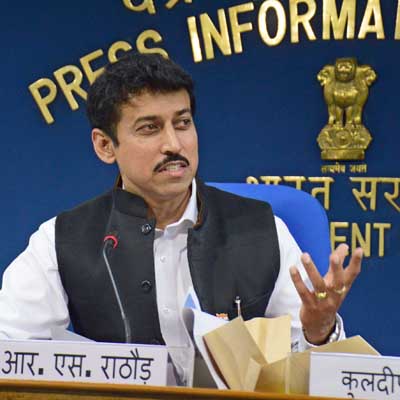
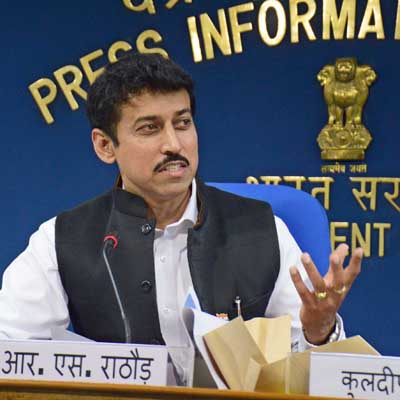
    Information and Broadcasting Minister of State Rajyavardhan Singh Rathore said, “The grant of permission to private TV channels is dependent upon requisite clearances from various ministries and departments. After receipt of all clearances, the ministry takes up the case for grant or rejection of permissions.”


    The Minister further added that the matters were being taken up regularly with various departments and ministries at various levels for early clearance so that the permission to the TV channels could be granted.


    Giving details on the pendency, Rathore said that there were 36 applications in 2012, 59 in 2013, 56 in 2014 and 27 in 2015.


    The Minister said that the Ministry, at present, granted permission to 832 TV channels out of which 406 were news and 426 were general entertainment channels (GECs). Religious channels and sports channels are included in the GEC category.

  • Prasar Bharati asks for additional Rs 112 crore for supplementary demands

    Prasar Bharati asks for additional Rs 112 crore for supplementary demands

    NEW DELHI: An additional sum of Rs 111.98 crore has been sought by Finance Minister Arun Jaitley for providing additional grants-in-aid – General of Rs 1.98 crore, and grants-in-aid – salaries Rs 110 crore for Prasar Bharati.


    The demands have been made in the Supplementary Demands for Grants tabled in Parliament by Jaitley, who also holds the Information and Broadcasting portfolio.


    A sum of Rs 1.5 crore has been demanded for meeting additional expenditure towards providing grants-in-aid – general for National and International Children’s Film Festival under the Plan Scheme; Promotion of Indian cinema through film festivals and film markets in India and abroad.


    Grants-in-aid – salaries totalling Rs 1.85 crore has also been sought towards providing to the Children’s Film Society, India (Rs 4 lakh), Satyajit Ray Film and Television Institute in Kolkata (Rs 83 lakh), Indian Institute of Mass Communications (Rs 80 lakh) and Press Council of India (Rs 18 lakh).


    In the case of these three demands, the Minister said, “As savings are available in the same section of the grant, a token supplementary is sought.”


    A sum of Rs 5.7 crore has been demanded for upgradation of the Siri Fort Complex (Rs 40 lakh), building infrastructure of Films Division (Rs 50 lakh), and the Electronic Media Monitoring Centre (Rs 4.8 crore). The Minister has said, “Taking into account the savings of Rs 2.49 crore available in the same section, a technical supplementary for the balance amount of Rs 3.21 crore is sought as equivalent savings are available in the revenue section of the grant.”


    In addition, the supplementary demands for grants have sought a sum of Rs 3.24 crore as capital outlay.  


  • Govt reiterates no plans to cap number of TV channels in country

    Govt reiterates no plans to cap number of TV channels in country

    NEW DELHI: Even as the Government has no plans to put a cap on the number of satellite television broadcasting channels in the country, the Parliament was informed today that permission had been withdrawn to 27 news and current affairs channels in the past three years.


    Minister of State for Information and Broadcasting Rajyavardhan Rathore today told Parliament that the Telecom Regulatory Authority of India (TRAI) in response to a reference by the Ministry had said on 23 July, 2010 that “no cap should be placed on the number of satellite broadcasting channels to be permitted to be downlinked from viewing in India or to be uplinked from India.”


    The Minister also said that there was no proposal to amend the uplinking and downlinking guidelines to check the increase in the number of news channels in the country.


    In reply to another question, Rathore said that the Ministry had withdrawn permission of 27 news and current affairs TV channels for reasons of non-operationalization of TV channels or surrender of permission, etc.


    He said issues related to employment of media personnel, working in the TV channels (including news channels), are governed by the prevalent Labour Laws.


    The number of permitted satellite television channels by the end of December last was 826, which include 405 news and current affairs channels and 421 general entertainment channels.


    The statistics show that 697 channels (including 382 news channels) were permitted to uplink and downlink from within the country, and 36 (including seven news channels) were uplinked from India for beaming overseas and not in the country. The number of channels uplinked from overseas and downlinked into India was 93 (including 16 news channels).


    The year 2014 has thus saw the clearance to more than 30 channels.