Tag: Parle

  • Amid pandemic, GECs take lion’s share of brands’ TV advertising budget

    Amid pandemic, GECs take lion’s share of brands’ TV advertising budget

    As the entire country is battling the second wave of coronavirus outbreak, advertisers asserted that they will continue advertising on television as it is the most effective medium to flaunt their product before Indian audiences. In the recent Tele-Wise Kannada panel discussion organised by Indian Television Group in association with Colors Kannada, industry experts debated whether regional channels were the next frontier for Indian advertisers to advertise their products. The discussion was moderated by Indiantelevision.com’s founder, CEO & editor-in-chief Anil Wanwari. 

    Television continues as the most preferred medium

    During the event, ITC head of marketing Aishwarya Pratap Singh stated that his company trusts television as the most effective medium of advertising, as it offers 96 per cent penetration rate. According to him, television and print are ITC’s most preferred mediums to advertise their products, especially in Karnataka. 

    “As long as the market is there, lockdown or no lockdown, we will continue to invest in TV,” added Singh. 

    Airtel vice president – media Archana Agarwal said, “Television remains the highest reach medium. We may look at other options if we are to focus on specialised local markets, but for the entire state, TV is the medium.” 

    Parle Products sr category head Krishnarao Buddha revealed that they did not have much chance to experiment on advertisements, as their stocks were shrinking due to increased demand. However, the consumer goods major trusted television as its primary advertising medium, and advertised their products across channels. 

    “Last year, there was not much possibility for us to advertise. But, we stitched a new creative from our old creatives. We also went out of our way to support broadcasters, like Star Sports and news channels,” he said. 

    Setbacks faced during pandemic times

    Krishnarao admitted that Parle had faced a setback, especially in the confectionery segment due to the Covid2019 pandemic. 

    “We have deferred some of our launches due to the pandemic. Overall, the confectionery category has been impacted. Children always buy confectionaries in mono packs. As schools remain closed, the sale of mono packs has been impacted. But we have seen an increase in the sale of salty snacks as people now confined to their homes,” he elaborated. 

    ITC’s Pratap Singh said, “Noodle businesses are stable, in fact, a little more, as people tend to eat more while being at the home. We were able to grow even in Covid times. During these pandemic times, we focus more on quick selling products rather than spending time on slow-moving products.”

    Challenges faced by advertisers in Karnataka

    Industry experts who attended the virtual summit unanimously agreed that the multifaceted culture in Bengaluru is one of the main challenges they face while delivering region-specific ad campaigns. 

    “In Karnataka, 60 per cent of TV viewership comes from Kannada channels, and 15 per cent from Hindi speaking channels, so a lot depends on the language. But when it comes to Bengaluru, only 53 per cent of TV viewership comes from Kannada channels. For advertising, a drop of seven per cent cannot be ignored. So, instead of creating region-centric ad campaigns, we always roll out national ad campaigns in Karnataka too,” detailed Airtel’s Agarwal. 

    Pratap Singh further explained why exclusively Kannada campaigns may not work in Bengaluru. “There is a lot of Tamil and Telugu-speaking population in Bengaluru. Due to the staggering amount of Tamil-speaking people in Bengaluru, Tamil channels are also faring big in Bengaluru.” 

    “We have not experimented a lot with Karnataka specific campaign. We typically use an entire south Campaign or an all India campaign,” remarked Krishnarao when asked about Parle’s marketing strategy for the region. 

    Favourite genres for advertisers 

    The overarching consensus among the talking heads at the Tele-Wise Kannada panel discussion was that general entertainment channels (GEC) are the best option to reach consumers. The reason is simple – it’s the category that offers the biggest reach.

    “In most cases, we prefer GECs and sports. Movies play a big role, especially when there’s no fresh content on TV during the lockdown. News channels do not give us high reach somehow. Sports, yes, we are on IPL. We strongly believe in the power of cricket. It is quite expensive but it’s worth investing there,” said Pratap Singh. 

    Agarwal revealed that Airtel has not invested much in reality shows. 

    “Most of the reality shows are on similar lines. But, we haven’t sponsored any show in the last two or three years in any market, except for Kerala,” she said. 

    Krishnarao explained, “The reality shows come at a premium. So we have to evaluate our needs. But, we have associated with a few channels, and we are continuously on the lookout for more impact.” 
  • Covid2019 did not upset top brands’ growth: Kantar report

    Covid2019 did not upset top brands’ growth: Kantar report

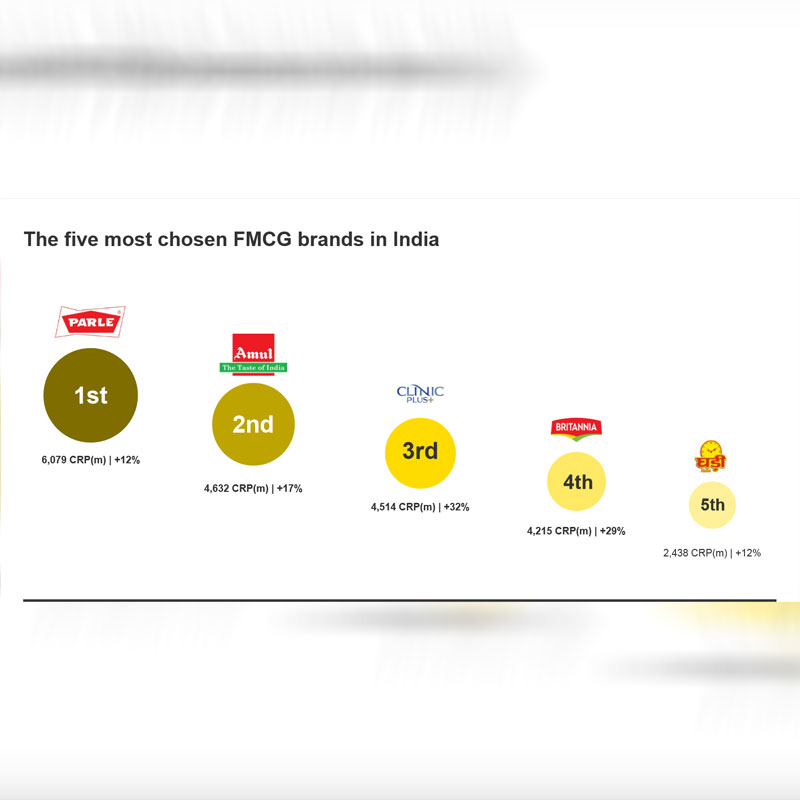
    NEW DELHI: According to Kantar’s Brand Footprint 2020 report, brands including Parle, Amul, Clinic Plus, Britannia and Ghadi emerged as the topmost chosen brands in the country in 2019. The report is an annual ranking of FMCG brands based on the Consumer Reach Points the brands scored in a year. The report is in its eighth edition this year.

    Brand Footprint 2020 follows CRP based ranking which considers the actual purchase made by the consumers and the frequency at which these purchases are made in a year.

    According to the report, scoring the highest CRP (million) at 6029 with a 12 per cent increase, Parle ranked first, which was followed by Amul at 4,632 CRP (million) and 17 per cent increase, Clinic Plus at 4,514 CRP (million) with 32 per cent increase, Britannia at 4,215 CRP (million) with a 29 per cent increase and Ghadi at 2,438 CRP (million) with a 12 per cent increase.

    The report further highlighted that this year five new brands made it to the Billion CRP Club including Dabur, Vim, Sunfeast, Brooke Bond and Patanjali and 21 brands joined this group in 2019 compared to 16 in both 2018 and 2017.

    Consumers made significantly more choices this year leading to a significantly better CRP performance by brands – 57 per cent brands record growing CRPs and bigger brands find better growth and follow the golden rule, brands grow faster by growing penetration. Colgate stands at the highest penetrated brand at 88 per cent, as per the report.

    In the foods category, Britannia is the second-most chosen brand, seventh-highest penetrated brand with a household penetration at 67.6 per cent. Aashirvaad saw a surge with 4 per cent penetration increase and +55 per cent CRP growth.

    Dabur as a brand came out strong in personal care and foods category with 34 per cent increase in CRP growth, making it the fifth-most chosen beauty and health brand in India with a 70 per cent per cent household penetration.

    “Consumer reach points are a great way to measure and rank brands as it is a measure of the number of opportunities a brand has, to interact with a consumer. It is great to see consistent validation for the fact that if you build penetration, frequency and growth follow. This has really been a year of global brands in terms of their higher growth than others. Like these, this year’s report has a lot of interesting nuggets to derive a lot of information and insights on top the behaviour of consumers towards brands in the last year,” Kantar MD- south Asia, worldpanel division K Ramakrishnan said. 

    The report concluded that 2020 is the year of global brands and for the brands that focused on reaching more targets were the clear winners. It also said that Covid2019 did not upset the top brands’ growth.

  • Parle Products brings back consumer favourite Rol.a.Cola

    Parle Products brings back consumer favourite Rol.a.Cola

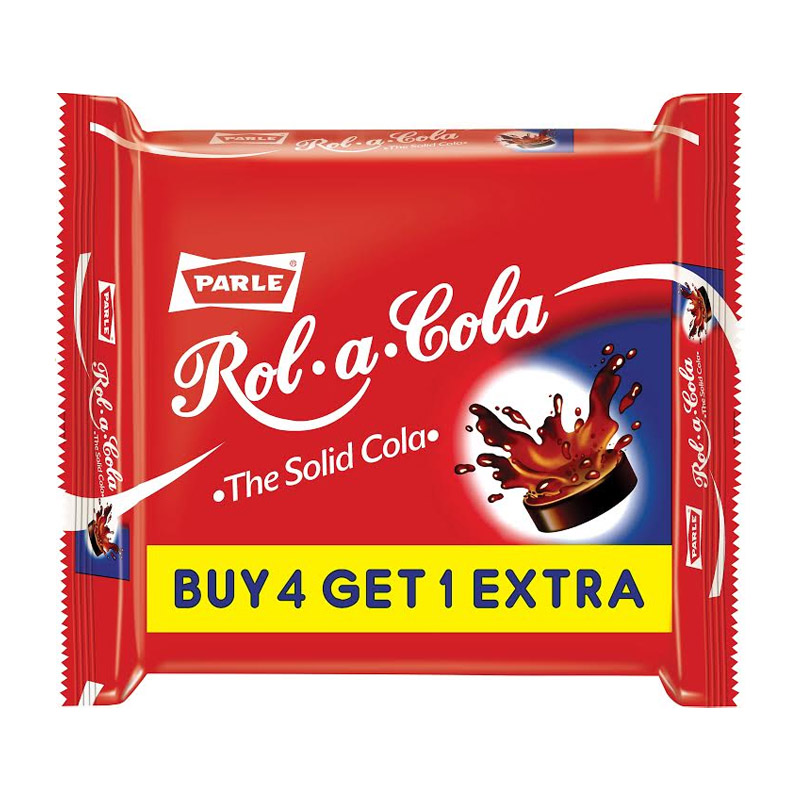
    MUMBAI: Parle Products, India’s leading biscuits and confectionery manufacturer, today announced the relaunch of its most popular confectionery product Rol.a.Cola on the back of popular demand led by the social media buzz earlier this year. Priced at Rs 5 and Rs 20, Rol.a.Cola will not only make its way back into Parle's other iconic product line-up but also mark one of the biggest brands moves in Indian FMCG in the recent past.

    Rol.a.Cola, the hard-boiled candy with the Cola flavour is a rolled format which was discontinued by Parle in 2006. 13 years hence in February 2019, after a social media user tweeted requesting Parle to bring back his favourite cola candy, Parle Products sought 10,000 retweets to bring back Rol.a.Cola. In response, consumer driven #BringRolaColaBack campaign went viral and secured more than 711k impressions on Twitter. Soon, Parle Products initiated the #RolaColaIsComingBack campaign to assure the consumers that their wish was granted. This is the first time in India that a product was making a comeback because of a digital movement run completely organically by users. The entire campaign on social media garnered a whopping 5M digital footprints.

    Speaking on the launch, Krishnarao S Buddha, Sr. Category Head – Marketing at Parle Products commented, “While a tweet created a disruption in the market for a comeback of the iconic Rol.a.Cola candy, we connected with the emotions to honour consumers demand. Earlier, consumers had no platform in which they could voice their opinions and concerns. Now, they can simply reach out to a brand they like and let them know what they think. Today, each user is an influencer who played an essential role in our marketing efforts. The love received by people led us to accelerate the manufacturing of the candy and we are extremely thrilled to give back the Rol.a.Cola to our consumers.”

    He further added that, “Our classic Rol.a.Cola candies were made to be shared with others. By maintaining its rolled candy format, we hope that adults as well as kids are inspired to share a candy and make new connections with people.”

    Parle is changing how it does business, thereby transforming the way brands interact with consumers, making it personalized and adopting a pro-consumer approach. As a pioneer in the FMCG space, the company has begun its robust distribution for the confectionary and is expected to be available in every market within this month. With a modernised packaging and fresh approach to connect with consumers, the company has assured consumers that the candy will retain its original taste and will be priced at Rs 5 for same roll candy format. For the modern trade channel, Parle is looking to launch a bigger multiple pack offering priced at Rs 20 a unit.

  • Parle’s bid to overthrow Britannia’s Nutrichoice

    Parle’s bid to overthrow Britannia’s Nutrichoice

    MUMBAI: The digestive cookies range in India is dominated by Britannia Nutrichoice range of biscuits. The market is huge and every brand now sees opportunity in the segment due to increased awareness and healthy eating choices of the consumers.

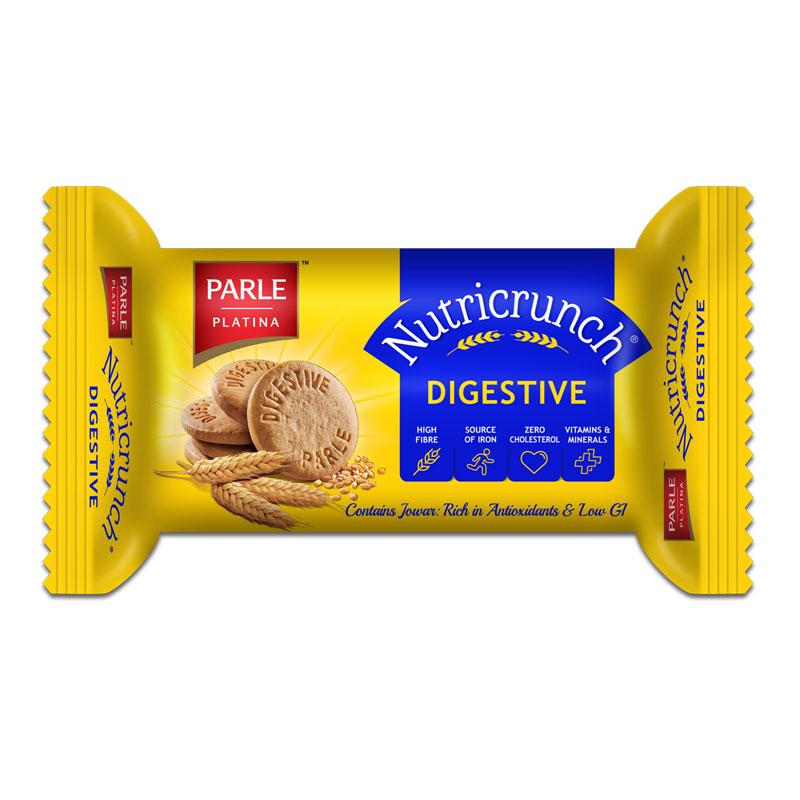
    In a bid to compete and make its mark in this sector, home grown brand Parle Products has launched its own range of digestive biscuits under the umbrella of NutriCrunch. The launch of the healthy range of biscuits  is inspired by the growing demand for healthy snacking options among Indian consumers and will include products like Nutricrunch Digestive, Nutricrunch Honey & Oats, Nutricrunch Digestive Marie and Nutricrunch Lite Cracker.

    This is the second innings for brand Parle in the health category. The company has decide to phase out its older health biscuit offerings that was sold under the Simply Good brand name. While the production of Simply Good has been completely stopped, Parle Products now wants to complete switch and focus on NutriCrunch. The sheer reason for Simply Good not being so “simply good” was due to lack of effort and focus on the product’s marketing as a healthy alternative to regular biscuits and Parle Products does not want to repeat the same again.

    Priced at a sweet spot of Rs 20, the confectionary and biscuit giant wants to capture a sizeable share of 15 per cent in the 1200 crore health segment in India. The company, however, faces stiff completion from Britannia Nutrichoice that occupies a major 70 per cent premium health biscuit category followed by ITC’s Sunfeast range of Famlite biscuits and McVitties Digestive biscuits.

    For Parle Products, it’s important to diversify its portfolio into more premium products as a majority of its revenue – both in value and volume terms – still comes from its mass market brand Parle G. While that segment is growing steadily, premium offerings will bring in better margins and faster growth in future. The Platina division is just a year old but is already growing in the high double-digits.

    Indiantelevision.com spoke to Parle Products category head for biscuits Mayank Shah to understand insights into launching the product, competition with Britannia, scope in the market and much more.  

    Why did you decide on launching health products at this point in time?

    It was the right time for us to enter the market as we see huge potential in this category. Consumers of health category are divided into those who are actively seeking healthier options and those that passively consumer healthy products once in a while to reduce the guilt of leading an unhealthy lifestyle. A primary reason why we didn’t want to get into health segment was because a larger pool of consumers were passive health-conscious but that is increasingly changing. The active health conscious consumers will not consider the price of a product while purchasing a product, whereas passive consumers only tend to buy when there are offers or the products are available at a cheaper price.

    But why did you decide on launching NutriCrunch? What happens to Simply Good then?

    We were already present in the health category but we didn’t really focus on those products and rather focused on our other products. We didn’t really see a huge value in Simply Good products as well. That why our focus was limited. However, we have seen an increasing traction in the health category. Soon after we launched the Platina category last year, health segment was always going to be our next focus.

    What kind of consumer research behind the product launch? You much have had a lot of pressure on getting it right the second time?

    We conducted extensive research this time. We reached out to consumers across India and asked them what kind of product would they like to have. Our research revealed that most consumers were looking at healthier alternatives with low sugar and multigrain biscuits.

    What kind of growth opportunity do you see in the sector?

    The health segment in India is growing in double digits. It is growing at the rate of 15-17 per cent per annum. There is a shift in consumer’s trend where they are actively seeking healthier products. There is a large quantum of consumers that seek healthier options out of guilt and we see a large scope there and want to tap those consumers.

    What is your distribution plan like for the new range of products?

    It’s launched under the Platina range and so will be well distributed across metros and mini metros. We are looking at selling it to more than 1 million towns over the next two-three months.

    What about online sales? Will that also be your focus to get the product out in the market?

    Online and modern trade will be an important channel for us. We will be available across all leading e-commerce platforms.

    Why did you launch this new category under Platina umbrella?

    Simply because Platina is skewed towards modern trade and online channels. Also because it has a natural fit with the distribution channel and the consumers. Platina consumers are relatively evolved and modern who don’t mind spending some extra bucks for a quality product.

    What are your revenue expectation with this product?

    There is a huge potential and scope in this segment. The health segment market is currently valued at Rs 1200 crore and we want to corner a 15 per cent share of it by 2019 (by the end of first year of operation for Nutricrunch).

    Don’t you think it is a super competitive market for you to enter in? There are already established players in the market…

    Yes, it is a super competitive market but it is an extremely growing category as well and there is a scope for more players to participate in it. Its because of the entry of multiple players coming in and more buzz around the category.

    What kind of investment went into the launch of this new product line?

    We cant really reveal the numbers but yes, we did invest heavily into the R&D for these products and getting them right. It took us a year and half to design the product.

    What were your biggest barriers while entering into the category? What sort of challenge do you see in the market?

    Our biggest challenge right now is to make the product available across India at the earliest and have a strong distribution muscle. The biggest challenge initially was supplying the products to retailers due to the recent transport strike. We were all ready and geared up for the launch but had to push it due to the transport strike. Our next challenge will be to ensure that we have enough conversions from passive health product custumers to active consumers. We will have to make consumers relatively price insensitive and ready to pay a fair price for these products.

    When will you launch your campaign to advertise and market these products?

    Once we roll out the products entirely, which should be done by mid September, then we will look at launching the campaign in August.

    Will you look at having a brand ambassador for the category since you also have Twinkle Khanna for Platina?

    No, we are not looking at having a brand ambassador at the moment.

    What will be your marketing strategy for product marketing?

    It will definitely be a 360-degree campaign with an increased focus on digital.

    Lately, a lot of brands are looking at cutting down sugar and salt in the products. Will Parle Products also look at going the same route?

    Our new range of products is a step towards cutting down sugar and salt content in products and we will increasingly look at how we can improve the quality of our existing line of products without changing the taste of quality.

  • Parle 20-20 tickles a funny bone to reward positive thinking

    Parle 20-20 tickles a funny bone to reward positive thinking

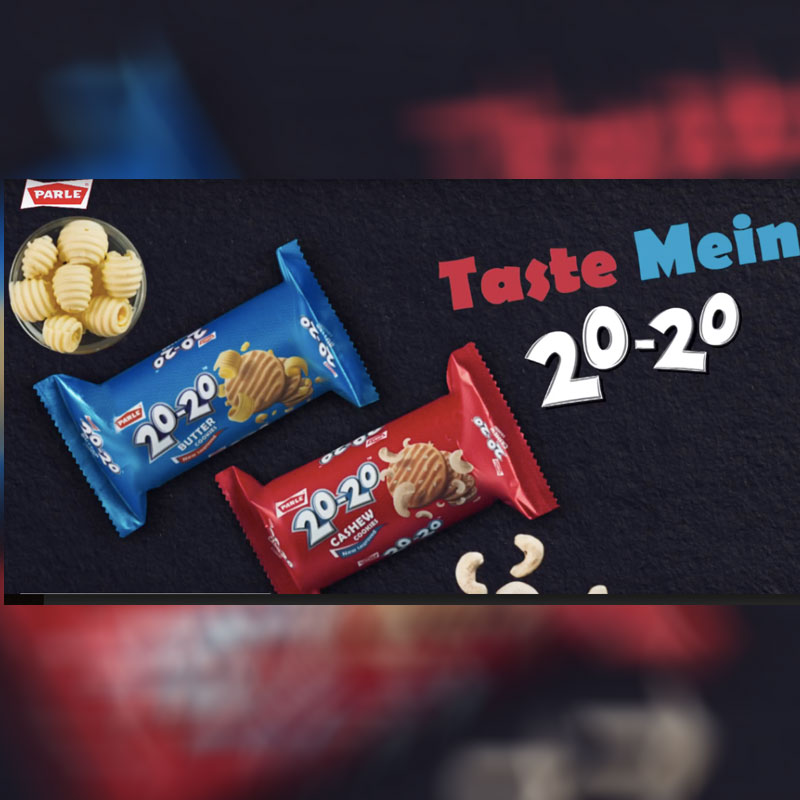
    MUMBAI: Parle Products, India’s favourite FMCG brand has launched a new campaign titled, ‘Taste mein 20 out of 20’ for its leading cookie brand, 20-20. 

    The campaign is an honest effort from Parle to showcase everyday situations that today’s youth encounter while dealing with redundant traditional norms. It metaphorically connects forward-thinking values to 20 -20 cookies by giving full marks to characters that behave positively to unconventional thought process.

    Conceptualised and crafted by Everest Productions, the campaign features five TVCs. All five TVCs display an entertaining event involving social situations affecting young adults – a mother encouraging her daughter to dress as she pleases, a father supporting her teenage daughter to travel with boys, a landlord bonding with a potential tenant from another religion, a modern twist to arranged marriages and a real estate agent supporting a live-in couple looking to rent out a house in the city. Parle’s 20-20 cookie features as an integral part of the narrative applauding each character that has moved ahead with times and is taking baby steps to gradually change orthodox social values.

    Parle Products category head Mayank Shah says, “Parle 20-20 cookies was created by Parle Products for the young adults. This audience is self-aware and is re-inventing social values to make the world a better place. As we celebrate Parle 20-20’s 10 years of existence, we want to appreciate individuals who encounter these young adults and don’t judge them for their choices. We also wanted to build a strong consumer franchise by positioning 20-20 as a brand that supports this new-age thought process which is free of prejudice and extremely inclusive of change.”

    Everest Brand Solutions executive creative director Pramod Sharma adds, “The brief was to create a narrative for today’s youth by keeping Parle 20-20 core values at heart. We have incorporated both these elements with a humorous twist to showcase a progressive society and positioned Parle 20-20 cookies as a reward to those who adapt to positive change easily. We hope the audience like the TVCs and it makes a good impact towards social change.”

    Cookies as a category promises indulgences and delight to consumers, thought to be occasion specific snacking. With a six per cent annual growth, Parle 20-20 cookies has been successful in making consumption of category occasion independent and more frequent. Parle 20-20 cookies are available in cookies cashew, cookies butter and cookies butter-jeera variants. 

    The TVC will be released in 11 languages and will be sustained through a digital campaign.

  • Parle mandates Taproot Dentsu to change communication for Milano

    Parle mandates Taproot Dentsu to change communication for Milano

    MUMBAI: Parle is ensuring that the growing frenzy behind wellness items does not dim the interest of people in its classic biscuit Milano. It appointed Taproot Dentsu to pick up pace for the brand and enable it to reclaim lost ground.

    The brief was to shed the earlier idea of sinful, indulgent consumption that was labelled to this group of cookies. Taproot Dentsu had to make it relevant but light hearted as well.

    Speaking about the campaign, Parle Products category head Mayank Shah said, “Since the launch of the Platina range last May, we have observed a renewed interest among consumers towards Parle’s premium offerings. We have always been innovators across categories and while we were happy that our premium brands were being well received, we also felt the need to bring something refreshingly new to the consumers. Extensive research and understanding of our target audience’s evolving tastes led us to add new variants to the Milano range, which consequently resulted in India’s first cookie with Hazelnut filling by an FMCG brand.”

    Taproot Dentsu Mumbai GM Ayesha Ghosh said, “In times where balance and perfection are being chased and when indulgence is frowned upon, our task was to carve out a special guilt-free place in the minds of consumers for a rich, delicious cookie like Milano. The idea that followed was to approach it from an individual’s perspective, bringing out the importance of irreverent self-pampering. The fact that Twinkle Khanna personally identified with the messaging, further spurred off the idea for us to also add the element of ‘There’s a me in every Milano’ in the TVCs. Overall, the ads have been shot in a manner to remind us that every now and then, it’s okay to listen to your heart, give in to a craving and bite into that tempting cookie!”

    Taproot Dentsu Mumbai, executive creative director Pallavi Chakravarti said, “Twinkle is the perfect spokesperson for Milano. She doesn’t take herself too seriously, she’s her own person, which is evident from the career and life choices she has made. Milano, while maintaining the `category codes’ of a premium cookie is evolving the same codes with a playful dig at rigid dietary fads that can suck the joy out of life. With this film, we want to tell people that it’s absolutely fine to give in to the indulgence of a delicious Milano every now and then.”

  • Parle launches campaign for new Milano range

    Parle launches campaign for new Milano range

    MUMBAI: India’s leading biscuits and confectionery manufacturer, Parle Products, which unveiled its premium division ‘Platina’ a year ago, has now taken a step further to strengthen the range’s position in the market.

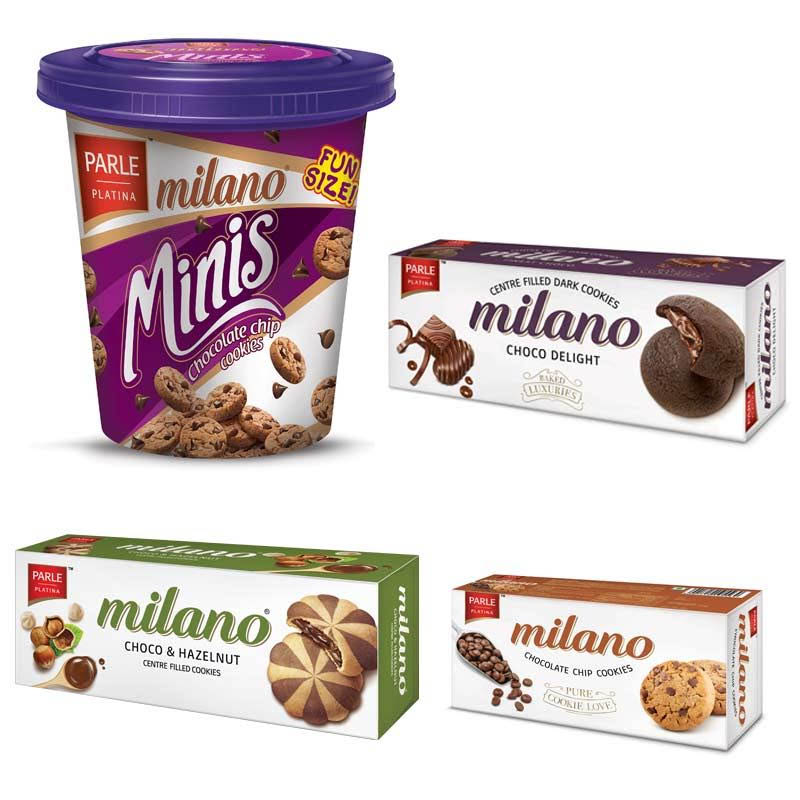
    Identifying the positive reception that the Platina range has received over the past one year from consumers who wish to try premium offerings from the house of Parle, the company has added unique offerings like Mixed Berries Centre Filled Cookies and Hazelnut Centre Filled Cookies to its indulgent Milano range. The addition of new variants to Parle’s most premium chocolate chip cookie offering comes on the back of the love that Platina’s flagship product Milano has enjoyed since its launch in 2006. Parle Products has launched the variants with a focused approach, tying up with select chains to make them available to a targeted audience.

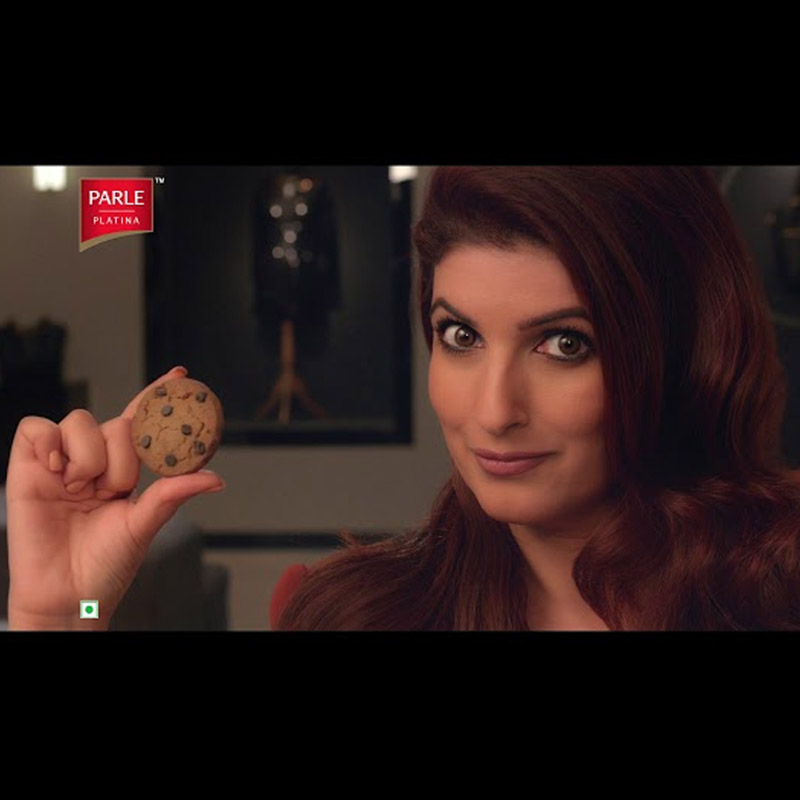
    Along with expansion of the Milano range under Parle Platina, the FMCG giant is going all out to augment impact of the announcement by means of two new TVCs featuring celebrity Twinkle Khanna which will go on air this IPL. The television commercials have been filmed with a quirky undertone and communicate that one can never be too diet-conscious to indulge a little in a delicious Milano cookie.

    Parle Products category head Mayank Shah says, “Since the launch of the Platina range last May, we have observed a renewed interest among consumers towards Parle’s premium offerings. We have always been innovators across categories and while we were happy that our premium brands were being well received, we also felt the need to bring something refreshingly new to the consumers. Extensive research and understanding of our target audience’s evolving tastes led us to add new variants to the Milano range, which consequently resulted in India’s first cookie with hazelnut filling by an FMCG brand”.

    Conceptualised by Taproot Dentsu, the campaign will feature two TVCs which send out a message that a cookie is all about savouring good taste and enjoying a great feeling and not something that is necessarily frivolous. The brand features this as an integral part of the TVC narrative, where Twinkle Khanna breaks the fourth wall and shares her own witty take on fitness-related clichés like having a six-pack or a size zero figure, using Milano packs.

    Commenting on her association with Parle for the TVCs, Khanna mentions, “Having grown up on many of Parle’s products which still ring in much nostalgia, I was instantly excited to be a part of this series of TVCs. I identified with the messaging, tone and treatment of the TVCs right from the word go as I personally feel that you need to have a good balance between health and indulgence. Milano’s exotic range comes in variants and these make for the perfect guilty pleasure every once in a while”.

    Taproot Dentsu ECD Pallavi Chakravarti said, “In times where balance and perfection are being chased and when indulgence is frowned upon, our task was to carve out a special guilt-free place in the minds of consumers for a rich, delicious cookie like Milano. The idea that followed was to approach it from an individual’s perspective, bringing out the importance of irreverent self-pampering. The fact that Twinkle Khanna personally identified with the messaging, further spurred off the idea for us to also add the element of ‘There’s a me in every Milano’ in the TVCs. Overall, the ads have been shot in a manner to remind people that every now and then, it’s okay to listen to your heart, give in to a craving and bite into that tempting cookie!”.

    Since 1929, Parle has grown to become India’s leading manufacturer of biscuits and confectionery. An in-depth understanding of the Indian consumer psyche has helped Parle develop a marketing philosophy that reflects the needs of the Indian masses. It has made it a tradition to deliver both health and taste, with a value-for-money positioning that allows people from all classes and age groups to enjoy Parle products to the fullest.

  • Parle Products eyes China for next phase of growth

    Parle Products eyes China for next phase of growth

    MUMBAI: The girl with the glucose biscuit is probably the most iconic image after the Amul butter girl in India. The Parle-G girl is a part of the Parle Products family that has been in existence since 1929, founded by the Chauhan family in Vile Parle, Mumbai. Until a few years ago, as you crossed the station, you could smell the aroma of the baked biscuits wafting through the air and immediately got transported back in time to your childhood. The now-defunct factory on the premises is a great reminder of the company’s heritage. Now, Parle is gearing up to make a bigger impact in China and is planning to build a manufacturing facility in Mexico.

    In 1947, when India became independent, the company launched an ad campaign, showcasing its glucose biscuit, Parle-G, as an Indian alternative to the British biscuits. The Parle brand has since become well known in India expanding to other names such as Milano, Hide & Seek, Poppins, Kismi, and Melody.

    Parle-G continues to hold 20 per cent share of the Rs 25,000 crore biscuit market by value. Since 1990, the product has managed to retain 80 per cent of the glucose biscuit market while premium biscuits are worth only Rs 5000 crore in the total biscuits market. 

    While biscuits have always been the anchor of the company, comprising nearly 70 per cent of its Rs 10,000 crore turnover in 2017, Parle is now seeking to enhance its confectionery portfolio that generates revenue of more than Rs 1000 crore. The company has also entered into a new category of staples in the recent past.

    Parle Products category head Buddha Krishna Rao says that in the last year and half, the company has seen good growth coming back to categories like biscuits, confectionary, snacks, cakes and rusks.

    While the brand’s core target has always remained women and kids, a few products have a great appeal with the younger generation. Parle has over a period of time learned to customise its content and communication that cuts the ice with the audience as the market changes.

    Parle is working on being relevant in the digital space. Krishna Rao says, “We are in talks with a few production houses for brand integration on digital platform for a customised series, which will be targeted at the Parle audience. The webisode series is slated to launch in late 2018.”

    Parle recently rebranded one of its quintessential products, Kismi. The product now also comes in two additional Indianised flavours of rosemilk, kulfi and rajbhog along with the traditional elaichi flavourajr. Kismi, along with Melody, was once the star product for the brand that started to lose its sheen with the entry of newer products in the market. 

    “Although many believe it was out of the market, it just wasn’t marketed enough. In the last four years, we have felt the need to communicate for the brand and we choose to communicate with youngsters,” Krishna Rao adds. Since the product caters to the younger generation, Parle will engage in a lot of OOH, radio, college fest and other opportunities to connect with the millennials. 

    Madison recently launched its 2018 outlook report for adex. The report projected that ad expenditures are likely to grow at 12 per cent this year and Krishna Rao thinks the projection is a fair expectation. Parle itself will increase the ad spends by 11-12 per cent in 2018 and the majority of the ad spend will go to the digital medium. 

    Known for its distribution strength, Parle Products currently reaches out to 4.5 million outlets directly and also has an indirect reach of 6 million. Kaccha Mango Bite has been the best-selling candy in terms of sheer volume for the brand. Parle Products rebranded its chocolate Lacto Bite as Londonderry in 2012, which competes directly with Perfetti Van Melle’s Alpenliebe. Parle discontinued its mint-flavoured candy, Mints, in early 2017 as it was under performing. 

    The company exports to various markets across the globe including the US, the UK, Europe, Africa, the UAE, South East Asia and Pakistan. It is also looking at spreading its presence in China. Among all the countries Parle exports to, majority of demand comes from Africa as it is still a developing nation and Parle products are available there at economical prices. The company also has two manufacturing units set up in Africa at Cameroon and Nigeria and is already working on setting up a new unit in Mexico. Products like Parle-G, Marie, Krack Jack are locally produced in Africa and the brand wants to predominantly target the Indian diaspora living abroad. Going forward, Parle is looking at having customised products for international markets which would result in more local authentic flavours and combinations to attract local buyers.

    Also Read:

    Kids’ candy segment: Communication sees a shift

    Digital takes centre stage on tepid Valentine’s Day for brands

    Cinema advertising begins to take centre stage 

  • Star India bags 5 new advertisers for IPL 2018

    Star India bags 5 new advertisers for IPL 2018

    MUMBAI: Star India is building up on its advertiser list for IPL 2018 with the announcement of five new brand additions, taking its total portfolio to 16. New names include Colgate, Amul, MakeMyTrip, Parle Products and Vu TV.

    Vivo, Coca-Cola, Polycab, Kent, Elica and Dream 11 are existing names. Speaking on the association Star Sports EVP and head of ad sales Anil Jayaraj said, “Combining the power of television, digital and new-age technology, Star India promises to transform the Vivo IPL 2018 into, perhaps, the most immersive cricket viewing experience the fans have ever seen. The brands that have come on board will get to leverage the power of multiple screens, multiple languages and broaden their reach and engagement like never before. Advertisers’ interest in Vivo IPL continues to be very high and we are in advanced conversations with a number of other categories and brands which we will close over the next few days.”

    Parle Products category head Mayank Shah said, “We have been investing in IPL over the past few seasons and it has worked very well for us. We believe that this year it will be much bigger and better than before. With six languages and the extra focus on regionalisation, Vivo IPL will help us target consumers across the country in a language that resonates with them.”

    MakeMyTrip group CMO Saujanya Shrivastava feels that April May (the IPL months) are the best for its business. He said, “We are confident that this association will strengthen our position and have a significant positive impact on our business”

    Star India has reimagined the Vivo IPL 2018 and is set to make India’s greatest sporting spectacle more engaging for its fans than ever before with technology at the heart of this experience. The network will broadcast every match live in six different languages across TV and digital. According to the broadcaster, last month’s auction alone drew a viewership of 46.5 million fans on television, six times more than the number that tuned in last year, in addition to digital viewership which was five times more than that recorded last year.

    Also Read :

    Star India bags production rights for IPL 2018

    Star ushers in IPL’s new era with a bang

    IPL 2018 gets a makeover with Star India

  • Amul, Parle amidst global brands liked by Indians

    Amul, Parle amidst global brands liked by Indians

    MUMBAI: Domestic brands such as Amul, Parle, Big Bazaar and Dabur are liked and revered by Indian consumers at par with international brands like Samsung and Coca-Cola, a Nikkei BP-Market Xcel Data Matrix survey has revealed.

    The top 10 brands featured in the survey are a mix of technology, FMCG and retail brands.

    According to the Brand Asia Survey 2017, Samsung has emerged as the most popular brand in terms of consumer brand relationship, followed by food and drinks brand Amul and mobile brand Nokia.

    “Amul, the food and drinks brand, has scored second place this year beating Coca-Cola (rank 10) and Pepsi (rank 15),” Ashwani Arora, Senior VP Research, Director on Board, Market Xcel, told IANS.

    “Nokia is one brand which is revered by Indians and has a high connect and past equity. The brand was once a household name in India. The relaunch of the brand in India has refurbished the emotional connect with consumers as is evident in the survey,” Arora said.

    Samsung mobiles and fast-moving consumer goods (FMCG) company Parle ranked fourth and fifth in terms of the most popular brands in India.

    “Parle — a brand from the pre independence era — goes on to prove the love people have for it still. It has ranked fifth this year and its win is solely dedicated to the wide variety of its biscuits which has satiated consumer palettes since ages,” said Arora.

    “Hence, Indian brands are equally liked and revered by consumers,” he added.

    The survey revealed that Future Group-owned retail business Big Bazaar was the only retail brand to mark a place in the top 10 popular brands at rank six.

    According to Arora, the kirana shops are unable to provide the choice, ambience, service and discounts which Big Bazaar offers leading to its popularity among customers.

    “The (Big Bazaar) brand has many firsts to its credit. The only national competitor to the brand being Reliance Retail,” he added.

    The rest of the brands in the top ten category included toothpaste brand Colgate, messaging platform WhatsApp, FMCG brand Dabur and beverages company Coca-Cola.

    A total of 200 brands were surveyed in 13 countries across Asia with a mix of national and international brands.

    The categorisation of nominated brands was from FMCG, food and drinks, clothing/fashion, automaker, IT/home electronics, telecom, media/entertainment, finance, retail, restaurants (QSRs), sporting goods, transportation/logistic, aviation, finance and social media (internet).