Tag: Parijat Chakraborty

  • Tier one town residents happiest at 86 per cent: Ipsos IndiaBus Happiness Monitor

    Tier one town residents happiest at 86 per cent: Ipsos IndiaBus Happiness Monitor

    Mumbai: The Ipsos IndiaBus Happiness Monitor of November 2023 shows at least three in four urban Indians (75 per cent) claim to be happy – a four per cent increase from the previous month. Interestingly, happiness has surged across all parameters used in the survey to gauge happiness.

    A graph of different colored lines Description automatically generated

    Who are the happiest?

    Citizens residing in tier1 towns are the happiest at 86 per cent. Followed by tier2 towns (77 per cent), tier3 towns (72 per cent) and least happy were those living in the metros (68 per cent).   Retired/ military/ prefer not to answer citizens (80 per cent) are the happiest, followed by full time parents and homemakers (79 per cent), self-employed (77 per cent), students (74 per cent), full/ part time employed (73 per cent) and the unemployed were least happy (53 per cent). SEC A (79 per cent) and SEC C (79 per cent) were happier than SEC B (70 per cent). Those with low education (76 per cent) were happier than those with high education (74 per cent). Interestingly, citizens in west zone were happier (83 per cent) than those in north zone (78 per cent). South zone (69 per cent) and east zone (67 per cent) were comparatively less happy – though both east zone and south zone have witnessed a double-digit increase in happiness levels over October 2023, of 16 per cent and 11 per cent respectively. Women were happier (78 per cent) vis-à-vis men (73 per cent). And students have seen a five per cent drop in happiness in Nov, from the previous month.

    Biggest contributors to happiness – what makes Indians happy?

    Happiness is not just an emotion or a state of mind. The survey shows happiness manifests in different aspects of life. Across all our happiness waves, family has been the biggest contributor to happiness and in the Nov wave as well, family is the biggest source of happiness (78 per cent), followed by health (72 per cent), friends’ circle (67 per cent), employment/work (67 per cent), colleagues, business associates (65 per cent), neighbours (63 per cent), economic/financial conditions (57 per cent), situation of the country (55 per cent) and situation of the world (51 per cent).

    A table with numbers and a number on it Description automatically generated

    Elucidating on the findings of the Nov wave of the Happiness Monitor, Ipsos India Group service line leader, public affairs, corporate reputation, ESG and CSR Parijat Chakraborty said, “Happiness levels have surged overall and across cities and demographics in November. From October end to mid-November, it was festival time which is a big mood booster. There are celebrations in the family, cities are decked up to radiate festive fervour, whether it is Durga Puja, Diwali, people wear their best clothes, bond with family and it is the time for shopping and family outings. Tier1 citizens are the happiest as they have the best of both worlds. Good jobs, income and recreation options of big cities, without the pressure of big cities or the higher cost of living of big cities (metros). Retired/ military & those preferring not to answer people are the happiest as they have the comforts of their savings and facilities abound, giving them enough personal time to relax and utilize the time to indulge in pursuits of leisure, likewise for full time parents and homemakers. Family remains the focal point of happiness for most Indians. Followed by health, friends, work etc. It is a package deal. Happiness is not just an emotion. It depends on several factors and disruption in one area can pull happiness levels down.”  

    ‘It will be good to see if Indians can sustain the current momentum of happiness to the next month,” added Chakraborty.

    Methodology:

    Ipsos IndiaBus is a monthly pan India omnibus (which also runs multiple client surveys), that uses a structured questionnaire and is conducted by Ipsos India on diverse topics among 2200+ respondents from SEC A, B and C households, covering adults of both genders from all four zones in the country. The survey is conducted in metros, Tier 1, Tier 2 and Tier 3 towns, providing a more robust and representative view of urban Indians. The respondents were polled face to face and online. We have city-level quota for each demographic segments that ensure the waves are identical and no additional sampling error. The data is weighted by demographics and city-class population to arrive at national average. The data collection is done in every month and the results are calculated on two-months rolling sample.
  • PM Narendra Modi achieves an approval rating of 65 cent in September 2023: Ipsos IndiaBus Poll

    PM Narendra Modi achieves an approval rating of 65 cent in September 2023: Ipsos IndiaBus Poll

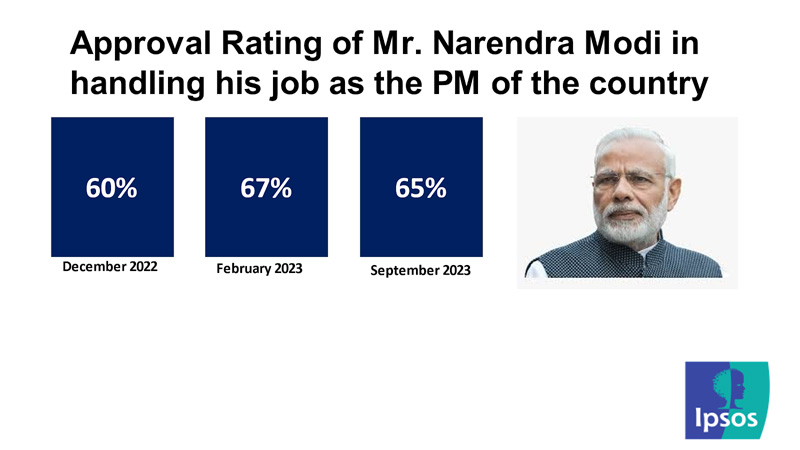
    Mumbai: According to the new wave of the Ipsos IndiaBus Poll, PM Narendra Modi has achieved an Approval Rating (AR) of 65 per cent among urban Indians. Seven per cent were neutral, 18 per cent disapproved and nine per cent were undecided.

    Ipsos IndiaBus Poll

    Zones, cities,  SECs, age groups, cohorts – How does Mr Modi stack up

    Zone-wise, the approval rating outcome showed Mr Modi achieving a higher rating in western India (80 per cent), eastern India (73 per cent), and northern India (72 per cent), though in southern India his approval rating was a measly 31 per cent. Likewise, his AR was higher in tier one (76 per cent), tier two (64 per cent) and tier three (62 per cent) vis-à-vis metros (58 per cent). Interestingly, his AR was almost the same across SECs – SEC A (69 per cent), SEC B (64 per cent) and SEC C (63 per cent).

    Approval rating across the two genders was almost at par – women (65 per cent) and men (64 per cent). A similar trend was noticeable across age groups where his approval rating was steady – 18-30-year-olds (66 per cent), 31-45 years (64 per cent) and 45 (64 per cent).  Also across the different cohorts, his approval rating was high – unemployed (75 per cent), students (69 per cent), employed (67 per cent) and full-time parent/ homemaker (63 per cent), with the exception of the self-employed (47 per cent).

    Notably, those with higher education gave a higher approval rating of 70 per cent to Mr Modi versus those with lower education, who gave an AR of 61 per cent.  

    ESG and CSR group service line leader, public affairs, and corporate reputation Parijat Chakraborty said, “PM Narendra Modi has achieved an approval rating of 65% on how Indians perceive his role as the prime minister of India. By and large across demographics Mr. Modi has received high approval ratings considering some respondents were undecided or neutral. His disapproval is less than 2 in 10, while his approval is 2 in 3 of those polled. Only the residents of the south zone and the self-employed seem disgruntled. Under his stewardship India has been shining on several fronts, recently he has gathered new feathers in his cap of Chandrayaan 3, Aditya L1 and India successfully hosting the G20 Summit. He also has the gift of the gab and connects with audiences across SECs and age groups.”      

    Methodology:

    Ipsos IndiaBus is a monthly pan India omnibus (which also runs multiple client surveys), that uses a structured questionnaire and is conducted by Ipsos India on diverse topics among 2200 respondents from SEC A, B and C households, covering adults of both genders from all four zones in the country. The survey is conducted in metros, Tier 1, Tier 2 and Tier 3 towns, providing a more robust and representative view of urban Indians. The respondents were polled face-to-face and online. We have a city-level quota for each demographic segment that ensures the waves are identical and no additional sampling error. The data is weighted by demographics and city-class population to arrive at the national average.

  • September bliss Ipsos survey finds consistent happiness levels!

    September bliss Ipsos survey finds consistent happiness levels!

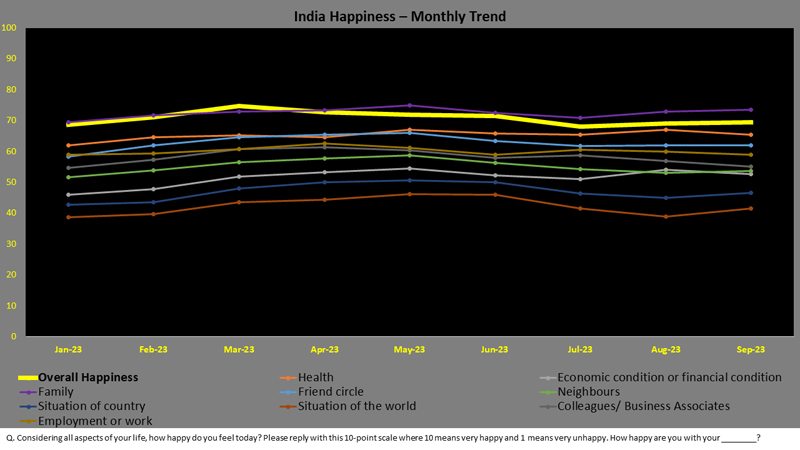
    Mumbai: The September wave of Ipsos IndiaBus happiness monitor shows happiness has stayed steady in September with no change in happiness levels. However, 69 per cent of urban Indians claim to be happy.

    A graph showing different colored lines

    Description automatically generated

    Interestingly, the cohorts that emerged happiest were full-time students (74 per cent), homemakers (73 per cent), women (71 per cent) and those with higher education (70 per cent).

    94 per cent of urban Indians living in tier-one towns claimed to be happy. Urban Indians in the west and north were happier than those in the South and East. 87 per cent of urban Indians living in the west zone were happy and similarly, 77 per cent of those living in the north zone claimed to be happy. Only 54 per cent of those living in the South Zone were seen to be happy. And only one in two (50 per cent) in the east per cent one were happy. The trend was seen across demographics.

    Overall, happiness has surged for family (+1 per cent), situation of the world (+3 per cent), situation of the country (+2 per cent), and neighbours (+1  per cent); and decreased for health (-2 per cent), economic/ financial conditions (-1 per cent), colleagues/ business associates (-2 per cent), employment or work (-1 per cent) and with no change around friends’ circle, in September, over the previous month.

    Looking at the pecking order of happiness contributors for urban Indians, it was led by family (74 per cent), health (65 per cent), friends’ circle (62 per cent), employment or work (59 per cent), colleagues/ business associates (55 per cent), neighbours (54 per cent), economic/ financial conditions (53 per cent), situation of the country (47 per cent) and situation of the world (42 per cent).

    Commenting on the findings of the survey, ESG & CSR group service line leader, public affairs, and corporate reputation, Parijat Chakraborty said, “Happiness Levels have held steady and family continues to be the biggest driving force in infusing happiness. The happiness monitor also shows happiness is defined by different aspects of our daily life. It is about close family ties, social framework and societal engagement, work environment and colleagues, financial conditions, how the country is being run and how the global scenario looks. The G20 Summit has rubbed off on the perception of India and the world and is being positively manifested in the happiness monitor in September. Likewise, work and colleagues and increasing work pressures have slightly dented happiness levels. Women and homemakers seem happier with their “me” time.”    

    “West and North zones have seen a maximum boom in terms of jobs, access to the best of facilities and overall development. Tier one towns are the emerging centres of consumerism. Seeing a major boost in quality of life and happiness,” added Chakraborty.

    Methodology

    Ipsos IndiaBus is a monthly pan-India omnibus (which also runs multiple client surveys), that uses a structured questionnaire and is conducted by Ipsos India on diverse topics among 2200+ respondents from SEC A, B and C households, covering adults of both genders from all four zones in the country. The survey is conducted in metros, Tier 1, Tier 2 and Tier 3 towns, providing a more robust and representative view of urban Indians. The respondents were polled face-to-face and online. We have a city-level quota for each demographic segment that ensures the waves are identical and no additional sampling error. The data is weighted by demographics and city-class population to arrive at the national average. Data collection is done every month and the results are calculated on a two-month rolling sample.

  • Happiness levels surge for urban Indians in August 2023: Ipsos IndiaBus Happiness Monitor

    Happiness levels surge for urban Indians in August 2023: Ipsos IndiaBus Happiness Monitor

    Mumbai: Happy tidings! Urban Indians have turned happier in August 2023, over the previous month and driving happiness levels up are particularly the family, health and economic and financial conditions, according to the August wave of the Ipsos IndiaBus Happiness Monitor, that gauges happiness levels of urban Indians overall and across a host of parameters.   So, 69 per cent of urban Indians claim to be happy! Displaying a one-point improvement over the previous month and across some of the key areas that define happiness.

    Parameters that define happiness and areas showing improvement

    Happiness levels have particularly surged around family 73 per cent (+2 per cent), health 67 per cent (+2 per cent), economic & financial conditions (54 per cent) (+3 per cent), while it has receded around the rest. Though the biggest contributors to happiness for urban Indians in the pecking order in August were: family (73 per cent), health (67 per cent), friends’ circle (62 per cent), employment or work (60 per cent), colleagues and business associates (57 per cent), economic and financial conditions (54 per cent), neighbours (53 per cent), situation of country (45 per cent) and situation of the world (39 per cent).

    Ipsos India group service line leader – public affairs and corporate reputation Parijat Chakraborty said, “We see an uptick in happiness of urban Indians in August 2023 and further, family, health and economic and financial conditions are turning up the happiness meter, conveying a pertinent message that the biggest sources of happiness continue to be close family ties, salubrious health  and financial security. Though work, colleagues, friends’ circle,  neighbours, situation in the country and around the globe, all these factors accentuate happiness for urban Indians.”

    “Happiness is not superficial. It manifests itself  in different areas that have a bearing on our day to day existence. And slippage in one area can impact all other areas,” added Chakraborty.  

  • Personal relationships rated most trusted Source of News, ahead of all forms of conventional media: Ipsos Survey

    Personal relationships rated most trusted Source of News, ahead of all forms of conventional media: Ipsos Survey

    MUMBAI: According to a new survey by Ipsos titled Trust in Media – 78% urban Indians said they trust people they know personally, as the most reliable source of news, ahead of all forms of formal media sources!  Ergo, media sources trusted most in the pecking order were newspapers and magazines (77%), followed by television and radio (71%), and online news websites and platforms (66%) – online platforms were found to have some bit of trust deficit, with at least 3 in 10 Indians (32%) doubting the efficacy of news. Trust was found to be the lowest as a new source, for People-known-predominantly-through-the-internet (53%). 4 in 10 Indians were mistrusting of this news source.         

    Most relevant News Sources?

    Newspapers and magazines have been rated best for providing most relevant news and information, by majority of Indians (82%); personal relationships come next as a relevant news source (79%); followed by Television and radio (75%), online news websites and platforms (72%) and people known via the internet (62%). 

    “We tend to trust people we are close to, most. It now extends to even news and information, displacing all forms of media, relegating them below personal relationships. Newspapers and magazines fortunately redeem their position, as the best news source for relevant news, “says Parijat Chakraborty, Country Service Line Leader, Ipsos Public Affairs, Corporate Reputation and Customer Experience. 

    Has the Trust in Media increased or diminished in the last 5 years?  

    India, Saudi Arabia, South Africa, Malaysia and China, buck the global trend of increasing distrust in Media, in the last five years. 

    Fake News 

    Fake News exists and Indians as well as global citizens believe that there is fair bit of Fake News across all media outlets. 

    So, where is it most prevalent?  

    67% Indians believe that there is prevalence of fake news in news and information of Online News Websites and Platforms; next, 63% Indians feel that people they know predominantly through the internet are the purveyors of fake news in the news and information they share; 59% Indians feel Television and Radio have fake news in their content; 55% Indians feel Newspapers and Magazines have prevalence of fake news in their news and 51% Indians feel people known personally also provide fake news in the information they share.      

    “Keeping in view the highly detrimental impact of Fake News, regulatory action is necessary,” reasons Chakraborty. 

    New Sources and Intentions

    News Source perceived to be with the best intentions?

    Personal Relationships have been rated the news source with the best intentions by a whopping 80% of urban Indians, followed by newspapers and magazines (79%),Television and radio (72%),Online news websites and platforms (69%) and People known via the internet (63%). 
    All news sources are perceived to be of good intentions by majority of urban Indians, polled. 

    Public Broadcaster Versus Private Broadcaster – who is trusted more?

    Indians display more trust in public broadcasters vis-à-vis private broadcasters.  
    Public TV and radio broadcast are perceived to be a necessary service by majority of Indians (65%), polled.
    ‘Public broadcasters (TV & radio) are controlled by the government, so they are trusted more for authentic news and for government announcements and policy changes, making them an intrinsic part of our lives,” adds Chakraborty. 

    Methodology: 

    These are the findings of Ipsos’ Global Advisor survey, an online survey conducted between January 25 and February 8, 2019. 

    The survey instrument is conducted monthly in 27 countries around the world, via the Ipsos Online Panel system. The countries reporting in this release are Argentina, Australia, Belgium, Brazil, Canada, Chile, China, France, Germany, Great Britain, Hungary, India, Italy, Japan, Malaysia, Mexico, Peru, Poland, Russia, Saudi Arabia, Serbia, South Africa, South Korea, Spain, Sweden, Turkey, and the United States.

    The results are comprised of an international sample of 19,541 adults ages 16-74 in most countries, ages 18-74 in Canada, South Africa, Turkey, and the United States, and ages 19-74 in South Korea. Approximately 1000+ individuals participated on a country by country basis via the Ipsos Online Panel, except for Argentina, Belgium, Hungary, India, Mexico, Poland, Russia, Saudi Arabi, South Africa, South Korea, Sweden, Turkey, Malaysia, Chile, Peru and Serbia, where each have a sample of approximately 500+.

    15 of the 27 countries surveyed online generate nationally representative samples in their countries (Argentina, Australia, Belgium, Canada, France, Germany, Great Britain, Hungary, Italy, Japan, Poland, South Korea, Spain, Sweden, and United States).

    Brazil, China, Chile, India, Malaysia, Mexico, Peru, Russia, Saudi Arabia, South Africa and Turkey produce a national sample that is more urban & educated, and with higher incomes than their fellow citizens. We refer to these respondents as “Upper Deck Consumer Citizens”. They are not nationally representative of their country.
    Data are weighted to match the profile of the population. The precision of Ipsos online polls are calculated using a credibility interval with a poll of 1,000 accurate to +/- 3.1 percentage points and of 500 accurate to +/- 4.5 percentage points. For more information on the Ipsos use of credibility intervals, please visit the Ipsos website.

  • Business Entrepreneurialism sees emergence of Social Entrepreneurialism: Ipsos Survey

    Business Entrepreneurialism sees emergence of Social Entrepreneurialism: Ipsos Survey

    MUMBAI: According to a new survey by Ipsos, a global market research agency, the traditional definition of entrepreneurialism is now undergoing a metamorphosis of sorts and is moving from pure play business entrepreneurialism and is adding a key element of social entrepreneurialism to make a definitive impact – so starting a new set up is good, but giving back to society will now complete the picture. 

    “Business entrepreneurialism has been the primary motive of those who have forayed into entrepreneurship, in India. Social Entrepreneurship is the new emerging trend. It is either competing with business entrepreneurship or working in conjunction with business entrepreneurship and is creating a holistic picture of entrepreneurialism,” said Parijat Chakraborty, Executive Director, Public Affairs, Ipsos India.

    The study was conducted online in 24 countries including India, among a more affluent, connected population, to coincide with Global Entrepreneurship Week (Nov. 12-18, 2018). The study has delved into new territory -entrepreneurship being manifested in non-economic start-ups (like Charities) and whether entrepreneurs are likely to be engaged in societies and emotions associated with entrepreneurialism.  

    Capturing views on Entrepreneurial Experience, 40 per cent of Indians polled said that they have started at least one business in the past, while 39 per cent have considered starting it and 21 per cent denied. 25% of those polled said they have started a Charity or Community Group in the past and 39% have contemplated about doing it (balance, denied). 31 per cent Indians have started an Interest Group and 37% have considered doing it (the rest, denied). 

    Chakrabortyis not alarmed with the figures: “Many of the business start-ups referred here are basic and rudimentary in nature, without demanding much investment or manpower. However, the sheer proportion of those who have dabbled in any business, two in five, is one of the highest in the world, points towards the high level of unemployment and underemployment in our country.”

    The survey also mapped the entrepreneurial aspirations of Indians. And the response was quite encouraging. 50 per cent of those polled said that they would like to give wings to their aspirations and start a new business venture in the next two years. 19 per cent were neutral, while 31 per cent said that they were unlikely. 

    Interestingly, 41% Indians have shown high entrepreneurial aspiration for starting a Charity or Community Group in the next two years, 21 per cent were neutral, while 38% were unlikely. Also, 45 per cent have shown entrepreneurial aspiration for starting an Interest Group. 18% were neutral and 37% were unlikely to do it. 

    Net-Net – Total Entrepreneurial Aspirations (Business + Charity/ Community Group +Interest Group) in the next 2 years showed that 37% of Indians plan to start a business + 1 other (from social), 13% want to kick off business only; 19% are interested in Others (Charity/ Community Group/ Interest Group) only; and 31% seemed to have no interest in entrepreneurship at all.