Tag: Pankaj Krishna

  • Tauquir Zaidi appointed as SVP on Chrome Data Analytics & Media

    Tauquir Zaidi appointed as SVP on Chrome Data Analytics & Media

    MUMBAI: Tauquir Zaidi has been appointed senior vice president-revenue in the Pankaj Krishna led Chrome Data Analytics & Media.

    An industry veteran with over 17 years in the broadcast industry, Zaidi has had an integral role in organizations such as STAR, NDTV Media, Times Television and Doordarshan.

    After expanding the market base for Star India, Zaidi joined NDTV Media as AVP, Ad Sales, and went on to head the team for NDTV 24×7 and NDTV India. :Later, Zaidi spearheaded Ad Sales in the North and West Markets as the Regional Head at Times Television.

    Zaidi will focus on growth and expansion of the organization by driving several new initiatives. He will be reporting directly to Pankaj Krishna.

    Commenting on his appointment, Krishna said, “Tauquir comes to us with over 17 years of experience in the media industry, and he will be an important figure in our journey to become the most respected media audit and intelligence company. We are happy and excited about having him on board.”

    Zaidi added, “Working with Pankaj is an opportunity I could not have passed on, having followed his career over the years. Chrome DM is at an exciting juncture, poised to take the leap to the next level with a well laid out diversification plan.  As they grow their stable of products, leveraging their already established market standing, I look forward to the challenge of driving revenue growth and the excitement of working with a young, talented team.”


  • Consumer fail to get adequate information on packages and so any agreement remains unilateral, says Chrome study

    Consumer fail to get adequate information on packages and so any agreement remains unilateral, says Chrome study

    New Delhi, 28 March: Even when the third phase of digitization of cable television is underway and the country is proceeding towards the final phase, the average consumer remains unaware of answers to simple questions that can be provided by the local distributor/direct-to-home operator or cable operator.

    Thus, a bilateral transaction remains unilateral as consumers pay for a certain package consisting of a series of channels but are not made aware when a package is revised, leaving them to continue paying the same amount, regardless of whether the revised price of the package is lesser.

    A Chrome DM report says that “the broadcasters and consumers are both left in the dark. Similarly, consumers may not necessarily require all the channels provided in the package, and would be watching channels worth less than the amount they are paying. For example, they may pay Rs. 400 per month, whereby their content affinity may be towards channels that cost only Rs. 250”.

    In fact, the Report says even basic questions remain unanswered despite the Telecom Regulatory Authority of India have introduced the e-CAF (Consumer Application Forms) to increase the efficiency in the system, and giving it priority by advertising on all TV channels.

    For example, few consumes know what DTH platform they use at home, the package they are subscribed to, or the channels available on those packages, as they accept a lucrative offer that comes their way and accept it without asking questions.

    The Report says these basic questions give rise to huge discrepancies on-ground, impacting the stakeholders in the scenario, in various ways; namely the government, broadcasters, cable operators and consumers.

    Interestingly, the study found that consumers are under the misconception that à la carte is only for sports channels. And though there may be curious consumers who visit respective websites to get information, they find that these may or may not be updated.

    Thus, the notion that the flow of information should be two-way is undermined as the key stakeholders – the consumers – remain uninformed.

    “The total package implementation that collectively took place in Phase I and Phase II is 16 per cent, across the digital universe, with a subscriber base of 2,90,14,214. Despite Phase I and Phase II being implemented in November, 2012 and December, 2013, respectively, the package implementation in Phase I has only been 24 per cent and 13 per cent in Phase II,” the study claims.

    PHASE
    PACKAGES IMPLEMENTED
    PACKAGES NOT IMPLEMENTED
    GRAND TOTAL
    % OF IMPLEMENTATION
    Phase 1
    20
    63
    83
    24%
    Phase 2
    32
    213
    245
    13%
    Grand Total
    52
    276
    328
    16%

    “Discrepancies have definitely arisen from the problem of package implementation. The overall scenario requires much more clarity and I always believe that this is purely contingent on basics. For instance, a leading DTH provider launches a brilliant mobile application meant to be paired with a certain set-top box – however, they go wrong by not seeding the new boxes before launching the application itself! Transparency in the system facilitates concrete addressability. If there were no electricity metres and individuals were to pay electricity bills based purely on negotiations, havoc would ensue.”

    The primary data Chrome DM collected from the ground showed some grave discrepancies. In two areas in Kolkata (Rajabazar and Radhamadhav Dutta, Garden Lane), two respondents in the respective areas are paying two separate prices to their cable operators (Rs 330 and Rs 350 respectively), whereas the former is receiving only 228 available channels and the latter is receiving 342. The respondents are not even provided with receipts.

    Chrome Data Analytics & Media founder and CEO Pankaj Krishna said that “the basics should be very carefully focused upon in order to create a strong and successful foundation upon which the rest of the infrastructure can be implemented.”

    The lack of awareness of the end-consumers and the gravity of this issue as a whole has to be addressed as early as possible if digital addressable system has to succeed, says the study.


  • Consumer fail to get adequate information on packages and so any agreement remains unilateral, says Chrome study

    Consumer fail to get adequate information on packages and so any agreement remains unilateral, says Chrome study

    New Delhi, 28 March: Even when the third phase of digitization of cable television is underway and the country is proceeding towards the final phase, the average consumer remains unaware of answers to simple questions that can be provided by the local distributor/direct-to-home operator or cable operator.

    Thus, a bilateral transaction remains unilateral as consumers pay for a certain package consisting of a series of channels but are not made aware when a package is revised, leaving them to continue paying the same amount, regardless of whether the revised price of the package is lesser.

    A Chrome DM report says that “the broadcasters and consumers are both left in the dark. Similarly, consumers may not necessarily require all the channels provided in the package, and would be watching channels worth less than the amount they are paying. For example, they may pay Rs. 400 per month, whereby their content affinity may be towards channels that cost only Rs. 250”.

    In fact, the Report says even basic questions remain unanswered despite the Telecom Regulatory Authority of India have introduced the e-CAF (Consumer Application Forms) to increase the efficiency in the system, and giving it priority by advertising on all TV channels.

    For example, few consumes know what DTH platform they use at home, the package they are subscribed to, or the channels available on those packages, as they accept a lucrative offer that comes their way and accept it without asking questions.

    The Report says these basic questions give rise to huge discrepancies on-ground, impacting the stakeholders in the scenario, in various ways; namely the government, broadcasters, cable operators and consumers.

    Interestingly, the study found that consumers are under the misconception that à la carte is only for sports channels. And though there may be curious consumers who visit respective websites to get information, they find that these may or may not be updated.

    Thus, the notion that the flow of information should be two-way is undermined as the key stakeholders – the consumers – remain uninformed.

    “The total package implementation that collectively took place in Phase I and Phase II is 16 per cent, across the digital universe, with a subscriber base of 2,90,14,214. Despite Phase I and Phase II being implemented in November, 2012 and December, 2013, respectively, the package implementation in Phase I has only been 24 per cent and 13 per cent in Phase II,” the study claims.

    PHASE
    PACKAGES IMPLEMENTED
    PACKAGES NOT IMPLEMENTED
    GRAND TOTAL
    % OF IMPLEMENTATION
    Phase 1
    20
    63
    83
    24%
    Phase 2
    32
    213
    245
    13%
    Grand Total
    52
    276
    328
    16%

    “Discrepancies have definitely arisen from the problem of package implementation. The overall scenario requires much more clarity and I always believe that this is purely contingent on basics. For instance, a leading DTH provider launches a brilliant mobile application meant to be paired with a certain set-top box – however, they go wrong by not seeding the new boxes before launching the application itself! Transparency in the system facilitates concrete addressability. If there were no electricity metres and individuals were to pay electricity bills based purely on negotiations, havoc would ensue.”

    The primary data Chrome DM collected from the ground showed some grave discrepancies. In two areas in Kolkata (Rajabazar and Radhamadhav Dutta, Garden Lane), two respondents in the respective areas are paying two separate prices to their cable operators (Rs 330 and Rs 350 respectively), whereas the former is receiving only 228 available channels and the latter is receiving 342. The respondents are not even provided with receipts.

    Chrome Data Analytics & Media founder and CEO Pankaj Krishna said that “the basics should be very carefully focused upon in order to create a strong and successful foundation upon which the rest of the infrastructure can be implemented.”

    The lack of awareness of the end-consumers and the gravity of this issue as a whole has to be addressed as early as possible if digital addressable system has to succeed, says the study.


  • Chrome DM launches Bangladesh operations; to track overseas viewership

    Chrome DM launches Bangladesh operations; to track overseas viewership

    MUMBAI: Chrome Data Analytics & Media has launched Chrome Bangladesh Track, an exhaustive viewership and channel availability audit. With this, Chrome Data has become the first Indian distribution and audit firm to take an initiative towards tracking viewership and channel availability overseas.

    The Chrome Bangladesh Track report will contain vital indicators, specifically designed to provide channels with a holistic view of their performance, namely; performance index, distribution details, distribution summary, neighborhood analysis, OTS summary and weekly highlights enabling broadcasters to obtain data about the visibility of their channels.

    This strategic tool will cover 28 major cities of Bangladesh enabling broadcasters to view their own distribution status, as well as that of their competitive sets, across all key markets, at a head-end level. As a result, complete transparency in the system can be witnessed, allowing broadcasters to take immediate corrective distribution measures.

    Chrome Data Analytics & Media founder & CEO Pankaj Krishna said, “Preparations for commencement of Chrome Bangladesh Track have been in full swing since January, 2015. The team has worked relentlessly over the last eight months, to tap a new territory, which now takes Chrome DM to an international level, in line with our mission statement – to become the most respected media audit and intelligence company in India and globally, creating a substantial stakeholder value, through continuous improvement driven by the integrity, teamwork and innovative approach of its’ people.”

    Bangladesh is the world’s eighth most populous country with over 160 million people and is among the most densely populated countries. Making effective use of its concrete infrastructure of 150+ field staff, 50+ managerial staff and 125+ tele-callers speaking 22+ Indian languages, at par with their proprietary tools, Chrome DM will map 4.5 million households, on a monthly basis, in Bangladesh.

    Out of 182 channels available in Bangladesh, the majority (66 per cent) is made up of Indian channels:

    Genre-wise channel list:

    Also highlighted in the first top lines of Chrome Bangladesh Track, broadcaster’s can obtain data about the visibility of their channels. Currently, the channels that are most available in Bangladesh’s prime band are ATN Bangla, BTV, BTV World, NTV and Channel I. With regards to Indian origin channels, the most available channels in the prime band are Star Plus, Star Jalsha, Zee Bangla, Max and Sony.

  • Chrome launches tool to study TV consumption pattern in rural India

    Chrome launches tool to study TV consumption pattern in rural India

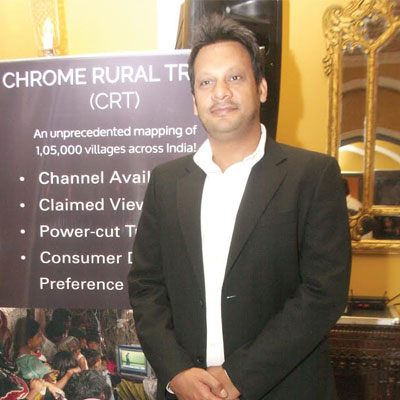
    MUMBAI: India’s TV research and analytics company Chrome DM has launched Chrome Rural Track. Every month, Chrome Rural Track will map 1,05,000 villages across India to study the consumption patterns in television viewing.

    The tracking will involve massive infrastructure of field staff and tele-callers, with knowledge of 22 languages, advanced technology, etc. through use of six proprietary tools.

    The field-work for Chrome Rural Track was initiated in April 2015 and the data compilation for Phase I comprising 25,484 villages is underway. Every month, Chrome Rural Track will encompass channel availability, claimed viewership, power-cut trends and consumer durable preference and ownership (colour TV, LPG stove, ceiling fan, car/jeep/van, two wheeler, refrigerator, washing machine, air conditioner, PC/laptop and agricultural land).

    The tracking will be categorised into four Chrome Rural Strata (CRS) based on population density. CRS 1 will be in villages with population greater than 20,000; CRS 2 between 10,001 – 20,000; CRS 3 between 5,000 – 10,000 and CRS 4 will track villages with population less than 5,000.

    The monthly tracking is aimed to assist the marketers in strategising for rural India. It will also help bring the issues affecting rural India into mainstream discussion, thus bridging the urban-rural divide in social and economical considerations too.

    Chrome DM CEO and founder Pankaj Krishna said, “The size and social-cultural complexity of India’s rural landscape warranted the tracking at such a scale. Despite constituting 69 per cent of the population, rural India remains considerably unmapped across segments. We believe that this is a part of our endeavour to bring rural representation on to the radar. Consumption patterns, consumer preferences and purchasing power of rural areas are significantly different from that of the cities. If we further dissect the data, there are radical differences in consumer behaviour within individual villages. Chrome Rural Track is our attempt to map the diversity that exists in our vast country and provide the industry/decision makers with rural data.”

    He further added, “Along with agriculture and simplicity of life – Rural India is today unfortunately synonymous with racism, gender inequality, honour killings and the highest rates of female foeticide across the globe. There are over 1000 female abortions in day in India. Any happening that does well for a story, genuine or non-serious makes it to the headlines across multiple media; however most of these stories are skewed to happenings in and around metros and urban centres. With the launch of Chrome Rural Track, across an unprecedented 105,000 villages of India, our endeavour is to bring Rural India on to the media radar.”

    Chrome Data Analytics & Media advisory board member Monica Tata asserted, “There is a huge gap in the understanding of India’s rural consumers. Marketers need information that is dissected to a village level across India. With television being the main tool to communicate with consumers, it is critical that the brands have a refined knowledge television viewing. Through Chrome Rural Track, we aim to bridge this gap. This data spanning 105,000 villages will be indispensable for both advertisers and agencies and help them take more informed decisions.”

    Some of the interesting findings from Chrome Rural Track include vast differences in the percentage between Cable, DTH and Terrestrial modes among various states. While 99.1 per cent of Kerala villages, 85.4 per cent of Gujarat villages and 70.3 per cent of Maharashtra villages get TV through cable, 62.4 per cent of villagers in Uttar Pradesh and Bihar access TV through DTH.

    Some of the other interesting findings are mentioned in the following table:

    Source – Chrome Rural Track August 2015

    Terming rural India as virtually a black hole in terms of available information on consumption habits, Chrome Data Analytics & Media member of advisory board Bharat Ranga said, “As part of the Zee Network and responsible for its multiple launches, I have actively used Chrome Data along with the highest levels of analytics. I am sure that Chrome Rural Track will help enhance our content production with a better understanding of rural tastes and lifestyle.”

    Mentioned below is a state-wise comparison of media preferences in rural areas across seven states:


  • Chrome DM advances data release of broadcast industry report

    Chrome DM advances data release of broadcast industry report

    MUMBAI: With the broadcast industry currently going through a transition phase with regards to its ratings currency, analytics measurement and distribution audit body Chrome DM has decided to advance its data delivery from Monday to Saturday.


    Correspondingly, the data collection week’s definition would shift from the earlier “Sunday-Saturday” to “Saturday-Friday.” For example: Week 16, data collection would move from “Sunday, 12 April to Saturday, 18 April,” to “Saturday, 11 April to Friday, 17 April.” 


    The advancement of the data release date is a radical shift for stakeholders as media agencies and broadcasters can now take immediate corrective measures with more lead time. This will not only give broadcasters sufficient time to predict reach numbers that would be released during the course of the week, but will also give them a head-start for planning the course for their respective channels.


    Speaking to Indiantelevision.com, Chrome DM CEO and founder Pankaj Krishna says, “The CEOs would prefer to have the data on their table on Saturday instead of Monday and our infrastructure enables us to generate real time data with supreme accuracy and hence we came with this decision.”


    Chrome has also launched a new tool named Chrome DTH, which enables broadcasters to scrutinize a comprehensive view of all-India DTH operations, including channel status, package information and on-ground market offers across markets and regions. “We are making constant efforts to grow and ensuring that we leave no stone unturned. With this new tool, we will provide quality analysis of DTH data, which will be generated after analyzing huge sum of reports acquired from the length and breadth of the country,” informs Krishna.


    Chrome Track 2.0 is an industry currency with over 300 channels detailing connectivity with weighted OTS (Opportunity-to-See) analytics as well as highlights that mark out the changes in channel placements on a daily basis.


    The Chrome DM methodology also addresses three key issues concerning the media universe:


    Sample Size: Chrome DM consolidates connectivity via scanning 101 million homes; through 24/7 surveillance supported by 3.6 lakh Chrome DM respondents & 12000+ Chrome Panel homes across multiple modes of Television Delivery.


    Swings in the ratings: 24×7 surveillance coupled with the fact that Chrome monitors ‘universes’ and not ‘samples’, thereby leaving no room for statistical aberrations. Unlike any other television monitoring service in the country today, Chrome Track provides access to data at a head-end level, thereby ensuring complete transparency in the system.


    Accurate representation in the East & South: Chrome is the only company to address eight markets (Arunachal Pradesh, Assam, Manipur, Meghalaya, Mizoram, Nagaland, Sikkim and Tripura) in the North-East and one of the few companies to cover 11 markets (Bangalore, Chennai, Hyderabad, AP+ Telangana .1 to 1Mn, AP-Rest 1Mn.+, Karnataka .1 to 1Mn, Kerala .1 to 1Mn., Kerala LC1, Kerala 1Mn. +, TN .1 to 1Mn., TN-Rest 1Mn.+ ) in the South, spanning 14+ million C&S homes.


    “Chrome DM has been working closely with the industry since 2009 and has to constantly live up to the analytic needs of 300+ channel partners. The industry, today, is going through a transition in the way we look at ratings and the currencies we adopt – there are millions of advertising bucks riding on the IPL and the corresponding pressures on placements across cable and DTH only gets higher. We recognize the importance of actionable data on a timely basis and hence the advancement of our data by two days,” Krishna concludes.

  • Chrome Data: Sports channels witness maximum growth

    Chrome Data: Sports channels witness maximum growth

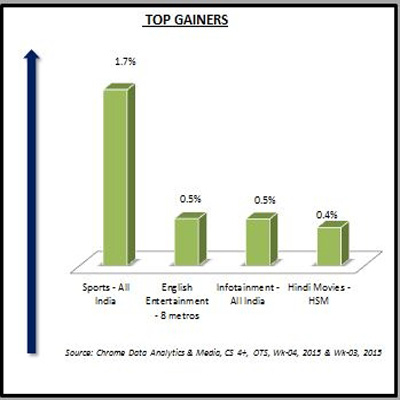
    MUMBAI: Sports channels across India saw the highest jump of 1.7 per cent when it comes to opportunity to see (OTS) collated by Chrome Data Analytics & Media.


    DD Sports with 74.4 per cent OTS led the charge in the category.


    English Entertainment channels in the eight metros and Infotainment channels across India witnessed 0.5 per cent jump. In their respective categories, Comedy Central with 60 per cent OTS and Discovery with 84.9 per cent OTS topped the charts.


    In the Hindi speaking marketing (HSM), Hindi Movie channels saw a 0.4 per cent hike. Zee Cinema with 95.3 per cent OTS gained the most in the genre.


    As for the losers, Hindi GECs in the HSM and English News in the eight metros saw a marginal drop of 0.4 per cent.


    Star Plus with 97 per cent OTS and Times Now with 79.8 per cent OTS reigned their respective genres.

  • Chrome Data: Channels see marginal jump in week 3

    Chrome Data: Channels see marginal jump in week 3

    MUMBAI: The opportunity to see (OTS) collated by Chrome Data Analytics & Media didn’t see a major hike in the third week of the year.


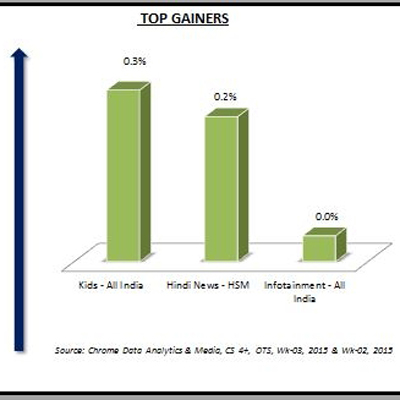
    Across India, kids channels saw a minor jump of 0.3 per cent followed by Hindi News in the Hindi speaking market (HSM) with 0.2 per cent.


    Cartoon Network with 80.9 per cent OTS and ABP News with 94.7 per cent OTS gained the most in their respective genres.


    As for the losers, Hindi News in the HSM witnessed the loss of 1.3 per cent. Max, with 95.8 per cent OTS, ruled the genre. 


    English Entertainment and English Movies in the eight metros saw a drop of 1.2 per cent and 0.6 per cent, respectively. 


    Comedy Central, with 60 per cent OTS and Romedy Now with 69 per cent OTS, gained the most in their categories.


    In the HSM, Religious channels too saw a drop 0.6 per cent. Aastha with 96.9 per cent OTS continued its reign in the genre.

  • Sony tops week 1 of OTS chart

    Sony tops week 1 of OTS chart

    MUMBAI: The first week of 2015 didn’t see much hike, when it comes to opportunity to see (OTS) collated by Chrome Data Analytics and Media.

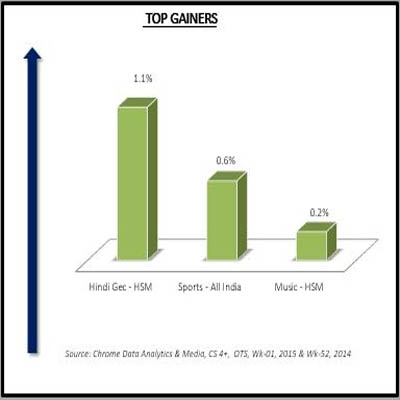
    Hindi GECs in the Hindi speaking market (HSM) witnessed a marginal jump of 1.1 per cent. Sony with 96.9 per cent OTS topped the charts.

    Sports across India jumped 0.6 per cent followed by Music in the HSM with 0.2 per cent. DD Sports with 74 per cent OTS and MTV with 90.7 per cent OTS gained the most in the respective genres.

    As for the top losers, English News in the eight metros saw a steep fall of 6.9 per cent. Times Now with 79 per cent OTS continued its reign in the genre.

    English Movies with 3 per cent fall followed suit in the eight metros. Romedy Now with 66.7 per cent OTS laughed its way up in the category.

    Infotainment channels across India and Business News in the eight metros saw a drop of 2.8 per cent and 2.4 per cent, respectively. Discovery with 85.4 per cent OTS and Zee Business with 81.1 per cent OTS gained in the respective genres.


  • Chrome Data: Week 51 sees a marginal gain

    Chrome Data: Week 51 sees a marginal gain

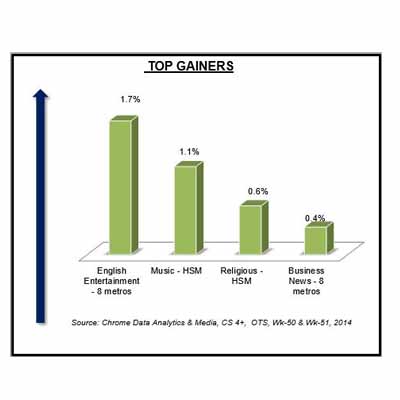
    MUMBAI: The week 51 of opportunity to see (OTS) collated by Chrome Data Analytics & Media saw English Entertainment channels in the eight metros rise by 1.7 per cent. Comedy Central toppled AXN to lead the genre with 63.8 per cent OTS.


    In the Hindi speaking market (HSM), Music channels with 1.1 per cent and Religious channels with 0.6 per cent saw an upward trend. MTV with 90.3 per cent OTS and Aastha with 97.2 per cent OTS ruled their respective genres.


    Business News in the eight metros too saw a marginal growth of 0.4 per cent. CNBC Awaaz with 81.7 per cent OTS gained the most in the genre.


    As for top losers, all across India Infotainment channel dropped by 1.6 per cent. Discovery continued with reign in the genre with 85 per cent OTS. Both, Hindi GECs in the HSM and English News in the eight metros saw 0.7 per cent drop. DD National with 96.9 per cent OTS and Times Now with 80.7 per cent OTS gained the most in their respective genres.


    Sports channels across India too fell by 0.3 per cent. DD Sports ruled the game with 73.3 per cent OTS.