Tag: Pankaj Krishna

  • Chrome releases HD’s India penetration report

    Chrome releases HD’s India penetration report

    MUMBAI: Chrome Data Analytics and Media has released ‘Now Playing: HD’, a report around the rise and penetration of high-definition television in the Indian broadcast industry.

    The report covers key aspects of the evolution of HD TV, which primarily gives broadcasters and advertisers a deeper insight into potential target markets. Not just this, the report captures nuances of an HD TV consumer that industry players can make the most of, for maximizing their consumer base.

    Amongst a range of observations and findings, the report has come up with a list of factors that drive a consumer into purchasing high definition packs and set top boxes. During the research, it was found that DTH & Digital Operators push attractive offers while selling the SD or HD DTH boxes including foregoing installation costs that greatly encourage consumers to opt for HD TV viewing. On the other hand, when the consumer upgrades from SD to HD, he is required to pay for installation charges.

    It was further found that on events of significance (eg: sports tournaments), HD boxes were charged to fulfil high quality viewership needs which means HD pack top ups were primarily event led.

    Commenting on the changing trends in TV viewership, Chrome DM MD Pankaj Krishna said “HD is here to stay but understanding consumer behaviour, which is ever evolving, is the key to capture maximum markets. Also, with the launch of Reliance Jio, OTT HD consumption will be on a steep rise and we see this complimenting the HD consumption growth on television.”

    The 60-page long report is divided into four sections, where the first part talks about the HD penetration in India. The second and third sections talk about factors affecting consumer choice of DTH Player and the last one talks about industry projections, making the report a wholesome approach towards understanding the HD penetration in the broadcast industry.

    Owing to the rise of HD viewership in India, the overall HD penetration for All India metro cities stands at 1,766,709, whereas for tier II cities, the penetration is at 1,338,551.

  • 25% of Rural Maharashtra Uses Internet Services on their Phones reveals Chrome survey

    25% of Rural Maharashtra Uses Internet Services on their Phones reveals Chrome survey

    MUMBAI: Post a successful execution of the world’s largest rural survey by Chrome Data Analytics and Media, the company has revealed some game- changing numbers for FMCG brands.

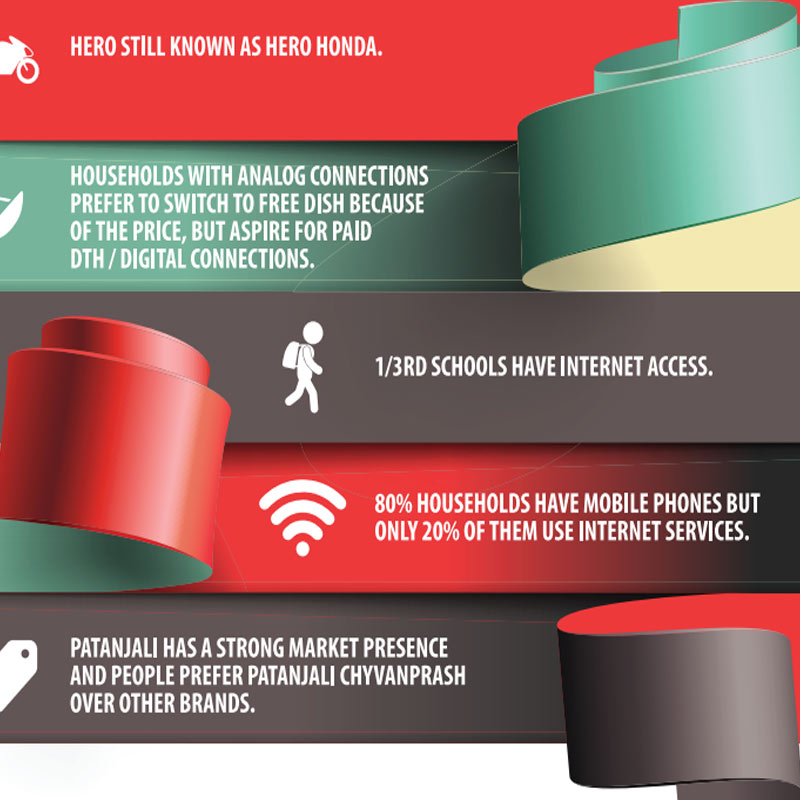
    Amongst other findings, the Rural Establishment Survey states that while 80% of rural Maharashtra uses mobile phones, only 20% are actually using internet services on them. The extensive survey that was spread across a period of 15 months, has also reported a number of other interesting insights that will change the way FMCG brands are targeting their user base.

    When it comes to educational infrastructure, the rural institutions seem to be moving in the right direction. According to the report, 1/3rd of schools in the area have access to the internet. The report also goes into marketing and branding effectiveness through the questionnaire. For example, one of the country’s largest selling two-wheeler companies is still known by its former name, years after breaking up with its Japanese collaborator.

    On speaking to Chrome DM CEO Pankaj Krishna about the impact of this study he stated that ‘The study has taken a deep dive into rural India’s consumer behavior and habits, which is a sure shot solution for FMCG brands to redirect their sales and marketing strategies.’

    Further to this, the report is aimed at assisting companies to tap the untapped market. Especially since 74% of the Indian population still resides in rural areas, there is a huge opportunity for companies to scale up their sales to the next level.

  • 25% of Rural Maharashtra Uses Internet Services on their Phones reveals Chrome survey

    25% of Rural Maharashtra Uses Internet Services on their Phones reveals Chrome survey

    MUMBAI: Post a successful execution of the world’s largest rural survey by Chrome Data Analytics and Media, the company has revealed some game- changing numbers for FMCG brands.

    Amongst other findings, the Rural Establishment Survey states that while 80% of rural Maharashtra uses mobile phones, only 20% are actually using internet services on them. The extensive survey that was spread across a period of 15 months, has also reported a number of other interesting insights that will change the way FMCG brands are targeting their user base.

    When it comes to educational infrastructure, the rural institutions seem to be moving in the right direction. According to the report, 1/3rd of schools in the area have access to the internet. The report also goes into marketing and branding effectiveness through the questionnaire. For example, one of the country’s largest selling two-wheeler companies is still known by its former name, years after breaking up with its Japanese collaborator.

    On speaking to Chrome DM CEO Pankaj Krishna about the impact of this study he stated that ‘The study has taken a deep dive into rural India’s consumer behavior and habits, which is a sure shot solution for FMCG brands to redirect their sales and marketing strategies.’

    Further to this, the report is aimed at assisting companies to tap the untapped market. Especially since 74% of the Indian population still resides in rural areas, there is a huge opportunity for companies to scale up their sales to the next level.

  • Chrome Data rolls out massive rural habits report, cable TV included

    Chrome Data rolls out massive rural habits report, cable TV included

    MUMBAI: The Pankaj Krishna-led Chrome Data Analytics & Media today announced the completion of their proprietary Rural Establishment Survey (RES), an unprecedented study covering consumer behaviour and habits in over 200,000 Indian villages, representing over 300 million Indians.

    The survey, which was done over a period of 15 months, involved the entire Chrome Data infrastructure of over 650 field executive, 450 telecalling staff and the 150 strong analytics team, together speaking over 22 languages to map the length and breadth of the country. According to Chrome Data, one in a 100 households covering the sample area were reached.

    Respondents were made to fill out a detailed questionnaire which included consumer habits, family income and lifestyle patterns among other things.

    All the products in the naional consumer classification survey (NCCS), cable penetration, electricity, power cut data, political preferences, subscriber attached to each platform by village, are some of the data points which have been captured by the rural establishment report.

    The survey holds direct actionables for brands and agencies to help target growth regions

    Broadcasters, for example can know the exact subscriber base of cable networks in the villages covered. Along with this, it also gives the number of active subscribers of each cable network. The company believes RES will add immense value to business strategies for broadcasters, agencies and advertisers.

    Speaking on the product, Chrome Data CEO Pankaj Krishna: “It has been a humbling experience to be a part of a study of such a massive scale, and I’m proud of the team for the amount of efforts they’ve put in over the past 15 months. Even we weren’t prepared for some of the findings – for broadcasters for example, there are pockets of rural areas that have seen Freedish penetration spiral up to almost a hundred percent.”

    Chrome RES, he added, will be key for any business planning to capitalize on data driven strategies to exploit the 74% rural population.

    Pricing for the rural establishment report varies between Rs 35 lakh to Rs 1.8 crore depending on the number genres and channels that are subscribing to to it.

  • Chrome Data rolls out massive rural habits report, cable TV included

    Chrome Data rolls out massive rural habits report, cable TV included

    MUMBAI: The Pankaj Krishna-led Chrome Data Analytics & Media today announced the completion of their proprietary Rural Establishment Survey (RES), an unprecedented study covering consumer behaviour and habits in over 200,000 Indian villages, representing over 300 million Indians.

    The survey, which was done over a period of 15 months, involved the entire Chrome Data infrastructure of over 650 field executive, 450 telecalling staff and the 150 strong analytics team, together speaking over 22 languages to map the length and breadth of the country. According to Chrome Data, one in a 100 households covering the sample area were reached.

    Respondents were made to fill out a detailed questionnaire which included consumer habits, family income and lifestyle patterns among other things.

    All the products in the naional consumer classification survey (NCCS), cable penetration, electricity, power cut data, political preferences, subscriber attached to each platform by village, are some of the data points which have been captured by the rural establishment report.

    The survey holds direct actionables for brands and agencies to help target growth regions

    Broadcasters, for example can know the exact subscriber base of cable networks in the villages covered. Along with this, it also gives the number of active subscribers of each cable network. The company believes RES will add immense value to business strategies for broadcasters, agencies and advertisers.

    Speaking on the product, Chrome Data CEO Pankaj Krishna: “It has been a humbling experience to be a part of a study of such a massive scale, and I’m proud of the team for the amount of efforts they’ve put in over the past 15 months. Even we weren’t prepared for some of the findings – for broadcasters for example, there are pockets of rural areas that have seen Freedish penetration spiral up to almost a hundred percent.”

    Chrome RES, he added, will be key for any business planning to capitalize on data driven strategies to exploit the 74% rural population.

    Pricing for the rural establishment report varies between Rs 35 lakh to Rs 1.8 crore depending on the number genres and channels that are subscribing to to it.

  • Chrome at variance with MIB on DAS Phase III, claims 78.6 per cent completed

    Chrome at variance with MIB on DAS Phase III, claims 78.6 per cent completed

    MUMBAI: Even as the Information & Broadcasting Ministry has claimed almost 100 per cent digitization in the ongoing Phase III of digital addressable systems, Chrome Data Analytics & Media says its studies show the figure is much lower at 78.6 per cent.

    The Task Force for the final two phases set up by the Ministry was informed in its 15th meeting on 30 May 2016 that about 41 million set top boxes had been seeded in Phase III despite the pending cases in many high courts.

    As reported by indiantelevision.com, the claim was made by Information and Broadcasting joint secretary R Jaya who had earlier told the 14th meeting on 16 February 2016 that around 90.44 percent success had been achieved in DAS phase III. During the meeting it was informed that the seeding of STBs by MSOs increased from 6.91 million to 12.43 million between 31 December 2015 and 15 February 2016.

    However, Chrome says its calculation of 78.6 per cent is primarily based on the 31.83 million C&S population that was digitized out of a total of 40.50 million C&S population in DAS III areas.

    This number was based on primary research that supports the company’s proprietary tools like the Chrome subscriber establishment survey, widely used by the broadcasting industry, taking into account the Census 2011 numbers.

    Chrome Data Analytics & Media CEO Pankaj Krishna told indiantelevision.com that “what we have seen in the current DAS phase is significant gains for DTH players, with their considerable infrastructure contributing towards these gains.”

    Phase IV of DAS, the last phase of digitization that aims at covering all the remaining urban and rural areas in the country is set to be completed by 31 December 2016.

  • Chrome at variance with MIB on DAS Phase III, claims 78.6 per cent completed

    Chrome at variance with MIB on DAS Phase III, claims 78.6 per cent completed

    MUMBAI: Even as the Information & Broadcasting Ministry has claimed almost 100 per cent digitization in the ongoing Phase III of digital addressable systems, Chrome Data Analytics & Media says its studies show the figure is much lower at 78.6 per cent.

    The Task Force for the final two phases set up by the Ministry was informed in its 15th meeting on 30 May 2016 that about 41 million set top boxes had been seeded in Phase III despite the pending cases in many high courts.

    As reported by indiantelevision.com, the claim was made by Information and Broadcasting joint secretary R Jaya who had earlier told the 14th meeting on 16 February 2016 that around 90.44 percent success had been achieved in DAS phase III. During the meeting it was informed that the seeding of STBs by MSOs increased from 6.91 million to 12.43 million between 31 December 2015 and 15 February 2016.

    However, Chrome says its calculation of 78.6 per cent is primarily based on the 31.83 million C&S population that was digitized out of a total of 40.50 million C&S population in DAS III areas.

    This number was based on primary research that supports the company’s proprietary tools like the Chrome subscriber establishment survey, widely used by the broadcasting industry, taking into account the Census 2011 numbers.

    Chrome Data Analytics & Media CEO Pankaj Krishna told indiantelevision.com that “what we have seen in the current DAS phase is significant gains for DTH players, with their considerable infrastructure contributing towards these gains.”

    Phase IV of DAS, the last phase of digitization that aims at covering all the remaining urban and rural areas in the country is set to be completed by 31 December 2016.

  • Will mobile devices/alternate screens takeover television?

    Will mobile devices/alternate screens takeover television?

    In an age where the usage of connected devices is booming, it is a huge benefit for consumers to be able to watch content on alternate screens, alongside the conventional way, increasing the amount of overall content consumption in the Nation.

    The alternate screens for a television viewing experience include Connected TVs, Internet Set-Top Boxes, Personal Computers, Smart-phones, Tablets and Smart Blu-ray players. Connected TVs (Smart TVs) are integrated with the internet, providing a technological convergence between computers and television sets/set-top boxes – these provide online interactive media, Internet TV, over-the-top content and on-demand streaming of media. Similarly, computers can also be used for streaming live television over the internet via websites. In the context of India, the use of mobile devices in the Nation has sky-rocketed, owing to the combination of inexpensive devices, low tariffs and the introduction of various applications, including those made particularly to stream television content such as Hotstar (Star TV) and most recently, VOOT (Viacom). Hotstar outdid apps such as Facebook, Instagram and Twitter to become the fastest to cross the million downloads mark within a week. VOOT is the only OTT player to start with original content from Day 1, which has specifically been made only for the digital platform itself.

    With the advent of Netflix in India, we have the liberty to reap the benefits of the world’s top video streaming service, which allows users to watch content on various screens, now entering the Indian space with subscription for as low as Rs. 500. Globally, Netflix has been used extensively – with an average of 45GB of data consumed by their 20 million subscribers, across 130 countries per month. In the US, 36% of US homes are subscribed to the platform. In order to match increasing demands, Netflix pushed 329,400,000,000 GBs of data in 2015. Another factor that can be done away with whilst using alternate screens is to avoid watching advertisements; it was estimated that Netflix subscribers avoided watching 130 hours of commercials per year, by not watching broadcast TV.

    Another powerful entrant providing 4G-based digital services with offers such as on-demand content and launching with 450 channels is Reliance JioPlay, with cutting edge features such as voice control and program catch-ups. Yet another introduction by one of the kingpins, Zee Entertainment, is OZEE, leaving consumers spoilt for choice with their video-on-demand platform, whereby the content of Zee channels is made available almost instantly, complementing the wave of viewers breaking away from appointment television. Collaboratively, there is much to look forward to in the realm that is Live TV on alternate screens of content consumption.

    The success of these initiatives has come on the back of the increased usage of mobile devices and the internet; India currently has 980 million active mobile users, 171 million smart-phone users and 272 million wireless internet subscribers. To gauge an understanding of the current scenario of mobile usage around the world, the global internet average speed is supposedly 5.1 Mbps, with highest in South Korea at 23.6 Mpbs and 2.3 Mpbs in India.

    A report by Ernst and Young expresses that Smart-phone penetration in the country is expected to grow to 520 million by 2020. To add to this this, the next phase of internet usage is expected to come from Tier II and Tier III cities, through wireless mobile internet. Basis the fact that Indian consumers have a significant inclination towards watching regional content, by 2020, of the 650 million internet users, 50-55 per cent are expected to be rural users, from the earlier 33% in 2013.

    Pankaj Krishna, CEO & Founder of Chrome Data Analytics & Media, expressed his views, “Linear television continues to be the largest form of television viewing, in spite of technological advancements in the industry and alternate platforms to watch content, including tabs and mobile devices. They say old habits die hard; despite the paper and ink of newspapers being the costliest, they are still read as much as always – the same notion holds when it comes the conventional TV set. There are two qualities of viewing that one can choose – be it a 40″ TV screen or a 5″ tablet, the former is still as popular and, thus, may not be completely replaceable.”

    Thus, it is safe to say that omni-platform content is taking over the nation (and world) by storm, without greatly cannibalizing viewing through conventional television sets, but instead – increasing the usage of other forms of content distribution. This use of smaller screens will fuel watching content individually, with 45% of all content consumed expected to be on the small screen by the next four years. The question is whether the rise of these alternate platforms will eventually make a dent in conventional television content viewing, or not, in the years to come.

  • Will mobile devices/alternate screens takeover television?

    Will mobile devices/alternate screens takeover television?

    In an age where the usage of connected devices is booming, it is a huge benefit for consumers to be able to watch content on alternate screens, alongside the conventional way, increasing the amount of overall content consumption in the Nation.

    The alternate screens for a television viewing experience include Connected TVs, Internet Set-Top Boxes, Personal Computers, Smart-phones, Tablets and Smart Blu-ray players. Connected TVs (Smart TVs) are integrated with the internet, providing a technological convergence between computers and television sets/set-top boxes – these provide online interactive media, Internet TV, over-the-top content and on-demand streaming of media. Similarly, computers can also be used for streaming live television over the internet via websites. In the context of India, the use of mobile devices in the Nation has sky-rocketed, owing to the combination of inexpensive devices, low tariffs and the introduction of various applications, including those made particularly to stream television content such as Hotstar (Star TV) and most recently, VOOT (Viacom). Hotstar outdid apps such as Facebook, Instagram and Twitter to become the fastest to cross the million downloads mark within a week. VOOT is the only OTT player to start with original content from Day 1, which has specifically been made only for the digital platform itself.

    With the advent of Netflix in India, we have the liberty to reap the benefits of the world’s top video streaming service, which allows users to watch content on various screens, now entering the Indian space with subscription for as low as Rs. 500. Globally, Netflix has been used extensively – with an average of 45GB of data consumed by their 20 million subscribers, across 130 countries per month. In the US, 36% of US homes are subscribed to the platform. In order to match increasing demands, Netflix pushed 329,400,000,000 GBs of data in 2015. Another factor that can be done away with whilst using alternate screens is to avoid watching advertisements; it was estimated that Netflix subscribers avoided watching 130 hours of commercials per year, by not watching broadcast TV.

    Another powerful entrant providing 4G-based digital services with offers such as on-demand content and launching with 450 channels is Reliance JioPlay, with cutting edge features such as voice control and program catch-ups. Yet another introduction by one of the kingpins, Zee Entertainment, is OZEE, leaving consumers spoilt for choice with their video-on-demand platform, whereby the content of Zee channels is made available almost instantly, complementing the wave of viewers breaking away from appointment television. Collaboratively, there is much to look forward to in the realm that is Live TV on alternate screens of content consumption.

    The success of these initiatives has come on the back of the increased usage of mobile devices and the internet; India currently has 980 million active mobile users, 171 million smart-phone users and 272 million wireless internet subscribers. To gauge an understanding of the current scenario of mobile usage around the world, the global internet average speed is supposedly 5.1 Mbps, with highest in South Korea at 23.6 Mpbs and 2.3 Mpbs in India.

    A report by Ernst and Young expresses that Smart-phone penetration in the country is expected to grow to 520 million by 2020. To add to this this, the next phase of internet usage is expected to come from Tier II and Tier III cities, through wireless mobile internet. Basis the fact that Indian consumers have a significant inclination towards watching regional content, by 2020, of the 650 million internet users, 50-55 per cent are expected to be rural users, from the earlier 33% in 2013.

    Pankaj Krishna, CEO & Founder of Chrome Data Analytics & Media, expressed his views, “Linear television continues to be the largest form of television viewing, in spite of technological advancements in the industry and alternate platforms to watch content, including tabs and mobile devices. They say old habits die hard; despite the paper and ink of newspapers being the costliest, they are still read as much as always – the same notion holds when it comes the conventional TV set. There are two qualities of viewing that one can choose – be it a 40″ TV screen or a 5″ tablet, the former is still as popular and, thus, may not be completely replaceable.”

    Thus, it is safe to say that omni-platform content is taking over the nation (and world) by storm, without greatly cannibalizing viewing through conventional television sets, but instead – increasing the usage of other forms of content distribution. This use of smaller screens will fuel watching content individually, with 45% of all content consumed expected to be on the small screen by the next four years. The question is whether the rise of these alternate platforms will eventually make a dent in conventional television content viewing, or not, in the years to come.
  • Tauquir Zaidi appointed as SVP on Chrome Data Analytics & Media

    Tauquir Zaidi appointed as SVP on Chrome Data Analytics & Media

    MUMBAI: Tauquir Zaidi has been appointed senior vice president-revenue in the Pankaj Krishna led Chrome Data Analytics & Media.

    An industry veteran with over 17 years in the broadcast industry, Zaidi has had an integral role in organizations such as STAR, NDTV Media, Times Television and Doordarshan.

    After expanding the market base for Star India, Zaidi joined NDTV Media as AVP, Ad Sales, and went on to head the team for NDTV 24×7 and NDTV India. :Later, Zaidi spearheaded Ad Sales in the North and West Markets as the Regional Head at Times Television.

    Zaidi will focus on growth and expansion of the organization by driving several new initiatives. He will be reporting directly to Pankaj Krishna.

    Commenting on his appointment, Krishna said, “Tauquir comes to us with over 17 years of experience in the media industry, and he will be an important figure in our journey to become the most respected media audit and intelligence company. We are happy and excited about having him on board.”

    Zaidi added, “Working with Pankaj is an opportunity I could not have passed on, having followed his career over the years. Chrome DM is at an exciting juncture, poised to take the leap to the next level with a well laid out diversification plan.  As they grow their stable of products, leveraging their already established market standing, I look forward to the challenge of driving revenue growth and the excitement of working with a young, talented team.”