
Tag: Pandemic

  • Guest Column: The great streaming transformation

    Guest Column: The great streaming transformation

    New Delhi: It’s one of the great truths that some of the most significant events in human history have left a lasting legacy of unanticipated and permanent societal change. Last year the global pandemic caused the world to enter a long, dark tunnel from which it is yet to emerge. We don’t know yet what its permanent legacy will be, but in media and entertainment, streaming has catapulted to the forefront as the fastest-growing segment for content consumption.

    It’s true, the global content viewing revolution had already begun with the birth of global SVOD players like Netflix and Amazon in the last decade, but in 2020 digital transformation was supercharged. In the FICCI-EY report ‘Playing by new rules’ (March 2021), 37 per cent of surveyed Indian consumers said they are more likely to consume their media via OTT after the pandemic. For home entertainment, the digital age has well and truly arrived.

    OTT (over-the-top) streaming services thrive by offering low-cost, high utility alternatives to traditional television and make money by mining the margin previously enjoyed by pay and FTA broadcasters who have much higher infrastructure costs. Their algorithm-directed content picks take the place of human-driven programming selections and deliver the customer a sense of personalisation and “endless choice”, which sometimes belies the actual quantity of programmes available. These services’ responsiveness to consumer behaviour, with their ability to serve up just enough of the right content to maximise subscription and to reduce churn, also sets them apart. If they can find their niche in a crowded market they can be incredibly successful.

    The global OTT market is huge and growing fast – estimated by Research Dive to grow at a CAGR of over 19 per cent out to 2026 becoming then worth over US$400 billion globally. This surging growth, never stronger in a single year than in 2020, has led to the mass uptake of a huge range of existing and new local and global platforms and services. Many of these services were accessed for the first time by individuals and families who were living through months of economic and social lockdowns.

    In the Asia Pacific, more broadly, according to PWC, the regional OTT market will surpass that of the United States sometime in 2021.

    Last year, everyone was talking about the most popular streaming shows. If it wasn’t The Crown, it was The Queen’s Gambit or Criminal Justice: Behind Closed Doors on Disney+ Hotstar, produced by BBC Studios India. In India, there are now more than 40 OTT providers in a crowded market challenging for a share of the valuable streaming wallet.

    Our content sales business has been able to benefit from this growth. In India last year BBC Studios struck a deal with Lionsgate Play to showcase premium dramas Brexit, Pure, Class, Les Miserables and SS-GB. The ever-popular Doctor Who reached its audience on Disney+ Hotstar and Amazon Prime Video. Celebrated BBC pre-school content appeared on Voot Kids, providing entertaining and educational content for young families stuck at home. Sony BBC Earth also had a strong year.

    How are producer-distributors to continue to respond to this challenge and yet potentially huge opportunity? One thing that has become apparent is the vital importance of the ownership of intellectual property. This realisation was the driving force behind the 2018 spin-off of the BBC’s in-house production arm and consolidation with distribution company BBC Worldwide, to create a producer-distributor powerhouse, BBC Studios. And no doubt, ownership of content and IP has become even more important since then.

    As an owner, BBC Studios extracts value at all points in the IP’s lifecycle, from initial production to distribution to licensing and merchandising. But it doesn’t end there. Running a true IP ecosystem also requires participation in the OTT market itself. The development of authenticated VOD service – BBC Player in Singapore and Malaysia and the partnership with ITV in streaming service BritBox, which is enjoying huge success in the US, Canada, and Australia are evidence of this.

    In the US, many of the big studios executed gigantic mid-course pivots to streaming, involving consolidation, big money investments, channel closures, and painful restructuring. Last year, Warner Brothers stunned the market by announcing that they planned to release their entire 2021 film slate on HBO Max simultaneously with movie theatres in the US.

    Recently we learned that Disney will take the unprecedented step of closing 18 of their linear channels in South East Asia and Hong Kong to concentrate on their OTT business. Both seem incredibly bold but understandable moves given the state of the market, the pace of change, and the growing size of the streaming prize.

    Linear channels will continue, albeit on a slow decline in some markets. MPA recently forecast that total pay-TV industry revenues will actually grow at a CAGR of 3 per cent between 2020-25, driven by India, China, and Korea. However, those still in the linear business must continue with the modernisation of their services, building digital extensions, and increasing their cost efficiency while preparing to participate in a primarily digital future.

    The advent of OTT streaming delivers a stark choice for IP owners – either stay on the sidelines and risk having their primary business model eroded, or take the plunge and transform their business model to take advantage of the age of streaming.

    (Jon Penn is the executive vice president for BBC Studios APAC. The views expressed in the column are personal and Indiantelevision.com may not subscribe to them.)

  • Domestic travel picks pace amid vaccine roll-out, easing of rules shows survey

    Domestic travel picks pace amid vaccine roll-out, easing of rules shows survey

    MUMBAI: More than a year into the pandemic, restrictions on movement continue across various countries. However, the global appetite for travel remains intact, with an inclination towards domestic travel (51 per cent) exceeding international (18 per cent). A significant fact is that the resumption of travel will start closer to home.

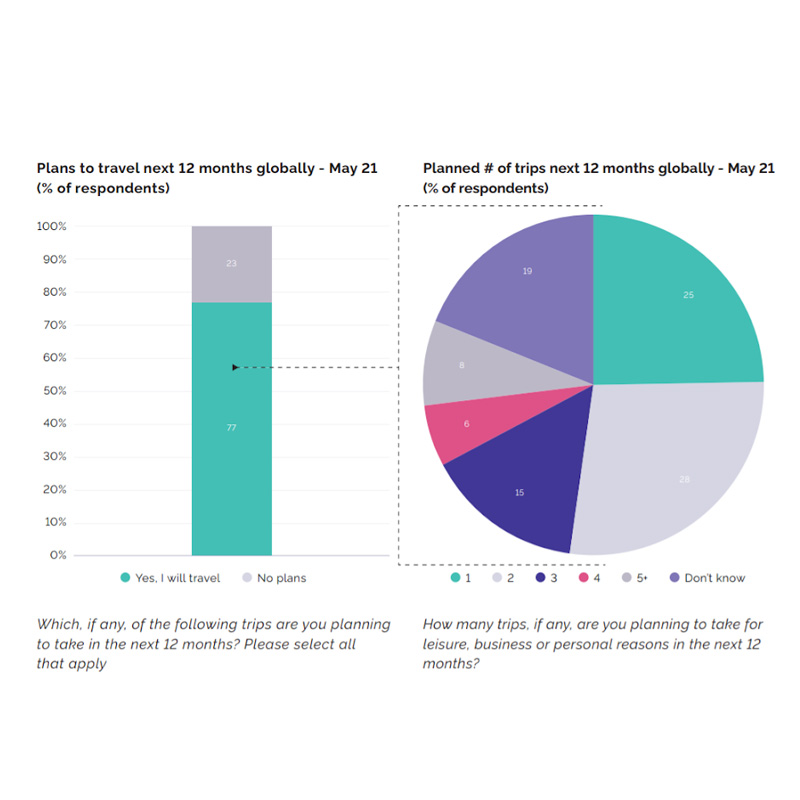
    According to YouGov’s ‘International Travel & Tourism Report 2021: The road back to normality‘ , post-pandemic international travel will begin with familiar destinations, while business travel recovery may take longer. It also showed that 77 per cent of global consumers plan to travel in the next 12 months with 57 per cent planning over two trips. Majority of the travel demand will be led by millennials and Gen X, according to the survey.

    The survey conducted in 25 global markets including India among 1.8 lakh respondents found that there is a gradual fall in the number of people concerned over health risks across the globe since January 2021, in line with the approvals of vaccines and their widespread rollout.

    As the pandemic begins to subside globally and extensive vaccinations buoy up spirits in most parts of the world, what does the road back to normality look like for the travel & tourism sector? Encouragingly for travel companies, the intent to travel domestically for leisure rose sharply at the start of 2021. The recovery of international travel depends on softening of restrictions, found the study which shows that international travel intent in 2020 remained low due to strict restrictions. But as more herd immunity is reached in various parts of the world, it’s reasonable to expect declining health concerns, even if they don’t disappear completely.

    With the European Union all set to roll out its ‘Green Pass’ or Digital Covid certificate to facilitate free movement during these challenging times, there’s a glimmer of hope for the travel industry in 2021. And now with news coming in that European countries, including Switzerland and Germany, are ready to extend the pass to Indians vaccinated by Covishield, there is some respite in store for those pent-up wanderlust emotions lying suppressed for over a year now.

    The road back to normality for the travel industry, however, is going to be a bumpy one. Only one in five consumers globally plan to travel internationally in the next 12 months. The report analyses consumer travel preferences and identifies the emerging opportunities that will prove most lucrative for industry players. As travel attitudes and restrictions shift rapidly, so do travelers’ interests in particular destinations.

    The changes we see in travelers’ consideration of different destinations appear linked to both the seasonal relevancy of the destination, as well as the restrictions that are currently in place to travel to or from the locale.

    Health risks remain the biggest barrier to travel (48 per cent) for global survey respondents, followed by safety (37 per cent) and travel restrictions (35 per cent)- Although, the proportion of those concerned about health risks from travelling has gradually decreased since January, when it stood at 56 per cent, in line with the rollout of the vaccine.

    A clear appetite for travel globally is indicated with more than 77 per cent of the respondents planning trips during the next 12 months and with more than half of this group planning two or more journeys (57 per cent).

    Millennials and Gen X have the confidence and the means

    The youngest generation, Gen Z, has been the hardest hit economically. While they have less concern over health risks, a lack of disposable income is holding them back in terms of their ability to travel freely, the study shows. The oldest generation is on the other side of the coin – with savings due to having spent less in the last year, but more concerns around travel safety. Somewhere in the middle is the audience travel companies are looking for. Millennials and Gen X on average have the combination of confidence to travel, lack of immediate health risks, and the finances to fund trips in the coming months and years.

    The survey indicates that around a third of people globally feel restrictions are preventing them from traveling. Travel restrictions and risks of quarantine have proven to be a more constant dampener than concerns about the virus. Uncertainty over local and national lockdowns as well as international travel will continue to put downward pressure on a fragile recovery.

  • National Doctors’ Day: CNN-News18 salutes medics with its social campaign

    National Doctors’ Day: CNN-News18 salutes medics with its social campaign

    New Delhi: In the midst of COVID-19 pandemic, doctors and the entire medical fraternity have worked selflessly and relentlessly to not only treat patients but also help raise awareness to keep people safe. To salute their undying spirit and pay tribute to the brave doctors, CNN-News18 has launched the #ExtraordinaryAmongUs campaign starting from 1 July.

    Commemorating National Doctor’s Day, the news channel has announced a week-long programming line-up exemplifying the relentless drive of our doctors. The line-up will comprise special shows such as Warrior’s Talk that will capture the stories of doctors, their experiences of treating the patients, and ensuring their mental and emotional well-being.

    The campaign will also bring an exclusive segment called Survivor’s Note which will showcase the heartening stories of the survivors of COVID-19. Viewers will witness hitherto unheard stories of tender care given by the doctors helping people fight and survive through COVID-1

    Speaking on the campaign, Network18’s CEO -business news cluster, Smriti Mehra said, “As a responsible news channel, we, at CNN-News18, have always believed in driving impact through engaging conversations. With this campaign, we recognize the unwavering spirit and commitment of our doctors and the entire medical fraternity in these unprecedented times. #ExtraordinaryAmongUs aims to highlight the stories of bravery, and selfless service provided by the doctors.”

    The campaign will conclude with Doctors’ Corner, a virtual conclave that will host some of the notable personalities from the Indian medical fraternity as they share their experiences from the COVID-19 wards. The channel’s formidable team of editorial experts led by veteran anchors and journalists will also pay their tribute to the incredible service offered by the doctors to humanity. 

  • News18 HSM Network brings special programing on National Doctors’ Day

    New Delhi: The difficult times faced by all amidst the COVID-19 pandemic has brought to the fore the contributions and sacrifices made by doctors and healthcare staff around the globe on a daily basis.

    To honor these selfless heroes, News18 HSM Network has planned special shows on the occasion of National Doctors’ Day. These special shows will be dedicated to all medical professionals who have put the welfare of others above all else even at the risk of their own lives, said the network.

    The programming will feature eminent personalities from the medical field as well as political leaders in a discussion which will focus not only on the healthcare challenges that the country has been facing, but also the steps need to be taken to avoid and handle any health emergencies in the future.

    “The special Doctors’ Day celebration on News18 HSM channels is an attempt on our part to express our gratitude to these “angels in white” and highlight their importance in our lives,” said the network in a statement.

    The special programming on July 1 will begin on News18 Rajasthan at 2:00 pm, News18 Bihar/JHH at 6:30 pm, News18 UP/UK at 4:30 pm, News18 MP/CG at 3:30 pp and News18 PHH at 8:30 pm.

  • Pandemic drags down DishTV India’s FY’21 financials

    MUMBAI: India’s first DTH operator Dish TV India continues to slog it out to get out of the financial quagmire it has got itself into. That’s despite the fact that the company  has seen a loss of subscribers in its latest quarter ended 31 March 2021 and for the full year, its top line has dipped even as it continues to report losses. According to its audited Q4 FY 21 results released yesterday, Dish TV India  has reported consolidated subscription revenues of Rs  685.2 crore (Rs 776.6 crore in Q4 FY’20) and operating revenues of Rs  751.7 crore (Rs 869.06 crore). EBITDA for the quarter was Rs 426 crore (Rs 543.2 crore). Net loss was Rs 1415.3 crore as against a loss of Rs 1456.2 crore  in the same quarter last year.

    Subscription revenues for the whole year have fallen from Rs 3192.8 crore in FY ’20 to Rs 2987.4 crore in FY’21, even  as operating revenues saw a reduction to Rs 3249.4 crore as against Rs 3556.3 crore in FY20.  EBITDA for the full year fell to Rs 2017 crore as against Rs 2106 crore in FY’20. However, to its credit, it has reduced the red ink on its bottomline to Rs 1189.9 crore as against Rs 1654.8 crore in the previous financial year.

    What helped it shore up its performance in the latest financial year is its hard focus on shaving expenditure which it has reduced by 15 per cent to Rs 1232.4 crore as against Rs 1450.4 crore in FY ’20.  

    Dish TV management said the company has been hit by the sporadic lockdowns due to the ongoing pandemic during the year and the last quarter. “The later part of the fourth quarter saw re-emergence of urban to rural migration, amongst migrant workers. The sporadic lockdowns have left many in the aspiring class with reduced disposable incomes while taking a toll on overall consumer confidence. Subscriber churn, thus remained on the higher side during the quarter and full year,” said Dish TV India group CEO Anil Dua in a press release.

    Additionally, the company largely relied on internal cash flows for capital expenditure and for debt reduction. Hence, it kept a tight rein on capital expenditure which in turn limited new subscriber additions, and when compounded with high subscriber churn, it  led to a net reduction in its subscriber base.

    Overall, Dish TV repaid Rs 213 crore of its debt in the quarter, reducing its loan  exposure to Rs 809.9 crore at end FY’21 as against  Rs 1817.5 crore at end FY20.  

    Said Dish TV chairman & managing director Jawahar Goel: “The year gone by was difficult but has left us stronger with all the innovations and process improvements in place. However, with continuing uncertainties, we maintain a cautious stand. A strong balance sheet boosts confidence in such tough times and our focus on paying down debt and other liabilities is in that direction only.”

    Dua said that investors need to take heart about the positive manner in which Dish TV has pivoted to take advantage of the opportunities that the pandemic has thrown up. “Effectively, the pandemic rushed the need to innovate. Be it artificial intelligence for resolving customer complaints, enabling work-from home for customer care agents and employees, developing set-top-boxes and other key accessories in India, moving trade partners to a fully digital recharge mode or upgrading our OTT platform, Watcho, we rose to the challenges thrown by the trying year while touching new highs in EBITDA margins.”

    What according to the two of them shows promise is the growth in sign-ons to DishTV’s OTT service Watcho to 25 million by FY 21 year end as against just a million users in January 2020.  Said Dua: “At Dish TV India, it has always been our endeavor to meet the entertainment needs of all our subscribers all the time. Watcho is a step in that direction and delivers a seamless, streaming entertainment experience to viewers through future ready technology and diverse content.”

    Dua is quite optimistic about the company’s fortunes pointing to the important role TV continues to play in viewers lives in India, and believes that a revival in discretionary spending, due to economic activity normalizing going forward, will improve business revenues. The company is going ahead with the procedures relating to raising funds through a rights issue totting up to Rs 1,000 crore.

  • DD, AIR go paperless with 100% adoption of e-Office

    New Delhi: Use of technology has turned the operations at Prasar Bharati around. It’s no more business as usual, as in less than two years, 577 Centers and 22,348 employees of Doordarshan (DD) and All India Radio (AIR) have embraced e-Office operations. The initiative has helped the public broadcaster to cut down its expenditure on paper by almost 45 per cent in the last two years.

    “Kudos to all 500+ field units of Prasar Bharti across DD and AIR as we cross a significant milestone with 100 per cent adoption of e-office. For an organisation which was 100 per cent paper-based till three years ago, it is a remarkable transformation,” tweeted Prasar Bharti CEO Shashi Shekhar Vempati.

    According to the public broadcaster, the IT enablement of routine office functions through e-Office on the Cloud came as a blessing during the pandemic with the flexibility to work remotely, keeping operational decision making going and reducing the need for unnecessary physical movement of files.

    Prasar Bharti had introduced e-Office in August 2019 a year before the pandemic spread across the world. The idea was to make operations more efficient and paperless. Of total 577 Prasar Bharati centers across the country, 10 per cent adopted e-Office in 2019 (Aug – Dec), 74 per cent in 2020 and the remaining 16 per cent have joined by 18 June, it said in a recent statement.

    The transformation has not only brought speed and transparency in the working of the organisation, but led to creation of more than 50,000 e-Files with the status of every file available online. Internally, concerned departments can trace their files, whether it is in movement or parked or closed.

    “On an average, the complete process of clearing one physical file used to take almost a week. Through e-Office, this has been drastically reduced to 24 hours on an average, sometimes even a couple of hours,” said the public broadcaster. As a result, the figures on total volume of cleared files over almost the last two years and average number of files cleared every month during the same period have jumped significantly, the statement added.

    Apart from reducing Carbon footprint, paperless work also enhanced the COVID safety during the pandemic through remote working, work from home, etc, thus reducing the chances of infections.

  • ZEE MPCG launches new conversation series ‘Chhattisgarh Ki Baat’

    New Delhi: ZEE Madhya Pradesh-Chhattisgarh has announced a series of events and conclaves called Chhattisgarh Ki Baat, which will be held in various Tier two cities, where both the economy and the society have been deeply affected by the pandemic.

    The channel aims to establish a direct connection with the general viewers through these events & help them raise their concerns. All local and micro-level issues will be discussed and put forward in front of the stakeholders and the policymakers. The initiative will also provide a platform for businessmen and industrialists to put forward their challenges and discuss possible solutions.  

    The first event of the series will start from Bilaspur, the administrative capital of Chhattisgarh on 20 June. Multiple panel discussions and interviews with the policymakers, industrialists, and subject experts will be held on topics varying from the ways to tackle the effect of COVID to the further development of the city. ZEE MPCG will also recognize and honour those people who went out of their way during these tough times and contributed significantly to the development of the state and the region.

    Speaking on the occasion, ZMCL CEO Cluster three, Dileep Tiwari said, “ZEE MPCG has always worked as a bridge between the people of the state and the authority. We felt that at this time when the economy is recovering from the impact of the pandemic it is extremely important to take such initiatives at the city level so that each city and their industries get a platform to connect with the policymakers, discuss their challenges, and have a significant impact on the development of their city.”

    ZMCL, chief revenue officer, Manoj Jagyasi said, “With ZEE MPCG’s wide reach, this initiative will engage the viewers, the leaders, and the facilitators to develop a constructive discussion for the development. We are more than just a news channel, we want to be the ultimate solution provider to our business associates and our viewers. We will take this to 60 cities of MP, CG, UP Uttarakhand, Punjab, Haryana & Himachal. This will be the biggest outreach program done by a network.”

  • Times Network launches 2nd edition of Living Room Conclave – India Health Mission

    Mumbai: Times Network has announced the second edition of Living Room Conclave – India Health Mission, a conclave series that will focus on combating the COVID-19 pandemic. 

    As India moves ahead while battling the cruel second wave, it is pertinent to continue following the safety protocols and avert the threat of a possible third wave. Addressing these imminent challenges through a course of discussions with eminent figures, who are at the epicentre of the pandemic management, India Health Mission will air from 19 June, every Saturday at 6.30 pm on TIMES NOW & TIMES NOW WORLD and at 7:30 pm on ET NOW. 

    The five-part series will feature key stakeholders from healthcare and health ministry including Cipla MD & CEO Umang Vohra, The Calcutta Medical Research Institute director & HOD, Pulmonology Dr. Raja Dhar, Madras Diabetes Research Foundation director & chief Dr. V Mohan, Gleneagles Global Hospital – Infectious Diseases and Infection Control, Chennai director Dr. Subramanian Swaminathan, amongst others.  

    The launch episode will witness a special panel discussion on India’s Vaccine Roll Out with B Medical Deputy CEO Jesal Doshi, Nephron Clinic Chairman Prof. Dr. Sanjeev Bagai and Neuberg CMD Dr. GSK Velu. 

    Times Network MD & CEO MK Anand said, “The catastrophic COVID-19 second wave has led to a dramatic loss of human lives and presented immense challenges to a strained medical infrastructure. As the country stabilizes with measures including accelerated nationwide vaccination drive and gradual unlocking of States, it is critical to stay focused and brace ourselves to combat possible new waves. Focusing on Covid-19 pandemic preparedness, India Health Mission, is an initiative to empower citizens with critical health and safety advisories through discussions with key stakeholders from the healthcare sector and the health ministry.” 

    Led by Times Network’s leading news anchors, India Health Mission will cover all the critical questions related to COVID-19 and offer important updates to the viewers including steps required to preventing the virus from spreading, vaccination drives, unlock phase across cities, key measures undertaken by the government to combat the situation and how we can prevent the third wave.

  • DB Corp q4 PAT grows by 158 %, circulation revenue dips

    New Delhi: Print media company, DB Corp Limited (DBCL), which is home to flagship newspapers – Dainik Bhaskar, Divya Bhaskar, Divya Marathi and Saurashtra Samachar has announced its financial results for the quarter ended 31 March, 2021.

    Despite the strong pandemic led headwinds, the company said its carefully calibrated editorial, circulation and ad revenue strategies continued to help it outperform the industry performance in both circulation as well as ad revenue fronts.

    The consolidated profit after tax (PAT) for Q4FY21 grew by 158 per cent YOY at Rs. 619 million as against Rs. 241 million. For Q4, the advertising revenue for Q4 stood at Rs. 3084 million as against Rs. 3303 million, while the circulation revenue stood at Rs. 1104 million as against Rs. 1200 million.

    The continued efforts of the circulation teams have yielded results with the Group managing to salvage a challenging year. “The on-ground calibrations done by local teams have helped Dainik Bhaskar achieve almost 95 per cent of pre-Covid levels in select cities and towns. The recoveries have been significant in the key states of Madhya Pradesh, Rajasthan, Gujarat,” it said on Thursday.

    The financials results showed that the circulation revenue of the company for FY21 dropped to Rs. 4146 million as against Rs. 5122 million in FY20, while the advertising revenue stood at Rs. 10,084 million as against Rs. 15,640 million.

    The total revenue came in at Rs. 15222 million as against Rs. 22363 million the previous fiscal. The EBITDA stood at Rs. 3193 million as against Rs. 4940 million and PAT stood at Rs. 1414 million as against Rs. 2750 million.

    “The unprecedented year has reaffirmed the changing dynamics of the Print Industry,” said DB Corp Ltd, managing director, Sudhir Agarwal. “The Indian language newspapers performed significantly better than our English counterparts and outstripped them not only in circulation numbers, but in advertising revenues as well. We are happy to reiterate that the un-metro path chosen by our founder and solidified by the company over the past few years is continuing to fructify. Our digital efforts are also beginning to see traction and we are confident that we will continue to deliver quality journalism through all mediums. The local content has further strengthened the franchise.”

    On the advertising front, the Group published over 20 ‘Mega Editions’ across its major markets, despite challenging fiscal, re-affirming its strategy of operating in the Tier-II, Tier-III cities and beyond. 

  • CARS24 expands operations to UAE and Australia

    New Delhi: E-commerce platform for pre-owned vehicles, CARS24 is set to disrupt the used automobile ecosystem around the globe. The company has launched its business in Australia and UAE and is gearing up to launch business in Southeast Asian and Middle East countries this year.

    As part of its expansion strategy, CARS24 will use its India playbook to expand globally and continue to invest in technology to transform the consumer experience in buying-selling cars, it said on Thursday. “In the last six years, we have worked very hard to revolutionise the way our consumers buy or sell their cars in India. Interestingly, the pain points of used car consumers across the globe remain pervasive. We are sure with our expertise and experience of operating in a diverse market like India, we will be able to cater to the needs of our new customers as well,” said CARS24’s co-founder and CEO Vikram Chopra.

    Elaborating on the company’s international expansion plans, Chopra said, CARS24’s launch in markets of UAE, Australia and Southeast Asia marks a milestone moment in its growth story. “CARS24 is well-poised for explosive growth internationally and we will continue to offer our burgeoning roster of offerings to newer markets that have been at the forefront of embracing new technology and innovation,” he added.

    CARS24 has earmarked an investment of over $100Million for international markets in 2021. These investments will be used to build the brand in these new territories coupled with a strong supply of cars for the platform, and a state-of-the-art workshop to recondition cars to ensure top quality, the company said in a statement.

    Currently, CARS24 is shipping cars to customers across Dubai, Abu Dhabi and Sharjah and to Brisbane in Australia, shortly followed by Sydney and Melbourne as well. “We are delighted to be spearheading the global expansion of CARS24 in the Australian market. Australia is a car-loving nation of consumers who have had no alternative to the traditional used car buying model – until now. Australians are truly ready to embrace 100% online car buying; and with the support of our founders, we have incredibly high expectations for our growth in this market.”, said CARS24 Australia, GM Australia, Olga Rudenko.

    Founded in 2015, CARS24 has grown rapidly over the years, using product, tech and data science, to fuel the growth in the Indian used cars sector and enabling a quality experience for sellers and buyers, completely online & from the comfort of their homes.