Tag: Pandemic

  • FCB India’s  Rohit Ohri’s advertising mantras

    FCB India’s Rohit Ohri’s advertising mantras

    NEW DELHI: FCB India group chairman & CEO Rohit Ohri doesn’t need a long introduction. An ad veteran, with years of experience in the trenches, he has earned respect and his stripes over the past three decades.

    Hence, when he got together with  Indiantelevision.com founder CEO & editor-in-chief Anil Wanvar over in a virtual fireside chat on Saturday when the rest of the industry was putting its legs up, resting, one expected some interesting insights. And boy! did he provide them.

    For instance, he revealed that he is not a great votary of working from home (WFH), which has become the norm now. He has accepted it as a necessity but is raring to get back to the office.

    “I come from the pretty old school of advertising, and WFH is much harder because you’re doing so many things altogether,” he said. “Advertising is a people business. Yes, virtual meetings are good, we are getting more work done, and are saving on travel time. But the business of advertising requires ideas, which we get in casual interactions and in the face to face meetings and even in having fun. That constant interaction is essential to get the creative juices flowing more. I can't wait to get back.”

    He, however, admitted that the past few months of lockdown and WFH have allowed him the opportunity to get involved in the larger set of business needs. Plus it has lent to a cleaning up of the environment something that millennials have really appreciated.  “Nature is telling us it is possible to clean up your act and this realization has made an impact among people,” he revealed.

    Read our coverage on FCB

    Ohri shared that he has learned all about advertising from his first boss Kolkata-based Response Advertising’s Ram Ray who passed away in November 2019.

    “His skills, his passion, his attention for detail was impeccable, his eye for detail are qualities that I have never seen in many ad professionals,” he expounded. "Ray used to write letters to clients and employees, one of the best lessons I learned in business communication. He always had said if you don’t pay attention to your own brand and if the client sees shoddy communication how will you handle them? Ray took me under his wings, and I learned so many things.”

    Ohri firmly asserted, as leaders of companies and organizations it’s our responsibility to mentor the next generation and leave a rich legacy.

    According to him, Ogilvy’s Piyush Pandey brought about a change in the way creative brand advertising can be used to build organisations just like he did for Pidilite.

    Read our coverage on Rohit Ohri

    But he was also very clear that he lets FCB’s advertising output do the talking rather than sounding a bugle about its creative prowess. “I don't believe in the flamboyance of agencies at all, the flamboyance should be the brands,” he emphasised. “In my head, what work we do, and the best rewards are when the brands do well in the market. In my book, there’s no other flamboyance required. It is genetically against the way FCB is as an organization. We believe in solid partnership with clients.”

    He believes that an agency’s role has evolved to become more of a marketing solutions provider. “It’s not just about advertising. It goes way beyond helping them solve any marketing problems. This is something FCB is known for since Anil Kapoor’s days,” he pointed. For instance, the decision to air old Amul commercials during Ramayan and Mahabharat on Doordarshan was something that both the FCB and the Amul team reached. “It was a nostalgic journey into the Amul history,” Ohri explained. ”And on many levels, AmulDoodhPeetaHaiIndia will go down in marketing history because of the way the brand behaved during this crisis. It built a new bond with the whole set of consumers. There was not a day when Amul Milk was off the shelves even during the lockdown. Even with consumers, it brought back the nostalgia, and everybody felt connected with the brand.”

    Ohri shared that he is cautiously optimistic about the advertising industry’s propsects going forward. “We have a global freeze on recruitments or increments, everyone is holding together in these difficult times. But the good news is that clients are coming back and there’s a lot of pent up demand,” he revealed. “FMCG, automotive, white goods are a few categories that have seen improvements.

    He pointed out that there’s a clear pathway that he has charted out for the FCB group (which includes FCB Ulka, FCB Interface, Lodestar UM, FCB Digital, and FCB Cogito). “We are not in the binge acquisitions game,” he said. “We work with partners to provide services to our clients who are satisfied with what we have to offer. That's the path we will continue to tread. Additionally, we have brought all our digital offerings in-house under the main agency. I believe that way we can work holistically together to offer clients a comprehensive solution.”


  • Chaubey Ji makes a comeback Dabur Red Paste

    Chaubey Ji makes a comeback Dabur Red Paste

    New Delhi: In the wake of the Covid2019 pandemic, both businesses and consumers are focusing on essentials. Most of the communication has been a creative rendition of social distancing and washing hands, the two most important preventive measures to break the chain. However, a third was added – building immunity – and this gained momentum post the directives from the Ayush ministry.

    While immunity-boosting foods like Amla, Ginger and Haldi are commonly consumed in India, but as beneficial as they are in fighting diseases, they are quite tough to chew and hard on the teeth.

    Drawing from an inherent product truth of healthy and strong teeth, Dabur Red Paste – the No. 1 Ayurvedic toothpaste – launched 3 films adding to the ‘#ChabaateyRahoIndia’ series, advising people to remain tough, resolute and prepared against the pandemic.

    Done in the usual fun and light-hearted manner that we all have come to like about the ‘#ChabaateyRahoIndia’ series, the thought is brought to life through tough to chew ‘immunity building foods,’ that we consume to boost our immunity. In the film, we can see our protagonist ‘Chaubey Ji’ chewing through the toughest foods like Amla, Ginger and raw Turmeric to prepare himself against the pandemic but is not fazed by their toughness because he uses Dabur Red Paste.

    The brand campaign comprises a series of films that have been conceptualized by Ogilvy Gurgaon.

    Ogilvy North CCO Ritu Sharda said, “The ‘#ChabaateyRahoIndia’ series by Dabur Red Paste makes a comeback this year, and our favourite ‘Chaubey Ji’ is here to chabao some things that are important for all of us to stay fit. While everyone talks about chewing on haldi, ginger and amla, we understand that they are hard to bite, and one would need healthy teeth to chew them properly. So, make your teeth strong to make your immunity strong. Chabatey raho India, aur har problem ko bhagatey raho.”

    Ogilvy president & head of office Shouvik Roy said, “The platform of ‘#ChabaateyRahoIndia’ for the brand Dabur Red Paste is all about chewing through adversity. It was a challenge to bring back ‘Chaubey Ji’ without cricket, especially in this current situation. Yet again, the strong teeth and ‘chaba dalengey’ connect gave birth to 3 beautiful films.”

    Dabur India Oral Care head of marketing Harkawal Singh said, “Dabur Red Paste – the #1 ayurvedic toothpaste – stands for providing strong teeth and complete oral protection with clinically proven Ayurveda. Though this is a serious and efficacious proposition. We created a platform ‘#ChabaateyRahoIndia’ to make it engaging for consumers, celebrating their love for food, their resolve to chew away obstacles, and their will to chew away every hardship and stand tall. In our effort to connect with people and give oral health another fun twist, we are bringing out Season 2 of the endearing ‘Chaubey Ji’ films in which Mr. Manoj Pahwa again helps deliver the brand’s message, urging people to focus on oral health for overall health.”

    Watch the YouTube Links:
    Amla –

    Ginger –

    Haldi –

    CREDITS:

    Client: Dabur India Limited

    Agency: Ogilvy Gurgaon

    Creative: Ritu Sharda, Dalip Daniel, Preeti Koul Chaudhary, Avik Bose, Sumit Vashisth

    Account Management: Shouvik Roy, Atif Rahman, Soumyabrata Banerjee, Asim Mathur

    Planning Team: Rohitash Srivastava, Jose John

    Production House: Dreamcatchers Films Director: Ishwar Singh

  • Kent RO’s film honours building watchmen on Independence Day

    Kent RO’s film honours building watchmen on Independence Day

    NEW DELHI: As the nation preps up to commemorate its seventy-fourth Independence Day, Kent RO has come up with a campaign #NewNazairya which is currently doing the rounds of digital media. The first short digital film has a core message at its heart: let’s celebrate the unsung heroes who have helped us during the raging Covid2019 pandemic by bringing them centre stage on Independence Day.

    Conceptualised and produced by Jigsaw Pictures, it begins with the secretary of a residential housing society looking upset when he is informed that he will not be hoisting the flag on 15 August like he has been doing for the past five years. That’s because Ramdhan will be taking his place, he is told, and that change for him is unwelcome and undignified. His wife, who overhears his annoyance, calmly fills a glass of water from a Kent RO water purifier and while he sips from it she explains to him that there is dignity in getting freedom from old and sick thinking.  “Whether it’s you or Ramdhan, all are equal. Maybe he’s more than equal.”

    The next shot reveals who Ramdhan is: the watchman or security guard of the building complex. Masked and very grateful at being given the honour, he hoists the national colours with the members urging him on and saluting the flag.  A beaming Ramdhan gratefully acknowledges the honour that has been thrust on him. The secretary’s wife then says: “This act was his right. He kept us safe 24 hours every day during the pandemic.”

    The film ends with a voiceover declaring: “Let’s celebrate Independence Day by honouring our Covid2019 warriors.”

    At first glance, it looks like a very ordinary film, a simple thought, a simple truth, which has been used in many a film earlier in the past few months. But its message is deep. The SarsCov2 virus has taught us that it does not differentiate between rich and poor, it infects both, and kills both. It is the great leveller, just as death. The film makes us ponder how we can acknowledge this and respect those who keep us safe. And it brings to our attention the watchmen who are under our noses, but whom we take for granted.

    “We have all experienced the surge of humanism and equality around and within us due to many who have come forth to help us be safe and survive,” says Jigsaw Pictures founder and creative producer Rajnish Lall. “Amongst the set of Corona warriors, the one who didn’t get much appreciation widely was the security guard or watchman manning our residences as they are not specialists.”

    Adds Lall: “Watchmen all over India have gone beyond their defined duties and duty hours; they have made huge sacrifices. They have ensured that social distancing is practised and thus have helped millions of us escape the ravages of the infection. This is our way of reminding us of their contribution. We hope many other residential buildings and societies take note after watching our film and acknowledge their watchmen too. That will give us the greatest satisfaction.”

    Kent Ro has collaborated with the official brand ambassador Hema Malini in most of its advertising. However, this time the brand has opted for well-known film and TV actors Apara Mehta and Feroz Bhagat, who are playing the husband and wife in this film.

     “Kent Water Purifiers and Hema Malini are synonymous because of their long and impactful association,” explains Lall. “But as in the past, Kent makes its digital medium communications with actors other than Hema Malini. Because of the values the brand and she share, she’ll also be happy with the purity of thought in this communication and help spread it.”

    The producer shared that filming in early August was a different experience altogether, “We shot in a restricted controlled environment. We had to ensure that everyone felt safe on the set hence extra efforts had to be put to adhere to the SOPs set by the government. Then the post-production had to be done completely from remote which is much more taxing and time-consuming both. This really tested the patience of all the team members since weren’t around to see or hear and approve every bit of creative,” Lall points out. “But after seeing the end result I really believe it has been worth it.”

  • India Today suspends print publication Mail Today; turns digital

    India Today suspends print publication Mail Today; turns digital

    NEW DELHI: Most newspapers in India are facing an uphill task to maintain their readership amidst the pandemic. India Today too faced the burn. The group announced that its English language tabloid Mail Today will suspend its print publication with effect from 10 August 2020. The reason stated is that the print segment has been hit due to the pandemic but the content shall continue to be published in the digital format.

    The BSE filing read that the newspaper Mail Today comprises an insignificant portion of the business of the company. Mail Today newspaper in its physical mode contributed less than two per cent to the total revenues of the company during the quarter ended 30 June 2020, therefore, the said the suspension shall not have any material impact on overall business of the company.

    Last year, India Today’s opinion website DailyO got shut and it was reported that many employees lost their jobs. 

  • 5 million cable TV subscribers cut the cord during Covid2019

    5 million cable TV subscribers cut the cord during Covid2019

    KOLKATA: The lockdown and its lack of content on television seem to have had an impact on viewers. About 4.5 to five million subscribers have gotten off TV and DTH services since lockdown started. Additionally, several others have downgraded their subscription packages. Coupled together, they have held back revenue income for companies.

    Star and Disney India distribution and international business president and head Gurjeev Singh Kapoor shared the numbers in a webinar hosted by Indiantelevision.com. Kapoor attributed the loss to two reasons – one is commercial establishments cutting the cords and the other is migrants returning home. While he agreed that loss of subscribers coupled with the downgrading of packs led to a revenue loss, he is confident that the ecosystem is in a position to get those consumers back, especially when the economy opens fully. 

    Even though subscribers left or changed packs, the existing viewers provided more eyeballs, most likely because of movies and news keeping them entertained and informed. “During the lockdown, we had 1.2 trillion minutes a week which was the number during the month of April and May and prior to that 0.9 trillion was during January, February. The average time an individual was spending before the lockdown was closer to 20 hours and after lockdown, the number of hours was 27. Television became a good mode of entertaining,” he said.

    The first lockdown with its strict rules made it difficult for cable operators to collect subscription even though TV and cable services were provided uninterrupted. The government even classified them as essential services. To help them out, Star India started a digital recharge campaign to help the fraternity. IndiaCast Media Distribution Ltd president Amit Arora also spoke of initiatives like running tickers and scrolls to push subscribers to pay digitally. There were several reports indicating a drastic fall of DPO collection by 40-50 per cent but Arora said it was not down by such a huge number.

    The lockdown period has been a boon for OTT platforms that saw a surge in users, motivated by free premium packs. This is likely to be a challenge for television. “The whole set of subscribers which came in March have started trickling away in April. So, now we are more preoccupied with how to take this entire journey forward. The business and revenue have to grow for the entire value chain. The customer is going to be very stingy. This time he has discovered new content on OTT.  Is he really going to loosen the purse to hand over money to the traditional platform and broadcasters, these challenges will come as time goes by. It’s more and more partnering between platforms and broadcasters to see us through the entire time of crisis and the bigger challenges that pose ahead of us,” Arora added.

  • Aim to reach 70- 80% revenue in July: Cantabil’s Shivendra Nigam

    Aim to reach 70- 80% revenue in July: Cantabil’s Shivendra Nigam

    NEW DELHI: The apparel industry was one of the hard-hit ones as e-commerce halted and people were locked at home and in no need for new clothes. Now, brands are aggressively pushing to get back consumers to stores and re-build consumer sentiments. Indiantelevision.com had a fireside chat with Cantabil Retail India Ltd chief financial officer Shivendra Nigam. The session was moderated by Indiantelevision.com senior reporter Dolly Mahayan.

    Fashion apparel brand Cantabil has a network of around 260+ exclusive retail outlets in 16 states across the country. With a manufacturing plant in Haryana, it produces 10 lakh pieces of garments per annum.

    Shivendra said, “Lockdown came at a time when all our merchandise of the summer season was on the shelf at all the stores. We did not face any distribution channel. When the lockdown was imposed all the products were hit at the stores for the sale. As per our plans, we always keep 90-120 days ahead of inventory.”

    On the financial front, he said, “Comparing this year Q1 revenue to last year Q1 revenue will be unjustified. For Cantabil, there was no revenue in the month of April, but in May, revenue started coming as unlock 1.0 began. Even in June, we are slightly above the expectations, not even 100 per cent.”

    He shared that the inventory cycle for from production to reaching the shelf is done in five to six months. The company has started production for the winter season now.

    As public gatherings and parties will not be taking place in the near future, Nigam shared that Cantabil has seen a category shift. “Consumers are more interested in buying casual wear as compare to formal clothes. The revenue has been generated in a very good amount for the company. We have clocked 50 per cent revenue from the full season and our aim is to reach at least around 70-80 per cent revenue in July.”

    The company last year announced that it is adding 100 new outlets. Nigam said, “We are not going to open many stores since all our plans have been extended for one more year. Second half will see mainly expansion on the franchise side rather than company model. Things are likely to get back on track by next year.”

    Nigam added, “We are not only focusing on tier I expansion but tier II and tier III markets as well. 60 per cent of sales are coming from this market, and we are hopeful it will contribute in the same manner. But, there are chances tier I will shift for one more quarter in terms of getting the sales back.”

    Since its inception, Cantabil’s USP is men’s wear, but gradually women’s category is contributing well in the overall business revenue and it recently launched kids’ section too. “We are trying to become a complete family wear brand. Though the formal share is always very high and 60 per cent revenue comes from there," revealed Nigam.

    It recently announced its entry in the e-commerce space as well. Nigam said that the company is hoping to get 10-15 per cent revenue coming from this channel by next year.

    While the company has been known to provide deep discounts, it is attempting to keep that just for the festive season now. Nigam said, “40-45 per cent discounts for the festive season is for every year, but what’s important is to maintain a balance between the online and offline stores in terms of discounts. We can’t deplete by giving more discount online and damaging our own physical retail stores. Striking a balance is very important. There are no changes in our business plans, just a few things have been extended.” He also added that diwali is going to be a big celebration not only for businesses but for the economy as well.

    In the concluding remark, Nigam disclosed that the company will soon rope in a new face for the brand. It was supposed to be done this year but the pandemic has pushed that further.

  • Godrej Appliances aims to reach 80% capacity by July 2020

    Godrej Appliances aims to reach 80% capacity by July 2020

    NEW DELHI: Home appliances player Godrej Appliances today launched new products and aims to reach full production facility from August onwards.

    The company shared that the pandemic has impacted badly the sales figures and the company reported a revenue loss of 40-45 per cent. April was a complete washout as there was no business.

    Godrej Appliance business head and executive VP Kamal Nandi said, “Sales in May were at 30-35 per cent on average, while in June it is already at last year's level. 95-97 per cent market has begun which is encouraging for the industry we will reach 80 per cent capacity in July and full capacity from August. Godrej Appliances said sales in May was at 35-40 per cent of last year, while in June it is already at last year's level. Industry too has reached 90 per cent of pre-Covid2019 level sales. We expect sales will improve from July onwards and will be better than pre-Covid2019 till the festive season. We expect to reach 80 per cent capacity in July and full capacity from August."

    He also shared that the last two months saw a demand for cooling products.

    Nandi explained that the self-reliance campaign by the government will boost confidence among manufacturers, “The #MakeinIndia, and vocal for local will bring opportunities not only for local players to establish but will help big players as well in terms of doing business and it will enhance manufacturing, which will lead to more demands.”

    He added that manufacturing, logistics and services were affected in the lockdown. Godrej Appliances faced issues on the service front as customers are not allowing mechanics to enter their homes. So, it is helping customers to do the product services by themselves, and at the same time re-building confidence among customers.

    Nandi said, “The company has plans to expand into newer categories for products which are in demand right now and there will

    be no immediate price hike since commodity prices are stable but any duty changes by the government will have an impact.”

    Since the Covid2019 pandemic placed restrictions on large scale gatherings, Godrej Appliances has been the first in the industry to swiftly adapt to launching new products in a virtual format. These zone wise segregated launches were designed to engage with 5000+ trade partners from the comfort of their home.

    Godrej Appliances national sales head Sanjeev Jain said, ‘’At the beginning of the lockdown, we took the herculean task of enabling our network of trade partners to reach customers digitally. We have been breaking barriers across all fronts – from product cataloging and showcasing, multiple cashless online payment facilities to initiation of video-assisted remote selling initiative. By exploring alternative ways to communicate and engage, we were able to offer fantastic opportunities to our trade partners. We plan to launch new products across the year across different segments."

    Follow Tellychakkar for the consumer facing news & entertainment

  • Pizza Hut starts contactless takeaway across stores in India

    Pizza Hut starts contactless takeaway across stores in India

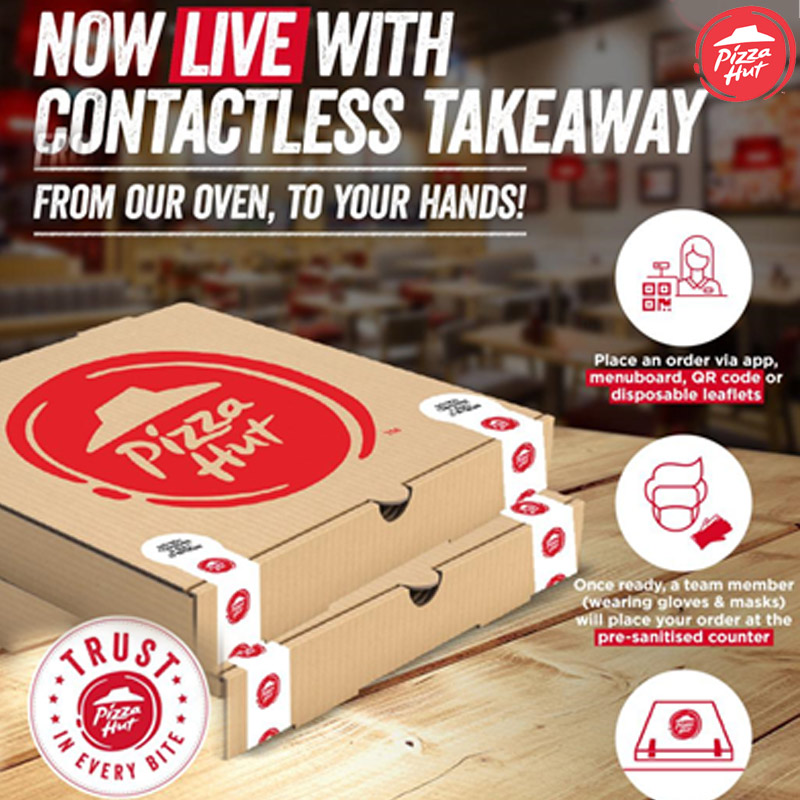
    MUMBAI: As social distancing becomes the new norm, Pizza Hut, India’s most trusted and loved pizza brand, will now offer contactless takeaway across all operational stores in India. The company will continue its oven-to-home contactless delivery facility as well, which has been functioning throughout the lockdown.

    With contactless takeaway, Pizza Hut is ensuring the maximum level of safety and hygiene for consumers who choose to pick-up their order from the store. Customers just need to simply place orders on the Pizza Hut app, m-site, website or via the menu board in stores. Food is then baked at over 240 degree Celsius for a minimum of six minutes to eliminate all viruses and bacteria and packed piping hot straight from the oven into disinfected boxes. The container is then sealed with tamper-proof stickers to ensure that only the consumer is able to touch the meal inside.  The staff thereafter places the order on a designated pre-sanitized table from where the customers can pick up their orders and exit. No direct contact is established at any point in this process, ensuring the safety of customers and employees.

    Pizza Hut India marketing director Neha said, “With the easing of lockdown norms, more people will be out and about for work and will need access to safe and hygienic food. Our Contactless Takeaway service ensures that customers can pick-up their order while on-the-go, in an easy and fast manner, without compromising on their safety. It is the need of the hour and we are happy to have responded quickly by starting this service in India.”

    Since the start of the pandemic, Pizza Hut has upgraded all its existing stringent safety and hygiene processes across India. The brand has implemented all regulatory protocols and guidelines issued from time to time by the government, WHO and FSSAI such as thermal screening of employees and visitors, mandatory use of face masks and gloves, washing hands every 30 minutes and disinfecting all kitchen surfaces, food packing boxes, delivery bags and bikes. The brand has been following a Contactless Delivery system, wherein the Pizza Hut delivery executive places the packed food on a clean surface, near the doorstep of the customer and waits at a distance of six feet to make sure that the customer has picked up the order.

  • Is television viewership petering out as India adjusts to lockdown?

    Is television viewership petering out as India adjusts to lockdown?

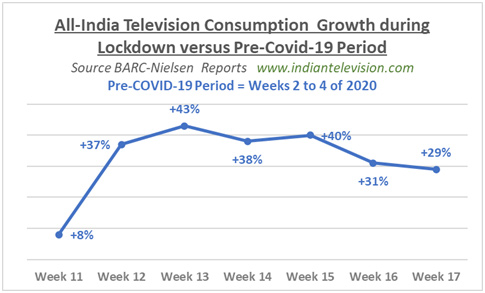
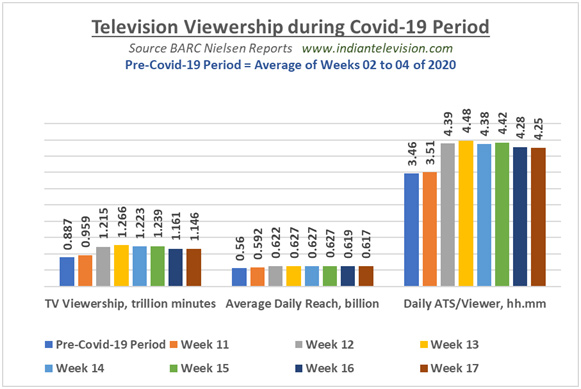
    BENGALURU: Television consumption in India seems to be petering out, according to Broadcast Audience Research Council of India (BARC)-Nielsen Reports. Of course, even in the sixth week and the second extension of the national lockdown to lockdown 3.0, television consumption is 29 per cent higher than during pre-Covid2019 periods. BARC and Nielsen have compared data for the pre-Covid2019 period with average numbers for Weeks 2 to 4 of 2020. Television consumption had peaked in Week 13 of 2020, the first full week since the lockdown commenced in the middle of Week 12 of 2020, on 25 March 2020 in India. Television consumption grew 43 per cent in Week 13 of 2020 as compared to the pre-Covid2019 period. BARC-Nielsen reports are available for the period starting Week 11 of 2020 until Week 17 at the time of writing of this paper.

    Please refer to the figure below for All-India television consumption trends.

    The basic currency for total television consumption is trillion minutes. Average television viewership during the pre-Covid2019 weeks considered in the BARC-Nielsen Reports (Average of Weeks 2 to 4 of 2020) was 887 billion minutes with an average daily reach of 560 million. This worked out to a daily average time spent (ATS) watching television of 3 hours 46 minutes. In Week 13 of 2020, this peaked to 1,266 billion minutes with a reach of 627 million and ATS of 4 hours and 48 minutes.  These numbers have been sliding down since then. Please refer to the figure below.

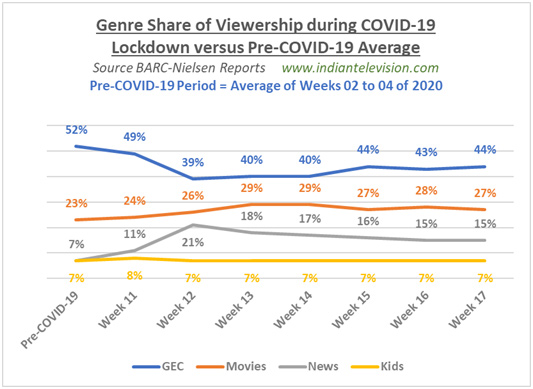
    In the pre-Covid2019 weeks, four genres had 89 per cent of viewership share – in terms of size, they are GEC, Movies, News and the Kids genres.  During the 7 weeks for which BARC-Nielsen Reports are available (Weeks 11 to 17 of 2020) at the time of writing this report, their combined share grew to 93 per cent. During the pre-Covid2019 weeks considered in the BARC-Nielsen Report (Weeks 2 to 4 of 2020) GEC had the largest viewership share of 52 per cent, followed by Movies with 23 per cent, the news and the kids’ genres with 7 per cent each. During Week 13 of 2020, this had changed to 40 per cent for GEC, 29 per cent for Movies, 18 per cent for news and 7 per cent for Kids. It must be noted that though share of the Kids channels was has generally been steady, overall television viewership has gone up during the lockdown period, and hence the number of viewers and ATS on the Kids was much higher than earlier times. It must further be noted that News had a share of 21 per cent in Week 13 of 2020.

    GECs, which had been experiencing a decline in viewership share during the Covid2019 lockdown due to the lack of fresh programming, got a breath of fresh air by way of re-runs of mythology and old classics on pubcaster network DD’s DD National and DD Bharati.  GECs’ viewership share has climbed to 44 per cent in weeks 16 and 17 from a low of 39 per cent in Week 12. The Movies genre seems to have stabilized at abut 27 per cent share as compared to the 23 per cent share during the pre-Covid2019 weeks considered in the BARC-Nielsen Reports.

    Please refer to the figure below:

    Overall, television consumption seems to be petering out slowly across the other major genres also.  Besides the four genres mentioned above, business news, youth, infotainment and lifestyle have witnessed changes in consumption growth. Relatively, the lifestyle genre seems to have had stabilized with about 32 per cent growth since week 13 of 2020 as compared to the average of the pre-Covid2019 weeks considered by BARC-Nielsen. The news genre, which had seen consumption triple in week 12, has stabilized consumption at around 165% growth in Weeks 16 and 17 of 2020 as compared to the average of the pre- Covid2019 weeks. Please refer to the figure below:

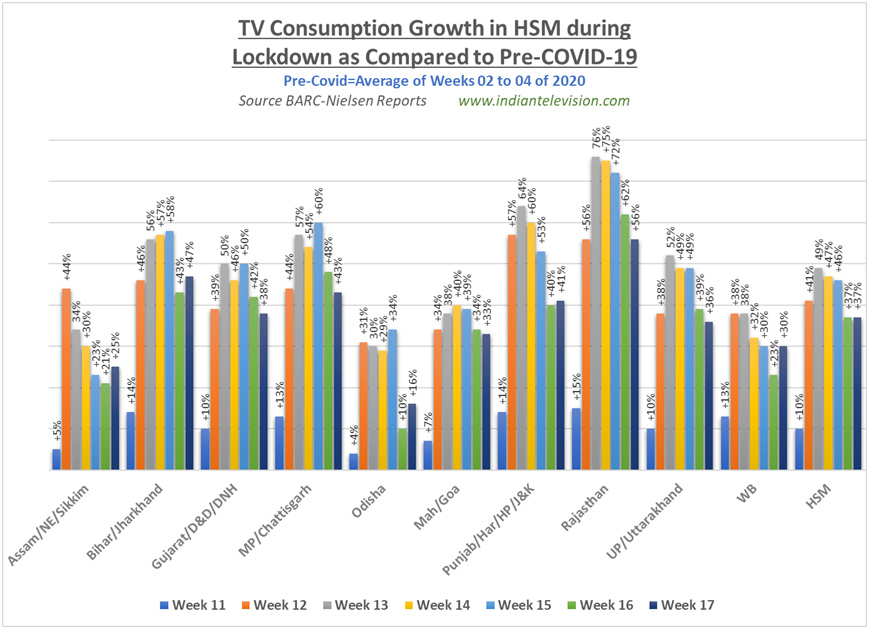
    BARC considers the Hindi Speaking Market or HSM as All India minus the four Southern Languages: Kannada, Malayalam, Tamil and Telugu. The South is a mature market with a higher penetration of television as compared to the HSM. Television consumption is also higher in the South. Hence, growth in the South market has been more muted as compared to the HSM during the lockdown weeks to date as compared to the average of the BARC-Nielsen Covid2019 weeks. The North Eastern states saw television consumption peak in week 12 itself – this was the week when the Janata Curfew and a couple of days later the first series of Lockdown or Lockdown 1.0 were announced by Indian Prime Minister Narendra Modi.  Most of the states saw viewership peak in Week 13. The exceptions were a few states where more of local ‘Covid2019’ and or/or events such as the lynching of the Sadhus in Maharashtra or the swearing in of ministers in Madhya Pradesh. There has been a general decline in television consumption since then, as mentioned before. Please refer to the figure below:

    Further, as mentioned above, South India has seen lower growth in viewership during the lockdown weeks because of its higher base and longer ATS spent even before the Covid2019 lockdown weeks. Hence the decline in television viewership since the peak has been lower in the South markets as compared to HSM. Please refer to the figure below:

    Is this the way forward?

    Television networks have tried to bring in viewership and maintain viewer stickiness. News by itself has grown as a genre because of the playout of events around the lockdown. Taking a cue from the movies genre, many networks have started beaming film-based content, but this has not been enough. The South GECs have witnessed growth on the back of comedy films over the last few days. Channels have brought back mythology and classics. Reruns of the Ramanand Sagar Ramayan and the B R Chopra Mahabharat, through daily episodes as opposed to the weekend episodes that were experienced when these magnum opuses were first aired, have brought in viewers and ensured their loyalty in the case of DD National and DD Bharati. Since mythology seems to have worked for DD, private networks have decided to include them in their programming mix. This seems to have worked to an extent in the case of Star Plus which launched of Ramayan in Week 17, and that slot for the channel has seen viewership grow by 65 per cent according to a preview of data by BARC for Week 18. Viacom18’s flagship Hindi GEC Colors has seen viewership growth of 24 per cent in Week 18 for the time slot when it commenced airing Mahabharat.

    It is still early days for a cure or vaccine for the pandemic to make things easier for humans, to bring back some form of normalcy. A lot more people will continue to stay at home. As the world and India slowly limp back in a phased manner to a ‘new normal’ from the Covid2019 lockdown, fresh content will surely be produced. However, given the circumstances globally, the ‘new normal’ has yet to take on a definite shape. If study, work, exercise, etc. from the home becomes the ‘new normal’, then ‘entertainment consumption at home’ is definitely set to be a big part of daily life. Content viewership from home, be it on the OTT platform, or the idiot box, or on the smart phone or a computing device, is definitely set to be much larger than during the pre-Covid2019 weeks. The question is“Will it be higher than during lockdown weeks?”

  • Facebook’s Asia-Pacific numbers lesser impacted than other regions in pandemic quarter

    Facebook’s Asia-Pacific numbers lesser impacted than other regions in pandemic quarter

    BENGALURU: As people across most of the globe retreated indoors under the lockdown announced by most of the countries to reduce the growth rate of Covid2019, world economies were badly hit. Officegoers had no other option but to use media to keep themselves occupied as the amount of work-to-do shrank. With the closure of education institutions, theaters and malls and hotels, etc., misplaced suspicion about the safety of newsprint, no new television/film content being produced, news and movies on television, OTT, internet, social media, became the new tools for entertainment and information, for networking and socialising distantly, education, occupying minds, etc.  

    Social media networking major Facebook or FB reported its numbers for the first quarter ended 31 March 2020 (Q1 2020, quarter or period under review). Facebook reported 15.87 per cent lower Q-o-Q numbers for the quarter under review as compared to the previous quarter (quarter ended 31 December 2019, Q4 2019), but 17.64 per cent higher Y-o-Y than the year ago quarter Q1 2019. FB has witnessed Q-o-Q revenue declines in the first quarter earlier – in Q1 2018, revenue declined 7.76 per cent as compared to Q4 2018 and in Q1 2019 it declined 10.86 per cent as compared to Q4 2018. Overall, Facebook numbers have shown an increasing trend, the Covid2019 quarter is just a slightly bigger than the normal bump in its path to growth.

    FB reports revenues from four major geographical regions in the world – the largest in terms of revenue being the US-Canada region, followed by Europe, Asia-Pacific (A-Pac) and the Rest of the World or RoW. The US-Canada region contributes about 48 per cent, the Europe region about 24 per cent, APAC region about 18 per cent and RoW about 10 per cent to FB’s revenues. Please refer to the figure below for FB revenue breakup.

    Advertisement is the major revenue stream for FB that contributes to more than 98 per cent to its overall revenues. The figure below shows contribution in terms of percentage of ad revenue to total ad revenue from these geographical regions. As is obvious, the APAC region is the only one that has shown growth in contribution to FB’s ad revenues during Q1 2020 – It contributed 17.56 per cent to FB’s ad revenues in the previous quarter and its contribution to ad revenue increased to 18.56 per cent  in Q1 2020. As a matter of fact, the APAC region has shown only two downward blips in its contribution to ad revenue during 9 quarters (the quarter under review and its preceding 8 quarters). These two blips happened in Q1 2020 and Q4 2018.

    Growth in contribution to revenue from the APAC region has generally been steadier than the other regions. When FB’s revenues have declined Q-o-Q, the decline in revenues from the APACregion has been lower than the other regions during these nine quarters. The APACregion’s total revenue declined 11.13 per cent Q-o-Q in Q1 2020 as compared to declines of 16.45 percent, 17.54 per cent and 17.21 per cent from US-Canada, Europe and RoW regions respectively. Y-o-Y, revenues grew 17.16 percent, 16.55 percent, 21.44 per cent and 15.80 per cent in Q1 2020 from FB’s US-Canada, Europe, APAC and RoW regions, respectively.

    Facebook’s Daily Active Users or DAU grew 4.65 per cent in Q1 2020 to 1.734 billion as compared to 1.657 billion in Q4 2019. The APAC region has a major chunk of humanity, consequently, the company’s largest DAU are from the APACregion, and the number of these APACusers in Q1 2020 has grown 5.77 per cent Q-o-Q. Comparatively, the US-Canada, Europe and RoW regions have seen DAU growth in the quarter under review versus the immediate trailing quarter of 2.63 percent, 3.74 per cent and 4.51 per cent respectively. Please refer to the figure below:

    The US-Canada region has the least DAU  among the four FB regions, however, this region has FB’s highest ARPU or average revenue per person, as well as the highest Family Average Revenue Per Peson or ARPP. Facebook defines a monthly active person (MAP) as a registered and logged-in user of Facebook, Instagram, Messenger, and/or WhatsApp (collectively, FB’s "Family" of products) who visited at least one of
    these Family products through a mobile device application or using a web or mobile browser in the last 30 days as of the date of measurement. 

    With drop in revenue, Facebook’s ARPU in Q1 2020 dropped 12.89 per cent Q-o-Q world wide. Q-o-Q FB’s APAC region ARPU declined 6.08 percent. ARPU drops of 13.6 per cent by US-Canada, 13.02 per cent by Europe and 10.43 per cent by RoW also happened in the quarter under review. Please refer to the figure below:

    Excerpts on what the company has to say

    "Our work has always been about helping you stay connected with the people you care about," said FB founder and CEO Mark Zuckerberg, "With people relying on our services more than ever, we're focused on keeping people safe, informed and connected."

    Impact of Covid2019 on Outlook

    On Revenue: Our business has been impacted by the Covid2019 pandemic and, like all companies, we are facing a period of unprecedented uncertainty in our business outlook. We expect our business performance will be impacted by issues beyond our control, including the duration and efficacy of shelter-in-place orders, the effectiveness of economic stimuli around the world, and the fluctuations of currencies relative to the U.S. dollar.

    After the initial steep decrease in advertising revenue in March, we have seen signs of stability reflected in the first three weeks of April, where advertising revenue has been approximately flat compared to the same period a year ago, down from the 17 per cent year-over-year growth in the first quarter of 2020. The April trends reflect weakness across all of our user geographies as most of our major countries have had some sort of shelter-in-place guidelines in effect.

    On Expenses:We expect to realize operational expense savings in certain areas such as travel, events, and marketing as well as from slower headcount growth in our business functions. However, we plan to continue to invest in product development and to recruit technical talent. In addition, we have committed over $300 million to date in investments to help our broader community during the crisis, which will have an impact on our financial performance this year. As a result, we expect total expenses in 2020 to be between $52-56 billion, down from the prior range of $54-59 billion. While this reflects a moderate reduction in the planned growth rate of total expenses, our overall expense growth in the face of expected revenue weakness will have a negative impact on 2020 operating margins.

    On Capex: Our significant investments in infrastructure over the past four years have served us well during this period of high user engagement. We plan to continue to grow our capex investments to enhance and expand our global infrastructure footprint over the long term. In 2020, we expect capital expenditures to be approximately $14-16 billion, down from the prior range of $17-19 billion. This reduction reflects a significant decrease in our construction efforts globally related to shelter-in-place orders. Given the strong engagement growth and related demands on our infrastructure, this year's capex reduction should be viewed as a deferral into 2021 rather than savings.