Tag: Pan Nalin

  • People want choices, and it is happening with the arrival of OTT streaming services, says filmmaker Pan Nalin

    People want choices, and it is happening with the arrival of OTT streaming services, says filmmaker Pan Nalin

    Mumbai: An invitation to join the Academy of Motion Picture Arts and Sciences has been offered to rising talent and Gujarati-born filmmaker Pan Nalin. Nalin becomes the first Gujarati to join the Oscar organiser’s membership ranks in 2022. Other invitees include the actors Kajol and Suriya, as well as the filmmaker Reema Kagti, Rintu Thomas, and Sushmit Ghosh.

    Nalin’s most recent release, “Last Film Show,” which is partly based on his own childhood, had its global premiere at the Tribeca Film Festival and is distributed by Samuel Goldwyn Films. Since then, the movie has picked up dozens of awards, including Best Picture, Best Director, Best Actor, and multiple Audience Choice Awards.

    Prior to “Last Film Show,” Nalin is best known for directing award-winning movies like  “Samsara,” “Valley of Flowers” and “Angry Indian Goddesses.” His debut feature “Samsara” (Miramax) won worldwide critical and commercial acclaim and went on to win awards like Best First Feature Film at Durban International Film Festival and Grand Jury Prize – Special Mention at AFI Fest.

    His journey, from his remote village of Adtala, Gujarat, India where he helped his father sell tea on a railway platform on Khijadiya Junction Railway Station, to worldwide recognition as a filmmaker has not always been easy and one filled with its own twists and turns.

    In a fascinating interview with Indiantelevsion.com, Nalin shared his views on topics ranging from his early fascination with films to the future of entertainment and the Oscar buzz surrounding his latest work, “Last Film Show.”

    Edited Excerpt:

    On becoming the first Gujarati member of the Academy of Motion Picture Arts and Sciences.

    As a filmmaker, I chose a very difficult path in the kind of cinema I was doing, and I didn’t realise that such high-profile directors were watching my work and decided to invite me. So, I kind of feel this is finally some kind of recognition for two decades of work and that I must be doing something right. My manager told me I am invited to join in the director’s category and that is very prestigious. As a filmmaker, you always want to keep your craft updated and at its best and this will give me the opportunity to interact more with members and participate in Academy events, seminars and retreats and I feel very honoured and privileged by this.

    On his most recent film, “Last Film Show.” What drew him to filmmaking?

    I grew up in a very remote village in Gujarat and I don’t remember seeing any movie until I was around eight and a half years old. At that time, I remember, the preparation to go see a movie in a theatre started three days ahead of time. You know, you get new clothes and the barber would come and my mother and sister would go brag to the neighbour about it. We would start out very early and take a train to a town called Lathi, which had an actual movie theatre. My mother would prepare food ahead of time that we would eat, some on the train and some during the intermission. Oftentimes, we would come out of the theatre and have to wait for the train and would arrive back at our village very late in the night. That was my early movie-going experience. It was on these first trips, I saw the movie, “Jai Mata Kali” and was totally blown away…mesmerised. Since that day, I wanted to be a filmmaker and never really wanted to do anything else.

    On his distribution deals throughout the world for “Last Film Show” but not yet in India.

    We are still in talks for distribution in India. The main issue in India is that the distributors and movie theatre owners decide what people are going to like and what not and in some cases I feel they are very wrong. People want to be given a choice and they saw that now with the arrival of streaming. Indian people are now watching South Korean shows, Mexican novellas, South Indian movies are big now, they are watching everything. Theatre owners still prefer movies with big name stars with big songs. Independent filmmakers don’t have the marketing budget to go up against this. So, distribution can be a big problem. However, things are changing now, they’ve gotten shaken up. People in India are showing that they are ready to embrace change and that they want choices now.

    On the Oscar buzz for “Last Film Show.”

    There are people in Hollywood who are very interested but of course it’s up to the Indian government to submit this film. The US distributor, Samuel Goldwyn Films, has written a letter to concerned persons in India spelling out why they believe this film is a serious Oscar contender. Distributors, like Samuel Goldwyn, know how to market films. In 2020, they acquired a Danish film, “Another Round,” and it went on to win the Oscar for Best International Feature. In India, the committee that decides on the Oscar entry is not really allowed to talk with distributors so their reasoning is not factored in. This is unfortunate because these distributors, oftentimes, know what the Academy may like because they know the members and what they would be more likely to vote for.

    On “Angry Indian Goddesses,” his most popular film in India till date and the challenges occurred during the making of this movie.

    I believe it came at the right time where no one was making movies with women as heroes in India. You know, the popular Bollywood cinema is always about two or three guys that go off somewhere and have a great time. Urban women, in particular, were asking why can’t three girls go off to somewhere like Spain or Switzerland and bond? The main reason was it was thought women can’t carry the box office.

    After a time, two of my female assistant directors, along with myself, started doing some research. We observed that there were many films about women in villages with problems and being repressed but realised we also need to talk about urban women. There are about 200 million women who live in urban areas. So, we started talking to these women: the CEO, the pilot, the struggling actresses in Bollywood, the dancers, etc. We did a lot of interviews and started getting very excited. These were stories of comradery, of sexual harassment and even rape. Many opened up with heart wrenching stories. We found that the common thread among many of these stories was anger. Anger about women not succeeding in society. Anger about the Nirbhaya rape case, which had recently happened.

    So, we decided to move forward and make a movie. We found a private investor in India and also investors in Germany who believed in the story. We decided to make a film about women and what they had to say. I made sure the crew was made up of women. We developed characters but it was, more or less, a script-free film where the actresses shared their stories in an organic way. It was a beautiful experience in many ways. The film received critical and commercial success in global markets and was also acclaimed in India although it was censored and many cast and crew members, at the time, received death threats. The movie particularly resonated with urban women and the word of mouth helped push it forward.

    On his views on OTT platforms vs a theatrical release. Where do you see the future of entertainment going?

    Creatively as a storyteller I like to embrace whatever changes are coming and so I do see value in accessibility in terms of OTT platforms. The market for theatrical distribution has been tougher because of the pandemic for independent filmmakers in the US with the bigger films creating a kind of monopoly. Movie theatres are being taken over by big corporate chains that factor into how much popcorn and Coca-Cola they sell, so smaller films are being shut out. At the same time, the problem with OTT platforms is they are becoming so abundant with Netflix, Hulu, HBO Max, etc…it’s endless. You end up getting multiple subscriptions in order to watch all the shows you want and how many subscriptions are you going to have?

    I can’t say what the future will be but, as a filmmaker, ideally and from a profitability standpoint, it’s great to have, what I call, the “3S’s.” Which is a star, a studio and then a streaming platform.

    However, I do feel the future will bring a hybrid of OTT and theatrical and also a new frontier where different forms of entertainment are blurring. Even before the pandemic, video games have taken over and have become huge and we see here the merger of cinema happening. Entertainment may no longer be passive but an immersive and interactive experience. Instead of being a spectator, we will become a participant.

    On one piece of advice for young filmmakers in India.

    First thing I believe they should do is to be honest with themselves as to the kind of storytelling that inspires them. It’s easy to get lost. Oftentimes, I find young filmmakers go to school and get  lost in formulas. They need sometimes to go back to their roots as to who they are. The more original they are and honest they are, I think the better the film will be, because then at least, they will be offering something new.

    On Pan Nalin’s future projects.

    I’m in post-production with a movie called, “The Disappearance of Eva Hansen,” a spiritual thriller set in the Himalayas, it’s the first New Zealand – India co-production. I’m also in the development phase for a trilogy called “Santori Trilogy.”  Three films that are a high-voltage, action-packed adventure about an Asian superhero. Also, I’ve just started talks to shoot a Bollywood type feature in India. There may be a big name star attached but too soon to share much about that now.

  • ‘Angry Indian Goddesses’: It’s different

    ‘Angry Indian Goddesses’: It’s different

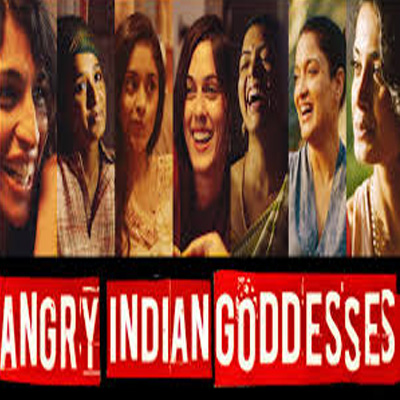
    MUMBAI: Thanks to the world of media and entertainment opening up, filmmaking has been continuously expanding its dimensions. A lot of filmmakers are breaking the genre barriers and daring to project stories that would have been unimaginable until not so long ago. The era of abla Indian naari is long gone, at least, as far as the film stories go. As the title asserts, Angry Indian Goddesses is about a bunch of women who don’t conform to the stereotype. 

    Sarah-Jane Dias, Anushka Manchanda, Sandhya Mridul, Pavleen Gujral and Amrit Maghera are career women (except Pavleen). Sarah, a professional photographer, is asked to compromise: make a dark model look fair for a fairness cream. She is supposed to just shoot her pictures and the rest will be done on Photoshop, she is assured. But, she would not compromise on her skill and walks off.

    Similarly, Sandhya, a tycoon, has a problem on hand as her mining fields are controversial and have been shut down due to a protest led by Tannishtha Chatterjee. Amrit is an aspiring actor but walks out of a film shoot when she is padded up all over to just look sexy and vulnerable instead of acting her part. 

    Pavleen is a merit list graduate but is married off early into a traditional family where the only expectation from her is to deliver a child, sort of, without her husband’s participation. These all are Sarah’s dear friends. 

    Sarah, having walked out of her photo-shoot assignment, heads straight to Goa to her ancestral home. She plans to marry and decides to invite her friends. So, Sarah, Sandhya, Anushka, Pavleen and Amrit gather under one roof in a Goa village. Also around is Sarah’s childhood companion cum maid, Rajshri Deshpande, a gutsy, street smart woman. 

    As one sits through the film, nothing is happening except that this bunch has what is their idea of fun. Generally, this involves pulling each other’s leg, drinking, dancing and finally opening up with their respective problems. As they open up, you feel like an eavesdropper on an all girls’ party! None of them are really happy as the others perceived. One thinks the women have been told by the director to just go along and do as they liked; their idea of a get-together of a bunch of friends.

    If there is a purpose to the film, the indications come only post interval as Sandhya, the tycoon’s b?te noire, Tannishtha, walks in as another guest. 

    The women, all troubled by their circumstances, having time of their life and none feels like going back. On one of their outings, they confront some bike-riding bullies. The guys run away but that is not going to be the end of it. Because, the makers also plan to stress on rape and the attitude of the law and views on a woman’s dressing.

    Finally, Sarah is forced to reveal who she is going to wed and that is another aspect rarely ventured on Hindi screen. It is the last half an hour or so that turns the film around and gives it a purpose. The climax is interesting.

    Pan Nalin has penned and directed this film and he has handled it well considering this is a dicey theme with little substance in the footage for most part. The film has a very situational musical score. The Konkani song, rendered by Anushka, a musician herself, is a delight. The location being Goa, it is a pleasure to watch and aids the cinematography look pleasant to eyes. 

    Angry Indian Goddesses is an interesting watch if you are a discerning film lover with patience. Eventually, it makes up for your patience and money spent. 

    Producers: Pan Nalin, Gaurav Dhingra

    Director: Pan Nalin

    Cast: Sarah-Jane Dias, Tannishtha Chatterjee, Anushka Manchanda, Sandhya Mridul, Amrit 

    Maghera, Rajshri Deshpande, Pavleen Gujra, Arjun Mathur, Adil Hussain.

    ‘Hate Story 3’: Rides on brand equity

    The Hate Story franchise has been a moderate success twice before, albeit, in a limited range. Not blockbusters but profitmaking all the same. And so the story continues. You have a title and you have the basic theme of skin show. Rest would be easy.

    However, while rules at the censor board are still the same, the implementation has changed. So, liberties can’t be taken. ForHate Story 3, the germ is borrowed from the Hollywood movie, Indecent Proposal (1993).

    Sharman Joshi is a successful entrepreneur with an ever growing business empire. He has a loving wife by his side in Zarine Khan. But, there is a sinister man around who has a glad eye for Zarine. That is Karan Singh Grover. He invites Sharman and Zarine for a business launch. He offers to help Sharman to grow his empire even further because, he says, he likes self-made men! However, for his help Sharman would have to send Zarine to Karan to spend a night with him. Now, why should Karan even imagine Sharman, a self-made man rich man would want to do that? You may borrow an idea from a foreign film but how about logic?

    Rejected, Karan becomes vengeful and plans to destroy Sharman and his business. He starts with contaminating the soft drinks in Sharman’s factory. Sharman is wary. He deputes his secretary, Daisy Shah, to lure Karan and find out what he is up to. But, it is not all that easy as Daisy is killed and her body is found in the bushes.

    Hate Story 3 has a weak base and far short of content compared to the earlier two versions. The direction is okay but not good enough to stretch the limited content to over two hours. The songs, usually the strength of a T-Series home production, have limited appeal. Two song, Tumhe apna bana…and Wajah… sound pleasant. Editing needed to be slicker. 

    Performance wise, Sharman looks a bit ill at ease. Karan is okay. Zarine is good. Daisy is passable. 

    Hate Story 3 has taken a good opening thanks to its brand equity. Made within a controlled budget, it has a two week open window without opposition and will make the most of it. 

    Producer: Bhushan Kumar, Vikram Bhatt Director: Vishal Pandya

    Cast: Sharman Joshi, Zarine Khan, Daisy Shah, Karan Singh Grover

  • Pan Nalin’s ‘Angry Indian Goddesses’ at Rome Film Festival

    Pan Nalin’s ‘Angry Indian Goddesses’ at Rome Film Festival

    MUMBAI: The cast and crew of Indian director Pan Nalin’s film Angry Indian Goddesses is on a roll. After winning many a hearts across the globe, the movie is now officially the only Indian movie selected at the Rome Film Festival, which will be held from 16 to 23 October.


    Overall, 37 films from 24 countries are playing in the Rome Film Festival this year, out of which Angry Indian Goddesses will be the only Indian movie. Last year Vishal Bhardwaj’s Haider had bagged the People’s Choice Award in the world category at the Rome Film Festival.


    A story of seven girls at a wild bachelorette party made with Goa as its backdrop, the film was honoured the Grolsch People’s Choice Award at the Toronto Film Festival and was screened at the 35th Atlantic Film Festival in Halifax. It will be screened at the 11th edition of the Zurich Film Festival (ZFF). 


    The movie stars Sarah-Jane Dias in the lead.

  • Pan Nalin’s Kumbh Mela film finds buyers in Europe

    Pan Nalin’s Kumbh Mela film finds buyers in Europe

    Eminent Indian-origin filmmaker Pan Nalin’s documentary Faith Connections has been sold to France and Switzerland ahead of its world premiere at the Toronto International Film Festival.


    SDD (Sophie Dulac Distribution) has acquired French rights to the India-French co-production, filmed at India’s Kumbh Mela, while the Swiss rights went to Filmcoopi. Advanced negotiations are also underway for sales to Canada, the US, Germany and India.


    The film is being sold by Raphael Berdugo’s Cite Films, which is also co-produced with Nalin and Gaurav Dhingra’s Jungle Book Entertainment. Berdugo, Dhingra, Nalin and Virginie Lacombe are credited as producers.


    Faith Connections follows the stories of holy men, policemen, pilgrims and a runaway child at India’s biggest religious festival, which is held once every 12 years and attracts around 100 million Hindu pilgrims.


    Nalin has previously directed feature documentary Ayurveda: Art of Being and narrative features Samsara and The Valley of Flowers.


    “We decided to co-produce and take on the sales of this film because we trust the talent of director Pan Nalin to tell us deeply moving human stories which can appeal to the world,” said Berdugo.


    “My experience of international sales when I was in charge of Roissy Films was that the common language of the world is emotion and people are eager to be moved while discovering other cultures.”


    “Ayurveda: Art of Being and Samsara were huge successes in Switzerland – both were based on the vast interest of our audience in spirituality and a quest of wellbeing of humanity. Pan Nalin’s new film follows these themes and we are sure that it will be successful too,” said Filmcoopi’s Felix Hachler.


    “A garland of magnificent images captured by Pan Nalin; truly exceptional characters with simple but astonishing stories; and an incredible happening which only occurs once in twelve years encouraged us to bring this extraordinary documentary to the French public,” said Dulac.