Tag: P. Sainath

  • Fourth Indian Screenwriters Conference to focus on stories that reflect ‘India’s Reality’

    Fourth Indian Screenwriters Conference to focus on stories that reflect ‘India’s Reality’

    MUMBAI: The television and film writers are pulling their socks for the fourth edition of Indian Screenwriters Conference. The Film Writers Association, Mumbai are set for the conference on 3 and 4 August 2016 at St. Andrew’s Auditorium, Bandra West – Mumbai.

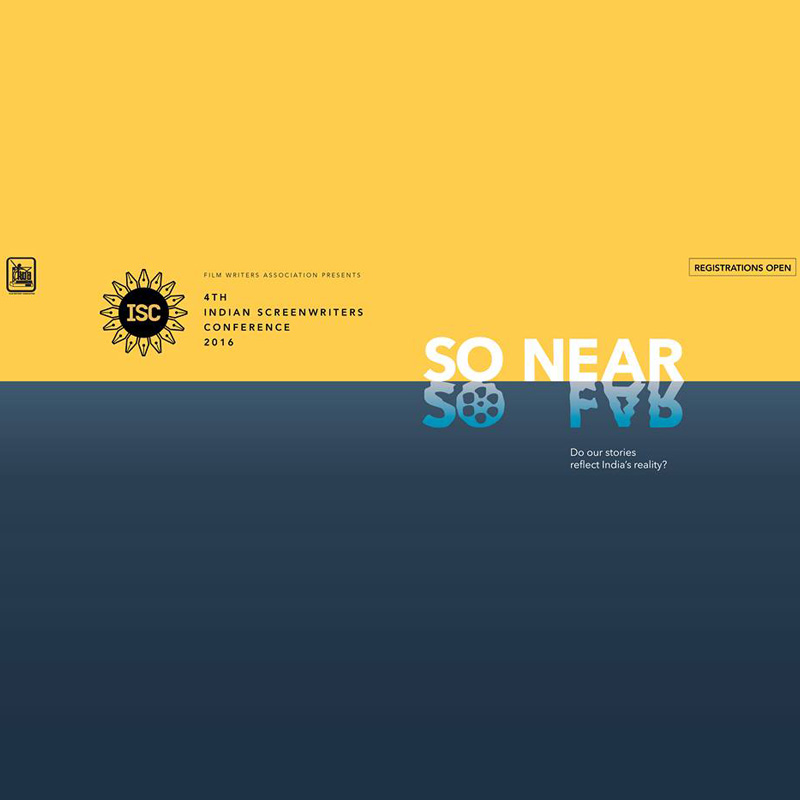
    During 4ISC, the prominent names from the writer fraternity, along with writer-directors, producers, TV channel representatives and film lovers, would network and indulge in stimulating discussions revolving around various issues concerning screenwriting and screenwriters in India. The theme in the fourth edition is So Near So Far: Do our stories reflect India’s Reality? The issues relevant to writing profession will also be addressed in the conference.

    The first conference, held at FTII, Pune, in August 2006, was attended by 275 writers.The second, at the Indira Gandhi Institute of Development Research, Mumbai, in December 2008; saw 575 screenwriters and writer-directors attending it. Third ISC at St. Andrew’s Auditorium, Bandra, in February 2013, had the participation of 700 screenwriters. The event has been garnering popularity over the years. The association is claiming the fourth edition to grow bigger.

    The sessions will tackle the theme from different angles. The sessions included are- Little Big Films: Small films, driven by strong scripts and the passion of the filmmakers, are increasingly ending up as surprise successes. What is the scope and future of such efforts?

    Serial Killers: Does our current TV content reflect our times and society? Why are we stuck in some unchangeable grooves? What is the way out?

    Writers & Producers: Partners or Adversaries?: Writers feel they are undervalued while producers complain of lack of quality scripts. How can this relationship be made more collaborative, more mutual, and more productive for both?
    The Feminine Factor: Are female actors getting better roles now? Is our audience comfortable only with stereotypical women characters? Are we ready to have a more realistic gender equation on screen?

    The Digital Explosion: Is the Internet the answer to our creative and economic issues?
    The Business of TV Writing: The leverage of the TV writer is growing; it appears, with him/her turning into a producer. Is this the model for all TV writers to move towards?

    Well known poet Ashok Vajpeyi will be the chief guest of the conference, while journalist P. Sainath will deliver the keynote. Other expected penalists are- Javed Akhtar, Gulzar, Siddharth Roy-Kapur (Disney), Ronnie Screwvala (UTV), Gaurav Banerjee (Star), Ritesh Sidhwani (Excel), Anooj Kapoor (SAB), Danish Khan (Sony), Ravina Kohli (Epic), Vishal Bhardwaj, Jaideep Sahni, Sriram Raghavan, Rajat Kapoor, Hansal Mehta, Juhi Chaturvedi, Jayesh Patil, Aatish Kapadia, Purnendu Shekhar, Shridhar Raghavan, Nagraj Manjule, Neeraj Ghaywan, Sonali Jaffer, Shashi Mittal, Varun Grover, Himanshu Sharma, Sudip Sharma, Saurabh Tiwari, Biswapati Sarkar (TVF).

  • Fourth Indian Screenwriters Conference to focus on stories that reflect ‘India’s Reality’

    Fourth Indian Screenwriters Conference to focus on stories that reflect ‘India’s Reality’

    MUMBAI: The television and film writers are pulling their socks for the fourth edition of Indian Screenwriters Conference. The Film Writers Association, Mumbai are set for the conference on 3 and 4 August 2016 at St. Andrew’s Auditorium, Bandra West – Mumbai.

    During 4ISC, the prominent names from the writer fraternity, along with writer-directors, producers, TV channel representatives and film lovers, would network and indulge in stimulating discussions revolving around various issues concerning screenwriting and screenwriters in India. The theme in the fourth edition is So Near So Far: Do our stories reflect India’s Reality? The issues relevant to writing profession will also be addressed in the conference.

    The first conference, held at FTII, Pune, in August 2006, was attended by 275 writers.The second, at the Indira Gandhi Institute of Development Research, Mumbai, in December 2008; saw 575 screenwriters and writer-directors attending it. Third ISC at St. Andrew’s Auditorium, Bandra, in February 2013, had the participation of 700 screenwriters. The event has been garnering popularity over the years. The association is claiming the fourth edition to grow bigger.

    The sessions will tackle the theme from different angles. The sessions included are- Little Big Films: Small films, driven by strong scripts and the passion of the filmmakers, are increasingly ending up as surprise successes. What is the scope and future of such efforts?

    Serial Killers: Does our current TV content reflect our times and society? Why are we stuck in some unchangeable grooves? What is the way out?

    Writers & Producers: Partners or Adversaries?: Writers feel they are undervalued while producers complain of lack of quality scripts. How can this relationship be made more collaborative, more mutual, and more productive for both?
    The Feminine Factor: Are female actors getting better roles now? Is our audience comfortable only with stereotypical women characters? Are we ready to have a more realistic gender equation on screen?

    The Digital Explosion: Is the Internet the answer to our creative and economic issues?
    The Business of TV Writing: The leverage of the TV writer is growing; it appears, with him/her turning into a producer. Is this the model for all TV writers to move towards?

    Well known poet Ashok Vajpeyi will be the chief guest of the conference, while journalist P. Sainath will deliver the keynote. Other expected penalists are- Javed Akhtar, Gulzar, Siddharth Roy-Kapur (Disney), Ronnie Screwvala (UTV), Gaurav Banerjee (Star), Ritesh Sidhwani (Excel), Anooj Kapoor (SAB), Danish Khan (Sony), Ravina Kohli (Epic), Vishal Bhardwaj, Jaideep Sahni, Sriram Raghavan, Rajat Kapoor, Hansal Mehta, Juhi Chaturvedi, Jayesh Patil, Aatish Kapadia, Purnendu Shekhar, Shridhar Raghavan, Nagraj Manjule, Neeraj Ghaywan, Sonali Jaffer, Shashi Mittal, Varun Grover, Himanshu Sharma, Sudip Sharma, Saurabh Tiwari, Biswapati Sarkar (TVF).

  • Side effects of high decibel quotient on news channels

    Side effects of high decibel quotient on news channels

    MUMBAI: Surprisingly the largest read English newspaper in the world hails from India. More surprisingly, India, which is often perceived as a country suffering from poverty with low literacy rate has a whopping 99,660 publications registered with the Registrar of Newspaper in India (RNI). The story of pride and honor doesn’t end there; the country has in excess of 90 24×7 news channels operating in more than 10 languages. Such is India’s journalistic story.


    Take a walk down memory lane and you’ll see that Indian media received global recognition on many occasions. Young aspirants were inspired by the words of P Sainath, Shekhar Gupta and Aroun Shourie. While Indian Express’ blank editorial page to protest emergency enthralled journalism of courage in young minds, R Jagannathan business analysis informed readers about numbers in the most exquisite manner. Indians were not only reading but were also watching headlines in World This Week with Dr Prannoy Roy in the broadcast medium.


    While the past makes us nostalgic, the ecstasy in present poses a threat to the future. Senior journalists are taking on each other on public forums. More than news, anchors are speaking about ratings, whereas hashtags like #presstitutes, #whoownsNDTV #traitortimesnow are trending on social media. Competition has transformed to jingoism and campaigns are launched to take on each other. While one is calling the other’s show hysteria, the other is claiming to be the best in the business. Not only that jingoism is going to such an extent that reputed journalists are tagging and bantering with each other on Twitter.


    And all this to garner high ratings, which in turn will bring 12 money-making minutes per hour to the channel! But what about the millions who are following these veteran journalists on social media platforms? Why has minting money become the foremost target of news channels? And more importantly, how will it stop?


    Almost every news channel now has a campaign, which indirectly depicts loopholes in the ratings of Times Now’s prime time show News Hour hosted by the effervescent Arnab Goswami. What’s more, Times Now has now launched a campaign hitting out at the other four English news channels namely India Today Television, NDTV 24×7, CNN-IBN and NewsX.


    Not long back Goswami directly targeted Rajdeep Sardesai after Sunanda Pushkar’s coverage on erstwhile Headlines Today (now India Today Television). Goswami went to such an extent that Sardesai went on to offer an indirect apology when he wrote, “Yes, we are driven by a TRP culture and see a murder case involving the rich and famous as ideal fodder. Yes, this case must be thoroughly investigated. But are we conducting a media trial based on sensationalizing facts?”


    Sardesai’s blog further added, “Last night, I carried a video of the dead body with marks on it. We saw it as evidentiary value and, therefore, relevant to the case. On hindsight, in showing close ups of the body, we erred: could we not have just blurred the body pictures? I plead guilty. Sunanda deserves justice. She also deserves dignity, in death as in life.”


    Goswami also publicly opposed NDTV’s decision to premiere India’s Daughter – a documentary directed and produced by Leslee Udwin on the Delhi rape case. The Government of India intervened and a decision was passed to forbid the premiere. It must be noted that Times Now also aired a controversial documentary on Purulia Arms Drop featuring interviews of accused Kim Davy and Peter Bleach. The documentary exposed many holes in the Indian judicial system and Times Now’s investigative journalism witnessed mass acknowledgement. So when Times Now airs a controversial documentary, it’s investigative journalism and if NDTV does so it’s an insult? Nirbhaya’s parents had no problem with the documentary, so what was the real issue? Was insecurity of others getting higher viewership the problem? What happened to freedom of expression?


    A senior media planning executive is of the opinion that at the end of the day, ratings is what planners look at and that’s the reason why all this is happening. The more the eyeballs… the more the brand interest. “Negative publicity does not result in brands rejection until and unless viewers reject the show and stop watching it,” the planner adds.


    The most recent development in this entire scenario is Times Now’s new campaign hitting on the other four channels, which earlier took the campaign route to criticize News Hour.


    Speaking to Indiantelevision.com, journalism professor of Calcutta University Tapati Basu says, “There are a huge number of young minds who want to be journalists. A majority of them look at Arnab, Barkha and Rajdeep for inspiration. Them bantering with each other for whatever reason impacts those igniting minds. They should set an example, a path, which young ones will follow and grow. And not only students, this public bantering affects the mass too. As of now there is no downward trend in enrollment.”


    Former Symbiosis media dean and current Amity University dean Ujjwal K Chowdhury opines, “The campaign of picking on each other is not healthy. The attempt of any news-initiative campaign should be on the strengths of the initiative and not on others’ weaknesses. And when you resort to such a campaign, you are actually giving importance to your rivals perhaps more than they deserve. Or, at least more than what YOU think they deserve. Having said this, sensationalism and commodification of news have been on the rise, more so in television and the thought that only talking loud, creating quarrels on screen, taking moral high positions, and playing to the emotions, almost playing to the gallery are sure shots of success. So, there is bound to be a backlash.”


    On the issue of negative impact on students, Chowdhury feels, “There will not be any perceived impact of this campaign on media education in general, or journalism in particular. However, the buzz is out that newer ways to tackle Times Now type of journalism are needed. The exclusive interview of Lalit Modi by India Today Television is one such way. Original, incisive and investigative journalism will be respected and become more popular ahead.”


    Sardesai is the largest followed Indian journalist on Twitter with 2.42 millions. Barkha Dutt, whose footage from the warfront still gives goose bumps to many, holds the second position with 2.34 million followers. On the other hand, Goswami has so far failed to take the Twitter bait and is unlikely to hop on to the social networking site anytime soon. However, Times Now, which is almost synonymous with Goswami, has 2.48 million followers. No matter the permutation combination, at least 20 per cent of those followers will be aspiring journalists, who look up to the stalwarts for inspiration. These veteran journalists also have a moral responsibility towards the younger lot. In the end, it’s not just about the 12 money-making minutes per hour.


    Three Parting Thoughts:


    “The true function of journalism is to educate the public mind, not to stock it with wanted and unwanted impressions.” MK Gandhi