Tag: ownership

  • TV ownership increased by 14% in 2017: IRS

    TV ownership increased by 14% in 2017: IRS

    MUMBAI: After a gap of four years, the Indian Readership Survey (IRS), which documents the growth of the media industry, has been released for 2017. The survey methodology was criticised in 2014 and, therefore, was halted for an upgrade. This time, the sample size has been increased by 34 per cent to 3.2 lakh households. The entire process was audited by E&Y.

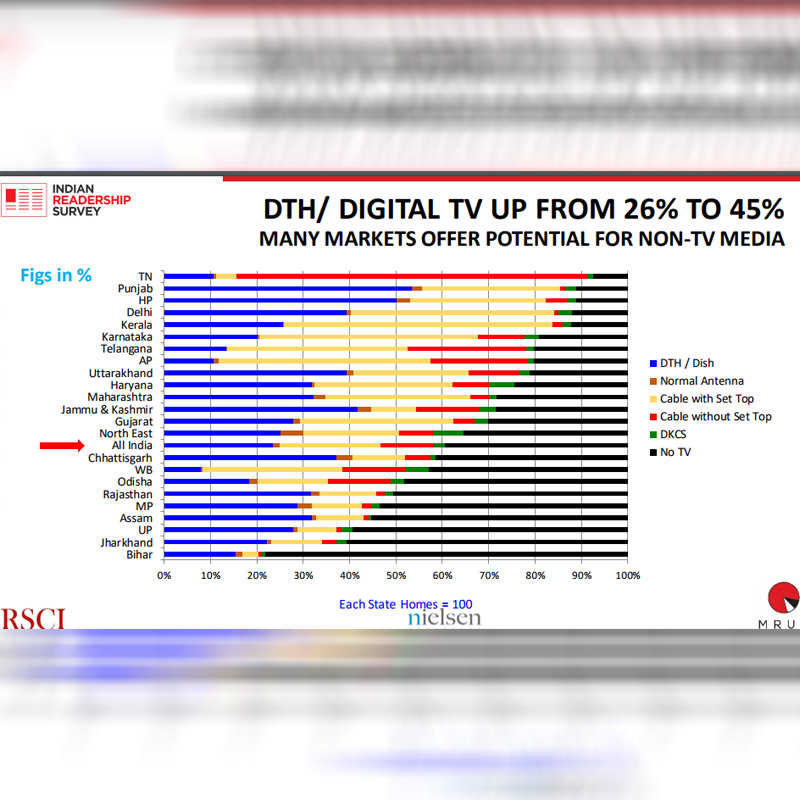
    The study found that there has been an overall 14 per cent increase in TV ownership in Indian households. TV ownership, according to the 2011 census, stood at 47 per cent but the IRS study found it to be 61 per cent in 2017. Tamil Nadu had the highest TV penetration with 93 per cent followed by Kerala at 90 per cent. Punjab and the National Capital Region of Delhi tied at third position with 88 per cent. The census numbers for these states were 87 per cent, 77 per cent, 83 per cent and 88 per cent, respectively. The lowest reach, as per the IRS, was of Bihar with 22 per cent and 15 per cent as per census.  TV ownership was lowest in Tamil Nadu with less than 10 per cent. The number of no TV homes was highest in Bihar with more than 75 per cent.

    The percentage reach for TV in the last one month in the age group of 12 + (L1M) was 75 per cent, 10 per cent higher than IRS’ 2014 study. In this, urban reach was 88 per cent, 3 per cent higher than 2014 and rural reach was 68 per cent, 14 per cent higher.

    The DTH or digital TV market was up from 26 per cent to 45 per cent. Punjab leads with close to 55 per cent homes with DTH followed by Himachal Pradesh with 50 per cent.

    Colour TV ownership stood at 61 per cent in 2017 up from 55 per cent in 2014.

    Also Read:

    BARC sets a deadline for IRS

    BARC gets IRS data, to start installation of peoplemeters soon

  • TAM applies for registration with MIB

    TAM applies for registration with MIB

    MUMBAI: When Kantar Market Research Services, a shareholder of India’s only operational ratings agency TAM Media Research, decided to go to court against the government’s cross-shareholding norms for television ratings agencies, there was a big question mark on the future of TAM.


    But as Kantar on 11 February succeeded in obtaining a stay on the cross-shareholding norms from the Delhi High Court till a judgement is delivered on its petition, it had some hope that TAM could continue to operate as a television ratings service provider.


    The court granted TAM two weeks after the guidelines take effect on 15 February to apply for registration with the ministry of information and broadcasting (MIB).  It had time till the end of next week to apply, but it submitted its registration application much earlier, on Friday.


    Kantar CEO Eric Salama confirmed to indiantelevision.com that TAM has submitted its application for being registered as a television ratings service provider.


    However, there is no clarity on the period within which the ministry will take a decision on TAM’s application for registration.


    There are various scenarios that can play out in the coming weeks for TAM. Further hearing on the Kantar petition will happen on 6 March.


    The first but highly unlikely scenario is the ministry acting on TAM’s application and before 6 March accepts the company as eligible to be granted a registration certificate. The next step will be the company, its board of directors, MD, CEO and CFO going through a security clearance.


    The second scenario is that the ministry rejects TAM’s application before 6 March, which also seems highly unlikely, or that the application is rejected after the hearing on 6 March. This could lead to Kantar filing an appeal against the government’s rejection of its application either in the High Court or in the Supreme Court and praying for allowing continuity in their business in the country. While granting the stay on cross-shareholding  norm, the court had also allowed TAM to continue to publish their television ratings.


    The third scenario could be the government asking TAM to submit more documents. In such a case, Kantar could approach the Delhi High Court for more time to submit the documents sought by the government.


    The fourth and more probable scenario is that the ministry may not act on TAM’s application till the Delhi High Court verdict on cross-shareholding is delivered. If the ministry finally rejects TAM’s application, Kantar may go in appeal against it.


    Finally, in the event of the Delhi High Court upholding the cross-shareholding norm, Kantar could either go in appeal against the verdict in the Supreme Court or may decide to restructure shareholding of TAM to comply with the government’s shareholding regulations.


    The government’s norm requires that shareholders of a television ratings agency should not hold more than a 10 per cent stake in broadcasters, advertising agencies or other television ratings agencies.


    In all, it seems like TAM has got some time to continue publishing its television viewership ratings in the country.