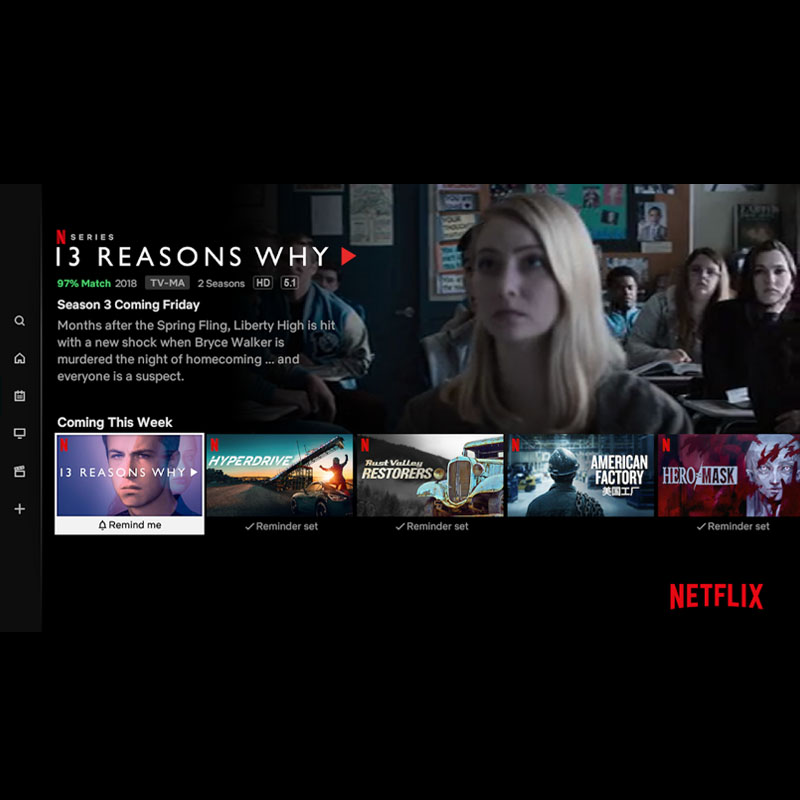
MUMBAI: Streaming giant Netflix has rolled out a new feature designed to alert subscribers about what’s new and coming soon on the platform. The new move will allow members to explore all the latest additions to the service and also get a sneak peek at what they’ll be watching next.
According to a Netflix blog, the new ‘Latest’ tab, located on the left side navigation bar, will break titles down into three helpful new categories: ‘New This Week,’ ‘Coming This Week,’ and ‘Coming Next Week.’ The three rows will reach across all content areas like drama, comedy, horror, docs, foreign, original, licensed and even kids’ content.
Moreover, users will now be able to click a ‘Remind me’ button on specific upcoming titles to receive a notification when they are available to stream.
The feature which was launched in August will continue to be rolled out by the company on eligible devices over the next few weeks. The ‘latest’ tab will be available on all Netflix enabled devices, including many game consoles and Roku devices while Smart TVs and others will get this upgrade in the coming months.
MUMBAI: Sony Sab is aiming to reduce the quality gap between channels and OTT platform with the launch of its new show Baalveer Returns. Baalveer Returns is the first show from Sony Pictures Network India which is digital-first. The show will be streamed on Sony LIV at 9 am for paid subscribers and it will be telecast on Sony Sab at 8 pm from 10 September.
Sony SAB, PAL and Sony MAX movie cluster business head Neeraj Vyas said, “Television today is competing with OTT which essentially is about binge-watch, less number of episodes and the quality that they deliver will also be a challenge for TV to match. But this one show will be bridging the quality gap. The show will go a long way in enhancing the perception of the channel and the brand even more than what it is.”
For the past few weeks, Sony Sab has been consistently seen at number 2 or 3 in the top 10 Hindi GEC channels list of BARC India ratings. With the launch of the new show, the channel expects that its efforts and time taken in creating ‘Baalveer Returns’ gets transformed into ratings.
However, Vyas is of the view that more than ratings, the attempt is to get people to take note of the quality.
The channel is also elated that even in a post-NTO world, subscribers have decided to pay Rs 15 for Sony Sab. "Ratings is one reality but it is not the only reality which means we have to work on the quality of the product that we deliver day in and day out," he said.
Giving more details into the show, Vyas said, “Baalveer is not just a show, it’s a legend! Years ago, when we showcased Baalveer on Sony SAB, it quickly gained a huge fan following. We are expecting this fan following to become bigger than ever with the launch of Baalveer Returns. This show is a true example of fantasy done right. With cutting edge VFX which will delight, stunt work that will boggle the mind and performances that will move, Baalveer Returns is going to be an epic adventure that audiences are sure to fall in love with. With a universal theme of Good vs. Evil, the show will appeal to everyone – young and old alike and is a true representation of the kind of content Sony SAB is appreciated for – values driven and with a heart. The show fits beautifully with our commitment to provide happiness and we believe it has got all the ingredients to become a massive hit.”
Sony Pictures Networks CEO NP Singh said, “Sab is in its fifteenth year now. In April 2004 we re-launched SAB after the acquisition of the channel as Sony SAB. I am very proud and satisfied as it is one of the most stable channels in the genre. For the last couple of months, SAB has been in the top three channels.”
He further said, “A new fresh energised SAB is something that we are showcasing now, from being a comedy channel it has now become a channel for family. After the NTO implementation SAB’s audiences have remained loyal to the channel and our subscriber numbers are also increasing month on month. With the launch of Baalveer Returns, it is expected to grow further. Time spent on the channel has grown dramatically. People not only subscribe to it but also watch it on a regular basis which is reflecting when the ratings come."
SonyLIV Digital Business business Head Uday Sodhi commented, “We are excited to bring this iconic show to our digital viewers in India on our OTT platform. For the first time ever, Baalveer Returns will be available on SonyLIV a few hours prior to its televised broadcast to all premium subscribers. This is an innovation to get the mobile-first audience to watch the show and add to the excitement that the show offers. SonyLIV has always been a frontrunner in streaming relatable content to its viewers and this is our endeavour in that direction.”
Optimystix Entertainment founding chairman & MD Vipul D Shah said, “Baalveer Returns has been produced such that it revolutionises the way people watch fantasy dramas on television. Besides the new cast, a lot of effort has gone into designing the costumes and the sets, so that we provide a thrilling, edge-of-the-seat, visual treat to the viewers. The fans are in for a real extravaganza! Besides the look and feel of the show, a lot of fine work has gone into the scripting which will get the fans hooked on to the show and we hope to receive the same love & approval they have shown before.”
MUMBAI: Despite the popularity and endless love for movies and catch-up content among Indian consumers, original content is emerging as an important category for online video viewers. However, traditional content categories like movies and related content like catch-up TV content dominate the current consumption trend on online video viewing probably due to limited supply of originals in contrast to library content.
In a report by Eros Now and KPMG India based on a survey carried out among 1458 OTT users in 16 cities of India, it has been revealed that 10 per cent of respondents prefer watching original content online given the current availability of the category standing at less than one per cent of overall content. Moreover, the preference for original content was consistent among all age groups proving that the category is no longer limited to millennial audience. The survey also revealed that 30 per cent of respondents prefer original content while 22 per cent prefer catch-up content.
“If you look at television, there are hundreds of channels, there are 8-10 Hindi GECs and in each language there are multiple GECs, each channel targeting same consumers. In a situation like that, there isn't any major differentiation in the content being offered. The question at this stage of evolution of digital platform is that you need to differentiate against other platforms or TV. Right now the effort is to take time away from TV to OTT because the consumer has a limited time available on hand,” KPMG India media and entertainment partner and head Girish Menon commented in a press meet.
“It came out in the survey that most consumers are using these platforms to consume catch-up content. Therefore the same level of brand awarness that exists between TV channels is existing between the platforms at this point because majority of the content is library content. If you see the content that is being consumed other than movies it is TV content, sports and original content. Original and exclusive content will trigger cord-cutting also,” he added.
The study also emphasised on the fact that freshness and uniqueness of content are the key determining factors for installation and uninstallation of apps along with respondents subscribing to platforms as nearly 87 per cent of the respondents install an app considering the quality of content.
30 per cent of the respondents prefer watching content in languages other than Hindi and English. The preference for content consumption is significant in the native languages across large parts of the country, with South India observed to be the most loyal to their native tongue.
Online video platforms are truly going mass as the Indian OTT viewer spends approximately 70 mins per day on online video platforms, with a consumption frequency of 12.5 times a week i.e. more than once a day. Viewers are also accessing ~2.5 platforms at a given time. While the customer sets are fairly heterogeneous, there is a trend of homogeneity that was observed in terms of consumption frequency and duration across age groups, income levels and genders.
The report also revealed that OTT video could usher in cord cutting sooner than expected. While 38 per cent of the respondents could consider cord-cutting in the future as they responded to their entertainment needs being fully met online, 14 per cent of the respondents considered subscription to online video platforms as an alternative to TV subscription.
“Cord-cutting because of regulator set up, quality of content, VAS, that transition in India will potentially jump the curve in the US,” Eros Now COO Ali Hussein said in the press meet.
The importance of telco platforms for the distribution of online video content has again been proved in the survey as three out of ten respondents viewed online video on telco platforms. Jio TV emerged as the platform with the highest usage with Airtel TV being a distant second. The report also added that integrated telco billing is one of the factors that is likely to help drive VOD subscriptions in the future despite the fact that SVOD users preferred dire usage of specific platforms.
"It benefits immensely. I am getting subscriber, money, time-spent, viewership. 80-85 per cent of this country will continue to be bundled market because of the price consciousness," Hussein added.
OTT is increasingly becoming anywhere-anytime phenomenon as nearly 87 per cent of the respondents consumed content on their mobile phones, with nearly 28 per cent of the respondents consuming content during the traditional office hours of 10 am-6 pm.
MUMBAI: For the last three-four quarters, Shemaroo Entertainment Ltd has been guiding for softer margins due to investments in multiple initiatives. Among other initiatives, the new streaming service ShemarooMe and device business have also left an overall impact due to the higher investment. However, the company hopes to reap benefit from the new initiatives both in terms of margin and top-line. Despite some cyclical issues, the company hopes to grow at 38 per cent CAGR or higher over the next few years.
“If you see even for this quarter, the people expenses are up by about 40 per cent. Other expenses are up by 50 per cent. So, there is a certain investment that is being done. There are certain cyclical aspects, how long they will last? We do not know. So, it is very difficult for me to guide for the rest of the year because the economy is in a certain state,” Shemaroo Entertainment CEO Hiren Gada commented in an earnings call after Q1 FY 19 results.
But he also noted that over the last several decades of being in business, they have seen many cycles which have been regarded as opportunities to actually build longer-lasting and better return businesses.
While new media growth also slowed down to 25 per cent from 35 per cent, the telecom segment contributed 40 to 45 per cent to the overall revenue and the rest of the contribution was equally split between YouTube and syndication having 27 to 30 per cent. Though YouTube and syndication both continue to grow more or less equally fast, Gada hopes that over the next few quarters, ShemarooMe also will kick-in in terms of monetisation and revenue.
“Telco piece is now in a phase where that business is transitioning from a feature phone product to the smartphone; the market itself is transitioning from feature phone to smartphone. So, that is the whole aspect of that business. So, that business in a way you can say will be shrinking over the next few quarters,” Gada added.
Despite overall growth in the YouTube segment, the growth in revenue has been significantly lower compared to viewership growth as the realisations on a CPM basis, the ad rate basis continue to fall.
“So, this quarter, definitely YouTube has at least grown or come back into the growth trajectory or rather, I would say remained in the growth trajectory which it was towards the end of last year that has continued. So, that is one thing, in terms of the overall growth of digital media, I think one is that the base is now significantly higher. So, definitely that base effect is bound to kick in. That is one reason for the slowdown,” Gada added.
Shemaroo recently launched its over-the-top platform ShemarooMe in a market where more than 30 players are trying to win over consumers. Rather than creating web series or acquiring the latest and greatest movie blockbusters, Shemaroo has focused on segmenting the audience based on consumer needs.
MUMBAI: Bharti Airtel (Airtel), India’s largest integrated telecommunications services provider, today announced the launch of its converged digital entertainment play: Airtel Xstream.
Airtel Xstream is part of Airtel’s vision of building a world-class digital entertainment ecosystem for Digital India and make it accessible to customers through innovative devices and exciting applications. Over the coming months, Airtel plans to roll out a range of exciting solutions to cater to the entertainment needs of every customer segment of India that is getting transformed through rapid adoption of high speed data services.
All the content on one platform, delivered across screens: Airtel Xstream brings one of the widest entertainment catalogues – hundreds of satellite TV channels, tens of thousands of movies and shows in English, Hindi and multiple Indian languages, millions of songs, plus access to all the popular OTT entertainment apps on one platform. It enables customers to access all this content across the screen of their choice – TV, PC, and Smartphone with a unified User Interface.
Future Ready platform for connected Homes: Airtel Xstream devices will come with capabilities beyond world-class entertainment and will be the IoT gateway for enabling a range of solutions for connected homes.
Exclusive benefits for Airtel Thanks customers: Airtel Thanks customers will enjoy exclusive benefits on Airtel Xstream, including free access to premium content from Airtel’s content catalogue plus offers on a range of other services.
Bharti Airtel Bharti Airtel chief product officer Adarsh Nair said, “Airtel is on an exciting mission to provide a broad array of digital services and platforms that can form the foundation for a rising India. As part of our digital entertainment play, our vision is to truly massify digital entertainment and make it accessible to more and more customers through innovative platforms.
“Today, we are announcing India’s first converged entertainment platform Airtel Xstream that brings together your favorite content including Live TV, video, music, news, and sports across an OTT smart stick, internet enabled set top box and handheld devices. Digital India is transforming the way content is being consumed over internet connected devices. Airtel Xstream will cater to needs of a new generation of consumers who are looking for seamless and converged entertainment across multiple screens at home and on the go.”
With the launch of Airtel Xstream, Airtel has become the first company in India to enable a seamless digital entertainment experience, with a unified user interface across all screens. Airtel has rolled out a new range of Airtel Xstream connected devices that will make any TV a smart TV and will be available to customers starting today. Airtel Xstream devices offer blazing-fast performance and slick viewing experience through solid product engineering, deep design excellence coupled with strong device specifications.
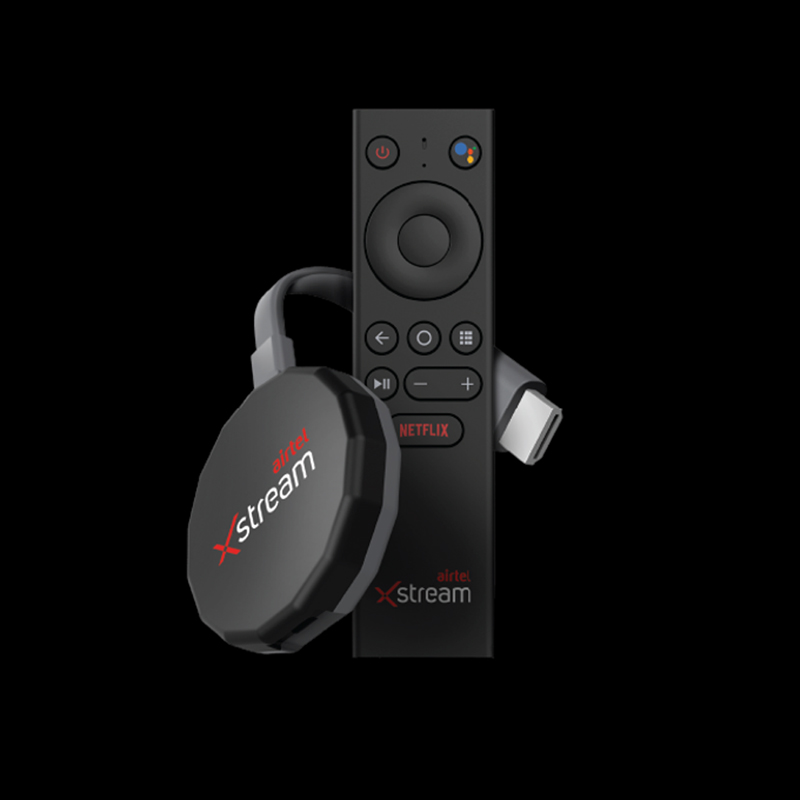
Airtel Xstream Stick
An Android 8.0 based OTT stick designed for plug & play experience on any TV screen, the Airtel Xstream Stick comes with a single subscription plan that provides access to all digital entertainment at a one-stop destination with over 10,000 movies and shows from top OTT content partners like ZEE5, Hooq, Hoi Choi, Eros Now, HungamaPlay, ShemarooMe, Ultra and Curiosity Stream, in addition to over 6 million songs from Wynk Music’s library. The Airtel Xstream Stick will also provide access to Netflix, Amazon Prime Video and other Google Playstore applications to enable users to download any app of their choice.
The Airtel Xstream Stick with built-in Chromecast is powered by best-in-class 1.6 Ghz processor. The stick remote comes with voice enabled search feature and Bluetooth 4.2 makes it faster and more energy efficient.
The Airtel Xstream Stick is priced at Rs 3999/-. Airtel Thanks Platinum and Gold customers get complimentary access to the content subscription plan on Airtel Xstream Stick. All other customers get free access to the content for the first 30 days and will need to subscribe to a Rs 999/- annual plan to continue enjoying the exciting content catalogue.
For the launch of Airtel Xstream Stick, Airtel has partnered with Flipkart as the exclusive online partner. The stick will also be available starting today across leading Airtel retail stores, airtel.in, top electronic retail chains like Croma and Vijay Sales.
Airtel Xstream Box
Powered by Android 9.0, the Airtel Xstream 4K Hybrid Box seamlessly brings satellite TV and OTT content together onto the TV screen with the convenience of a single device, making any regular TV a smart TV.
Along with the option to choose from 500 plus TV channels, the Airtel Xstream Box comes preinstalled with Airtel Xstream app (10,000 plus movies and shows), Netflix, Amazon Prime Video, YouTube and Airtel Store (for advanced gaming with high end graphics).
The Airtel Xstream Box has Wi-Fi and Bluetooth connectivity and built-in Chromecast. It comes with a universal remote that features Google Assistant based voice search and hot keys for Netflix, Amazon Prime Video and YouTube.
Priced at Rs 3999, the Airtel Xstream Box comes with a complimentary one year subscription (worth Rs 999) to all Airtel Xstream app content in addition to one month subscription to a HD DTH pack.
All existing Airtel Digital TV customers can upgrade to Airtel Xstream Box at a special price of Rs 2249 only.
Airtel Xstream Box is available starting today across leading Airtel retail stores, airtel.in and top e-commerce sites like Flipkart, Amazon and electronic retail chains like Croma and Vijay Sales.
Airtel Xstream App and Web access
Airtel Xstream app is a revamped version of Airtel TV app. The refreshed app has a new User Interface and much sharper content discovery and recommendation engine. Airtel Xstream app continues to have one of the widest content catalogues with over 400 LIVE TV channels and 10,000 plus movies and shows from top content providers like ZEE5, Hooq, Eros Now, HungamaPlay and much more.
MUMBAI: As distribution plays a crucial role along with content for the business of over-the-top (OTT) platforms, Eros Now is betting big on partnerships in international markets to expand its reach in international markets. After recently striking deals with Vodafone Qatar and China’s WASU Media, the streaming player is also looking at such other partnerships. Although India definitely remains a large focus of the business, the company is trying to strengthen international distribution also.
Talking to Indiantelevison.com, Eros Digital chief operating officer Ali Hussein spoke about the objective of the partnerships. He emphasised on the importance of two of the partnerships as both the countries are very important for the company.
“We did an announcement for WASU in China which was our second partnership there. So, I don’t think any Indian OTTs really have any distribution partnership in China where we already have two. Moreover, China is doing a lot of investment in terms of market development on how to increase the further distribution of Indian programming or Indian content around the world. China is obviously a big market in terms of theatrical releases also and we are investing lots of resources trying to improve our digital distribution in China,” he commented.
Talking about the Vodafone Qatar partnership, he noted that the Middle East is a focus area for the company. The company would try to penetrate better in the UAE and now in Qatar with the partnership along with Bahrain and some of the other countries.
Hussein added that each market is unique in itself when it comes to content strategy thus requiring multiple strategies based on the market with localised approach like dubbing, subtitling, etc. Along with that, marketing is another area to get subscribers in conjunction with its partners also.
Interestingly, these markets have two kinds of audience as Hussein shared. The Indian audience and South Asian audience are watching a lot of South Asian content but it is some of the local audience watching Bollywood films. He also added that each market has a very different objective with different understanding of the audience behaviour. According to him, curating customer journeys, marketing the product and localisation of the product are also important factors.
“Direct subscription we are doing anyway. This kind of telco partnership helps because they have the billing relationship with consumers. They are very accurate in customer profiling. As Telcos are more accurate in what is the type of customers looking to watch what kind of content, customer targeting is better done through these partnerships. So, I think both these efforts continue to go ahead hand in hand. We don’t segregate, it’s just different means of how do you acquire customers,” he commented.
A recent KPMG report noted that telco partnerships contributed 30-35 per cent to the overall subscription revenues of OTT platforms in FY19. The report also added that although a majority of the subscription revenues are expected to come from direct subscriptions, the revenue from telco partnerships is also expected to achieve a robust growth, although slower as compared to direct subscriptions.
“Our maximum growth actually has been coming from beyond the top eight cities. Some of our originals are also garnering a large amount of viewership from beyond the top six or eight cities. Actually, the number from metros is quite high but if you look at the growth percentage from tier-II, tier-III cities, that has been maximum for us,” Hussein commented on the subscriber growth of the platform.
“Although user engagement also has a lot to do with the quality of network and quality of services, our time spent in terms of retention has gone north up of 75 minutes for most active users. A lot of original launches contribute to longer sessions. In general, we have seen a significant increase in time spent. For long-form episodic content, the company is trying to hit one original a month in the second half of the year,” he added.
The company is now looking at the interactive video area. Other key areas the company is focusing on are Eros Now Quickies and short films.
MUMBAI: Ever since Flipkart announced its entry into India’s booming video streaming space, it’s been the talk of the town. The Walmart-owned e-commerce platform will open it up for Flipkart Plus loyalty program members in a fashion similar to Amazon Prime Video.
The upcoming video streaming service will enter the market in September, before the festive season of Diwali. The difference between the two is that Flipkart’s service is entirely free for Plus members while the other entails a cost of Rs 129 a month. Another difference is that Flipkart is currently licensing content while Amazon invests in its own. However, industry experts are divided on the effectiveness of the e-commerce player’s plan to enter the market with commissioned content.
“Walmart acquired Vudu in 2010 and has been trying to scale it with an ad-funded model rather than originals/subscription. For India, if they have decided to do aggregated content, I think it is because they are testing waters initially. Walmart as a new video OTT player is a good step for consumers and the industry. I think once they taste the success they will start investing in local content or originals as well. Walmart is also as deep-pocketed as Netflix or Amazon,” Eros International group chief marketing officer Manav Sethi commented on the strategy.
On the other hand, Elara Capital vice president research Karan Taurani is of the view that until and unless OTT players make an investment into original content, no massive changes can be expected since it is a very crowded space with more than 30 players. Reports say that Flipkart has not ruled out the possibility of launching originals.
Despite its different stance, experts are sure that it will definitely boost Flipkart’s business. One media analyst opined that the model is similar to Amazon Prime Video where content is one offering in Flipkart’s loyalty programme. However, instead of targetting a million subscribers, Flipkart’s aim is to get more consumers to spend money on its platform.
“The play they want to have is really similar to Amazon than Netflix. The idea is to hook the audiences to its content to study consumer behaviour for better targetting,” said another analyst from an auditing firm who wished to remain unnamed. He added that if it can get people to linger on the platform and increase the number of services provided to them, Flipkart will be in a better position to target them efficiently. But he added that the quality of content and price point will also matter.
“In the past 10 years, our vision and ethos have been to create India-specific tech solutions. What we are rolling out when it comes to addressing the needs of the next 200 million users in our country, is taking forward those founding principles of access and affordability,” Flipkart group CEO Kalyan Krishnamurthy commented as per media reports.
Taurani added that Flipkart can tie up with multiple OTT platforms which will help it boost its e-commerce segment. As Amazon Prime is restricted to have in-house content, this can be an advantage.
Moreover, as per Taurani, the OTT platforms or broadcasters providing content to Flipkart will also gain from the deal as this will be an additional revenue stream for them apart from their current tie-up with the telcos. Hence, it’s a win-win situation for both but it will obviously help Flipkart’s e-commerce play more.
It’s yet to be ascertained how this move will create a dent in the market. “It will increase the competition. The consumers who were having 30-plus options will have one more big option to consume. Depending on how Walmart packages and prices it, I think it should see significant consumption uptake,” Sethi added.
According to a recent report from KPMG, the digital segment of the media and entertainment industry in India contributed Rs 173 billion in revenue in FY19 with digital advertising and subscription from OTT platforms contributing significantly. The potential of the market is noticeable as the report predicts 580 million OTT consumers by FY24 will be spending more than 30 minutes on online video platforms each day.
MUMBAI: SEMrush, the online visibility management and content marketing SaaS Platform, recently conducted data analysis on three most trending media services in India – Netflix, Amazon Prime, and Tata Sky. The case study revealed amazingly interesting facts regarding the growth of traffic from different devices and an increase in the search volume. Netflix Subscription is the most searched keyword in the time duration from Jan 2018 to July 2019. After the announcement of Netflix’s new subscription plan for India, its price search volume increased swiftly by 83% between June 2019 and July 2019. Besides, Amazon Prime Subscription stands as the second most searched keyword with an average search volume of 6,878.9.
On the other hand, Tata Sky’s app has the highest searched volume of 44,826 during the same time duration. Tata Sky has the smallest traffic volume, but it has shown a tremendous year-on-year growth counting to 293 per cent. Wherein, Netflix witnessed a 146 per cent growth in its traffic volume after Tata Sky. Interestingly, Amazon Prime enjoys the biggest traffic volume from India, but its year-on-year growth is merely 70 per cent.
The desktop traffic to Netflix and Amazon Prime Video in July was 11,138,893 and 13,593,504 respectively. Both the media services have grown by 36 per cent in July 2019 as compared to the previous month. Netflix shows the biggest growth of mobile traffic (15.6 per cent) between June 2019 and July 2019, after it announced its new subscription plan, however, Tata Sky and Amazon still are bigger in numbers of mobile device traffic counting to 7,537,672 and 12,290,142 respectively as compared to Netflix’s traffic count 6,244,056.
“Netflix, Amazon Prime, and Tata Sky are the new age media services which are giving tough competition to each other. All three of these media services are significantly attracting Indian audiences for the subscription with interesting packages. The data revealed in the study is self-explanatory for their accelerating popularity amongst viewers. According to this case study by SEMrush, Indian audiences are inclining more towards Netflix’s subscription in last couple of months, all credits to its interesting subscription plan,” SEMrush international market Fernando Angulo said.
MUMBAI: The digital segment of the India media and entertainment industry is projected to reach Rs 386 billion by FY22 from Rs 173 billion in FY19. The burgeoning sector is set to overtake print media and be behind TV within the same period, according to India’s Digital Future, a report by KPMG. By FY24, the digital market will be half that of TV in the Indian economy.
Moreover, advertising growth will also be driven by the digital billion with close to 580 million OTT consumers by FY24. The report also added that with the proposed third party digital measurement systems coming into place in India over the next 12 months, the CPMs are also likely to see some growth from FY21 onwards, contributing to the overall growth of the segment. As per the report, video ads on OTT platforms are likely to constitute the bulk of the segment revenues.
On the other hand, the revenue from OTT digital video is expected to reach 129 billion by FY22. While Indian OTT market’s revenue will continue to be dominated by advertising, the direct subscriber base in India will rise to as much as 55-65 million by FY24, driven by the availability of high quality content curated for different audiences.
While the subscription revenues registered a nearly 3x increase in FY19, totalling Rs 12 billion, direct subscriptions contributed around 65-70 per cent and the rest were realisations from telco partnerships. Despite the growth of direct subscriptions, the revenue from telco partnerships is also expected to achieve robust growth, although slower as compared to direct subscriptions.
The digital consumers have also been divided into four categories. The digital sophisticates who consume global content and tent-pole, original Indian programming tailored for the urban audience, typically behind a paywall in English and Hindi. The second is digital enthusiasts who will watch mainly Indian narratives in Hindi and regional languages and some pockets of English. The third is digital mainstream who are looking for free content available online or bundled plans through telcos and other distribution platforms and the last is fringe users who will have sporadic digital access on account of either poor connectivity or irregular income.
On the course of digital segment evolution, technology and associated tools such as artificial intelligence will provide much needed direction around decisions relating to content creation, distribution and monetisation for digital businesses. It has also been pointed out that micro-segmentation of target markets in an increasingly upwardly mobile economy would be essential for effective monetisation.
MUMBAI: After revolutionising the mobile data use in the country, telecom giant Jio is now ready to turn around the fortune for the broadband sector in India. Jio Fiber is not only merely providing high-speed internet connection but it is bundling a number of offers and features like access to premium OTT services and the concurrent release of movies. The high-speed home broadband will definitely boost the over-the-top ecosystem but experts have mixed views on how it will impact theatres and multiplexes.
At the 42nd annual general meeting of Reliance Industries Ltd (RIL), CMD Mukesh Ambani revealed 5 September as the date for the commercial launch of the much-awaited service. “Jio Fiber Services to be launched on commercial basis on 5 September 2019 – on the third anniversary of Jio’s launch. (We) plan to reach 20 million residences and 15 million business establishments in 1,600 towns,” the business tycoon announced.
Industry veteran Paritosh Joshi pointed out that watching cinema is much more than just a question of consuming a few hours of content as it is an immersive experience. He also compared the arrival of the multiplex revolution in India about 15-20 years back which signalled a departure from basic movie experience. He added that multiplexes are trying to make experiences rich and interesting.
“So in my opinion, theatrical exhibition business will not disappear merely because of cinema being released concurrently on digital media. Watching a film at home is different than in a
cinema theatre where you get completely emerged in the movie experience. At some level it might even help the theatrical release because people who would not have had a chance otherwise to experience that film may sample it on their personal devices at home and then still want to really experience what the full thing is by going to the theatre,” Joshi added. Moreover, he also added that international studios operating in India may not agree for a concurrent window with Jio Fiber.
Another veteran media analyst also agreed that multiplexes won’t be affected by Jio. He added that Indian audiences still like to go to the theatre for community viewing.
PwC – Risk Assurance (Media, Entertainment & Sports) Managing Director Anand Punmiya said, “Getting movies at home on the day of release will be a boon for many, however going to multiplex & watching is considered "friends & family time" and there will still be takers for that as well. In fact, in recent past we experience reverse migration, wherein selective Cricket World Cup matches were exhibited in multiplexes, since multiplexes offers an enhanced viewing experience.”
PVR Ltd also said in a statement that cinemas continue bringing people together to share a communal experience. This irreplaceable element, which is at the core of theatrical experience, continues to deliver a robust box office performance not just in a growing market such as India but also in the more matured markets such as the US, China, Europe, etc. where cinemas have regularly competed with many similar initiatives such as Netflix Original Movies.
The company also added that for decades, theatrical release window has been a valuable model for exhibitors and producers alike. In India and globally, producers have respected the release windows and kept a sacrosanct gap between the theatrical release date and the date of release on all other platforms, i.e. DVD, DTH, TV, OTT, etc.
"We would also like to point out that producers, distributors and multiplex owners in India have mutually agreed to an exclusive theatrical window of 8 weeks, between the theatrical release of a movie, and release on any other platform. This exclusive theatrical window is a model that is followed internationally, in order to ensure the robust financial viability of all the segments of the sector, and has been replicated in India," Inox said in a press release.
Elara Capital vice president research Karan Taurani said that the Jio deal won’t have a big negative impact for multiplexes as the release of a movie in cinema is very important in order to get deals on digital and satellite. He also added that there are about 400 films released every year across genres and hence release of a few films directly on Jio won’t impact footfall.
“Cinema-going is considered a family outing in India and we don’t see large budget films going for direct release on Jio. It will be limited to smaller films going directly on digital, as the economics of a big film doesn’t work for the same,” Taurani added.
Keeping the mixed economy structure of Indian internet users, Jio Fiber’s plans have been fixed from 100 mbps speed to all the way up to 1 Gbps. The pricing will range between Rs 700 per month to Rs 10,000 per month. “Premium JioFiber customers will be able to watch movies in their living rooms the same day these movies are released in theatres,” Ambani said while revealing all the offers. Jio Fiber also comes bundled with a free subscription to premium OTT services.
“Vodafone, Airtel, Jio are already bundling content from over-the-top platforms. It’s the sheer scale on which Jio operates and subscribers they may have that makes it more interesting for streaming service operators to deliver the product to broadband and mobile customers. One thing became clear last year – the telecom play is substantially data play and data play is all about entertainment content. The main use of data is consuming audio-visual entertainment content,” Joshi commented on Jio Fiber’s impact on the over-the-top ecosystem.
Another analyst added that while the OTT ecosystem will definitely improve, the question is about how Jio wants to bundle the offering, which mainly depends on the pricing.
Punmiya said, “There is a kind of "OTT War" which is in place for some time now and wherein every platform is engaged in creating unique and engaging content. While, OTT is "Content at Convenience" multiplexes offers a great viewership experience. Even if small and big screen are competing they will continue to thrive Indian markets for long given every platform have their ardent followers.”
Balaji Telefilms’ management is also upbeat about the changes that Jio will bring. “We are looking upon this as a very positive development, it will help consumers access internet at a very high speed. We have seen previously when Jio was launched that Reliance has revolutionised this market and made internet accessible to the masses of India that fits very well with our strategy. Our content has been historically mass content, so all steps and measures taken to spread internet out at high speed like Jio Fiber will do is a positive move and a very positive development for us,” said Balaji Telefilms management in its earnings call.