Tag: OTT

  • Hindi GEC & Southern channels evenly matched across genres as TV viewership drops

    Hindi GEC & Southern channels evenly matched across genres as TV viewership drops

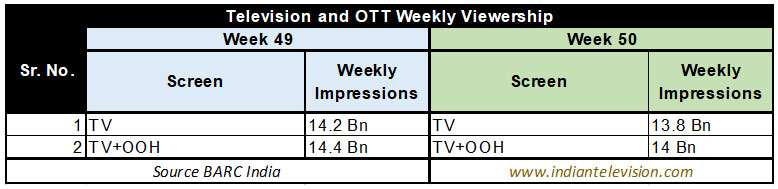
    BENGALURU: Southern languages channels shared equal space in Broadcast Audience Research Council of India (BARC) weekly list of Top 10 Channels on All Platforms Across genres list with Hindi GECs in week 50 of 2019 (Saturday, 7 December 2019 to Friday, 13 December 2019, week or period under review). In the meantime, TV viewership dropped to 13.8 billion weekly impressions in week 50 of 2019 from 14.2 billion in the previous week. 

    Overall TV and OTT weekly viewership according to BARC data declined 2.8 percent to 14 billion weekly impressions during the period under review from 14.4 billion impressions reported in week 49 of 2019. The Top 10 Pay Channels Across genres incurred a higher loss than the Top 10 Free to Air (FTA) Channels Across Genres did in week 50 of 2019 as compared to week 49, as their respective chartswhich follow in this paper will demonstrate.

    Please refer to the chart for TV and OTT viewership for week 49 and 50 of 2019: 
    Top 10 Channels on All Platforms Across Genres

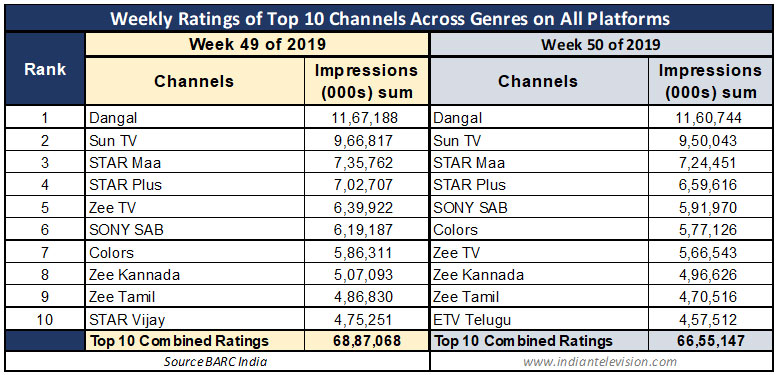
    There were five channels each from Hindi GEC and three South Indian languages in Broadcast Audience Research Council of India (BARC) weekly list of Top 10 Channels on All Platforms Across genre for week 50 of 2019 as mentioned above. There were two channels each from the Tamil and Telugu genres and one channel from the Kannada genre in the top 10 across genres on all platforms weekly list for week 50 of 2019.

    There were three channels from Zee Entertainment Enterprises Limited (Zeel), two channels each from Star India and Network18/Viacom18 and one channel each from Enterr 10 Television, Sony Pictures Network India (SPN) and the Sun Tv Network in BARC’s weekly list of Top 10 Channels on All Platforms Across genre for week 50 of 2019.

    Nine of the channels in the across genres on all platforms list in week 50 of 2019 were same as in the previous week with some shuffling of ranks. Star India’s Tamil GEC Star Vijay exited the list in week 50, while the Network18 associated Telugu GEC ETV Telegu reentered the weekly list. One channel, the most watched one – Dangal TV was free to air (FTA), while the other nine were on the pay TV platform.

    The Top 10 Channels on All Platforms Across Genres recorded weekly impressions of 6.655 billion in week 50 of 2019, 3.4 percent lower than the 6.887 million weekly impressions in week 49.

    Please refer to the figure below:
    Top 10 Pay TV channels Across Genres

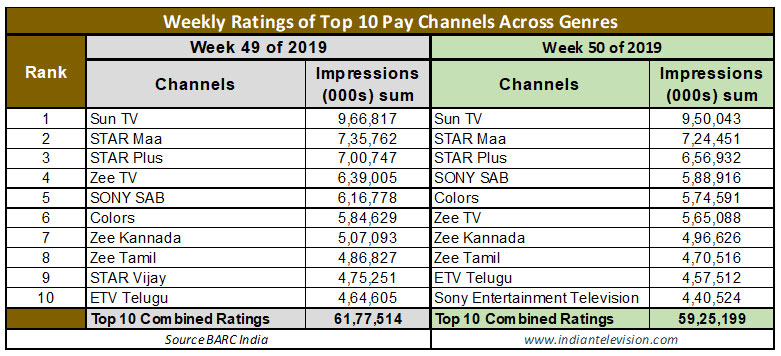
    It was the three South Indian languages channels that dominated BARC’s weekly list of Top 10 Pay Channels Across Genres in week 50 of 2019 in terms of viewership. There were five channels – two each from the Tamil and the Telugu and one from Kannada genres in BARC’s weekly list of Top 10 Pay Channels Across Genres during the period under review. Besides the five South Indian channels, there were four Hindi GEC’s in BARC’s weekly list of Top 10 Pay Channels Across Genres in week 50 of 2019. The combined weekly impressions of the five South Indian channels was 3.099 billion weekly impressions, 9.7 percent more than the 2.826 billion weekly impressions of the Hindi GECs’ in week 50 of 2019. In week 49 of 2019 (previous week), there were six South Indian languages channels and four Hindi GECs’ in BARC’s weekly list of Top 10 Pay Channels Across Genres.  

    Further, as has been the case over the past few weeks, the most watched pay channels were not Hindi GEC – they were Tamil and Telugu GECs’ at ranks one and two respectively in the list. 

    Nine of the channels in the weekly pay TV across genres list in week 50 0f 2019 were same as in the previous week with a slight shuffling of ranks. SPN’s flagship Hindi GEC Sony Entertainment Television or SET reentered the list on the exit of Star India’s Tamil GEC Star Vijay. There were three channels fromZeel, two channels each from Network18/Viacom18, SPN and Star India and one channel from Sun Tv Network in BARC’s weekly list of Top 10 Pay Channels Across Genres in week 50 of 2019.

    As mentioned above, the Top 10 Pay Channels Across Genres lost viewership in week 50 of 2019 as compared to week 49. The combined viewership of the Top 10 channels in week 50 of 2019 was 5.925 billion weekly impressions, 4.1 percent lower than the 6.178 billion weekly impressions in week 49.

    Please refer to the chart below
    Top 10 Free channels Across Genres

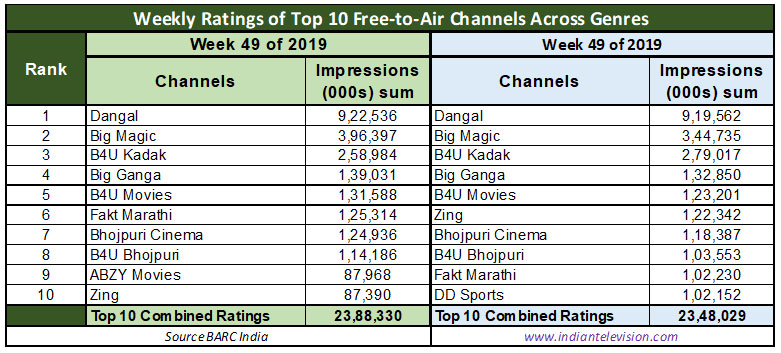
    Nine channels in BARC’s weekly list of Top 10 Free to Air Channels Across Genres in week 50 of 2019 were the same as in the previous week with slight changes in the ranks. SkyStar’s Hindi Movies channel ABZY Movies exited the list in week 50 of 2019 to be replaced by Doordarshan’s sports channel DD Sports, now that the one day series between India and West Indies is being played. 

    There were three channels each from Enterr 10 Television, the B4U Network and Zeel and one channel from Doordarshan in BARC’s weekly list of Top 10 Free Channels Across Genres for week 50 of 2019. There were three channels from the Hindi Movies genre, two movies each from the Bhojpuri and the Hindi GEC genres, and there was one channel each from the Marathi, Music and Sports genres in week 50 of 2019 in the free channels across genres weekly list.

    The combined viewership of the Top 10 Free Channels Across genres in week 50 of 2019 dropped 1.7 percent to 2.348 billion weekly impressions as compared to 2.388 billion weekly impressions in the previous week.

    Please refer to the chart below:
  • Netflix Originals most in-demand among OTTs: Report

    Netflix Originals most in-demand among OTTs: Report

    MUMBAI: At the moment, the future of streaming services' uncrowned king Netflix has been over-discussed due to the entry of deep-pocket competitors. But till the third quarter of 2019 (July-September), Netflix has been able to retain its leadership position. A report from Parrot Analytics says that Netflix digital originals has the highest share of demand for digital original series around the world.

    According to the report, 61.3 per cent of the global demand for all digital originals is expressed for Netflix originals. However, despite the dominance of Stranger Things this quarter, the 61.3 per cent figure for 2019 Q3 is 1.3 per cent lower than the 62.6 per cent Netflix share in 2019 Q2. On the other hand, Amazon Prime Video has the largest demand gain in this period as its share grew 1.6 per cent from the previous quarter’s (2019 Q2) 10.8 per cent demand share. Across all other platforms the demand share has been relatively stable across quarters.

    The report also provided an insight into how the genres and subgenres of digital originals performed in the quarter. In all the markets, undoubtedly drama was the highest in-demand genre. While US has the highest digital original drama demand share at 66.9 per cent, with 63.8 per cent of demand, Columbia acquires the second position. Peru is one of the three most drama dominated markets in the report where drama captures a robust 62.3 per cent of demand share. In all the ten markets- United States, Argentina, Colombia, Peru, United Kingdom, Poland, Greece, Vietnam, Malaysia, The Philippines- Stranger Things was highest in-demand digital original in the quarter.

    Among the sub-genres, sci-fi genre dominated the top position in almost all the markets. In Malaysia and the Philippines superhero series just edged out sci-fi drama for the top spot in the most in-demand subgenre ranking. On the other hand, fantasy drama acquired the top spot in Vietnam. In Greece, Argentina and Peru crime drama peaked as the second most in-demand subgenre.

    In the US market, Amazon Prime Video and Hulu are neck and neck to be the platform with the second highest share of demand for digital original drama series. Prime Video surged in the final month of the quarter to overtake Hulu. Other than in the US, Prime video witnessed good growth in the UK, Greece, Vietnam. 

  • Netflix discloses paid subscriber number region wise

    Netflix discloses paid subscriber number region wise

    MUMBAI: For the first time, streaming giant Netflix has disclosed operating results for international business. Although Asia-Pacific till now stands as the smallest market of Netflix with 14.5 million subscribers, the market boasts of highest growth.

    In the region, the revenue over the past two years grew at 153 per cent to $382 million at the end of the third quarter of 2019 while the streaming subscribers grew 148 per cent  over that time period. Netflix’s average revenue per subscriber in Asia-Pacific markets is $9.29 (Approx. Rs 650).

    According to the statistics shared by the platform, it has 67.1 million pay subscribers in the United States and Canada. In the Middle East, Europe and Africa region, the paying subscriber number currently stands at 47.4 million members. The region has seen a growth of 105 per cent compared to the same quarter two years prior.

    The paid membership grew by 61 per cent to 29.4 million over the same time period in its third largest market  Latin America while streaming revenue increased 71 per cent  from the end of the third quarter of 2017 to $741 million the end of the third quarter of 2019.

    The United States and Canada have the most revenue per subscriber at $13.08 (Approx. Rs 929) followed by EMEA’s $10.40 (Approx. Rs 739). Latin America has the lowest revenue per subscriber at $8.63 (Approx. Rs 613).

  • Convergence, consolidation & collaboration to fuel growth of cable, broadcast & OTT sectors

    Convergence, consolidation & collaboration to fuel growth of cable, broadcast & OTT sectors

    MUMBAI: In 2019, the Indian cable, broadcast and OTT industry witnessed many fundamental changes from digital dynamics to behavioural change of broadcasters moving from B2B to B2C model to industry stakeholders adjusting to the new tariff order (NTO). Indiantelevision.com’s VBS 2019 provided a platform to the industry experts to discuss and address the key issues faced them. Industry doyens revealed that convergence, consolidation and collaboration are the three 'C's to fuel the growth of the industry.

    VBS 2019’s panel discussions on ‘Transforming the sector to fuel growth’ included Elara Capital VP-research analyst Karan Taurani, Shemaroo Entertainment chief operating officer Kranti Gada, BBC Global News South Asia distribution head Sunil Joshi, PwC India partner and leader- media, entertainment Raman Kalra along with moderator SBICAP Securities equity research head Rajiv Sharma.

    Sharma set the tone of the discussion by briefing the audience on the major issues faced by the industry's stakeholders like cable, DTH, broadcasters, OTT, consumers and regulators in 2019.

    Kalra said, “We have been talking about convergence for a very long time and consolidation will keep on happening if we are willing to provide relevancy to the consumer. In the entertainment media space it is important to find a model which is relevant at scale. But how do you make relevant at scale? The relevancy for scale will trigger the consolidation because it leverages number on the financial statements and on the balance sheets of the company. It brings about so many synergies to the business models to run profitable, long term and sustainable business.”

    Taurani shared his view on consolidation in the cable space. He said, “Firstly it is important to highlight that business dynamics are changing completely. Broadcasters have been used to the B2B model since inception but now we are moving to B2C kind of a model. Basically everyone is well aware that if we really want to move to next level on digital, scalability is a very big factor and OTT platforms just offering about 10, 15, 20 movies will not help. So, to achieve that scale we need to invest in content. Apart from driving the partnership with other DTH cos or MSOs, achieving the scale on the digital part is needed. So I think it would take some more for them to understand the market and move to the next level.”

    Gada believes it is a great time for the media industry. With the emergence of OTT, the industry has added one and a half hours of screen time on digital front along with the television screen. Therefore the engagement of the end consumer with the content or with media or films has increased multifold.

    Gada says, “With deep-pocketed players cost goes haywire because short-term profitability is not their outlook, maybe their content is not their mainstay investment. It is sometimes just for consumer stickiness."

    Joshi said that convergence is the mantra of the day. “We have broadcasters, DTH, cable, OTT, consumers and a regulator who are the stakeholders of the value chain. If we look at post NTO and market dynamics, OTT is being discussed so widely because of its crispness and on-point approach to the consumers. Most of the broadcasters have direct consumer reach on their OTT to take care of and keep the stickiness on the linear also both compliments.”

    “Going forward, television needs to learn from OTT on what is been offered. So that on a quality level, both competes and at the operational level both collaborate. We have seen the collaboration of distribution platform and OTT because of their synergy and potential to exploit the potential consumers. Though they are competing at some level they are collaborating as well,” added Joshi.

    The panellists also elaborated on the digital monetisation model. They believe that there are three ways to monetise on digital platforms. The first is the business model, second is consumer centricity and third is the experience. Consumer centricity focuses on investing in knowing consumers. The second point of experience focuses on delivering the right experience. With respect to the business model, one has to experiment with multiple business models.

    The panellists also dwelled on the importance of the subscription model as AVOD does not lead to profitability because of the delivery cost, customer acquisition cost etc.  

    Stating an example of TataSky's binge initiative, Gada urged MSOs to become digital distributors and come up with aggregated and discounted offering for the consumer and make it convenient for those who are struggling with five to eight OTT apps. Gada asked MSOs to apply similar principles they used to offer TV channels to come up with bouquets of digital channels.

    The panel also highlighted the surge in term of telcos spending towards OTT. The new emerging game-changers today are e-commerce, smart TV and VMC.

    Sixty per cent of the money on digital advertising spent between Facebook and Google network. But now that is changing and the share is moving more towards OTT. The panel discussion ended on a positive note expecting that share of digital advertising will be 20-30 per cent whereas video advertising will be 40 per cent plus.

  • OTT & streamers 2019: Full steam ahead!

    OTT & streamers 2019: Full steam ahead!

    MUMBAI: If 2018 was big for the over-the-top (OTT) platforms, 2019 was even bigger for the ecosystem. Existing platforms pumped in in even more money into content creation, distribution and customer acquisition even as new players made a grand entry. While in the previous year, the focus was just on content creation, 2019 was about course correction, forging partnerships, striking distribution deals, entering new segments, innovating and getting to know the consumer better. Not just for the homegrown players but for the big international ones as well.

    2019 was the year when indiantelevision.com evolved its Vidnet OTT confab into one which offered conferences, training and masterclasses from some of the creators of successful originals.

    New kids on the block:

    Maybe a little late in the day, but a few platforms started their journey this year and created a buzz in the market. In February 2019, Times Internet launched a new avatar of its one of the most ambitious bets, MX Player. To grab a bigger slice of the ambitious video streaming market, the OTT platform commenced its play with five MX Original Series. Shemaroo Entertainment Ltd, one of the legacy players, which owns a rich content library, forayed into the space around the same time. However, Shemaroo banked on its existing content for ShemarooMe rather than burning cash for original content. But while MX Player went totally advertising-led, ShemarooMe took the freemium route.  

    Later in the second half of the calendar year, IN10 Media, a diversified vertical of infotainment channel Epic TV launched a new subscription-based documentary streaming platform DocuBay. The last quarter witnessed another major announcement – the launch of VOOT Kids from the house of Viacom18 which has already established a significant digital play with VOOT.  Unlike its main OTT platform, Viacom18 is relying on subscription for the kids’ platform right from the get-go. 

    Moreover, the year was equally eventful in the global OTT market as well. Tech giant Apple forayed deeper into streaming with the launch of its subscription-based video streaming service Apple TV+ in November. A few days later, Walt Disney launched its much-awaited streaming service Disney+ at a very reasonable sticker price. While the former made its streaming service available in India at Rs 99 per month, what the Star Disney combine will do with Disney+ in India has to still to be worked out, considering the huge popularity of Hotstar.

    More investment in original content:

    Along with new OTT platforms entering the market, the existing platforms also increased their investments in original content.  ZEE5 from Zee Entertainment Enterprises spent the year increasing its focus on large-scale originals, franchises, digital original films and regional language shows even as it has already developed a robust original content library across languages.

    Among  the shows that struck a chord with viewers include: Rangbaaz, which was launched late 2018 soared in 2019. The Kunal Khemu-starring BP Singh-produced Abhay too made its mark after being launched in early 2019. Kaafir – an original from Siddharth Malhotra’s Alchemy Films – too was much talked about. Zeel took its successful TV show Jamai Raaja to Zee5 in the shape of Jamai 2.0 during the year.

    After banking on catch-up and sports content for a long time,  Star India’s Hotstar also decided to invest in premium original content. Reportedly, Hotstar jumped onto the bandwagon with a Rs 120 crore investment plan. The primary reason to launch originals is to convert users into paid subscribers in the face of increasing competition. Hitherto, adapting successful foreign shows by infusing local flavours had been an important aspect of Hotstar’s strategy but it is certain that the platform is not going to limit itself to adaptations.

    Another player with deep pockets, Amazon Prime Video, also scaled up its local content offering along with a stellar roster of movies. With highly acclaimed originals like Made in Heaven, The Family Man, the OTT platform has already attracted enough user attention. Moreover, the second seasons of earlier hits are also in pipeline.

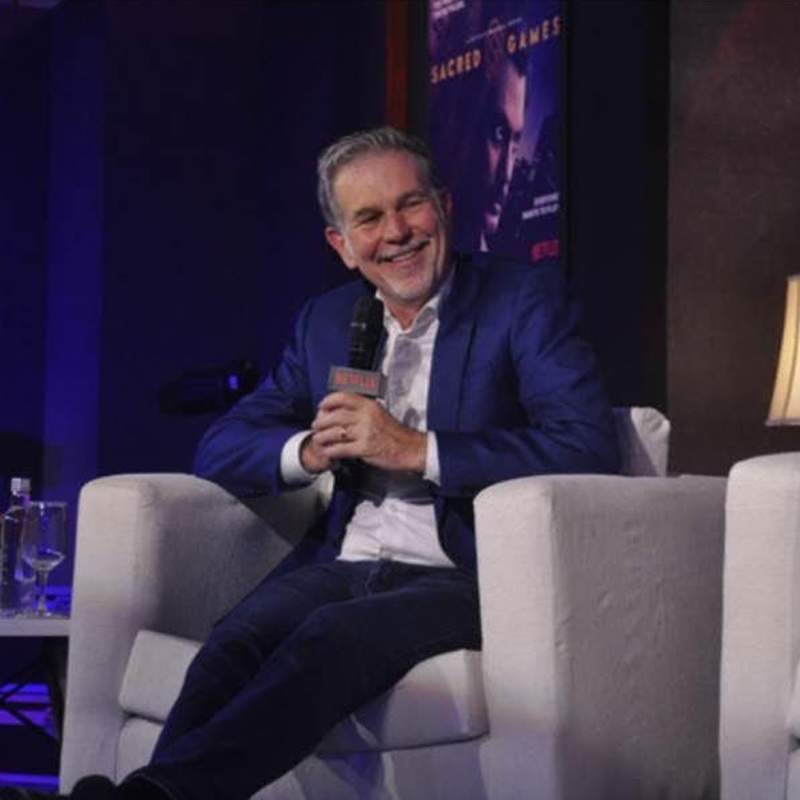
    Amazon Prime Video’s international rival has gradually evolved its investment in India – Netflix CEO Reed Hastings in his latest visit revealed that it is committing Rs 3000 crore in this year and next for Indian content.

    Other homegrown players like VOOT, SonyLIV also realigning their focus on original content as they don’t have significant play in the segment.

    Innovation with pricing:

    The streamers are not only experimenting with content to make build consumer love, but they are also jiggling around with pricing  in order to find the sweet spot which appeals to consumers. Rather than directly slashing prices, the streaming platforms have opted for sachet pricing.

    All the major players – Hotstar, Netflix, Amazon Prime Video, ZEE5, SonyLIV followed this strategy.

    Hotstar launched a Hotstar VIP pack at Rs 365 a year, much lower than its premium service which is priced at Rs 999 per year. SonyLIV has already tested a weekly subscription package priced at Rs 29 only. While ZEE5 has  launched special packages in languages including Tamil, Telugu and Kannada, it is looking at a mobile-only plan as well.

    Even ALTBalaji is also likely to consider having sachet pricing in the next two years.

    Most importantly, Netflix in an industry-first move launched a mobile-only pack in India priced at Rs 199. Maybe the myth that Indian consumers are shy to pay for content has been broken but the players have also realised Indian consumers are value-conscious.

    Experimenting with new partnerships:

    At the same time when the platforms were trying to differentiate in the crowded space, they also forged interesting partnerships. The new entrant MX Player stitched content tie-ups with Sony Liv, Arré and Hoichoi. Hotstar did a deal with Hooq to make its Hollywood offering stronger. But the most interesting one was the betrothal announcement between ZEE5 and Alt Balaji. It went way beyond content syndication – more towards content sharing, an arrangement that includes co-creation of a number of premium originals which will be available to subscribers of both the platforms.

    Although telco-partnerships have proved to be helpful for OTT platforms, the profitability of platform-to-platform alliances in the long-run yet remains to be tested.

    Key people movements:

    Along with changes in business plans, content strategy, the OTT platforms reshuffled their teams in 2019 as well. Netflix continued expanding its Indian team with TV and streaming veterans being hired locally,  including the appointment of Voot content head Monika Shergill, and the BBC’s Myleeta Aga. VOOT on its part recruited its new COO Gourav Rakshit from Shaadi.com keeping its subscription business in mind. After Uday Sodhi quit, SPNI handed the reins of SonyLiv to television vet Danish Khan. Ekta Kapoor-led ALTBalaji has seen high profile exits as CEO Sunil Lulla and COO Sunil Nair quit the organisation this year.

    2019 was exciting for the OTT platforms undoubtedly. The cloud of content regulation over the platforms also seems to be clear as the government has reportedly agreed to allow the streamers to self regulate.

    But a few of the old issues like lack of OTT measurement systems, lower broadband penetration, content piracy are still proving bothersome.

    In addition to that, the global and Indian economic crises, a hike in telecom and data tariffs may prove a dampener for the industry, if not in the long-term, at least for the first half of the next calendar year.

    So the challenges will continue to dog the streamers as they plod on to conquer a nation’s TV junkies.

  • BARC Week 49: Across genres list shared equally by Hindi and South Indian GECs

    BARC Week 49: Across genres list shared equally by Hindi and South Indian GECs

    BENGALURU: There were five channels each from Hindi GEC and three South Indian languages in Broadcast Audience Research Council of India (BARC) weekly list of Top 10 Channels on All Platforms Across genre for week 49 of 2019 (Saturday, 30 November 2019 to Friday, 6 December 2019, week or period under review). There were three channels from the Tamil genre and one channel each from the Kannada and Telugu genres in the top 10 across genres on all platforms weekly list for week 49 of 2019.

    There were three channels each from Star India and Zee Entertainment Enterprises Limited (Zeel) and one channel each from Enterr 10 Television, Sony Pictures Network India (SPN), Sun Tv Network and Viacom 18 in BARC’s weekly list of Top 10 Channels on All Platforms Across genre for week 49.

    Eight of the channels in the across genres on all platforms list in week 49 were same as in the previous week. Zee’s Tamil channel Zee Tamil Star India’s Tamil GEC Star Vijay reentered the weekly list at the cost of SPN’s flagship Hindi GEC Sony Entertainment Television  (SET) and the Network18/Viacom18 associated Telugu GEC ETV Telugu. The first seven channels in BARC’s weekly list of Top 10 Channels on All Platforms Across genre for week 49 of 2019 were same in rank and file. Zeel’s Zee Kannada climbed up a place in week 49 to eighth rank in week 49 from ninth place in the previous week. One channel, the most watched one – Dangal TV was free to air (FTA), while the other nine were on the pay TV platform.

    Please refer to the figure below:

    Top 10 Pay TV channels Across Genres

    It was the three South Indian languages channels that dominated BARC’s weekly list of Top 10 Pay Channels Across Genres in week 49 of 2019. There were six channels – three from Tamil, two from Telugu and one from Kannada genres in BARC’s weekly list of top 10 pay channels across genres during the period under review.Besides the six South Indian channels, there were four Hindi GEC’s in BARC’s weekly list of Top 10 Pay Channels Across Genres in week 49 of 2019.

    Nine of the channels in the weekly pay TV across genres list in week 49 0f 2019 were same as in the previous week with a slight shuffling of ranks. SET exited the list and was replaced by Star India’s Tamil GEC Star Vijay. There were three channels each from Star India and Zeel, two channels from Network18/Viacom18 and one channel each from SPN and Sun Tv Network in BARC’s weekly list of Top 10 Pay Channels Across Genres in week 49 of 2019.

    As has been the case over the past few weeks, the most watched pay channels were not Hindi GEC – they were Tamil and Telugu GECs’ at ranks one and two respectively in the list.

    Please refer to the chart below:
    Top 10 Free channels Across Genres

    Top 10 Free to Air Channels Across Genres

    The first nine channels in BARC’s weekly list of Top 10 Free to Air Channels Across Genres in week 49 of 2019 were the same as in the previous week with slight changes in the ranks. Enterr 10 Television’s Hindi Movies channel Enterr 10 exited the list in week 49 of 2019 to be replaced by Zeel’sMusic channel Zing.

    There were three channels each from Enterr 10 Television, the B4U Network andZeel and one channel from SkyStarin BARC’s weekly list of Top 10 Free Channels Across Genres for week 49 of 2019. There were three channels each from the Hindi Movies  and the Bhojpuri genres, two were Hindi GECs’ and there was one channel each from the Marathi and Music genres in week 49 of 2019.

    Please refer to the chart below:

    Television viewership went up by 0.2 million weekly impressions in. week 49 of 2019 as compared ton week 48 while OTT viewership remained the same at 0.2 billion weekly impressions as per BARC weekly data for TV+OTT for week 49 of 2019. Please refer to the chart below:


  • Santoor Sandal and Turmeric becomes top brand in BARC week 48 rankings

    Santoor Sandal and Turmeric becomes top brand in BARC week 48 rankings

    MUMBAI: The Broadcast Audience Research Council (BARC) India has released its data for top advertisers and brands for the period between 23 November and 29 November 2019.

    The data reflects top 10 advertiser and brands across genre on Indian television, including OOH screen, (U+R): 2+, Individuals NCCS All, demonstrating ads that were inserted the most in week 48 of 2019.

    Top Advertisers:

    Minor shuffles were observed in the week 48 rankings of BARC, as compared to the past week. As expected, Hindustan Unilever Ltd remained the top advertiser. It had made 191003 ad insertions on TV. 

    Reckitt Benckiser reclaimed its position on the second spot, after a minor slip in the past week, with 62287 insertions.

    ITC Ltd slipped down a spot to rank third. Its impression count was 61685. Wipro Ltd. climbed up two spots and rank fourth with 44039 insertions. 

    Ponds India found itself on the fifth spot, two ranks down from week 47, with 42943 insertions.

    Other top advertisers in the list were as follows: Godrej Consumer Products Ltd, Brooke Bond Lipton India, Smithkline Beecham, Cadbury India Ltd, and Procter & Gamble respectively.

    Rank

    Advertiser

    Insertions


    Week 48


    1

    HINDUSTAN LEVER LTD

    191003


    2

    RECKITT BENCKISER (INDIA) LTD

    62287


    3

    ITC LTD

    61685


    4

    WIPRO LTD

    44039


    5

    PONDS INDIA

    42943


    6

    GODREJ CONSUMER PRODUCTS LTD

    39458


    7

    BROOKE BOND LIPTON INDIA LTD

    34798


    8

    SMITHKLINE BEECHAM

    27864


    9

    CADBURYS INDIA LTD

    22208


    10

    PROCTER & GAMBLE

    19906


    TOP 10 Advertiser *Across Genre : All India (U+R) : 2+ Individuals.


    Top Brands: 

    The top brands also witnessed little reshuffles in the BARC week 48 rankings. Lux Toilet Soap was replaced from the top slot by Santoor Sandal and Turmeric, which ranked up two places, with 16803 insertions. Lux Toilet Soap came in second with 16504 insertions.

    Vaseline Intensive Care Lotion slipped down a rank, with 14410 insertions. Trivago maintained its position on fourth rank with 13699 insertions. Dettol Toilet Soaps re-entered the list at fifth spot after a small break with 12629 insertions.

    Other top brands in the list were as follows: Santoor Beauty Soaps, Horlicks, Lizol, Flipkart Video Originals, and Clinic Plus Shampoo, respectively.

    Rank

    Brands

    Insertions


    Week 48


    1

    SANTOOR SANDAL AND TURMERIC

    16803


    2

    LUX TOILET SOAP

    16504


    3

    VASELINE INTENSIVE CARE LOTION

    14410


    4

    TRIVAGO

    13699


    5

    DETTOL TOILET SOAPS

    12629


    6

    SANTOOR BEAUTY SOAPS

    12455


    7

    HORLICKS

    11166


    8

    LIZOL

    9966


    9

    FLIPKART VIDEO ORIGINALS

    9860


    10

    CLINIC PLUS SHAMPOO

    9184


    TOP 10 Brands *Across Genre : All India (U+R) : 2+ Individuals.

  • Eight of top ten across genres channels from 4 major networks

    Eight of top ten across genres channels from 4 major networks

    BENGALURU: Week 48 of 2019(Saturday, 23 November 2019 to Friday, 29 November 2019, week or period under review) saw two each channels from four major networks amongst Broadcast Audience Research Council of India (BARC) weekly list of Top 10 Channels Across Genres on All Platforms. Star India, Viacom18 and Zee Entertainment Enterprises Limited (Zeel) had one channel from the Hindi GEC genre and one channel each from three South Indian genre language in BARC’s across genres on all platforms weekly list for the week under review. Sony Pictures Network India (SPN) had two channels from the Hindi GEC genre during the period.

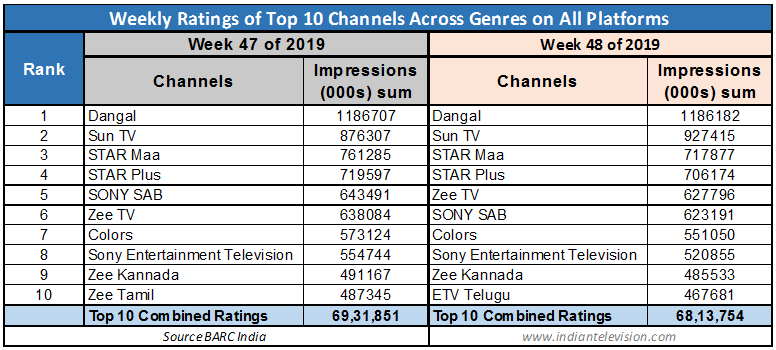
    Nine of the channels in BARC’s across genres on all platforms weekly list for week 48 were the same as in week 47 with a slight tweak in the ranks. The Network18/Viacom18 associated ETV Telugu reentered BARC’s across genres on all platforms weekly list  at the cost of Zeel’s Tamil GEC Zee Tamil during week 48 of 2019. The combined weekly impressions of the top 10 channels across genres on all platforms were slightly lower because viewership of the 9 persisting channels declined slightly in week 48 of 2019 as compared to the previous week.

    As has become a norm, Enterr 10 Television’s free to air (FTA) Hindi GEC Dangal headed BARC’s across genres on all platforms weekly list on all platforms in week 48 of 2019, followed by the Sun Tv Network’s flagship Tamil GEC Sun TV. As mentioned above, the other 8 channels were from 4 major networks.  Six Hindi GEC’s, two Telugu channels and one channel each from the Kannada and Tamil genres made up BARC’s weekly list of top 10 channels across genres on all platforms. Nine of the channels in BARC’s weekly list if top 10 channels on all platforms across genres were on the pay TV platform while one was FTA.

    Please refer to the chart below:

    BARC’s weekly list of top 10 pay channels across genres saw one change – Network18/Viacom18’s Telugu GEC ETV entered the list at the cost of the same network’s kids channel Nick. 

    BARC weekly list of Top 10 Pay Channels Across Genres had three channels from Zeel, two channels each from SPN, Star and Viacom18 and one channel from the Sun Tv Network in week 48 of 2019. There were five channels from the Hindi GEC genre, two channels each from the Tamil  and Telugu genres and one channel from the Kannada, genre in  BARC’s weekly list of Top Channels Across Genres on the Pay Platform in week 48 of 2019.

    As has been the case over the past few weeks, the most watched pay channels were not Hindi GEC – they were Tamil and Telugu GECs’ at ranks one and two respectively in the list.

    Please refer to the chart below:

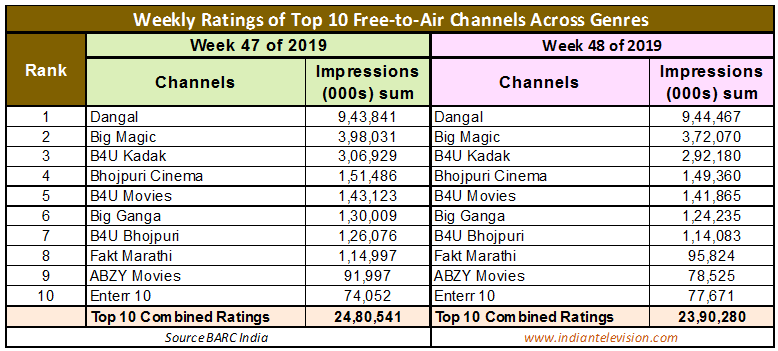
    BARC’s weekly list of Top 10 Free Channels Across Genres was the same  in rank and file in week 48 of 2019 as in the previous two weeks. Four channels from Enterr 10 Television, three channels from the B4U Network, two channels from Zeel and one channel from SkyStar made up BARC’s weekly list of Top 10 Free Channels Across Genres for week 48 of 2019. Four of the channels were from the Hindi Movies genre, three were from the Bhojpuri genre, two were Hindi GECs’ and one channel was from the Marathi genre in week 48 of 2019.

    Please refer to the chart below:
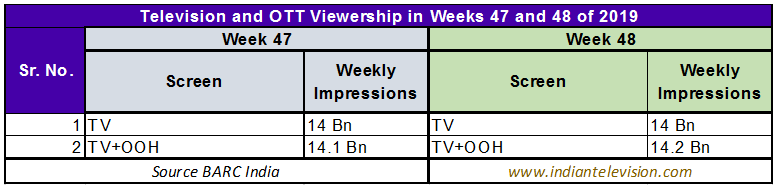
    Though TV viewership seems to have remained stagnant in week 48 of 2019 as compared to the previous week at 14 billion impressions, OTT viewership seems to have doubled according to BARC data. Please refer to the figure below:


  • Netflix to spend Rs 3000 crore on Indian content

    Netflix to spend Rs 3000 crore on Indian content

    MUMBAI: Netflix is upping its India game significantly as the streaming giant is ready to spend Rs 3000 crore on Indian content for this year and the next. Netflix founder and CEO Reed Hastings spoke about the investment during his India visit on Friday while illustrating the country’s important in their business.

    "We launched in 2016 and we have continued to invest. So we have a lot of content from the United States, the UK and Spain. We are developing our Indian content here,” Hastings said at the Hindustan Times Leadership Summit, according to media reports. "This year and next year, we will spend about Rs 3,000 crore developing content and you will start to see a lot of stuff hit the screens," he added.

    He also added that top performing Netflix shows from India include Sacred Games, Little Things and Delhi Crime. Talking about content made in India and watched by the world, Reed highlighted Mighty Little Bheem, which since its release in 2019,  has been watched by 27 million households around the world, including Latin America, Australia and New Zealand.

    Since launching here four years ago, Netflix has licensed hundreds of Indian films and shows, and invested in over 40 Netflix originals – almost all of which have been commissioned by Indian executives who live locally, know the culture and speak the language. These originals have been shot in over 20 cities across the country, including Delhi, Jaipur, Mumbai, Hyderabad, Lucknow, Kolkata, and Kochi.

    "The next 5-10 years will be the golden age of television. You are seeing unbelievable and unrivalled levels of investment. Partially from the global companies like Apple, Amazon, Disney and Viacom. There are all investing here in India as well as in the UK and the US. We are seeing more content made than ever before. It's a great export,” he said.

    "The internet has the possibility to really transform the Indian content market to be export-driven. So far, we have had some amazing successes. Sacred Games travelled around the world. We are really excited about those stories," he added.

  • Netflix available in more than 300 mn pay-TV households

    Netflix available in more than 300 mn pay-TV households

    MUMBAI: A new report from UK research firm Ampere Analysis has said that Netflix is available in more than 300 million pay-TV households. It also added that more than 50 million of those have come during 2019.

    The reach through Pay TV partnerships is almost double the company's current global subscriber base of 158 million. Netflix has been active in signing deals with pay-TV operators to extend its global reach. This year also, Netflix has signed more than 15 deals with major international pay-TV operators.

    While Western Europe has highly contributed to the growth, Netflix is available in about 86 per cent of all pay-TV homes in North America. The report also found that the streaming platform was available in about one-quarter of pay TV households in the Middle East and North Africa at the end of 2018, driven by its regional partnership with operator OSN. However, the partnership ended in August 2019, leaving Israel as the only market in the region with existing deals.

    The scenario is different in Central and South America, Asia Pacific and Central and Eastern Europe are blank canvases for Netflix. There are 400 million pay-TV subscribers in the region excluding China but Netflix has availability to about 40 million of those. While India is a key market for Netflix, fewer than one per cent of all pay-TV households in India subscribe to the OTT platform.

    “These onboarding deals give Netflix pay TV reach in every region bar SubSaharan Africa, while the Western European pay TV market has shown the most rapid growth for these deals,” the report said.