Tag: OTT

  • Eros Now partners with EUROSTAR Group

    Eros Now partners with EUROSTAR Group

    MUMBAI: Eros Now, the cutting-edge digital over-the-top (OTT) South Asian entertainment platform owned by Eros International, a global Indian Entertainment Company, has announced its partnership with UAE-based digital retail giant, EUROSTAR Group. The association enables the large diaspora from the Indian sub-continent and locals across GCC countries to access Eros Now’s vast content library of more than 12,000 movies, music videos, original shows, short format content quickie and more.

    The massive fan base of Indian entertainment content in the GCC markets can now take advantage of monthly and annual subscription packs of Eros Now from their nearest EUROSTAR-serviced retail outlet. The partnership promises to deliver entertainment and enhance customer convenience by offering seamless access to the premium OTT platform.

    Expats from India, Sri Lanka, Bangladesh, Pakistan and Egypt living in UAE and other GCC markets are massive fans of Indian entertainment, especially Bollywood movies and stars. Eros Now, apart from offering a huge Bollywood film catalogue, is also known as the one-stop destination for regional films in Tamil, Telugu, Malayalam, Kannada, Gujarati, among other Indian languages. The Company’s direct-to-digital offerings, ground-breaking original shows and short-format content category, quickie, further encourages GCC market consumers to avail subscription from EUROSTAR retail outlets.

    Eros Now chief executive officer Ali Hussein said, “We at Eros Now believe in constantly enhancing consumer experience and expand reach by partnering with relevant leading brands globally. The partnership with EUROSTAR is a testament to our endeavor in offering easy accessibility and unparalleled entertainment to the massive consumer base across GCC countries. We are confident that with a plethora of choices as well as regional languages to choose from, audiences in GCC will find there is no better place to go.”

    EUROSTAR spokesperson and executive director Shaan Jethwani said, “We are happy to partner with India’s leading OTT platform Eros Now to offer their bouquet of content to our audience. The increasing demand for Indian entertainment content in GCC markets is the driving force behind this decision. With EUROSTAR’s legacy on Pay TV distribution, we envisage to deliver its vast entertainment content to a massive consumer base across GCC countries.”

  • Eros Now Channel live on Wasu Media for Chinese users

    Eros Now Channel live on Wasu Media for Chinese users

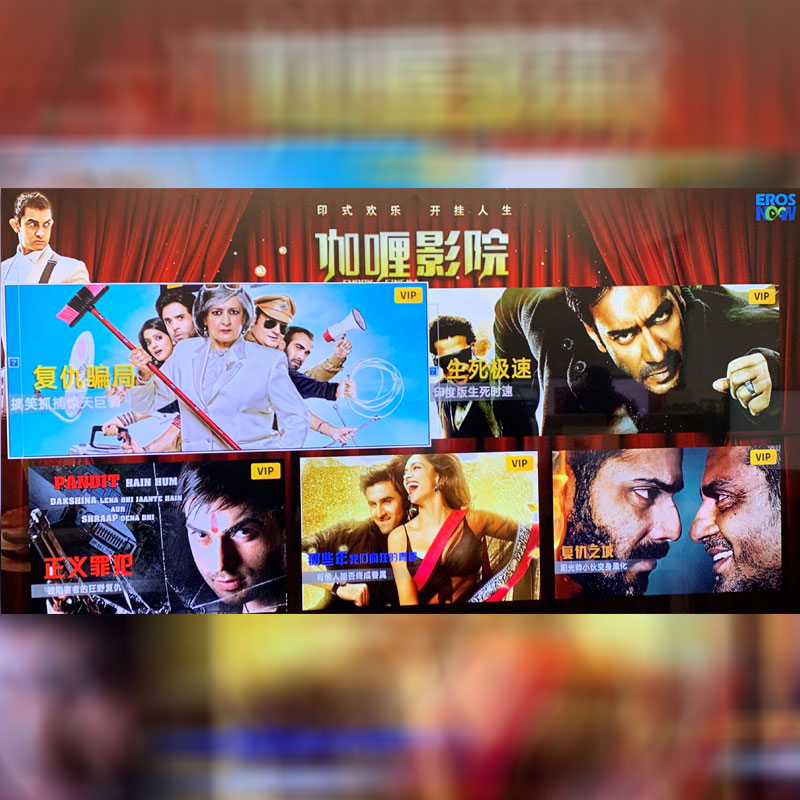
    MUMBAI: Eros Now, the cutting-edge digital over-the-top (OTT) South Asian entertainment platform owned by Eros International Plc (NYSE: EROS) (“Eros” or “the Company”), a global Indian Entertainment Company, in 2019 had announced a partnership with Wasu Media, a major cable television, broadband network OTT and IPTV service provider in China. Eros Now is pleased to reveal that the service is now live on Wasu Media in China and able to deliver Bollywood and digital original series to the Chinese viewers.

    Eros Now further cements its position as a pioneer as it is the only Indian OTT player which will have live services for Video on Demand in China, including on Wasu Media and iQiyi.

    Wasu Media, which has a strong base in the country, reaches 125 million users via its Cable TV, OTT and IPTV distribution network to more than 100 cities in China is now providing Eros Now a platform to further expand its subscriber base. The partnership will enable Wasu Media to provide Bollywood content as a SVOD service to Chinese viewers and further enhance the demand that Bollywood content has seen in China over the last few years.

    There is a massive cultural overlap in the viewing behaviour of Chinese audiences with that of South Asian audiences. This has been demonstrated by the success of movies like Dangal, Bajrangi Bhaijaan and Andhadhun released in China over the last few years with significant success at the Chinese box office. The trend now has escalated to digital platforms with Eros Now at the forefront with this transformation of building viewership of Indian movies with digital viewers in China.

    Eros Digital chairman & CEO Rishika Lulla Singh said, “Eros Now is the most popular destination for Bollywood & Indian movies across the globe. We are glad to go live in China in partnership with Wasu Media which caters to 125 million users in the country. The partnership with Wasu Media and uCast ties in with our ethos of connecting with Bollywood fans across the world. Through such alliances, we will continue to build on our global reach for Eros Now.”

    Wasu New Media Operations general manager Lu DanQiang said, “Wasu Media's partnership with Eros and uCast significantly promotes the development of Indian film and television in China, delivering more Bollywood content to Chinese audiences. Chinese film fans now have the opportunity to watch high quality Indian film and TV content, which is win-win cooperation for both parties.”

  • TVF eyes regional content and new genres in 2020

    TVF eyes regional content and new genres in 2020

    MUMBAI: After a year of “phenomenal growth”, The Viral Fever (TVF) is looking at 2020 to be more exciting and hectic. While TVF will continue to work with OTT platforms it collaborated with in 2019, it is also open to uploading content on its own app TVFPlay. The premium and one of the early digital content creators of India will also look at regional shows in this year.

    “In that way, we are very unique. We are one of the leading content creators. At TVF what we want to be known as the guys who give the best stories, best shows in the country. Where we do it, that’s something we are open to. We are open to collaborating with other OTTs, we are open to putting it on our own app,” TVF Originals chief content officer and head Sameer Saxena said talking about how they want to build TVF’s identity going forward.

    “We are actually looking at regional shows in 2020. We are working on Marathi shows. We want to line up shows in Tamil and Telugu too. In 2020, we will get into regional space and we will later expand into other languages,” Saxena commented.

    In 2019, the platform has produced shows for major OTT platforms like Amazon Prime Video, Netflix, SonyLIV, MX Player, etc. According to Saxena, the deals have worked in favour of brand TVF. He said the alliances have helped them to increase reach because all these platforms have their own set of audience. Hence, working with them opens up the opportunity to reach them. The platform is also looking at expanding these numbers.

    The company produced Immature on MX Player, Tripling season 2 and Gullak for SonyLIV. Kota Factory was another hit from the creator which went on TVFPlay and YouTube. Saxena noted that they want to continue short-form content and branded content pieces for TVFPlay. They are concentrating on short form for TVFPlay which they are not doing for any other OTT platform.  

    “We will continue to work with brands; we will do short-form content. These channels can be a learning stage for new writers,” he added on TVFPlay.

    “Overall content strategy for TVF would be to make more shows, make shows in different genres, languages. We are exploring supernatural and horror amongst others,” he commented.

    Talking about noticeable changes in the OTT ecosystem, Saxena said that more players have come in and different types of stories are being told across platforms. He also added that new types of stories are getting accepted too. Saxena perceives it as a great sign as going forward TVF also wants to tell different stories.

  • Higher investment in content & tech, innovative marketing strategy led OTT industry in 2019

    Higher investment in content & tech, innovative marketing strategy led OTT industry in 2019

    MUMBAI: The over-the-top (OTT) market in India turned more saturated in 2019. To make a dent in the cluttered space, the contenders have significantly upped their game with a greater amount of high-quality original content, incorporating new technologies and increasing marketing spend.

    As per EY and FIICI 2019 report – ‘A Billion Screens of Opportunity,’ the OTT sector in India grew by a whopping 59 per cent in FY2019, growing from Rs 13.5 billion in 2018 to Rs 17 billion in 2019. The sector is estimated to reach Rs 24 billion by 2021.

    How OTT platforms significantly upped investment in content and technology

    While ZEE5 has been bullish on producing original content since the beginning among the domestic OTT platforms, Zee Entertainment Enterprises Ltd (ZEEL) CEO Punit Goenka said that the financial year FY 2019-20 will be the year of peak investment for its video on demand (VoD) platform. Throughout the year, ZEE5 launched over 80 originals across languages in the calendar year 2019. In this over-competitive market, ZEE5 stands ahead of SonyLIV by 1.7x, approximately 5-6 times ahead of each the platforms – MX Player, Amazon Prime Video, VOOT and 14x of Hotstar.

    Along with launching a number of Bollywood-starring web-series, bringing back popular franchises in Hindi, the platform had at least one original web series come out in six different languages each month on an average in regional languages including Marathi, Bengali, Telugu and Tamil. As Indian audiences have always been an avid follower of movies, the platform strengthened the movie library as well. While the platform already boasts of over 20 original direct to digital films, it also made Bollywood hits like URI: The Surgical Strike, Dream Girl, Simmba, Sonchiriya, Kedarnath, PADMAN, Veere Di Wedding, Mulk, Parmanu, The Tashkent Files, The Accidental Prime Minister, Judgemental Hai Kya available for its users.

    After banking on catch-up and sports content for a long time, the leader in the Indian OTT pack, Star India’s Hotstar also decided to invest in premium original content. Reportedly, Hotstar jumped onto the bandwagon with a Rs 120 crore investment plan. The primary reason to launch originals is to convert users into paid subscribers in the face of increasing competition. Hitherto, adapting successful foreign shows by infusing local flavours had been an important aspect of Hotstar’s strategy but it is certain that the platform is not going to limit itself to adaptations.

    The traditional player Shemaroo also entered the OTT market in 2019 with its new platform ShemarooMe. The platform launched a host of new and exciting properties to keep the audiences entertained throughout the year including Shemaroo Bollywood Premiere, Shemaroo Comedy Studio, Shemaroo Bhakti Studio, Komal Nahta…aur ek Kahani, Mantlya Manat, etc.

    Shemaroo Entertainment Ltd COO Kranti Gada said that ShemarooMe’s Bollywood Premiere, the offering that showcases World Digital Premiere of critically acclaimed movies every Friday, was launched in September 2019 and has received positive response from not only the audiences but also the actors and the teams involved in the making of the films.

    “Shemaroo has seen a loyal base of audience as well as manifold growth with the increase of more varied content. Content is the only factor that lures viewers to any OTT platform or deters them,” Gada added.

    Times Internet’s MX Player, which entered the market in February 2019 after re-invention, also created a buzz with originals like Hello Mini, Immature, CheeseCake, Thinkistaa and Queen. International streaming giants are also looking at rich local content library to make their games stronger in India. Reportedly, Amazon Prime Video is looking to double its original content offering for India.

    At the same time, Netflix chairman and CEO Reed Hastings recently said at the Hindustan Times Leadership Summit that the company is looking to invest Rs 3,000 crore for original content in India this year and the next. He also added the top-performing Netflix shows from India include Sacred Games, Little Things, and Delhi Crime. He highlighted Mighty Little Bheem, since its release in 2019, has been watched by 27 million households around the world, including in Latin America, Australia and New Zealand. Since launching here four years ago, Netflix has licensed hundreds of Indian films and shows, and invested in over 40 originals.

    According to a MediaPartnersAsia report in July 2019, ZEE5 holds 44 per cent, Amazon Prime Video holds 17 per cent, Netflix holds 11 per cent, SonyLIV holds 10 per cent, VOOT and Hotstar hold 9 per cent each of the cumulative original content hours for OTT in India.

    To retain users and advertisers on the platforms, all the major platforms highly emphasised on better user experience. The way ZEE5 made its content strategy stronger, it made significant investment in technology too. The platform launched a one-of-its-kind industry-defining ad-suite, the ad:tech solutions for advertisers. The offering hosts tools likeAmpli5, Ad-vault, Infonomix, PLAY5, Wishbox.

    ShemarooMe entered into an in-app travel partnership with ixigo, app in app partnership with Dainik Bhaskar, and made the platform available on Roku. According to Gada, the availability of the channel on Roku devices further strengthened ShemarooMe’s presence in the US market by offering its vast library of Bollywood and regional language content to the Indian diaspora residing in the US while it did a global launch after seven months of its domestic launch.

    “2019 for the digital streaming industry was a revolution with multiple shows being launched, and many platforms experimenting with new technologies and new business models. 2019 also saw the rise of gamification for the non – fiction shows that were tried as a successful experiment with at least two other platforms. However, they have been for network-related apps with shows being broadcast simultaneously on television. The crux lies in independent apps adopting this to engage audiences with their Original content as a scalable model. It also saw the OTT platforms experimenting with influencer marketing, AI and VR filters, microbloggers, VR innovations, extensive usage of UGC apps etc,”  ALTBalaji senior VP and head marketing  Divya Dixit said.

    In a recent interview withIndiantelevision.com, MX Player CEO Karan Bedi said that the platform has invested a lot of money on video compression which means that the amount of video the platform can deliver in 1GB data is much more than others. Bedi added that buffering or latency is much lower on the platform which translates into lower cost for the user and the platform. He also added that the platform has also been investing a lot in recommendation systems.

    PwC, in its 2019 annual report – ‘Global Entertainment & Media Outlook 2019-2023,’ estimated that the Indian OTT market will grow to Rs 11,976 crore by 2023, growing at a CAGR of 21.8 per cent. During that period, India is also slated to be the eight biggest OTT market overtaking South Korea.

    How streamers innovated the marketing strategy

    “All the OTTs in India are suffering from a similar issue which is to get the audience to pay wholeheartedly for content. On top of that, very few OTTs have been able to create attractive content. People have also followed the GEC mantra in OTT advertising. Basically, you know like take a show and cluster it across. The most remarkable thing is the absence of remarkability,” McCann Worldgroup vice chairman and managing director Partha Sinha said.

    ZEE5 India SVOD marketing head Reilly Rebello said OTT platforms made communication a lot more contextual while talking about marketing trends in 2019. He added that even radio and outdoor were very contextual to location and geography this year. Moreover, OTT platforms are going on new social media platforms like TikTok, ShareChat, Helo.

    “The third one was that we saw a lot of OTT players going in the outdoor space. We did a lot of outdoor advertising in the first half of the year and it became noticeably larger in the second half of the year. We saw a lot of video advertising happening which was quite a move away from static poster-driven advertising. We emphasised on video and it was not only TV but also social media, YouTube and other OTT platforms,” Rebello added.
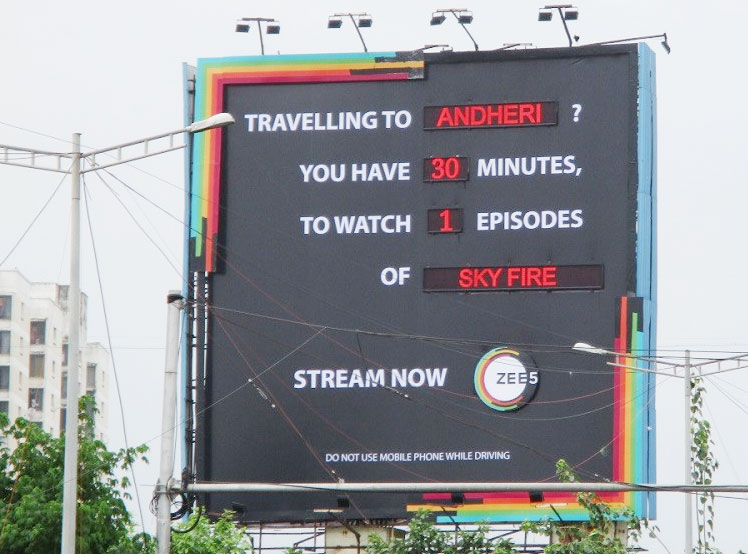
    “With each show the challenge is to break the mould and do something new appealing to the audience, Maybe that’s why the skyline of cities is dominated by OTT platforms. Billboards are prima facie an ‘announcement medium’ providing prominence across prime locations in target markets. It helps the vast audience pool notice and register a particular campaign, thereby increasing recall. However, from a show perspective, there are always several factors involved, largely the celeb value, the genre of the show etc. Marketing the show has science in its core element, in a never-seen-before manner. It lies perfectly in sync with adopting new-age technology that appeals to our target audience. If it’s an innovation hoarding, then it doesn’t just grab eyeballs, but registers in the minds of the audience owing to its novel concept,” ALTBalaji’s Dixit added.

    Shemaroo’s Gada commented that with bite-sized video content and emergence of regional social media apps gaining popularity, the industry eventually saw influencers and celebrities joining the bandwagon thereby driving adverting dollars to these new-age platforms.

    Rebello noted that ZEE5 changed the whole advertising game to be more video-focused as people are watching a lot more video. He also added that the measure has given a huge upside in terms of subscription and brand association.

    “We tried making things a lot more contextual. For example in our outdoor hoardings for Rangbaaz every line which has been there was made contextual to the location of the city. We got a lot of good feedback taking this approach. The dialogues are getting more popular. We also started our TikTok presence,” he added on ZEE5’s marketing initiatives.

    Talking about marketing mix, Rebello said that TV and digital hold equal importance as TV still gives most reach. Followed by TV and digital, outdoor and radio gets importance as those two mediums help in branding. He also emphasised on the importance of social media for the overall marketing strategy.

    “We saw many interesting campaigns by McDonalds and Burger King taking on each other through advertisements. Interestingly,  we also saw another form of this back home in India  when Shemaroo seized the opportunity of an ongoing “Masala Nahi Toh Mazaa Nahi’ campaign of Society Tea and placed their OOH hoarding right below the Society Tea hoarding with a continued conversation to say, ‘Toh Masala Chai ke Saath Ek Masala Movie ho Jaye? A unique way to complement each brand’s strength to woo audiences and strike a relevant connection seems natural and organic,” Gada added.

  • ZEE5 unveils ‘calendar for January’ 2020 with new originals

    ZEE5 unveils ‘calendar for January’ 2020 with new originals

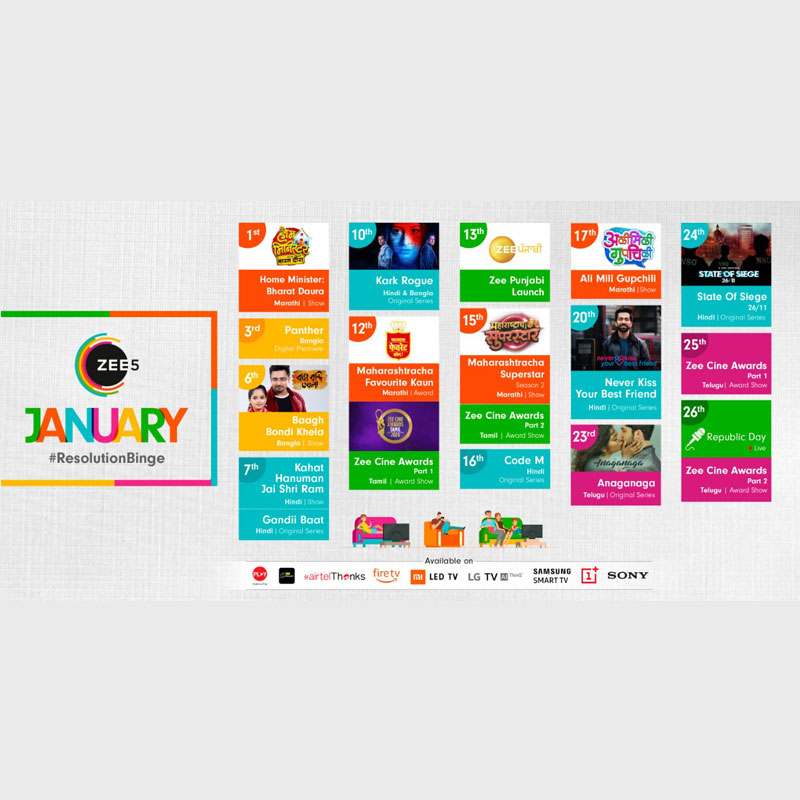
    MUMBAI:  ZEE5, India’s largest over-the-top platform unveiled a power-packed calendar for January 2020 with new launches across genres and languages.

    ZEE5 has already launched over 100+ Originals across top Indian (regional) languages and created a milestone in the Indian OTT space in 2019.

    Gearing up for next year, ZEE5 India programming head Aparna Acharekar said: “We are the only OTT platform in the country to have consistently delivered originals across genres and languages for all audience groups.”

    “We are all set to break our own records in 2020 and are constantly working towards ensuring an engaging experience for our viewers,” Acharekar added.

    The launch event hosted by Acharekar, marked the presence of actors Vivek Dahiya, Nakuul Mehta, Rituraj Singh, Sid Makkar, Vivek Mushran, Vipul Deshpande, Vikram Gaikwad, Chitrangada Satarupa, Rajesh Sharma, Aadesh Bandekar, Jiten Lalwani and Sneha Wagh amongst others.

    The indigenous OTT player has scheduled two shows adapted from books of popular Indian authors;  ‘Never Kiss Your Best Friend’ a millennial rom-com based on the young author Sumrit Shahi’s best-selling novel of the same name.

    And, State of Siege: 26/11 is a gripping tale of the terror attacks that rocked Mumbai on 26/11. The show is based on the book ‘Black Tornado: The Three Sieges of Mumbai 26/11 written by top journalist and author Sandeep Unnithan.

    Breaking the stereotype, the platform to also feature shows with women as protagonists; one such original called as Code M starring Jennifer Winget, Tanuj Virwani and Rajat Kapoor and Kark Rouge to be a bilingual series in Hindi and in Bengali starring Chitrangada Satrupa, Indraneil Sengupta and Rajesh Sharma.

  • OTT India 2019 – key trends and crystal ball gazing for 2020

    OTT India 2019 – key trends and crystal ball gazing for 2020

    While  creating this write up on something that’s as wide and far as India OTT we decided to be as objective as possible and use data to establish and talk about some key trends that we see both unique as well as interesting on how the sector is evolving.

    App Annie is a third-party app analytics tool that provides the starting point to map the market within the limitation of the methodology that they use. While it cannot be a gospel of truth, its a good indication of trends. Hope you find this useful high-level dynamics.

    Some caveats and assumptions that we have made:

    • Data is App Annie for Jan-Dec 2018 and Jan-Oct 2019 extrapolated for Jan-Dec 2019

    • SVOD classification: including Telco, International and few independent apps

    • AVOD/Freemium classification: including Broadcast and other independent apps

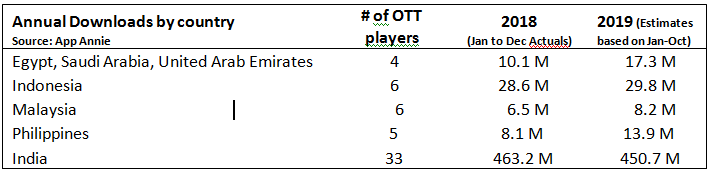
    1. How does the India OTT market compare with some of the countries emerging OTT markets?

    • In terms of the # of OTT players India continues to be the most competitive in the world.

    • In India, while a few players seem to have stopped reported by App Annie they have been replaced by another set of new players keeping the total number of players to 33 as reported the same vis-a-vis 2018

    • The India market continues to be represented uniquely by all 4 segments of players – Broadcasters who have risen well to the challenge, International players with deep pockets like Netfilx, APV and Apple TV, the telcos and finally a large number of independents like VIU, Balaji Alt, Eros Now, HoiChoi.

    • Other territories are less competitive (or benign?) vs India OTT with the International players dominating in most markets. With exception of the MENA region, hardly any broadcasters participating as vigorously as in India

    • Crystal Ball Gazing: It will be interesting to see how much consolidation accelerates in 2020 with Disney Plus and more activity from the defenders?

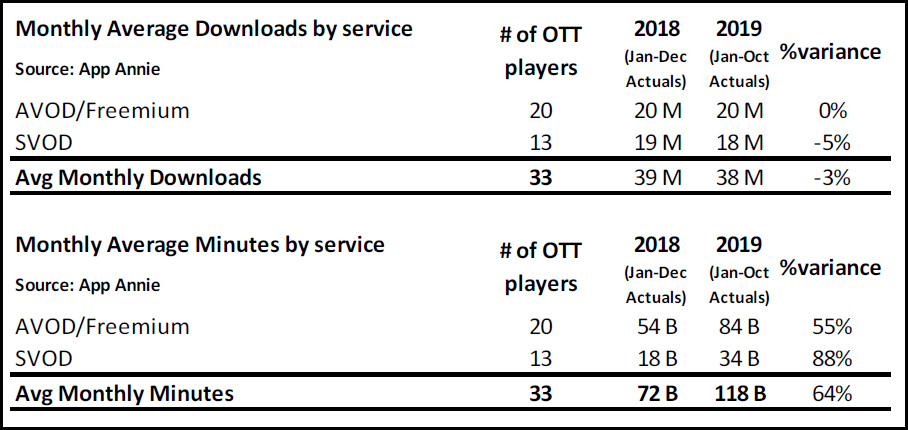
    2. How has the India OTT market progressed vs 2018 on downloads and on consumption?

    • The number of downloads has remained flat vs 2018 but the Minutes Consumed increased by 64%. Is there some sign of maturity and loyalty setting into the behaviour of the consumer now?

    • Indians are consuming on an average 118 billion minutes per month consuming on OTT apps in the country. Clearly that’s coming at the cost of more traditional video sources.

    • We don’t think OTT will kill TV but the challenge is now very real and visible. Is potential finally turning to reality?

    3. The most polarising part of the OTT business. What is the interplay between the SVOD and the AVOD services?

    • Downloads growth is flat between the two segments. On Minutes growth, the SVOD services seem to have made gains although they still lag the AVOD / Freemium in terms of absolutes.

    • Clearly the paying or free trial customer is making full use of the SVOD access. Depth of content, highly visible shows in terms of promotions by the SVOD players like Netflix and APV seem to be winning customers.

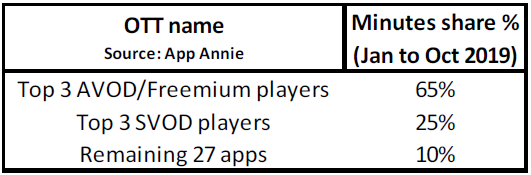
    App Annie data also indicates how skewed the market is towards the top cluster. In terms of minutes share, 90% of the total minutes is contributed by 6 apps with the remaining 27 players giving 10% of minutes share. These top OTT apps by minutes share are:

    While 2018 was a year of making a splash with never before seen production mounting on the OTT space, heavy marketing spends to support these launches 2019 did come across to be a year of and consolidating. Focus on revenue and recovery of investments (real profitability is still some time away) was high.

    Some bets on 2020:

    • Original content launches will be the flavour of the season with all the effort and our suspicion is that the hours of content here will rival that of a GEC channel producing and releasing first run content.

    • Regional will continue to grow. More regional OTT launches – be it from broadcasters or from International players will be seen and there will also be a few independents like in the case of Telugu launching services.

    • The “for whom” will assume a stronger accent on content productions. More TG focused web originals will emerge instead of GEC style of content catering to a wider base

    • Technology driven by personalization, AI powered discoverability to unearth content specific to viewers will take on a deeper play.

    • SVOD players will innovate on pricing or payment mechanisms to deepen penetration, AVOD players will push for innovation on monetization beyond inventory to realise their reach potential

    2020 promises to be a tough year for the players but an exciting one for consumers who will continue to be spoilt for choice.

    (Vishal Maheshwari is country manager, and DS Ramakant Raju is associate director, growth marketing at Viu India. The views expressed are their own and Indiantelevision.com may not subscribe to them.)


  • A view of the trends in Hindi mainstream cinema in 2019

    A view of the trends in Hindi mainstream cinema in 2019

    2019 was a great year for Hindi mainstream cinema starting with Vicky Kaushal’s Uri: The Surgical Strike, based on the Uri attack of 2016, which did over Rs250 crore net box office.

    And somewhere it is ending with Dabangg 3 , which has underperformed and opened at 5th position this year, behind Ayushman Khurana’s Bala .

    What’s happening here since the last 3 years in Hindi cinema is a renaissance of a certain kind.

    To me it’s the classic buffet v/s a-la-carte menu- earlier a meal out was always to a buffet place- value for money meant getting a variety, didn’t matter if the menu repeated itself – butter chicken, dal tadka, palak paneer , papad pickle .. but now the audience prefers an a-la-carte, curated menu. ( It can still be the butter chicken and dal tadka, with a twist and served with the most authentic kulcha that does not come from a cookie cutter.

    2019 has further proven that formulas don’t work. What’s clearly working is unconventional storylines coupled with a few more important aspects of storytelling.
    The audience really wants authenticity coupled with entertainment. Indian audiences are reacting positively to the shift to show more local content that represents them and provides wholesome entertainment. 
    The audience is not relating to films on just who the star is- they don’t care if it is big or small as long as the films represent what they have set out to tell , with honesty, quirkiness, and relatability.

    Success is being witnessed with biopics, patriotic and multiple small star films in 2019 and ones that show unseen flawed characters played by lead actors..

    Rajkummar Rao has played the lovable, desi, non sophisticated , wearing- his- emotions- on- his- sleeve- hero to great effect. No six packs abs, no conventional hero looks- just sheer acting prowess bringing hours of joy to the audience. “Vicky Pleeej” has charmed the hearts of the staunchest propah English speaking audience. 

    2019 further brought dialogue delight . We started the year with 'How's the Josh?' which was quickly followed by 'Apna Time Aayega.' These dialogues connected with the audiences and will stay on even after the year ends. 
    Localised dialects are also becoming more of a norm with authenticity being key to how audience member responds to a film. Be it the Mumbai slang we see in Gully Boy, or the accents that show us the universe of Dreamgirl, the more specific the dialogues are, the wider its mass appeal. 

    Kabir Singha, the Telugu remake of Arjun Reddy became a blockbuster. Personally I have an issue with the subject, but the film also worked because it was authentic in terms of its characters. The flawed titular character in the film, who even though is scary with his violent streak, struck a chord with the masses.

    At the same time, stories that come from a real, personal space like Chhichhore, did well- backed again by authentic characters , with its soul in the right place and a story that resonated and entertained 

    Besides authenticity and entertainment, the emotional foundation in a film should be strong and relatable and this renaissance we are witnessing shows us that films withrealistic emotional depth work brilliantly – Article 15, Gully Boy also proves that. 

    Akshay Kumar, the only actor besides Ayushman Khurana who has had a long run of hits , set a new trend for himself and Hindi cinema by doing unconventional storylines.
    Khiladi Kumar had an unforgettable 2019 with three consecutive hits so far, each of which was a different genre film. He started the year with the historical film Kesari, which garnered him rave reviews and great collection at the box office. This was followed by the real-life Mars' mission-inspired Mission Mangal, which had an ensemble cast primarily dominated by female actors. The movie won the masses again with a timely release over the Independence Day weekend. His last film Housefull 4, the fourth instalment of the comedy franchise, quickly became a super hit partly because of the uniqueness of the story itself. The actor's last film of the year would be the family entertainer Good Newwz, which is also being touted to win hearts with its uniqueness and humour. 

    A huge trend that will continue to work is heartland heartland heartland- this has proven to be the cash cow, as audiences are charmed by the language the setting the humour and the stories themselves.

    Ayushmann Khurrana, has created a huge die hard audience base by bravely playing flawed, insecure men with confidence issues much to the delight of writers, directors and producers who can now look at the so-called hatke films with dollars in their eyes.

    If 2018 showed Khurrana’s range as an actor, 2019 showed his talent at drawing numbers at the box office with each of his three films – Article 15, Dreamgirl, and Bala. With every film being as different as it can get, Khurrana managed to pull a coup with his idiosyncratic characters. Each of Khurrana’s films delved into a socially relevant and yet unique idea which given the numbers, audiences strongly related with. He even managed to draw crowds in the Chinese multiplexes with his 2018 release Andhadhun, which released in China this year and minted $45 million at the box office.

    This takes me to what Vijay Sethupathy has done for Tamil cinema, similar to Khurana – playing comical, vulnerable and flawed characters.

    The underdog that is unapologetically exposed, is worth every rupee.

    War is not part of this trend, but then War’s trailer kept its promise- bromance, high class sophisticated action, sex on toast, bronzed Hrithik and Tiger—and a film that held it all together. The audience got its bang for their buck… at an average Rs 300 it was truly worth spending 3 hours in the cinema hall.

    There is also the learnings from what didn’t work- Kalank, Student of the Year 2, amongst many others. The learning were- top stars, great opulent sets, fantastic songs and choreography cannot ensure box office success. The film needs to touch hearts , make people laugh, be genuine and written really well. And no amount of marketing can take the place of the powerful word of mouth. 

    The Indian audience is smart, sassy and knows value for money. 

    In terms of the business side of things, 2018 saw steller performance in the box office revenues which grew by 12.2% to reach an annual revenue of Rs 174.5 billion. Of this amount, the domestic film revenues crossed Rs 100 billion with net box office collections for Hindi films at Rs 32.5 billion – the highest ever.
    Thirteen Hindi films reached the Rs 100 crore mark in 2018, the highest number the industry has ever seen. Multiplexes added to the total screen count to reach 9,601.
    A major reason for this exponential growth is digitisation and the infusion of over-the-top (OTT) platforms.
    Specifically, the digital revolution has created a tectonic shift in content consumption in India. In keeping with the global digitisation trend, OTT platforms invested heavily in acquiring exclusive rights to cinematographic films.
    2019 will also be a growth year- growth coming from the unconventional and from Khurrana.  But to me finally, any film, that makes the popcorn taste better, is the one to watch. 

    (The author is senior VP, creative and production at Kross Pictures. The views expressed are her own and Indiantelevision.com may not subscribe to them.)
     

  • MX Player’s strategy to lead the OTT game in 2020

    MX Player’s strategy to lead the OTT game in 2020

    MUMBAI: The bets on the Indian OTT market have seen an exponential rise over the last few years. However, only a handful of companies have been able to make a mark. One of them is Times internet’s daring bet MX Player. In the coming year, MX Player is looking at strengthening its vernacular focus as well as gaming.

    When the company shifted its focus this year, there was a doubt about its transition from utility to service. However, MX Player CEO Karan Bedi says that the platform has exceeded all the targets and the target for March 2020 has already been achieved in September 2019. Bedi says that original content has performed well. The platform is still learning about things like which content works, what the user likes, how they react to a product, how to improve, etc.

    The year 2020 will see another 35-30 new original shows with 15-16 in the first half of the year in different genres. Out of these, three to four are big regional shows.

    “There is a whole slate of exciting shows coming up. We obviously continue to work with our partners who bring exciting content in the regional and Hindi side. We have already originals in Tamil, Telugu, Punjabi, Marathi, and we will continue to do more in Bhojpuri, Kannada, Malayalam, and in Bengali. You will see originals across languages. In the coming year, probably 40-50 per cent of content will be regional. It’s exciting. And gaming is a big focus in 2020,” he says.

    MX Player hosts other platforms’ content as well including Arre, ShemarooMe, Pocket Aces, Ms. Malini, QYOU Media, EPIC channel, etc. It says that this strategy of partnership doesn’t hamper its own image building. Instead, it wants to be the destination that people come to for any content they like.

    “I think we are happy to be in a situation where there is content that we produce and content that our partners produce. There is no reason why I should deny my audience what they want to watch. And all the relationships we have are win-win. It grows the market. So I think that we are not in any way worried about that,” he comments.

    He also mentioned that they have had over 100 brands for MX Player from Airtel to Godrej, Amazon to Flipkart, even FMCG companies like Dabur. There are a total of 150 clients now. He added that many of them are repeat clients who continue to spend on the platform on a regular basis as they are seeing ROI.  According to him, there is a good split of brands coming on OTT platforms. While FMCG is huge in traditional media, the ratio is not equal on OTT as the audiences are totally different. Though e-commerce and BFSI brands are early adopters, FMCG is also catching up.

    “I think everybody is in investment mode. I have to say that it takes time to build large consumer businesses. Even if you look at the TV industry in India for the first 10-12 years in-fact I don’t think profits came. I don’t think we will take that long. I think OTT will take much less because overall the ecosystem has evolved now. The ad and payment ecosystems are much more evolved compared to when TV started in India. Certainly, there was a long period of investment before the business became sizeable. I don’t think profitability or break-even is that far away,” he concludes.

  • South Korea sees growth in pay TV numbers

    South Korea sees growth in pay TV numbers

    MUMBAI: This is one market that  is bucking the OTT trend and pay TV is actually looking strong here. South Korea has seen a growth in its pay TV subscriber base to 33 million in the first six months of the year, up 540,000 or 1.67 per cent over the second half of last year. The numbers include subscribers to system operators, satellite services and IPTV services. The most buoyant of these three has been IPTV services.

    Amongst the leaders figure fixed-line and telco services provider KT with a market share of over 21.4 percent or just under 7.1 million subscribers, followed by SK Broadband with 14.7 percent and LG Uplus with 12.4 percent. These three offer IPTV services to their subscribers and have been showing healthy growth.

    At the No 4 and No 5 spots are CJ Hello and KT Skylife with market shares of 12.3 percent and 9.9 percent, respectively.

    The division between IPTV, system operators, and satellite TV is 47.6 percent, or 16 million people; 41.5 percent and 9.9 per cent respectively.

  • ShortsTV OTT app to launch in Q2 FY 2020

    ShortsTV OTT app to launch in Q2 FY 2020

    MUMBAI: In November 2018, ShortsTV entered the Indian market with the concept of showcasing the world's largest catalogue of high quality short films and series. In partnership with various distribution platforms like Tata Sky, Airtel Digital, DIsh TV and D2H, the channel reached over 60 million households in India. The next big move coming from the company is to launch a video streaming app in the second quarter of 2020. Another focus of ShortsTV in 2020 will be on creation and acquisition of regional contents. 

    "We’re thrilled by the response we’ve received so far by audiences in India. People here love short films," comments ShortsTV chief executive Carter Pilcher. 

    In an interaction with Indiantelevision.com, Pilcher informs, “We are very excited about the coming year as we have a lot of plans for the Indian market. We will be focusing a lot on content creation and acquisition including adding to our growing portfolio of regional language content. Another key initiative is the launch of our video streaming app which is expected by the second quarter of 2020 in India.”

    The app will mainly have short films and series in all formats and genres including live action, animation, dramas and  documentaries.The company is currently testing the app in beta mode in the US. He says, “There are huge opportunities in India around mobile, as more and more people are streaming content on their mobile devices. Short films are perfect for this, as they can be enjoyed anywhere and anytime. We are looking forward to providing the best short film content to mobile viewers in India.”   

    He said that the big focus in 2020 will be the launch of ShortsTV’s app, which uses a machine-learning algorithm like Spotify. Viewers will be able to choose from categories based on director, language, mood and genre. 

    In 2020 ShortsTV will also be seen investing heavily in producing regional content in Tamil, Telugu, Marathi, Kannada, Malayalam apart from Hindi and English languages. 

    Pilcher comments, “We see regional content as hugely important as there are many emerging filmmakers producing exciting short films in different parts of the country. Our existing catalogue offers shorts in Hindi, Marathi and Tamil and our acquisitions team is always on the look-out for more regional films to add to our service. Next year we plan to add more content in local languages like Telugu, Kannada and Malayalam and beef up our existing regional portfolio.”

    ShortsTV launched in India with 150-175 hours of Indian titles with another 500 hours of international content. Over the next year it aims to add another 200 hours of Indian origin shorts and have 50 per cent of the library of Indian short films.

    It has a growing catalogue of more than 13,000+ Indian and international short movies. Top of the list are award-winners from all the biggest international award franchises: Oscars, BAFTAs and Cannes with the biggest Hollywood and Bollywood stars: Benedict Cumberbatch to Jackie Shroff and Judi Dench to Radhika Apte. “In India, currently about 30 per cent of our content is Indian produced and we’re working to increase that amount by acquiring content from leading producers around the country,” opines Pilcher.

    Pilcher believes, in India, the most popular genres are horror, thriller and crime. He says, “Millennials are inclined to watch all kinds of content. They are more open to edgy and provocative films than earlier generations, which short films are great at delivering and which we have a lot of on ShortsTV.”

    ShortsTV has partnered with some of India’s short film producers, including Large Short Films, Terribly Tiny Tales and Humara Movie. Some of the popular titles in its catalogue include Chutney, Ahalya, Kheer, Int. Café Night, Half Full, etc. featuring some of the leading Bollywood actors like Radhika Apte, Naseeruddin Shah, Jackie Shroff, amongst others.

    It has also partnered with Bollywood directors like Anurag Kashyap and Subhash Ghai’s film school Whistling Woods to bring alive more creative shorts content.