Tag: OTT

  • ZEE5 starts streaming TV9 news channels on its platform

    ZEE5 starts streaming TV9 news channels on its platform

    MUMBAI: ZEE5 has recently added news network TV9 to its rich roster of regional news channels giving consumers option to choose from various languages available. TV9 is now going to be available on the ZEE5 platform to bring to viewers daily updates via their flagship channels TV9 Telugu, TV9 Kannada, TV9 Marathi, TV9 Gujarati, TV9 Bharatvarsh, and News 9.

    ZEE5’s understands the pulse of the Indian audiences and the initiatives for the regional audiences have added to the platform’s appeal. The integration of TV9 on the platform is a result of the platform’s endeavours to provide more real-time and detailed information to regional audiences. The audiences across the country can now comfortably access verified news in their preferred language. At a time when getting real-time and verified data is a necessity for India, ZEE5 and TV9 together provide a destination where you are guaranteed of getting all the relevant data you need to know in real-time.

    ZEE5 is the largest producer of regional content in India, with a bouquet of offerings in the regional library across multiple genres and formats. ZEE5 is continuously adding to and reinventing the platform to curate more content at regular timelines. This partnership is another step in ZEE5’s journey to truly become India’s Entertainment Super-App by further expanding the platform’s ever-expanding regional reach.

  • Global video streaming market forecast to reach $184.3 billion by 2027

    Global video streaming market forecast to reach $184.3 billion by 2027

    MUMBAI: The global video streaming market size is expected to reach $184.3 billion by 2027, registering a CAGR of 20.4 per cent from 2020 to 2027. Rising technological advancements such as the implementation of block-chain technology in video streaming and the use of artificial intelligence (AI) to improve content quality are expected to boost market demand over the forecast period. Furthermore, growing adoption of cloud-based streaming solutions to increase the reach is directly influencing market growth. This trend is observed in numerous parts of North America and Asia Pacific. Factors behind the growth of these regional markets include rapid digitalization, increasing use of mobiles and tablets, and growing popularity of online viewing.

    Globally, the rising demand for on-demand video and extensive growth of online video are key drivers of the market. Moreover, increasing demand for high-speed internet connectivity acts as an advantage for the market. The growing acceptance of smartphones in combination with an extensive range of high-speed internet technologies such as 3G, 4G, and LTE has substantially led to the trend of online broadcasts. In addition, the growing demand for devices that can support digital media is helping consumers' access media content anywhere in the world.

    Key findings from the report:

    Increasing usage of videos in corporate training and in the education sector are anticipated to drive the market

    The over-the-top (OTT) segment held the largest revenue share and is also expected to grow at the fastest pace over the forecast period

    Asia Pacific is expected to witness significant growth over the forecast period, majorly due to increasing demand for high-speed internet connectivity and on-demand video streaming

    Key players in the video streaming market include Akamai Technologies, Amazon Web Services, Inc., Apple Inc., Cisco Systems, Inc., Google, Kaltura, Inc., Netflix, International Business Machine Corporation (IBM Cloud Video), Wowza Media Systems, LLC, AT&T Intellectual Property, and Hulu.

  • MX Player recognized as a “Great Place to Work”

    MX Player recognized as a “Great Place to Work”

    MUMBAI: Rising to the top in a short span of 15 months, entertainment streaming platform MX Player has been recognized as a “Great Place to Work”. The young brand, that went live with its OTT offering in February 2019, has been certified in the small and mid-size organizations category, in the survey conducted by Great Place to Work Institute, India.

    With a strength of 300 employees across its Mumbai, Delhi, Bengaluru and Beijing offices and a participation of 87 per cent, MX Player’s organizational strengths were reflected as pride responsibility and empowerment – mirroring its work environment of camaraderie, respect and a culture of going over and beyond the call of duty whilst on the job.

    “The continued success of MX Player is attributed to its employees and their passion”, said MX Player HR head Anjani B Kuumar. He added: “We aim to create a holistic environment while offering well-rounded opportunities to our employees that is reflected in the results of the survey. Staying true to our proposition and delivering ‘everytainment’ to the audiences while having a happy set of employees is something, we truly take pride in.”

    The Great Place to Work® assessment is considered the gold standard in the space of workplace culture globally and evaluates an organisation based on its employee feedback and people practices impacting the entire lifecycle of employees. The institute evaluates more than 1000 organisations every year in India and only the organisations meeting the criteria based on the rigorous assessment get certified.”

    Prasenjit Bhattacharya, CEO, Great Place to Work® Institute, India said, “The Great Place to Work® Certification indicates that there is a high level of trust, pride and camaraderie in the workplace culture. We see a high trust culture normally translates to sustained business performance.”

  • Are producers and cinemas heading for showdown on OTT release?

    Are producers and cinemas heading for showdown on OTT release?

    MUMBAI: Nothing compares a theatrical experience: the sprawling screen, overall ambience, high-quality surrounding sound system, the cheering (and sometimes jeering!) crowd, and the overall immersive experience it provides. The pure joy of being there just cannot be supplanted with any other medium. But, the Covid2019 pandemic has necessitated the need for other means of movie release: OTT.

    Cinemas are unhappy with the release of movies directly on an OTT platform by skipping theatrical windows. With the Covid2019 pandemic refusing to fade away anytime soon, theatre release is not possible, at least in the foreseeable future. Will this lead to a showdown between cinemas and producers? Or will there be co-existence to find common ground?

    A recent statement by INOX has pitted the exhibitors against the producers. The cinema chain expressed “extreme displeasure and disappointment” on an announcement made by a production house to release their movie directly on an OTT platform by skipping the theatrical window run. The decision of the production house to deviate from the globally prevalent content windowing practice is alarming and disconcerting, said INOX in a statement.

    According to INOX, cinemas and content creators have always been into mutually beneficial partnerships. “INOX has been investing profoundly towards adding world-class quality screens, across the country, only to provide more eyeballs to the great content being produced. This partnership has endured for decades and has provided succour to each other. INOX will be “constrained to examine its options… and reserves all rights, including taking retributive measures, in dealing with such fair-weather friends.”

    In response to this, producers’ guild of India issued a statement, expressing disappointment at the “abrasive and unconstructive messaging from some of our colleagues in the exhibition sector.”

    “Statements that call for “retributive measures” against producers who decide to take their movies directly to OTT platforms, especially at a time when cinemas are unfortunately closed for the foreseeable future, do not lend themselves to a constructive or collaborative dialogue on the way forward for the industry.”

    The guild said that we are in unprecedented times, facing one of the greatest public health and economic emergencies of our lifetimes. This is a time for the entire film industry to come together with empathy and support for the difficult predicament.

    The production sector (just like the exhibition sector) is suffering hundreds of crores of losses on a daily basis. Elaborate and expensive sets erected for under-production films have had to be taken down due to no date in sight for shoots to resume, with the sunk cost of the set and studio rentals to be borne completely by producers, as insurers refuse to cover the cost. Shoot schedules have had to be abruptly cancelled due to the lockdown, with huge cancellation charges being borne completely by the producer, again with no support from insurers. Interest costs are mounting on amounts raised to fund films, with producers having to bear this additional burden with no date in sight for cinemas to re-open. In this context, the guild said, it is important that each stakeholder understands and empathises with the predicament of the other, rather than adopting an adversarial stance which is counter-productive for the entire value chain.

    Indiantelevision.com reached out to producers and directors to seek their reaction in this regard. The overwhelming feeling among the fraternity is that it is a temporary phase and that OTT release is the need of the hour – the product of a peculiar situation like this. Once the situation normalises, theatrical releases will happen and people will throng to watch movies on the big screen.

    Film producer Ramesh Taurani feels that taking the OTT route is the right decision at this point of time.

    “The current scenario has led to producers taking this decision. In an ideal world, these films would release theatrically, but we are still trying to figure a way for theatres to reopen safely. Since the majority of the content is being consumed online right now it is the better call given the pandemic. Producers also have their financial restraints and can’t hold on to their films beyond a point so it definitely is the correct decision right now,” he said.

    Hats Off Production founder Jamnadas Majethia says: “As I always say that these are extraordinary circumstances and unique situations. So such decisions and behaviour will surface till we really don’t have a clarity on the impact of Covid2019.”

    According to him, films have premiered on OTT earlier also. “And we will see ‘houseful’ boards at cinema halls again. These habits of the big screen experience have been built over the number of years and we can’t change it over with a few months of restrictions. The vaccine will do the magic for the world. And till then it will be creations, innovations and survival of the fittest and emergence of good human behaviour that will help us create new opportunities of business,” he adds.

    Malayalam producer-director Anil Thomas said producers have no other option but to release movies in OTT. “Even in the Malayalam film industry we are releasing movies on OTT platforms as we are left with no choice. Theatres are the last thing that will open after lockdown is lifted. So, producers over here have mutually decided to release shows on OTT platforms.”

    According to him, not all the movies will be released but the ones which have low shelf-life or. “Nobody wants to release on OTT platforms; theatre has its own experience but till the time everything will get back to normalcy it will be too late. They are mainly worried because if content gets released on OTT platforms then there will be a shortfall for theatrical films.”

    Anil Thomas feels that theatre bodies and film producers will have to find common grounds. “In the long-run for all of us to survive, there should not be a showdown and all. We have to find a solution. I am also releasing my film Soothy Sujathayum on Amazon Prime,” he said.

    Film director Kunal Kohli said: “Let INOX release what per cent of their revenue is ticket sales vs F&B. No one goes to a theatre to eat, right? Start sharing that revenue with producers as well, before accusing them of trying to survive in a world pandemic never witnessed before by mankind.”

    A user said: “Well sir it is all about business. Don’t forget how many people rely on these cinemas. If everything changes suddenly, who will be responsible for those people who will lose their jobs? Though everything is becoming online, but don’t forget the whole chain.”

    Replying to this, Kunal said: “There is an even longer chain of workers making the films. They also need to survive. Pls read my tweets properly. Theatres like I said WILL survive. Films WILL release in theatres. Some have chosen to go digital. Nothing wrong with that. Need to support them as well.”
  • ZEE5 strikes partnership with Samsung ‘My Galaxy’

    ZEE5 strikes partnership with Samsung ‘My Galaxy’

    MUMBAI: ZEE5 today announced its partnership with Samsung ‘My Galaxy’, the all-in-one entertainment app for Samsung smartphone users. The partnership will open up a new world of digital entertainment for Samsung smartphone users by giving them easy access to ZEE5’s vast content library available across 12 languages and genres. The digital content partnership will offer a seamless OTT experience to Samsung smartphone users and they will be able to access ZEE5 content from within the ‘My Galaxy’ app without installing the ZEE5 app separately.

    ZEE5 India business development and commercial head Manpreet Bumrah said, “With a wide range of entertaining content, ZEE5 with over 100+ originals across genres and languages, is India’s entertainment super app and largest original content producer. We are extremely delighted to have partnered with Samsung for their flagship ‘My Galaxy’ offering and we are confident that this synergy between the two iconic brands will further augment the entertainment quotient delivered for the audiences across Samsung devices anytime, anywhere.”

    Samsung India senior director – content and services Pramod Mundra said, “Keeping in mind the evolving entertainment needs of Indian consumers, Samsung is delighted to bring exciting content from ZEE5’s bouquet of original shows, movies, Live TV channels, and catch-up TV on its ‘My Galaxy’ App. We are confident that this content will resonate well with our consumers and keep them entertained on their Samsung smartphones.”

    Samsung smartphone users can for the first-time use ZEE5 directly without having to download the app from Google Play Store. Samsung smartphone users can simply register and start consuming ZEE5 content from within the Samsung ‘My Galaxy’ App. They can also subscribe to ZEE5 to stream premium content. Consumers get access to over 1.25 lakh hours of great content in 12 languages across original shows, movies, Live TV channels, and catch-up TV.

    ‘My Galaxy’ app provides Samsung consumers in India exciting content to meet their growing entertainment needs. It offers a unique all-in-one experience including videos, music, games, news and personalised offers and updates.

    Follow Tellychakkar for the consumer facing news & entertainment

  • OTT players eye CDNs for optimised video delivery on mobile devices

    OTT players eye CDNs for optimised video delivery on mobile devices

    MUMBAI: There's no doubt that content is the most important component for over-the-top (OTT) platforms and publishers. But what has been put on the backburner is how platforms deliver content to our devices; i.e, the role of content delivery network (CDN) in the online ecosystem. During the Covid2019 lockdown, all OTT platforms and news websites have seen 2X-3X growth on average and CDNs have ensured uninterrupted consumer experience. As smartphone usage shoots up with more interactive content, CDNs need to innovate as well.

    Snapdeal CTO Prashant Parashar said during a virtual roundtable organised by Indiantelevision.com that CDNs have not focused highly on mobile devices while Indian consumers mostly consume content on smartphones. According to him, it is the right time for CDN players to innovate on the mobile side of videos and images and optimise for the newer economy in the post-Covid2019 world.

     “A lot of time we experience that video delivery is not as optimised as you would expect for mobile platforms. As new content is not being created, content consumption has spread out quite a bit. As a result, it is putting pressure on CDNs in terms of efficiency. Hence, it has become tough managing traffic,” Viacom18 Digital Ventures technology and engineering head Mohit Srivastava added.

    Limelight Networks product management senior director Michael Milligan also acknowledged that serving video to mobile devices have certain challenges. If a user is on fixed broadband, the bandwidth can be anticipated. But in terms of mobile connection, bandwidth as well as the latency may change unpredictably.

    “So from a Limelight point of view, we have done a lot to optimise how we can sustain network condition changes in real-time. We have done a lot of work in CDN and HTTP streaming capabilities to be aware of bandwidth changes quickly and to work with our customers to make it easier as things like buffer rate have a huge impact in countries where people are watching mostly on mobile. We have optimised a lot of our CDN to do that,” he added.

    “It has to do with TCP optimisation and understanding a client’s bandwidth. There are various algorithms which you can use to understand real-time bandwidth. It's a very interesting technical challenge because as you are trying to measure the bandwidth, you are actually impacting how you do that. There are some algorithms that have been developed lately by companies like Google and Netflix to help do that in a way that’s more efficient. We look at the connection real-time and understand the bandwidth and latency simultaneously,” he elaborated.

    Asked as an OTT player what he expects from a CDN, Srivastava said that cost is very important because the amount of video OTT players deliver can really change the economics of the business. But beyond cost, everyone who delivers video is looking at the quality of service that they can expect of a CDN along with the kind of configurabilty and customisability that it provides because the video has multiple use cases. He mentioned that broadcast is an easier case to serve but as soon as it comes to peer-to-peer communication, it starts becoming a challenge. According to him, CDNs have not played that important role so far in the case of such communication.

     “For customers, we are looking to have specific types of applications they want to build for something specific. We have edge computing capabilities around the world. They can use it to deploy their application. When we specifically talk about low-latency types of communication, we do have a real-time screening application that we have rolled out. We provide the ability to share video with viewers anywhere around the world in less than a second,” Milligan responded.

    EPIC ON COO Sourjya Mohanty highlighted that the challenge of compression continues to exist. Milligan added that consumer appetite for quality goes up but at the same time they need to have a compression standard. He also stated that several compression tools have come into the market. Srivastava added that it’s not only about newer compression technologies being available but also be adaptable on client devices as well. Hence, CDNs still need to evolve and invest despite being an essential requirement for the online content ecosystem. 

  • No option but to protect digital IPs today: SonyLIV’s Manish Verma

    No option but to protect digital IPs today: SonyLIV’s Manish Verma

    MUMBAI: The increasing popularity of streaming platforms brings with it the threat of piracy. To tackle this menace, SonyLIV recently chose Intertrust’s cloud-based multi-DRM (digital rights management) service, ExpressPlay DRM, to protect content streaming and downloads, including both online and offline playbacks on all devices.

    “We all want to protect content. If the content is available freely, the value of the content goes down. Piracy is one of the key concerns for all of us and we want to make sure that we minimise the piracy. It is one of the key considerations when we talk about content protection,” SonyLIV technology head Manish Verma said.

    Verma said that they had been discussing the deal for six-eight months.

    “When you are using a DRM, there is a lot of backend processing, packaging, content integration, etc., and we need to make the change across all these. When you get into such a strategic partnership, you need to keep in mind what is available now, what is going to be available in the future, what is the potential of the company and the evolution of the product,” he added.

    Intertrust Technologies India strategy and business DVP Manas Mati said that it isn't just about security. As SonyLIV is available across many countries with live sports channels, it is also to ensure that it can give lower latency along with encryption services. As to what makes it different from competitors, Mati said they have better knowledge of content security standards and guidelines, having worked with a lot of large studios in the US with a larger geographical footprint.

    “We always work in the future. For example, today we are streaming SD, HD content; we have customers who are streaming 4k content. That means if somebody wants to stream 4k content, we can bring the technology soon to them,” Mati added.

    “This (DRM) is not an option anymore. Over a period of time, all the OTT players have started investing in content protection. We have no other option to protect the IP that we are producing and if you don’t do it, you will be at a loss. So it is a necessity to protect premium content and offers seamless buffering across devices,” Verma added. 

  • Is television viewership petering out as India adjusts to lockdown?

    Is television viewership petering out as India adjusts to lockdown?

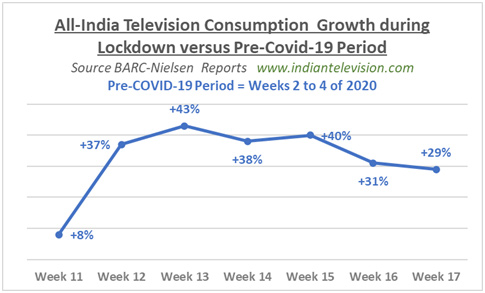
    BENGALURU: Television consumption in India seems to be petering out, according to Broadcast Audience Research Council of India (BARC)-Nielsen Reports. Of course, even in the sixth week and the second extension of the national lockdown to lockdown 3.0, television consumption is 29 per cent higher than during pre-Covid2019 periods. BARC and Nielsen have compared data for the pre-Covid2019 period with average numbers for Weeks 2 to 4 of 2020. Television consumption had peaked in Week 13 of 2020, the first full week since the lockdown commenced in the middle of Week 12 of 2020, on 25 March 2020 in India. Television consumption grew 43 per cent in Week 13 of 2020 as compared to the pre-Covid2019 period. BARC-Nielsen reports are available for the period starting Week 11 of 2020 until Week 17 at the time of writing of this paper.

    Please refer to the figure below for All-India television consumption trends.

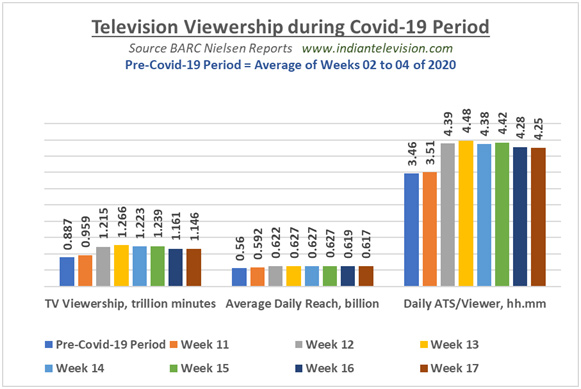
    The basic currency for total television consumption is trillion minutes. Average television viewership during the pre-Covid2019 weeks considered in the BARC-Nielsen Reports (Average of Weeks 2 to 4 of 2020) was 887 billion minutes with an average daily reach of 560 million. This worked out to a daily average time spent (ATS) watching television of 3 hours 46 minutes. In Week 13 of 2020, this peaked to 1,266 billion minutes with a reach of 627 million and ATS of 4 hours and 48 minutes.  These numbers have been sliding down since then. Please refer to the figure below.

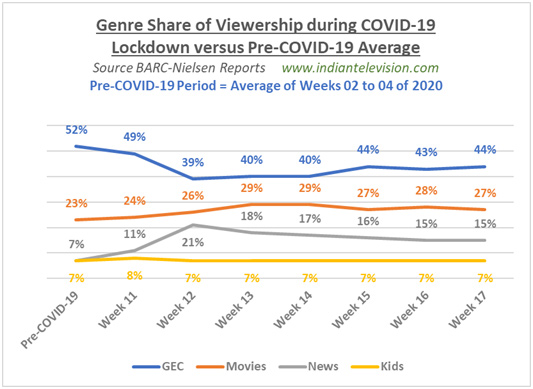
    In the pre-Covid2019 weeks, four genres had 89 per cent of viewership share – in terms of size, they are GEC, Movies, News and the Kids genres.  During the 7 weeks for which BARC-Nielsen Reports are available (Weeks 11 to 17 of 2020) at the time of writing this report, their combined share grew to 93 per cent. During the pre-Covid2019 weeks considered in the BARC-Nielsen Report (Weeks 2 to 4 of 2020) GEC had the largest viewership share of 52 per cent, followed by Movies with 23 per cent, the news and the kids’ genres with 7 per cent each. During Week 13 of 2020, this had changed to 40 per cent for GEC, 29 per cent for Movies, 18 per cent for news and 7 per cent for Kids. It must be noted that though share of the Kids channels was has generally been steady, overall television viewership has gone up during the lockdown period, and hence the number of viewers and ATS on the Kids was much higher than earlier times. It must further be noted that News had a share of 21 per cent in Week 13 of 2020.

    GECs, which had been experiencing a decline in viewership share during the Covid2019 lockdown due to the lack of fresh programming, got a breath of fresh air by way of re-runs of mythology and old classics on pubcaster network DD’s DD National and DD Bharati.  GECs’ viewership share has climbed to 44 per cent in weeks 16 and 17 from a low of 39 per cent in Week 12. The Movies genre seems to have stabilized at abut 27 per cent share as compared to the 23 per cent share during the pre-Covid2019 weeks considered in the BARC-Nielsen Reports.

    Please refer to the figure below:

    Overall, television consumption seems to be petering out slowly across the other major genres also.  Besides the four genres mentioned above, business news, youth, infotainment and lifestyle have witnessed changes in consumption growth. Relatively, the lifestyle genre seems to have had stabilized with about 32 per cent growth since week 13 of 2020 as compared to the average of the pre-Covid2019 weeks considered by BARC-Nielsen. The news genre, which had seen consumption triple in week 12, has stabilized consumption at around 165% growth in Weeks 16 and 17 of 2020 as compared to the average of the pre- Covid2019 weeks. Please refer to the figure below:

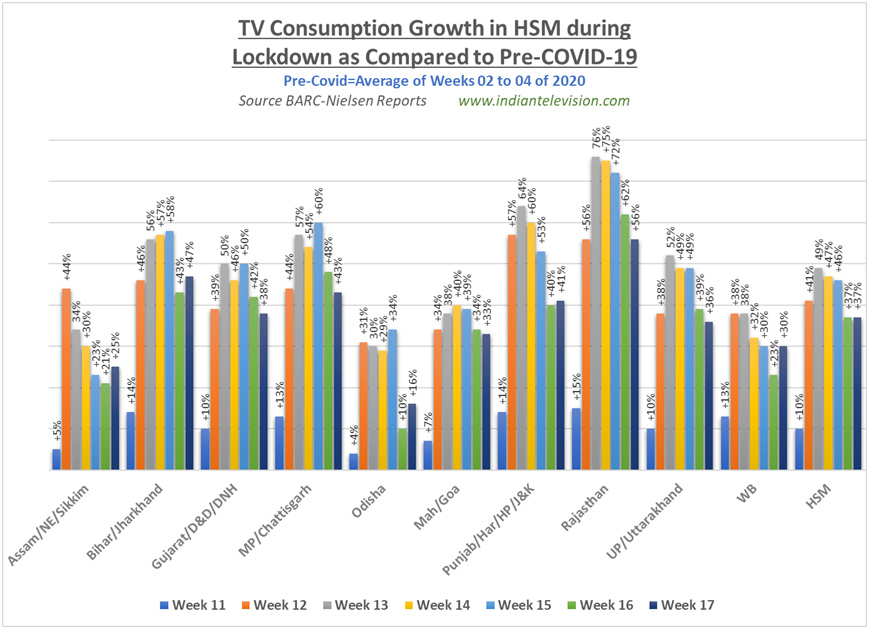
    BARC considers the Hindi Speaking Market or HSM as All India minus the four Southern Languages: Kannada, Malayalam, Tamil and Telugu. The South is a mature market with a higher penetration of television as compared to the HSM. Television consumption is also higher in the South. Hence, growth in the South market has been more muted as compared to the HSM during the lockdown weeks to date as compared to the average of the BARC-Nielsen Covid2019 weeks. The North Eastern states saw television consumption peak in week 12 itself – this was the week when the Janata Curfew and a couple of days later the first series of Lockdown or Lockdown 1.0 were announced by Indian Prime Minister Narendra Modi.  Most of the states saw viewership peak in Week 13. The exceptions were a few states where more of local ‘Covid2019’ and or/or events such as the lynching of the Sadhus in Maharashtra or the swearing in of ministers in Madhya Pradesh. There has been a general decline in television consumption since then, as mentioned before. Please refer to the figure below:

    Further, as mentioned above, South India has seen lower growth in viewership during the lockdown weeks because of its higher base and longer ATS spent even before the Covid2019 lockdown weeks. Hence the decline in television viewership since the peak has been lower in the South markets as compared to HSM. Please refer to the figure below:

    Is this the way forward?

    Television networks have tried to bring in viewership and maintain viewer stickiness. News by itself has grown as a genre because of the playout of events around the lockdown. Taking a cue from the movies genre, many networks have started beaming film-based content, but this has not been enough. The South GECs have witnessed growth on the back of comedy films over the last few days. Channels have brought back mythology and classics. Reruns of the Ramanand Sagar Ramayan and the B R Chopra Mahabharat, through daily episodes as opposed to the weekend episodes that were experienced when these magnum opuses were first aired, have brought in viewers and ensured their loyalty in the case of DD National and DD Bharati. Since mythology seems to have worked for DD, private networks have decided to include them in their programming mix. This seems to have worked to an extent in the case of Star Plus which launched of Ramayan in Week 17, and that slot for the channel has seen viewership grow by 65 per cent according to a preview of data by BARC for Week 18. Viacom18’s flagship Hindi GEC Colors has seen viewership growth of 24 per cent in Week 18 for the time slot when it commenced airing Mahabharat.

    It is still early days for a cure or vaccine for the pandemic to make things easier for humans, to bring back some form of normalcy. A lot more people will continue to stay at home. As the world and India slowly limp back in a phased manner to a ‘new normal’ from the Covid2019 lockdown, fresh content will surely be produced. However, given the circumstances globally, the ‘new normal’ has yet to take on a definite shape. If study, work, exercise, etc. from the home becomes the ‘new normal’, then ‘entertainment consumption at home’ is definitely set to be a big part of daily life. Content viewership from home, be it on the OTT platform, or the idiot box, or on the smart phone or a computing device, is definitely set to be much larger than during the pre-Covid2019 weeks. The question is“Will it be higher than during lockdown weeks?”

  • Covid2019 a disruptor for digital content delivery

    Covid2019 a disruptor for digital content delivery

    MUMBAI: It's not easy to cope with the rising anxiety and uncertainty while sheltering-in-place. Fortunately, there is a huge amount of content available online that keeps everyone entertained and informed. With the exponential rise in content consumption, the tech teams of over-the-top (OTT) platforms and publishers have taken up important roles to serve consumer needs along with the help of content distribution networks (CDNs). However, the challenges of delivering content have risen during the Covid2019 crisis due to the overwhelming surge in consumption, a panel comprising industry experts during a virtual discussion agreed.

    The panelists included Viacom18 Digital Ventures technology and engineering head Mohit Srivastava, EPIC ON COO Sourjya Mohanty, The Indian Express CTO Amardeep Vishwakarma, Asianet News Media and Entertainment assistant director of technology Anoop Mohan, Quintype head of engineering Rashmi Mittal, Snapdeal CTO Prashant Parashar, Simsim CTO Gaurav Kalra, Limelight Networks product management senior director Michael Milligan, VideoTap founder and CEO N Dilip Venkatraman, Limelight Networks India sales director Ashwin Rao and Kavasam Konnect chief information and technology officer Koushik Ramani.

    The panel discussion, on the importance of CDN for data and video explosion in the post-Covid2019 world, was organised by Indiantelevision.com and moderated by its founder, CEO and editor-in-chief Anil Wanvari. 

    Srivastava said that consumption has gone up exponentially both for AVOD and SVOD models on VOOT; the latter has seen really skyrocketing growth.

    Mohanty also mentioned that its two OTT platforms have been doing really well. It has witnessed consumption going up 3-4x many days. He also added that along with more consumers, they have received more consumer insights too during this period.  

    Vishwakarma also added that traffic has increased 2x across its platforms. Although it's not inclined too much to video, people are consuming available static content on websites. 

    Mohan also spoke about a 2-2.5x growth across Asianet platforms. While it serves in seven languages, growth is occurring in each. It has also started producing Covid2019-related content to avoid fake news. 

    Mittal also added that the number of page views has doubled for its client publishers. On the other hand, Ramani said that it's leveraging social media platforms more as its OTT platform is not fully launched yet. 

    Snapdeal recently entered the video content space. Parashar said that during the lockdown, when non-essentials were not being shipped, it wanted to engage customers and started using video for that. Kalra, too, acknowledged that there has been an impact on the business as commerce is not happening. Hence, its focus has deviated more towards content.

    Parashar said that they have to put more efforts to deliver similar quality content at a lesser speed of data used by consumers. He brought up an important aspect that CDNs have not focused highly on mobile devices while Indian consumers mostly consume content on smartphones. According to him, it is the right time for CDN players to innovate on the mobile side of videos and images and optimise for the newer economy in the post Covid2019 world. 

    “A lot of time we experience that video delivery is not as optimised as you would expect for mobile platforms. As new content is not being created, content consumption has spread out quite a bit. As a result, it is putting pressure on CDNs in terms of efficiency. Hence, it has become tough managing traffic,” Srivastava added. Mohanty also agreed that this has been a key challenge: reduction of latency and better response time.

    Limelight Networks' Milligan noted that although smartphones are heavily dominating the Indian market, the Indian audience is also watching content on connected devices. “It's not only about the mobile experience, but content providers also have to think of connected devices. So, as a content distributor you have to find out how you can give the best experience on both,” he added.

    Mohan also revealed that as Asianet users are in tier-III cities and rural areas, where consumers use a lower version of Android, it created a multi-CDN strategy. It reached out to different CDNs to see how it can optimise them and deliver content faster.

    However, publishers in the panel said that CDNs have been very helpful to deliver static content during this crisis taking up a lot of load. Their challenge was another: the decline in ad revenue despite growing consumption.

  • Eros Now partners with Visa to expand consumer offering

    Eros Now partners with Visa to expand consumer offering

    MUMBAI: OTT platform Eros Now has partnered with Visa, which allows Visa debit and credit card users in India to avail Eros Now’s massive content library. This includes 12,000-plus movie titles, original shows, music videos, short format content, Quickies, at a discount to the annual Eros Now subscription price.

    This partnership will offer Visa cardholders a discount of 50 per cent on their annual subscription to Eros Now and access to a plethora of entertainment from cult Bollywood movies such as Maine Pyaar Kiya, Rangeela, Hum Dil De Chuke Sanaam to Love Aaj Kal, Tanu Weds Manu, Manmarziyaan, amongst others. The library also entails originals from the house of Eros Now that caters to varied genres such as drama, thriller, comedy, to name a few.  

    According to a 2019 report by Eros Now and KPMG, more Indians are consuming content across an array of digital formats and platforms. The average time an Indian consumer spends on OTT platform is 70 minutes, and the average frequency of access is 12.5 times a week. The average single session duration is 40 minutes. This data thus shows that consumers are spending considerable time watching online content. This partnership with Visa will further enable consumers to choose from varied entertainment options that will help in boosting viewership. 

    Eros Now’s collaboration with Visa will strengthen the payment integration for Eros Now that provides high-quality digital video experiences. At a time when there is unparalleled growth in online payment and digital video streaming platforms, the partnership, exclusive to Visa consumers, will offer a wider range of payment options that they can pay for seamless access to unlimited and superior entertainment content.

    Eros Now CEO Ali Hussein said: “Eros Now is known to entertain audience, since generations and an association such as this with Visa helps in further strengthening our promise of offering consumers with the best of entertainment. Visa, a leader in payments technology around the world, has been offering a great value proposition to Indian consumers. Therefore, this association will help in further boosting the viewership by offering them easy access to the vast content catalogue of Eros Now.”

    Arvind Ronta, head of products, Visa India & South Asia, says; “Today, there is an uptick in the consumption of digital entertainment through OTT platforms by consumers. We are happy to partner with Eros Now to give its customers the option of paying for subscriptions through Visa cards, that too at a special rate.  This offer will enable more users to avail of the vast Eros Now library to watch superior content and pay for it securely and seamlessly through existing Visa credit and debit cards.”