Tag: OTT

  • #Throwback2020: Programming across OTT & television

    #Throwback2020: Programming across OTT & television

    MUMBAI/KOLKATA: Life coach and motivational speaker Tony Robbins once remarked that “we aren’t in an information age, we are in an entertainment age.” The past year has shown that Robbins' observation wasn’t far off the mark. As people were bombarded with information from all sides, most of it unpleasant (what with a global pandemic, wildfires, erupting city blocks and violent racial protests, just to name a few), and with cinemas shuttered and live sports cancelled, they retreated to the only safe space left – their television and mobile screens. In fact, 2020 was also remarkable for another fact; TV and OTT saw unprecedented rise in viewership and time spent on the platforms compared to preceding years.

    One of the biggest trends that we saw on OTT and television in 2020 was the re-emergence of the golden era of family viewing. A classic example of this was the reruns of Mahabharat and Ramayan on Doordarshan during the lockdown. IndiaToday touted Mahabharat as the “baap of all masala entertainers” and no wonder, everyone in the family – from grandparents to kids – tuned in to the decades-old show. And as streamers were – for a large part of the year –   were the only ones where fresh content was in supply, audiences signed up for the services in big numbers.

    Programming on television

    With people confined to their homes, TV took them to places where they could find some respite, whether in the form of a supernatural show, a murder mystery, Mills & boons romance thriller, an endearing fish-out-of-water comedy, or a very old daily soap. Some shows nailed tricky tones; others offered unforgettable concepts.

    The pandemic forced general entertainment channels to go for reruns initially as there was no fresh content production for nearly three months. DD emerged the frontrunner, as, besides Mahabharat and Ramayan, it brought many other iconic shows such as Dekh Bhai Dekh and Shriman Shrimati, thereby raking in massive viewership. Private broadcasters took the same route to entertain audiences. Programmes that had been relegated to sister FTA channels, such as Saath Nibhana Saathiya, Kumkum Bhagya and Ye Rishta Kya Kehlata Hai, made a comeback on the pay platform and attracted a lot of eyeballs.

    Daily soaps dominate

    A lot of shows focused on family bonding, women taking charge of the household, and the parent-child relationship. Most of these serials tend to have family drama as the core thread with a love story running through it.

    Naagin, Chotti Sardaarni, Barrister Babu and the recently launched Shubharambh delivered – and continue to –  the bounty for Colors. Zee TV’s Kundali Bhagya and Kumkum Bhagya (both produced by Ekta Kapoor’s Balaji Telefilms) and Guddan Tumse Na Ho Paayega garnered significant eyeballs. Sony TV’s Mere Dad Ki Dulhan, which recently went off air, was centered on the theme of a second chance at love for middle-aged parents.

    Audiences across markets opted for a slice of life and family dramas. The overall Hindi GEC (U+R) and the Hindi GEC (U) audiences preferred to watch recently launched shows like Anupama, Imlie, Ghum Hai Kisi ke Pyaar Mein on Star Plus, and Zee TV’s most popular long-running shows Kundali Bhagya and Kumkum Bhagya.

    Several experimental shows such as 9 Months Wali Love Story, Kaatelal & Sons also found takers, but there wasn’t much in the way of breakthrough content outside of Anupama. The latter is a regular family drama showcasing the taboo subject of extramarital affairs on Indian television.

    Ormax Media partner Keerat Grewal said, "I think the challenge with the category is that experiments with new story ideas are there, but we have not seen any paradigm shift, something that we saw with KBC and Balika Vadhu. Over the last few years non-fiction has had an uptake on HGECs due to the fiction cynicism that’s set in gradually as audiences have been seeing 'more of the same'. This year however non-fiction has struggled as well, with both KBC and Bigg Boss not being able to deliver. Bigg Boss is generally shows an upward trend after a few weeks, once contestant familiarity sets-in."

    With production budgets slashed across channels by almost 20-25%, extending this year's Bigg Boss season even with lower than expected ratings, could be a matter commercial feasibility for the channel, she said

    Star Plus also managed to get its regional shows successfully remade into Hindi with Anupama and Ghum Hai Kisi Ke Pyaar Mein. This urge to adapt and remake has been picked up by other channels as well.

    Non-fiction shows struggled to top the charts

    Kaun Banega Crorepati, Bigg Boss, and The Kapil Sharma Show were produced under strict Covid2019 precautions. The drastically smaller production teams innovated on the sets to adhere to protocol and ensure safety of the participants. For instance, there is a restaurant, a shopping mall, a theatre, and a spa inside the Bigg Boss house. In KBC 12, besides the crew, even those who accompany the contestants on the show have socially distanced seating. There was no live audience and the audience poll lifeline was replaced by video-a-friend. The Kapil Sharma Show introduced recorded audience applause, and cut-outs in the background to make the set look lively. The IPL also did the same.

    Unlike other years, Bigg Boss – while generating a lot of buzz – has had a relatively subdued season and has not picked up in ratings. The non-fiction show has always been known to pick up from the mid-season where it brings older participants to pump up nostalgia and drama. This year, Colors has decided to extend Bigg Boss 14 till February 2021, with the grand finale scheduled around Valentine's Day. Traditionally, non-fiction shows have always given fiction shows a run for their money.

    And while the IPL was a huge production and advertising success, buoying industry sentiment,  the same cannot be said for other marquee non-fiction properties, which compete with it.

     “I think the challenge is that they keep experimenting with new story ideas but we have not seen any paradigm shift, something that we saw with KBC,” noted Grewal.

    The year of OTT

    2020 was the year of OTT, as people sampled and adopted them in droves. Likewise, the investment in content has also increased manifold. As more people turned to premium online content, the platforms also experimented with the formats of their new shows.

    A new genre on the streaming horizon is musical. Amazon Prime Video’s Bandish Bandits gathered buzz with its music-themed plot depicting the clash between two different worlds of music. Although some viewers found the format cliched, the catchy tunes by composers Shankar-Ehsan-Loy made it extremely appealing. MX Player’s music reality show Times of Music was loved for its unique format – it's a crossover between reality and chat show. Bringing the best composers in the Indian film industry together on one stage, the series included recreations of many celebrated songs. Times of Music charmed Indian music lovers at a time when live musical events had come to a halt.

    Experimentation and innovation

    More than simply offering a library of content, OTT platforms in India are trying to establish a stronger connection with consumers through interactive content. The trend has not picked up for premium originals yet but broadcaster-led streaming platforms are experimenting with the format for their catch-up content. Zee5 launched Zee5 Super Family League where participants could  create their own family by selecting their favourite characters from the network’s popular primetime shows. Voot and SonyLIV also created avenues for immersive experience around tentpole content like Bigg Boss and KBC.

    2020 was a series of unusual, new experiments to face the challenges posed by the pandemic. OTTs led the field when it came to producing new shows while sitting at home. Voot devised an innovative content format with locked room murder mystery The Gone Game, shot in cast members' residences. Eros Now also premiered a show made in lockdown – A Viral Wedding. Amazon Prime Video unveiled CU Soon, a film shot entirely during quarantine.

    Sequels spell success

    For many people, the saving grace of 2020 was their favourite shows returning with new seasons. The hugely popular Mirzapur series generated tons of excitement. Among other much-awaited shows, MX Player’s Aashram, Disney+Hotstar’s Hostages, Amazon Prime Video’s Breathe: Into the Shadows wooed the audience with returning seasons. Other than Indian originals, viewers enjoyed new seasons of international series like Money Heist, Dark and The Mandalorian.

    The rise of K-love

    Indian audience’s watch list is no longer defined by local content or few American dramas anymore. All things ‘K’ (as in South Korean, not Ekta Kapoor’s defining alphabet) had a major breakthrough in India amid the pandemic. Netflix India witnessed a whopping 370 per cent growth in the viewership of Korean dramas, with The King: Eternal Monarch, Kingdom (S2), It’s Okay to Not Be Okay and Crash Landing on You dominating the trending list for weeks. MX Player also reported considerable growth of Korean drama in its international segment. Interestingly, the K-drama fad is not limited to millennials and gen Z anymore. Other than romances, older audiences also watched other complex genres like Korean historical dramas and thrillers.

    OTTs have moved on from male, metro, millennial demographic to an increasing number of female content consumers. As a result, platforms focused on women-centric content representing strong female characters. The shows ranged from comedy to thrillers, romance, and social drama. Pushpavali, Four More Shots Please, Arya, Bulbbul, Masaba Masaba, Churails, Code M were some programmes that appealed to and were loved by women viewers.

  • Face of M&E industry in the next 5 years

    Face of M&E industry in the next 5 years

    KOLKATA: Overall advertising spend took a hit in 2020 due to the unprecedented Covid2019 crisis. With hints of recovery, experts are upbeat about adex growth this year as well as in the long term. India’s advertising market is estimated to post a CAGR of 16 per cent over the next five years factoring Covid2019 impact. While digital advertising is estimated to double its share in the overall ad pie, TV spends will largely remain stable, according to a report from Elara Capital.

    However, it mentions that TV advertising may witness a decline in the ad share pie post-2025, if digital scales up further. Globally, digital advertising accounts for 61 per cent of ad spend whereas TV is 23 per cent, given demographics in India (the big mass market with several languages), it is believed that the share of mediums like TV and print will remain higher than the global average.

    Elara Capital VP research analyst (media) Karan Taurani said huge pent-up demand in some sectors (travel, retail & tourism), which were negatively affected during Covid2019, an increase in the number of SME-led advertisers, and the surge in digital advertising led by favourable demographics will drive the growth.

    “Facebook, Google and YouTube will continue to dominate the social, search and video advertising segment within digital advertising. Video advertising, which accounts for almost 30 per cent of digital advertising spend, has outperformed with a 50 per cent growth rate in CY19; however, the larger share keeps moving toward Hotstar and YouTube as they account for almost two thirds of this video advertising pie,” he stated.

    During a panel discussion in Vibes 3.0, The Everywhere Content, Elara Media & Entertainment Conference, experts also reflected similar optimism. They said broader advertising trends within the TV vertical indicate a good recovery, backed by IPL after a big blow during the lockdown. Currently, ad spend stands in good stead after a K-shaped recovery, with some new ad verticals coming up while some old ones are drying up, they added.

    The panellists added that digital will trigger new opportunities as millions of advertisers have moved to digital. SMEs do their own digital advertising, but their adoption is much slower. However, gradually these businesses have been shifting, in line with trends overseas a few years back.

    Digital adoption has been noticeable in consumption patterns too, especially as it has leapfrogged during Covid times. In India, around 10 million viewers have cut chords during Covid2019 lockdown, choosing OTT platforms largely due to a variety of content. The key remains to keep up the engagement of audiences on the OTT platform. TV and OTT can coexist at least for the next eight-ten years. While men used to explore OTT content and women preferred daily soaps on TV, this trend has changed during the pandemic, where family viewing has grown significantly.

    According to the panellists, the value of a revenue-paying subscriber is going to increase significantly. Earlier, with 30-40 OTT platforms and several TV networks, content demand was high. But now, the audience has become quality content-specific and is willing to spend on marquee shows and content. Partnerships with telecom service providers (TSP) will continue to account for a larger chunk of SVOD revenue for broadcaster and other OTTs in the near term; smart TV and smartphones too will support the growth of India’s SVOD ecosystem in the medium term, Taurani added.

    Among other trends in media and entertainment industry, Taurani said cinema remains an outing and socialising trend in Asian countries, such as Singapore, Taiwan, China, the UAE and India. This means there is relatively low or no threat of OTT, unlike the West (US and UK) wherein consumers visit a cinema only to watch a movie. In terms of screen openings too, APAC has 88 per cent of screens open, whereas the US and the EMEA have opened up only 38 per cent and 24 per cent of screens, respectively, until now.

  • The Family Man all set for second innings on Amazon Prime Video

    The Family Man all set for second innings on Amazon Prime Video

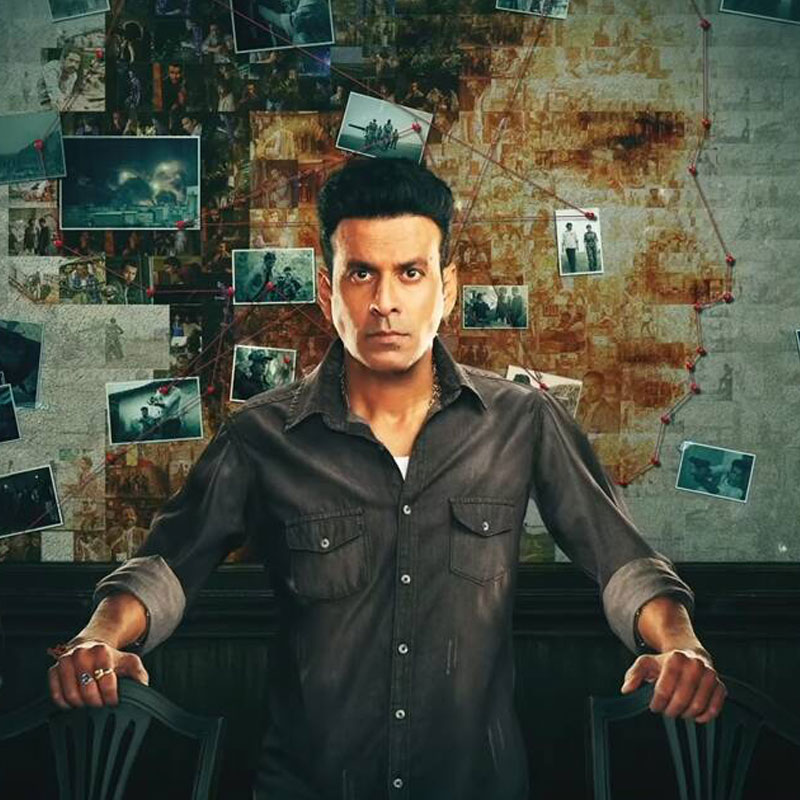
    NEW DELHI: Amazon Prime Video’s acclaimed series The Family Man season 2 is all set to premiere on 12 February, the showrunners announced in a brief clip. Starring Manoj Bajpai, Samantha Akkineni and others, the new season promises to offer up another gripping mystery for the audience’s viewing pleasure.

    The Family Man season one released in September 2019 and was a runaway hit. The show was applauded for its direction, performances and writing. It is an edgy, action-drama series, which tells the story of a middle-class man, Srikant Tiwari, who works for a special cell of the National Investigation Agency. The series explores Srikant's tight-rope walk as he juggles his secretive, low paying, high-pressure, high-stakes job, and being a husband and father. This is as much a satirical take on the geopolitics of the region as it is the story of a middle-class guy who is a world-class spy.

    This time Srikant, while struggling to balance his personal and professional life, will be pitted against a new nemesis, Raji played by Samantha Akkineni. Replete with twists and turns, the upcoming season will see Srikant embarking on a new mission as ‘This Time, No One is Safe’.

    Amazon Prime Video head of India Originals Aparna Purohit said, “The Family Man had set a new benchmark in the spy thriller genre in India. Appreciated by fans and critics alike for its compelling storyline and phenomenal performances, the show became a part of our popular culture. The fact that the fans had successfully managed to decode the show’s launch date by reading ‘2021’ as ‘1202’ in reverse when we recently unveiled the teaser poster is a testament to the show’s unparalleled fandom.”

    Raj and DK said, “We are thrilled and excited to return to the world of The Family Man. The response to the first season was overwhelming and it struck a real chord with the viewers. And we are hopeful that we can continue to tell a story which is as compelling and engaging as the first season. The one question we were asked for the last 16 months is – when is season 2 coming. Our team has worked from home through the pandemic and amidst all the constraints to complete the season. We wish to thank everyone involved in our show. And our fans can be sure that we have plenty of surprises in store for the new season of The Family Man.”

    The other members of the cast include Priyamani, Sharib Hashmi, Seema Biswas, Darshan Kumar, Sharad Kelkar, Sunny Hinduja, Shreya Dhanwantary, Shahab Ali, Vedant Sinha, and Mahek Thakur.

    Produced by D2R Films, the much-awaited show will launch exclusively on Amazon Prime Video in over 240 countries and territories.

  • Stride Ventures leads Rs 17 crore debt round in Pocket Aces

    Stride Ventures leads Rs 17 crore debt round in Pocket Aces

    KOLKATA: Stride Ventures has led a Rs 17 crore debt round in digital entertainment company Pocket Aces. Stride will be a strategic partner in Pocket Aces’ growth journey with their customised offerings and deep relationships across banks and corporates.

    This partnership with Pocket Aces is the twelfth investment from Stride Ventures’ maiden fund, marking its foray in the digital media and entertainment space as gaming and OTT has had a breakthrough year with industry revenues surging and subscriptions rising through the lockdown.

    Stride Ventures founder and managing partner Ishpreet Gandhi said, “Pocket Aces has truly pioneered digital content in India through its data driven approach to content creation. More importantly, the company creates highly relatable content, making it appealing especially for the younger demographic. At Stride, we strive to partner with indigenous companies which have the ability to scale up rapidly by leveraging technology and we see Pocket Aces as a great addition to our portfolio.”

    Pocket Aces co-founder Aditi Shrivastava added, “2020 was an unprecedented challenge for humanity and we were privileged to entertain the Indian audience during this difficult time. The lockdown accelerated adoption of digital media as the primary source of consumer entertainment , and so we innovated rapidly to ensure that we could continue to thrive and increase content output in this new normal. As a result, we saw growth in all our major business lines this year. As we go into 2021, we are more excited than ever about the size of the entertainment opportunity in India and are happy to partner with Stride Ventures on our growth journey. This debt instrument is one of the first of its kind for the sector and we think it underlines Pocket Aces’ leadership of the sector as well as the innovation focus of Stride Ventures.”

    Pocket Aces will utilise the capital raised to scale the current content output and invest further in new content formats and distribution channels. In 2020, Pocket Aces released multiple shows across its channels that kept audiences gripped with stories of love, life, and the new normal. The company has worked with over 100 brands across sectors including Tinder, Hindustan Unilever, PureMe, Bacardi, Unacademy, and Mondelez, among others. 

    On the other hand, its game streaming and e-sports platform Loco, has hosted some of the biggest mobile gaming tournaments India has ever seen. Loco also entered into strategic partnerships with Red Bull, Fnatic, NBA 2K League, and other leading brands. The year also saw Pocket Aces launch Clout, its talent management division, which exclusively represents over 60 of the digital industry’s finest and most popular faces.

  • How 2020 turned out for Zee English cluster

    How 2020 turned out for Zee English cluster

    MUMBAI: Despite the challenging business environment, 2020 was a year of adaptability, growth and innovation. During the lockdown, television came across as a trusted medium. There was significant growth in TV viewership, led by more walk-ins as well as more time spent on television. The Zee English cluster of channels grew by 93 per cent (BARC data week 12-week 22 vs week 1 to week 11).

    &flix, the Hollywood blockbuster movies channel had one of the most engaged audiences in megacities, with 56 minutes (BARC data week 12-week 22) average weekly time spent on the channel. This, given the context of the lockdown, tells us that viewers find content on television compelling and comforting, said ZeeL premium channels business head Kartik Mahadev.

    English entertainment (movies + GEC) on television caters to 216 million+ viewers (BARC data All India Period: week 01’20-week 49’20). The lockdown has shown broadcasters that people choose to watch television for the curated content experience it provides, not just to individuals but the entire family. Mahadev shared that the English entertainment viewership grew by 45 per cent as compared to last year (BARC data @ All India 2+ U+R data, week 12-week 22’20 vs week 12-week 22’19).

    This year, Zee English cluster introduced tactical changes in the programming with specially curated properties to suit the entertainment needs of a steady subscriber base. For instance, Zee Café added 300+ hours of new content, which includes the latest season of dramas such as Grey’s Anatomy, Nancy Drew and Evil along with iconic sitcoms such as Seinfeld and I Dream of Jeannie along with the original airings of the celebrity chat show Starry Nights GEN Y. Recently, the channel launched its first-ever original production Dance With Me with celebrity dance experts Shakti Mohan and Mukti Mohan. According to Mahadev, the show added to the merriment of the festive season coupled with a unique and interactive format via exciting weekly hook step challenges. The year 2020 also marked the milestone celebration of 20 years for Zee Café.


    Moreover, with the growing popularity of Hollywood movies across India, the network launched ‘Flix for All’ on &flix, which played blockbuster movies in English, Hindi, Tamil and Telugu. With this, the channel witnessed a 41 per cent jump in viewership. The ‘Pick your Flix’ initiative found consumer resonance with immense traction across &flix’s social handles, with 2X engagement and 3.5 million reach.

    While the supply was sporadic, the demand for movies in regional languages also grew. Thus, the network spearheaded the launch of ‘Ticket to Hollywood’, a pan network offering where it combined the might of Zee to broaden access to Hollywood movies across the width and breadth of the country through a multi-channel, multi-language offering.

    “In addition, our fastest to TV premieres with the First Day First Show at Home of blockbusters like Jumanji: The Next Level and Bad Boys For Life enthralled audiences through the year while delivering value to our brand partners. A true testimony to this is the premiere of Jumanji: The Next Level on &flix and a simulcast on Zee Cinema clocking a whopping 34 million impressions,” Mahadev said.

    *(BARC; TG : NCCS AB 15-40, Megacities, pre-Flix For All Period- week 45’19- week 14’20, during Flix For All Period- week 15’20 – WK 37’20).

    English GECs are facing tough times but at a macro level, interest in English content is growing. There is a whole set of audiences moving from regional to English content as they become more comfortable with English as a professional, conversational language. Mahadev has designed unique offerings such as world television premieres, multi-language block, Flix for All on &flix and locally nuanced content on Zee Café, that will stand out as enablers of bringing an aspirational, English-comfortable audience onboard.


    On television, he has witnessed a trend in audience preferences towards light-hearted content, superhero flicks and adventure as a genre. Moreover, ‘nostalgia’ clearly emerged as a big theme across shows, with several successful examples in Hindi GEC.

    There was a growth in non-prime time viewing as well, and hence to keep viewers entertained throughout the day, Zee Café introduced back-to-back episodes of MasterChef Australia S8, Nancy Drew and Evil, Everybody Hates Chris, and The Big Bang Theory S12. There is also an increasingly leaning towards genres like action, animation and horror. 

    As for the network’s distribution strategy, its strengths and weaknesses across time bands, Mahadev revealed that post lockdown, there has been a growth in English content viewership led by both reach and a more engaged audience across dayparts. Zee Café introduced 'Café Film Club' which features blockbusters from Hollywood in the afternoon time band, leading to cutting-edge English GEC content in the prime-time band.

    He highlighted that the youth-focused premium brands can choose from a repertoire of high-quality content to drive association with and reach a premium subscriber base, given a sharply segmented audience that English entertainment on television attracts while similar content on digital is behind a paywall. Said he: “Over the years, we have delivered value to some of the most reputed brands who have partnered with us in our endeavour to engage an evolved audience with the latest in international content. At present, some of the top categories active across Zee English cluster include FMCGs, auto, BFSI and insurance, OTT, smartphone brands, and e-commerce.”

    The rapid flux in the traditional media landscape and rising levels of digital sophistication in consumers has led to the emergence of multiple mediums to engage with the consumer. Context has also emerged as a key factor in any integrated marketing strategy. With the Covid2019 outbreak, there has been a surge in television viewership alongside brands engaging on digital through live video formats. In the English cluster, Mahadev has adopted digital engagement alongside television as part of the channel marketing strategy. He quipped, “For instance, our First Day First Show at Home campaign featuring comic José Covaco garnered an overwhelming response with nine million views on YouTube.


    For Zee English cluster, the primary target audience for &flix include Hollywood enthusiasts from metros. They are brand-conscious, tech-savvy, and in sync with the latest trends. When it comes to Zee Café, the viewers are evolved, motivated and have a global outlook. &PrivéHD, on the other hand, is for the non-conformists and cinephiles who appreciate nuanced content.

    During the pandemic, we saw a shift in consumer trends toward OTT platforms, and it has confirmed that the digital video platforms are here to stay. However, today we live in an ‘and’ world, not an ‘or’ world. Studies reveal that consumption of overlapped content between TV and OTT grew on television from 59 per cent pre-NTO to 82 per cent contribution post-NTO for sitcom, drama, reality genres. It naturally follows that navigation between screens is seamless and consumption on TV and digital is complementary in nature.

    “When it comes to OTT, content discovery is and will continue to pose a challenge to viewers looking to unwind with quality content. This is where television channels that understand their consumer and curate well, delight the viewer. With content availability growing across platforms leading to fragmented viewing, it has led to a greater and a more central role for television. Curation of content on television that lends to co-viewing, making TV for a great community experience for family and friends,” added Mahadev.

    All in all, he believes the network has certainly moved the needle to a noticeable degree this year and the future too looks promising.

  • Zee5 Global unveils new content line-up for January

    Zee5 Global unveils new content line-up for January

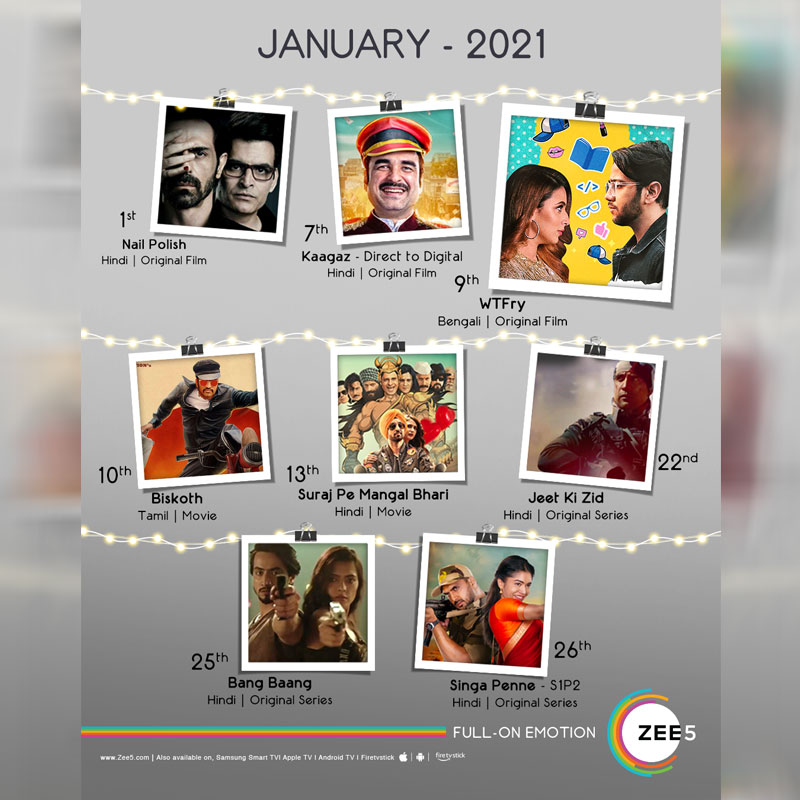
    KOLKATA: Leading OTT Zee5 Global has unveiled a line-up of fresh content to kickstart the new year with a bang.

    Raising the curtains on 2021 on 1 January, the much-anticipated Zee5 Original Nail Polish takes viewers on a hypnotic journey of the uncertainties of the human mind. Nail Polish features an ensemble cast including Arjun Rampal, Manav Kaul, Ranjit Kapoor, and Anand Tiwari.

    On 7 January, a satirical comedy Kaagaz will narrate the story of a man who fought for his life for 19 years after being declared dead by a group of people keen to take over his assets. Starring the epitome of versatility, Pankaj Tripathi in the lead role, Zee5 original Kaagaz is directed by Satish Kaushik and is one of the most anticipated releases of 2021.

    Zee5 second Bangladeshi original What The Fry is set to premiere on 9 January. Directed by National Award-winning director Anam Biswas, What The Fry is a heart-warming tale of a suicidal film star who meets a simple guy and finds a deeper meaning to life. The show is free to watch for viewers in Bangladesh.

    Under its pay-per-view vertical Plex, Zee5 Global is set to release two digital-first blockbuster films. Premiering on 13 January, the comedy-drama Suraj Pe Mangal Bhari will take viewers back to the 90’s, before the social media era, where a wedding detective performs background checks on prospective grooms. The movie features some of the most acclaimed actors of the industry including Manoj Bajpayee, Diljit Dosanj and Fatima Sana Shaikh.

    On 14 January, another comedy-drama Biskoth will drop, with two prolific stars of the Tamil film industry – Santhanam and Tara Alisha.

    On 22 January, the platform will release a gripping original Jeet Ki Zid. An Amit Sadh starrer, the series is based on a true story of grit, determination and the military. It’s the tale of a soldier whose never give-up attitude helps him overcome tough challenges and turn the impossible into possible.

    Yet another action-packed Original, this time from Zee5-Alt Balaji combine, Bang Bang will premiere on 26 January. Shot in the picturesque landscape of Maharashtra, it is a high-octane thriller starring Ruhi Singh, Faisal Sheikh amongst others.

    Popular Tamil serial Singa Penne will return to Zee5, continuing the story of a girl who falls in love with a boy in the armed forces and decides to cross every hurdle to join the army herself. The second part of Singa Penne season one premieres on India’s Republic Day – 26 January.

    Lastly, on 27 January, Zee5 Global will stream its new TV show, Teri Meri Ek Jindri, encompassing the lives of two young lovers against the backdrop of Punjab. The new Zee TV romantic show is based on the evergreen mantra that opposites attract.

  • MX Player & Akamai partner to deliver seamless viewing experience

    MX Player & Akamai partner to deliver seamless viewing experience

    KOLKATA: MX Player has partnered with Akamai Technologies to provide its increasing user base in India with a seamless digital experience.

    In 2020, MX Player was ranked by App Annie as the no.1 streaming app in India and the onset of the pandemic saw the platform witness not just a massive boost in viewership, but also new subscribers, and a newer audience. This accelerated growth heightened MX Player’s need for infrastructure that could support the scale and availability of the app across different networks and locations.

    MX Player found Akamai’s world class media delivery solution to be the right choice in order to deliver a high-quality viewing experience to their customers across different cities. The enhancement in performance and user experience was particularly pronounced in the case of MX TakaTak, a popular short video platform, that has seen a rapid surge of users, with a large portion of them coming from tier-2 and tier-3 towns.

    According to Redseer, online content consumption in India grew by 35 per cent in April 2020 compared to January 2020. It further stated that short-form video content consumption recorded the most significant jump during the lockdown.

    MX Player COO Vivek Jain said, “In the last couple of months, our user base has increased exponentially. The demand to consume content on the go and the need for virtual entertainment amongst the middle, mass, mobile, millennial audience in India is growing faster than ever before. MX Player has seen more than 7X jump in time spent on the app. “

    “Even MX TakaTak, which we recently launched, crossed one billion video views per day within a month from launch and has quickly become the market leading app in the short video category. We have always obsessed about best-in-class video load times. Akamai is a pioneer in Edge distribution and its presence particularly in tier-2 and tier-3 towns has helped us deliver an unmatched viewing experience for our customers across India’s mega cities as well as the hinterlands,” Jain added.

    Akamai media and carrier section India sales head Mitesh Jain noted that unprecedented demand for content coupled with rapidly evolving user behaviour poses a challenge for apps trying to ensure high-quality viewing experience across a complex network topology.

    “We are glad to have partnered with MX Player to help them scale the user base and step up to conform with user expectations of evolving Indian consumers. Given MX player’s ambition, I am sure that this is just a start and we will be accomplishing many more milestones together,” Jain said.

  • #Throwback2020: Heavyweights of M&E industry

    #Throwback2020: Heavyweights of M&E industry

    NEW DELHI: Finally, we are over with 2020, a year that will go down in history for perhaps all the wrong reasons. While it brought businesses and industries across the board to a standstill, the time also taught everyone to come out of their comfort zone and think differently. The media and entertainment (M&E) industry was no different.

    Apart from serving regular entertainment and keeping the content pipeline steady, the industry also saw regulatory interventions, scams, big movements, great strategies, new platforms and trends emerging that challenged its status quo. Be it the coverage of Sushant Singh Rajput’s death that triggered the debate over toxicity on news channels, the release of the highly acclaimed Scam 1992, TRP racket, arrests in the news and broadcast world, or Uday Shankar’s decision to step down from Disney Star India – all these developments and more had the industry grapevine buzzing.

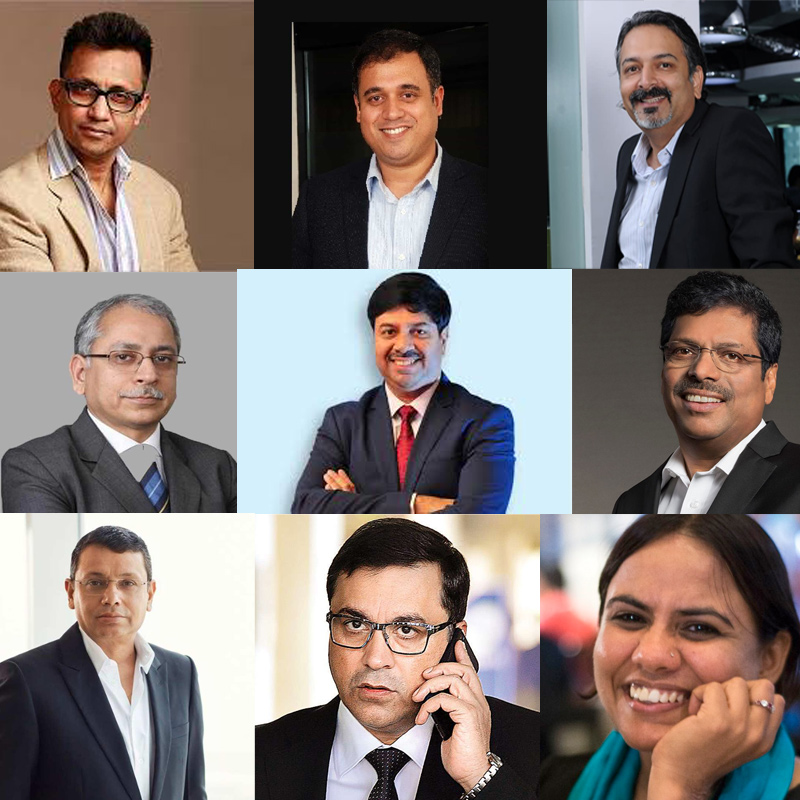
    Indiantelevision.com skimmed through all these conversations of 2020 and selected top heavyweights of the M&E sector of India who steered these discussions and shaped the industry – for better or worse, only time will tell.

    Arnab Goswami, ARG Outlier Media

    The MD, editor-in-chief and co-founder of Republic Media Network became the newsmaker in the second half of the year for multiple reasons. Goswami aggressively went after the police, political leaders and several lobbies in the film industry during the investigation into Sushant Singh Rajput’s death. While several industry members and advertisers questioned his style of editorial reporting, some also blamed him for spreading toxicity in the news. Goswami, however, maintained that he will be relentless in his search for the truth for his audiences. He was soon caught up in a legal storm in two separate cases as police charged his media network for rigging TRPs, and abetment to suicide of an architect and his mother. Members of the Republic, including Goswami, were arrested during this time and multiple lawsuits were filed in both matters. Undaunted, Goswami has continued with his combative editorial style and is expanding the network’s footprint in different languages both in the online and offline space.

    Sunil Lulla, BARC

    2020 has been a very busy year for current BARC CEO Sunil Lulla. He had to make some tough calls and introduced landmark initiatives that changed the course of the industry. It began with the Telecom Regulatory Authority of India (TRAI) interfering with BARC and making recommendations on its functioning, governance, transparency, accountability, operations and robustness. Lulla took a stand on the matter and clearly established that BARC is an integrated business body and is not influenced by the government.

    Later, in a landmark move, BARC came up with algorithms to mitigate the impact of landing pages, which was welcomed by the industry. Towards the end of the year, the agency has been weathering the TRP scam, which brought ignominy to the entire news broadcast industry – so much so that BARC decided to pull back the weekly ratings for the news genre. The scam got murkier with several ex-BARC employees getting arrested. The regulatory body is now drawing a new mechanism to ensure that the methodology is more precise and the industry is able to trust those ratings once again. However, amidst this entire storm Lulla is standing tall and leaving no stone left unturned to maintain the integrity and sanctity of the organisation.

    Shashi Shekhar Vempati, Prasar Bharti

    He was the man behind the uninterrupted supply of entertainment and news to the remotest corners of the country. Vempati led Doordarshan and All India Radio carried on operations uninterrupted throughout the pandemic. During the first lockdown, when fresh content dried up on GECs, Vempati’s team brought back yesteryear shows on the channel and gave everyone some respite from the wrath of the Coronavirus. This decision was so successful that it broke all viewership records of Doordarshan. The state-run broadcaster ensured that people in the far-flung areas were able to access news and updates in their own native languages via Doordarshan and All India Radio. Vempati’s team also initiated tele-classes for students so that their year does not go waste. He is now on a government committee that will closely look into the operations of BARC to assess the existing rating system (the committee was formed after TRP scam was busted).                     

    K Madhavan, Star & Disney India

    An old hand at Star India, K Madhavan, the man who was responsible for building the network’s regional business replaced Sanjay Gupta as he took on the mantle of the TV business across verticals and markets at the end of last year. The network continued to grow in 2020 and post the big announcement of Uday Shankar’s departure, Madhavan was given the responsibility of leading Star & Disney India. Madhavan was also elected the president of the Indian Broadcasting Federation 2020-2021. He will be working closely with the I&B ministry, TRAI, and other bodies to look after the broadcaster’s interest and policy implementation. Madhavan also steered the ninth CII Big Picture Summit this year with hundreds of delegates from all over the world participating in it.

    Uday Shankar, Former The Walt Disney Company

    The biggest shocker for the M&E industry came when Uday Shankar announced his departure from Disney Star India. Shankar ended his 13-year long stint at the organization on 31 December. After taking over the reins of Star India in 2007, he transformed the company into one of the largest and most successful media conglomerates in Asia. He led Star Sports to be the largest sports broadcaster in India. In the general entertainment segment, Star India has a presence in all major regional markets along with a massive dominance in the Hindi speaking market. From launching Hotstar in India to expanding Disney+’s operation in Asia as Disney APAC boss, he has left a rich legacy in the OTT segment as well.

    Adding another feather to his cap, Shankar has been elected president-elect of Ficci for 2020-21, the first-ever media and entertainment executive in India to lead a national industry chamber. 

    Pradeep Dwivedi, Eros STX

    In 2020, Dwivedi spearheaded the global ambitions of 40-year-old production house Eros Now. He led the merger of Eros Now with US-based production house STX Filmworks and uniquely positioned the combined entity Eros STX across the US, China and India. Eros STX will be a publicly traded, independent content and distribution company with global reach. It will now be able to create and distribute both Bollywood and Hollywood content. On the domestic front, Eros Now expanded into linear business and capitalised on the growing demand for OTT with its originals and existing library. Dwivedi was also chosen as VP & area director for IAA Asia Pacific.

    Ajit Mohan, Facebook

    It has been an interesting year for the social media platform in India. It inked a partnership with Jio to establish itself as a strong content player, worked towards bringing small businesses on the platform to expand its base and increase ad spends, joined the government’s atmanirbhar initiative, launched Instagram Reels, Watch on Facebook and WhatsApp pay to further offer new products to the audiences and keep the engagement going on. On the content front, Mohan has been stressing the imminent need for new rules that guide and give clarity over some of the regulatory aspects of what should be allowed and what shouldn’t. He has urged for global cooperation between Indian authorities and others to clearly set these guidelines. The platform also faced government scrutiny as it was summoned by a parliamentary committee for letting content from a right-wing outfit go unchecked. However, Mohan has staunchly denied such violations and stated that the platform takes its safety and security protocols very seriously.

    Barun Das, TV9 Network

    At the outset of the year, Das took on the News Broadcasters Association with an iron hand as the latter questioned the meteoric rise of the network. He took on the veterans and explained to them the television business in an official release. Later, the network announced its big decision to foray into the Bangla market with the launch of a news channel. However, during a discussion with Indiantelevision.com on the ongoing TRP scam investigations, Das urged for zero tolerance towards such criminal activities. He also reminded the industry that the ones who initially flouted these ratings are the ones who are now questioning it. Today, thanks to his hard drive and innovation, what was once a southern news network, is amongst the leading news networks in the country. Additionally, Barun surprised many when he went out on a limb and announced increments for his staff in September with retrospective effect at a time when the news industry was struggling.  Some say this had a ripple effect on the industry with others too rolling back their salary cuts. 

    NP Singh, SPNI

    The ongoing Covid crisis was unprecedented and had a cascading impact on the entire ecosystem. Owing to the nationwide lockdown, there was a complete cessation of content production for TV and OTT films, sports, and events. Advertising spends declined drastically but it did not deter the plans of Sony Pictures Networks MD and CEO NP Singh. He is currently basking in the success of original series Scam 1992: The Harshad Mehta Story on SonyLIV. Despite challenges, Singh expanded offerings: in sports, the recent extension of its broadcast deal for WWE content provides SPN the rights to showcase WWE Network through SonyLIV; SPN has curated content from WWE’s extensive archives library, which includes events, iconic matches, and interviews with legends, reality shows and documentaries on its own platforms. The network also continued with its flagship shows like KBC.

    Megha Tata, Discovery Communications

    Last year, broadcasters pushed the digital agenda, realigning their content strategies, business models to cater to consumers’ interests. Under the leadership of Discovery Communications India south Asia MD Megha Tata, the network entered the Indian OTT space with the launch of Discovery Plus offering premium content at an annual subscription of Rs 299 and a monthly subscription of Rs 99.

    Post pandemic, there has been a massive surge in the OTT content consumption and no network wants to miss the bus. However, as a broadcaster, Tata clearly emphasised protecting the linear business as it is still funding the digital business. She believes there is still time for digital business to reach profitability and monetisation status and TV has to play a key role in that. Contrary to the popular opinion that TV is dying, Tata noted that all linear and digital platforms will continue to co-exist. For her, both mediums are important – one is the business of today and the other is the business of tomorrow. She was also elected as the president of the India chapter of the International Advertising Association (IAA).

    Ekta Kapoor, Balaji Telefilms

    Known as the ‘Czarina’ of the TV industry, Ekta Kapoor, over the years, has emerged as one of the most powerful women entrepreneurs. This year, Kapoor was nominated to receive the fourth highest civilian honour – Padma Shri Award. Apart from dominating the Hindi GEC space, she has clearly stated her intentions for the OTT space by targeting the nation’s low- and mid-income consumers. AltBalaji is likely to release four to five of its big-budget movies in 2021 when Kapoor expects viewers to flock back to cinemas. Balaji Telefilms is set to take over the content studio Ding Infinity to produce 100 per cent premium original cut through the cluttered content. Recently the supreme court granted her interim protection from arrest in an FIR against her for alleged objectionable content in her web series XXX season 2.

    Punit Goenka/ Amit Goenka / Rahul Johri at ZeeL

    Zee Entertainment Enterprises Ltd (ZeeL), which has been going through money circulation points for over 12 months, unveiled a massive restructuring process as part of Zee 4.0 Strategy. It includes restructuring across content, revenue, and digital arms with a renewed focus on revenue maximisation and foraying into newer territories.

    Under this strategy, the company will integrate all of its digital assets under a single umbrella, which includes Zee5 (Domestic AVOD+SVOD), Zee5 Global, SugarBox and Digital Publishing. 

    ZeeL roped in Rahul Johri as president for south Asia enterprise to spearhead the built-in revenue and content material monetisation crew. In other key shuffles in the top leadership, ZeeL elevated CEO (broadcast) Punit Misra as president – content and international markets, while Amit Goenka, the younger brother of Punit Goenka, has taken over as the president – digital businesses and platforms.

    Kevin Vaz, Star & Disney

    Star & Disney India recently elevated Kevin Vaz as CEO of infotainment & kids genre. This is in addition to his regional entertainment portfolio where he is heading Star India regional channels portfolio across Maharashtra, Bengal, Tamil Nadu, Andhra & Telangana, Kerala and Karnataka. He was given the responsibility following the departure of Anuradha Aggarwal who was head of English, infotainment and kids cluster at the company.

    Anuj Gandhi, IndiaCast

    The group CEO of IndiaCast, a joint venture between TV18 and Viacom, Anuj Gandhi is heading a team of professionals for traditional and new media platforms. With a distinct understanding of content, monetisation, and market, Gandhi is a firm believer that in the world of multi-screen obsession, linear TV will remain present. In addition to Gandhi’s responsibility at IndiaCast, he is also involved with Reliance Jio as head of content acquisition for all Jio video and audio apps. IndiaCast Media in the month of March announced an agreement with Cox Communications with the launch of Aapka Colors on Contour TV.

    Sameer Nair, Applause Entertainment

    In 2020, Applause Entertainment spearhead by Sameer Nair developed a robust and varied pipeline of shows and has successfully released 18 series spanning different genres across multiple platforms. Nair has focused on creating a combination of smart originals of international formats, book to screen adaptations, and Applause Originals. The studio has created the official Indian adaptations of popular international shows including The Office, Criminal Justice, Hostages and Your Honor. It is presently developing Indian versions of the hit series Call My Agent, Fauda and Luther. They’ve developed a rich slate of original content with shows like Rasbhari, Undekhi, Bhaukaal, Hasmukh among others, and book to screen adaptations of Avrodh, Hello Mini, and the recently released Scam 1992: The Harshad Mehta Story has been successful in wowing critics and audiences alike.

    Abhishek Rege, Endemol Shine India

    Endemol Shine India, over the last couple of years, has been actively pursuing a two-pronged strategy – preserve and grow its non-scripted portfolio with newer formats and platforms; and significantly scale up the scripted portfolio. Endemol Shine India CEO Abhishek Rege believes Banijay and Endemol will continue to compete with each other, instead of amalgamating under one umbrella. For Rege, the digital streaming space will add to its revenue from the scripted content. To this end, the studio has made series like Arya for Hotstar Originals and Bombay Begums for Netflix. It is bullish on acquiring book rights – including The Sane Psychopath, based on Salil Desai’s novel, content based on American novelist Robin Cook’s books, and an original series based on Amitav Ghosh’s Ibis Trilogy. With this, Rege hopes it will catapult Endemol Shine India onto an international pedestal.

    Sunil Rayan, Disney + Hotstar

    He is not a familiar face in the media and entertainment industry but now the ecosystem has its sharp eye on him. Early in 2020, Sunil Rayan was mandated to head India’s top OTT contender Disney+ Hotstar. The position had been vacant since Ajit Mohan left in 2018. His appointment excited the industry due to his accomplishments across global brands like Google, McKinsey & Company, IBM, Mastech, Infosys.

    Rayan joined the platform at a very crucial time – Disney+Hotstar has upped its focus on originals, has been aggressively chasing Bollywood movies with big names. The platform which already has about 26 million subscribers, is also highly focused on sports and gaming, where Rayan’s tech understanding will be instrumental. 

    Sudhanshu Vats, former Viacom18 CEO

    After a stint of eight years at Viacom18, ex- group CEO and MD Sudhanshu Vats decided to quit the organisation in April. Vats charted the growth of the broadcaster to grow from a six-channel network to 54-channel media empire in India. Along with expanding Viacom18’s base in regional markets taking on Star India, ZeeL, he also steered the group’s studio business with bold bets in unconventional storytelling. Under his leadership, Viacom18 entered the digital arena with the launch of Voot. During his tenure, he proved to be an effective leader who earned admiration across the industry. While he joined Viacom18 from FMCG leader Hindustan Unilever, he has been appointed as MD and CEO at Essel Propack Ltd post-departure.

    RS Sharma, TRAI

    Industry watchdog Telecom Regulatory Authority of India (TRAI) has also undergone a change in leadership. Ex-TRAI chairman Ram Sewak Sharma stepped down from his position in October. During his tenure, the telecom industry saw a significant shift, more so than the broadcasting industry. After his term got extended in 2018, many consultation processes were initiated by TRAI would have a long-lasting impact on new technologies.

    Sharma has left behind a mixed legacy as many major reforms were taken ahead under his leadership, like new tariff order for the cable TV and broadcasting industry, net neutrality for the telecom industry. At the beginning of this year, TRAI again brought an amendment to NTO 2.0. that has been panned by the industry and legally challenged in courts. But Sharma, firm on his position, strongly defended the move till his last day at TRAI. He also led the mandate of overhauling the TV measurement system as TRAI floated a consultation paper this year. Though he has been highly criticised for the deteriorating relations between the regulator and the industry, he spearheaded technological advancements in the sector.

    Monika Shergill, Netflix

    Netflix is scaling up its local content library in India, one of its key international markets. To understand the pulse of the market, it hired industry veteran Monika Shergill as director of series in India in 2019. Now, she is handling Indian content slate for the platform as VP content. Shergill is working on what she has been doing for years with leading entertainment brands in the country, churning out stories that audiences can connect with.

    She has aided the streaming service to capture a slice of the OTT pie in India delivering original movies and series such as Masaba Masaba, A Suitable Boy, Jamtara, and Bulbul. Like her peers in the industry, Shergill has also focused on direct-to-digital releases in 2020 as theatres were shut for a long period. Backed by strong localised content, Netflix has significantly scaled its subscriber base and market revenue, according to reports. 

    Aparana Purohit/ Gaurav Gandhi/ Vijay Subramaniam, Amazon Prime Video

    The team at Amazon Prime Video has excelled in capturing the Indian market. While Amazon boss Jeff Bezos committed to double its investment in India, these three local executives have made it possible to push his Indian dream. The streaming service has rolled out a number of original series which has struck a chord with Indian viewers. It also came outshining at the Flyx Filmfare Awards which has awarded digital originals for the first time. The top executives have also ensured that it is also a frontrunner in the race of direct-to-digital releases. 

    Tarun Katial, Former Zee5 CEO

    Katial is one of the most celebrated executives in the media and entertainment business. After building up the business at Big FM from scratch, he joined Zee5 in 2018 to take the homegrown OTT to new heights. From setting up the team and business, he turned Zee5 into a leading streaming platform in the market. Before putting down papers for one of the most coveted roles in the media world, he helped Zee5 expand its offerings during the pandemic as well.

    2020 was the first year when Zee5 has contributed to its parent organisation’s overall domestic subscription revenue. It has forayed into the short video segment with the launch of HiPi, close on the heels of the TikTok ban. Moreover, Katial has worked on a self-regulation code for the OTT industry as chairman of IAMAI.

    Danish Khan, SPNI

    Khan is one of the emerging leaders of the M&E industry. His acumen at picking up trends and content preferences of the audiences is well-proven with the success that SonyLiv has enjoyed in the last year with shows like Avrodh, Scam1992: The Harshad Mehta Story, JL 50 and others. Khan has steered the success of the platform and managed to get strong subscriptions for it as the competition in the category is growing fast with both local and global players spending heavily on content creation. A seasoned professional, Khan has a great understanding of business, content, revenue and consumer.

    Sunil Taldar, Airtel DTH

    Under Taldar’s leadership, Airtel has been able to scale up its DTH business over the years, reaching 16.6 million subscribers at the end of FY20.  As Covid2019 has led more consumers to tune into OTT, the company has increased its focus on the hybrid set-top box segment. The DTH operator is sparing no effort to stay relevant in the changing industry scenario. While it is breaking into the top tier of the market with the XStream box, it is also addressing opportunities in the lower end too.

    Harit Nagpal, Tata Sky

    In an age of great disruption, Harit Nagpal has ensured that Tata Sky stays resilient through innovations. The market leader in the DTH space has reinvented its approach to acquire and retain consumers. It introduced Tata Sky Binge+, a smart set-top box earlier this year and pushed it aggressively through various campaigns. Nagpal has always been quick to adapt and evolve with market dynamics. To push its hybrid boxes, the company has struck partnerships with all major OTT platforms.

  • #Throwback2020: Linear TV ad volumes on the mend, revenues sluggish

    #Throwback2020: Linear TV ad volumes on the mend, revenues sluggish

    NEW DELHI: For linear television, 2020 was like a ride to hell and back, owing to the Covid2019-induced lockdown. It was the first time that shoots were canned wholesale, there were no new shows running, and advertising volumes hit abysmal lows. All was not doom and gloom – the industry saw meteoric rise in viewership, initially banking on reruns of old classics like Ramayan and Mahabharat, followed by marquee properties like the IPL, KBC, and Bigg Boss making their way to our screens. While this may have resulted in an uptick in subscription revenues, advertising prospects remained stunted through the year. Here’s a quick overview of how advertising fared on linear television in 2020. 

    The maths of it 

    The first quarter of FY21 saw the industry incurring huge losses as advertisers pulled out advertising monies as production and supply chains across industries took a big hit.

    Average ad volumes per day dipped to 752 hours in April-June ‘20 quarter, as compared to 1,032 hours in January-March ’20, according to TAM data. The ad revenues for broadcasters witnessed a year-on-year decline of 59 per cent in Q1 of FY21, as shared by ICRA. Depending on genres, advertisement revenues were impacted by 25-60 per cent (vis-a-vis pre-Covid average monthly revenues) in Q1 FY21. While news and movie genres were on the lower end of the spectrum, with an average decline of 25-30 per cent in advertisement revenues, GECs and sports channels witnessed a sharp 50-60 per cent reduction in advertisement revenues. 

    This was despite a meteoric rise in TV viewership in those months. BARC data reports a nine per cent increase in TV viewership during January-June ‘20 as compared to the corresponding period last year; the growth was led by the news, kids, and movie channels. Understandably, the viewership declined by three per cent for GECs, given the lack of fresh programming. 

    The industry started getting back on its feet steadily as lockdown restrictions eased and businesses started moving forward, the IPL and festive season gave it further momentum. The ad volumes in the second half of the year showed outstanding growth. Average ad volumes per day rose by 39 per cent in the fourth quarter compared to average ad volumes of the previous three quarters, TAM data showed. 

    Caption– Source: TAM

    According to BARC estimates, advertising volumes grew by 10-11 per cent over 2019 during Dussehra and Diwali 2020. Ad volume for Ganesh Chaturthi was up seven per cent over last year. Another study, by TAM, revealed that there were 655 new advertisers who made an appearance on GECs in September-November 2020, as compared to the past two years. This new league of advertisers included names like Facebook, Airtel Payments Bank and WhiteHat Education Technology.

    As per ICRA, TV broadcasters saw a strong sequential recovery of 86 per cent in advertising revenue in Q2 FY21. However, it still remained 20 per cent lesser on a year-on-year basis. GECs too regained their popularity. 

    As expected, the biggest share of this improving pie landed in the IPL’s kitty. Despite the sponsorship rate for the league going down by 25 per cent, the industry is positive that the league would have made 10-15 per cent more in revenues (https://www.indiantelevision.com/mam/media-and-advertising/sponsorship/eventually-ipl-2020-scored-big-with-advertisers-sponsors-201111) as compared to 2019, clocking around Rs 2,000 crore on TV alone.  Comprehensively, TV broadcasters in ICRA’s sample set reported a 21 per cent year-on-year decline in revenues in H1 FY21. 

    On an overall level, the industry has indicated mixed projections for the state of ad revenues for broadcasters in 2020. While Edelweiss has pegged it to grow by 6.5 per cent, KPMG and GroupM are indicating a contraction. 

    Talking to Indiantelevision.com in April this year, the industry indicated a negative growth for 2020 (https://www.indiantelevision.com/mam/marketing/mam/covid-19-might-push-traditional-advertising-towards-negative-growth-200428). 

    Madison Media and OOH group CEO Vikram Sakhuja said the advertising growth, which was pinned by his firm at around 10 per cent at the beginning of the year, will take a big hit in this calendar year. “We were expecting around a six per cent growth for traditional and around 28-30 per cent for digital media. However, looking at the current scenario, traditional media might observe a negative growth, while digital will also shrink considerably. We will be lucky if we can see a one-two per cent growth this year.”

    The rise of new categories

    Top ranks of advertisers on television underwent some shuffling as industries dealt with the crisis. As per TAM data, personal care/personal hygiene sector had a 20 per cent share of ad volumes, followed by F&B with 18 per cent share. Education became the only new entrant in the top 10 list of sectors advertising on TV. It was possibly because of the new home education module that people were forced to live with. Ed-tech companies like Byju’s, WhiteHat Jr, and Vedantu advertised heavily on television. 

    Source: TAM 

    Additionally, Ecom-media/entertainment/social media moved up five positions to achieve the second spot in leading categories advertising on television.

    Source: TAM 

    Hand sanitisers also registered robust growth and it was reflected in the television ad volumes too. Most of the leading exclusive brands in the year belonged to the category, along with social media, ed-tech, and OTT services. 

    Source: TAM 

    On the contrary, the FMCG sector that jumped the fence to go digital in 2020 might have taken out some from the TV pie. For instance, India’s largest advertiser Hindustan Unilever spent Rs 1,936 crores in the July-September quarter, 17 per cent less than the corresponding quarter in 2019. While the ad volumes from FMCG brands clung back to pre-Covid levels, it is yet to be seen if the revenues will turn back or not. 

    The year saw the television industry in a massive flux, struggling to keep up with the rapidly changing state of affairs. While categories like news remained on a positive incline through the year, GECs suffered losses for the most part of it. In terms of ad revenues, it might be clocking much less than what was forecast at the beginning of 2020, but industry projects fair tidings from the second quarter of 2021. It will be interesting to see how the industry fares in the coming year. 
     

  • #Throwback2020: OTT, WhatsApp marketing, social commerce defined growth of digital

    #Throwback2020: OTT, WhatsApp marketing, social commerce defined growth of digital

    MUMBAI/NEW DELHI: It is needless to say that digital was somewhat less impacted than any other medium in 2020. The pandemic, in fact, propelled the adoption of digital across industries because of its sheer acceptance and obvious advantages. Though we expected digital to grow at the rate of 27 per cent in 2020, as highlighted by a dentsu International report that was launched before the Covid outbreak, it is now speculated that the industry growth will be around 13-16 per cent over 2019. Having said that, digital is by far the only medium to see positive double-digit growth in this period. 

    This can be contributed to all the facets within the digital industry experiencing a significant boost – be that social, content, search or streaming. However, OTT platforms were by far the most popular source of entertainment during the lockdown, with 70 per cent of respondents saying so, according to the OTT report by Dentsu Marketing Cloud – Dentsu International. With new users joining social media platforms every day and even more so during the pandemic, its popularity is ever on the rise. 

    WATConsult’s report ‘Digital, Diverse & Multilingual India’ states that just three social media apps – Facebook, WhatsApp and Instagram – are responsible for a whopping 76 per cent usage by the people. With increasing internet adoption and penetration, we saw brands altering their content too, to maximise their reach. Also, in terms of brands' expenditure, spends on social media, online videos and paid search are among the highest in the digital sphere. 

    Another big trend that got into the limelight this year was Whatsapp marketing. As small-scale stores, kirana shops, local businesses, etc took a huge hit during the nationwide lockdown, they utilised the platform quite skilfully in order to stay digitally connected to their consumers and promote their products and services. 

    Social commerce too gained more traction because of similar reasons. Home deliveries increased significantly, and not just by the big brands and e-commerce platforms, but rather by local businesses and new entrants in the fashion and apparel industry, who were seen offering delivery options for a convenient and safe environment for consumers. 

    Programmatic advertising was also on a disruptive ride with new technologies such as artificial intelligence, machine learning, voice search and digital OOH attracting most advertisers. The rapid increase in mobile usage and internet penetration has led to more than 70 per cent of digital media spends being directed towards mobile devices. Voice assistants have increasingly gained much traction on smartphones, in fact, 60 per cent of people use them to give voice commands, as per WATConsult’s report, ‘Voice technology in India: Now and Future’. So, if one has to see the spends on these platforms, online video and social media on mobile devices are speculated to register an encouraging growth, amongst others, in 2020. In the past few years, India has witnessed a rapid technological boom which has indeed, led to reformations and emergence of voice technology in the country. 

    Also, according to the aforementioned report, speech and voice recognition technology market stood at Rs 149.95 crore by the end of 2019. It played a crucial part in the functioning of several industries, like voice-bots answering queries and helping to build better customer relations in the BFSI sector; educational institutes and educators employing voice-enabled technology as a promising tool, for example, Google’s ‘Bolo’ application; 49 per cent consumers making purchases with the aid of a voice assistant in the consumer product and retail industry. Furthermore, we expect it to grow at 40.83 per cent CAGR to reach a market size of Rs 417.51 crore by 2022, witnessing a growth of 2.8X.

    I expect 2021 will be one of the best years for the digital industry, simply because of what 2020 has been like. This year tremendously pushed the advancement of digital, as both marketers and consumers gravitated towards it as the much-needed alternative for the traditional means in light of the pandemic. This led digital to reach the masses on a newer and much deeper level and allowed people to appreciate the multitude of benefits it has to offer. The pandemic also changed people’s view of digital from being a luxury to a necessity, hence making it a much more significant fixture in the daily lives of millions of people. 

    (Heeru Dingra is the CEO of WATConsult. This is an excerpt from a conversation she had with Indiantelevision.com’s Mansi Sharma.)