Tag: OTT

  • Balaji Telefilms targets OTT as core business in 5 years’ time

    Balaji Telefilms targets OTT as core business in 5 years’ time

    BENGALURU: Just a couple of days back at the Indian Digital Operators Summit (IDOS) 2015 organised by Indiantelevision.com and Media Partners Asia, Telecom Regulatory Authority of India (TRAI) principal advisor SK Gupta said that ‘the customer was king’ and suggested that players in the broadcast industry ecosystem look at over-the-top (OTT) platforms to cater to the consumers need.


    Taking a cue from the current ‘over the top’ mood in the Indian broadcast industry, Balaji Telefilms Ltd is planning to make digital B2C (business to consumer) as its core business in five years’ time. This strategy will be driven via its own content as well as curated content.


    As was reported earlier by Indiantelevision.com, this business will be housed under Balaji’s subsidiary company ALT Digital, which was re-launched in Q2-2016 with renewed vigour.


    With a three-pronged growth strategy covering television, films and digital B2C, Balaji Telefilms is looking at becoming a diversified media company. The most important component of the company’s growth strategy is to diversify into new opportunities via digital B2C. Balaji’s plans are built around the emerging changes in the consumers’ viewing habits.


    Through ALT Digital, Balaji plans to offer original and curated premium content on its own Subscription Video on Demand (SVOD) and advertising -Video on Demand (AVOD) platform across multiple genres and languages to garner a share of the online mobile and video market. The subscription driven platforms on ALT mobile app and other connected devices as well as the ALT website are slated for a Beta launch in Q3-2016 (quarter ending 31 December, 2016). Additionally, technical development, content production, promo launch and pre-launch marketing is also being targeted in the same quarter. The formal launch is being targeted for Q4-2016 (quarter ending 31 March, 2016).


    While Balaji has been a content company, it seldom has had the chance to interact directly with the consumers. Now with the digital foray, not only will it have an opportunity to connect with consumers but will also be the owner of the digital IP unlike in television content where the IP of the show belongs to the broadcaster.


    According to the company, a majority of content available online are either re-runs or DIY, which in turn leaves a big opportunity to offer original web-series for internet audience.


    The business model that Balaji has chalked out for digital is subscription based ‘freemium’ approach as the primary source of revenue. Revenue from advertising, licensing and sponsorship will be the secondary source of revenue.


    Targeting an urban and semi-urban audience group that comprises smartphone internet users active on YouTube and social media in the 19-34 age group, Balaji plans to use global ‘best of breed’ technology to ride on the imminent explosion of internet bandwidth in the country. Viewers will have streaming and offline viewing options, delivered over multiple screens. 


    The company’s strategy is to churn out original, edgy, never-seen-before content in India created especially for the OTT platform.


    Balaji Telefilms is in the process of putting together a skilled team. Additionally, a robust implementation plan is being executed to help realise the opportunity and meet its goals.


    Apart from its digital focus, Balaji Telefilms’ other two areas of focus are its existing businesses of television content and film production. On the television front, the company, which has had Hindi fiction as its mainstay until now, is planning to foray into regional and non-fiction content by making selective risk-reward plays. On the other hand, for films Balaji’s strategy is to scale moderately and become profitable.

  • TV content creators keen on digital platforms but rue dearth of writers

    TV content creators keen on digital platforms but rue dearth of writers

    GOA: Producers of content for television feel that they are not creating value as the intellectual property rights go to the channels. However, they are ready to invest in creating content for digital networks and over-the-top (OTT) platforms.


    Addressing a session on whether the content ecosystem was ready to serve 2000 channels, these producers said serials made for television gave them money but they did not feel satisfied since they were not the owners of their creations. 


    Contiloe Pictures CEO Abhimanyu Singh said there was little doubt that TV got more eyeballs than cinema, but this was not totally satisfying. Singh was in fact keen to syndicate their content, which the company could then monetize in different languages.


    “One reason why content creators settle for the present position is because the risk lies with the broadcaster and not with the creator,” he said.


    In the session moderated by Indiantelevision founder CEO and editor-in-chief Anil Wanvari, Singh said that he was keen to take up the challenge of creating content for other digital platforms.


    Further stating that the younger generation was not coming to television but taking to other mediums, Singh lamented the shortage of good writers in the industry. “The ecosystem has to change for content creators, and this can happen when the intellectual property rights remain with the creator,” he emphasised.


    Concurring with Singh on the shortage of writers, Colosceum Media CEO Lalit Sharma looked upon the future as an opportunity for new people to come in. He said, “We will be ready to create content for other digital platforms.”


    Beyond Dreams Entertainment Ltd founder Yash Patnaik added, “We have already been doing programmes for other platforms and we have tested audiences for new formats. I am waiting for the market to open up with the entry of OTTs.”


    Referring to the shortage of writers, Patnaik said that the writer was also preparing himself for digital platforms. “It is an investment on losses, which may turn into profits later. Content creation needs money, which in turn will create value, which will fetch more investments,” he added. 


    Wanvari expressed confidence that OTT players will pay well.

  • Star disrupts programming; moves Plus’ youth show ‘Badtameez Dil’ to hotstar

    Star disrupts programming; moves Plus’ youth show ‘Badtameez Dil’ to hotstar

    MUMBAI: ’Tis the age of disruption and leading from the forefront is Star India. Even as media pundits have been shouting from rooftops about how over-the-top (OTT) platforms are poised to disrupt the Pay TV business, Star Plus has gone ahead and done the unthinkable.

    In a first of sorts, the network is uprooting Star Plus’ youth fiction show Phir Bhi Na Mane Badtameez Dil from the channel and moving it exclusively to its OTT platform – hotstar. 

    The show will be available on hotstar exclusively from Monday, 28 September. New episodes of the show will be released every weekday morning.

    Produced by Tequila Shot Productions’ Saurabh Tewary, Star Plus launched the show on-air on 29 June. It was being aired six days a week from Monday to Saturday in the 8.30 pm slot.

    In an earlier interaction with Indiantelevision.com, Tewary had said that it would be a finite show with 300-350 episodes. “It is impossible to narrate a love story for ages and ages. Love stories are always finite shows and cannot be kept running for a longer period otherwise the show will lose its relevance and visibility,” he had said. 

    While internationally, seasons of shows like House of Cards amongst others have been exclusively released on the online platform Netflix, India is just waking up to the OTT game. A few baby steps have been taken by Indian OTT players like Sony Liv, ErosNow, DittoTV etc to churn out innovative and exclusive original content for the platform. However, this is the first time that a show from a linear channel is being uprooted and put on an OTT platform.

    Phir Bhi Na Maane… Badtameez Dil is a love story between a VJ and a business head. The story revolves around the two, who get separated because of their misunderstandings and the manipulations of others only to meet again after seven years to resolve unsettled issues.

    Star India has taken this step keeping in mind the fan following that Phir Bhi Na Mane Badtameez Dil has attracted on hotstar amongst digital users in the 18-24 age group. 

    The OTT space in India is rapidly picking up pace with companies churning out innovations and exclusive content. With competition heating up amongst players, disruption will be the only way forward to stay ahead in the game.

  • BBC to launch US OTT service in 2016

    BBC to launch US OTT service in 2016

    MUMBAI: BBC is planning to launch a new over-the-top (OTT) video service in the US by next year. 


    BBC director general Tony Hall made the announcement during the Royal Television Society Convention in Cambridge.


    “Following on from our AMC partnership in the US, we have just signed a new joint venture with Sony Multi-Screen-Media to launch a BBC Earth channel to India. And we’ll begin to try out businesses that go direct to the public. Next year, we’re launching a new OTT video service in America offering BBC fans programmes they wouldn’t otherwise get – showcasing British actors, our programme-makers – and celebrating our culture,” Hall said.


    He also informed that the plans would increase commercial returns from BBC Worldwide to ?1.2 billion over the next five years, more than 15 per cent higher than the returns of the previous five years.


    While addressing the conference, Hall said that BBC would work with global partners to grow BBC Worldwide further, taking advantage of the demand for British programming and new digital opportunities with offering such as the new OTT service.


    Hall hit back at critics, pointing out that to deliver the quality content licence fee payers should expect, the BBC needed a commercial strategy where BBC Worldwide delivers as much as possible back into public service programmes. He said that in 2014 the commercial arm was an indivisible part of the BBC and had a turnover of ?1 billion that gave the BBC a record return of ?226 million.

  • Cisco launches cloud video solutions for broadcasters, media cos

    Cisco launches cloud video solutions for broadcasters, media cos

    MUMBAI: Cisco has unveiled its new ‘Infinite’ suite of cloud-powered video solutions, which will help broadcasters, media companies and service providers deliver outstanding TV experiences to multiple screens, utilising one cloud, on any access network, within the home and on the go.


    Cisco introduced two members of the Infinite family namely Infinite Home and Infinite Video. While Infinite Home will cater to any screen over two-way and telco networks, Infinite Video will cater to a variety of consumer electronics devices via unmanaged over-the-top (OTT) Internet connections. Both will deliver full-featured linear, on-demand and cloud DVR (cDVR) video experiences.


    Cisco senior vice president and general manager, service provider video software and solutions Yvette Kanouff said, “The video business is changing and consolidating fast. Our customers tell us they need video infrastructure that delivers the most compelling customer experiences to multiple screens, across a dynamic mixture of networks and devices. The result is Cisco Infinite Solutions. No other company has the leadership in cloud and orchestration, the network expertise and the video product scope to deliver anything like this.”


    Each solution applies Cisco’s cloud and virtualisation technologies to transform how video works, enabling service providers to cut the time it takes to perform standard business operations, thereby increasing their competitiveness and reducing their costs.


    Infinite solutions are pre-integrated to minimise time to deploy, and use open-source components and offer open APIs to enable faster integration and customisation.


    Whether Cisco Infinite solutions are deployed as software-as-a-service (SaaS) or private cloud, every Infinite solution is based on the same software components, so video operators initially choosing one solution and deployment mode can easily migrate to others as needs evolve.


    N Screen Media digital media analyst and strategic consultant Colin Dixon said, “Getting video services to market quickly and keeping them competitive is crucial to video operators in today’s web-speed marketplace. Cisco’s Infinite cloud and virtualisation solutions suite is exactly the type of technological approach capable of delivering against this need for speed. And that agility will have huge implications for operator competitive position.”


    Kabel Deutschland senior vice president Florian Landgraf added, “As we announced in January, Kabel Deutschland is developing a next-generation video service based on a new cloud-powered TV platform. The platform moves control and functionality into the cloud, making it quick and easy for Kabel Deutschland to rapidly update features and offer new services. Kabel Deutschland is working with Cisco on this new platform, which uses Cisco’s Infinite Home solution.”


    Eastlink senior vice president engineering and CTO John Fitzgerald said,  “We plan to trial Infinite Video next quarter to deliver next-gen personalised video to multiple screens. We need a solution that combines a great user experience and comprehensive video services with fast time-to-market and continuous improvement that only the cloud can deliver. Cisco’s Infinite Video promises these characteristics plus the operational readiness, scale and flexibility we expect from Cisco, and we are looking forward to seeing the product in action.”

  • Vision247 acquires Synapse TV; Mike Alexanxder named MD

    Vision247 acquires Synapse TV; Mike Alexanxder named MD

    NEW DELHI: Broadcast services expert Vision247 has acquired interactive TV application and services specialist Synapse TV.


    Vision247’s Connected Freeview services, including the VisionTV multi-channel portal, are operated by Synapse TV. The two organisations have been working closely for some time now. 


    Synapse – previously a subsidiary of Strategy & Technology (S&T) – has developed a sophisticated suite of technologies that allows interactive TV applications to be deployed quickly and cost-effectively. The majority of Synapse’s TV applications have been for MHEG-based platforms such as UK Freeview, but Synapse also now provides solutions for browser-based technologies such as HbbTV that are used in a growing number of markets worldwide.


    Vision247 CEO Petra Oblak said, “We took a lead in OTT delivery of linear content via Connected Freeview over three years ago, so we fully understand the unique opportunity this provides broadcasters to deliver their services via Freeview – the UK’s largest TV platform – at a fraction of the cost associated with traditional over-the-air (OTA) broadcasting. Knowing the class-leading technology, unwavering customer focus, supreme professionalism and unique expertise within Synapse, it was a natural move to bring the company under the Vision247 umbrella.”


    Synapse will operate as an independent business and continue under the leadership of Mike Alexander, who has been named managing director of Synapse TV.


    The existing Synapse engineering team will be based at Vision247’s brand new facility at Chiswick Park, London. In addition to his Synapse role, Mike Alexander will also take up the position of commercial director at Vision247. 


    Alexander said, “I’m hugely excited by the combined opportunities resulting from this acquisition. Not only will we continue to provide broadcasters and media owners with the ability to deliver content to many millions of Connected Freeview homes in the UK, together we can provide a complete, fully-integrated end-to-end service and are ideally placed to serve the growing market for delivery of content to TVs and mobile devices.”


    S&T will maintain a minority interest in Synapse while continuing to focus on its world renowned carousel generation solutions as well as its well established business supplying MHEG engines to digital TV receiver manufacturers around the world. 


    S&T co-founder and MD David Cutts said, “Vison247 and Synapse are service-orientated operations with significant synergies and complimentary offerings. I know that the TV application business we have built up over recent years will flourish under Vision247’s ownership.”


    Synapse-operated services on Freeview currently include VuTV (channel 238), TVPlayer (241), VisionTV (244) and Planet Knowledge (245) with a number of additional services in the pipeline and scheduled to launch over the coming months.

  • Comedy Central revamps; positions as ‘Your Happy Place’

    Comedy Central revamps; positions as ‘Your Happy Place’

    MUMBAI: Taking a cue from the age of cut-throat competition, which demands constant innovation, Comedy Central India has revamped itself with a new look and tagline. What’s more, the channel has also lined up a slew of new shows.


    Moving away from the tagline of ‘Laugh it off,’ the channel has now adopted ‘Your Happy Place’ as its new ethos. 


    Three and a half year since its launch, Viacom 18’s Comedy Central is now poised for a new beginning with ‘Your Happy Place,’ which will reflect on the channel from 10 September, 2015.


    Speaking to Indiantelevision.com, Viacom 18 executive vice president – English entertainment Ferzad Palia said, “We had launched with ‘Laugh it off’ three and half years back and now after serving the country with comedy and laughter, we think it’s time for us to call it ‘Your Happy Place.’ The fact is established now that Comedy Central is a place that will make you happy and hence the new tagline.”


    Comedy Central aims to bring a fresh take on its brand elements and content with this change. The new look showcases this positioning by using a rich and vibrant color palette, slick animation and an overall design package that is very easy on the eyes. Using the circle to signify locations and happy zones, these elements also help to highlight each show. The use of innovative stickers helps qualify these shows as well. The entire creative aspect was taken care of by the in-house team.


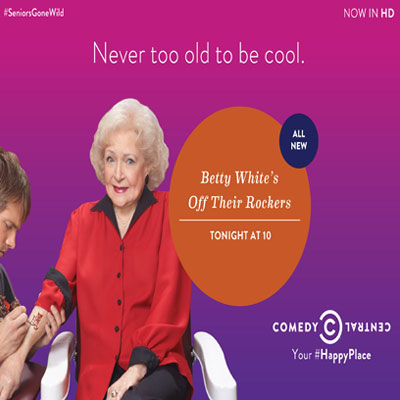
    Understanding the pulse of its viewers, Comedy Central India has repositioned itself aiming to increase the engagement with viewers through a new line-up of diverse shows in September including the likes of Younger, Betty White’s Off Their Rockers, Your Family or Mine and The Mindy Project Season 3.


    “This is just the beginning. We will have more new shows coming in and it will be a new Comedy Central with ‘Your Happy Place,’” informed Palia.


    While content acquisition costs have been increasing at a brisk pace, the question is whether the English entertainment genre in India has a strong enough revenue model. To this, Palia said, “The English entertainment space has spread enormously over the last few years. So the demand has increased and subsequently the cost has gone up. When it comes to Viacom 18, we have our business model and we are doing good. Comedy Central has performed beyond expectations both from consumer point of view as well as business point of view.”


    Apart from high cost of content, piracy is another menace that the English entertainment genre has been grappling with. However, now with the US simulcast and instant premieres, that aspect is partly taken care of. That aside, will the emerging OTT platforms and Netflix’s impending arrival, pose a threat to the channels having English shows? Palia replied, “I don’t think there will be an either – or situation in India. Both platforms will compliment each other. By paying Rs 250 per month, one gets a huge number of channels. It will be difficult for an OTT model to come in and cause disruption. I think the emergence of OTT will be good for consumers but it will co-exist with television.”


    Palia is of the opinion that English entertainment viewers are not only limited to Phase I and II areas of digitisation, but phase III and IV areas will also play vital role in ensuring growth of the English entertainment genre. “If we see the social media insights, a huge number of impressions are registered from the phase III and IV areas. Those areas are important and English content consumers are very much there. So I think time ahead will be hugely positive.”

  • ErosNow launches on Jadoo TV OTT platform worldwide

    ErosNow launches on Jadoo TV OTT platform worldwide

    MUMBAI: Jadoo TV’s parent company CloudStream Media, Inc has inked a partnership with Eros International to bring the ErosNow streaming service to the Jadoo TV over-the-top (OTT) streaming platform worldwide.


    With this deal, Jadoo TV’s consumers will get instant access to Bollywood movies, television shows and music videos. Jadoo TV will make the ErosNow premium service available starting September 2015 for free to Jadoo4 users for the first year, amounting to a $100 value.


    With this latest announcement, Jadoo TV continues to provide its customers with an industry leading line up of on-demand and live South Asian film and television content on its.


    ErosNow premium service users on Jadoo TV will see films releasing immediately after their theatrical release and prior to their television release. ErosNow will also include in-house flagship original programming delivering shows with film-like production values. Content across several genres that include reality shows, adaptations of international series, and original productions spanning drama, comedy and thrillers will also be made available. Full seasons of these shows and series will be available for viewing exclusively on ErosNow.


    “Partnering with Eros is an exciting opportunity for us as it significantly bolsters our on-demand content offering, allowing our customers access to the latest selection of high quality Bollywood and regional movies, television shows, and music videos. Jadoo TV is the leading platform for the South Asian diaspora, and we believe that this partnership will significantly change the digital media distribution landscape,” said CloudStream Media, Inc CEO and Jadoo TV founder Sajid Sohail.

  • Sun TV loads South Indian languages films on HOOQ in multi-year deal

    Sun TV loads South Indian languages films on HOOQ in multi-year deal

    MUMBAI: The OTT acceleration in India is rapidly getting recognition from film and television companies. After collaborating with the likes of Yash Raj Films and Shemaroo Entertainment, OTT player HOOQ has now joined hands with top South Indian broadcaster Sun TV in a multi-year deal.

    HOOQ will carry Sun TV’s library that includes a mix of super hit films in Tamil, Telugu, Malayalam and Kannada languages. 

    Sun TV group CEO S L Narayanan said, “We are excited about the possibilities arising out of our association with HOOQ, a digital distribution platform of impeccable lineage. Sun TV holds a large library of blockbusters and timeless classics with enduring appeal.”

    “Sun TV Network’s extensive library with titles from Tamil to Malayalam will help us ensure we have something for everyone in India. More importantly, we want our customers to continue to enjoy the largest and best catalogue of Hollywood and Indian content of any service available today,” added HOOQ CEO Peter Bithos.

    It may be recalled that Asian OTT player HOOQ recently set shop in India with over 30,000 hours  of movies and TV series.

  • “If OTT players offer a unique proposition, all of them can co-exist:” Debashish Ghosh

    “If OTT players offer a unique proposition, all of them can co-exist:” Debashish Ghosh

    ditto TV – India’s first OTT venture owned by media mogul Subhash Chandra – is all set to thrust forward in the space with a strong focus on innovation and fresh content. The OTT player has launched its international operations and will soon have content from across the globe. 


    In conversation with Indiantelevision.com’s Anirban Roy Choudhury, ditto TV CEO Debashish Ghosh shares his vision and thoughts on the emerging OTT market in India. Prepared to take on international players entering the market, he says that Zee Entertainment Enterprises does not believe in loss making business propositions. Every business under the conglomerate is financially independent. The emerging market not only has the potential to grow rapidly but also offers ample scope for innovation.


    Excerpts:


    Is India ready for OTT platforms? How is the market shaping up?


    The Indian market is surely getting ready for OTT. The only challenge that Indian OTT players face is that of bandwidth. The cost of data be it mobile or cable is high. For an average Indian to shell out Rs 2000 individually to have internet on their mobile is still a challenge. Yes, things are improving and it’s but natural that penetration will increase. Statistically, we are going over the US when it comes to penetration of the Internet.


    We at ditto TV are cognizant of the bandwidth condition in the country from the very beginning. Hence, we are not a platform that only works on 3G or Wi-Fi. ditto TV also works on 2G, WAP as well as on feature phones. The OTT market in India is growing and has great growth opportunity. The infrastructure will get better and data will become cheaper as we go along. The growth of OTT will also be interconnected with the new set of consumers that are coming in. Anybody born post 1990s and is above 25 years old doesn’t really watch TV today. They watch all their content on the digital platform.


    Which revenue model will sustain in the long run for OTT players in India and which model will ditto TV follow?


    I don’t believe any one model will work. It has to be a hybrid scenario. Advertising revenue for at least next three – five years is not the proposition that will be sufficient to offset the cost, so if the business strategy is to incur huge losses then going with the advertising platform is okay. We don’t believe in such loss making propositions. We believe in that whatever business we do, must pay for itself and that’s the reason why we follow the subscription model. I think we are one of the two players, who follow a subscription revenue model. World over the subscription based revenue model is something that’s proven to be sustainable and I don’t see that changing in India.


    What kind of advertising can OTT platforms offer? What is the advertiser’s overview on the platform?


    If today India is paying for TV that means they are paying for content. The way digital platforms have progressed in this country, creates a challenge. So far the advertising model was working but we all know that it’s stagnating now. Display advertising by its own nature isn’t attractive anymore on digital for brands. As digital is a measurable medium, people over the platform want to target a specific audience and hence the funda of mass roll-out does not work here. That’s why a proposition like native advertising is coming in and innovations like brand solutions, integrated marketing and most importantly proposition like highly targeted advertising will work. Now when a brand wants to advertise, they won’t say “I want ‘X’ GRP” or “‘X’ circulation of a medium,” but will instead say “I want to target 1 million Male, who are aged between 24-32 and are interested in sports.”


    BARC is scheduled to release data for all screens which will also include screens that OTT caters to. Do you feel we have enough data to provide brands with a platform for targeted advertising?


    Even if BARC provides data for all screens, it will still remain a sample based proposition.


    On the other hand, publishers today have the capacity to roll out empirical data. We can give empirical data of the number of people watching our content, how they are watching it, how much time they are spending and how many of them are coming back. Based on this data, we can target specifically. That infrastructure is a function of technology and technology exists today. There are many data management companies like Lotame and Bluberry, which are in play today. So it is possible to fulfil advertisers’ demand and those who can fulfil this will remain in play or get premium CPM for their inventory. The growth will come from targeted advertising. But I believe that India is a market where if the content is original, attractive and effective, people will pay for it.


    What’s your take on the current content on OTT platforms? What will be ditto TV’s content strategy and what kind of content is likely to work?


    Largely, OTT players today are going for pre-produced TV content, which is easily available. At the same time, brands, freelancers and MCNs are also creating a lot of original content. ditto TV has also invested in creating original content. We launched a music show, which is exclusively for digital and then we are also moving towards producing a whole lot of original shows in different genres like humor, horror, short series and short movies etc. This is sharable content that resonates with consumers, which is not necessarily long. 


    I believe that the debate between long and short show is a wrong one. Content is what is important. If the content has quality, short will also work. We can take example from Sujoy Ghosh’s Ahalya, which got more than two million views in three days. So if the content has quality, it will fly. We make so many long movies but how many do we actually remember at the end of the day?


    Do you think an ‘only original’ content strategy is monetarily sustainable at this stage?


    Creating content cannot be the only strategy. Producing content is also a strategy. One must have all sorts of content including original content. You cannot drive something only on the basis of original content. Let’s face the reality, TV content is still attractive and liked by the mass so there is no point in saying that we will only create original content and dump TV.


    Also if you create content, you have to find different ways of monetizing it and that’s where syndication comes in. If you are stuck to a particular model, it’s highly unlikely that you will recover money. Also, the more the content is watched, the more relevant it becomes. House of Cards, Game of Thrones and Orange Is The New Black are examples that we already seen.


    Do you feel post the 4G launch, there will be more mobile consumption?


    I am keenly waiting for 4G to roll out. But I believe that content will be consumed on both mobile as well as broadband devices. Expecting someone to watch content full day standing on one leg is a little too much as entertainment is not only about content quality but also experience. So group viewing will continue but at the same time when someone is travelling, instead of missing the content because they are in transit, they will watch it on mobile devices, which they wouldn’t be able to do if OTT wasn’t present. In my opinionm consumption is never a ‘or’ but is always an ‘and’ proposition.


    Do you feel that the launch of global OTT players Netflix and HOOQ can pose a threat to existing Indian OOT platforms?


    India is a very big market and there is scope for everybody to play, provided you are unique. Whether you are ditto TV, HOOQ, Netflix or Hotstar, your USP should be clear to the consumers. The consumer is fickle, so if these players bring in a unique proposition in terms of content and entertainment, all of them will reside simultaneously.


    However, in the long run, there will be players who will survive and those who will perish. The platform offering the best holistic experience will survive and hence OTT players will have to keep innovating and setting benchmarks.


    Was ditto TV’s new TVC with the tagline ‘Who watches TV alone?’ launched with the aim of taking a dig at Hotstar’s ‘Go Solo’ campaign?


    If you don’t go only by the last line, with this campaign what we are actually trying to convey is that television viewing is a collective experience. Initially when TV came to India, it used to be a community viewing. We all used to go to the neighbour’s place and watch Mahabharat. I believe that has not changed significantly because it’s entertainment at the end of the day.


    Entertainment is consumed with people one cares for and that’s what we wanted to communicate. In today’s world, where cultures are shifting, people are moving out of their families, nuclear families are mushrooming but relationships do not change. So if people have separated due to circumstances, they don’t need to change their habit of watching TV together. That’s why we showcased mother – daughter, fiancé, brother and sister as well as friends in our campaign. This campaign was executed after research and has nothing to do with Hotstar or its campaign.


    With the campaign, was the aim to reach a particular milestone in terms of downloads? What is ditto TV’s subscriber base at this stage?


    Downloads mean nothing to us. Ideally, download should mean nothing to everybody. It is just an eyewash. Being a subscription based platform, we analyse ourselves on the basis of the number of active subscribers we have and our target is always to enhance the subscriber base, not the downloads.


    We have 1.5 million monthly paid subscriber base out of which most of them are based in India. We have just launched our international operations and have around 20,000 international subscribers. We believe that international operations will play a big role in our growth in terms of monetisation. 


    What is the roadmap ahead for ditto TV?


    Our goal is to have a worldwide presence with a versatile range of content, which includes both regional as well as international content. We will keep innovating and offering people an exquisite experience. We will make subscription easy and have a wide range of packs, which will make people pay for what they want.


    A Bengali has no necessity of a South Indian pack and vice versa, so we will make sure that channels are not forced on to consumers. We allow users to download shows and watch them at their leisure. So overall, we will keep innovating and I believe that’s something that the OTT sector also needs to do non–stop.