
Tag: OTT

  • Pay-TV in vital stage; service providers must innovate: Study

    Pay-TV in vital stage; service providers must innovate: Study

    SINGAPORE: Pay-TV has entered a period of significant change. Competition is set to increase dramatically, and, in order to grow, service providers will have to innovate strongly.
    Nagra, a Kudelski Group (SIX:KUD.S) company and the world’s leading independent provider of content protection and multi-screen television solutions, in partnership with MTM, has published the global learnings from the Pay-TV Innovation Forum. Findings from the Asia Pacific leg of the programme were released last month.

    According to the global findings, industry participants strongly believe that pay-TV, while still growing worldwide, has entered a period of significant change, creating both challenges and opportunities. 83% of executives stated that competition is set to increase dramatically and 78% agreed that in order to grow, service providers will have to innovate strongly over the next five years. However, the state of innovation varies by region. North American pay-TV service providers are notable for their innovation capabilities, offering the most advanced and diversified product and service portfolios. In comparison, pay-TV markets in Asia Pacific are much more fragmented, with market characteristics and service-providers’ innovation capabilities varying substantially by territory.

    Looking forward, executives cited strengthening their core pay-TV platform by going beyond traditional services as their main area of opportunity by focusing on multiscreen/TV everywhere services (76 per cent), new types of content (74 per cent), and new content pricing and packaging strategies (73 per cent). Just over half of executives also see opportunities in advance advertising and data (54 per cent), as well as standalone OTT services (53 per cent).

    Identifying opportunities for innovation globally, the research notes that many service providers have already started investing in new growth areas. North American providers, for example, see a significant commercial opportunity in new forms of content that appeal to Millennials and Generation Z such as digital-first short-form content, on-boarding of third-party OTT services, virtual reality, and gaming. Some European and Asia Pacific pay-TV service providers also see value in providing OTT or gaming services on their pay-TV platforms, particularly through partnerships. Only a smaller number of large scale operators currently address business adjacencies such as advanced advertising and Internet of Things (IoT).

    The research also identifies four major innovation success factors for the industry including strong customer and market insight, having the right platforms and processes, as well as strategic and collaborative partnerships with best-of-breed technology suppliers and content companies.

    “As broadband becomes more ubiquitous in several markets, competition from streaming media platforms intensifies and consumer TV and video journeys evolve, it is clear that the industry needs to innovate at a faster pace to satisfy its customers and remain relevant,” said Simon Trudelle, Senior Product Marketing Director for NAGRA. “Thanks to the work of the Pay-TV Innovation Forum, we now have a global view of the state of innovation around the world and a foundation of key learnings to ensure future success and growth for pay-TV service providers.”

    “The pay-TV industry is a global success story,” said Jon Watts, Managing Partner at MTM. “Despite some regional differences, the majority of executives expect to continue innovating around their core pay-TV services, improving user experience and developing new ways to price and package content, bringing new kinds of content onto their TV platforms, and continuing to invest in multiscreen offerings. The research programme also shows that successful service providers have focused strongly on developing their innovation capabilities, enabling them to adapt to new market conditions.”
  • Pay-TV in vital stage; service providers must innovate: Study

    Pay-TV in vital stage; service providers must innovate: Study

    SINGAPORE: Pay-TV has entered a period of significant change. Competition is set to increase dramatically, and, in order to grow, service providers will have to innovate strongly.
    Nagra, a Kudelski Group (SIX:KUD.S) company and the world’s leading independent provider of content protection and multi-screen television solutions, in partnership with MTM, has published the global learnings from the Pay-TV Innovation Forum. Findings from the Asia Pacific leg of the programme were released last month.

    According to the global findings, industry participants strongly believe that pay-TV, while still growing worldwide, has entered a period of significant change, creating both challenges and opportunities. 83% of executives stated that competition is set to increase dramatically and 78% agreed that in order to grow, service providers will have to innovate strongly over the next five years. However, the state of innovation varies by region. North American pay-TV service providers are notable for their innovation capabilities, offering the most advanced and diversified product and service portfolios. In comparison, pay-TV markets in Asia Pacific are much more fragmented, with market characteristics and service-providers’ innovation capabilities varying substantially by territory.

    Looking forward, executives cited strengthening their core pay-TV platform by going beyond traditional services as their main area of opportunity by focusing on multiscreen/TV everywhere services (76 per cent), new types of content (74 per cent), and new content pricing and packaging strategies (73 per cent). Just over half of executives also see opportunities in advance advertising and data (54 per cent), as well as standalone OTT services (53 per cent).

    Identifying opportunities for innovation globally, the research notes that many service providers have already started investing in new growth areas. North American providers, for example, see a significant commercial opportunity in new forms of content that appeal to Millennials and Generation Z such as digital-first short-form content, on-boarding of third-party OTT services, virtual reality, and gaming. Some European and Asia Pacific pay-TV service providers also see value in providing OTT or gaming services on their pay-TV platforms, particularly through partnerships. Only a smaller number of large scale operators currently address business adjacencies such as advanced advertising and Internet of Things (IoT).

    The research also identifies four major innovation success factors for the industry including strong customer and market insight, having the right platforms and processes, as well as strategic and collaborative partnerships with best-of-breed technology suppliers and content companies.

    “As broadband becomes more ubiquitous in several markets, competition from streaming media platforms intensifies and consumer TV and video journeys evolve, it is clear that the industry needs to innovate at a faster pace to satisfy its customers and remain relevant,” said Simon Trudelle, Senior Product Marketing Director for NAGRA. “Thanks to the work of the Pay-TV Innovation Forum, we now have a global view of the state of innovation around the world and a foundation of key learnings to ensure future success and growth for pay-TV service providers.”

    “The pay-TV industry is a global success story,” said Jon Watts, Managing Partner at MTM. “Despite some regional differences, the majority of executives expect to continue innovating around their core pay-TV services, improving user experience and developing new ways to price and package content, bringing new kinds of content onto their TV platforms, and continuing to invest in multiscreen offerings. The research programme also shows that successful service providers have focused strongly on developing their innovation capabilities, enabling them to adapt to new market conditions.”
  • Saying traditional TV is dying in India is premature

    Saying traditional TV is dying in India is premature

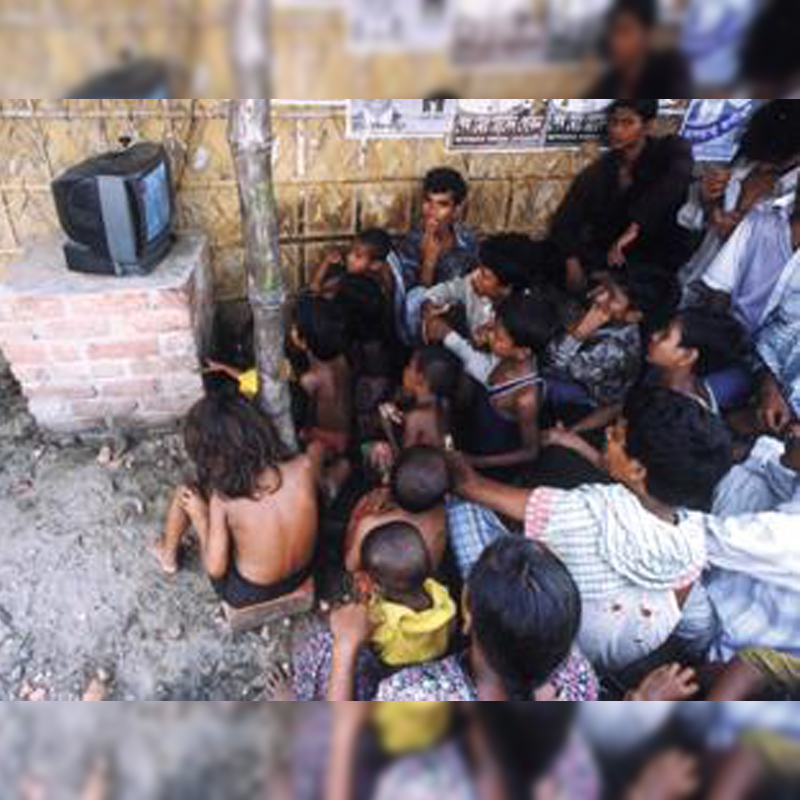
    On a recent road trip to Ladakh with friends we stopped at a nondescript roadside ‘dhaba’ (makeshift eatery) near the Himachal Pradesh and J&K border for tea and to stretch sore limbs. As tea was being boiled, stifled giggling from inside the hutment attracted me. While trying to see if my smart-phone was working so I could check-in on FB, I peeped inside. A group of local kids were enjoying a soap opera on television; courtesy DD FreeDish, a free-to-air DTH platform. My mobile phone, in the meanwhile, showed no signs of life with a No-Network message flashing.

    This, and many other such examples in India’s hinterland, highlight a fact loud and clear: India may be going digital, but Bharat (as non-urban hinterlands of India is referred to by some sociologists and marketers) still roots for the traditional. Such instances also tell us that in a country as diversified, complex and challenging as India, traditional habits, like TV watching, are there to stay despite technological disruptions like streaming video and smart-phones.

    Globally, death of traditional TV viewing has been predicted for past few years. But data and analytics from more mature and developed markets and even some East Asian nations – where digital is a big draw – show that TV as we know it is not going away anytime soon.

    A US Department of Labour Survey, released early 2016, states that watching TV was the leisure activity that “occupied the most time (2.8 hours per day), for those aged 15 and over.”

    BARB (UK equivalent of BARC India) data shows that average daily video viewing by all individuals is 4hrs 35mins and that TV accounts for 94 per cent of all video advertising time. Over the last decade, despite several “disruptive” technological developments, time spent watching TV has hardly dipped, as was being forecast. More importantly, TV continues to have largest reach of all media: it reaches 71per cent of population in a day, 93per cent in a week, and 98 per cent in a month.
    And, these are markets with near total saturation of TV homes, and a highly developed and widespread digital eco-system.

    What about India?

    Appetite for more TV content is only bound to grow given that only 153 million homes in India have TV out of a total of about 250 million (a penetration of about 60 per cent). Rise in disposable incomes, increasing fragmentation of families and continued challenges of Indian infrastructure are bound to push TV viewing higher.

    All-India BARC data for 47 weeks appear to validate that. Average daily TV viewing stands at 3 hours 16 minutes, showing headroom for growth, compared to more mature TV markets that have higher TV penetration rate of 97+ per cent.

    India has close to 900 licensed channels and while Ministry of Information and Broadcasting (MIB) agrees some of these licensees may not be on air, but scores of applicants are in queue too — another indicator of growth in appetite for TV.

    But, what about the perception that traditional TV viewership is losing out due to growth of digital platforms?

    Let’s look at BARC India data for a recent TV event, the Rio Olympics. TV viewership for Rio 2016 grew 2.65 times as compared to London 2012. While 16 million unique viewers watched the broadcast of London Games in India, the corresponding figure for Rio Games is 43 million (using the same viewership base – 1million+ towns). If one looks at the all-India (Urban+Rural) base, Rio 2016 set another high of 203.8 million unique viewers.

    This brings us to cricket, India’s fav sports (apart from politics). BARC data shows that a new viewership high was achieved during an India-Pakistan ICC T20 World Cup match in 2016, which generated a whopping 80.5 million impressions across Star Sports Network and DD National. And these numbers came on the back of not just a larger number of people watching TV, but also considerable higher time spent on TV.

    When asked about linear TV’s impending death in India owing to digital’s growth, Colors CEO and President of the Advertising Club (of India) Raj Nayak waved away the analysis asserting, “I am ready to stick out my neck on this. People who say that traditional television is dying don’t know what they are talking about. TV has been growing and there is still big headroom for its growth in India.”

    India may be adopting mobile phones faster than the US or other western countries, and a major percentage of them are smart-phones. Still, challenges for digital players are big and many ranging from costly data, indifferent bandwidth speed and getting the right content mix for a country that has 22 official languages and over 700 dialects.

    At Vidnet2016, an OTT conference organised by indiantelevision.com recently, Hotstar chief Ajit Mohan admitted that high cost of data is a major hurdle for expansion of streaming services like Hotstar and others like Voot, dittoTV, BoxTv, Arre, Savvn, Hooq, Viu, SonyLiv, etc.

    Data pointing to greater consumption of TV is one side of the picture. Globally, studies and data also indicate that TV remains a highly effective form of advertising.

    A study by the Institute of Practitioners of Advertising (UK’s equivalent of India’s AAAI) shows that TV continues to guarantee best commercial outcomes of campaigns for things such as sales, profit, market share, etc. Echoing similar sentiments, Colors’ Nayak added, “Digital advertising does not have the same impact that TV (advertising) has… Even Amazon, Google and other e-commerce companies have to use TV to make an impact.”

    US-based eMarketer (started in 1996 to study digital trends and considered one of the most widely cited research providers in the media) admits that despite a drop in TV watching time, in general, it hasn’t stopped marketers from pouring significant amounts of money into television advertising.

    Without discounting the strides being made by digital players in India (and they seem to be mushrooming all over like dotcoms during the dotcom boom of the late 1990s), traditional TV’s importance and reach still outstrips that of digital.

    Pointing out that digital does offer consumers choices of watching TV (government lingo for video consumption) at different time and in different formats, a senior government official, having worked at MIB, on condition of anonymity admitted that TV is not going away from India. Rather, the size of India will help it retain its pre-eminence as opposed to other media.

    GroupM too testifies to TV’s strong presence in India compared to other segments of media like print, OOH and digital. In projections made in January 2016, which are re-visited mid-year to do any course corrections if necessary, the company said television was estimated to grow by 17.6 per cent to touch Rs 27,074 crore (Rs. 2,7,0740 million) this year against Rs 23,022 crore (Rs. 23,02,20 million) last year as far as advertising spends go.

    Colors’ Nayak aptly sums up the issue: “There is no doubts that digital will see growth at a phenomenal pace especially with Reliance Jio addressing the bandwidth and speed issues, but digital must be seen as another platform for delivering content and that’s it. There will be lot of content consumption on digital platforms, but it will not be at the cost of (traditional) TV viewing.”

    Like Nayak, I too am ready to bet my bucks on linear or traditional TV in India. Digital has to travel many more miles in India before it can be a replacement for TV, which is still far off from near-saturation point or even plateauing off.

    (Author is Consulting Editor to indiantelevision.com)

  • Saying traditional TV is dying in India is premature

    Saying traditional TV is dying in India is premature

    On a recent road trip to Ladakh with friends we stopped at a nondescript roadside ‘dhaba’ (makeshift eatery) near the Himachal Pradesh and J&K border for tea and to stretch sore limbs. As tea was being boiled, stifled giggling from inside the hutment attracted me. While trying to see if my smart-phone was working so I could check-in on FB, I peeped inside. A group of local kids were enjoying a soap opera on television; courtesy DD FreeDish, a free-to-air DTH platform. My mobile phone, in the meanwhile, showed no signs of life with a No-Network message flashing.

    This, and many other such examples in India’s hinterland, highlight a fact loud and clear: India may be going digital, but Bharat (as non-urban hinterlands of India is referred to by some sociologists and marketers) still roots for the traditional. Such instances also tell us that in a country as diversified, complex and challenging as India, traditional habits, like TV watching, are there to stay despite technological disruptions like streaming video and smart-phones.

    Globally, death of traditional TV viewing has been predicted for past few years. But data and analytics from more mature and developed markets and even some East Asian nations – where digital is a big draw – show that TV as we know it is not going away anytime soon.

    A US Department of Labour Survey, released early 2016, states that watching TV was the leisure activity that “occupied the most time (2.8 hours per day), for those aged 15 and over.”

    BARB (UK equivalent of BARC India) data shows that average daily video viewing by all individuals is 4hrs 35mins and that TV accounts for 94 per cent of all video advertising time. Over the last decade, despite several “disruptive” technological developments, time spent watching TV has hardly dipped, as was being forecast. More importantly, TV continues to have largest reach of all media: it reaches 71per cent of population in a day, 93per cent in a week, and 98 per cent in a month.
    And, these are markets with near total saturation of TV homes, and a highly developed and widespread digital eco-system.

    What about India?

    Appetite for more TV content is only bound to grow given that only 153 million homes in India have TV out of a total of about 250 million (a penetration of about 60 per cent). Rise in disposable incomes, increasing fragmentation of families and continued challenges of Indian infrastructure are bound to push TV viewing higher.

    All-India BARC data for 47 weeks appear to validate that. Average daily TV viewing stands at 3 hours 16 minutes, showing headroom for growth, compared to more mature TV markets that have higher TV penetration rate of 97+ per cent.

    India has close to 900 licensed channels and while Ministry of Information and Broadcasting (MIB) agrees some of these licensees may not be on air, but scores of applicants are in queue too — another indicator of growth in appetite for TV.

    But, what about the perception that traditional TV viewership is losing out due to growth of digital platforms?

    Let’s look at BARC India data for a recent TV event, the Rio Olympics. TV viewership for Rio 2016 grew 2.65 times as compared to London 2012. While 16 million unique viewers watched the broadcast of London Games in India, the corresponding figure for Rio Games is 43 million (using the same viewership base – 1million+ towns). If one looks at the all-India (Urban+Rural) base, Rio 2016 set another high of 203.8 million unique viewers.

    This brings us to cricket, India’s fav sports (apart from politics). BARC data shows that a new viewership high was achieved during an India-Pakistan ICC T20 World Cup match in 2016, which generated a whopping 80.5 million impressions across Star Sports Network and DD National. And these numbers came on the back of not just a larger number of people watching TV, but also considerable higher time spent on TV.

    When asked about linear TV’s impending death in India owing to digital’s growth, Colors CEO and President of the Advertising Club (of India) Raj Nayak waved away the analysis asserting, “I am ready to stick out my neck on this. People who say that traditional television is dying don’t know what they are talking about. TV has been growing and there is still big headroom for its growth in India.”

    India may be adopting mobile phones faster than the US or other western countries, and a major percentage of them are smart-phones. Still, challenges for digital players are big and many ranging from costly data, indifferent bandwidth speed and getting the right content mix for a country that has 22 official languages and over 700 dialects.

    At Vidnet2016, an OTT conference organised by indiantelevision.com recently, Hotstar chief Ajit Mohan admitted that high cost of data is a major hurdle for expansion of streaming services like Hotstar and others like Voot, dittoTV, BoxTv, Arre, Savvn, Hooq, Viu, SonyLiv, etc.

    Data pointing to greater consumption of TV is one side of the picture. Globally, studies and data also indicate that TV remains a highly effective form of advertising.

    A study by the Institute of Practitioners of Advertising (UK’s equivalent of India’s AAAI) shows that TV continues to guarantee best commercial outcomes of campaigns for things such as sales, profit, market share, etc. Echoing similar sentiments, Colors’ Nayak added, “Digital advertising does not have the same impact that TV (advertising) has… Even Amazon, Google and other e-commerce companies have to use TV to make an impact.”

    US-based eMarketer (started in 1996 to study digital trends and considered one of the most widely cited research providers in the media) admits that despite a drop in TV watching time, in general, it hasn’t stopped marketers from pouring significant amounts of money into television advertising.

    Without discounting the strides being made by digital players in India (and they seem to be mushrooming all over like dotcoms during the dotcom boom of the late 1990s), traditional TV’s importance and reach still outstrips that of digital.

    Pointing out that digital does offer consumers choices of watching TV (government lingo for video consumption) at different time and in different formats, a senior government official, having worked at MIB, on condition of anonymity admitted that TV is not going away from India. Rather, the size of India will help it retain its pre-eminence as opposed to other media.

    GroupM too testifies to TV’s strong presence in India compared to other segments of media like print, OOH and digital. In projections made in January 2016, which are re-visited mid-year to do any course corrections if necessary, the company said television was estimated to grow by 17.6 per cent to touch Rs 27,074 crore (Rs. 2,7,0740 million) this year against Rs 23,022 crore (Rs. 23,02,20 million) last year as far as advertising spends go.

    Colors’ Nayak aptly sums up the issue: “There is no doubts that digital will see growth at a phenomenal pace especially with Reliance Jio addressing the bandwidth and speed issues, but digital must be seen as another platform for delivering content and that’s it. There will be lot of content consumption on digital platforms, but it will not be at the cost of (traditional) TV viewing.”

    Like Nayak, I too am ready to bet my bucks on linear or traditional TV in India. Digital has to travel many more miles in India before it can be a replacement for TV, which is still far off from near-saturation point or even plateauing off.

    (Author is Consulting Editor to indiantelevision.com)

  • SPN to use Nice analytics for OTT, On-Demand videos

    SPN to use Nice analytics for OTT, On-Demand videos

    BARCELONA: Nice People at Work (NPAW), the leader in business intelligence and analytics technology for the online video industry, announced that Sony Pictures Networks India (SPN) has chosen YOUBORA to optimize quality of experience to boost audience engagement.

    By utilizing NPAW’s YOUBORA solution, SPN will be able to deliver quality television content via the internet.

    Launched in 1995, SPN is one of India’s largest Hindi language content providers in the Indiansub-continent, airing local hits such as Kaun Banega Crorepati, CID, Taarak Mehta Ka Ooltah Chashmah among others. SPN has integrated with YOUBORA analytics to accommodate the growing demand for OTT and On Demand videos, to present quality content equal to conventional television to its online viewers.

    YOUBORA, NPAW’s award winning analytics and business intelligence platform, leads the industry in providing content providers with detailed read-outs of the video delivery ecosystem. With this tool, content providers can respond appropriately to delivery issues, thereby boosting audience engagement, satisfaction and consequently loyalty by minimizing experience problems such as buffering or lag time. Such disruptions are managed easily with YOUBORA’s real time data collection capabilities, the most granular in the industry including the platform’s SmartModules.

    “Too often, South Asia is overshadowed by the Far East, Western Europe and America where business opportunity is concerned. We feel privileged to assist Sony Pictures Networks India (SPN) in delivering superior video experiences to their audience.” said NPAW’s CEO, Ferran Gutiérrez, of the agreement.

    “Our audience deserves the best experience possible when they turn to their computer or any device to watch their favorite programming”, said Ajay Kumar Meher, Sr. VP – IT & Post Production of Sony Pictures Networks India (SPN). “The real-time quality and audience engagement metrics provided by YOUBORA leads the industry in this regard, and we are excited SPN will have access to this resource.”

    NPAW is a Business Intelligence and Big Data company serving the online video industry. Sony Pictures Networks India (SPN), (formerly Multi Screen Media Private Ltd.), is a subsidiary of Sony Corporation which owns and operates the Sony Entertainment network of television channels.

  • SPN to use Nice analytics for OTT, On-Demand videos

    SPN to use Nice analytics for OTT, On-Demand videos

    BARCELONA: Nice People at Work (NPAW), the leader in business intelligence and analytics technology for the online video industry, announced that Sony Pictures Networks India (SPN) has chosen YOUBORA to optimize quality of experience to boost audience engagement.

    By utilizing NPAW’s YOUBORA solution, SPN will be able to deliver quality television content via the internet.

    Launched in 1995, SPN is one of India’s largest Hindi language content providers in the Indiansub-continent, airing local hits such as Kaun Banega Crorepati, CID, Taarak Mehta Ka Ooltah Chashmah among others. SPN has integrated with YOUBORA analytics to accommodate the growing demand for OTT and On Demand videos, to present quality content equal to conventional television to its online viewers.

    YOUBORA, NPAW’s award winning analytics and business intelligence platform, leads the industry in providing content providers with detailed read-outs of the video delivery ecosystem. With this tool, content providers can respond appropriately to delivery issues, thereby boosting audience engagement, satisfaction and consequently loyalty by minimizing experience problems such as buffering or lag time. Such disruptions are managed easily with YOUBORA’s real time data collection capabilities, the most granular in the industry including the platform’s SmartModules.

    “Too often, South Asia is overshadowed by the Far East, Western Europe and America where business opportunity is concerned. We feel privileged to assist Sony Pictures Networks India (SPN) in delivering superior video experiences to their audience.” said NPAW’s CEO, Ferran Gutiérrez, of the agreement.

    “Our audience deserves the best experience possible when they turn to their computer or any device to watch their favorite programming”, said Ajay Kumar Meher, Sr. VP – IT & Post Production of Sony Pictures Networks India (SPN). “The real-time quality and audience engagement metrics provided by YOUBORA leads the industry in this regard, and we are excited SPN will have access to this resource.”

    NPAW is a Business Intelligence and Big Data company serving the online video industry. Sony Pictures Networks India (SPN), (formerly Multi Screen Media Private Ltd.), is a subsidiary of Sony Corporation which owns and operates the Sony Entertainment network of television channels.

  • SVod outpacing pay TV in W. Europe’s consumption trends: Report

    SVod outpacing pay TV in W. Europe’s consumption trends: Report

    MUMBAI: Subscription video on-demand (SVoD) content is increasing more and more as compared to Pay TV.

    Several discussions have taken place in India with the growing number of digital platforms. Broadcasters such as Star India, Viacom18, Zee Media and Sony Television, etc have entered this space with their own OTT/VOD platforms. Debates not just confined to the emergence of VOD platforms but also the entry of various global players have been raging since.

    The fact that digitisation is at a nascent phase in India only paved the way for the players to experiment various models. This also raised a few eyebrows on the existence of cable and satellite television.

    While most follow an advertising-led model or a ‘freemium model’, the countable ones have taken the challenge of following a subscription-based model. As print has survived after the entry of broadcast, analog and digital cable network will also co-exist with the emergence of various digital platforms. With the robust penetration of internet in the US, Pay TV has remained powerful.

    But is it the same everywhere else? Certainly not. The scenario is completely different in Western Europe. SVoD subscription has been outstripping Pay TV since 2012. The subscription net addition of Pay TV in 2016 is 2 million which is estimated to see a downfall by 2021 to 1 million.

    On the other hand, SVoD in 2016 is 9 million only and evaluated to come down to 3 million by 2021. Both the services are currently at its peak but are substantially going to see some disruption. This clearly shows that currently the viewers are ready to pay for good quality content.

    These were some of the findings presented in a report at IBC by Ampere Analysis, a London based analyst firm, at Amsterdam yesterday.

    According to the Ampere report, SVoD is growing as a significant segment not just in the USA but also in other countries such as Poland, France, the Netherlands, Spain, Italy, Germany, the UK, Sweden and Denmark. The average SVoD-only homes in the second quarter of 2015 has been 5 per cent while, in the current scenario, it has grown by 2 per cent for the first quarter.

    US specifically has seen a growth from 9 per cent to 13 per cent whereas the UK has seen an increase of 2 per cent from 8 per cent to 10 per cent in just a year.
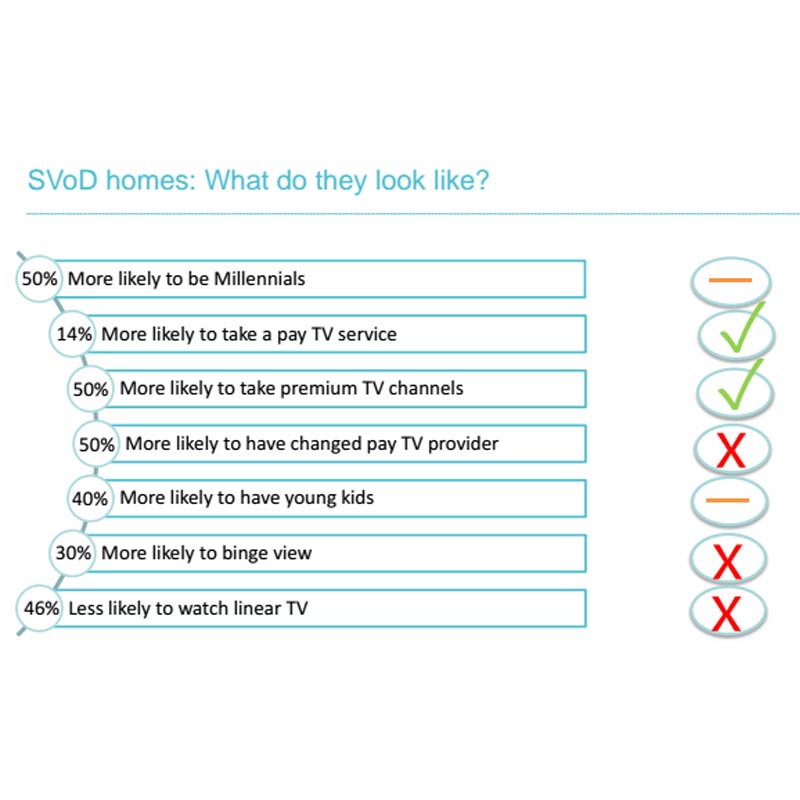
    So, what exactly do the SVoD homes constitute of? The three most relevant observations about who is consuming such massive content on digital platforms are — a big percentage comprise millennials, and the remainder people are more likely to take premium TV channels and some pertcentage have most likely changed their Pay TV provider.

    In all, 46 per cent are less likely to pay for linear TV, while 40 per cent of homes have kids. 30 per cent of the homes have shown an inclination to binge watching. Only 14 per cent of people have opted for a Pay TV service, according to Ampere.

    Business-wise, the concept of platform and channel is evolving though the producer and distributor remain unhampered. Earlier, content was distributed on platforms like Sky, Moviestar and Canalsat, etc which is now replaced by Facebook, Twitter, Snapchat, YouTube, etc. On the other hand, the channel from which content was ideally consumed has converted from Discovery, Fox, HBO, etc to digital platforms like Netflix, SeeSo, CuriosityStream, etc.

    Pay TV and new media products are segmenting, the report states.

    People with lower income are on-demand led whereas people with higher income are linear-led. Young millennials and teenagers can be appealed via services such as Whistle Sports, Soccer, Snapchat, Facebook,etc. Higher income traditional broadcast get pushed through Sky Q to protect high-end broadcast viewers. Direct To Consumers (DTC) cost to get a channel on air are considerably lower. So with a satellite you are going to take your yearly transponder, but with an OTT service you do not have that significant upfront cost. But, what you do have is a scaling cost, CDN delivery, that grows with your customer base.

    Ampere accepts that the latter factor makes OTT uneconomic for reaching very large audiences, estimating that for a single channel or service offering video in any definition from SD to UHD, a satellite feed works out cheaper beyond 10m viewers’ even if they watch on average just one minute of content per day. For a daily viewer base below 20,000, OTT always works out cheaper, even if all viewers watched five hours of content a day and all content was transmitted inUHD, Ampere found.

    With changing economics, channel groups are increasingly looking to Direct To Consumers (DTC) SVOD service. Viewers/advertising spends have shifted to online, operators are pushing back on channel carriage fee, content owners’ margins have squeezed and the DTC, SVoD launch have led to recoup margin. The millennials are already approaching two SVOD services per home. In the US, millennials have crossed the more than 2 number than the average. They are approaching to the number in Germany, Denmark, Poland and UK. Out of the 1002 sample survey, 255 are Netflix customers in UK which only means that the country is most likely to have more Netflix customers.

    It is not all about broadband penetration, because size is also important. And actually if we look at the size of the addressable market, emerging markets like Mexico, Brazil, Russia, China, Taiwan, Thailand, etc all have started to become interesting [DTC] markets when we talk about the total addressable size.

    Ampere’s research found that in the UK a Netflix customer is 1.5 times more likely than average to also take Sky’s Now TV OTT service; 1.8 times more likely to also take Amazon; 2.5 times more likely also to take Spotify’s streaming music services; and 1.5 times more likely to use the catch-up TV apps of the major broadcasters.

    To date, Netflix’s growth strategy has relied on geographic expansion. But, its set to run out of road by 2017. Central, South and Western Europe saw 6 customer additions on an average in 2015 which has reduced to 4 or 5 in 2017 further reducing in 2021. But in Asia Pacific region, the customer addition has gone up from 1 to 5 and is estimated to be 3. Even after this, the fact that Netflix has invested a huge amount of money on content cannot be ignored. Netflix is spending like a broadcast or premium channel group. It spends 60 per cent revenue on program followed by premium platforms contributing 40-70 per cent revenue. Pay multichannels are putting 30-40 per cent revenue on programs.

    Pay TV is still growing but OTT is growing faster – much faster. And that fact sums up both the threat and the opportunity that OTT video presents to platform operators. The survival of service providers depends on their ability to launch new services ahead of the competition.

  • SVod outpacing pay TV in W. Europe’s consumption trends: Report

    SVod outpacing pay TV in W. Europe’s consumption trends: Report

    MUMBAI: Subscription video on-demand (SVoD) content is increasing more and more as compared to Pay TV.

    Several discussions have taken place in India with the growing number of digital platforms. Broadcasters such as Star India, Viacom18, Zee Media and Sony Television, etc have entered this space with their own OTT/VOD platforms. Debates not just confined to the emergence of VOD platforms but also the entry of various global players have been raging since.

    The fact that digitisation is at a nascent phase in India only paved the way for the players to experiment various models. This also raised a few eyebrows on the existence of cable and satellite television.

    While most follow an advertising-led model or a ‘freemium model’, the countable ones have taken the challenge of following a subscription-based model. As print has survived after the entry of broadcast, analog and digital cable network will also co-exist with the emergence of various digital platforms. With the robust penetration of internet in the US, Pay TV has remained powerful.

    But is it the same everywhere else? Certainly not. The scenario is completely different in Western Europe. SVoD subscription has been outstripping Pay TV since 2012. The subscription net addition of Pay TV in 2016 is 2 million which is estimated to see a downfall by 2021 to 1 million.

    On the other hand, SVoD in 2016 is 9 million only and evaluated to come down to 3 million by 2021. Both the services are currently at its peak but are substantially going to see some disruption. This clearly shows that currently the viewers are ready to pay for good quality content.

    These were some of the findings presented in a report at IBC by Ampere Analysis, a London based analyst firm, at Amsterdam yesterday.

    According to the Ampere report, SVoD is growing as a significant segment not just in the USA but also in other countries such as Poland, France, the Netherlands, Spain, Italy, Germany, the UK, Sweden and Denmark. The average SVoD-only homes in the second quarter of 2015 has been 5 per cent while, in the current scenario, it has grown by 2 per cent for the first quarter.

    US specifically has seen a growth from 9 per cent to 13 per cent whereas the UK has seen an increase of 2 per cent from 8 per cent to 10 per cent in just a year.
    So, what exactly do the SVoD homes constitute of? The three most relevant observations about who is consuming such massive content on digital platforms are — a big percentage comprise millennials, and the remainder people are more likely to take premium TV channels and some pertcentage have most likely changed their Pay TV provider.

    In all, 46 per cent are less likely to pay for linear TV, while 40 per cent of homes have kids. 30 per cent of the homes have shown an inclination to binge watching. Only 14 per cent of people have opted for a Pay TV service, according to Ampere.

    Business-wise, the concept of platform and channel is evolving though the producer and distributor remain unhampered. Earlier, content was distributed on platforms like Sky, Moviestar and Canalsat, etc which is now replaced by Facebook, Twitter, Snapchat, YouTube, etc. On the other hand, the channel from which content was ideally consumed has converted from Discovery, Fox, HBO, etc to digital platforms like Netflix, SeeSo, CuriosityStream, etc.

    Pay TV and new media products are segmenting, the report states.

    People with lower income are on-demand led whereas people with higher income are linear-led. Young millennials and teenagers can be appealed via services such as Whistle Sports, Soccer, Snapchat, Facebook,etc. Higher income traditional broadcast get pushed through Sky Q to protect high-end broadcast viewers. Direct To Consumers (DTC) cost to get a channel on air are considerably lower. So with a satellite you are going to take your yearly transponder, but with an OTT service you do not have that significant upfront cost. But, what you do have is a scaling cost, CDN delivery, that grows with your customer base.

    Ampere accepts that the latter factor makes OTT uneconomic for reaching very large audiences, estimating that for a single channel or service offering video in any definition from SD to UHD, a satellite feed works out cheaper beyond 10m viewers’ even if they watch on average just one minute of content per day. For a daily viewer base below 20,000, OTT always works out cheaper, even if all viewers watched five hours of content a day and all content was transmitted inUHD, Ampere found.

    With changing economics, channel groups are increasingly looking to Direct To Consumers (DTC) SVOD service. Viewers/advertising spends have shifted to online, operators are pushing back on channel carriage fee, content owners’ margins have squeezed and the DTC, SVoD launch have led to recoup margin. The millennials are already approaching two SVOD services per home. In the US, millennials have crossed the more than 2 number than the average. They are approaching to the number in Germany, Denmark, Poland and UK. Out of the 1002 sample survey, 255 are Netflix customers in UK which only means that the country is most likely to have more Netflix customers.

    It is not all about broadband penetration, because size is also important. And actually if we look at the size of the addressable market, emerging markets like Mexico, Brazil, Russia, China, Taiwan, Thailand, etc all have started to become interesting [DTC] markets when we talk about the total addressable size.

    Ampere’s research found that in the UK a Netflix customer is 1.5 times more likely than average to also take Sky’s Now TV OTT service; 1.8 times more likely to also take Amazon; 2.5 times more likely also to take Spotify’s streaming music services; and 1.5 times more likely to use the catch-up TV apps of the major broadcasters.

    To date, Netflix’s growth strategy has relied on geographic expansion. But, its set to run out of road by 2017. Central, South and Western Europe saw 6 customer additions on an average in 2015 which has reduced to 4 or 5 in 2017 further reducing in 2021. But in Asia Pacific region, the customer addition has gone up from 1 to 5 and is estimated to be 3. Even after this, the fact that Netflix has invested a huge amount of money on content cannot be ignored. Netflix is spending like a broadcast or premium channel group. It spends 60 per cent revenue on program followed by premium platforms contributing 40-70 per cent revenue. Pay multichannels are putting 30-40 per cent revenue on programs.

    Pay TV is still growing but OTT is growing faster – much faster. And that fact sums up both the threat and the opportunity that OTT video presents to platform operators. The survival of service providers depends on their ability to launch new services ahead of the competition.

  • Imagine Communications extends functionality of Selenio One unified transcoding platform to OTT

    Imagine Communications extends functionality of Selenio One unified transcoding platform to OTT

    MUMBAI: Imagine Communications, empowering the media and entertainment industry through transformative innovation, today introduced a high-density adaptive bitrate (ABR) transcoding product built on Selenio One™, the company’s software-defined linear transcoding platform. Selenio One is designed to deliver new levels of performance, flexibility and cost efficiency to broadcasters, network operators and video service providers (VSPs). The latest addition to the Selenio One family, which will be previewed at IBC2016, is purpose built to enable media companies to generate new revenue and maximise the efficiency of their networks by expanding the number of high video quality ABR and linear channels they can deliver over existing infrastructures.

    Today’s VSPs, including cable operators, telecommunications companies and satellite TV providers, are struggling to cost-effectively keep pace with requirements to deliver high-quality video to an increasing diversity of Internet-connected devices. By leveraging state-of-the-art standard computing resources powered by high-performance transcoding software from Imagine Communications, the newest product in the Selenio One family provides VSPs with the ability to expand the channel-carrying capacity of their video delivery networks on demand while enabling service providers to reduce costs by moving all compression operations to a common, software-based platform.

    “The high-density transcoding instantiation of Selenio One was designed to relieve a particularly acute pain point for today’s content distributors, who have been steadily increasing the cost and complexity of their networks to accommodate shifting video consumption patterns,” said Brick Eksten, Chief Product Officer, Imagine Communications. “Selenio One redefines the operational environment for transcoding, offering cloud-like control of mixed services with the ability to define and redefine those services on the fly. Combining centralised control with dynamic service provisioning allows the operator to be more fluid in operations while providing the ability to create new services on demand.”

    This new addition to the Selenio One platform supports HEVC/H.265 and AVC/H.264 encoding in both ABR and linear transcoding formats at extremely high densities, enabling VSPs and other media companies to realise significant space and power savings. The first release of the product is capable of supporting up to 180 HD ABR or 360 HD linear channels per 4-RU server, establishing new cost-per-channel benchmarks for high quality video transcoding. Source formats supported in the first release are MPEG-2 or H.264 and HEVC/H.265 or H.264 on the output.

    Well suited for high-density terrestrial, satellite and primary distribution transcoding with ABR transcoding for over-the-top (OTT) multiscreen applications, the latest product in the Selenio One family provides a single system for any VSP looking to launch more channels, move from MPEG-2 to H.264, add HEVC/H.265, or address a multiservice lineup with linear transcode and OTT/ABR delivery.

    Imagine Communications introduced the Selenio One platform earlier this year at the 2016 NAB Show. The initial product release focused on high video quality H.264/MPEG-2 transcoding using PCIe video acceleration with integrated software multiplexing and processing. Selenio One’s software-based architecture enables service providers to customise the functionality of the platform through the selection of video processing engines. This approach ensures consistency across all compression operations through a common architecture and control system.

    All products built on the Selenio One are powered by Zenium™, a next-generation software framework that also underpins several additional solutions from Imagine Communications. Zenium utilizes a Micro Services approach to implementation and deployment that enables cloud-native component technologies to be easily distributed across multiple platforms. Zenium-powered platforms, including Selenio One, are designed to seamlessly integrate new technology as it becomes available and adapt to multiple deployment scenarios, from appliance to datacenter to cloud.

    The latest Selenio One product provides unprecedented flexibility, allowing commercial off-the-shelf (COTS) platforms to be optimised for software-only and GPU-accelerated encoding, as well as enhancing the specialised video processing and acceleration capabilities of modern processors with field-proven intellectual property from Imagine Communications.

    The first release of the high-density transcoding Selenio One includes the following features:
    • Support for up to 180 HD ABR and 360 HD linear channels per 4.3RU server
    • HEVC/H.265 and H.264 support
    • GPU-powered transcoding with Imagine’s enhanced video quality
    • Selenio One Media Manager system for redundancy and network management
    • Linux-based and distributed software architecture

    The latest release of the Selenio One platform is also a critical product within Imagine’s CloudXtream™ multiscreen solutions. The new product is tightly integrated with Telurio™ Packager to support a broad selection of packaging formats and DRM technologies. It also supports the insertion of ads and alternative content as part of the CloudXtream dynamic ad insertion solution.

    Selenio One has been shortlisted in the Playout & Delivery Systems category as a “Finalist for the IABM Design & Innovation Awards 2016.” Category winners will be announced on September 10th.

    For a demonstration of the Selenio One platform, please visit Imagine Communications at IBC2016 (Amtrium, Stand 4.A01). For more information about Imagine Communications, please visit www.imaginecommunications.com.

  • Imagine Communications extends functionality of Selenio One unified transcoding platform to OTT

    Imagine Communications extends functionality of Selenio One unified transcoding platform to OTT

    MUMBAI: Imagine Communications, empowering the media and entertainment industry through transformative innovation, today introduced a high-density adaptive bitrate (ABR) transcoding product built on Selenio One™, the company’s software-defined linear transcoding platform. Selenio One is designed to deliver new levels of performance, flexibility and cost efficiency to broadcasters, network operators and video service providers (VSPs). The latest addition to the Selenio One family, which will be previewed at IBC2016, is purpose built to enable media companies to generate new revenue and maximise the efficiency of their networks by expanding the number of high video quality ABR and linear channels they can deliver over existing infrastructures.

    Today’s VSPs, including cable operators, telecommunications companies and satellite TV providers, are struggling to cost-effectively keep pace with requirements to deliver high-quality video to an increasing diversity of Internet-connected devices. By leveraging state-of-the-art standard computing resources powered by high-performance transcoding software from Imagine Communications, the newest product in the Selenio One family provides VSPs with the ability to expand the channel-carrying capacity of their video delivery networks on demand while enabling service providers to reduce costs by moving all compression operations to a common, software-based platform.

    “The high-density transcoding instantiation of Selenio One was designed to relieve a particularly acute pain point for today’s content distributors, who have been steadily increasing the cost and complexity of their networks to accommodate shifting video consumption patterns,” said Brick Eksten, Chief Product Officer, Imagine Communications. “Selenio One redefines the operational environment for transcoding, offering cloud-like control of mixed services with the ability to define and redefine those services on the fly. Combining centralised control with dynamic service provisioning allows the operator to be more fluid in operations while providing the ability to create new services on demand.”

    This new addition to the Selenio One platform supports HEVC/H.265 and AVC/H.264 encoding in both ABR and linear transcoding formats at extremely high densities, enabling VSPs and other media companies to realise significant space and power savings. The first release of the product is capable of supporting up to 180 HD ABR or 360 HD linear channels per 4-RU server, establishing new cost-per-channel benchmarks for high quality video transcoding. Source formats supported in the first release are MPEG-2 or H.264 and HEVC/H.265 or H.264 on the output.

    Well suited for high-density terrestrial, satellite and primary distribution transcoding with ABR transcoding for over-the-top (OTT) multiscreen applications, the latest product in the Selenio One family provides a single system for any VSP looking to launch more channels, move from MPEG-2 to H.264, add HEVC/H.265, or address a multiservice lineup with linear transcode and OTT/ABR delivery.

    Imagine Communications introduced the Selenio One platform earlier this year at the 2016 NAB Show. The initial product release focused on high video quality H.264/MPEG-2 transcoding using PCIe video acceleration with integrated software multiplexing and processing. Selenio One’s software-based architecture enables service providers to customise the functionality of the platform through the selection of video processing engines. This approach ensures consistency across all compression operations through a common architecture and control system.

    All products built on the Selenio One are powered by Zenium™, a next-generation software framework that also underpins several additional solutions from Imagine Communications. Zenium utilizes a Micro Services approach to implementation and deployment that enables cloud-native component technologies to be easily distributed across multiple platforms. Zenium-powered platforms, including Selenio One, are designed to seamlessly integrate new technology as it becomes available and adapt to multiple deployment scenarios, from appliance to datacenter to cloud.

    The latest Selenio One product provides unprecedented flexibility, allowing commercial off-the-shelf (COTS) platforms to be optimised for software-only and GPU-accelerated encoding, as well as enhancing the specialised video processing and acceleration capabilities of modern processors with field-proven intellectual property from Imagine Communications.

    The first release of the high-density transcoding Selenio One includes the following features:
    • Support for up to 180 HD ABR and 360 HD linear channels per 4.3RU server
    • HEVC/H.265 and H.264 support
    • GPU-powered transcoding with Imagine’s enhanced video quality
    • Selenio One Media Manager system for redundancy and network management
    • Linux-based and distributed software architecture

    The latest release of the Selenio One platform is also a critical product within Imagine’s CloudXtream™ multiscreen solutions. The new product is tightly integrated with Telurio™ Packager to support a broad selection of packaging formats and DRM technologies. It also supports the insertion of ads and alternative content as part of the CloudXtream dynamic ad insertion solution.

    Selenio One has been shortlisted in the Playout & Delivery Systems category as a “Finalist for the IABM Design & Innovation Awards 2016.” Category winners will be announced on September 10th.

    For a demonstration of the Selenio One platform, please visit Imagine Communications at IBC2016 (Amtrium, Stand 4.A01). For more information about Imagine Communications, please visit www.imaginecommunications.com.