Tag: OTT

  • Processing video from linear to live, OTT & VR: Verizon launches Exponent for global carriers

    MUMBAI: Verizon has globally launched Exponent, a new business and technology venture offering a portfolio of software and internet platforms designed to enable carriers around the world to quickly deploy and launch next-generation solutions. Exponent offers a foundation for carriers to fuel their digital transformation and compete with a range of new digital service providers by expanding their Big Data and Artificial Intelligence, Internet of Things (IoT), Media Services and Internet Services Delivery platforms.

    Exponent combines Verizon’s cutting edge innovation with the operating know how of running one of the most advanced networks on the planet, to provide carriers with the right expertise and capabilities to accelerate growth, optimize performance, and monetize assets.

    “As carriers around the world seek to compete with new, emerging technology players and OTT service providers, Exponent provides a cost-effective way for them to leverage Verizon’s investment and experience to diversify and help grow their revenue streams while relying on our tradition of innovation, reliability and excellence,” said Verizon chief product officer Guru Pai.

    Exponent platforms provide a broad range of business and technical benefits to carriers including:

    Big Data and Artificial Intelligence Platform – designed to assist carriers to unlock and monetize their wealth of data through the application of advanced machine learning techniques, deep analytics, and artificial intelligence. This new groundbreaking platform enables services providers to utilize their unique data sets in the marketplace and open new business opportunities.

    IoT Platform – from silicon to vertical solutions, this platform eliminates many of the limitations carriers have traditionally faced in managing the known complexities of its IoT growth business. By integrating a wide set of capabilities, from managing all end user devices and connections to a developer and customer marketplace, carriers are empowered to accelerate their IoT use cases.

    Media Services Platform – through cross-platform video and advanced media services across multiple networks with different end point devices, this platform reduces complexity to a simple integrated end-to-end next-generation video technology, handling everything from content ingestion to the final user screen. These solutions allow carriers to easily process at scale any type of video content from linear TV feeds to live streaming, OTT and emerging formats such as 360 video and VR, at a very convenient cost structure, while delivering a rich and customizable user experience.

    Internet Services Delivery Platform – with the goal of managing the ever-increasing infrastructure demand, this platform provides a powerful and flexible real-time flow-based solution that helps operators launch revenue-generating internet services, create value-based pricing and consumer engagement plans, and deliver dynamic network optimization capabilities through a simple management interface.

    Cloud Computing and Storage Platform – designed and built with carrier-sized deployments in mind, this container-based architecture allows carriers to rapidly deploy new services with a focus on scale and security, all while optimizing for both performance and cost.

    Exponent’s platforms were designed to bring the flexibility and openness of internet technologies with the scale and consistency of carrier-grade solutions, leveraging open source software, comprehensive application programming interfaces (APIs) and micro-services architectures. The platforms interoperate seamlessly with existing carrier’s assets to maximize their utilization and give the customer the ability to scale as their business model evolves.

    “Exponent’s approach to designing and deploying platforms with an open architecture model offers carriers an innovative and much-needed entry into new growth areas while mitigating the required investment and resources to get started. There is significant value for both sides in this model,” said IDC Research group VP Courtney Munroe.

    Created by a carrier, for carriers, Exponent has the potential to change the carrier landscape by helping to generate new revenue streams, reduce investment risk, and embrace tomorrow’s business opportunities.

    “Our launch of Exponent demonstrates our commitment to providing best-in-class experiences and services to the carrier community. After many years of hard work, we are ready to launch and share our learnings, and we welcome all services providers globally to partner with us,” said Exponent VP and GM Brian Higgins.

    Learn more about Exponent at the Verizon Operator Marketplace Speaker Series at Mobile World Congress in Barcelona on February 27, 2017. Over the four days of Mobile World Congress, Verizon will be hosting a dynamic Operator Marketplace and an engaging speaker series, showcasing products and solutions that are disrupting the technology industry. See firsthand and learn from top leaders about how innovation in platforms, content, and advertising will shape the future on a global scale.

  • Eros Now partners SpeedPay, bundled with BSNL

    MUMBAI: Over-the-top (OTT) Bollywood entertainment platform Eros Now has partnered with SpeedPay, a multi-purpose offline wallet and Indian state owned telecommunications provider, Bharat Sanchar Nigam Ltd (BSNL). With these partnerships, the OTT platform will now be bundled across all the existing and new data pack users of the telco provider.

    The tie-up also enables Eros Now’ premium content including old and new Bollywood movies, music videos, TV shows, originals, etc available to the data pack users.

    Eros International president business development Kumar Ahuja is extremely hopeful about the two strategic partnerships. He believes that this tie up will boast their customer base across non-metros and tier 2 cities. Associating with SpeedPay will reaffirm the platform’s philosophy and will provide premium and unparalleled entertainment services on the go.

    The partnership further strengthens Eros Now’s presence across BSNL’s SpeedPay outlets.

    Pyro CEO Paritosh Reddy expects the partnership to enhance their customer experience and hopes that it will make the unbanked sector enjoy the benefits of OTT service. For them, this alliance clearly brings more business looking at the subscribers of the digital video streaming platform.

    SpeedPay is a multi-purpose offline wallet that is used to purchase various service on-mobile from affiliated merchants based on ‘anywhere-anytime’ concept and provide safety and convenience for the customer. It claims to have approximately 1.2 million unique visitors transacting every month in the Middle East, and approximately 4 million transactions per day in India.

    Eros Now will be able reach out to a large database of over 1.3 million retailers and approximately over 2 million unique users in India through SpeedPay.

    Also Read:

    Eros Now partners Paytm, Mobikwik & Freecharge

    Eros Now to premiere original series ‘Salute Siachen’ on 15 Jan

    Eros International raises $30 million for Eros Now

  • Exponential OTT growth: Shemaroo inks licensing deal with Viu

    MUMBAI: Shemaroo Entertainment Ltd, one of the leading content houses in the country, has inked a content licensing deal with Vuclip’s premium OTT video on demand service, Viu.

    Through this deal, Shemaroo Entertainment’s catalogue of contemporary full length Hindi movies like Sarkar, Black, Ishqiya, Traffic Signal, Bheja Fry 2, and The Dirty Picture can be enjoyed by subscribers of Viu which can be accessed from www.viu.com or by downloading Viu’s Android and iOS apps.

    Shemaroo director Jai Maroo said, “OTT services are growing exponentially in India. Given the dynamics of the OTT space, content has become the key driver for subscriber acquisition and growth. We are pleased to join hands with Vuclip’s premium OTT video on demand service. Viu in our ongoing efforts to reach out to the digital consumer.”

    Commenting on the partnership, Vuclip India head Vishal Maheshwari said, “Our subscribers see great value in content that is high in quality and freshness. Our content partnership with Shemaroo plays a part in delivering this value to our highly engaged viewers.”

    Shemaroo Entertainment is an established Filmed Entertainment “Content House” in the country, active in Content Ownership, Creation, Aggregation and Distribution with a large content library of over 3000 titles. Shemaroo is engaged in the distribution of content for satellite channels, physical formats and emerging digital technologies like the Mobile, Internet, Broadband, IPTV and DTH among others. Vuclip, a PCCW Media Company, is a leading premium video-on-demand service for emerging markets with 10 million subscribers per quarter. The company’s premium OTT service Viu is currently enjoyed by consumers in Hong Kong, Singapore, Malaysia, Indonesia, Egypt and India.

    Also Read:

    http://www.indiantelevision.com/cable-tv/multi-system-operators/premium-vas-shemaroo-hathway-tie-up-170216

    http://www.indiantelevision.com/dth/dth-services/powered-by-shemaroo-ptc-videocon-d2h-adds-two-vas-services-170117

  • YuppTV-ETV partner exclusively for Telugu channels for US market

    MUMBAI: Clearly this is going to be something that’s going to work in its favour. The Emerald Media funded-UdayReddy run (over the top/video on demand) OTT/VOD service YuppTV has signed an exclusive partnership with the Ramoji Rao-promoted K. Bapineedu-run ETV Network to stream  ETV Telugu’s entertainment content in  the US market. Viewers in Uncle Sam will get to see ETV Telugu shows like Padutha Teeyaga, Jabardasth, Extra Jabadasth and Manasu Mamatha exclusively on YuppTV.

    YuppTV’s target audience is the south Asian diaspora globally and a substantial portion of the hardware and software engineers working in the US are from either Andhra Pradesh or Telangana. Microsoft CEO Satya Nadella for example was born to Telugu speaking parents. An estimate is that around 250,000 Indians working the US speak Telugu. And more than 2 million Telugu speaking Indians are dispersed the world over.

    ETV is also introducing introducing ETV Life, ETV Plus, ETV Cinema and ETV Abhiruchi for the first time in the US. As part of the association, fans of ETV shall be able to access their Telugu shows on the YuppTV app available on six screens including smart TVs/blu-ray players, smart media players, PC, smartphones, tablets and gaming consoles.

    “ETV Telugu’s entertainment content has been successful in striking the right chord with the users and we are happy to make the same available in the US markets, henceforth exclusively,” says YuppTV founder & CEO Uday Reddy. “We further look forward to a long term association with channels and would always strive to surprise our users with further such engaging and entertaining associations.”

    ETV Network CEO K Bapineedu adds: “We have enjoyed our association with YuppTV for a while now. The decision to go exclusive on our partnership with the platform was taken due to the positive response, especially in the US market. Our entertainment shows have become popular over the time in the Indian expat community settled in the US. We further look forward to enhancing the reach of our entertainment content via the incredible penetration and popularity of YuppTV.”

    YuppTV has 25,000 hours of entertainment content catalogued in its library, while nearly 2500 hours of new on-demand content is added to the YuppTV platform every day It offers live TV and catch-Up TV technology. It  recently launched YuppFlix, a movie on-demand streaming service for the expat market, and YuppTV Bazaar, an online marketplace for the premium content curator.

    YuppTV is currently ranked #1 Internet Pay TV platform for Indians living abroad and also the largest internet TV platform from premium content availability in India. YuppTV is the most downloaded Indian SmartTV app and it also boasts of eight million mobile downloads with 4.0 user rating.

    Subscribers in India pay Rs 5 for a day pass or Rs 99 for a month’s pass to watch all of YuppTV’s content. US-based subscribers pay $15.99 monthly for a Telugu Gold Value Pack, $99.99 for a half yearly pack and $169.99 for an annual pack. It charges $29.99 per month for a Telugu Platinum Value Pack.

    Also Read-

    YuppTV set to close Rs 100-crore plus funding

    Arre’s ‘A.I.SHA | My Virtual Girlfriend’ wins at WebFest

  • TRAI data: Mobile b’band subs get over DeMon in December 2016

    MUMBAI: This is good good news for the those in the OTT/SVOD/App ecosystem. According to the latest telecom subscription up to 31 December 2016 released by the Telecom Regulatory Authoriy of India (TRAI), Indian consumers quickly got over the demonetisation hiccup – at least as far as subscribing to mobile broadband, and dongles are concerned.

    Growth at 8.89 per cent has come back in the December month with the total number of mobile broadband subscribers rising to 217.36 million from 199.61 million subs earlier.

    This increase has come about primarily due to Reliance Jio’s relentless drive to build a user base: it had 72.16 million mobile broadband users, whereas Bharti Airtel (43.56 million), Vodafone (35.02 million), Idea Cellular (27.04 million), and BSNL (20.36 million) followed.

    Prime minister Narendra Modi announced the scrapping of Rs 500 and Rs 1,000 notes on 8 November 2016. In that month, the number of users of broadband via mobile and dongles fell by 0.14 per cent from 199.91 million to 199.61 million. Probably, their woes in depositing the old notes and getting cash for themselves kept them preoccupied.

    In the months prior to that (October and September) subscription growth for wireless broadband and dongles was running at double digits at 14.97 per cent to 199.91 million and 13.31 per cent to 173.87 million.

    Reliance Jio accounted for 52.23 million (November), 35.94 million (October), and 16 million subs (September). Bharti Airtel’s figures for the same period were 41.90 million, 46.22 million, and 44.25 million respectively. Whereas the numbers for the respective period for Vodafone were (34.87 million) (40.19 million) and (35.93 million) and for Idea Cellular were (28.40 million) (29.76 million) (30.72 million).

    We will have to wait and watch whether the media blitzkrieg and broadband offers by Idea and Bharti Airtel which commenced a month or so ago will help slow down the uptake of Reliance Jio and swing subscribers back towards them. For Reliance Jio, of course the challenge remains how to convert the large number of free subscribers it has signed on into paying ones.

    As of a month or so ago, it had limited the daily bandwidth consumption to 1 GB at 4G speeds, following which data speeds drop. But users don’t seem to be complaining as they are quite hopeful that the free offer will continue courtesy the largesse of Mukesh Dhirubhai Ambani beyond 31 March 2017.

  • How Sultan and Naagin are being pirated in Russia

    MUMBAI: Here’s some food for thought for Indian TV channel broadcasting executives zapping their channels via satellite, cable TV or VOD services into Russia and syndicating content to Vladmir Putin’s land. And this includes movies such as Sultan, and super popular shows such as Naagin.

    A survey by content and data security specialist IRDETO in partnership with YouGov amongst 1,055 Russian adults online, revealed that 87 per cent of Russian consumers believed that producing or sharing pirated video content is not against the law while 66 per cent think that streaming or downloading pirated content is legal.

    Russia, like India and many other nations, has strict regulations against unauthorized copying, broadcasting, distribution or reproduction of copyrighted material – including audiovisual content.

    More than half of those (57 per cent) who participated in the survey said that they actively watch pirated content while 22 per cent said that they watch stolen shows and films at least once a week or more.

    38 per cent of respondents said that they pirate current movies being shown in theatres, 21 per cent said theat they were interested in pirating a TV series. Pirated live sports, OTT content from Netflix and Hulu was preferred by just six per cent of those who answered the survey.

    Almost 75 per cent use their laptops or desktop computers to watch the pirated content whereas tablets and smart phones accounted for just five percent each respectively.

  • Viu goes regional with original

    MUMBAI: Vuclip has announced that its premium OTT service Viu, will launch the production of originals, both in long and short form, in regional languages this year, beginning with Telugu. For the same, Viu is partnering with Annapurna Studios, a leading production house for film and TV content, with Telugu film hits such as Shiva, Ninne Pelladutha, Rajanna and Manam in its roster.

    “We know the kind of fervor Telugu films evoke. As a brand, we are a celebration of this fandom and are proud to partner with Annapurna Studios, one of the best production houses in the business. Going regional with our Originals content strategy is a means to bring premium local entertainment to the global Telugu audience” said Vuclip India country head Vishal Maheshwari.

    It will co-produce a premium and uniquely youthful urban entertainer in Telugu titled PillA through this partnership in association with one of South India’s fastest growing digital networks, Tamada Media to be directed by Pavan Sadineni. This show is scheduled to be released in the first quarter of 2017.

    The partnership will also see the co-production of a wedding comedy set in rustic Amalapuram with a working title Pelli Gola which is directed by Mallik Ram.

    The management of Annapurna Studios said, “Digital is gaining traction and mobile and laptop screens are the screens of choice for today’s youth. You can win this audience only by giving them high quality content that resonates with their evolved way of thinking and entertainment preference. Our pedigree and longstanding experience in the Telugu film industry along with Tamada Media’s ability to attract the right talent and execution prowess and Viu’s digital experience and deep consumer insights makes for a win-win combination.”

    Additionally, Viu will host two short form original shows titled Munching with Mahathalli and Cinema Pichollo in Telugu on 18 February that celebrate the fandom of Tollywood cinema. It has partnered with Tamada Media and Whacked Out! Media, respectively for these two short form originals.

    Munching with Mahathalli is a 26-episode series in which Tollywood’s Jahnavi Dasetty conducts satirical interviews with stereotypical characters of the Telugu film industry played by her. The show will have special guests from the film industry who will be seen having a gala time with Jahnavi on the show.

    The other show starring ‘Viva’ Harsha is a celebration of Tollywood cinema and the fanaticism associated with it. Titled Cinema Pichollo, the star will be anchoring the show along with Shanmukh Jaswanth in a 26-episode series.

    In addition to adding Telugu premium shows to its catalogue, Viu will become the first OTT VOD service in India with customized video offerings in regional languages starting with Telugu.

  • Future Watch: Expectations from Indian OTT Industry in 2017

    Future Watch: Expectations from Indian OTT Industry in 2017

    India has witnessed an over-the-top (OTT) explosion in 2016. The entry of leading international players, coupled with the rise of local OTT ventures, has only intensified the competition in a market earmarked for exponential growth.

    Statistics underline why OTT is fast becoming the primary medium of entertainment consumption for Indian viewers. Over 65% of the 450+ million internet users in India are currently mobile-only, and the country is adding 6 million new internet users every month who are exclusively accessing digital connectivity through on a mobile phone.

    With almost 2.1 billion people, or 28.7% of the world’s population, already estimated to own smartphones, the rate of smartphone adoption will continue to be robust across the globe with double-digit growth. Smartphones will also outstrip feature phones when it comes to sales and adoption. “Nearly 47.4% of mobile phone users own a smartphone at present. Keeping in mind the industry trends, smartphone users could very well outnumber feature phone users by the end of 2017.”

     Nearly 47.4% of mobile phone users will possess smartphones by the end of this year. By the end of 2017, smartphone users will outnumber feature phone users. (Source: eMarketer)

    public://11111.jpg

    Source: eMarketer

    public://2222222.jpg

    Source: iCube

    Mobile is driving the growth for Internet in India; the country is predicted to be home to 640 million internet users and 700 million smartphone users by 2020 (Source: iCube). Online video content, as a result, is thriving; videos comprise 50% of total mobile data traffic at present. This clearly shows the potential that the Indian market is sitting on. The gold rush will continue in the future as well, as more viewers shift towards easy-to-use, on-demand services that offer cross-platform access.

    public://3333333333333.jpg

    The Indian OTT industry has been majorly driven by disruption. OTT Trends to watch for in 2017 (Source: MUVI):

    LIVE Streaming:

    As more consumers shift towards anytime, anywhere viewing experience, live streaming will continue to be in demand in 2017. To make the most of it, OTT platforms must have to leverage the following:
    –    Capture live on Ad-hoc/breaking stories (to capture the thrill)
    –    Live Sports & Events
    –    Linear TV schedule of the series programming (creating a VOD playout)

    People are demanding more and more live experiences for their favorite content over-the-top, especially for top content such as news and sports. Studies suggest that viewers in fact demand this content later if they miss the live broadcast.

    Sports live streaming saw impressive reception in the year 2016, with UEFA European Champions 2016 in France scoring massive viewership on SonyLIV’s web and mobile app platforms. With much more expected in the live streaming space in the coming year, the trend is here to stay.

    AR, VR & 360 videos:
    Videos in recent times have moved beyond their traditional boundaries and have become more immersive with the advent of augmented reality and virtual reality tech. With 4K becoming the hot new trend for device manufacturers, video qualities have improved dramatically. As a result, engaging  life-like experiences through videos are no longer far-fetched fantasies, but are actively becoming a part and parcel of the overall entertainment viewing.

    Original Content:

    OTT players have started coming up with their own original series to hook viewers’ attention. This is generating impressive traction and has viewers switching over from the expensive Pay TV, thanks to the freshness and greater relevance of the content as well as the increased convenience of anytime, anywhere viewing.
    Hybrid Platforms:

    OTT right now, is at a position where e-commerce was a few years ago – new, and trending, and adapting to new ways of winning. Making OTT platforms capable of selling physical products along with audio and video service offerings is definitely going to be an upward trend in 2017 due to the synergy between the two sectors. A prime example of this is Amazon, an e-commerce company, which has now jumped into video streaming. Allowing free shipping of Amazon products on Prime Video memberships has very quickly allowed the company to transform most of its e-commerce consumers as streaming service subscribers.

    Rural will drive the internet growth and local languages content will rise:

    India is estimated to have 250 million rural internet users, while non-metros are driving 60% of the overall e-commerce growth. Nearly 43% of internet users are non-English, a number which is estimated to grow to 62% by 2020. This could see a tangible increase in regional language-based content available on the digital medium, as more and more OTT platforms and production houses develop entertainment tailored to meet the specific requirements and sensibilities of their regional audiences.

    public://444444444444.jpg

    Source: IAMAI India Internet Report, Indian Readership Survey

    Micro transactions & cashless transactions:

    According to a Frost & Sullivan report, there are 66 million unique connected video viewers in India, of which 1.3 million are paid video subscribers. These video subscription numbers, however, are not absolute, and fluctuate drastically every month. But with the country heading towards becoming a cashless economy and colossal changes expected in the way netizens make their day-to-day transactions, the number of OTT subscribers is expected to grow and stabilize, even as the number of unique online video viewers grows to 355 million by 2020.

    E-payments and mobile wallets are getting more popular among the millennials in the country. Digitization of cash will accelerate over the next few years. Non-cash payments, which today constitute 22% of all consumer payments, will overtake cash transactions by 2023.

    Digital payments instruments will drive the growth in non-cash payments, according to a Google BCG Report. Micro-transactions will form a substantial portion of the industry, with over 50% of person-to-merchant transactions expected to be under INR 100 according to the study. The report also predicts that the value of remittances and money transfer that will pass through alternate digital payment instruments will double to 30% by 2020.

    public://555555555555555.jpg

    Source: Google – BCG

    TV ad revenue to shift to Digital by 2017 in Asia-Pacific

    Net advertising revenue in the Asia-Pacific has grown at 5.8% in 2016 and is expected to increase at a compound annual growth rate (CAGR) of 5.5% till 2020. This reflects stable but moderate growth across both mature and emerging markets in the region.

    India and China will continue to be the fastest growing ad markets in the region, expanding in excess of 10% and 8% respectively according to a new report by Media Partners Asia, an advisory, research, and consulting firm. The share of digital media in the advertising market in Asia-Pacific is projected to overtake that of television by 2017 and increase to 44.2% by 2020, up from 30.7% in 2015. The biggest contributors to this growth will be Australia, China, Korea, Japan, and Taiwan.

    Although television will remain a critical advertising medium, its regional advertising share will decline as ad spending in Australia and China shifts to digital. However, television will continue to be the biggest advertising medium in key markets such as India, Japan, and Korea even in 2020. The Media Partners Asia report forecasts that over the next five years, the fastest growing markets in Asia-Pacific will be India at 10.7%, China at 8.4% and Indonesia at 8.2%. In 2015, the net advertising revenue in Asia-Pacific grew by 5.3%, the slowest rate of growth since 2009. Advertising expenditure growth continued to remain slow in Indonesia and contracted in Singapore, Malaysia, and Hong Kong.

    Social Platforms

    Mobile video accounts for 50% of mobile traffic around the world and, by 2021, video will account for 70% of the overall mobile internet traffic. (Source: Ericsson Mobility Report).
    1 out of 8 people around the world accesses Facebook on a mobile phone at least once a day. (Source: BI Intelligence estimates, Facebook)

    Snapchat is the up-and-coming disrupter. It isn’t just mobile-first; it is mobile-ONLY and is witnessing exponential growth in its mobile audience. (Source: Snapchat, BI Intelligence estimates)

    Skype, WhatsApp video call has brought the world and its people closer to one another. LIVE serves the same purpose, allowing brands an opportunity to add personality and a personal touch to their communication. LIVE comes as a breath of fresh air to engage with dormant audiences and boost engagement. From a brand’s point of view, this can be a way of showing people what actually happens behind the scene rather than pushing out branded content all the time. This will allow them to  tap Audiences which might have otherwise been inaccessible to them. For example, while only a few thousands could attend the Coldplay concert in India, millions could view it on the LIVE broadcast. Additionally, when a brand goes LIVE, it gives an assurance to audiences that there is no gimmick involved and everything that is being showcased is true, which adds credibility. With LIVE, the brand and consumer relation stands to evolve. Facebook LIVE has started a new trail of information share from brands. Some good examples of LIVE video are the El Clasico LIVE voting on SonyLIV, which got a reach of 1 million organically in only 90 minutes while the match was live. Multiple creative uses of the feature can be seen in the coming year, as marketers will look to use it differently to engage their target audiences. With LIVE expected to evolve further in future iterations, brands and marketers can look forward to exciting times ahead.

    Cord Cutting:

    The increased digitisation of entertainment means that cord cutting will continue to grow in the coming year as well. One in every four millennials does not subscribe to pay TV, and 13% have never used a pay TV subscription. Digital TV Research estimates that the number of pay TV subscribers in Canada and the U.S. will fall, while Statista predicts that there will only remain 96.4 million pay TV households by 2019.

    People have been ditching their pay TV connections due to the lack of interesting content on-demand and the high costs of subscriptions. OTT platforms, by providing viewers the flexibility of accessing their favourite content at their fingertips, anytime, anywhere, have been winning this battle.

    On-demand platforms are adding TV programs to their bundles, bringing in a better content library of old as well as original programming, localizing in niche territories, and keeping up with technological innovations such as 4K, AR, VR and 360-degree video production. This will allow them to leapfrog appointment-based TV broadcasters and establish OTT platforms as the default medium of entertainment content consumption.

    public://YMNIVzea_400x400.jpg
     
    (Abhishek Joshi is Sony Pictures Networks India VP & Head – Marketing & Analytics, Digital Business. The views expressed here are personal, and Indiantelevision.com need not necessarily subscribe to them.)


  • OTT poses regulatory challenges but govt committed to digitisation

    OTT poses regulatory challenges but govt committed to digitisation

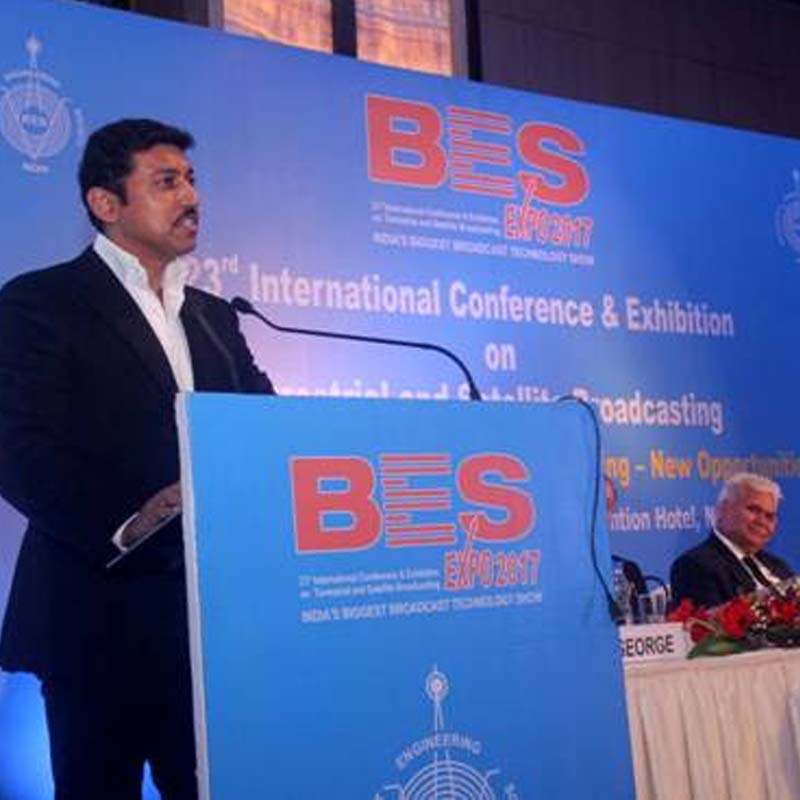
    NEW DELHI: Minister of State for Information and Broadcasting (MIB) Rajyavardhan Rathore has said that digital technology platform acted as an equalizer ensuring level playing field and providing equal opportunities for all irrespective of age, region and economic background, but cautioned that techs like OTT posed regulatory challenges too.

    Digital technology apart from providing better services, also ensured transparency that enabled plugging leakages at every levels so that the intended benefits trickle down to every citizen, the Minister said here yesterday at the inaugural ceremony of the 23rd International Conference & Exhibition on Terrestrial and Satellite Broadcasting, organised by the Broadcasting Engineering Society (BES) that also is holding the BES Expo 2017.

    Also present on the occasion were TRAI chairman RS Sharma and Member of Parliament and Zee chairman Subash Chandra. The theme of the event is `Hybrid Technologies in Broadcasting’.

    Rathore said that while digital technology offered immense opportunities to reach out to people, it also posed many challenges with regards to content regulation, illegal broadcasts that demanded innovative solutions to address the concerns. The Over the Top (OTT) applications have democratized the reach of content providing a wide range of services especially to young people with smart gadgets.

    However, the OTT applications were a concern for regulatory authority as they were not governed by any law, Rathore said, adding that the government was committed to digitization and the latest Union Budget 2017 had included digital economy as one of the key themes that had allotted Rs 10,000 crore (Rs. 100,000 million) for the Digital India program launched by PM Narendra Modi.

    The Minister, along with Chandra and Sharma, also felicitated the winners of the awards constituted by Broadcast Engineering Society in various categories such as broadcasting, engineering, training and innovation. The life time achievement award was conferred to BB Srivastava for his outstanding contributions to the radio FM industry.

  • OTT poses regulatory challenges but govt committed to digitisation

    OTT poses regulatory challenges but govt committed to digitisation

    NEW DELHI: Minister of State for Information and Broadcasting (MIB) Rajyavardhan Rathore has said that digital technology platform acted as an equalizer ensuring level playing field and providing equal opportunities for all irrespective of age, region and economic background, but cautioned that techs like OTT posed regulatory challenges too.

    Digital technology apart from providing better services, also ensured transparency that enabled plugging leakages at every levels so that the intended benefits trickle down to every citizen, the Minister said here yesterday at the inaugural ceremony of the 23rd International Conference & Exhibition on Terrestrial and Satellite Broadcasting, organised by the Broadcasting Engineering Society (BES) that also is holding the BES Expo 2017.

    Also present on the occasion were TRAI chairman RS Sharma and Member of Parliament and Zee chairman Subash Chandra. The theme of the event is `Hybrid Technologies in Broadcasting’.

    Rathore said that while digital technology offered immense opportunities to reach out to people, it also posed many challenges with regards to content regulation, illegal broadcasts that demanded innovative solutions to address the concerns. The Over the Top (OTT) applications have democratized the reach of content providing a wide range of services especially to young people with smart gadgets.

    However, the OTT applications were a concern for regulatory authority as they were not governed by any law, Rathore said, adding that the government was committed to digitization and the latest Union Budget 2017 had included digital economy as one of the key themes that had allotted Rs 10,000 crore (Rs. 100,000 million) for the Digital India program launched by PM Narendra Modi.

    The Minister, along with Chandra and Sharma, also felicitated the winners of the awards constituted by Broadcast Engineering Society in various categories such as broadcasting, engineering, training and innovation. The life time achievement award was conferred to BB Srivastava for his outstanding contributions to the radio FM industry.