Tag: OTT

  • Bengali OTT players prioritise market growth over competition

    Bengali OTT players prioritise market growth over competition

    MUMBAI: Demand for regional content has received a boost like never before thanks to the smartphone and internet explosion in tier II and III cities. Not only are international and national over-the-top (OTT) players delving into regional content, but also local players.

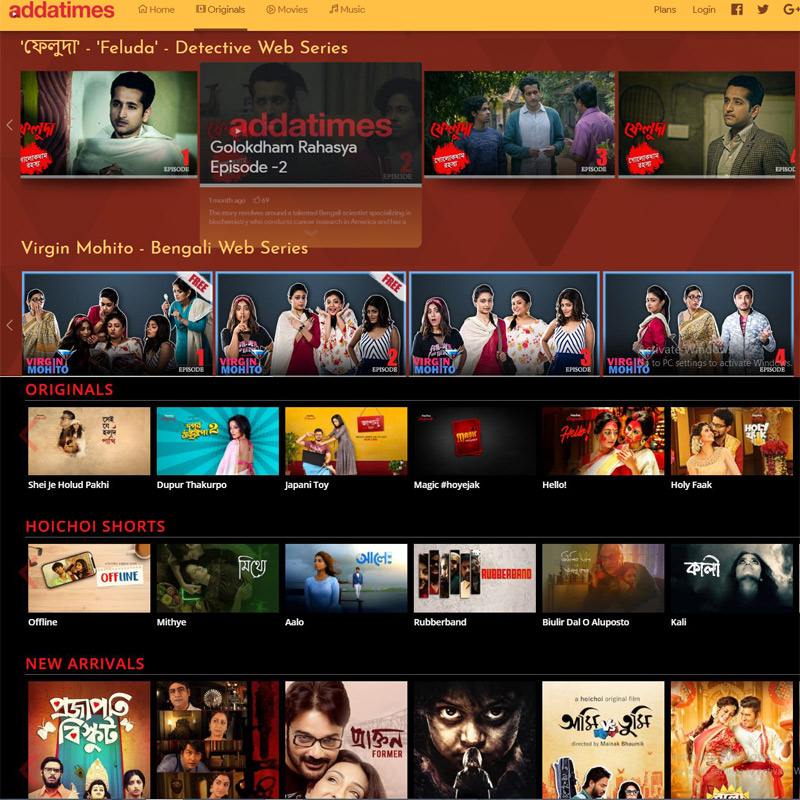
    One such upcoming regional OTT market is the Bengali one. Though Hoichoi is climbing the ranks to the top, Addatimes is also chasing not far behind. For now, the two players believe in healthy co-existence rather than competition.

    Addatimes and Hoichoi, both were launched in the same year, i.e. 2017. For obvious reasons, Hoichoi could come up with more content and better market strategy because of its parent company SVF’s huge capital. Now, Surinder Films, another leading production house in Bengali industry has started investing in Addatimes for a 33 per cent stake which could give a major boost to the platform.

    Addatimes managing director and founder Rajiv Mehra had a 14 years stint in the Bengali television industry. Speaking to Indiantelevision.com, Mehra said that he felt there was no creativity left in daily soaps and channels had the ultimate power in hand. Then came the inflection point when he decided to start a digital venture. Despite knowing the fact that it would take a long time to break even, he trusted the digital medium.

    All content was free for the first five months and then a subscription model was added at Rs 100 for three months and Rs 300 for a year. The Addatimes spokesperson claims to have 30,000 subscribers currently and 39 lakh unique viewers.

    Since its launch, it has emphasised on original content but there are some movies also. From mid-August the films produced by Surinder Films will be available on Addatimes. Till July, the platform will see the launch of one web series and one movie a month and from August onwards, there will be two of each.

    Mehra expects the business to break even in 2021. Due to limited funds, it is strategically avoiding cash-burning mode so that the platform can sustain in the market for the next three to four years.

    Hoichoi isn’t too concerned about competition in the market. “We don’t think about competition because it’s not critically important today. It’s about getting more and more people in online ecosystem to grow. Having more players is better because that helps to grow the ecosystem, grows awareness and creates a habit among consumers,” said Hoichoi co-founder Vishnu Mohta. He also sees opportunity in the market for more players dedicated to Bengali content. Other than West Bengal, Bangladesh is also a potential market for both the platforms.

    Mehra also reflected the same tone. “It’s not about what we have, they don’t have. Everyone is going forward with their own strategies for the business. But since they (Hoichoi) have more capital, they might reach the desired target one year before us. Eventually, we will also reach the target,” he commented on the competition with Hoichoi.

    These apart, deep-pocketed players at the national and international level will also be able to get into people’s phones faster than the regional ones. If the regional players fail to make a mark soon, they will face difficulty in grabbing a larger market share.

  • Eros Now leverages content to create a new culture for viewers

    Eros Now leverages content to create a new culture for viewers

    MUMBAI: Amid a cluttered over-the-top (OTT) space in India, Eros Now always faced less challenge than other players to differentiate itself. With Eros International’s deep-rooted history in the film industry, the digital arm played with a specialised strategy since the beginning. While the subscription-based business model in the Indian OTT market is still nascent, the company has always prioritised SVOD model. However, riding the waves of change, the company is also updating content strategy, even working on something very interesting from its business model perspective.

    Recently, the leading OTT platform reached over 100 million registered users and 7.9 million paying subscribers worldwide with a 58 per cent quarter-on-quarter growth. Speaking to Indiantelevision.com, Eros Digital COO Ali Hussein discussed the factors that fuelled the growth along with what will be the content strategy going forward.

    Talking about the significant surge in terms of paid subscribers, Hussein mentioned the combination of efforts including programming, marketing strategy, enhanced relations with telco partners and marketing alliance partners as key contributors to the customer uptake. The new movies added to the catalogue, as well as refurbishing content helped to develop a consistency from the programming perspective. Active marketing both at the digital level and brand level also played a key role.

    While the OTT platforms keep adding subscribers, high churn rates are challenging for subscription video businesses. “Essentially we learnt from data that there are two kinds of significant components. One is the larger users experience on the product side and second is in terms of being able to kind of refurbish content. So, I think the combination of two efforts from the consistency of programming leads to a larger subscriber affinity and two is, in terms of being able to ensure that we are able to create a user experience at the core,” he says.

    “Then there are certain other remarketing strategies we establish in terms of being able to cluster our audience better and ensuring that we get a month-on-month growth,” he added.

    Though, since its launch, the OTT platform has been hailed for its rich movie library and currently is also working on the movie catalogue, the company is not willing to entirely depend on it.

    However, despite originals being an important part of programming strategy, he does not believe in gambling all the money for it. The team is working on short-form content ideas also as a part of the overall content strategy.

    In late April, Eros Now premiered its first direct-to-digital film Meri Nimmo kicking off a new trend of distribution as well as adding a new dimension to its content strategy. Viewers have responded well to the film. Moreover, it has helped to attract new users to the platform.

    “From a qualitative point of view, it was a very good thing. Something that we will do going forward also in terms of looking at digital original film as a key part of content strategy,” he said.

    The success of the first initiative in the genre has helped the company to fix focus on such projects. Currently, it is looking at multiple projects that will be released direct on digital.

    Very recently, Eros Now launched a new brand campaign titled ‘Bolo kya dekhogey’. It claims that the quality of organic users coming on the platform has gone up drastically after the launch of the campaign. Usually, many players go to third-party digital agencies for marketing campaigns but Eros Now relied on in-house creativity.

    “We are also a production house first; we develop a lot of creative ideas. So, people who worked on the quality movies over the years should be able to come up with good creative ideas itself to market around products. Historically, we have been the one marketing our movies also,” Hussein explains.

    Since the beginning of this year, from appointing some new key executives including Hussein to launching new brand campaign, expanding content library, extensive marketing, the first half has been momentous for the streaming platform. The company is heading in a direction to reach about 12-15 million paid subscribers in next 12 months on the back of such focussed strategies. 

  • Next 250 M digital video users will be non-English speaking: Uday Sodhi

    Next 250 M digital video users will be non-English speaking: Uday Sodhi

    MUMBAI: These are exciting times at Sony Pictures Network (SPN) India. When it comes to scale in sports broadcasting, the FIFA World Cup ranks second only to the Olympics. It’s safe to assume that bringing world football’s showpiece event to audiences is hugely challenging yet satisfying. In a sense, the chatter and bustle on the fourth floor of SPN’s Malad headquarters highlights this. There is a distinct flavour and energy to the environment that points to one thing – it isn’t business as usual.

    However, Uday Sodhi, the big boss of SPN’s digital arm, appears relaxed. The veteran of many battles has a lot at stake at the moment. Having played an instrumental role in building SPN’s OTT SonyLIV, the onus is on Sodhi to guide his team through what many are describing as India’s first OTT video World Cup. Never before have as many Indians consumed digital video content at such high speeds and low costs.

    As the driving force behind SonyLIV, Sodhi is at the forefront of the changing face of India’s digital landscape. Indiantelevision.com caught up with the man of the moment to talk about week one of the World Cup, India’s OTT industry and the future of digital video consumption.

    Lionel Messi’s Argentina crashing out at the group stage is bad for business?

    Not really. I think teams like Spain and Portugal are very popular. Portugal because of Ronaldo and Spain due to the presence of a lot of La Liga club stars. Brazil is an evergreen team too. Germany remains a hot favourite.

    Tell us a bit about the viewership patterns on the SonyLIV app?

    I classify football viewers into three groups – fanatics, fans and flirts. The first week numbers point to a 85per cent contribution of male viewers as opposed to the 15per cent female fans. On digital, people tend to move back and fourth during live matches. The average viewing time in the first week comes to 16-18 minutes. If that’s the average, then a lot of people are watching 30-40 minutes. Like everything else in life, there is a pyramid. There are a lot of people who watch the full 30-40 minutes. However, we look at viewing times at a stretch. So they probably take a break during the interval and come back. So my guess is there are a lot of people who come, watch the score and go back. A lot of people do the under five minutes viewing. A lot of matches are during working hours, some people are traveling. The watch times increase when people get home. People tend to hit the scorecard and go back a lot.

    Can you give us a break up of the numbers you’ve done so far?

    There are about a five million users a day on the app and website. The Match Centre and Second Screen engagements are about 25 million in the first week. That’s been the key takeaway. We expect 40-45 millions users on SonyLIV through the course of this World Cup.  The Spain vs Portugal had 3x traffic as compared to any other game.

    The first match didn’t go as per plan?

    Instead of a five minute delay on the ad-supported feed, there was a slightly longer delay of 10-15 minutes. We had some blip, there was a heartbeat missing somewhere.

    How many advertisers have you signed up for the World Cup ?

    We have 15 (and counting) advertisers on the app. We have all the big brands like Patanjali, Red Bull, Nivea, Carlsberg, VIP, Swiggy to name a few.

    How crucial is sports content for an OTT platform? Can Indian broadcasters build a world-class product without sports?

    Absolutely, you can build a solid platform without sports. Does it become easier and faster with sports? Yes! Does it give you more traction? Yes! You have to spend less on marketing and you gain more organically with sports content. You have to work harder without sports. But your technology has to be far stronger in sports. Sport tests you far more, as consumers are more touchy. Two or three minutes here and there and the whole world comes to an end. With fiction you tend to get more chances to get things right.

    What has been your biggest learning in the last five years?

    The importance of technology is one key thing we have learnt. We realised that just the video is not enough. There needs to be data too – what’s happening in the match, what’s happening around the match. People want to come back and see the clips, highlights. A lot of surround stuff has to happen. The quality of the product, its availability across platforms, across devices. There has to be a seamless experience. That’s the challenge. Its very easy to put up an android app with video playing capabilities. That’s vanilla these days. That’s not a tough one to do.

    So, what’s a tough one to do?

    The real tough one is to do it across platforms, do it seamlessly, do it live, publish it live. We did 3000 live events last year. To be able to do that on a weekend is tough. At times we had 20 concurrent matches happening – Serie A football, tennis, MotoGP together. You need that kind of infrastructure to publish 20 live games. That takes real effort. That’s the real story. That’s the blood and sweat behind the business. Technology is the key. Content is easy vanilla. Everyone has it. Real challenge is to make sure the platform works day in and day out. Spikes in sport are phenomenal. Those are learning that don’t come in a text book. That’s something the team learns from experience.

    How much has the company invested in building SonyLIV?

    We don’t talk numbers. But there’s a technology layer at one end and is huge invest. Sports rights is another very, very expensive piece. We are making sure our digital investments and our digital business grows along with the sports investments we are making. So, this year we have FIFA, India vs England, then there is India vs Australia. So, there is tremendous investment that is happening back to back on sports. All of it is hard cash going out. Over and above that you are putting layers of content that you are acquiring, stuff that we are doing with various partners. We are building a huge repository of content. We service all the needs of the customer from high-end sports to travel and food.

    How big is the SonyLIV team?

    Internally and externally there are about 200-250 people working on the platform.

    Is there room for more OTT players in the market?

    We have just started this journey. There are close to 500 news sites in India, probably 800 TV channels. So why not more OTT platforms? Digital video advertising, and I’m not talking about subscriptions, is about Rs 2000 crore in India. Digital advertising business as a whole is about Rs 8000 crore. In China it is a Rs 60,000 crore market, with digital video advertising contributing to Rs 30,000 crore. That’s as big as our television advertising business. So, we too will get there in the next five to seven years. China has 650 million digital video users, we have 250. In the next 1000 days, we’ll be double our size. When the consumer base doubles, the advertising revenue doesn’t go up 2x. It goes higher.

    Do you see any particular trends for the future?

    The next wave of digital content consumers will be big on video, not text. Attention spans of users will continue to increase due to cheaper Internet data. The next 250 million digital video users will be non-English speaking. They’ll consume content in their local languages.

  • Telco apps emerging as one-stop destinations in India: Report

    Telco apps emerging as one-stop destinations in India: Report

    MUMBAI: The newest trend in the world digital content consumption, is the emergence of telco apps as one stop shops for users. According to a Bank of America Merrill Lynch (BofAML) report quoted by Bloomberg Quint, Indians have shown a tendency to use apps like Jio TV, Jio Cinema, Airtel Wynk instead of downloading individual over-the-top (OTT) streaming apps.

    Among all the offerings from the data disruptor Jio, the live television streaming app Jio TV was the most used. Even Airtel’s Airtel TV app has clocked over 10 million downloads since its launch. Other than Jio TV, Jio Music and Jio Cinema also managed to capture the imagination of Indian users.

    Among the BofAML 1,000 consumers surveyed by BofAML, Jio recorded the highest number of users. The objective of the study was to document data consumption patterns. It found that 76 per cent users use mobile data to watch online videos, while 68 per cent download and save them

    The online content viewing numbers have increased exponentially, with 30 per cent of users breaching their daily limit of 1/1.5 GB almost regularly.

    Among the video streaming platforms, YouTube continues to hold its sway with consumers, with 58 per cent of them using the platform. 38 per cent viewed content on Hotstar, with ZEE5 and Eros being used by 2 per cent and 1per cent respectively.

    “We consider this as a new emerging theme in India and expect content companies to be beneficiaries of the telco price wars. However, given the nascent stage of the market, we don’t see a clear “winner” currently in the OTT space,” read the BofAML report.

    The findings of the study also indicated that cord-cutting may not disrupt the Indian television industry anytime soon, as monthly cable bills (200-400) continue to be significantly lower than what decent broadband connections cost.

    Also read: Reliance Jio to soon launch 5G services: all you need to know

    Amazon India’s new monthly subscription plan


  • More than 85% of US millennials tune in to OTT platforms

    More than 85% of US millennials tune in to OTT platforms

    MUMBAI: Over-the-top (OTT) platforms have become the new opium for millennials. According to a new report from the analyst firm Parks Associates, more than 85 per cent of millennials in the US subscribe use at least one OTT video service. Interestingly, the number of OTT subscribers among other generations is also growing gradually.

    An earlier report from Parks Associates showed that the number of households worldwide with an OTT video service subscription will exceed 265 million by 2022. Since 2010, a steady increase has been noticed in the adoption of smartTVs and streaming media players.

    Many of the millennials opt for more than one platform for browsing. More than one-fourth of millennials subscribe to three or more OTT services, and more than 50 per cent subscribe to at least two. OTT service penetration among ‘Baby Boomers’( 1946-64) and older generations grew more than 10 per cent between the two groups as a whole between 2016 to 2017.

    public://gr_2.jpg

    “Overall penetration of subscription OTT video services among millennials has topped out, suggesting that those households that want such a subscription already have one or more. The more interesting and important question is how many subscriptions they will keep,” Parks Associates research senior director Brett Sappington said.

    Millennials are more prone to consume online content not only because of a personalized experience but also due to the flexibility it offers. Various reports since 2014 have highlighted how millennials are opting for streaming services like Netflix, Hulu, Amazon over television.

    Parks Associates researcher Hunter Sappington thinks self-aggregating content is simply a part of the entertainment experience, particularly in millennial households. 

    “Their evaluation criteria for services, and brand loyalty, differs from that of previous generations. To take advantage of this self-aggregation trend, providers need to understand the evaluation criteria consumers use for their OTT services, which can vary from household to household,” he commented.

    Also Read :

    Global OTT subs to cross 265 mn by ’22: Park Associates 

    India to enter top 10 OTT video markets in 2022: PwC

  • Tata Sky inks deal with ThinkAnalytics for personalised content recommendations

    Tata Sky inks deal with ThinkAnalytics for personalised content recommendations

    MUMBAI: Leading DTH brand Tata Sky has selected content recommendation Engine ThinkAnalytics to power its personalised content recommendations across connected devices. The yet-to-be-launched service will be available on Tata Sky’s applications across mobile and PC platforms to begin with.

    Tata Sky has partnered with ThinkAnalytics because of its proven skill to scale to millions of users along with its track record in helping Pay-TV and OTT operators to boost engagement and loyalty.

    The company believes that a personalised contextual recommendation will give users a new realm of experience.

    “ThinkAnalytics has a strong reputation as the market leader in personalized recommendations and we are confident that together we can get a better understanding of our customers’ behavior and build a superior, customized experience for them across our connected platforms,” Tata Sky chief commercial officer Pallavi Puri said.

    While content discovery is an issue for users across platforms, Tata Sky subscribers will find it easier to find content on the back of advanced AI and machine learning techniques. The content discovery platform is combined with ThinkMovies and ThinkTV semantic microgenre metadata to enhance the level of personalisation of the content recommendations.

     “Tata Sky is India’s leading content distribution platform and a brand that strongly believes in pushing the innovation boundaries to simplify and enhance the user journey. By offering personalised recommendations across connected devices, Tata Sky’s customers will find it really easy to discover relevant live and on-demand content to watch, boosting viewer engagement and increasing loyalty,” Think Analytics APAC senior VP Alan Dishington said.

    Also Read :

    Tata Sky offers Reliance DTH consumers migration deal, Dish TV too in play

    How Harit Nagpal plans to keep Tata Sky ahead

  • Digital media spends to increase by 49 per cent next year: Nielsen Report

    Digital media spends to increase by 49 per cent next year: Nielsen Report

    MUMBAI:  A Nielson report has now confirmed what many believed of the growing ad spends in the digital world. The study has found that digital ad spends have now eclipsed traditional marketing budgets of brands.  The report also says increase in digital media budgets are poised to jump considerably over the next 12 months. However, over the top (OTT)services have to go a long way to win over marketer.

    The responses for the report were gathered through in-depth interviews of marketers and extensive surveys of  marketing executives from across verticals. The goal was to identify their most valued digital media channels categorised as social media, search, mobile, programmatic, OTT-TV/Connected TV(CTV).

    Important digital media channels

    Social media and search engines are considered extremely important by marketers . 79 per cent of respondents ranked search as “very” or “extremely” important, while 73 per cent thought the same about social media. A large majority also considered online video (64 per cent) and email (59 per cent) to be critical.

     Surprisingly, while a bunch of OTT platforms are mushrooming worldwide, marketers showed least reliance for OTT or Connected TV (CTV). Fewer than 8per cent of respondents considered it extremely important (and 18 per cent very important) at this point. Nearly 25 per cent of respondents ranked it as “not so” important or “not at all” important to their current media strategy.

    public://Figure 1.JPG

    Effectiveness of digital media channels for business:

    Other than zeroing in on the most important digital channels, the report also found effectiveness of each of these digital media channels. Again, search (68 per cent), social media (68per cent) and mobile (59 per cent) were ranked as “very” or “extremely” effective by a large section of respondents.

    Only 28 per cent of marketers ranked OTT TV/CTV as a “very” or “extremely” effective channel, the lowest among the individual categories. Over 30 per cent of respondents have yet to dedicate media budget to OTT TV/CTV. Over time when these channels will be more established, that number may decrease.

    public://figure 2.JPG

    “We are moving more and more toward [digital] marketing…social, search and [display] advertising driven. But we have just begun so the confidence in results is still being analyzed,” the report quoted one anonymous respondent.

    “Respondents reported digital media as representing 37.6 per cent of total advertising spend. This is remarkably similar to the percentage of advertising budget dedicated to traditional media (when calculated the same way), which was only a percentage point off at 36.6per cent,” the report read.

    However, the next 12 months are  going to be very different. 82 per cent of respondents agreed that digital media spend is going to increase, with only 4 per cent forecasting a decrease. Respondents expect a  49 per cent increase in digital media budgets in the next 12 months, with some even suggesting a higher spike.

  • SonyLIV lines up an innovation filled FIFA World Cup 2018

    SonyLIV lines up an innovation filled FIFA World Cup 2018

    MUMBAI: The world’s most popular tournament – FIFA World Cup 2018 is just around the corner. SonyLIV, one of the premium OTT platforms in India, is the official mobile and internet broadcaster for FIFA and will be the go-to destination for all football lovers once the World Cup kicks off.

    This year SonyLIV brings to its viewers a host of innovations that will make watching the game more engaging on all screens. Features like key moments, highlights, match playbacks (VOD) and real time updates are available for a seamless viewer experience. The #ScreamLoud campaign by SonyLIV echoes the passion of fans and ardent followers of the game who are so involved that they end up screaming to cheer for their favourite star or country.

    To encourage exciting conversations with football fans through the season, SonyLIV has launched the first ever-social Facebook chatbot in the OTT entertainment space. The bot is intelligent and equipped to handle all queries and will update the user with match fixtures, points table and help set reminders for games.

    On Match Centre, viewers can see live scores, player positions, team information, match statistics and live commentary. To make their experience more engaging, users can set reminders or view the entire schedule, while the points table gives a quick update on the standings, scores, etc. Additionally, SonyLIV has also created a fan-zone on second screen, which users can access on their mobile phone or tablet and experience features like predictions, emotion meter, polls, contests, even as they watch the game in real-time.

    Some of the other features also include, viewing missed games with snippets and clips of key moments from every match along with highlights. To cater to the widest possible range of viewers, SonyLIV will be available in six simultaneous audio feeds – Hindi, Bengali, Tamil, Telugu, Malayalam and English.

    The FIFA World Cup 2018 will stream via SonyLIV on partner platforms like Xiaomi’s MI Phones and MI TV, Amazon Fire TV, Apple TV, Android TV, CTV and JIO feature phones.

    Subscribers get access to the live feed of all the matches without any delay while non-subscribers can still watch their favourite team play but with a delay of 5 minutes. SonyLIV has also introduced a ‘Super Sports’ pack at just Rs.199 for 6 months.

    SonyLIV is the biggest platform for all major football championships like UEFA Champions League, UEFA Europa League, La Liga, Serie A, Ligue 1 and more. So, this FIFA World Cup 2018, enjoy the best players and teams in the planet battle it out for football glory only on SonyLIV.

  • Comcast makes sweet $65 bn offer for Fox’s entertainment assts

    Comcast makes sweet $65 bn offer for Fox’s entertainment assts

    Let the games begin. That’s the clarion call that Comcast CEO Brian Roberts has given by making an offer of $65 billion to acquire the Murdoch-owned Fox entertainment assets. Priced at $35 a share, the Comcast “superior” offer is at a 19 per cent premium over what Disney’s Bob Iger  made last year at $28 per share or $52.4 billion in an all-stock transaction.  The deal is undergoing regulatory approval and includes Fox’s movie studios, networks Nat Geo and FX, Asian pay-TV operator Star TV, and stakes in Sky, Endemol Shine Group and Hulu, as well as regional sports networks.

    Comcast is already taking steps to clearly stake its claim to the prized 21C Fox assets.  Roberts in a letter addressed to Rupert, Lachlan and James Murdoch stated that his company was going ahead with filing a preliminary proxy statement with the Securities Exchange Commission (SEC) in opposition to the Disney merger proposal. He added that Comcast had been “advised this is necessary to be in a position to be able to communicate with your shareholders directly regarding the votes they are being asked to cast on 10 July We hope this is precautionary only, as we expect to work together to reach an agreement over the next several days.”

    The Comcast  offer comes a day after a US district judge Richrd Leon  approved AT&T’s $85 billion bid for Time Warner. Leon emphatically thumbed down the government’s claim that AT&T/Time Warner would be anti-competitive and harm consumers. Roberts who had already announced last month that his company would make an offer post the regulatory go ahead from the US law makers for the AT&T- Time Warner transaction.

    Most observers are expecting The Walt Disney Co to up the ante by bettering its bid possibly flagging off a bidding war.

    Roberts in a conference call with investment analysts said that Fox’s assets are financially attractive. “Fox is an outstanding company which has done an outstanding aggregating content and distribution on a global basis,” he said. “This transaction offers a good chance to add these complimentary assets to our existing NBC Universal portfolio laying the foundation for many group opportunities. We have a proven track record of integrating companies, investing in them and growing them. And we can do that for Fox assets.”

    Roberts was quite confident that Comcast’s proposed transaction will obtain all necessary regulatory clearances in a timely manner and that “the transaction is as or more likely to receive them than the Disney transaction. Accordingly, we are offering the same regulatory commitments as the ones 21CF has already obtained from Disney, including the same $2.5 billion reverse termination fee agreed to by Disney. To further evidence our commitment, we also are offering to reimburse the $1.525 billion break-up fee to be paid by you to Disney, for a total cost to Comcast of $4.025 billion, in the highly unlikely scenario that our transaction does not close because we fail to obtain all necessary regulatory approvals.”

    During the conference call. Roberts added that the acquisition of Fox’s assets would expand Comcast’s core businesses to new markets and give it leadership position in four of the markets of the US, the UK, India and Latin America. Also the third most valued media company’s  international revenue contribution to its top line would rise from nine percent to 27 per cent following the digestion of Fox assets. Distribution platforms  such as Tata Sky, Sky, Fox and X1 would accrue to its portfolio giving the company a collective customer relationship of 53 million. Additionally, OTT platforms such as Hotstar, Hulu, NowTV,and Fox Plus would help give it more content and revenue leverage.

    Roberts has urged the Murdochs to make haste as its merger proposal with Disney is coming up for shareholder vote on 10 July. And he has pointed that  “there should not be any meaningful difference in the timing of the U.S. antitrust review between a Comcast and Disney transaction.”

    Comcast CFO Michael Cavanagh told investment analysts that the media gianthad enough financial muscle on its balance sheet to be able to finance and see through the transaction quickly- within 12 months of signing. He pointed out that he expected cost synergies of $2billion to be realised post merger, keeping in mind that Comcast will acquire 100 per cent of Sky, He explained  that he expected the deal to add to the proforma company’s free cash flow per share and earnings per share. Cavanagh expected the company’s debt to be at four times net debt EBIDTA in 2019.

    Roberts told investors that he was waiting for a revert from the Murdochs and the Fox board. He also stated that he has known them for a long time and that “there was disappointment when 21CF decided to enter into a transaction with The Walt Disney Company, even though we had offered a meaningfully higher price.”

    Meanwhile, late in the day, Fox acknowledged that it had received a new offer from Comcast and in keeping with its fidicuary duties the Fox board said it will carefully review it.

    It added that it hasn’t decided whetther it would postpone or adjourn the 10 July meeting to vote on the Disney proposal. 

    It’s over to the Murdochs and The Walt Disney Co. 

  • Global OTT subs to cross 265 mn by ’22: Park Associates

    Global OTT subs to cross 265 mn by ’22: Park Associates

    MUMBAI: The number of households worldwide with an OTT video service subscription will exceed 265 million by 2022. The popularity of over-the-top (OTT) video services, such as Netflix, Amazon, and Hulu has driven a steady increase in adoption of smart TVs and streaming media players since 2010, according to `Global Connected Living Outlook: Expanding IoT Momentum’ by Park Associates’.

    “Fifty-three percent of the US broadband households own a smart TV, and both smart TVs and streaming media players are continually improving the user experience to accommodate the shifting habits of consumers, including integration with voice-based digital assistant ecosystems,” said Kristen Hanich, Parks Associates’ research analyst.

    “The rise of these digital assistants is another key trend over the last few years, with Apple Siri, Amazon Alexa, Google Assistant, Microsoft Cortana, and Samsung Bixby, among others, now on the market. Both smart home and connected entertainment developers are working to integrate this functionality into their products,” Hanich was quoted in an official statement put out by Park Associates.

    The `Global Connected Living Outlook: Expanding IoT Momentum’ provides a comprehensive overview and assessment of the markets serving consumers’ connected lifestyle. The report identifies key trends and market developments in service categories, including broadband, television and video, digital content, residential security, home energy management, home support services, and connected health and wellness, as well as connected consumer product categories, including home networks, smart home devices, and connected consumer electronics.

    The report identifies key companies to watch in each product category and includes five-year forecasts for select product categories.

    The global study reveals that consumers now own an average of 8.6 connected CE products in their home, an 87 per cent growth in the average volume of devices since 2010. Some of the highlights of the report are the following:

    More than 70 per cent of the US broadband households have an internet-connected entertainment device.
    17 per cent own both a smart home device and an internet-connected entertainment device.
    Parks Associates estimates over 265 million households worldwide will have a total of more than 400 million OTT video service subscriptions by the end of 2022.

    “With IoT expansion comes added expectations of interoperability,” said Park Associates Research Quality & Product Development director Jennifer Kent, adding, “Consumers prioritize general device interoperability over staying within a specific brand ecosystem when considering a purchase; three-fourths of consumers find it important to consider any smart home product brand that will work with other products in their home and 49 per cent find this very important.”

    Also Read :

    Traditional pay TV under pressure from OTT services: Horowitz report 

    Regional OTT content more than just catch-up TV    

    OTT platforms discuss need for regulation

    Apple bags rights to novel ‘Shantaram’ for drama series