Tag: OTT

  • YouTube to release first Indian original content soon

    YouTube to release first Indian original content soon

    MUMBAI: Streamers in India are about to get new delight. YouTube is bringing its first Indian original in the coming weeks called ARRived under an ad-supported model. The streaming giant has joined hands with music maestro AR Rahman for the show. Earlier also, YouTube global head original programming Susanne Daniels said that it is planning scripted series and original programming for international markets including India.

    “Affordable data costs are driving video consumption in India, data usage is about 8 GB a month per subscriber. This has pushed online video consumption as well, which is now about 75 per cent of all mobile traffic as per industry reports,” YouTube India entertainment head Satya Raghavan said.

    While in many countries YouTube offers its originals under the subscription model, in India it doesn’t have any premium model currently. According to some media reports, it will eventually come up with the premium service in India. YouTube’s international rivals Netflix and Amazon Prime have already released original shows in the country, some of which has been critically acclaimed too along with getting high popularity. The local OTT players are also eyeing the same pie in the growing video market. Players like ZEE5, Voot, ALTBalaji, Viu, Eros Now also have a pipeline of original shows to woo the audience. On the other hand, Hotstar has taken the top position among OTT players according to several reports.

    “Our DNA is built around partnerships, so a lot of competitors are our partners we work closely with, some of them are large advertisers of ours, some of them are large content partners. So for us, it is about growing the video pie not just for our own creators but for the entire online video industry for sure,” Raghavan commented.

    The company said it had run two sponsored shows as pilots, working closely with advertisers to test the market. It also claimed to have received a good response. Globally, YouTube Originals has released over 60 projects to date and plans to release more than 50 new shows next year.

  • Hathway to show Netflix content with new STB

    Hathway to show Netflix content with new STB

    MUMBAI: Hathway has taken the step ahead to bridge the gap between TV and OTT by landing a deal with giant Netflix. Consumers will get seamless access to Netflix through the Hathway set top box. While there will be a dedicated Netflix button on the remote of the set top box, Hathway subscribers will be able to pay for Netflix subscription using the Hathway bill.

    The introductory price for set top box has been set at Rs 2,999. All existing and new Hathway broadband consumers, who subscribe to Netflix and pay through their Hathway bill for their Netflix subscription, will receive this box for free.

    “In this smart and digital era, customers are looking at leading internet entertainment services like Netflix to access high quality, well produced entertainment. The soon-to-be launched Hathway set top box will make watching streaming videos on large screens an incredible experience. The Hathway set top box will be bundled with our high-speed, unlimited fibre-to-home monthly plans,”  Hathway MD Rajan Gupta said.

    In the changing content scenario, both OTT platforms and internet service providers are getting into deals to expand consumer reach. While for Netflix it is an important deal to reach local consumers, Hathway will also be able to lure customers on the back of the OTT platform’s content library. Moreover, when Jio is gearing up to roll out its fibre to home service, all other existing players have started changing their strategy.

     “We’re very excited to partner with Hathway Broadband in India to bring the latest technologies and great stories under one roof. The Hathway set top box will allow Hathway’s customers to use the Netflix button on their remote controls to seamlessly access and enjoy the best entertainment at high speeds,” Netflix Asia business development VP Tony Zameczkowski said.

  • ALTBalaji CMO Manav Sethi steps down

    ALTBalaji CMO Manav Sethi steps down

    MUMBAI: Manav Sethi, one of the prominent faces in Indian OTT industry, has stepped down from his position of chief marketing officer at ALTBalaji. Confirming the development to Indiantelevision.com, Sethi said he would be signing up with a new assignment very soon.

    The founding CMO of ALTBalaji joined the company in January 2017. He created and implemented brand strategies to build awareness and loyalty of the platform.

    His experience spans over fifteen years in managing & scaling up teams across product, engineering, technology and marketing both at national and international levels. Prior to his position in ALTBalaji, he worked with ASKME.com. He also worked with Getit Infoservices and Reliance Big Entertainment.

    Balaji Telefilm’s digital venture showed impressive result by acquiring 2.1 million new paid users in Q1 of FY19 excluding Reliance Jio platform users. The revenue also picked pace reaching Rs 5.8 crore in the quarter.

  • Hathway focuses on high data usage consumers to grow broadband

    Hathway focuses on high data usage consumers to grow broadband

    MUMBAI: Hathway Cable and Datacom Ltd (HCDL), which has been one of the major players both in broadband and cable business, could be most vulnerable to the changes in the ecosphere given that much of its business is urban-centric. Now, the company is focusing on high data usage customers (more than 80 GB per month users) to remain relevant in the competition and the company will roll out more plans around this segment very soon. To have a more stable and loyal subscriber base, apart from 30,000 regular churn, it had 57,000 forced churn from low speed, low data consumption consumers.

    The company had to take the step of forced regular churn because it did not want to utilize capex for them. Low pricing data plans from networks can easily lure the customers who use less than 40 GB data per month increasing the churn rate of the service provider. Especially, the bucket of 0-20 GB data has more low pricing deal seeking tendency as HCDL MD Rajan Gupta said in an earnings call. Though the company is focusing on retaining 80 GB data users, he also mentioned there’s no stress in the bucket of more than 40 GB usage.

    “These customers, who were anyway not using the network, are suddenly getting the same 12-20 GB for Rs 200 even on post-paid, even with the reputed number 1 and number 2 players. So these people from January- February started asking for more and more deals. So we had two options. We could have given them deals and maintained them at Rs 300 ARPU. But then I’m blocking my capex, my CMTS, my network hubs, my data centre, which will prevent me from giving that sort of quality service to all my high data users, or I have to put much more capex. We didn’t want either of the scenarios,” Gupta explained the logic behind cleaning up “non-productive base”.

    While the company currently stands with 5.5 million home passes, for the rest of this financial year it will not expand home passes any more. The focus will be on adding high usage customers within the current network. The strategy is to initially invest in growing this base through a mix of FTTH, pay TV, OTT and IoT services. In few select cities, the plan of offering home services bundling solutions along with high-speed data has already been rolled out on a four-month plan. Gupta claims to see 10 per cent increase in gross addition in those particular geographies while six to seven per cent current consumers are upgrading to it.

    But before coming up with extravagant marketing strategy, it wants to get the right product first. In the next three to four months, the company will master the product and overall service. However, while ARPU has declined to Rs 690 this quarter, the initial focus is on adding value to the service of high usage customers rather than expecting a return in ARPU. Basically, the plan is revolving around J-curve growth strategy where the initial focus on service will lead to harvesting revenue and higher EBITDA growth.

    Jio Giga Fiber has already lured customers with several additional amenities including Jio Giga TV set top box. In this changing scenario, Airtel and BSNL have already revised their plans. The giant DTH player Tata Sky has recently rolled out its broadband service in 12 cities. Another MSO DEN Networks has chalked out plans of working more closely with local cable operators to get a hold of last mile competition.

    However, like many other experts in the industry Gupta also emphasised that with the entry of large players, the awareness about fibre to home, high speed broadband will increase because of the PR and marketing efforts. He mentioned that out of the current 17 million wire and broadband base, only 5 million is high speed broadband. On an optimistic note, he thinks eventually this 5 million will become 17 million.

    “We want to make sure, in every market we operate, we have the best of solutions; either the ability to give even 1,000 GB to a consumer at a very low price or the ability to give speeds of 200-300 Mbps. On ARPU we’ll see 2-3 per cent reduction every quarter,” he added.

    While the company which itself is focusing so much on broadband business sensing the demand, the question rises how OTT is affecting the churn in its cable business wing. Gupta says a high number of consumers are still sticking to cable and DTH because of low monthly pricing. He adds that OTT and cable or DTH will more and more start complimenting each other over a period.

    “We don’t believe these are two very separate spaces. We believe our expertise is the last mile. We have access to consumers. Now if consumers want broadband, we are pretty much there. If consumers want OTT, we will be there. And if consumers want linear TV, which again, is not showing any sign of drop, we are already there,” he added.

    In the cable TV segment, the company plans to increase phase III, phase IV ARPU by about 15 per cent. While 6 per cent has already come in Q1 owing to the price implementation, balance effect is expected to come in Q2. In the case of the first two phases, the plan is to increase ARPU by 7 per cent. As all the price changes have been implemented from the month of August, it hopes to stabilise it by September.

    The company plans to have 25,000-28,000 gross additions per month in the next 9 months of FY19. Alongside that, the company is also focusing on doing underground fibre to increase the service to customers. As the entire fixed broadband business ecosystem gradually picks up thanks to more Indian, vernacular content on OTT platforms, Hathway is also taking more aggressive moves in the segment.


  • Pay TV execs feel need to innovate to remain relevant, finds study

    Pay TV execs feel need to innovate to remain relevant, finds study

    MUMBAI: With the advent of digital content platforms, pay TV industry across the world is facing stiff competition. The pay TV Innovation Forum report produced by Nagra in association with research firm MTM, found that 90 per cent of executives believe that pay TV providers will have to innovate strongly to remain competitive and relevant.

    The research has also found that 84 per cent of pay-TV executives expect competition for paid-for video services to increase dramatically over the next five years. The number of 90 per cent of executives who believe that pay TV providers will have to innovate strongly is 5 per cent up from last year. However, participants are optimistic they can continue to appeal to paying consumer.

    Findings of the report are based on extensive regional research conducted in Europe, North America, with a special focus on the United States, Asia-Pacific and Latin America.

    It has also highlighted that the pay TV (http://www.indiantelevision.com/television/tv-channels/viewership/india-china-to-provide-50-of-global-pay-tv-subs-by-2023-180411) industry is converging towards a platform-agnostic model and is transitioning into a paid-for-video market spanning a variety of offerings including standalone OTT and direct-to-consumer services. Moreover, 77 per cent of pay-TV executives consider innovation to be one of the top three strategic priorities for the industry.

    “Change is the one constant in the global pay-TV industry, driven by numerous pressures from competitors, pirates and subscribers, making it challenging for service providers and content owners to maintain revenue growth,” said NAGRA product marketing senior director Simon Trudelle.

    Executives have agreed that piracy remains a major problem. In addition to that, 47 per cent of respondents believe that piracy will lead to greater pressures on the industry over the next five years.

    “It is exciting to see a growing number of service providers embarking on the next stage of innovation, encompassing product and service portfolio improvements, alongside advanced technology platforms and new commercial and operating models,” said MTM managing partner Jon Watts said. “By keeping innovation at the core of their strategies and recognising the need to diversify, service providers can continue to compete effectively and grow revenue,” he added.

  • Airtel, Netflix enter strategic partnership

    Airtel, Netflix enter strategic partnership

    MUMBAI: Adding to the OTT-telecom deal list is the partnership between global Netflix and Airtel in India. Airtel subscribers of select postpaid and V-Fiber Home Broadband plans will be able to enjoy free streaming of Netflix for three months. After the free subscription period of three months, they will be able to pay for the platform using Airtel postpaid or home broadband bill.

    “Partnerships are at the core of Airtel’s DNA and we are delighted to expand our strategic relationship with Netflix. Affordable high speed data services and growing smart devices have created a massive opportunity, perhaps one of the biggest in the world, for the uptake of content – both local and global. We look forward to working closely with Netflix to leverage this huge potential and continue delighting customers with some amazing offerings,” Bharti Airtel MD and CEO Gopal Vittal said.

    Customers on eligible Airtel plans will be able to avail the opportunity through the Airtel TV app and the My Airtel app. Even customers not on plans eligible for this offer will be able to sign up or upgrade to claim this and pay for Netflix using their Airtel bill. It has also partnered to promote Netflix content through a dedicated row on the Airtel TV app.

    “We are delighted to expand our partnership with Airtel and combine the latest technologies and the best of entertainment. Be it Sacred Games, Ghoul or Stranger Things, more and more fans are watching on mobile so we’re bringing together Netflix’s award-winning TV shows and movies with Airtel’s amazing mobile and broadband networks. Airtel customers will enjoy the simplicity of one monthly bill for their Netflix subscription and Airtel postpaid/home broadband bill,” Netflix business development global head Bill Holmes said.

    Airtel, which is gradually losing ground to Jio is trying to get back in the race with several content deals. Recently, it struck an exclusive deal with ZEEL under which a select premium content from ZEE5 library will be available for Airtel consumers exclusively. The telco platform has an existing deal with Amazon Prime also. All these deals may bring more users to the network owing to the digital content portfolio. Meanwhile, Netflix is also trying to gain a stronger foothold in the Indian OTT market through new Indian originals and partnerships.

  • Hotstar most popular video streaming platform, finds study

    Hotstar most popular video streaming platform, finds study

    MUMBAI: It’s a tough game for international OTT players to beat Hotstar in India. A study conducted by SEMrush found Hotstar crossed the mark of 35 million searches during April 2018 having a difference of over 30 million searches with Netflix. It revealed the dominance of Hotstar on all other online TV and entertainment platforms.

    Hotstar with its range of content in every domain including cinema, sports, English TV series, regional shows, serials has number of options to lure viewers. The OTT platform has outrun its global peers and domestic competitors in the Indian market including Netflix, Eros Now, YuppTV, BoxTV, and others.  The search volume trends for Hotstar showed that the platform gained maximum popularity in the months of June and September 2017, and broke records in April 2018.

    The study also revealed Game of Thrones(GoT) as the TV series with the highest search volume in India marking over 600,000 searches during the year 2017-18. Hotstar having the rights of this over popular show could have acquired high number of viewers. GoT became the TV series with most searches in India since the telecast of its 7th series in August 2017.

  • QYOU aims to create content that will bring TV closer to digital

    QYOU aims to create content that will bring TV closer to digital

    MUMBAI: The future of the Indian entertainment market may be digital but the death of television is over-exaggerated. A recent survey conducted by Broadcast Audience Research Council (BARC) India found total TV viewership in India gone up by 12 per cent from 2016. On the other hand, recent data from PwC revealed the OTT video market in India is growing at a CAGR of around 23 per cent. While the main difference lies between the consumption habit of the older generation and millennial audience, QYOU Media’s Indian arm is thriving on the convergence between TV and online. In an exclusive interaction with Indiantelevision.com, QYOU Media CEO and co-founder Curt Marvis spoke about the Indian market and the company’s expansion plan in India.

    Curt Marvis, a renowned media veteran in digital ventures of Hollywood, has had a vivid experience. Way back in 1999, he co-founded online movie retailer CinemaNow and then spent a considerable amount of time in Lionsgate as president of digital media. In 2013, he co-founded QYOU, a media and production business that provides curated internet video content for television, mobile, and video-on-demand viewing. A year back it actively started to run operations in providing and packaging content for Indian audiences.

    Though the company is still in its early days, it is putting high effort to grow its presence in India. As part of its expansion, it has secured content partnerships with Pocket Aces, Culture Machine, Desi Hip Hop Inc., TheVibe, Power Drift, Arre, The Comic Wallah, FabForm, etc.  Its rebranded channel Q India is available on Tata Sky and Jio TV. It even appointed Andy Kaplan, former president of Sony Pictures Worldwide Networks, as chairman of board of directors for QYOU India.

    “India has a thriving TV market and mobile is fast becoming the first screen for many TV audiences in the region. Andy has significant expertise in this area and deep knowledge of the Indian market, which will help QYOU develop the right programming to meet the needs for mobile-first digital content, which is becoming an ever-more important objective for TV providers,” Marvis commented on his appointment.

    Marvis thinks TV is still hugely popular in India which isn’t going to change overnight. However, he underlines the difference in media consumption habit between younger digital-native audiences and older generations. Younger audiences are fond of streaming videos on social media sites and mobile devices remain primary medium for them to access video content. He claims that by providing linear feed and custom shows, QYOU is bridging these two worlds – offering the type of content that helps TV providers tap into digital-first creativity and use it to drive their programming agenda for younger audiences.

    In India’s OTT market, outsiders like Netflix and Amazon have found it tough to break into the country given the popularity of Hotstar. “Hotstar is currently India’s most popular OTT platform, enjoying 70 per cent of video streaming app downloads. In contrast, Amazon and Netflix only account for 5 per cent and 1.4 per cent of app downloads. One of the reasons why Hotstar is so well-liked is because, it has an extensive library of regional programming available in a number of local languages including, Hindi, Bengali, Kannada, Malayalam, Marathi, Tamil and Telugu,” he said.

    Rather than fall back on importing subtitled US TV shows and films, the international players need to invest in locally relevant original programming. Amazon and Netflix have recognised this and are launching Indian original series but Marvis thinks they’re still playing catch-up to local OTT services like Hotstar. “For QYOU, these trends have meant onboarding Indian content creators and making programming that is tailored to the territory and culture. This way we know our shows are more culturally relevant and therefore have more stickiness,” he added.

    Though Hotstar’s AVOD model has worked well for its acceptability among the mass audience, Indian audiences are not simply going for the cheapest option. He reaffirms the common belief of OTT players that audience is going for the service that they believe is the best value with the best programming. “Ultimately, the model which will work best in India will depend on the value the audience places on the service and we believe that high-quality regional programming can dramatically increase that value,” he concludes.

  • Revenue model of ZEE5-Airtel deal is cost per subscriber, duration viewed: Tarun Katial

    Revenue model of ZEE5-Airtel deal is cost per subscriber, duration viewed: Tarun Katial

    MUMBAI: The OTT players in India seem to have found telecom partnerships fruitful. Recently, ZEE Entertainment Enterprises Ltd (ZEEL) struck a three year deal with Airtel. Under the deal, the partners will do a co-branded promotion while the revenue model will be based on cost per subscriber and duration viewed.

    “There is select premium content from ZEE5 library that will be available for Airtel consumers exclusively in addition to being available on the ZEE5 platform,” ZEE5 India CEO Tarun Katial says. Though this deal is unique, ZEE5 is open to striking deals with other telecom operators also.

    “Revenue model is based on cost per subscriber and duration viewed for both in the three buckets. In the first bucket, it’s for cost per subscriber and there’s a minimum guarantee, in the second bucket it’s about volume deal for a subscription for a high-end Airtel consumer and the third model is about upscaling ZEE5 subscription packages,” he adds.

    Katial thinks this co-branding promotion across platforms will enable to create an understanding of content among consumers of ZEE5 as well Airtel. “It’s also a really good opportunity to be able to do both consumer insight as well as big data and create a recommendation for Airtel TV consumers of ZEE5 premium content,” he says. The partners will leverage each other’s social media assets also.

    Under the partnership, other than ZEE5 premium content, video content produced by ZEEL, including TV shows and movies will be available exclusively on Airtel’s digital properties like Airtel TV. Since ZEE5 already streams content produced by ZEEL along with its originals some of the selected curated content may be available on ZEE5 first while some will be concurrently available on both platforms but “deeper premium library” will be available only on its own OTT platform.

    Recently ZEEL snipped its deal with Reliance Jio pulling off all its available content on Jio TV. Though this kind of incident happens due to the failure of negotiation of cost, both the companies remained tight-lipped about the problem.

    However, the deal can boost Airtel also which has had its dominance in the telecom industry threatened after Jio’s entry. Reliance is already in a better position as it holds stakes in production companies like Eros International, Balaji Telefilms and Roy Kapur Films.

    As ZEE5 is a late entrant in the market, it is still far behind other domestic players like Hotstar, Voot and Eros Now. Moreover, international rivals like Netflix and Amazon are also eying the same OTT market. Hence, the deal is very critical for ZEE5 to reach more consumers across the country as well as to increase the visibility of existing shows on the platform. The industry being in a nascent stage does not have any clear winner till now, hence, leaving enough scope for each of the players.

  • WhatsApp needs to have local entity answerable to Indian laws: Govt

    WhatsApp needs to have local entity answerable to Indian laws: Govt

    NEW DELHI: The Indian government’s unambiguous and non-encrypted message to WhatsApp: set up a local entity in the country that is answerable to local laws, and find a tech solution to trace the origin of fake messages and content on the platform.

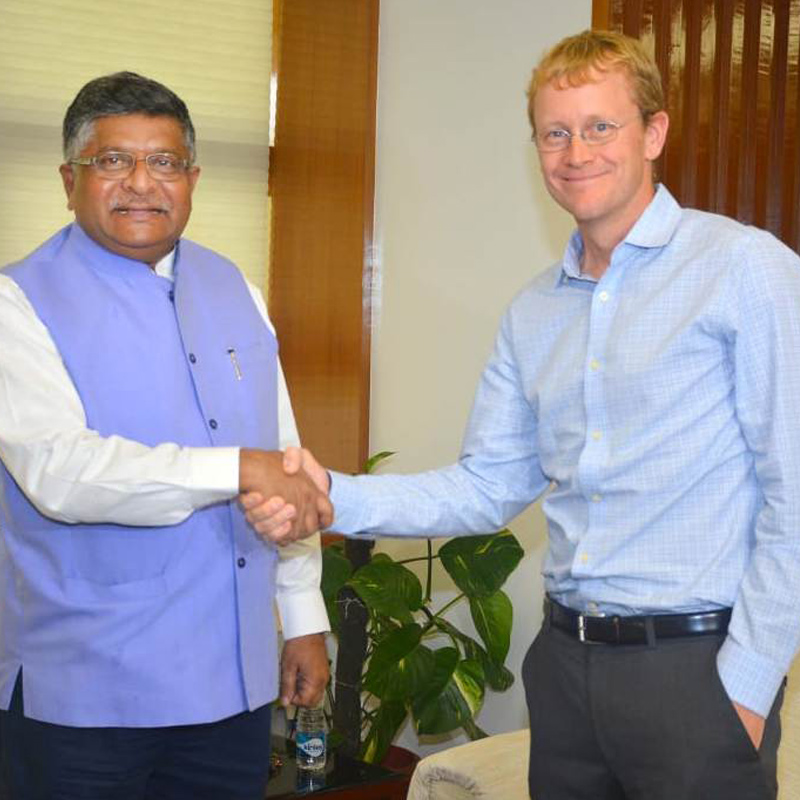
    “I had a productive meeting with Chris Daniels, the CEO of WhatsApp. I complimented him for the awakening, which WhatsApp has led in the entire country… But there are also sinister developments like mob lynching and revenge porn, you must find solutions to these challenges, which are downright criminal and [in] violation of Indian laws,” Minister of Electronics and Information Technology (Meity) Ravi Shankar Prasad was quoted by PTI as having said after meeting WhatsApp head Chris Daniels yesterday.

    While admitting that the Facebook-owned messaging app has contributed significantly to India’s digital story, Prasad said he has asked WhatsApp to set up a corporate entity in India, appoint a grievance officer and find a technical solution to tracing the origin of fake messages on its platform.

    “I requested CEO WhatsApp Chris Daniels to set up a grievance officer in India; establish a corporate entity in India & comply with Indian laws. He assured me that #Whatsapp will soon take steps on all these counts,” Prasad said in a tweet.

    Later talking to reporters in the capital, the minister added: “I had said earlier also; it does not take rocket science to locate a message being circulated in hundreds and thousands…you must have a mechanism to find a solution.”

    According to Prasad, Whatsapp could face abetment charges if no action is taken by it. The messaging platform has taken some corrective steps in the recent past like limiting the number of forwards that an individual can make in India.

    In recent times, WhatsApp has been facing the heat as it had been accused of being the platform via which hateful messages and rumours were spread in India leading to violence and crimes. The issue, which some critics said was akin to shooting the messenger instead of upholding the law of the land, has also reverberated in the Indian parliament with lawmakers trying to put the government on the mat for WhatsApp-spread rumours-linked deaths and crimes.

    While Prasad is on record saying he’s in favour of gradually evolving a policy for regulating the likes of WhatsApp, Facebook and Twitter, his ministry’s nudge has made the Department of Telecoms circulate a missive to telecom players and industry bodies seeking suggestions on ways to block services that ride the telecom infrastructure. The proposal has been criticized by many, including a chamber of commerce, Assocham.

    Telecoms regulator TRAI is also exploring regulations for OTT services like WhatsApp.