Tag: Ormax Media

  • Ormax Media launches India’s first Approval Rating Poll of Prime Minister & Chief Ministers

    Ormax Media launches India’s first Approval Rating Poll of Prime Minister & Chief Ministers

    NEW DELHI: Media consulting firm Ormax Media has announced the launch of The Ormax Prime Minister & Chief Minister Approval Rating. Based on continuous nationwide tracking across 22 states and one Union Territory, the polling tool covers 275+ cities and towns in India, with a monthly sample size of 12,000+. The Ormax Approval Rating will be India’s first through-the-year poll to track the public perception of the nation’s leadership. The tracking is being done independently by Ormax Media, with no affiliations to any media organizations or political parties.

    Approval Rating is a measure out of 100 (%) of the proportion of eligible voters who approve of the governance of the Prime Minister or the Chief Minister of their state. Speaking on the launch of the Ormax Approval Ratings, Ormax Media CEO Shailesh Kapoor said, “Approval Ratings are a norm in many democracies in the West, including the US. Hence, it is surprising to note that there has been no continuous tracking on the public perception of the political leadership in India all these years. After piloting this project for many months since mid-2018, we are now ready to roll out these ratings in the public domain. In a country with many political opinions and biases, including in the media, credibility and political neutrality are the cornerstones on which this poll has been conceptualized. We will not be sharing any ratings by religion, caste or any other such variable that can take the discourse around these ratings away from actual governance”.

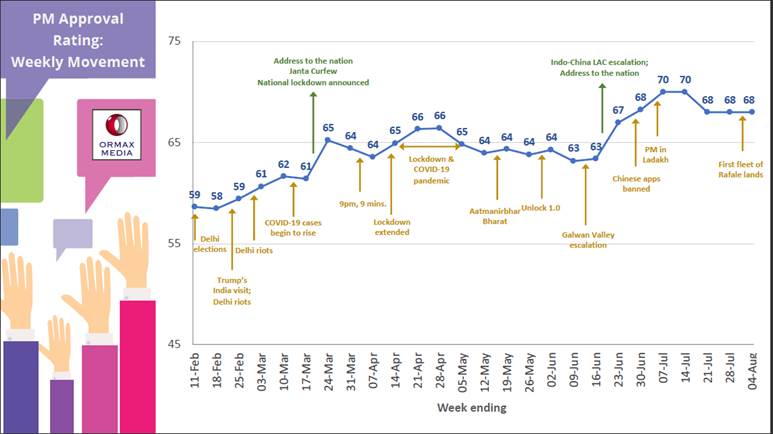
    As per the Ormax PM Approval Rating report released for the month of July 2020, Prime Minister Narendra Modi’s Approval Rating is steady at a high 68 per cent since the third week of July. The peak in July (70 per cent) was seen in the week when the PM went to Ladakh to examine the situation at the border with China. His popularity is the highest in Madhya Pradesh, Gujarat, Rajasthan, Chhattisgarh and Punjab, where he enjoys 75%+ Approval Rating in July 2020.

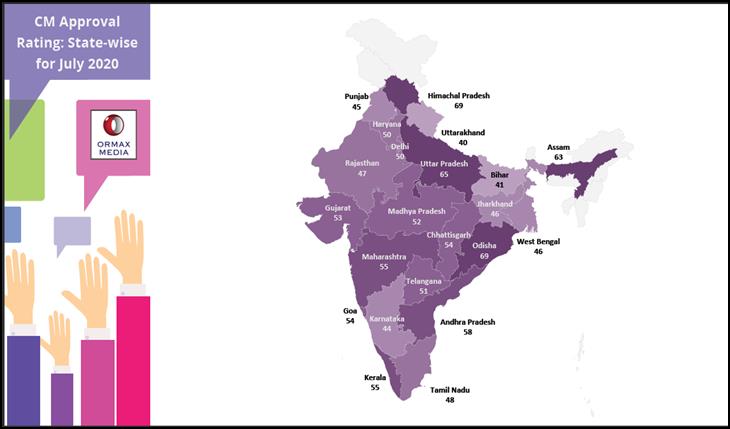
    Odisha’s Chief Minister Naveen Patnaik and Himachal Pradesh’s Chief Minister Jai Ram Thakur are by far the most popular Chief Ministers across the 22 states covered in the track currently, with an Approval Rating of 69% each in July 2020. Uttar Pradesh’s Yogi Adityanath and Assam’s Sarbananda Sonowal rank third and fourth on the list.

  • Indian OTT audience: Young, urban and male-dominated

    Indian OTT audience: Young, urban and male-dominated

    MUMBAI: India has seen a healthy growth of OTT audience in the last few years. Yet, brands and OTT service providers know very little about the demographics of their fast-increasing audience. How many are they in number, where do they exist, how do they watch, which genres of content do they prefer, are all important questions that can help in decision-making in the areas of content selection, target audience choice, media planning, market research and brand communication.

    To fill this knowledge-gap, Ormax Media has released its OTT Audience Report: 2019, with a large sample size of 10,000 over the period of May-September 2019. The report puts the regular OTT (online video content) audience in India at 76.5 million. The study defined ‘regular OTT audience’ as someone who watched two or more hours of OTT content every week.

    While the report confirms many of our perceptions about the Indian OTT audience, it also throws many new and interesting facets of its demographics.

    The report finds that Mumbai and Delhi lead with 3 million regular OTT audience each, followed by Bengaluru, Hyderabad, Kolkata, Ahmedabad, Surat, Chennai, Pune & Jaipur.

    Earlier in June, a study by Counterpoint Research found that tier I cities bring in 36 per cent of the audience and the top five metros account for 55 per cent of OTT users in the country.

    The audience, however, is heavily male-dominated. As many as 66 per cent regular OTT audience are men while only 34 per cent are women. ALT Balaji’s GandiiBaat emerged as the most male-skewed show, while Amazon Prime Video’s Mind The Malhotras emerged as the most female-skewed show, the study finds.

    The OTT audience, expectedly, is also young. Nearly 60 per cent of the regular OTT audience is below the age of 30, 21 per cent are in the age group of 31-40 and 20 per cent in the 41+ age group.

    Among the OTT platforms, YouTube emerged as the most-preferred OTT brand, followed by Netflix, Amazon Prime Video and Hotstar closely vying for the second position.

    The report also highlights how solo consumption is still the dominant viewing behaviour seen in the OTT category, with 82 per cent audience typically watching online videos alone. Hindi emerges as the most preferred language of online video consumption at 62 per cent, followed by English at 22 per cent, while regional languages, led by Telugu and Tamil, control the balance 16 per cent share.

    Speaking about The Ormax OTT Audience Report: 2019, Ormax Media CEO Shailesh Kapoor said: “OTT is an emerging and fast-growing category in India. While individual platforms have a lot of data on their own audience, there is little industry-wide understanding available on who the OTT audience in India exactly is, how many are they in number, where do they exist, how do they watch, which genres do they prefer, what are their subscription triggers, and many other such questions that are extremely relevant to any OTT business. This report, which will be an annual feature, answers many such questions in a manner that’s highly actionable.”

  • Ormax Media launches Technology-based OOH Measurement Service for Ambient Media called ‘Ormax OHM’

    Ormax Media launches Technology-based OOH Measurement Service for Ambient Media called ‘Ormax OHM’

    MUMBAI: Media consulting and analytics firm Ormax Media has announced the launch of its latest offering Ormax OHM (Out-of-Home Measurement). Ormax OHM offers real-time audience measurement solutions to owners and resellers of ambient media, such as malls, multiplexes and airports. The service comes in the context of a growing need for measurement of OOH media in India.

    Owners and resellers of ambient media can use the Ormax OHM to measure actual impressions (footfalls), dwell time, audience profile by gender and age and experiences across their various media assets such as displays, digital signages, entry points, kiosks, etc. Ormax Media has licensed computer vision technology from French OOH audience measurement company Quividi, which enables real-time audience measurement and analytics. Using this technology, Ormax OHM provides data and analytics collected in real time, measured 24/7, 100% enumeration using technology that works completely in the background, across their ambient media assets, empowering clients to offer smarter solutions to brands, such as impression-based pricing and targeted advertising. Ormax OHM has been architectured for OOH Media and offers great value to ambient media assets at airports, metros/train/bus stations and advertising options in cinemas and malls.

    Speaking about the launch of Ormax OHM, Shailesh Kapoor, CEO – Ormax Media, said: “Over the last 11 years, Ormax Media has played a pioneering role in enabling the use of analytics in the media & entertainment industry in India. Our forecasting models in films, TV and OTT categories are widely used   and   recognised   as   industry   benchmarks   for   content   diagnostics,   including   audience engagement measurement. With Ormax OHM, we are making an entry into the OOH category, where we are going to work with like-minded media owners to set industry benchmarks of how ambient media is measured, priced and sold”.

    Speaking about the need fulfilled by Ormax OHM, Satyen Sharma, Head – Ormax OHM, said: “The OOH media industry in India is facing a growing challenge in the measurement space. The paucity of credible, third-party measurement at an industry level leads to OOH media often being given a secondary status in media planning and buying when compared to other media like print and television, which have more robust audience measurement currencies in place. Ormax OHM will

    provide audience data measured in real time with actual numbers, which will elevate OOH media to a position of higher accountability and credibility.”

    Speaking  about   the   association  with  Ormax  Media,   Laurent  Fabry,  CEO  –  Digital  Content Technologies Pte Ltd, the authorised distributor for Quividi in Asia, said: “Our versatile technology is being successfully used in more than 80 countries across the world for OOH audience measurement. At Quividi, we use computer-vision technology to measure actual audiences and precisely measure the performance of OOH campaigns, helping media owners maximise the value from their media assets. We see India as a strong potential market and are excited to associate with Ormax Media for the use of our technology to help the Indian OOH industry market and sell itself better”.
     

  • Facebook aims to be first choice for movie marketing, fan engagement

    Facebook aims to be first choice for movie marketing, fan engagement

    MUMBAI:  Thursday morning Twitter was flooded with Karan Johar’s teaser tweet on his upcoming film Takht. Film marketing has changed so much over the time that fans are going gaga over a film which will be released after two long years. Not only Twitter but also other social media giants like Facebook and Instagram are becoming highly relevant for Hindi film marketing. Long gone are those days when the audience used to get information about an upcoming movie before a fortnight. Indian film industry, especially Bollywood, is optimising social media assets as much as possible.

    Research company Ormax Media and Facebook India have launched a report titled ‘Media Effectiveness in Hindi Film Marketing’ that studies and correlates the actual box office collections to a movie’s marketing mix. The research done independently by Ormax Media tracked the performance of nine media from both digital and traditional genre –  Facebook, YouTube, Instagram, Twitter, television, print, in-theatre, radio & OOH. Six film campaigns including Judwaa 2, Secret Superstar, Golmaal Again, Ittefaq, Tiger Zinda Hai and Pad Man were tracked using the research.

    The research went beyond analysing a film’s marketing success, basis the elementary media metrics like impressions and readership, and also focused on evaluating awareness or buzz among the audience and their intent to watch or appeal of the movie.

    The study found Facebook is one of the top three mediums among nine sample mediums in driving buzz and appeal for a film campaign. While buzz power stands for incremental awareness or discovery driven by the platform, appeal power stands for incremental interest in the audience via campaigns or content. Moreover, Facebook and Instagram combined proved to have delivered the highest impact with 21 per cent contribution to a Hindi film’s first-day box office sales.

    “The analysis was done for all nine media by extracting the buzz and appeal scores among those not aware of the film through that media. If the film’s actual first-day was X and the first-day without a particular media was projected as Y, the contribution of that media to the opening is X-Y. This contribution was calculated for all nine media,” the report reads.

    While organic methods like link shares and conversations helped to achieve the success, initiatives like Facebook Live also played an important role. Dharma Productions, the producer of recent hit Dhadak created an event on the platform using the feature Scheduled Live for the trailer launch of the movie. The trailer got 8.9 million video views. Other than that, several movies including Padman, Tiger Zinda Hai used Facebook Stories to engage fans.

    Akshay Kumar, a loyal Facebook user recently launched the trailer for his upcoming movie Gold on IGTV along with using Facebook Live.

    “Facebook is a great place for fans to directly connect with their favourite stars and movies and drive reach and more engagement. We aim to become the go-to destination for celebrities and movie marketers to promote and connect with their followers in an authentic way and experience the power of organic content and first-hand interactions,” Facebook APAC entertainment partnerships head Saurabh Doshi said.

    In case of any movie marketing campaign, Facebook typically divides it into three phases. While the first phase is about making users aware of the movie’s existence, second is about making relevant people engaged and the final phase is converting those users as actual moviegoers.

    Production houses leverage various Facebook features to create more engagement. Yash Raj Films uses Facebook for premium music through its weekly jukebox property where it streams full-length albums and music videos over a Facebook live. Red Chillies Entertainments experimented with the messenger bot for its movie Jab Harry Met Sejal where it used Shah Rukh Khan as the voice and face of the bot. Fox Star India also markets its films with gamification of the bot with videos, music, dialogues, and quizzes. Even the company created an AR Filter for movie Sanju where fans could get into the look of Sanjay Dutt using the filter.

    Facebook also partnered with PVR Cinemas to create a medium where celebrities could engage with the audience sitting in theatres. Under the partnership, the Facebook live of celebrities were broadcast on cinema screens. To make the engagement lively, Facebook also leveraged technology using physical cameras in cinema screen itself where the screen was tilted half and half so the celebrity also could see the audience sitting in the theatre. It launched the product with Dharma Productions for the film Raazi.

    Facebook’s relevance for marketing is not limited to big shot production houses, celebrities like Priyanka Chopra, Akshay Kumar and film fraternity.  Anupama Chopra’s movie review company Film Companion, MissMalini, Pink Villa, also leverage the Facebook community to engage in active conversations. The musician community of record labels, bands, independent artists also use the platform. Top examples include Maatibani, Sona Mahapatra, T Series who have created buzz and increased discoverability of their content through various initiatives on Facebook.

    It is no wonder given the rapid growth of internet and smartphone users that social media platforms will emerge as key players in digital marketing. Facebook standing with 217 million users every month is definitely going to acquire stronger foothold in near future.

  • Ormax Xpressive: Get ready for facial coding

    Ormax Xpressive: Get ready for facial coding

    MUMBAI: Expressions say it all, and researchers for long now have been reading people’s faces to know it all. A smile, a frown, a grin and many more can’t hide the real feelings. Keeping this in mind, researchers are now using facial coding to investigate how viewers react and behave towards TV shows.


    In India, Ormax Media which has launched various products to help the Media & Entertainment industry has launched a new one – Ormax Xpressive. The newest variant from the house is an automated face coding based content testing tool. It is powered by RealEyes, a Europe-based outfit who are a global thought leader in this technology.


     “Using Xpressive, Indian companies can test video content ranging from five seconds to 50 minutes. Unlike regular research, where consumers are shown the video and then asked a series of questions, this technology captures real behavourial data. It measures the second-by-second response of the audience. TV channels can use it for promo testing and pilot testing, while movies can use it for trailer testing,” highlights Ormax Media CEO Shailesh Kapoor.


    What was the thought process behind launching the product, Kapoor says, “Ad testing and video content testing is a common need in the Indian M&E industry. The nature of the industry is such that there is rarely any time to do such studies, because the results are needed within 1-2 days. Ormax Xpressive gives real-time responses, and hence, is highly relevant to the industry.”


    Also, since it is based on real response and not claimed response, its output is more credible. “The level of detailing facial coding data can reveal is extraordinary, as you get a second-by-second response, not just an overall response. We believe use of technology for better and more effective consumer research is important, and Ormax Xpressive is an example of our belief,” adds Kapoor.


    The media insights firm piloted the product in India in February 2014 for which the technology comes from RealEyes who has a team of scientists dedicated to the best interpretation of the facial response data. “Culturally, India and the West are different, and the expression of emotions can vary. Hence, India benchmarks are critical to build. We bring in that value, as well as the ability to interpret the findings given our strong understanding of the media and entertainment consumers in India,” points out Kapoor.


    The beauty of the technology is that it does not require any gadgetry. It is entirely over the webcam. Respondents watch the video and their facial expressions and captured via the webcam and then analysed in the backend by the facial coding software. Results are ready within 10 minutes.


    The six basic emotions measured are happy, sad, scared, confused, disgusted and surprised. Then, there are derived parameters, the most important one of which is engagement, which measures the overall engagement levels of the content. All parameters are measured at a second-to-second level, and can be seen by demographic cuts, such as market, age, gender and SEC. Ormax Xpressive studies can be done in two ways: a test link can be sent to respondents who can take the test via their webcam, or a Central Location Testing is conducted, where respondents are invited to a venue and administered the test there via a webcam-enabled computer.


    The media insights firm is targeting all media and entertainment companies, who have video content for the new product. It will be used by TV channels and film studios.


    However, there are a few media analysts who believe that though it is a good initiative and has its merits, there might be a few demerits attached with it as well. For instance, they believe that the state of mind of the respondent will play an important role in a person’s facial expressions. “Today, social media listening is more important. How well this product will help the industry, we will have to wait and watch,” says a media observer.


    Another media analyst agrees and adds, “The results will be subjective and hence, cannot be depended upon solely. If it compliments other parameters then it will definitely be put to a good use.”


    As for the future, the firm believes that the importance of research will only continue to grow as the market evolves. Technology will play a role in improving the output of research and making it more reliable and actionable. “Technology should not be used for the sake of using technology, but for a better output,” concludes Kapoor.

  • Ormax Media changes gear; talks expansion

    Ormax Media changes gear; talks expansion

    Five years is not a long time to learn the ropes of a business. But media insights firm, Ormax Media seems to have not just learnt the tricks of the trade but is also branching out well. Just a little over five years, the company already boasts of a clientele including big names in the film and television industry. The agency has witnessed continuous growth of 30 to 40 per cent year-on-year with annual turnover having grown three-fold in the last three years.

    Now, the company is busy reaching out to more markets with its different tools. It is also doing a lot of research work for the Marathi and Bengali film industry and soon wants to expand its operations to the South, Gujarati and other regional markets.

    Also, while till now the company has mostly been catering to the big film studios, it now plans to work with smaller producers who aren’t a part of the studios. Also on the anvil are many new products – one of its ambitious products is a “Promo Testing Tool” that will help test the promos of films and TV shows within a short span of two-three days.

    With Cinematix, one of the most popular tools for the film industry in its basket, it plans to expand to more markets by this weekend. It started by tapping six different markets, moved to 19 and now plans to spread to 29.

    Apart from general entertainment channels (GECs), kids and infotainment channels too are now coming on board. Recently, Ormax started working with National Geographic Channel, AXN, and has also entered the regional market.

    Colors' carries out extensive research along with Ormax to study the market. A still from 'Balika Vadhu'

    The best part is that almost the entire industry is admiring the organisation for its work. Recently, with its research, Ormax helped NGC understand the equity of the brand NGC and dive deeper into analysing interesting insights about the channel’s loyalists and what kind of variety seekers is it reaching out to. “With this research findings, we are well-armed while aligning the strategy and focusing on the target markets for the channel,” says National Geographic Channel VP, marketing Debarpita Banerjee, who thinks the company is target-oriented as far as achieving the objectives of the research study is concerned.

    Ormax Media has seen a meteoric rise under the leadership of CEO Shailesh Kapoor, an alumnus of IIT-Delhi and IIM-Kolkata.

    Always a TV and film fanatic, Kapoor’s heart beats for anything that is related to entertainment. However, that isn’t the reason he started Ormax Media. Growing up in the 90s, Kapoor instinctively knew that the entertainment industry was going to witness a boom with lot of scope for experimentation and thus after nearly 10 years of occupying key positions across functions like content, marketing, sales and strategy in channels such as Filmy, Zoom, Zee Cinema, indya.com and Sony Entertainment Television, Kapoor realised that just like in any other industry, even in media, “Consumers needed to be at the heart of a lot of decisions that a company takes.”

    That’s when he joined hands with Vispy Doctor, already into consumer research since a quarter of a century, to start Ormax Media in July 2008. “Doctor’s experience in the consumer sector helped us hugely in growing. He is still one of the driving forces,” says Kapoor, who also thinks that understanding the client’s perspective has worked in favour of the company.

    Arnab Das from Colors says that the research for TV is very different

    Over the years, Ormax has developed many different products to study the audience’s mindset. One of its most popular products is Ormax Brand Matrix (OBM), a viewership maximisation tool (VMT) that is used by broadcasters to increase their consumer base by up to 50 per cent. OBM can be used by channels across genres, such as GECs, news, movies, youth, music, infotainment, lifestyle, etc. The project design, such as markets and target audience demographics, is customised to the channel’s requirement.

    Colors head strategy and research Arnab Das informs that the channel has very strategically used the “Ormax Brand Matrix” to get a detailed understanding of its brand health. The channel has also used tools like “Showtracks” that is used to make content and communication changes to a running program for improved viewership, “Showbuzz” and “Character India Loves”.

    “We have worked with them across most of our major shows, including fiction and non-fiction, including Balika VadhuBigg BossSasural Simar Ka, MadhubalaUttaranKhatron Ke KhiladiAamna Saamna, etc.,” says Das, who is of the view that research in TV space is very different from other categories, purely due to the dynamic nature of the day-to-day business. “It is extremely important for any research agency to understand and work around these limitations – something that Ormax definitely has an edge on over others,” he says.

    NGC's Debaprita Banerjee thinks Ormax Media is target-oriented

    Even other channels have used its products well. Sony Max senior VP Neeraj Vyas says that they often work with Ormax Media with many different tools. “It’s quite a frequent affair to conduct a research along with them to study the consumer behaviour. The best part is that we get a fairly deep insight in to the consumers’ mind. Once the research on a certain programme is conducted, we model our campaign accordingly. It just doesn’t give us an organised way to go about it, but at times also gives us a reality check,” he says.

    After starting out as a TV research firm, Ormax spread it wings in 2010 and expanded to the film industry as well. However, it proved to be trickier terrain considering there was no concept of consumer research for films at all. “But once we started, we realised working on films is easier. Now, 30-35 per cent of our revenue comes from films,” says Kapoor, whose tryst with films started with Yash Raj’s Lafangey ParindeyRa.OneDum Maaro Dum and Khichdi: The Movie, among others.

    Interestingly, the Ormax Cinematix tool worked really well for the company with nine studios having subscribed to it. Cinematix tracks a film’s weekly report and measures awareness and interest of audiences to watch it.

    Yash Raj Films VP Marketing and Communications Rafiq Gangjee says that Ormax Media is their agency of first choice. “This largely stems from the fact that they are willing to listen and understand the brief. Often this becomes difficult in such a passionate industry,” he says and adds, “The film industry has always believed in ‘gut feels’ and it is nice to see someone factor in that aspect when chatting with us and come back with a grounded approach to the research required.”

    Lafangey-Parindey was one of the first films for which Ormax Media conducted a study

    Yash Raj recently commissioned an exclusive and extremely pertinent study with Ormax for its film Shuddh Desi Romance aptly titled – Shuddh Desi India ki Romantic Soch. “This was done essentially to figure out the changing face of perceptions, tolerance and acceptance of social and romantic norms we have so far held sacrosanct. We had done this to understand if we needed to approach our marketing somewhat differently since we were going out exclusively to the youth,” says Gangjee.

    After being so inclusively involved with its client, it doesn’t come as a surprise that Ormax has close to 40 clients in the film industry and they have tested 275 films in the last three years.

    “In the last one month, we have tested the marketing strategy, concept, TG, etc. for nine films. Unlike TV where channels don't talk to each other, the movie industry is very close-knit where word of mouth spreads very fast. We have grwon in the industry through such word of mouth,” says Kapoor.

    Besides working with its permanent products, Ormax also conducts research from time to time to test certain aspects of viewers. For instance, a particular research was: ‘And the remote goes to…’ where it studied ‘who controls the remote control in the Indian household’.

    Ormax Media recently conducted a research for Yash Raj Films for Shudh Desi Romance

    “These tools or products are developed to help the industry in whichever way we can. When we were taking up the study on who controls the remote, we didn’t really get a good response from the industry as most of them thought they knew the answer. But the revelations were surprising as unlike the general perception that youngsters handle the remote, it was women up to 35 years of age who controlled it,” says Kapoor.

    Since the company has tested waters in almost all areas in some way or the other, it is hoping that all its expansion plans will work well. “Now, at any stage, we don’t feel handicapped. In the five years of working, we have developed our resources well to take up multiple projects, big projects and go into the areas that were thought to be unreachable till sometime back,” he says.  
  • Ormax Media introduces forecast model for Hindi GEC launch viewership

    MUMBAIi: Media research and consulting firm Ormax Media has announced the launch of Opening Week Average (OWA), a scientific launch viewership forecasting model for Hindi general entertainment channels (GECs).

    The model forecasts the opening week average viewership of all weekday launches across six Hindi GECs (Star Plus, Zee TV, Colors, Sony, Sab and Life OK) from two weeks before launch up till the week of launch.

    Ormax informs that the OWA model takes into account a series of input parameters. These include inputs from Ormax Media‘s Hindi GEC awareness tracking tool Ormax Showbuzz, which tracks the performance of new Hindi GEC launches for more than four years now. Ormax Showbuzz covers 14 cities across India, with an annual sample size of over 42,000 Hindi GEC viewers. Other OWA model inputs include slot competition, audience profile and channel equity, on which normative data has been built by Ormax Media over the last five years.

    Ormax Media CEO Shailesh Kapoor said, “The forecast will be available up to two weeks before launch, giving the broadcasters enough time to take corrective action in their creative and media strategies. The forecast model has self-learning built into it, guaranteeing progressively better results with time.”

  • Ormax Media appoints Venugopal Bhamidipati as Insights Head

    Mumbai: Media insights firm Ormax Media has strengthened its research team with the appointment of Venugopal Bhamidipati as Insights Head – Print, Radio & Branded Entertainment.

    He will be based out of Mumbai and will be reporting to Ormax Media CEO Shailesh Kapoor.

    Kapoor said, “Our print and radio work has seen significant growth over the last two years. In the area of branded entertainment, we have been doing extensive work on evaluating the effectiveness of sponsorships and media associations for brand and their media agencies. With Venugopal’s diverse experience, we are ready to tap the true potential of these domains.”

    Bhamidipati said, “Ormax Media offers the best of both the worlds, consumer insights and media expertise. I look forward to working with the team at Ormax in these exciting times for the media & entertainment industry.”

    Bhamidipati comes with six years of research industry experience, having worked with IMRB International, Nielsen and Hansa Research Group.

    In his last assignment, Venugopal worked as Strategic Planning Director at Publicis Captial.

  • Ormax Media introduces IPL research to measure ad impact

    Mumbai: Media insights firm Ormax Media will be conducting a syndicated research to measure the impact of sponsorship and advertising on the brand partners of IPL 6.

    The research called ‘Ormax Trac20’ will be conducted across 9,000 respondents in three phases – pre-IPL, during the IPL and post-IPL – for the sixth edition of the tournament this year.

    ‘Ormax Trac20’ will track the advertising recall and effectiveness for IPL 6 advertisers who subscribe to the research. This will be done through a series of parameters, such as ad recall, ad likeability, innovations sponsorship recall and brand imagery impact.

    The study will measure key perceptions of IPL, such as team loyalty and viewing behaviour. Additionally, early subscribers will be allowed to add customised question to the track to suit their specific requirements.

    Ormax Media CEO Shailesh Kapoor said, “Ormax Trac20 is by far the biggest IPL research India has ever seen. It can be used by brands to measure the effectiveness of their association with IPL 6 at various levels, allowing them to take business decisions to optimize their high investments in IPL, both during the course of IPL 6 as well as for future seasons. The research is relevant for all advertiser types, be it ground sponsors, television sponsors or spot-buy driven advertisers.”

    The research will be conducted in the nine home markets for the franchisees, namely Mumbai, Delhi, Chennai, Hyderabad, Bangalore, Kolkata, Pune, Chandigarh and Jaipur.

  • Ormax launches diagnostic tools for Hindi GECs

    MUMBAI: Media and entertainment research firm, Ormax Media, has launched a new product for Hindi general entertainment channels called Showbuzz Ad-vantage.

    The diagnostic tool will equip broadcasters with detailed diagnostics and recommendations for their new launches, in both fiction and non-fiction genres. Based on weekly consumer research across 14 cities, the product will enable Hindi GECs to monitor their launch campaigns and take corrective action, both on-air and off-air, towards maximizing the launch viewership of new programmes.

    Ormax Media research head – television Anurag Bakhshi said, “In 2009, we had launched Showbuzz for awareness tracking of Hindi GEC launches. Showbuzz Ad-vantage is a natural but powerful product extension. While Showbuzz allows GECs to track the buzz around their new launches, Showbuzz Ad-vantage will take it one step further by highlighting the strengths and weaknesses of the campaigns, leading to sharp recommendations.”

    Showbuzz Ad-vantage tracks parameters like genre comprehension, promo-wise reach and likeability, sources of awareness, programme appeal, drivers and barriers, channel and day-date-time cut-through.

    Showbuzz Ad-vantage is available to Hindi GECs for subscription on a per-programme as well as annual basis.