Tag: Omdia

  • Bite-sized dramas are about to swallow the streaming world whole

    Bite-sized dramas are about to swallow the streaming world whole

    CANNES: Forget your boxsets. Forget your hour-long dramas. Audiences are ditching long-form television for something far more intoxicating: episodes that fit in your pocket and demand your full attention in under ten minutes.

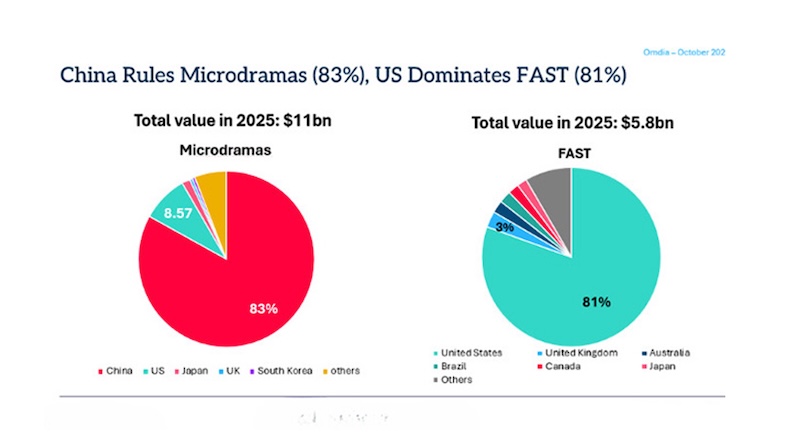
    Microdramas—those addictive mini-narratives designed for mobile consumption—are redefining entertainment. And the numbers are staggering. According to Omdia, the consultancy that presented its findings at Mipcom, Cannes, this genre will nearly double the revenue of Fast channels, which are projected to pull in just $5.8bn next year.

    “Viewers are willing to pay for content that captures them emotionally in seconds,” said María Rua Aguete, head of media and entertainment at Omdia. “Microdramas demonstrate that attention spans may be shorter, but engagement is deeper and more valuable.”

    The monetisation model is brutally simple: hook viewers with free episodes, then charge them through subscription or pay-per-episode channels. This approach accounts for more than 60 per cent of total revenue. The payoff is formidable. Average revenue per user can reach $20 per week—or up to $80 per month—making microdramas extraordinarily profitable.

    China dominates the space, generating 83 per cent of global revenue, fuelled by a colossal audience and a mobile-first culture. Beyond China, the US claims half of international revenue, with Japan, South Korea, the UK and Thailand emerging as hungry new markets.

    “Microdramas are redefining what it means to tell premium stories in the digital age,” Aguete said. “They combine the immediacy of social media with the emotional depth of dramatic television. They are short, addictive, and irresistible.”

    This isn’t a fad. As consumer habits shift inexorably towards mobile and short-form content, microdramas are poised to become the centrepiece of digital entertainment—a seismic fusion of social video and traditional storytelling that will reshape how the world consumes drama. The wave is here. And it’s only just begun to crest.

  • West Asia cinema market to get growth urge from Saudi Arabia

    West Asia cinema market to get growth urge from Saudi Arabia

    MUMBAI: For movie lovers in the middle east north Africa (Mena) region, this is great news. And for Indian movie producers and distributors it is probably even better news. Analysis by London-based research outfit Omdia has revealed that the Mena cinema market is poised to catapult to new heights with revenue growing from $900 million in 2024 to $1.5 billion by 2029. The main driver of this growth is going to be Saudi Arabia which will account for almost two-thirds of the region’s cinema revenue. 

    West Asia, according to Omdia, has emerged as the fastest cinema building market, adding 1,000 new screens, starting 2019 to reach 2.500 screens by end 2024. Saudi Arabia, which is on aggressive city and entertainment hub building spree is expected to lead the additions, reaching 803 screens by year end 2024. The UAE is expected to be next in the pecking order with 734 screens.

    To top that, OMDIA says that even though west Asia is focusing on local productions, expanding its theatre count, and spreading cinema culture there is still much work to be done to sustain interest in local films and broaden their appeal.

    Beyond cinema, the online video streaming market in Mena is also on a strong growth trajectory, projected to reach $2.7 billion by 2029. This reflects the region’s evolving entertainment landscape, where audiences are embracing both traditional cinema and digital streaming platforms, creating a diverse and dynamic entertainment ecosystem.

    Says Omdia senior  director of media & entertainment  Maria Rua Agute: “With films no longer made solely for cinema; streaming platforms play a major role in financing and offer audiences a great variety of films, including those that might not reach traditional cinemas due to cost or limited availability of screens. In a region with relatively few arthouse cinemas in the region, there is a growing need for more diverse venues and programming to reflect the evolving film culture and cater to different tastes and genres. Expanding the availability of diverse cinema will be key to meeting demand.

    “The growth of cinema in the Mena  region, particularly in Saudi Arabia, signals a major shift in both the regional entertainment landscape and global filmmaking. Investments in infrastructure, local film production, and streaming are helping diversify cinema offerings. As audiences embrace both traditional theater and digital platforms, the region’s film culture has immense potential to flourish and gain international recognition.”
     

  • Non-linear TV viewing draws attention of viewers in US, Europe & Australia: Omdia’s Report

    Non-linear TV viewing draws attention of viewers in US, Europe & Australia: Omdia’s Report

    Mumbai: New research from Omdia reveals that nonlinear viewing continues to gain greater hegemony in the daily viewing habits of TV users across the US, Europe, and Australia. Online long form and social media video viewing is growing beyond the previous year’s boom in viewing time.

    Omdia’s new ‘Cross-Platform Television Viewing Time Report – 2022’ finds that across all the markets covered, the average total daily viewing time reached 362 minutes per person per day in 2021 (six hours and two minutes), down 0.5 per cent on last year. Declines in linear TV, online short form and pay TV VoD account for this minor drop in viewing, with the former seeing the sharpest falls. Growth in online long form and social media video viewing, however, counterbalanced these declines, leaving overall viewing to drop by just two minutes.

    Linear TV viewing time decreased in all markets in 2021. The end of restrictions and lockdowns that marked most of 2020 was the primary cause, with the continual shift toward on-demand viewing also driving this.

    Omdia’s TV and Online Video team senior analyst Rob Moyser commented, “In highly developed markets such as the US and the UK, 2021 will likely be the last year where linear TV predominates over non-linear TV viewing. On a platform-by-platform level, however, linear TV still remains, by some distance, the most popular way to watch TV in the markets covered.”

    Online long form was a key area of growth across all markets, driven largely by incumbent online subscription services such as Netflix, Amazon Prime, and Disney+, and the launch of several new OTT services such as Discovery+ and Paramount+. In total, long-form viewing grew by eight minutes, reaching 68 minutes, eight minutes ahead of social media video viewing.

    Time spent viewing video content on social media platforms increased by nine minutes in 2021 to an average of 60 minutes per person per day across the nine markets analysed. TikTok was the standout performer for video growth during the year, with the platform set to overtake Facebook in total time spent for the first time in 2022.

  • UK SVoD growth up; people spending more time on streaming platforms: Omdia’s Research

    UK SVoD growth up; people spending more time on streaming platforms: Omdia’s Research

    Mumbai: According to a research report released recently at Connected TV World Summit, Omdia’s senior director Maria Rua Aguete said, “The number of people paying for video services in the UK has increased 11 per cent over the last year and quarter on quarter since April 2021.”

    According to Aguete, despite the UK cost of living crisis, UK people are tending to spend more and certainly no less in streaming video services. In terms of dealing with rising costs, consumers prefer to cut other expenses than their own home entertainment in order to deal with the rising cost. As the survey reveals, cuts in other spending has allowed them to subscribe to extra services.

    Currently, the average UK household has 2.6 pay subscription services at home, 2 Svod services and 0.6 Pay TV. Although the churn rate has increased significantly in the last 12 months.

    Despite Netflix results showing a decline in global subscriptions (200,000 in Q1 2022), Netflix remains the UK’s favourite video service. It is also still the most popular SVOD service in the domestic market, the USA.

    80 per cent of households in the UK have an online subscription. YouTube and BBC iPlayer tops the chart as most favourite online video services in the UK followed by Netflix. Netflix’s Svod service is still in the race with 15.5 million subscribers.

    Other most popular services in the UK are: Amazon Prime Video with 10 million subscriptions and Disney Plus with 7.5 million subscriptions.

    Churn has increased significantly in the last 12 months:

    45 per cent more subscription video services were cancelled in the last 12 months, while overall there were 20 percent more consumers cancelling their services compared to last year, but counteracting this trend, the number of services cancelled and re-subscribed to in the last 12 months has grown by 84 per cent meaning that although more people are churning, more people are subsequently resubscribing with 50 per cent more re-subscribers in the UK now.

    According to the reports, online video subscriptions will reach 2 billion in 2027. The biggest growth in the last six months comes from: Disney, Now TV, Netflix and Amazon Prime with 21 percent, 18 percent, 8 per cent and 5 per cent respectively.

    Those with four streaming video services per home are the ones churning less than those who took more than seven SVOD services are among the highest churners.

    Looking forward, Omdia expects that Netflix, currently in the lead in the streaming video race (Q1 2022), will still lead in five years’ time (2026) Aguete adds: “With the lowest churn rate across all streaming video services and highest lifetime value per customer, Netflix will continue and surpass Disney by 2026.”

  • VidNet 2022: ‘Over half of global online video services are subscription funded’

    VidNet 2022: ‘Over half of global online video services are subscription funded’

    Mumbai: Over half of the online video services worldwide were subscription funded at the end of 2021, according to a study. The key findings of the study pointed out that while there are more subscription funded over-the-top (OTT) services worldwide, advertising is a much larger revenue stream for video-on-demand platforms. Advertising revenue will also outpace subscription revenue over the next five years nudging many global OTT players including Netflix to introduce an ad-supported plan on their platforms. These insights and more were revealed in the session ‘Trends in Global OTT’ presented by Omdia senior principal analyst – digital content and channels Tim Wescott at IndianTelevision.com’s VidNet 2022 Summit on Thursday. 

    The two-day industry event was supported by technology partners Dell Technologies and Synamedia, summit partners Applause Entertainment and Viewlift, industry support partners Gupshup, Lionsgate Play and Pallycon, community partners Screenwriters Association and Indian Film and Television Producers Council and gifting partner The Ayurveda Co.

    Omdia is a research firm that focuses on technology, media and telecommunications sector and connects the dots in the global media ecosystem. 

    Wescott shared that there were 5671 online video services available at the end of 2021. This includes video sharing services like YouTube, subscription video-on-demand (SVOD) services like Amazon Prime Video, Netflix and transactional video services like Apple iTunes. “We have seen a plateau in terms of the number of online video services that peaked in 2019. New services are being launched all the time that are replacing old online video brands. Some services have been shuttered because they haven’t managed to turn a profit.”

    There were slightly more OTT services in 2021 as compared to 2020. There are 2222 subscription funded online video services followed by just over 2000 AVOD platforms and 1362 transactional video-on-demand services. There were just over 1000 dedicated sports streaming services, 600 virtual pay TV operators and 463 free video-on-demand services. Free VOD services are either promotional channels or are public broadcaster funded services.

    There are an estimated 127 online video services in Central and Southern Asia out of which 51 are AVOD services and 45 are SVOD services. “Despite the publicity of SVOD, advertising is the larger revenue stream and has been since 2010,” said Wescott. “It is going to outgrow subscription as a source of revenue for online video services over the next five years.”

    The online video world is dominated by YouTube and Facebook. A lot of OTT streaming services have started offering advertising including HBO Max, Peacock, Hulu, Disney+ (later this year) and Amazon Prime Video. “We heard recently that Netflix is considering adding an advertising tier,” noted Wescott. “It comes as no surprise as advertising supported plans are already being rolled out by other OTT players. We forecast that online video advertising is going to outstrip linear advertising in 2022. It is a very strong source of financing that will continue to grow.”

    The number of global online video subscriptions have seen dramatic growth since 2015 with the launch of more streaming platforms. Amazon Prime Video and Netflix launched globally in 2012 followed by Disney+ and Apple TV+ in 2019, HBOMax and Peacock in 2020 and Paramount+ in 2021. “We will continue to see subscription growth, especially with the advent of SVOD platforms of US studios. Earlier, these studios used to sell content directly to OTT players but now they view them as competitors.” 

    Omdia also conducted a consumer study in eight countries including India to understand consumer preferences when it comes to OTT services. They found that in most countries the arrival of SVOD services had decimated pay TV subscriptions. For example, SVOD services in the US have undercut existing pay TV in terms of pricing and have led to dramatic decline in pay TV subscriptions. The opportunity to watch on demand and binge watch content is something consumers have enthusiastically embraced, according to Wescott. The picture is similar in other countries where pay TV hasn’t declined as much as in the US but there are more SVOD subscriptions in most cases.

    India is slightly different from other markets because the pricing differential between SVOD and pay TV is not the same. In India, SVOD is a premium service whereas pay TV tends to be cheaper. There are also a lot more pay TV households than SVOD in India, though that is also because a lot of people get their television services via fraudulent operators.

    “While there is an increasing array of SVOD services being launched every year, clearly not every household is going to subscribe to all these services,” observed Wescott. “Our research shows that people use free ad funded services the most. So, YouTube is the number one choice in many countries including India. Before 2021, YouTube was the biggest online video service followed by Facebook Watch and then the free ad-supported tier of Disney+ Hotstar. Amazon Prime Video and Netflix are in the middle of the rankings among top ten OTT services. “Netflix has famously said that they’re competing with sleep for the consumer’s time but in reality, all online video services, whether they are AVOD or SVOD are competing for the consumer’s attention,” said Wescott.

    When Omdia asked consumers what they rated highly in a SVOD service, most respondents overwhelmingly said that original exclusive content i.e., content that is not available anywhere else was the most important aspect of any OTT. Consumers also wanted to watch the most talked about TV series that they had yet to catch up on. The depth of the content catalogue is rated as the next most important aspect for consumers of online video services. Advertising or lack of ad-supported content was also a big deal for some consumers but not as much as having original content.

    Omdia’s Wescott also shared some exclusive data at VidNet Summit 2022. The data showed that the number of original productions that were transmitted in 2021 by streaming services including Amazon Prime Video and Netflix were less than the previous year. There were also fewer hours of original content last year. Netflix produced the most original content coming up at 1767 hours. “The main reason for the decline in original productions is due to the production hiatus that began in 2020 due to the pandemic. We see that disruption working into the delivery pipeline for players such as Netflix and Amazon Prime Video. However, if you compare what Netflix is putting versus a typical US linear TV service then it is still a considerable amount of original content.”

    More global OTT platforms are commissioning originals locally. Netflix commissioned content in 47 countries in 2021 that were outside the US. Netflix’s most successful hits are being produced outside the US in languages other than English. In the last five years, Spain (Spanish shows) has been the biggest source of drama content for Netflix followed by India. “When Netflix came to India it wasn’t able to get as much local content as it would have liked and thus was obliged to originate content,” said Wescott. “Also, audiences in India prefer local content. While they will watch content from other countries, what they’re looking for is local content.”

    Similarly, India ranked as an important market for Amazon Prime Video, as most of its original drama productions outside the US, have been made in India in the last few years. Many direct-to-consumer services are offering a broader range of content and not just original content, even though they are increasing their original productions. US studios are expecting their new films to be a very important part of their SVOD service. Studios like Disney, Paramount, Universal and Warner Bros are planning to release their films exclusively on their SVOD services after the theatrical release. They also have deep libraries of film and TV content. Recently, Amazon completed the acquisition of legacy movie studio MGM and has access to 50 per cent of all James Bond titles.

  • 2021 global cinema revenues drop to half of pre-pandemic levels

    2021 global cinema revenues drop to half of pre-pandemic levels

    Mumbai: The total revenues generated by the global cinema industry are set to reach only 50 per cent of 2019’s pre-Covid revenues according to Omdia’s latest Cross-Sector Windows report.

    Global box office revenues are still being impacted by studios experimenting with differing release windows, alternative platform distribution models i.e., SVOD and PVOD, as well as government restrictions and more recently, a change in consumer confidence due to the Delta variant.

    In addition to reacting to the global conditions, studios are also experimenting with different release strategies as a co-ordinated way to build their own platform subscriber bases. One of the major challenges faced by studios with the move towards hybrid PVOD and SVOD strategies has been the increased issue of online piracy and accessibility of titles from launch.

    Overall, in 2021 consumer spend for movies across all platforms including SVOD, traditional home entertainment and theatrical will account for $60.4bn, down $5bn from pre-pandemic levels. At the height of the pandemic, total movie spends were recorded to be just $46bn with the largest share from a growing SVOD base.

    By 2022, with cinemas in a stronger position, Omdia forecasts that total movie spend will rise to a record $80bn globally.  Mid recovery, cinema will generate just one third of consumer movie spend this year compared with over 55 per cent pre-pandemic.


    Within the Windows report, Omdia compared the traditional cinema and home entertainment revenue of a top 50 2019 title with how it would perform across different pandemic-era release strategies. The scenarios take into account a relative cannibalisation of traditional windows by each strategy and offers how much missing revenue needs to be made up through SVOD subscriber gain or incremental PVOD revenue. 

    The baseline transactional revenues for a typical major blockbuster are around $300m per title of which cinema revenues are $178m per title. In the US typically, 60 per cent of aggregate revenue is generated within cinemas, with 75 per cent of this generated within the first 17 days / three weekends of release into theatres.

    The biggest impacts for exhibitors from shifting windows have most certainly been the introduction of day and date release windows across both SVOD and PVOD platforms including some of the largest titles of the year.

    Day and Date releases accounted for 54 per cent of box office revenues in US cinemas up to mid-June 2021, Omdia expects that studios will predominantly migrate back to a theatrical-first strategy for major titles over the next few months. Day and Date releases have been a way to ensure that people are still viewing blockbuster films either in cinema or at home during the recovery.

    Omdia’s scenarios suggest the day and date releases to SVOD (D2C) services would have the most significant impact on a title’s box office by as much as 20 per cent. Whereas minimally cannibalistic strategies such as a 45-day exclusivity window would have impacted box office takings by closer to 5 per cent, and alternative distribution models such as Dynamic PVOD and Day and Date PVOD (D2C) also fall into this range (5-20 per cent).  However, in each scenario, traditional home entertainment revenue was put at a greater risk over theatrical.

    Omdia principal analyst Charlotte Jones commented, “The Covid-19 pandemic has had a significant effect on studio revenues and shifted the way in which movies have been released. Theatrical windows are still a key revenue generator for studios and whilst there has been experimentation with alternative platforms and distribution models, over the course of the next few months studios will return to theatrical exclusivity for key blockbuster titles before releasing on other platforms.

    Blockbusters will continue to drive the most amount of box office revenue for cinemas, however, it is the Tier 2 / Tier 3 titles that will see their window models shift, resulting in a larger decline in the traditional revenue measurement for studios. Conversely, flexibility in release windows will also admit a wider variety of content into cinemas.”

  • Disney+ Hotstar & Netflix dominate India’s SVoD market: Omdia

    Disney+ Hotstar & Netflix dominate India’s SVoD market: Omdia

    MUMBAI: Now here’s further research confirming Netflix and Disney+ Hotstar’s dominance of the Indian streaming market. Research firm Omdia’s  2021 Online Video Market and Consumer Trends Report released on 31 March states that the two streaming giants accounted for 50 per cent of all subscription video on demand (SVoD) signups in India in 2020. This was on the back of the pandemic and nationwide lockdown which saw SVoD revenues spurt 142 per cent from $265 million to $639 million by end 2020. The duo accounted for 78 per cent of that final tally, meaning about $498.42 million.

    While Disney+ Hotstar trebled its subscriber base from eight million to 25.6 million in 2020, Netflix nearly doubled its subs from 2.4 million in 2019 to 4.4 million in the same period. The Indian streamer’s growth partly came from the  bundling of Disney+ and Hotstar, as well as the postponement of the start of the thirteenth  season of the Indian Premier League (IPL) from April to September, as well as competitive pricing plans and exclusive rights to foreign content such as Game of Thrones.

    One of the key factors for the growth of subscriptions for online video is the aggressive pricing models of both Disney+ Hotstar and Netflix, with the latter launching mobile only subscription packages in 2019, reflecting the Indian consumption habits. 82 per cent of online video services are accessed through smartphones with only 39 per cent accessing content through dedicated TV apps (data from Omdia’s 2020 consumer survey).

    Disney+ Hotstar on the other hand offers three specific content packages. The VIP plan (Rs 399 per year) offers dubbed local languages while Premium (Rs 299 per month) offers both English and dubbed version of content. In terms of device access, the VIP plan only allows its subscribers to watch on one screen in HD while Premium allows subscribers to watch on two screens simultaneously in full HD.

    By offering affordable streaming plans and partnering with large telcos such as Reliance Jio, Bharti Airtel and Vodafone India, Omdia expects that mobile-only subscriptions will continue to grow over the next couple of years. However, mobile-only subscriptions will face challenges from traditional pay TV services as pay TV services aggregate OTT video services with their core pay TV plans.

    Whilst retaining premium rights to foreign titles and sporting events have contributed to significant growth in revenues and subscribers, over the past few years there has been an increased focus on investing in original Indian language content, Omdia noted.

    In 2021, Amazon Prime and Netflix will continue their large investment in original Indian content, with the two major US services set to invest around $340 million, representing 52 per cent of the total investment in 2021. Omdia expects that close to 400 original titles (mostly series and films) will be produced in 2021 by the global and Indian OTT services.

    Most of the investment being made is directed towards original content in Hindi, around 65 per cent  of total spending, according to the Omdia report.

    “The online video (OTT) market of India is steadily growing its foothold in every direction,” says Omdia principal analyst – TV & online video, consumer Constantinos Papavassilopoulos. “The Covid2019 pandemic accelerated the growth rate of an already dynamic and robust OTT market. The basic elements that will propel the market to further growth in the near future are already there: very affordable mobile broadband prices, high penetration of smart-phones, a population eager to consume more content, an ever-growing investment in Indian originals and a plethora of choices with more than 40 OTT services operating in the country.”