Tag: OLED

  • Samsung working on tech breakthrough for 27-inch QD-Oled monitors for esports

    Samsung working on tech breakthrough for 27-inch QD-Oled monitors for esports

    MUMBAI: For gaming enthusiasts, this could be a godsend. Samsung Electronics’ offshoot Samsung Display is currently working on a new Oled display monitor which would have a record refresh rate, according to reports appearing in south Korean media. The size of the panel: 27 inches. The resolution: QHD/1440p or 2560X1440 pixels. 

    Samsung Display combined quantum dot and Oled technologies, and achieved a 500Hz refresh rate for the first time ever in an Oled display. The display is in the final stage of development as Samsung seeks potential partners in the gaming monitor business. Hope is that commercial manufacture should begin soon and the new panel should arrive in the market during H1 2025.  Some say the launch could happen at CES in Las Vegas. The product is targeted at the esports market. 

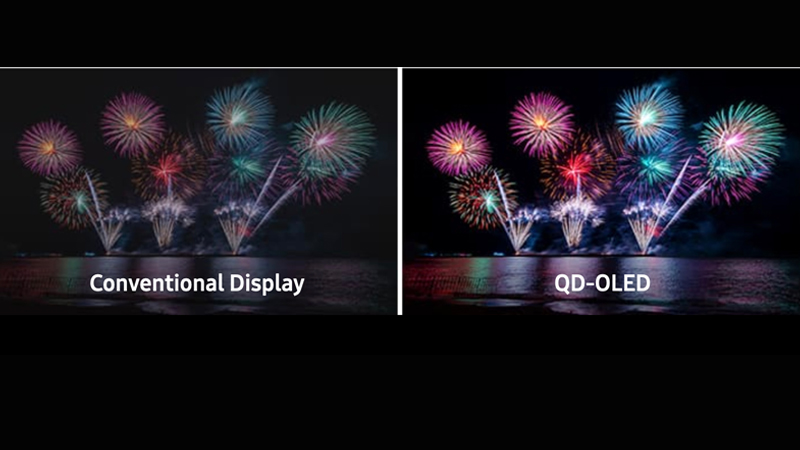
    QD-Oled panels reportedly offer superior color vibrancy, deeper contrast, and improved performance compared to traditional LCDs. This aligns with a broader trend among display manufacturers like LG Display and Samsung Display, which  compete to push the boundaries of high-refresh-rate Oled  monitors in various sizes and resolutions. Samsung’s  achievement has outpaced the displays of both Asus and LG which have a maximum refresh rate of 480Hz.

    Research firms have pointed out that while  annual global monitor growth is expected to take place at one per cent between now and 2028, Oled displays are expected to grow at 34 per cent per annum on an average in the same period.

    According to online panel analyst, FlatPanelsHD , 2025 could come up with a new trend for 27-inch QD-Oled and WOled monitors.Chinese firm  Light Soul is burning the midnight oil and is planning to release a 27-inch QD-Oled monitor with a 4k resolution, a 240 Hz refresh rate and 1000 nits of peak brightness. 

    On the larger screen front, LG is likely to come out with a 45 inch WOled panel with a resolution greater than the existing 3440×1440 pixel resolution. Expectations are that it could touch  5120×2160 pixels. This could spark off another trend for monitor manufacturers and developers.

  • Global TV shipments rise for second quarter in a row in Q3 2024

    Global TV shipments rise for second quarter in a row in Q3 2024

    MUMBAI: This is one piece of research that deserves closer attention. Global market research firm Counterpoint Research data around a week ago showed that TV shipments have maintained their buoyancy in Q3 2024. The growth year on year for the period was at 11 per cent to  62 million units, which was the second quarter in succession that the TV market showed a rise. Research data also showed that growth was distributed even across all regions, except Japan. East Europe showed the maximum jump at 24 per cent. North America and western Europe also showed healthy growth. 


    Global TV shipments

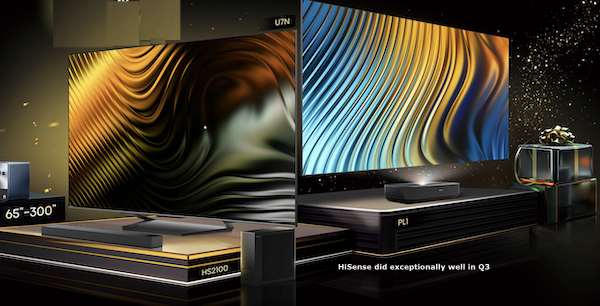
    Model wise, premium TV sets consisting of OLED, QD LCD, and MiniLED LCD shipments rose 51 per cent year on year, which was an all-time high. A lot of that growth came courtesy the Chinese brands Hisense and TCL, which more than doubled their shipments year on year, climbing to second and third place. Samsung of  course led this segment at 30 per cent, but it lost 13 per centage points of market share to the Chinese brands. Because of the Chinese aggression, LG was pushed to the fourth spot. 

    The premium TV segment saw shipments of MiniLED LCD TVs rising 102 per cent year on year, racing past OLEDs which accelerated by a mere 13 per cent year on year. QD LCD TVs also climbed past four million units –  50 per cent growth year on year.


    Premium TV shipments

    Overall for TV shipments, Samsung Electronics retained its top slot with a 15 per cent market share, but that  had slipped marginally compared to the previous quarter.  HiSense sprinted ahead of TCL by increasing its shipments by 19 per cent. LG was at the fourth spot with a close to 10 per cent share, by shipping out mor  seven per cent more TV sets.

    Counterpoint Research researcher Lim Soo-jung said, “In the TV market where replacement demand is the main issue, the fact that there has been year on year growth for two consecutive quarters can be interpreted as a shortened replacement cycle,” adding, “As TV companies continue to release new high-definition, large-screen models, it stimulates consumer purchases for users who want to enjoy videos on a larger screen at home.”


  • How to Decide Between QLED, OLED, 4K UHD or Full HD TV

    How to Decide Between QLED, OLED, 4K UHD or Full HD TV

    According to ECD, when buying a smart television in India, you need to consider several factors such as size, operating system and the picture resolution. Apart from that, you also need to check the type of display the TV provides because it determines the overall picture quality. 

    There are different types of smart TV displays which includes QLED, OLED, 4K UHD and Full HD.  In this article, we shall reveal how each one of them works to make your work easier when choosing the most suitable option.

    1.  QLED

    QLED or a Quantum dot Light Emitting Diode is made of quantum dots or tiny semiconductor crystals which ranges from 2nm- 10nm. It features a group of LCD panels which requires an external source of light to provide the images we seen on the television. The light source is normally located on the sides or behind the diode panel. Quantum dots provide color light according to their size and the energy gap of the materials being used. What sets QLED apart from its competitors is the fact that each pixel is able to emit or create its own light independently. The color of each pixel varies according to its size. For example, larger pixels emit a red light while the smaller ones produce a blue light.

    Pros

    •    Provides very sharp colors even when there is extreme brightness
    •    No burn-in or lag
    •    Thin and light
    •    The switching speed between on and off is very fast
    •    Brightness is 50-100 more than the LCD and CRT displays
    •    Available in higher display sizes which h means that consumers can choose from different sizes
    •    Very bright and vibrant colors
    •    Sizable

    Cons

    •  The quantum dots in QLED TVs use the light that is passed through them by a backlight

    1.  OLED [Organic Light Emitting Diode]

    Unlike the QLED technology, OLED is an independent display technology. This means that it does not require a backlight and instead, it produces its own light. The good thing about it is that it provides wider viewing angles and accurate color reproduction. This ensures that there are no alterations on color, brightness or contrast when you are viewing the screen at skewed angles. Again, OLED makes the screen to appear darker and this enhances the contrast. However, there is a risk of burn-in/ image retention and lower brightness as compared to LED displays.

    Pros

    •    The organic external layers ate light, sleek and flexible as compared to the glass layers on an LCD or LED.
    •    Light emitting layers of OLEDs are light which means that they make the substrate of the OLED flexible
    •    OLED displays are very bright because the organic layers used are thinner than the inorganic crystalline layers. Again, the emissive and conductive layers of OLEDs can be stacked together to make create multiple layers.
    •    Unlike the LCDs and LEDs that requires glass for support, the OLEDs do not. As a result, they are brighter since glass absorbs some of the light.
    •    They do not require a backlight since they emit their own light. Due to this, they have a wider viewing angle.

    Cons

    •    High manufacturing costs
    •    They are easily destroyed by liquids

    2.  4K UHD

    In simple terms, 4K UHD is the image resolutions or horizontal screen display of about 4,000 pixels. This type of display is also referred to as UHD-1 or just 4K. Other people may refer to it as 2160P. Unlike the full HD, the features of 4K UHD differ in the professional fields which leads to different definitions of the horizontal pixels x vertical pixels. For example, 4K UHD specifications refer to any of the two high definitions which are 3840 x 2160 pixels and 4096 x 2160 pixels. You will also find that most of the 4K UHD displays can support 3840 x2160 pixels and only a few products are able to support 4021 x 2160 pixels.

    If you want the display equipment to correspond to the 4k content as well as the 4K panel, you need to ensure that the related equipment is able to support that. In terms of picture quality, 4K UHD TV provides an incredible performance. As a result, they are very expensive. They are also available in different sizes which range from 40 inches to more than 100 inches.

    3.  HDR TV

    Even with their unique performance, 4K UHD TVs cannot match the HDR [High Dynamic Range] TVs. These TVs provides the highest level of color contrast which enables them to provide realistic images. If you want to enjoy true HDR contents, having a 4K HDR TV is not enough and you will need a player that can play HDR content for games and movies.

    4.  Full HD TV

    High Definition [HD]TV is the standard that has been  on the market for more than a decade. These TVs are able to display images at a resolution of 1280 x 720[720p]. Most modern TVs are able to provide Full HD which means that they displays images at a resolution of 1920 x 1080[1080p]. The ‘P’ stands for progressive which means that the whole image is drawn on each frame.

    Final Verdict

    If you have been thinking of investing in the best smart TV, the first thing you need to familiarize yourself on the different smart TV displays available. The type of display used in smart TVs determines the picture quality which means that some are clearer than others. We hope that after reading this article, you now know the difference between OLED, QLED, Full HD and 4K UHD and now you are able to choose the best. Each has its own advantages and disadvantages which means that you need to check them keenly before you make a choice.
     

  • Digital signage market likely to reach $27.34 billion by 2022

    Digital signage market likely to reach $27.34 billion by 2022

    MUMBAI: A ‘Digital Signage Market by Product (Kiosks, Menu Boards, Billboards, Signboards), Offering (Hardware (Display Panels, Media Players, Projectors), Software, and Services), Application, and Geography – Global Forecast to 2022’, published by MarketsandMarkets says that the digital signage market was valued at $16.88 billion in 2015 and is expected to reach $27.34 billion by 2022, at a CAGR of 6.7 percent between 2016 and 2022. The base year considered for the study is 2015, and the market size forecast is provided for the period between 2016 and 202

    The demand for emerging technologies used in ultra-high definition (UHD), LED-LCD, OLED displays is likely to accelerate the growth of the digital signage market during the forecast period says the report. With the increasing demand for digital signage, improvements in technology offerings, and infrastructure expansion is likely to fuel the digital signage market to continue the positive outlook during the forecast period. In addition, the integration of real-time data management tools, big data analytics, and smart content with multiple presentations and dynamic interfaces would further drive the market for public commercial displays.

    The market for software offerings is expected to grow at the highest rate during the forecast period. The expected growth of the digital signage market for software offerings is higher than that for hardware offerings as hardware devices such as displays, media players, projectors, and mounts and other accessories do not require frequent purchases or replacements. The high growth of the market for software offerings is because software licenses need to be regularly updated.

    Kiosks held the largest market share of the global digital signage market for products in 2015 and are expected to dominate the market till 2022. Kiosks plays a significant role in the digital signage market for providing access to information and communication, commerce, entertainment, education, and other applications. Kiosks are quick and effective solutions which can be used virtually in all locations.

    North America is expected to hold the largest market share and dominate the Digital Signage Market between 2016 and 2022, owing to the large number of suppliers of digital signage technologies and services in the region. The digital signage market in APAC and Europe is expected to have a promising future with tremendous opportunities, especially in commercial and infrastructural sectors.

    The major players in the digital signage market include Samsung Electronics Co., Ltd. (South Korea), LG Display Co., Ltd. (South Korea), Sharp Corporation (Japan), Sony Corporation (Japan), and Panasonic Corporation (Japan) among others.

  • Digital signage market likely to reach $27.34 billion by 2022

    Digital signage market likely to reach $27.34 billion by 2022

    MUMBAI: A ‘Digital Signage Market by Product (Kiosks, Menu Boards, Billboards, Signboards), Offering (Hardware (Display Panels, Media Players, Projectors), Software, and Services), Application, and Geography – Global Forecast to 2022’, published by MarketsandMarkets says that the digital signage market was valued at $16.88 billion in 2015 and is expected to reach $27.34 billion by 2022, at a CAGR of 6.7 percent between 2016 and 2022. The base year considered for the study is 2015, and the market size forecast is provided for the period between 2016 and 202

    The demand for emerging technologies used in ultra-high definition (UHD), LED-LCD, OLED displays is likely to accelerate the growth of the digital signage market during the forecast period says the report. With the increasing demand for digital signage, improvements in technology offerings, and infrastructure expansion is likely to fuel the digital signage market to continue the positive outlook during the forecast period. In addition, the integration of real-time data management tools, big data analytics, and smart content with multiple presentations and dynamic interfaces would further drive the market for public commercial displays.

    The market for software offerings is expected to grow at the highest rate during the forecast period. The expected growth of the digital signage market for software offerings is higher than that for hardware offerings as hardware devices such as displays, media players, projectors, and mounts and other accessories do not require frequent purchases or replacements. The high growth of the market for software offerings is because software licenses need to be regularly updated.

    Kiosks held the largest market share of the global digital signage market for products in 2015 and are expected to dominate the market till 2022. Kiosks plays a significant role in the digital signage market for providing access to information and communication, commerce, entertainment, education, and other applications. Kiosks are quick and effective solutions which can be used virtually in all locations.

    North America is expected to hold the largest market share and dominate the Digital Signage Market between 2016 and 2022, owing to the large number of suppliers of digital signage technologies and services in the region. The digital signage market in APAC and Europe is expected to have a promising future with tremendous opportunities, especially in commercial and infrastructural sectors.

    The major players in the digital signage market include Samsung Electronics Co., Ltd. (South Korea), LG Display Co., Ltd. (South Korea), Sharp Corporation (Japan), Sony Corporation (Japan), and Panasonic Corporation (Japan) among others.