Tag: OHH

  • Facebook celebrates the possibilities of connections with ‘More Together’

    Facebook celebrates the possibilities of connections with ‘More Together’

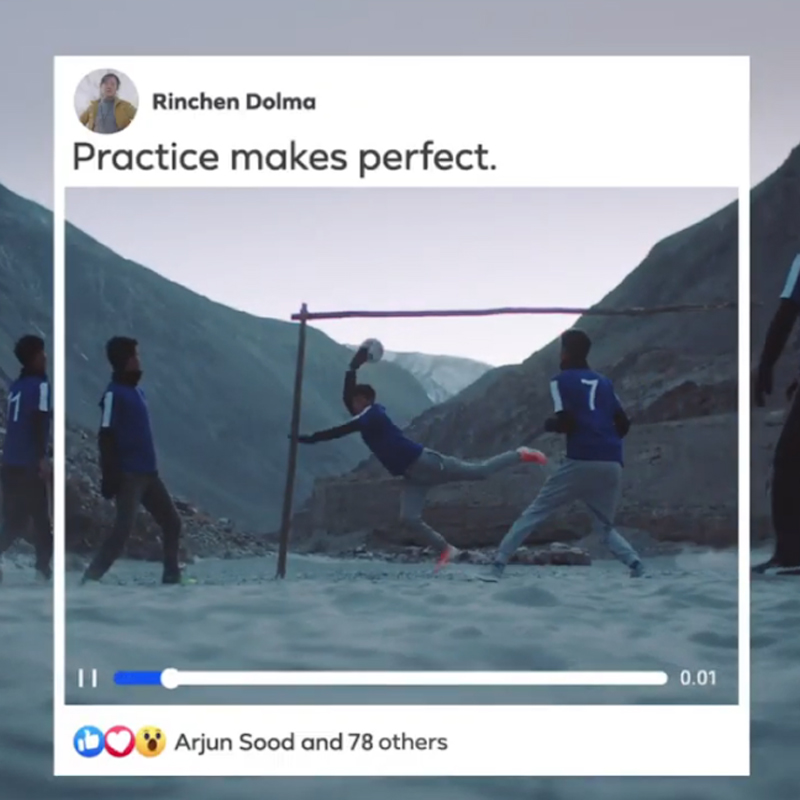
    NEW DELHI: Facebook has launched a new phase of its consumer marketing campaign in India – ‘More Together’. This phase marks the first anniversary of Facebook’s consumer marketing journey in the country, a key strategic focus area for the company, and continues to celebrate the power of connections and communities, and how people can do more together than alone.

    Facebook India director- marketing Avinash Pant said, “Facebook is deeply entrenched in the cultural fabric of India. The ability to connect and share with the world can lead to endless possibilities, and we feel humbled with the stories where our family of apps have provided this value to the people. Our consumer marketing journey over the past year has been focused on showcasing these diverse stories with the underlying belief that people can do more together than alone, and we continue to rally behind it.”

    The 360-degree campaign has been conceptualised and executed by Taproot Dentsu and Dentsu Webchutney and will go live in multiple languages across TV, digital, print, radio and OOH.  

    Taproot Dentsu Executive Creative Director Pallavi Chakravarti explained, “People want to be more, experience more, inspire more, help more, relax more, shine more – it’s in our DNA, this need to do more for ourselves and indeed for the world we live in. Facebook is a means to that end – a place where people come together resulting in delightful, sometimes entirely unexpected outcomes. This campaign will capture many such stories and trace the trajectories of people like you and me, who shared something with the world and got so much more back in return.”

    As part of the campaign, Facebook will leverage the power of its platform extensively to bring these inspirational stories to life and has partnered with Dentsu Webchutney to craft the creative strategy and communication across digital and social media including a digital campaign #FBPePoocho highlighting how people can get support and solutions by reaching out to their connections on Facebook. 

    Dentsu Webchutney vice president GD Prasad said, “On Facebook, everyone is just a conversation or comment away from unlocking the potential of achieving more together. With #FBpePoocho, we are celebrating the power of community. Our aim is to encourage people to activate their network, and in the process, help themselves and others grow. We've done this through interesting, everyday stories of people who've come together through the platform to realise impactful, incredible outcomes.”

  • How Covid2019 is affecting outdoor media

    How Covid2019 is affecting outdoor media

    Outdoor advertising had a fantastic 2019. Defying predictions, India’s OOH (Out Of Home) industry, grew at over 15 per cent. Driven by IPL, elections and a huge increase in the OTT industry’s outdoor advertising, the industry saw a big increase, enabled adequately by digitization. The industry itself has been seeing radical positive transformation over the years. From the rather primitive static format, it has now become a dynamic audiovisual one, with all kinds of creativity made possible by technology. Global giants like Google Maps and LinkedIn have used OOH to create an impact, in addition to Netflix, Amazon Prime and Hotstar. Events are a big money spinner for OOH, and last year KumbhMela was proof of this. Witnessing audiences in crores, the promotion of brands on-site contributed significantly. In the financial year 2019, the revenue generated from out-of-home advertising across India amounted to over Rs 34 billion. This was estimated to reach up to Rs 52 billion by the financial year 2024, and Rs 38 billion in 2020.

    But all this has now been severely affected by the pandemic Covid2019. Many organizations have slashed their ad campaign budgets and have left the advertisers reeling for their incomes. OOH has been acutely affected in this scenario.

    Looking at history does not help, as during the previous instances of recession or pandemic, digital media or ambient advertising (a variation of outdoor) were not as developed as it is today. 1918 was the year when the Spanish Flu hit the world, and at that point mass television broadcast was at least 25 years away. Much later, in 2008, when the financial crisis hit the world, digital marketing was just fledgling.  But today, it is hard to find a single household that is not reached through digital and/or outdoor advertising.

    Lockdown has changed the way we live and the way in which we consume media. Urging people to stay indoors has resulted in streets and roads being empty. Halting public transport has created a vacuum in bus shelters and train stations and the busy shopping areas are deserted. The familiar red colour of Coca-Cola or the bright branding of Samsung is no longer visible while walking down the busy areas of metros in India. Many hoarding sites are empty as there are no consumers to view these.

    In-home media has been the gainer during this period. Whether it is TV, which has increased reach in terms of viewers and duration of viewership, or web streaming, which has seen a significant climb in the household watching time, or even video games (where playtime has gone up), people staying at home has resulted in a sharp increase in in-home entertainment and viewing.

    Out-of-home also includes ambient advertising i.e., advertising in unexpected areas. Aimed at evoking an emotional response, ambient advertising includes placing products, models etc. in attractive locations like malls and restaurants in order to catch the consumer’s attention. It is also called ‘creative guerilla advertising,’ and that has also hit a new low now. Reduction in public traffic has done away with the need for this kind of advertising, at least temporarily. Cancelling events has also had a bearing on this industry. With no immediate need to promote new products on a mass scale, clients are cancelling these events, leaving the advertisers high and dry.

    So, how can the outdoor media industry buck the trend?

    Outdoor medium is an integral part of our cityscapes and our lives. It has always had a place in building trust with local communities. Located in proximity to where people live and commute, it ensures a special bond with the citizens of that geography. And in times such as the current crisis, the medium is all the more relevant in garnering faith and educating the public. The medium, therefore, needs to play to its strengths. There have been cases where governments have recognized this and placed their confidence in this medium. According to the Ad Council of the US, ‘Out Of Home’ media plays a critical part in informing local communities and residents on how to stay safe during times of uncertainty. As part of their ongoing efforts to address the growing Covid2019 pandemic, the US department of health and human services (HHS) and centers for disease control and prevention (CDC), have convened (OOH) industry leaders, to bring critical Covid2019 safety messaging to the American public. From mall kiosks to airport TVs to Uber car tops and billboards, the industry is leveraging their extensive networks to help slow the spread of the virus. The scenario in India is no different. The advertising giants – Lintas, Ogilvy, JWT, etc. – are all focusing efforts on their outdoor advertising arm to bring more awareness to the public on Covid2019.

    Already known for its novel campaigns in the ambient format, the OOH industry needs further innovations. Take the case of Ro, an American digital health company, that has both men and women health products. Situated in New York, they decided to use outdoor medium and came up with a public utility message on safety on billboards, while also announcing their website-based tele-health assessments. This dual-purpose innovation helped them gain consumer mind share while also doing public good.

    Flexibility is the other aspect that will enable OOH to flourish. Media agency outfits that have a digital or TV component should allow clients to trade their outdoor budgets for digital or TV campaigns during this lockdown period, thereby retaining clientele. This will give them the much-needed revenues and allow them to get back on track once the current crisis is over.

    Making advertising trustworthy has always been a challenge. The metric for measuring trust in advertisements – the AD TRUST Scale – highlights the reliability of source as the topmost. Outdoor medium scores significantly on that front. Seeing China rebound from Covid2019 gives hope to outdoor marketers that all will be well soon. Coincidentally, the Beijing Olympics of 2008 was one of the pioneer outdoor events which showcased what OOH was capable of, through spectacular creativity (and technology). Given that outdoor advertising touches people in a personal, topical way, it is important that the industry adopts a combination of the above-mentioned strategies of playing to its strengths, practicing innovation and retaining flexibility.

    (The author is senior associate professor (marketing), Great Lakes Institute of Management, Chennai.)