Tag: NXT Digital

  • Taj TV to supply signals to Grant Investrade after signing ICA

    Taj TV to supply signals to Grant Investrade after signing ICA

    NEW DELHI: Grant Investrade, which operates the headend-in-the-sky (HITS) brand NXT Digital, and Taj Television have arrived at an agreement.


    Taj Television will provide its signals to Grant Investrade as soon as an inter-connect agreement is signed.


    Stating this, the Telecom Disputes Settlement and Appellate Tribunal (TDSAT) noted however that the agreement will be “without prejudice to Grant’s rights and contentions with regard to those clauses.”


    Listing the case for 13 January, TDSAT chairman Justice Aftab Alam and members Kuldip Singh and B B Srivastava made this observation after counsel Salman Khurshid on behalf of Grant Investrade said his client had some reservations on two or three clauses of the agreement.


    Both counsels namely Pratibha Singh on behalf of Taj and Khurshid said there was broad agreement for supply of Zee channels as also for Turner channels and this would be signed this week.


    Singh accepted that the agreement would be signed “without prejudice to Grant’s rights and contentions with regard to those clauses.”

  • MSOs, LCOs upbeat about Hinduja’s NXT Digital HITS platform

    MSOs, LCOs upbeat about Hinduja’s NXT Digital HITS platform

    MUMBAI: The Indian television industry is bracing itself for the third phase of digitisation as the deadline for Digital Addressable System (DAS) ends on 31 December, 2015.

    Phase III deadline of digitisation is what the broadcast ecosystem has been talking for a year now. While on the one hand, the government of India has time and again made it clear that there will be no extension of deadline, which is 31 December, 2015, on the other, stakeholders are pointing fingers at the system as the teething issues like inter-connect agreement (ICA), CPS deals et al are yet to be taken care of. In a recent notice the Ministry of Information and Broadcasting (MIB) headed by Arun Jaitley and MoS RajyavardhanSingh Rathore, has asked broadcasters to stop beaming analogue signals to all MSOs. Now with only days to go, people are still unclear as to what’s ahead.

    Amidst the chaos of litigations between stakeholders and various pot-shots being fired, Hinduja’s Headend In The Sky (HITS) platform NXT Digital found its calm in doing actual ground work before launch.

    Harvard Business School professor Rosabeth Moss Kanter once said, “Leaders must pick causes they won’t abandon easily, remain committed despite setbacks, and communicate their big ideas over and over again in every encounter.” And that’s exactly what the team helming NXT Digital did. Prior to its launch on 16 September, the HITS platform carried out road shows involving Last Mile Operators (LMOs) in over 19 cities spread across the length and breadth of the country to communicate the new idea.

    While the initial reactions from the operators weren’t that encouraging, the lack of collaboration on-ground between existing MSOs and LCOs turned out to be a blessing in disguise for NXT Digital, which in turn fuelled its penetration into the hinterland. Now, MSOs and LCOs that Indiantelevision.com spoke to are upbeat about the new platform.

    An independent MSO from the North Eastern Province tells Indiantelevision.com, “I recently invested Rs 50 lakh to establish a cable head-end but as of now I don’t know how much I will be charging the consumers. The Cost Per Subscriber (CPS) model is not even talked about yet. Broadcasters are giving out different deals to different MSOs. If anybody asks me for a suggestion, I would tell them to go for HITS as it is a much more transparent platform.”

    Another impeding problem that the industry will soon face is a serious crisis of Set-Top-Boxes (STBs). While the boxes are assembled in India, the components are still being shipped from China. “The components have not yet been ordered. While a few have placed the first round of orders, there are many who are yet to do that. It takes three months for the components to be delivered from China and then an additional one month to assemble them. So it is certain that the boxes will not reach on time. The STB crisis will be there for NXT Digital too,” said a senior official of an established MSO.

    However, NXT Digital is unperturbed. A senior official of the company says, “There was going to be a set-top box crisis and we always knew about it. Hence we placed an order for four million boxes and there are close to 1.1 million boxes available for us at this stage. So NXT Digital is pretty sorted from the STB point of view.”

    If sources are to be believed, Star is charging Rs 38 for its bouquet in DAS Phase III areas, whereas the Zee bouquet costs close to Rs 30. Sony Pictures Networks India (erstwhile Multi Screen Media) is pricing its bouquet at Rs 24, while India Cast is charging Rs 20.

    On the other hand, NXT Digital is charging Rs 71 per box. “It’s a good deal. It’s just that they don’t have Zee in their package yet. But I don’t think it will take long for them to get them in,” says a reputed member of a Southern cable federation. “They are giving a total of over 300 channels and if there is a spike in demand, they have the infrastructure to meet it too. So it’s a good long term investment.”

    NXT Digital follows a prepaid model, which the Indian ecosystem is not yet used to. “That’s not really a big issue; people usually get used to it. I am getting a lot of positive feedback from the industry about the HITS platform. However, there’s one thing that I will request Mr Tony to look at and that is the exchange of STBs. People are not ready to forget the STB investment that they have already made to have one. If they give an exchange offer, it would be great for us,” opines an LMO.

    Now it remains to be seen how NXT Digital proceeds further and to what extend they succeed in capitalising the hinterlands.

  • HITS to be treated at par with pan-India MSOs; TDSAT advises TRAI to frame consolidated Broadcasting Code

    HITS to be treated at par with pan-India MSOs; TDSAT advises TRAI to frame consolidated Broadcasting Code

    NEW DELHI: In a judgment expected to have far reaching consequences on the Indian broadcasting industry, the Telecom Disputes Settlement and Appellate Tribunal (TDSAT) today said that headend-in-the-sky (HITS) players should be treated on the same level as pan-India multi-system operators (MSOs) for commercial purposes.
     

    In a judgment on a petition filed by the Noida Software Technology Park Ltd (NSTPL) against Media Pro and others, the Tribunal said its judgment would come into effect from 31 March, 2016 by which time the relevant reference interconnect offers will be revised wherever necessary.

    The Tribunal said, “It is difficult to see a HITS operator as different from a pan-India MSO and in our considered view a HITS operator, in regard to the commercial terms for an interconnect arrangement has to be taken at par with a pan-India MSO and must, therefore, receive the same treatment.”

    Expectedly, the judgment will also help Hinduja Group’s HITS platform NXT Digital, which entered into the fray earlier this year.

    TDSAT chairman Justice Aftab Alam and members Kuldip Singh and B B Srivastava said both Star and Taj, as well as the other broadcasters who have joined the proceedings as intervenors are directed to issue fresh RIOs in compliance with the Interconnect Regulations, as explained in the judgment within one month from the date this order becomes operational and effective. It will be then open to NSTPL to execute fresh interconnect agreements with Star and Taj, and with any other broadcasters on the basis of their respective RIOs or on negotiated terms within the limits.

     
    Star and Taj will have to execute fresh interconnect agreements with the petitioner within two weeks from the date of issuance of their fresh RIOs. The agreement with Star would relate back to 30 October, 2015 and with Taj to 30 June, 2015. The issuance of the fresh RIOs by the broadcasters will also give right to other distributors of channels with whom the broadcasters may be in interconnect agreement to have their agreements modified in terms of clause 13.2A.7.
     

    NSTPL had executed an RIO based agreement with Media Pro. At that time, it did not complain before the Tribunal that it was being forced into the RIO based agreement even though it had ample opportunity to do so as the Media Pro application was pending before the Tribunal. Later on, after Media Pro ceased to be an agent of the broadcasters, NSTPL, even after filing the present petition, signed RIO based agreements both with Star and Taj. The agreement with Star was for the period upto 30 July, 2015 and the two agreements with Taj were upto 31 March, 2015.
     

    NSTPL must, therefore, be held bound by those agreements till the periods of those agreements and further, three months beyond that in terms of clause 8 of the Interconnect agreement. After those dates (29 October in case of Star and 30 June in case of Taj) the arrangement will be governed by the fresh agreements.

    The Tribunal said the non-discrimination obligation, which TRAI acknowledges as the pivot of those regulations, appears inconsistent with a regime where parties are allowed full latitude to mutually negotiate their agreements and also not disclose the commercial terms of the agreement to other market participants.
     

    There is the obligation to frame a meaningful RIO in which all bouquet and a la carte rates are specified, and there is also some room for mutual negotiation (even on rates) within certain specified parameters. This will achieve the objective of introducing a transparent non-discriminatory regime whereby distributors can obtain access to content, while still retaining some latitude to mutually negotiate the terms and conditions of access. It will also make the nexus between a la carte and bouquet rates, which the regulator thought fit to introduce, applicable to all mutually negotiated agreements. Negotiations must be within the parameters to those mandatory.

     
    At the same time, TDSAT said it was conscious that the present judgment may unsettle the way in which various parties in the broadcasting sector have entered into existing agreements. “We are further conscious that while the TRAI has taken a position broadly in line with our conclusions in this case, that has not always been the case. As the Amicus Curiae and the counsel for the Petitioner have pointed out, the positions taken by TRAI in the past have not always been fully consistent. In particular, we note the observation of TRAI in Consultation Paper No.15 / 2008 that in view of the confidentiality restrictions, the automatic implementation of non-discrimination clause in Interconnect Regulation is practically difficult,” it said.
     

    Thus, as far back as 2008, TRAI was aware that the non-discrimination clause – which, in these proceedings, it has sought to place on a very high pedestal – was effectively inoperative. And yet, matters in the broadcasting sector have been allowed to lie where they are by TRAI.
     

    TDSAT said it had on past occasions as well, made similar suggestions with the hope of nudging the Regulator to take proactive steps to reduce the scope of disputes arising out of the Regulations. At the same time, the fact that regulatory intervention may be the ideal way forward cannot and should not be an excuse for this Tribunal to shirk the interpretative issues that have come before us. This is particularly so when there appears to be regulatory inertia.
     

    This was the reason for suspending the operation of this judgment till 31 March, 2016. The judgment shall take effect on 1 April, 2016. “While we are aware that this is not a common procedure, we are of the view that it is appropriate in the peculiar facts and circumstances of this case, since the effect of this judgment may be to unsettle a number of existing agreements and necessitate re-negotiation,” the Tribunal said.
     

    In the meanwhile it will be open to TRAI to undertake a comprehensive restructuring of the Regulations, which would hopefully clarify many of the issues that arise in these proceedings. “We make it clear that this Tribunal is issuing no such direction to TRAI. The delayed operation of the judgment is only to afford an opportunity to TRAI to consider the matter and act in the intervening period, if appropriate,” it further added.
     

    As a greater part of the country would come under the DAS regime with effect from 1 January, 2016 the Tribunal said it would be advisable that TRAI should try to frame a consolidated Broadcasting Code instead of the large number of Regulations dealing with different aspects of the service and each having undergone numerous amendments. In order to make a serious effort in that direction, TRAI would be required to get hold of all the negotiated interconnect agreements between the broadcasters and the distributors of channels, which the broadcasters are in any event obliged to submit to TRAI. The Regulator may even feel the need to take a re-look at the tariff orders framed by it.

     
    Needless to add that in case TRAI issues any fresh Regulations before 1 April, 2016, the petitioner and the broadcasters would be obliged to execute agreements on that basis. In case, however, no fresh Regulations are issued by TRAI, this judgment and order will come into effect from the aforesaid date and the parties would be obliged to follow the directions give above.

    Suspension of this judgment is in the larger interest of the broadcasting sector. But this leaves open the question of the petitioner’s liability to pay licence fees to the broadcasters Star and Taj for their signals received by it during the pendency of the petitions before the Tribunal and further until execution of fresh agreements in terms of this judgment or in terms of fresh Regulations, if any, framed by TRAI. And since it will not be fair that the broadcasters should continue to supply signals to the petitioner without any payment for the next several months, some interim arrangement under which the petitioner should make payment of licence fees to the two broadcasters until after execution of fresh agreements accounts are finally reconciled. For this purpose, the petition against the broadcasters was de-tagged from this judgment and kept pending.
     

    Star has already filed an application in Petition No. 314 (C) of 2015 claiming the dues of licence fees from the petitioner. Petition No. 526 (C) of 2015 is directed to be tagged with Petition No. 314 (C) of 2015. In these two petitions, the Tribunal proposes to determine the Petitioner’s liability to pay the license fees to Star and Taj on an ad hoc basis and as an interim measure until the execution of the agreements with the two broadcasters, and when the accounts of the two sides may be reconciled to determine any final liability of the Petitioner or Respondents to make any further payments.
     

    It also made clear that all future deals between broadcasters and MSO/HITS players will be bound by the RIO agreements.

     
    While the case was initially filed against Media Pro in mid-2014, NSTPL had subsequently in December last year filed another petition against Star India and Taj TV.
     

    Since the issues in both petitions were similar and any judgment would affect the broadcasting sector as a whole, TDSAT had on 30 July this year issued a public notice asking all stakeholders to present their case on the issues involved.
     

    In an earlier case in 2013 between NSTPL and Media Pro Enterprise India Pvt. Ltd. TDSAT had on 12 September, 2013 directed Media Pro to provide signals of its TV channels to NSTPL.
     

    Later, NSTPL moved the Tribunal against Media Pro in which Taj Television Ltd and Star India Private Limited were brought in. Telecom Regulatory Authority of India (TRAI) was also a party in the two petitions of 2014.

     
    The first petition 10 July, 2014, NSTPL raised some questions regarding RIO and wanted the Tribunal to declare Clause 3.2 of The Telecommunication (Broadcasting and Cable Services) Interconnection Regulation 2004, as amended from time to time should mandate that all distributors be offered the same rate per subscriber per month which is the rate specified in the broadcaster’s RIO, unless the conditions of Clause 3.6 of Interconnection Regulation are fulfilled.

     
    It also wanted declaration in terms of Clause 3.6 of Interconnect Regulation to the effect that any discounted volume related scheme must be disclosed in a transparent manner, so as to enable the similarly placed distributors to avail of the same.
     

    It demanded that Media Pro be directed to disclose the volume related schemes at which it offers TV channel signals to distributors that are similarly placed with NSTPL and permit NSTPL to avail of such schemes.
     

    The second petition on 12 December, 2014 was against Taj and TRAI, which impugned the disconnection measures that had been initiated by Taj against NSTPL on account of alleged defaults like non-payment of certain amounts of subscription fees.

  • Hinduja Group’s HITS to be available on Thaicom 7

    Hinduja Group’s HITS to be available on Thaicom 7

    MUMBAI: Thaicom, one of Asia’s leading satellite operators, announced that its Thaicom 7 satellite is fully booked following an order from Grant Investrade Ltd (GIL).
     

    GIL. a subsidiary of Hinduja Ventures Ltd, confirmed the order for the C-band transponders on the satellite, which it will use to provide digital cable TV services through its Headend-In-The-Sky (HITS) system.
     

    The HITS service, branded Nxt Digital, will help the distribution fraternity smoothly transition to digital and allow customers to choose channels through a satellite multiplex across India.
     

    “It is one of India’s national missions to roll out Digital Addressable Systems (DAS) of broadcasting all over the country and we believe ‘Nxt Digital’ is a significant step towards this goal,” said GIL, MD Tony D’Silva. “Thaicom is a trusted and experienced satellite provider which has played a vital role in this initiative and the substantial number of satellite transponders we have at the time of launch will continue to grow as we expand our portfolio.”


    “We are proud to be able to contribute to India’s broadcast and media development and thank our Indian partners for their trust in us. This latest deal is particularly exciting for Thaicom as it marks an important milestone for us, not only in regards to Thaicom 7 now being 100 percent booked, but also in bringing our platform for content distribution to India which sets us in good stead for the launch of Thaicom 8,” said Thaicom CEO Paiboon Panuwattanawong.


    Castle Media has been appointed as the technology program manager for Nxt Digital. It has been tasked with the design-to-delivery of the HITS service including setting up a state-of-the-art next generation broadcast facility and a robust back-end facility for SMS, CRM, Billing, CAS and other mission critical components and services.
     

    “Thaicom 7 being a recently launched satellite exhibits strong parameters to facilitate a high-quality digital HITS service in India. We’ll continue to work closely with Thaicom to upscale our transponder requirements as our business grows over the next few years, on the back of a strong push by the government to make India a digital nation,” Castle Media ED Vynsley Fernandes added in parting.


  • Hinduja’s NXT Digital installs Actus broadcast monitoring platform

    Hinduja’s NXT Digital installs Actus broadcast monitoring platform

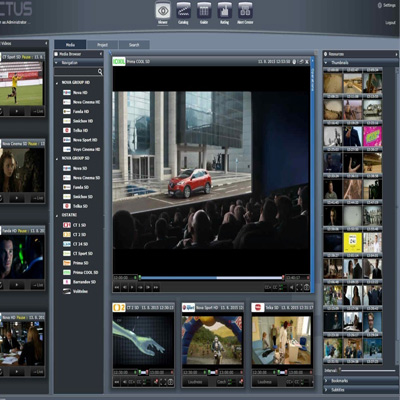
    MUMBAI: Hinduja Group’s headend-in-the-sky (HITS) digital service platform NXT Digital has installed the Actus broadcast monitoring platform.


    The recently launched HITS platform offers over 500 channels to the fast-growing television market in India.


    By implementing the latest version of Actus’s broadcast monitoring platform, NXT is being guaranteed that all IP-based channels are reliably recorded 24×7 and that whenever more channels are added; Actus’s scalable broadcast recording platform will be easily expanded. In order to comply with the current requirements, Actus has deployed Actus View to record and monitor the 350 IP-based channels, Actus Multitrak to support multiple audio tracks, Actus EncoderPro to save hardware resources, Actus Loudness to monitor audio levels, and Actus AlertCenter to provide NXT with real-time alerts for any audio or video issues.


    Grant Investrade MD Tony D’Silva said, “In the dynamic digital video world, we are assured that Actus Digital will not only fulfil our current requirements but also comply with future requirements that the digital world will dictate. Actus has vast experience with installations worldwide and we are confident that the platform will grow as our business expands constantly.”


    Actus was selected for this premier service after a rigorous four-stage RFP evaluation process conducted by Castle Media – Asian broadcast consultancy tasked with end-to-end programme management and delivery of the HITS project.


    “The Actus platform is scalable and modular, which makes the solution cost-effective by allowing GIL to implement only the modules required yet be assured that once additional requirements arise, Actus’s platform will provide us the solution,” added Castle Media executive director Vynsley Fernandes.


    Shaf Broadcast, Systems Integrator, implemented the solution. 


    “We have the knowledge base and experience to deploy Actus Digital’s solutions. The installation, implementation and integration of the Actus platform went fluently and complied with all of our high expectations. The Actus local team worked closely with Shaf engineers to make sure the system will be up and running and meet the high demands and tight time frames. I am assured Actus will provide an excellent platform to NXT Digital also in the future,” said Shaf Broadcast director P.R. Suresh. 


    “One of the challenges, beyond the installation of a large system, was the fastest-possible deployment that was required to meet the time frames of launching the digital rollout of NXT Digital services. In order to be sure that Actus would meet the tight time frames, we sent an Actus-trained local team to the customer’s site to prepare the site ahead of time. With good cooperation with Shaf, we optimized our recorders to take advantage of recent improvements in hardware and of a new version of Actus’s EncoderPro technology and were thus able to offer better performance than initially proposed for the same budget,” said Actus CEO Sima Levy. 

  • NAGRA powers Hinduja’s NXT Digital HITS platform in India

    NAGRA powers Hinduja’s NXT Digital HITS platform in India

    MUMBAI: Switzerland based Kudelski Group’s digital TV division NAGRA has powered the Hinduja Group’s new headend-in-the-sky (HITS) platform – NXT Digital in India.


    NAGRA’s anyCAST, OpenTV solutions and user interface are enabling NXT Digital. This makes it NAGRA’s first HITS platform in India, which is one of the fastest growing markets in pay-TV today, as the country continues the government-mandated digitisation process. According to a recent report by Media Partners Asia, the Indian pay-TV market is expected to grow by 11 per cent annually on average by 2018, with total pay-TV subscribers expected to grow from 65 million in 2013 to 165 million by 2018 and 180 million by 2023.


    NAGRA’s anyCAST content protection and OpenTV middleware solutions are enabling the HITS platform, which will provide backend operations to local and multi-system cable operators in India. NXT Digital offers a variety of packages and services including 500-plus MPEG 4-encrypted services featuring SD and HD channels along with value-added services like PVR and educational content.


    “Our new HITS platform gives regional cable operators access to an infrastructure that helps them deliver high-quality video services to a new generation of viewers. NAGRA has been a key partner in the process, providing the expertise and support expected of a pay-TV leader, as well as solutions that provide the right level of content protection, scale seamlessly and allow for flexible business models that are critical to our operators’ success as they kick off their new services,” said Hinduja Group subsidiary Grant Investrade managing director Tony D’Silva.


    “It is an honor to work with Grant Investrade and be a part of the digital TV transformation in India that is making access to digital TV services a reality for millions of people. This new platform makes it easy for local and regional cable operators to deploy new services without having to worry about the operational complexities that can come with installing their own system. And by leveraging NAGRA’s deployed, market-leading solutions, they are ensuring a high quality user experience that is not only highly secure but offers pay-as-you-grow models adapted to their strategy,” said NAGRA sales SVP Asia-Pacific Jean-Luc Jezouin.


    NAGRA’s anyCAST Security Services Platform, OpenTV middleware and user interface are ready-to-deploy solutions that enable of range of entry-level and advanced DTV services. They allow operators to leverage scalable, pay-as-you-grow business models with multiple set-top boxes and chipsets, and include an intuitive user interface adapted to India’s diverse population and languages.

  • NXT Digital ‘hits’ Indian market with total outlay of Rs 5000 crore

    NXT Digital ‘hits’ Indian market with total outlay of Rs 5000 crore

    NEW DELHI : After three and half years of struggle, Hinduja’s Headend In The Sky (HITS) platform NXT Digital finally got rolling with a total project outlay of approximately Rs 5000 crore. The mammoth investment will be utilised as the business continues to design and develop new products and services for a growing customer base as well as strive to enhance its own standards.


    Information and Broadcasting Minister Arun Jaitley officially launched the venture in the presence of Hinduja Group chairmanAshok Hinduja and Grant Investrade MD Tony D’Silva.


    Launching the platform, Jaitley said, “Multiple carriage technologies will provide customers more choice as to which technology platform to choose.”


    While Hinduja Ventures has set an initial budget of Rs 5000 crore for the project, the chairman is open to investing more if necessary. “We are here to aggressively back this initiative and if necessary we will invest double or triple the allocated budget. Last mile operators (LMOs) are the one who started the business by laying the first cable and this venture is for them,” Hinduja said.


    The HITS project will not only facilitate over 100 million homes go digital in Phase III & IV digitisation markets but will also raise the standards of quality of service. 


    To acquire the base model of a Cable Operators Premises Equipment (COPE), one has to pay Rs 10.60 lakh while the premium one can be acquired after a payment of Rs 14 lakh. The amount appears high for the LMOs but Hinduja said that the Group also has a finance group, which would help the LMOs. “The project has a lot of securities and the investment is certain to provide returns so it is a safe investment. We have insurance schemes for the operators so their investment is safe,” he added.


    According to D’Silva, the consumer will have to pay a maximum of Rs 50 per month. NXT Digital is presently equipped to beam up to 500 channels and this capacity can be raised to 1000. The earth station is in Sector 62 in Noida in the National Capital Region (NCR) of Delhi. NXT Digital has six transponders at present.


    D’Silva also noted that it was interesting that the last two phases of Digital Addressable Cable TV System (DAS) provided for only 32 per cent of the revenue though they would cover a much larger area.


    The DAS Phase III and IV areas, which are estimated to have more than 120 million home, are the prime focus of NXT Digital. To succeed in occupying 15 per cent of the market, the company will have to provide set top boxes (STBs) to 20 million home, which is a huge demand to supply. However, Hinduja is bullish about meeting the demand on time and optimistic that the platform will not face a situation where there will be shortage of boxes.


    NXT Digital is also positioning itself as a adopter of the government’s Make in India, Digital India and Skill India initiatives, which according to Hinduja was the byword for the Group. The LMOs in the DAS III and IV areas have to be skilfully equipped with modern technologies that NXT Digital will be bringing in.


    Asked about how his system was different from the already existing – NSTPL’s JainHits – Hinduja said that the aim of the Hinduja Group was to protect the LCOs because it was they who had built this industry in the late eighties. “Therefore, the LMO will not lose out in any way, will be fully in charge of his own company, and will have full freedom to operate in his own way,” he said.


    When queried as to why it had taken the Group three years to get a licence when there was no cap on HITS, Hinduja said, “Formalities take time.”


    He also said that wherever someone tries to bring in transparency in any system, there are objections. He was also conscious that there was competition in the field and this may even lead to some legal hassles, but his Group was prepared for everything.


    Hinduja said that he was conscious of the matter relating to NSTPL pending in TDSAT, which sought that broadcasters treat HITS players at par with multi system operators (MSOs). He said the NXT Digital viewpoint had been presented at the hearings.


    Senior Hinduja executive Aubin Das said that the NXT Digital platform also took efforts to curb the issue of piracy and if LMOs attempt to put on the channel of a broadcaster in the slots meant for local channels, it could be immediately traced and stopped.


    Commenting on the training and development initiatives Castlemedia director Vynsley Fernandes said, “We are travelling to every nook and corner of the country to skilfully equip and train people about our technological upliftment and it is a chain system. Around 200 people have been trained under a ‘Train the Trainer’ programme and they will train others. And we are not equipping them only about NXT Digital we are introducing them to the next generation.”


    D’Silva said that under NXT Digital, the LMO gets to continue their ownership, enter into broadcasting deals, do packaging and pricing according to market demands, acquire STBs at cheaper rates, run up to 16 local channels, and compete with direct-to-home (DTH) operators.


    He added that DTH was on Ku-Band, which got disturbed in rainy or inclement weather, but HITS being on C-Band will not be disturbed. Furthermore, the HITS headend was on ground while DTH had to depend on satellites. Furthermore, NXT Digital will be able to service both DAS and non-DAS areas.


    NXT Digital focused marketing and subscription drive in the Phase III & IV markets. The company has so far travelled across 400 districts in 20 states to contact and inform the cable fraternity there about its offerings. As of now it has 14 vans touring various parts of the country to give live demonstrations to LMOs and LCOs. 


    Welcoming the move, Maharashtra Cable Operators Federation president and task force member Arvind Prabhu said, “I would like to congratulate AP Hinduja, with this initiative he actually kickstarts the process of digitisation. Mr Hinduja thought about the last mile operators and came up with NXT Digital, which will help LCOs getting their due. The other HITS platform is providing the COPE at a cheaper price and that will be a challenge. The pricing that we got from them are really good but considering the fact that DAS III and DAS IV areas do not come under ratings I believe there can be further negotiation with the broadcaster. Overall I believe it’s a move for the LCOs.”


    LCO from Assam and Task Force member Md Iquebal Ahmed also welcomed the HITS venture. “Operators cannot afford headends and MSOs take total advantage of it and in that context, it’s a great initiative. But the content pricing needs to come out transparently. Affordable pricing is what we are looking forward to.”


  • Hinduja Ventures’ NXT Digital receives operating licence for HITS

    Hinduja Ventures’ NXT Digital receives operating licence for HITS

    MUMBAI: Grant Investrade Limited (GIL), a subsidiary of Hinduja Ventures, has crossed the final hurdle to start operations of NXT Digital – its headend in the sky (HITS) service. The company has received Wireless Operating License (WOL) from the Wireless Planning & Coordination Wing of the Ministry of Information & Communications Technology.


    The WOL is the final regulatory step before making HITS operational, in accordance with the terms and conditions stipulated in the Letter of Intent (LOI) issued by the Ministry of Information & Broadcasting to GIL last year.


    “We are delighted to confirm receipt of the WOL for us to commence operationalisation of the HITS service in India. The launch of NXT Digital is in line with the Government’s objective of making India ‘digital’ and we’re proud to be a part of this national initiative,” said GIL chairman AK Das.


    “NXT Digital has received an overwhelming response from the distribution fraternity in Phase III & IV markets in India. Our broadcast centre and our backend systems are fully operational; our broadcaster relationships have been formalised, we’ve already rolled out our COPE mini-headend systems and STBs and we’re ready to go ‘live’ shortly,” added GIL managing director Tony D’Silva.


    It may be recalled that the government recently ruled out the extension of the DAS phase III deadline of 31 December, 2015. In view of this, NXT Digital is being viewed as the enabler for the cable fraternity go digital as per government mandated standards and within the deadline.


  • Q1-2016: Cable TV in India – Sequential quarter revenues down, broadband shines

    Q1-2016: Cable TV in India – Sequential quarter revenues down, broadband shines

    Indian Cable TV is a long haul work-in-progress is what we had said last quarter. The results of the four sample companies in the quarter ended 30 June, 2015 (Q1-2016) in that report seem to endorse this fact. All four companies comprising the big three – Hathway Cable and Datacom Limited, Den Networks Ltd, Siti Cable Network Limited and the minnow – Ortel Communication Limited reported a quarter on quarter (QoQ) drop in total income from operations (TIO or revenue) in the current quarter. As expected, broadband subscribers and revenue continues to grow.

    Note: (1) 100,00,000 = 100 lakh = 10 million = 1 crore.

    (2) Some figures are approximate.

    (3) Generally other income has not been factored in for EBIDTA figures in the report.

    Performance

    Though Den Networks’ and Hathway’s YoY results in the current quarter deteriorated, QoQ, both performed better, albeit both the cable companies reported losses. Siti Cable’s loss in Q1-2016 increased YoY and QoQ, and though regional player Ortel returned a profit in the current quarter as compared to a loss in Q1-2015, its Q1-2016 profit was less than half the profit reported in the immediate trailing quarter.

    Over the last few quarters, Den Networks’ financial performance has shown a marked decline. From a company that reported profit after taxes, it has started reporting a loss. Without considering other income, the company reported a negative EBIDTA of Rs 4.67 crore as compared to the operating profit of Rs 57.16 crore in Q1-2015 and a higher operating loss of Rs 5.97 crore in the immediate trailing quarter. However, the company’s Cable TV segment reported a higher QoQ EBIDTA in Q1-2016 of Rs 18 crore (6.9 per cent margin) as compared to the Rs 14 crore (5.3 per cent margin) in Q4-2015, but a lot lower than the EBIDTA of Rs 69 crore (27 per cent margin) in Q1-2015.

    Hathway’s EBIDTA in the current quarter declined 25.4 per cent to Rs 32.73 crore (12.8 per cent margin) as compared to the Rs 43.87 crore (17.5 per cent margin) in the corresponding year ago quarter but was 5.7 per cent more than the Rs 30.98 crore (11.5 per cent margin) in the immediate trailing quarter.

    Siti Cable’s EBIDTA including other income for Q1-2016 increased 5.1 per cent to Rs 38.1 crore as compared to the Rs 36.26 crore in Q1-2015 and was 18.7 per cent more than the Rs 32.11 crore in Q4-2015.

    “Our commitment to improving operational efficiency and streamlining operations continues, leading to EBITDA growth of 18.7 per cent and margin expansion by 501 bps QoQ,” explains Siti Cable executive director and CEO VD Wadhwa.

    Ortel’s EBIDTA in the current quarter improved by 24.1 per cent to Rs 10.84 crore (26.7 per cent margin) as compared to the Rs 8.73 crore (22.1 per cent margin) in Q1-2015, but declined 34.5 per cent as compared to the Rs 16.55 crore (36.9 per cent margin) in the immediate trailing quarter.

    Ortel president and CEO Bibhu Prasad Rath said, “Overall growth was delivered on the back of steady contribution from Cable TV and Broadband segments supported by continued momentum in the Infrastructure Leasing segment. Significant growth in subscriber base, deeper penetration, enhanced product offerings and a strong team, should enable us to notably improve our performance going forward.”

    Total Income from Operations

    Please refer to the figure below. Den Networks, the company with the largest TIO among the four, reported TIO at Rs 265.60 crore, 11.1 per cent less than the Rs 298.81 crore in Q1-2015 and 1.7 per cent lower than the Rs 270.30 crore in Q4-2015. The company’s loss in the current quarter at Rs 51.89 crore was lower than the Rs 61.15 crore reported in the immediate trailing quarter Q4-2015. The company had posted a profit of Rs 1.12 crore (0.4 per cent margin) in the corresponding year ago quarter – Q1-2015.

    Though Hathway reported 5.7 per cent growth in standalone TIO in Q1-2016 to Rs 264,41 from Rs 250.11 crore in Q1-2015 QoQ, its TIO was 2.1 per cent lower than the Rs 270.03 crore in Q4-2015. Hathway’s loss in the current quarter widened to Rs 43.91 crore as compared to the Rs 0.93 crore in Q1-2015, but was considerably lower than the Rs 76.99 crore in Q4-2015.

    Siti Cable reported TIO of Rs 228.09 crore in Q1-2016, which was 9.1 per cent higher than the Rs 209.02 crore in Q1-2015, but was 10.9 per cent lower QoQ than the Rs 256.01 crore in Q4-2015. The company reported a higher loss of Rs 37.11 crore in Q1-2016 as compared to the loss of Rs 31.67 crore and a loss of Rs 34.13 crore in Q4-2015.

    Ortel reported 20.5 per cent growth in TIO at Rs 40.60 crore in Q1-2016 as compared to the Rs 33.69 crore in Q1-2015, but 9.6 per cent lower than the Rs 44.91 crore in Q4-2015. Ortel reported profit after tax (PAT) of Rs 2.44 crore (six per cent margin) as compared to a loss of Rs 1.16 crore in the corresponding year ago quarter, but Q1-2016 PAT was less than half (lower by 56.8 per cent) the PAT of Rs 5.65 crore (12.6 per cent margin) in the immediate trailing quarter.

    Cable TV (Video) Subscription Revenue

    Subscription revenue in the current quarter dropped QoQ in the case of Siti Cable and Hathway, while both Den Network and Ortel saw an increase in YoY and QoQ subscription revenue. At the same time, all the companies have reported higher digitisation numbers in DAS and non-DAS areas. Siti Cable and Ortel have reported a gain in subscription numbers as well. While Den Networks and Hathway have reported flat or slightly higher digital as well as analogue average revenue per user (ARPU), Ortel has reported a slight drop in both ARPUs. 

    According to company sources, Siti Cable, which is the biggest player among the four sample companies in terms of cable TV subscription revenue, had flat QoQ ARPUs in Q1-2016, while YoY ARPUs showed double digit growth. The company claims that its subscriber base has increased by two lakh (all digital) to 107 lakh as it expanded its footprint by entering into 12 new towns across India as a part of the ongoing voluntary digitization process in order to be compliant with the DAS phase III digitisation deadline.

    Despite the flat QoQ ARPUs and higher subscription numbers, Siti Cable’s cable TV subscription revenue fell QoQ because the company had initiated strict measures against erring LCOs and had switched off signals to the extent of about four lakh cable TV consumers, as per industry sources.

    “During the quarter, we have further tightened our credit control measures and started taking strict actions against defaulting operators, which shall result into improved credit discipline and saving in operating cost,” revealed Wadhwa. A source told Indiantelevision.com that Siti Cable’s strict measures seem to have worked and signals have been resumed to the subscribers, but that it would take time to reflect the improved numbers in its financials.

    Ortel’s Rath added, “I am also pleased to share that over and above the 542,217 RGUs (revenue generating users) as on 30 June, 2015, we have signed buy out agreements with multiple LCOs with total estimated RGUs of 33,000, which would be integrated into Ortel’s last mile network going forward. So we remain on track and are confident of achieving our target of one million RGUs by March 2017 backed by our LCO buy out strategy and focus on organic growth both in broadband and cable TV.”

    Pay channel Costs

    Please refer to the figure below that represents the Cable TV costs paid by the four sample companies. 

    The big three reported a QoQ fall in pay channel costs, while in the case of Ortel, pay channel costs rose. This does not mean that a la carte has become a reality and the multi-system operators (MSOs) are only paying for what their subscribers are paying. It’s just that this quarter, balancing amounts have been paid to a broadcast aggregator, since excess payments had been made until Q4-2015. 

    Diverting from the performance for a bit, a source from an MSO says, “As a matter of fact, it’s the big broadcasters that are resisting a la carte. A la carte will affect their overall advertisement revenues for packaged deals across the multiple channels within their fold.”

    Internet subscription revenue

    This is one avenue that most cable companies are looking at as their business and revenue growth alternative. Internet ARPUs in India are much higher – to the extent of 3 to10 times the ARPUs from cable television. All the four sample players in this article reported YoY growth. The big three- Hathway, Den and Siti Cable also reported QoQ revenue growth, while Ortel’s internet subscription revenue remained flat. Higher subscription numbers, higher ARPUs brought in the accelerated revenue growth for Hathway, Den and Siti Cable. Typically, broadband ARPUs for the big three were in the range of Rs 750 in Q1-2016 as Rs against 650-700 in Q1-2015 and Rs 720-750 in the previous quarter.

    Among the four, Hathway with an initial higher internet subscriber base in excess of four lakh plus, reported a growth of 50,000 subscribers to bring its total subscriber numbers to 4.6 lakh in Q1-2016. Already its internet revenue subscription has a reasonably big share in its overall revenue pie. Comparatively, the other three have internet subscribers than number in just tens of thousands, though all have reported reasonable YoY and QoQ growth in subscribers.

    Ortel reported a slight depletion in ARPUs and hence the flat internet subscription revenue despite a higher QoQ subscriber base. Ortel’s broadband RGUs in the current quarter grew 4.1 per cent to 60,900 from 58,519 in Q4-2015. Ortel also launched up to 50 Mbps DOCSIS 3.0 Broadband Internet in Odisha. The company’s broadband ARPUs in the current quarter also declined by Re 1 to Rs 393 from Rs 394 in Q4-2015.

    End Points

    At present, most MSOs have two separate arrangements with broadcasters – one for Digital Addressable System (DAS) areas and another for non DAS areas. Recently the Essel Group that operates both carriage platforms – DTH though Dish TV as well cable TV through Siti Cable – formed a common entity called “COMNET” to help synergize strengths of both entities in dealing with broadcasters. Siti Cable says that the primary reason for forming this venture was to ensure that consumers have access to quality content at affordable prices. This move would assist in keeping content cost in consonance with consumer ARPUs and market realities. 

    Players across mature markets such as the US continue to report a fall in video subscribers – to that extent that most companies there have higher broadband subscribers than video subscribers. Such a scenario is not probable in the near future in India, but cable TV players do face competition from wireless internet players and mobile companies as well as from other devices as a mode of entertainment rather than the idiot box. Carriage or placement fees could continue as bargaining currency in the near future.

    Once a la carte becomes a reality, to some extent, one could infer that if the pay channel costs are down, it’s because subscribers have used the option, and not that the player has lost more subscribers than it gained. In theory, DAS has made it possible for carriers to pay broadcasters if and when the subscriber subscribes for pay channels. It now remains to be seen if the players in the industry allow the theory to be put into practice. Cable TV subscription revenues and ARPUs could fall if players don’t play it right.

    The response to the Hinduja’s HITS (headends in the sky) platform from local cable operators (LCOs) has been tremendous, if one were to go by initial reports. The DTH industry has started making inroads into DAS phase III and IV areas and could grab more than the 30 to 40 per cent of the subscribers that it did in phase I and phase II.

    As has been pointed out by industry experts, just the seeding of set top boxes (often non-BIS compliant STBs) does not mean implementation of DAS as it was truly meant to be. It can be safely reiterated that there’s a lot of work to be done by the industry.
  • NXT Digital organises roadshows for LMOs across 19 cities

    NXT Digital organises roadshows for LMOs across 19 cities

    MUMBAI: Hinduja’s headend in the sky (HITS) platform NXT Digital is looking at a smooth rollout when it launches by this month end. In keeping with the launch timeline, the platform is talking to the last mile owners (LMOs) across the country directly to help them understand the functioning of the system as well as the advantages of moving from the current multi system operator (MSO) to the HITS platform.


    Over the last 11 days, NXT Digital has covered 19 cities including Delhi, Mumbai, Goa, Bhubaneswar and Kolkata among others through its roadshows. The final destination will be Visakhapatnam, where the HITS player will meet city LMOs on 10 August. 


    Through the initiative, NXT Digital has met close to 6000 LMOs so far. Additionally, as part of the training, the HITS player will run a live demo van covering 10 states. 


    As reported earlier by Indiantelevision.com, NXT Digital has signed up as many as one million analogue TV households in phase III markets in a span of three weeks.


    Grant Investrade Limited managing director Tony D’silva said, “The fraternity is extremely excited about NXT Digital. In just over three weeks since NXT Digital was announced, it has already been signed up to reach one million analogue TV households in phase III markets through LMOs and MSOs who have opted for our services.”


    “NXT Digital will empower and enable the distribution fraternity including LMOs and MSOs to offer a world of exciting digital services to their end-subscribers in all the analogue households across markets. Crucially, NXT Digital will not only help the LMOs and MSOs go digital as per government mandated standards and within the set deadlines, but, throughout the process, help them be independent and retain the ownership of their network,” added D’silva.