Tag: NTO 2.0

  • NTO 2.0: Sun TV Network publishes new RIO

    NTO 2.0: Sun TV Network publishes new RIO

    Mumbai: Sun TV Network has filed its reference interconnection offer (RIO) issued under telecommunications (broadcasting and cable) services interconnection (addressable systems) regulations, 2017 for all distribution platforms. The new RIO will be effective from 6 December onwards. 

    The tariffs for TV channels mentioned in the RIO adhere to the Telecom Regulatory Authority of India (Trai) new tariff order (NTO) 2.0.

    The network operates 23 pay-TV standard definition channels, eight high definition pay channels, and two free to air channels. It is also offering 21 bouquets. Tamil general entertainment channel (GEC) Sun TV, Telugu GEC Gemini TV, and Kannada GEC Udaya TV tariffs are greater than Rs 12.

    As per the new tariff regime 2.0 order, Trai has mandated that a channel’s MRP must not exceed Rs 12 for it to be included in any bouquet.

    The implementation of the new tariff order 2.0 is on hold as broadcasters under the aegis of the Indian Broadcasting Foundation (IBF) have challenged the Trai order in the Supreme Court. The final hearing on the matter is scheduled for 30 November.

  • Trai vs broadcasters: Impact could be larger than expected

    Trai vs broadcasters: Impact could be larger than expected

    Mumbai: The TV industry is eagerly awaiting the outcome of the court battle between the Telecom Regulatory Authority of India (Trai) and TV broadcasters led by the Indian Broadcasting Foundation (IBF) on the new tariff order (NTO) 2.0 case that will be heard on 30 November.

    The decision taken by the Supreme Court in the final hearing will significantly alter the dynamics of the TV broadcast industry that have been in place for more than a decade. The conflict essentially from Trai’s point of view is the fight for consumer’s choice that is being taken away by broadcasters.

    There are 346 pay-TV channels available to consumers, out of which leading broadcasters own and operate 255 pay channels. It’s standard industry practice to offer their pay channels in a bouquet that has a significant discount. This way the broadcasters can cross-subsidise their channels in a way that even a weak channel has an opportunity to get viewership.

    There are driver channels whose viewership is self-driven and niche channels that have a small but dedicated viewership. Trai’s contention is that broadcasters are pushing these ‘extra’ channels on to consumers to increase their revenues from advertising which accounts for two-thirds of their overall revenues.

    A senior expert in the broadcasting industry remarked that this view of Trai does not consider the complexities of the sector and understand what the broadcast consumer wants. “India is a price-sensitive market – we want everything to be free or at the cheapest but, at the same time, the best-in-class service,” he said requesting anonymity.

    There’s always going to be content on TV that the consumer doesn’t want to watch. On linear TV if the consumer wants to watch different content, he/she may switch the channel and watch something else. That’s why it makes sense for the consumer to have the option of multiple channels available.

    With the agenda of allowing consumers to pay only for the channels that they want, Trai mandated that broadcasters announce a-la-carte tariffs of their channels. To ensure that broadcasters do not entice consumers into opting for bouquets that are heavily discounted it created provisions in the amendment order to counter the practice. It mandated that a channel must have MRP no greater than Rs 12 to be included in a bouquet. It also prescribed a linkage between the a-la-carte price and bouquet by mandating that the sum of the a-la-carte price of channels in a bouquet will not be more than 1.5 times the bouquet price.

    Whatever consequence Trai had intended, the outcome of the NTO 2.0 has been very different. While the case is being fought in the SC, on 15 October broadcasters announced their reference interconnection offers (RIOs) and new channel rates adhering to the regulator’s order. If the consumer chooses to keep the same number of channels, then his/her content costs are likely to go up when the new tariffs come into effect on 1 December. They have listed the MRP price of their popular channels greater than Rs 12 which means that none of these channels will be a part of the broadcaster’s bouquets.

    There isn’t enough data to predict the resulting consumer behaviour after the implementation of the amendment order. The only example of a-la-carte implementation is the conditional access system (CAS) in 2007. CAS is a digital mode of transmission of TV channels via set-top-box (STB) and was rolled out in select metros – Mumbai, Delhi, Kolkata, and Chennai.

    “When CAS was implemented on a small population the consumer had opted for about 5-15 pay channels,” said a senior official from a leading cable operator on condition of anonymity.

    Note that this was a period when Star India was offering about eight channels versus 76 it is offering today. “Back then you had to offer every channel a-la-carte and Trai had fixed a ceiling price for pay channels at Rs 5,” he added.

    NTO 2.0 implementation will have an impact on a much larger scale. There is a huge economic divide between TV viewing audiences in India. As the official from the cable company puts it, “On the one hand, you have a consumer who decides to be economical and only watch FTA channels. We estimate that there are 30-50 million audiences who only watch Doordarshan on DD Free Dish. On the other hand, you have consumers who are ready to pay Rs 2, 000 to get an OTT subscription including Netflix, Prime Video, Disney+ Hotstar, SonyLIV, ZEE5, and Voot and they will have access to all their TV content as well. The rest of the consumers fall in between these two extremes.”

    So, what will be the consequence of broadcasters pulling their MRP channels out of the bouquet? “Personally, I have yet to see a car (niche channels) run without an engine (driver channels)” said the cable operator spokesperson. “Till date, driver channels have taken other channels to the same viewership level.”

    According to Trai, broadcasters are exploiting the freedom afforded to them by the NTO 2.0 provisions for a-la-carte pricing and have arbitrarily hiked the prices of their channels and that the new tariffs do not reflect consumer demand. The Tamil Nadu Digital Cable TV Operators Association has gone as far as to send a legal notice to Trai demanding that it intervene and ask broadcasters to reduce channel prices. It claimed that the new tariffs may inflate consumer bills by 100-200 per cent.

    “The distributed platform operators (DPOs) have begrudged broadcasters who are not only able to launch more channels, but they also get advertisement revenue. This has led to a corporate rivalry where unfortunately Trai has lent an ear to DPOs without understanding what’s best for the consumer and the larger creative ecosystem,” said an expert from the broadcast business.

    “The success of over-the-top platforms proves that without an overzealous regulator and fragmented/unruly intermediary, the content creators are able to know the pulse of their audience and cater to their needs and tastes. Additionally, content and carriage are neatly differentiated with transparency and accountability,” he added.

    OTT platforms have a mix of blockbuster and long-tail content that they offer to consumers. Most consumers come to OTT platforms to watch their blockbuster content, and some may also enjoy their longtail content. The OTT player can continue making enormous investments in fresh content because of the steady monthly subscription fee that it charges the viewer.

    It’s clear that the implementation of the NTO 2.0 based on the tariffs announced by leading broadcasters will essentially increase content costs for the consumer. The consumer must either opt for fewer channels to keep TV bills at the same levels or pay a higher cost in subscriptions. Trai has said that it will keep an eye on the industry and ensure that consumer bills do not go up. 

  • Broadcasters exploiting NTO 2.0 provisions for a-la-carte pricing: Trai

    Broadcasters exploiting NTO 2.0 provisions for a-la-carte pricing: Trai

    Mumbai: The Telecom Regulatory Authority of India (Trai) on Friday said that some broadcasters are exploiting the freedom given for al-a-carte pricing of TV channels and warned that it will keep a strict watch on the industry and not shy away from acting in the larger interest of consumers and the industry.

    With an increase in TV channel subscription rates impending, the Trai said in a statement that the new tariffs announced by leading broadcasters reflects their intention to raise the prices of driver and popular channels, according to a report by PTI.

    These driver channels include general entertainment channels (GECs) and sports channels. The regulator refrained from naming any broadcaster but alluded that some leading broadcasters had hiked channel tariffs arbitrarily.

    The regulator claimed that the prices that some of the broadcasters have announced for their channels are unsustainable, are not demand driven or market driven prices and are against the interest of the consumer.

    This price hike has been announced in the garb of complying with the NTO 2.0, which is not true and rather an attempt to defeat the purpose of NTO that has already benefited the consumer to a large extent, stated Trai.

    Trai further said, “A sustained and misleading campaign is being run to create an impression that the impending price increase is due to the new tariff regime (NTO) 2.0. It is being publicised that any/every consumer who opts for top GECs or sports channels will end up paying an extra amount of Rs 100,” according to the PTI report.

    The purpose of the amendments to regulations for broadcasting and cable services sector was to ensure that no service provider corners undue gains and profiteers at the expense of consumers, as per Trai. It pointed out, “the channel pricing has remained under the prescribed ceiling for 15 years since 2004.”

    Under the provisions of the new framework, broadcasters may freely fix the price of their television channels with certain conditions applicable for inclusion into a bouquet. The regulations state that a channel MRP greater than Rs 12 cannot be included into a bouquet. The framework should result in reduced bills for the consumers, said the regulator.

    The implementation of NTO 2.0 will lead to an era of transparent tariffs and usher in better channel content at the most competitive prices, stated Trai. The regulator said that it is conscious of the time required to implement necessary changes to be carried out to incorporate the considered choices of 150-160 million pay TV households.

  • NTO 2.0: Times Network publishes new RIO

    NTO 2.0: Times Network publishes new RIO

    Mumbai: Times Network has published its reference interconnection offer (RIO) issued under telecommunications (broadcasting and cable) services interconnection (addressable systems) regulations, 2017 for all distribution platforms. The new RIO will be effective from 1 December onwards. 

    The tariffs for TV channels mentioned in the RIO adhere to the Telecom Regulatory Authority of India (Trai) new tariff order (NTO) 2.0.

    Times Network owns and operates 13 channels including its flagship news channels Times Now, ET Now, Mirror Now, Times Now World HD, Times Now Navbharat HD, and ET Now Swadesh. Its entertainment offering includes music channel Zoom, English film channels Movies Now, Movies Now HD, Romedy Now, MN+ HD, MNX, and MNX HD. The broadcaster is offering eight bouquets under the new RIO.

    The implementation of the new tariff order 2.0 is on hold as broadcasters under the aegis of the Indian Broadcasting Foundation (IBF) have challenged the Trai order in the Supreme Court. The final hearing on the matter is scheduled for 30 November.

  • NTO 2.0: MSOs asks Trai to reject new RIOs published by broadcasters

    NTO 2.0: MSOs asks Trai to reject new RIOs published by broadcasters

    Mumbai: The Tamil Nadu Digital Cable TV Operators Association has  sent a legal notice to the Telecom Regulatory Authority of India (Trai) asking it to reject the new reference interconnection offers (RIO) published by broadcasters. The Association has also sought Trai’s intervention in asking broadcasters to reduce channel prices as it “will cause irreparable loss to the entire industry”.

    Major broadcasters including Disney Star India, Zee Entertainment Enterprises Ltd, Sony Pictures Networks India, and TV18 Broadcast Ltd, had published their new RIOs over the weekend starting from 15 October (Dussehra) with the new a-la-carte pay channel and bouquet pricing that adheres to Trai’s new tariff order (NTO) 2.0.

    The broadcasters had hiked the prices of their driver channels and pulled them from all their bouquets as Trai’s NTO 2.0 provisions mandated an MRP cap of Rs 12 for any pay channel to be included in a bouquet. The broadcasters are currently battling the Trai order in the Supreme Court stating that some of its provisions are arbitrary and outside the purview of the regulator. The final hearing is on 30 November.

    In its notice to Trai, the Association has stated that “major broadcasters have issued their RIOs where it can be calculated that majorly subscribed channels by the consumers will be inflated by 100 per cent to 200 per cent.”

    It added, “It is pertinent to mention here that during the situation when over-the-top service providers are trying to make their services more affordable to increase their subscriber base, the service providers of this industry will have to increase their rates substantially which will certainly cause loss of subscriber base of the local cable operators (LCOs) and multi-system operators (MSO).”

    These “excessive prices” will undoubtedly hurt the subscriber base of cable operators whose subscribers come from the rural areas of the country where income levels are comparatively lower. The MSO mentioned that any regulation/direction/order implemented by Trai should lead to the growth and development of service providers and consumers.

    “It is the contention of the Tamil Nadu Digital Cable TV Operators Association that the RIO published by Disney Star India has an illegal clause that requires MSOs to “continue the channels on the old LCNs and they cannot change it”. If new RIO is being asked to be implemented, then all its terms are liable to be renegotiated and the broadcaster cannot favourably keep the clauses of the old RIOs,” it said.

  • TV18 Broadcast publishes new RIO adhering to NTO 2.0

    TV18 Broadcast publishes new RIO adhering to NTO 2.0

    Mumbai: TV18 Broadcast Ltd has published its reference interconnection (RIO) offer issued under telecommunications (broadcasting and cable) services interconnection (addressable systems) regulations, 2017 for all distribution platforms. The new RIO will be effective from 1 December. 

    The tariffs for a-la-carte channels and bouquets published in the RIO adhere to the Telecom Regulatory Authority of India (Trai) new tariff order (NTO) 2.0.

    Viacom18 network channels including their flagship Hindi GEC Colors, Kannada GEC Colors Kannada both SD and HD will be priced greater than Rs 12. As per NTO 2.0, Trai has mandated that a channel’s MRP must not exceed Rs 12 for it to be included in any bouquet. The aforementioned channels will not be part of any of the 39 bouquets offered by the broadcaster.

    The implementation of the new tariff order 2.0 has been halted as broadcasters under the aegis of the Indian Broadcasting Foundation (IBF) have challenged the Trai order in the Supreme Court. The final hearing on the matter is scheduled for 30 November.

  • NTO 2.0: Zeel announces new a-la-carte channel and bouquet pricing

    NTO 2.0: Zeel announces new a-la-carte channel and bouquet pricing

    Mumbai: Zee Entertainment Enterprises Ltd (Zeel) has released its new a-la-carte channel and bouquet pricing in line with the Bombay high court order dated 30 June 2021 with regard to new tariff order (NTO) 2.0.

    “The said pricing is being released without prejudice to Zeel’s rights and contentions under all petitions pending adjudication before the Supreme Court w.r.t. new tariff order (NTO) 2.0,” said a Zeel spokesperson.

    The new channel rate card will be effective from 1 December.

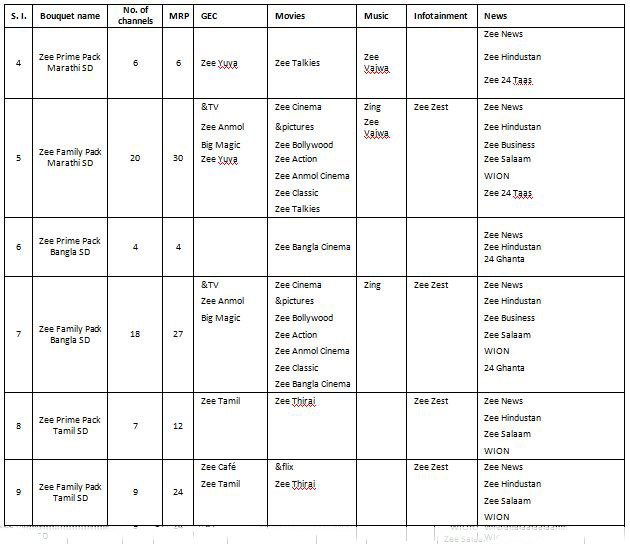
    According to the channel rate card, Zeel standard definition channels including Hindi GEC Zee TV, Marathi GEC Zee Marathi, Bengali GEC Zee Bangla, Odia GEC Zee Sarthak, Telugu GEC Zee Telugu, Kannada GEC Zee Kannada have been priced greater than Rs 12.

    Among its high-definition channels, Zee TV HD, Zee Marathi HD, Zee Bangla HD, Zee Tamil HD, Zee Telugu HD, Zee Cinemalu HD, and Zee Kannada HD also have an MRP greater than Rs 12.

    As per new tariff regime 2.0 order, the Telecom Regulatory Authority of India (Trai) has mandated that a channel’s MRP must not exceed Rs 12 for it to be included in any bouquet. The aforementioned channels will not be part of any of Zeel’s 26 bouquets.

    “We are confident that post implementation of NTO 2.0, Zee channels will continue their growth momentum across markets and create higher value for the company,” said Zeel president – business for South Asia Rahul Johri.

    “The new pricing regime in 2019 brought in a major shift in the way television was consumed in India,” said Zeel chief revenue officer – affiliate sales Atul Das. “On one hand, it brought in transparency about MRP of channels, while on the other hand it offered freedom to consumers to select channels they wish to watch. With NTO 2.0, consumers will get even more flexibility in the selection of channels.”

    “We will continue to provide multiple bouquets to consumers across the country at different price points. Premium English channels like Zee Café and &flix will continue to be available in a separate bouquet. Each bouquet constitutes a mix of channels, including GEC, movies, news, music and lifestyle genres. We look forward to working with our Distribution Platform Operators (DPO) partners for a smooth transition,” he added.


  • SPNI publishes new RIO effective from 1 December

    SPNI publishes new RIO effective from 1 December

    Mumbai: Sony Pictures Networks India (SPNI) has published its new reference interconnection offer (RIO) issued under telecommunications (broadcasting and cable) services interconnection (addressable systems) regulations, 2017 for all distribution platforms.

    The RIO is subject to the final outcome of the special leave petition filed by the company before the Supreme Court. The new channel rate card will be effective from 1 December.

    According to the rate card, SPNI channels including Hindi GECs Sony Sab, SET, English sports channels Sony Ten 1, Sony Ten 2, and HD channels SET HD, Hindi movie channel Max HD, Sab HD, sports channels Ten 1 HD, Ten 2 HD, Ten 3 HD, Six HD, and Telugu and Tamil sports channel Ten 4 HD have an MRP greater than Rs 12.

    As per the new tariff regime 2.0 order, the Telecom Regulatory Authority of India (Trai) has mandated that a channel’s MRP must not exceed Rs 12 for it to be included in any bouquet. The aforementioned channels will not be part of any of the 12 bouquets offered by SPNI.

    The implementation of the new tariff order 2.0 has been halted as broadcasters under the aegis of the Indian Broadcasting Foundation (IBF) have challenged the Trai order in the Supreme Court. The final hearing on the matter is scheduled for 30 November.

  • SC posts the final hearing on NTO 2.0 to 30 November

    SC posts the final hearing on NTO 2.0 to 30 November

    New Delhi: The Supreme Court has posted the final hearing on a bunch of petitions filed against the Bombay HC order regarding the implementation of the New Tariff Order (NTO) 2.0 to 30 November. In the meantime, the court has also asked the Counsel of all parties to file their written submissions before 12 November.

    When the matter was last taken up for hearing on Friday, senior advocate Mukul Rohtagi appearing on behalf of the Indian Broadcasting and Digital Foundation (IBDF) put forward brief arguments based on the rejoinder filed previously by the Indian Broadcasting and Digital Foundation (IBDF). However, due to paucity of time, the arguments could not be concluded.

    The Indian Broadcasting Foundation, an umbrella organisation of private TV broadcasters and a couple of other private channels had moved the SC in July against the Bombay high court judgment which had upheld the constitutionality of the NTO 2.0. According to the broadcasters, the new tariff order “impinges” on the broadcasters’ fundamental right of freedom of speech and expression under Article 19(1)(a) of the Constitution

    The NTO 2.0 passed by the Telecom Regulatory Authority of India (Trai) in January 2020 sought to cap the pay channel price at Rs 12 from the existing Rs 19. The move was vehemently opposed by the broadcasters, who challenged the order as “arbitrary and in violation of their fundamental right”, who moved the Bombay HC against its implementation.

    However, on 30 June, the Bombay HC had upheld the constitutional validity of NTO 2.0, but partly struck down the second provision of the twin conditions as “arbitrary”. As per the second provision, the a-la-carte rates of each pay channel (MRP), forming part of a bouquet, shall in no case exceed three times the average rate of a pay channel of the bouquet of which such pay channel is a part.

  • Twin conditions ensure broadcasters do not engage in ‘perverse’ pricing: TRAI

    Twin conditions ensure broadcasters do not engage in ‘perverse’ pricing: TRAI

    Mumbai: The twin conditions introduced in the New Tariff Order (NTO) 2.0 seek to ensure that broadcasters do not engage in “perverse pricing”; that consumers do not get a raw deal; and that choices offered by and to all market participants remain real. Both conditions are important in their own ways, observed Telecom Regulatory Authority of India (TRAI).

    The regulator made these statements in its counter-affidavit submitted to the Supreme Court quashing the writ petitions by the Indian Broadcasting Foundation (IBF) and other broadcasters to halt the implementation of NTO 2.0.

    The twin conditions introduced in the NTO 2.0 seek to discourage unfair bundling, stated TRAI. The first condition prescribes that the aggregate a-la-carte (MRP) prices of channels in a bouquet must not be more than 1.5 times the bouquet price, hereafter referred to as the “Aggregate Test”. So, if a bouquet has five channels A, B, C, D, and E (with their individual a-la-carte) and a bouquet price of X, the total/aggregate of A+B+C+D+E should not be more than 1.5 times X.

    The second condition, which alone has been struck down by the Bombay high court judgement, states that the MRP of any individual channel in a bouquet, i.e., its a-la-carte price, should not exceed three times the average MRP of a pay channel in that bouquet, hereafter referred to as the “Average Test”.

    TRAI alleges that broadcasters want to maximize their advertising revenue and hence are bundling their popular channels along with less popular channels to claim higher subscription and advertising revenues. The high-demand channels that do not need to be pushed, henceforth called driver channels, are bundled with those channels in which consumers otherwise have no interest.

    “In a large number of cases bouquet prices are the same as the a-la-carte price of the driver/popular channel. In many cases, the bouquet price artificially has reached such perversity that the bouquet price is cheaper than the driver channel in it,” observed TRAI.

    This perverse pricing compels the consumer to pick a bouquet over a-la-carte channel not by choice but out of compulsion, it alleged. 

    In a prior hearing, SC expressed three concerns with NTO 2.0 order: a) Whether the “Average Test” in the twin conditions formed a part of the pre-consultation process b) Are broadcasters and DPOs being treated equally c) Is “Average Test” severable from “Aggregate Test”.

    Referring to a) TRAI responded, “Both twin conditions were fully deliberated on prior to making of the 2020 framework. There is ample correspondence between TRAI and the broadcasters concerning the implementation of the twin conditions. Even the Telecom Disputes Settlement and Appellate Tribunal (TDSAT) has found broadcasters to be in violation of such twin conditions prescribed by TRAI in the past, and held that all reference interconnect offers had to be in consonance with those conditions.”

    TRAI denied discriminating between broadcasters and DPOs stating that there are exhaustive notes on the subject matter that point to the contrary.

    Referring to c) TRAI responded, “The 2020 framework seeks to address two major issues arising out of the formation of the bouquet by broadcasters. The first concerned heavy discounting of bouquet prices, and the second related to ‘pushing’ of unwanted channels to consumers.”

    “TRAI is duty-bound to resolve both issues, in order to safeguard the interest of all service providers and consumers,” it said. 

    The next hearing will be held on Tuesday 7 September.