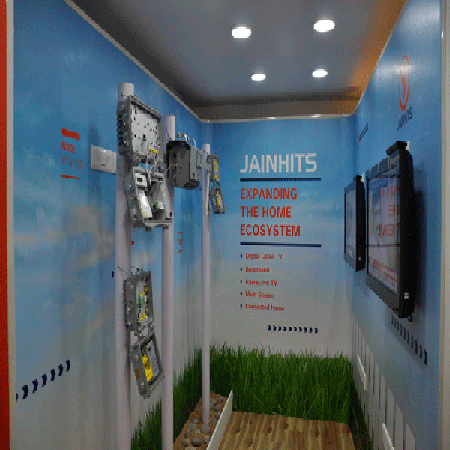
Tag: NSTPL

  • TDSAT rejects IBF plea for more time to sign RIOs with NSTPL saying HITS players get equal status with pan-India MSOs

    TDSAT rejects IBF plea for more time to sign RIOs with NSTPL saying HITS players get equal status with pan-India MSOs

    NEW DELHI: An application by the Indian Broadcasting Foundation seeking extension of time for its members to sign reference interconnect offers agreements with the Noida Software Technology Park Ltd (NSTPL)  has been turned down by the Telecom Disputes Settlement and Appellate Tribunal.  

    In a landmark judgment expected to have far reaching consequences on the Indian broadcasting industry, TDSAT had on 7 December last said that headend-in-the-sky (HITS) players should be treated on the same level as pan-India multi-system operators (MSOs) for commercial purposes.

    In its judgment on a petition filed by the NSTPL against Media Pro and others, the tribunal said its judgment would come into effect from 31 March 2016 by which time it hoped that the relevant reference interconnect offers will be revised wherever necessary.

    Apart from the IBF, some television channels had also filed applications seeking an extension, and the tribunal had addressed certain questions to the Telecom Regulatory Authority of India in this connection.

    In its order, chairman Aftab Alam and members Kuldip Singh and B B Srivastava said after hearing TRAI counsel Saket Singh on the questions addressed to the authority, “We take it to mean that TRAI does not wish any extension of the suspension of the judgment”.

    Answering the main of the four questions, Singh had told the Tribunal that the consultation paper dated 29 January 2016 under the caption ‘Tariff issues relating to TV services’ was part of an ongoing process which is undertaken by TRAI from time to time based on its assessment of the relevant issues in the sector. The exercise is undertaken independently though it may cover some of the issues highlighted in the tribunal’s judgment dated 7 December.

    The tribunal also noted that though the IBF had made the application for extension, it was ‘apparent’ from the hearings that took place on the previous dates that some of the major broadcasters ‘have divergent views not only inter-se but also at variance with the position taken the foundation in as much as none of the broadcasters has asked for any extension of the period of suspension of the judgment.’ The extension of the suspension of the judgment was primarily sought on the plea that following the judgment, TRAI had issued a consultation paper that intends to review the regulatory framework for the broadcasting sector.

    Naming the broadcasters – Star India, Taj TV, IndiaCast, and MSM who are all members of IBF, the tribunal said” “it appears that at least on the issue of enforcement or further suspension of the judgment, the foundation is not in a position to represent the collective views of all its members. We, therefore, see no reason to entertain the application on behalf of the foundation for any further suspension of the judgment.The application is turned down.” The tribunal directed the remaining cases in the batch to come up on 8 April.

    Expectedly, the judgment will also help the Hinduja Group’s HITS platform NXT Digital, which entered into the fray earlier this year.

    In the judgment of 7 December, the Tribunal had directed both Star and Taj, as well as the other broadcasters who have joined the proceedings as intervenors to issue fresh RIOs in compliance with the Interconnect Regulations, as explained in the judgment within one month from the date this order becomes operational and effective. It had said it would be then open to NSTPL to execute fresh interconnect agreements with Star and Taj, and with any other broadcasters on the basis of their respective RIOs or on negotiated terms within the limits.

    The tribunal said: “It is difficult to see a HITS operator as different from a pan-India MSO and in our considered view a HITS operator, in regard to the commercial terms for an interconnect arrangement has to be taken at par with a pan-India MSO and must, therefore, receive the same treatment.”

    The tribunal had noted that Star and Taj will have to execute fresh interconnect agreements with the petitioner within two weeks from the date of issuance of their fresh RIOs. The agreement with Star would relate back to 30 October 2015 and with Taj to 30 June 2015. The issuance of the fresh RIOs by the broadcasters will also give right to other distributors of channels with whom the broadcasters may be in interconnect agreement to have their agreements modified in terms of clause 13.2A.7.

    NSTPL had executed an RIO based agreement with Media Pro. At that time, it did not complain before the tribunal that it was being forced into the RIO based agreement even though it had ample opportunity to do so as the Media Pro application was pending before the tribunal. Later on, after Media Pro ceased to be an agent of the broadcasters, NSTPL, even after filing the present petition, signed RIO based agreements with both Star and Taj. The agreement with Star was for the period upto 30 July, 2015 and the two agreements with Taj were upto 31 March, 2015.

    The Tribunal had also said that NSTPL must therefore be held bound by those agreements till the periods of those agreements and further, three months beyond that in terms of clause 8 of the Interconnect agreement. After those dates (29 October in case of Star and 30 June in case of Taj) the arrangement will be governed by the fresh agreements.

  • TDSAT rejects IBF plea for more time to sign RIOs with NSTPL saying HITS players get equal status with pan-India MSOs

    TDSAT rejects IBF plea for more time to sign RIOs with NSTPL saying HITS players get equal status with pan-India MSOs

    NEW DELHI: An application by the Indian Broadcasting Foundation seeking extension of time for its members to sign reference interconnect offers agreements with the Noida Software Technology Park Ltd (NSTPL)  has been turned down by the Telecom Disputes Settlement and Appellate Tribunal.  

    In a landmark judgment expected to have far reaching consequences on the Indian broadcasting industry, TDSAT had on 7 December last said that headend-in-the-sky (HITS) players should be treated on the same level as pan-India multi-system operators (MSOs) for commercial purposes.

    In its judgment on a petition filed by the NSTPL against Media Pro and others, the tribunal said its judgment would come into effect from 31 March 2016 by which time it hoped that the relevant reference interconnect offers will be revised wherever necessary.

    Apart from the IBF, some television channels had also filed applications seeking an extension, and the tribunal had addressed certain questions to the Telecom Regulatory Authority of India in this connection.

    In its order, chairman Aftab Alam and members Kuldip Singh and B B Srivastava said after hearing TRAI counsel Saket Singh on the questions addressed to the authority, “We take it to mean that TRAI does not wish any extension of the suspension of the judgment”.

    Answering the main of the four questions, Singh had told the Tribunal that the consultation paper dated 29 January 2016 under the caption ‘Tariff issues relating to TV services’ was part of an ongoing process which is undertaken by TRAI from time to time based on its assessment of the relevant issues in the sector. The exercise is undertaken independently though it may cover some of the issues highlighted in the tribunal’s judgment dated 7 December.

    The tribunal also noted that though the IBF had made the application for extension, it was ‘apparent’ from the hearings that took place on the previous dates that some of the major broadcasters ‘have divergent views not only inter-se but also at variance with the position taken the foundation in as much as none of the broadcasters has asked for any extension of the period of suspension of the judgment.’ The extension of the suspension of the judgment was primarily sought on the plea that following the judgment, TRAI had issued a consultation paper that intends to review the regulatory framework for the broadcasting sector.

    Naming the broadcasters – Star India, Taj TV, IndiaCast, and MSM who are all members of IBF, the tribunal said” “it appears that at least on the issue of enforcement or further suspension of the judgment, the foundation is not in a position to represent the collective views of all its members. We, therefore, see no reason to entertain the application on behalf of the foundation for any further suspension of the judgment.The application is turned down.” The tribunal directed the remaining cases in the batch to come up on 8 April.

    Expectedly, the judgment will also help the Hinduja Group’s HITS platform NXT Digital, which entered into the fray earlier this year.

    In the judgment of 7 December, the Tribunal had directed both Star and Taj, as well as the other broadcasters who have joined the proceedings as intervenors to issue fresh RIOs in compliance with the Interconnect Regulations, as explained in the judgment within one month from the date this order becomes operational and effective. It had said it would be then open to NSTPL to execute fresh interconnect agreements with Star and Taj, and with any other broadcasters on the basis of their respective RIOs or on negotiated terms within the limits.

    The tribunal said: “It is difficult to see a HITS operator as different from a pan-India MSO and in our considered view a HITS operator, in regard to the commercial terms for an interconnect arrangement has to be taken at par with a pan-India MSO and must, therefore, receive the same treatment.”

    The tribunal had noted that Star and Taj will have to execute fresh interconnect agreements with the petitioner within two weeks from the date of issuance of their fresh RIOs. The agreement with Star would relate back to 30 October 2015 and with Taj to 30 June 2015. The issuance of the fresh RIOs by the broadcasters will also give right to other distributors of channels with whom the broadcasters may be in interconnect agreement to have their agreements modified in terms of clause 13.2A.7.

    NSTPL had executed an RIO based agreement with Media Pro. At that time, it did not complain before the tribunal that it was being forced into the RIO based agreement even though it had ample opportunity to do so as the Media Pro application was pending before the tribunal. Later on, after Media Pro ceased to be an agent of the broadcasters, NSTPL, even after filing the present petition, signed RIO based agreements with both Star and Taj. The agreement with Star was for the period upto 30 July, 2015 and the two agreements with Taj were upto 31 March, 2015.

    The Tribunal had also said that NSTPL must therefore be held bound by those agreements till the periods of those agreements and further, three months beyond that in terms of clause 8 of the Interconnect agreement. After those dates (29 October in case of Star and 30 June in case of Taj) the arrangement will be governed by the fresh agreements.

  • HITS to be treated at par with pan-India MSOs; TDSAT advises TRAI to frame consolidated Broadcasting Code

    HITS to be treated at par with pan-India MSOs; TDSAT advises TRAI to frame consolidated Broadcasting Code

    NEW DELHI: In a judgment expected to have far reaching consequences on the Indian broadcasting industry, the Telecom Disputes Settlement and Appellate Tribunal (TDSAT) today said that headend-in-the-sky (HITS) players should be treated on the same level as pan-India multi-system operators (MSOs) for commercial purposes.
     

    In a judgment on a petition filed by the Noida Software Technology Park Ltd (NSTPL) against Media Pro and others, the Tribunal said its judgment would come into effect from 31 March, 2016 by which time the relevant reference interconnect offers will be revised wherever necessary.

    The Tribunal said, “It is difficult to see a HITS operator as different from a pan-India MSO and in our considered view a HITS operator, in regard to the commercial terms for an interconnect arrangement has to be taken at par with a pan-India MSO and must, therefore, receive the same treatment.”

    Expectedly, the judgment will also help Hinduja Group’s HITS platform NXT Digital, which entered into the fray earlier this year.

    TDSAT chairman Justice Aftab Alam and members Kuldip Singh and B B Srivastava said both Star and Taj, as well as the other broadcasters who have joined the proceedings as intervenors are directed to issue fresh RIOs in compliance with the Interconnect Regulations, as explained in the judgment within one month from the date this order becomes operational and effective. It will be then open to NSTPL to execute fresh interconnect agreements with Star and Taj, and with any other broadcasters on the basis of their respective RIOs or on negotiated terms within the limits.

     
    Star and Taj will have to execute fresh interconnect agreements with the petitioner within two weeks from the date of issuance of their fresh RIOs. The agreement with Star would relate back to 30 October, 2015 and with Taj to 30 June, 2015. The issuance of the fresh RIOs by the broadcasters will also give right to other distributors of channels with whom the broadcasters may be in interconnect agreement to have their agreements modified in terms of clause 13.2A.7.
     

    NSTPL had executed an RIO based agreement with Media Pro. At that time, it did not complain before the Tribunal that it was being forced into the RIO based agreement even though it had ample opportunity to do so as the Media Pro application was pending before the Tribunal. Later on, after Media Pro ceased to be an agent of the broadcasters, NSTPL, even after filing the present petition, signed RIO based agreements both with Star and Taj. The agreement with Star was for the period upto 30 July, 2015 and the two agreements with Taj were upto 31 March, 2015.
     

    NSTPL must, therefore, be held bound by those agreements till the periods of those agreements and further, three months beyond that in terms of clause 8 of the Interconnect agreement. After those dates (29 October in case of Star and 30 June in case of Taj) the arrangement will be governed by the fresh agreements.

    The Tribunal said the non-discrimination obligation, which TRAI acknowledges as the pivot of those regulations, appears inconsistent with a regime where parties are allowed full latitude to mutually negotiate their agreements and also not disclose the commercial terms of the agreement to other market participants.
     

    There is the obligation to frame a meaningful RIO in which all bouquet and a la carte rates are specified, and there is also some room for mutual negotiation (even on rates) within certain specified parameters. This will achieve the objective of introducing a transparent non-discriminatory regime whereby distributors can obtain access to content, while still retaining some latitude to mutually negotiate the terms and conditions of access. It will also make the nexus between a la carte and bouquet rates, which the regulator thought fit to introduce, applicable to all mutually negotiated agreements. Negotiations must be within the parameters to those mandatory.

     
    At the same time, TDSAT said it was conscious that the present judgment may unsettle the way in which various parties in the broadcasting sector have entered into existing agreements. “We are further conscious that while the TRAI has taken a position broadly in line with our conclusions in this case, that has not always been the case. As the Amicus Curiae and the counsel for the Petitioner have pointed out, the positions taken by TRAI in the past have not always been fully consistent. In particular, we note the observation of TRAI in Consultation Paper No.15 / 2008 that in view of the confidentiality restrictions, the automatic implementation of non-discrimination clause in Interconnect Regulation is practically difficult,” it said.
     

    Thus, as far back as 2008, TRAI was aware that the non-discrimination clause – which, in these proceedings, it has sought to place on a very high pedestal – was effectively inoperative. And yet, matters in the broadcasting sector have been allowed to lie where they are by TRAI.
     

    TDSAT said it had on past occasions as well, made similar suggestions with the hope of nudging the Regulator to take proactive steps to reduce the scope of disputes arising out of the Regulations. At the same time, the fact that regulatory intervention may be the ideal way forward cannot and should not be an excuse for this Tribunal to shirk the interpretative issues that have come before us. This is particularly so when there appears to be regulatory inertia.
     

    This was the reason for suspending the operation of this judgment till 31 March, 2016. The judgment shall take effect on 1 April, 2016. “While we are aware that this is not a common procedure, we are of the view that it is appropriate in the peculiar facts and circumstances of this case, since the effect of this judgment may be to unsettle a number of existing agreements and necessitate re-negotiation,” the Tribunal said.
     

    In the meanwhile it will be open to TRAI to undertake a comprehensive restructuring of the Regulations, which would hopefully clarify many of the issues that arise in these proceedings. “We make it clear that this Tribunal is issuing no such direction to TRAI. The delayed operation of the judgment is only to afford an opportunity to TRAI to consider the matter and act in the intervening period, if appropriate,” it further added.
     

    As a greater part of the country would come under the DAS regime with effect from 1 January, 2016 the Tribunal said it would be advisable that TRAI should try to frame a consolidated Broadcasting Code instead of the large number of Regulations dealing with different aspects of the service and each having undergone numerous amendments. In order to make a serious effort in that direction, TRAI would be required to get hold of all the negotiated interconnect agreements between the broadcasters and the distributors of channels, which the broadcasters are in any event obliged to submit to TRAI. The Regulator may even feel the need to take a re-look at the tariff orders framed by it.

     
    Needless to add that in case TRAI issues any fresh Regulations before 1 April, 2016, the petitioner and the broadcasters would be obliged to execute agreements on that basis. In case, however, no fresh Regulations are issued by TRAI, this judgment and order will come into effect from the aforesaid date and the parties would be obliged to follow the directions give above.

    Suspension of this judgment is in the larger interest of the broadcasting sector. But this leaves open the question of the petitioner’s liability to pay licence fees to the broadcasters Star and Taj for their signals received by it during the pendency of the petitions before the Tribunal and further until execution of fresh agreements in terms of this judgment or in terms of fresh Regulations, if any, framed by TRAI. And since it will not be fair that the broadcasters should continue to supply signals to the petitioner without any payment for the next several months, some interim arrangement under which the petitioner should make payment of licence fees to the two broadcasters until after execution of fresh agreements accounts are finally reconciled. For this purpose, the petition against the broadcasters was de-tagged from this judgment and kept pending.
     

    Star has already filed an application in Petition No. 314 (C) of 2015 claiming the dues of licence fees from the petitioner. Petition No. 526 (C) of 2015 is directed to be tagged with Petition No. 314 (C) of 2015. In these two petitions, the Tribunal proposes to determine the Petitioner’s liability to pay the license fees to Star and Taj on an ad hoc basis and as an interim measure until the execution of the agreements with the two broadcasters, and when the accounts of the two sides may be reconciled to determine any final liability of the Petitioner or Respondents to make any further payments.
     

    It also made clear that all future deals between broadcasters and MSO/HITS players will be bound by the RIO agreements.

     
    While the case was initially filed against Media Pro in mid-2014, NSTPL had subsequently in December last year filed another petition against Star India and Taj TV.
     

    Since the issues in both petitions were similar and any judgment would affect the broadcasting sector as a whole, TDSAT had on 30 July this year issued a public notice asking all stakeholders to present their case on the issues involved.
     

    In an earlier case in 2013 between NSTPL and Media Pro Enterprise India Pvt. Ltd. TDSAT had on 12 September, 2013 directed Media Pro to provide signals of its TV channels to NSTPL.
     

    Later, NSTPL moved the Tribunal against Media Pro in which Taj Television Ltd and Star India Private Limited were brought in. Telecom Regulatory Authority of India (TRAI) was also a party in the two petitions of 2014.

     
    The first petition 10 July, 2014, NSTPL raised some questions regarding RIO and wanted the Tribunal to declare Clause 3.2 of The Telecommunication (Broadcasting and Cable Services) Interconnection Regulation 2004, as amended from time to time should mandate that all distributors be offered the same rate per subscriber per month which is the rate specified in the broadcaster’s RIO, unless the conditions of Clause 3.6 of Interconnection Regulation are fulfilled.

     
    It also wanted declaration in terms of Clause 3.6 of Interconnect Regulation to the effect that any discounted volume related scheme must be disclosed in a transparent manner, so as to enable the similarly placed distributors to avail of the same.
     

    It demanded that Media Pro be directed to disclose the volume related schemes at which it offers TV channel signals to distributors that are similarly placed with NSTPL and permit NSTPL to avail of such schemes.
     

    The second petition on 12 December, 2014 was against Taj and TRAI, which impugned the disconnection measures that had been initiated by Taj against NSTPL on account of alleged defaults like non-payment of certain amounts of subscription fees.
  • NSTPL application disposed as Govt. cancels tripartite agreements for DTH loan

    NSTPL application disposed as Govt. cancels tripartite agreements for DTH loan

    NEW DELHI: The Noida Software Technology Park Ltd (NSTPL), which is one of the two headend in the sky (HITS) players in the country, today withdrew its petition against the Government on being informed that a provision for tripartite agreement to provide loans to direct to home (DTH) operators had been cancelled.


    The note was produced before the Telecom Disputes Settlement and Arbitration Tribunal (TDSAT) by counsel Sandeep Mahapatra of the Information and Broadcasting Ministry.


    According to the note issued by the Ministry, the provision had been made for financial loan or assistance in the DTH sector by assigning licence agreement as security to banks and financial institutions.


    This was to be done in the form of a tripartite agreement with the bank or financial institution, the operator and the government.


    An order to this effect had been issued by the Ministry on 3 December, 2009.


    The order has now come into immediate effect. 

    Tribunal chairman Aftab Alam and members Kuldip Singh and B B Srivastava said that in view of the decision of the government, which was also conveyed to NSTPL, the “application no longer survives and is accordingly disposed of.”

  • TDSAT directs Star India not to disconnect signals to NSTPL

    TDSAT directs Star India not to disconnect signals to NSTPL

    NEW DELHI: Star India has been directed by the Telecom Disputes Settlement and Arbitration Tribunal (TDSAT) not to disconnect signals to Noida Software Technology Park Ltd (NSTPL) provided the latter makes an on-account payment of Rs 1 crore within one month.


    TDSAT chairman Justice Aftab Alam, and members Kuldip Singh and B B Srivastava while admitting the petition by NSTPL made it clear “that this payment is without prejudice to the rights and contentions of the parties.”


    Star India was directed to file reply within two weeks. Additionally, a rejoinder, if any, may be filed within one week from the date of receipt of a copy of the reply.


    The matter was directed to be heard along with a similar petition which is directed to be listed on 7 August.

  • TDSAT directs NSTPL to restore signals of cable network on receipt of payments

    TDSAT directs NSTPL to restore signals of cable network on receipt of payments

    NEW DELHI: The Telecom Disputes Settlement and Arbitration Tribunal (TDSAT) has asked Headend in the Sky (HITS) operator Noida Software Technology Park Ltd (NSTPL) to not disconnect signals to Guru Kripa Cable Network subject to the petitioner making certain payments.


    Member Kuldip Singh sitting in the vacation bench admitted the petition by the Cable Network.


    The Tribunal has directed payment of Rs 60,000 within three weeks from today and another payment of Rs 55,000 within three weeks thereafter.


    While the cable network admits dues of Rs 1,13,956, its counsel told the Tribunal that the amount needs to be reconciled since it had made some excess payment earlier.


    The Tribunal directed that NSTPL will file its reply within four weeks and rejoinder if any will be filed within two weeks of receipt of the reply.


    The matter will now go before the Registrar on 12 August for getting the pleadings completed, framing of issues and if the parties concur, taking evidences etc.


    Apart from the payment of the dues, Guru Kripa Cable Network will continue to make payment of the monthly subscription fees on the basis of invoices raised by the NSTPL.


     The payments will be without prejudice to the rights and contentions of the parties.


    The cable network told the Tribunal that some of their Set Top Boxes have been deactivated by NSTPL and they are not receiving all the channels on the other activated STBs. However, NSTPL counsel Joby Varghese made a categorical statement that all the channels are being given for the activated STBs. However, some STBs for which CAFs have not been submitted by the cable network have been disconnected.   


    Varghese stated that these STBs will be activated immediately but the petitioner must supply CAFs for the same, as required by the regulation.


    Cable network counsel Mayank Kshirasagar stated that the CAFs will be supplied within two weeks from today.


    The Tribunal said its order should not come in the way of the parties meeting to reconcile their accounts. The balance dues, found if any, shall be cleared by the network.

  • Application of Grant Investrade for HITS licence ‘under process’: Javadekar

    Application of Grant Investrade for HITS licence ‘under process’: Javadekar

    NEW DELHI: The application by Grant Investrade for permission to provide headend-in-the-sky services is ‘under process’, Lok Sabha was told today.

    Information and Broadcasting Minister Prakash Javadekar said in reply to a question that so far only the Noida Software Technology Park Ltd (NSTPL) has the licence to operate HITS services.

    Based on the recommendations of the Telecom Regulatory Authority of India (TRAI), the Government had in 2009 permitted HITS services, under which only companies registered in the country are eligible to launch the services.

    Grant Investrade, a wholly-owned subsidiary of Hinduja Ventures, had applied for a licence for HITS in November 2012.


    Under the guidelines, it has to pay a licence fee of Rs 10 crore before it gets the HITS licence. As reported earlier by indiantelevision.com, the company has made the payment.

    Grant Investrade will also have to seek two more clearances – one from the Network Operation Coordination Centre for the satellite to be used for the HITS services and second from the Wireless Planning and Coordination wing of the Ministry of Communications.


    Click here to read the previous story

  • JAINHITS welcomes TRAI’s new tariff order for commercial subscribers

    JAINHITS welcomes TRAI’s new tariff order for commercial subscribers

    MUMBAI:  Headend in the Sky (HITS) player JAINHITS has welcomed Telecom Regulatory Authority of India’s (TRAI) newly announced tariff order pertaining to commercial subscribers, subscribing to cable TV services in the country.


    As per the new order, commercial establishments who do not specifically charge its clients/ guests on account of providing TV programmes and offer them as part of amenities are to be treated like ordinary subscribers, wherein charges would be on per TV basis. In cases where commercial establishments specifically charge its clients/ guests on account of providing TV programmes, the tariff would be as mutually agreed between the broadcaster and the establishment. 


    “NSTPL during its response to TRAI Consultation Paper also supported that rates charged from hotels etc. should be on per TV basis. We at NSTPL fully support TRAI’s announcement, as this in a sense means that rates charged from commercial establishments/ hotels etc. for their lounges/ rooms shall be same as far as a normal subscriber till such time they offer it as basic amenities. It is aimed to streamline the distribution of TV services to commercial subscribers at competitive rates, and improve the availability of content for TV viewership in hotels etc,” said Noida Software Technology Park (NSTPL) head-regulatory and corporate affairs Devinder Singh.


    He added, “TRAI has clearly mentioned that in all the cases, commercial subscriber has to obtain television services only from a distribution platform operator (MSO/ DTH operator/ IPTV operator/ HITS operator/ Cable Operator). And JAINHITS is fully capable to meet the needs of the large establishments besides home consumers due to its ubiquitous reach across India. We have the ability to provide broadcast services to hotels and commercial establishments with a varied mix of content in regional, Hindi and English language across the country.”

  • Decks cleared for JAINHITS to get TV signals of MSM Discovery, ESPN and SUN channels

    Decks cleared for JAINHITS to get TV signals of MSM Discovery, ESPN and SUN channels

    NEW DELHI: In less than two months since Media Pro Enterprises India was given directions to supply the channels it distributes to JAINHITS, the country’s only headend-in-the-sky (HITS) platform, the Telecom Disputes Settlement and Appellate Tribunal (TDSAT) today directed Sun, Sony (MSMD) and ESPN to provide their television channel signals to the platform by this evening.

    The three channel aggregators between them provide more than fifty prominent channels, but had been delaying giving their channels to Noida Software Technology Park Ltd (NSTPL) – which manages JAINHITS – which had approached the authorised content aggregator for these channels owned by Sony, Sun and ESPN.

    TDSAT Chairman Justice Aftab Alam and member Kuldip Singh were not impressed by the argument that all operators had created fresh Reference Interconnect Offer for HITS which was yet to get the clearance of the Telecom Regulatory Authority of India (TRAI). They asked the counsel for respondents whether this did not amount to breach of violation of section 3.2 of the Digital Access System (DAS) regulations of the cable interconnect agreement.

    With this, JAINHITS will now be able to transmit over 250 channels to consumers all over the country. The 12 September order relating to Media Pro had brought a total of around 75 channels into the JAINHITS fold.

    The only satellite-based platform for the distribution of digital TV channels, NSTPL is currently the only distribution platform of TV channels that is providing advanced HITS services to consumers through local cable operators.

    NSTPL founder and chairman of Jain TV Group Dr. J.K. Jain said, “The mission of JAINHITS is to build and operate digital highways in collaboration with cable network owners. We thank TDSAT for the ruling as this is an important announcement not only for the 60,000 cable operators across the country but also to the consumers. Without proper digitisation, government is losing huge revenue.”

    Senior counsel for NSTPL Vivek Chib told indiantelevision.com that this order would not only be in the larger interest of the government’s digitisation policy, but would ultimately benefit the end-user with greater choice and better quality.

    NSTPL had filed the petition under sections 14 and 14A of the TRAI Act 1997 seeking directions to enter into the Interconnect Agreement on mutually agreed terms or in case the two sides are unable to come to any mutually agreed terms, as per the respondent’s Reference Interconnect Offer (RIO) and to provide to it the content/TV channels under the latter’s control.

    NSTPL obtained from the Information and Broadcasting Ministry in 2003 the licence to establish, install, operate and maintain “headends in the sky” system to provide digital cable services in India. Apparently, the licence was granted even before provisions were made for accommodation of the HITS operator in the regulatory framework. Suitable provisions were made in the regulations to accommodate the HITS operators.

    NSTPL claimed that it had even got its system checked by the Broadcast Engineering Consultants (India) Ltd.