Tag: North America

  • American, Canadian filmfests call for entries for features, documentaries

    American, Canadian filmfests call for entries for features, documentaries

    NEW DELHI: Several American and Canadian feature and documentary film festivals are calling for entries from across the world to compete their awards.


    The New York International Children’s Film Festival has set its final deadline for Feature Films as 10 November.


    The Festival is North America’s film festival for children and teens. Each year the Festival presents 100 animated, live action and experimental shorts and features from around the world plus retrospectives, filmmaker Q&As, workshops, audience voting and an annual Awards Ceremony.


    It wants creative, original, non-formulaic short and feature films that support the mission to create a more dynamic film culture for children and teens. It also often shows films that were not created with a young audience in mind, but are received passionately and enthusiastically by attendees aged 3 to 18.


    Members of the Festival jury include Susan Sarandon, Geena Davis, Bill Plympton, Christine Vachon, James Schamus, Henry Selick and Gus van Sant, among others.


    Meanwhile, the New York Festivals Awards 2015 ceremony will celebrate the World’s Best TV & Films, as well as present the Lifetime Achievement Award, Broadcaster of the Year, Production Company of the Year, and United Nations Department of Public Information Awards.


    The deadline to enter the 2015 Television & Film Awards competition is 15 October. All Entries in the 2015 competition will be judged online and screened by New York Festivals Television & Film Awards Grand Jury of 200 plus producers, directors, writers, and other creative media professionals from around the globe. Award-winning entries will be showcased on the NYF Television & Film Awards website.


    Meanwhile, the Nashville Film Festival will mark a celebration of the diversity of the human spirit expressed through the art of film. In year-round programs, NaFF helps build a more informed, collaborative and alive community. The call for entries for the 2015 Nashville Film Festival is open and cash and prizes valued at over $54,000 are given. Films that qualify are Live Action, Animated and Documentary Short Films for Academy Award. The deadline is 19 November.


    The Hot Docs, Canada’s largest documentary festival, conference and market, will present its 22nd annual edition from 23 April to 3 May 2015. An outstanding selection of approximately 200 documentaries from Canada and around the world will be presented to Toronto audiences and international delegates.


    Hot Docs will also mount a full roster of conference sessions and market events and services for documentary practitioners, including the renowned Hot Docs Forum, Hot Docs Deal Maker and The Doc Shop. In partnership with Blue Ice Group, Hot Docs operates the Bloor Hot Docs Cinema, a century-old landmark located in Toronto’s Annex neighbourhood.


  • Discovery Science presents new season of ‘Mega Moves’

    Discovery Science presents new season of ‘Mega Moves’

    MUMBAI: Imagine the supersize task of trucking two of the most precious steam locomotives across the Atlantic Ocean from North America to the UK or the herculean task of hauling a brand new ?20 million Search and Rescue Helicopter 3,500 miles to the Shetland Islands. Discovery Science takes you behind the scene of how mega structures get relocated in the new season of MEGA MOVES.

    Premiering on May 2, the series will air every Friday to Sunday at 9PM only on Discovery Science.

    Rahul Johri, Executive Vice President and General Manager, South Asia and Head of Revenue, Pan-Regional Ad Sales and Southeast Asia, Discovery Networks Asia-Pacific said, “Discovery Science has always been innovating through its unmatched content to offer captivating viewing experience to everyone. Towards this endeavour, Discovery Science brings the new season of its popular series MEGA MOVES which features some of the most daring and risky relocation projects ever attempted.”

    Each episode of MEGA MOVES will showcase the physics and the daunting challenge behind the trucking of oversize objects. The series begins with Titanic Train Trek in which a team of British engineers attempt to haul two historic A4 Pacific steam locomotives – each worth more than ?2 million – more than five thousand miles across the Atlantic to the National Railway Museum in York. In the next one, an expert team of heavy haulers attempts to transport a massive World War One artillery gun 400 miles from the Royal Artillery in Wiltshire to a museum in Utrecht, Holland. The rare 200-ton gun was designed to be moved around the Western Front on rail lines.

    This year, the stakes are higher for the haulers and the owners. The experience will be tested and revealed in the exciting series of MEGA MOVES.


  • Digital TV Research forecasts North America to add five million Pay-TV subs by 2020

    Digital TV Research forecasts North America to add five million Pay-TV subs by 2020

    MUMBAI: Digital TV penetration reached 94.2 per cent at the end of 2013, and will increase to 100 per cent by 2017 is the forecast that has been made by Digital TV Research. Of the 17 million digital homes to be added between 2013 and 2020, 5.5 million will come from cable, 5.9 million from IPTV, 4.6 million from DTT and 0.9 million from satellite TV added the research.


    Despite a small decline in 2013, the number of pay-TV subscribers in North America is expected to witness a spike, with Digital TV in North America forecasted to make five million additions by 2020.


    However, pay-TV penetration is expected to drop from 87 per cent in 2010 to 83.8 per cent by 2020, as pay-TV penetration has peaked in Canada and US subscribers fell slightly in 2013; most of the pay-TV subscriber losses over the last few years have been analogue cable subs. With 18.39 million analogue cable subscribers still prevalent at the end of 2010, the number is expected to fall to 3.75 million by the end of this year.


    According to the study, satellite TV is expected to overtake cable to become the largest pay-TV platform revenue generator in 2015. However, satellite TV revenues will increase by only $1.2 billion between 2013 and 2020, to $42.8 billion. Cable revenues will fall by nearly $13 billion in the same period (dropping by $2.5 billion this year alone) the study added.

  • Q3: Christmas, New Year delays invoicing at DQ Entertainment

    Q3: Christmas, New Year delays invoicing at DQ Entertainment

    BENGALURU: Christmas and New Year holidays resulted in invoicing delays and hence lower revenue for the Tapas Chakravarti-led DQ Entertainment (International) Ltd, (DQE). The company says that though deliveries for some products had been completed before December 31, 2013, approvals from its customers were delayed on account of the holidays, hence invoices have been raised in the fourth quarter. 


    The company reported consolidated revenue of Rs 50.85 crore for Q3-2014, 11.5 per cent more than the Rs 45.59 crore in Q3-2013 and 10.1 per cent lower than Rs 56.58 crore in Q2-2014.YTD, revenue in 9M-2014 was down 2.1 per cent to Rs 137.85 crore in Q3-2014 from Rs 140.86 crore in 9M-2013. For FY 2013, DQE reported revenue of Rs 229.05 crore. 


    DQE reported loss of Rs 1.24 crore in Q3-2014, against a profit of Rs 8.92 crore in Q3-2013 and a profit of Rs 22.72 crore in Q2-2014. YTD, for the nine month period ended December 31, 2013, DQE reported PAT of Rs 28.11 crore which was a little more than the double the Rs 14.01 crore in 9M-2013. For FY 2013, DQE’s PAT was Rs 37.31 crore. 


    Let us look at the other Q3-2014 numbers reported for Q3-2014


    Total expense (excluding finance cost) at Rs 38.59 crore in Q3-2014 was 27.7 per cent more than the Rs 27.39 crore in Q3-2013 and 40.9 per cent more than the Rs 26.04 crore in Q2-2014. YTD, Total expense fell 22.5 per cent to Rs 84.89 crore from Rs 109.57 crore in 9M-2013. For FY 2013 Total expense was Rs 168.83 crore.


    The company’s finance cost in Q3-2014 went up by 36.3 per cent to Rs 7.18 crore from Rs 5.27 crore in Q3-2013 and went up by 13.9 per cent from Rs 6.30 crore in Q2-2014. Finance Cost on a YTD basis was up 24.4 per cent to Rs 18.5 crore in Q3-2014 from Rs 14.87 crore in 9M-2013. For FY 2013, DQE paid Rs 20.94 crore towards Finance Cost. 


    The company’s Employee expense in Q3-2014 at Rs 18.64 crore was (12.9) per cent lower than the Rs 21.41 crore in Q3-2013 and 14.0 per cent lower than the Rs 19.74 crore in Q2-2014. In 9M-2014, Employee expense was 12.8 per cent down to Rs 58.61 crore from Rs 67.21 crore in 9M-2013. For FY 2013, Employee expense was Rs 87.58 crore. 


    Its other expense was up 26.9 per cent in Q3-2014 to Rs 8.26 crore from Rs 6.51 crore in Q3-2013 and was lower by 30.2 per cent from the Rs 11.83 crore in Q2-2014. Other expense was up 50.5 per cent to Rs 26.43 crore in 9M-2014 from Rs 17.57 crore in 9M-2013. For FY 2013, other expense was Rs 25.02 crore. 


    The company’s animation segment reported a 11.5 per cent drop in operating revenue in Q3-2014 to Rs 30.11 crore from Rs 34.03 crore in Q3-2013 and was 27.9 per cent lower than the Rs 41.77 crore in Q-2014. YTD, the company’s Animation segment reported operating revenue of Rs 98.18 crore which was 5.8 per cent more than the Rs 92.84 crore in 9M-2013. For FY 2013, this segment reported revenue of Rs 170.09 crore.


    Animation segment reported an operating profit of Rs 13.79 crore in Q3-2014, 17.6 per cent lower than the Rs 16.72 crore in Q3-2013 and 46.1 per cent lower than the Rs 25.59 cores in Q2-2014. In 9M-2014, the segment reported operating profit of Rs 50.84 crore which was 31.5 per cent more than the Rs 38.67 crore in 9M-2013. For FY 2013, this segment reported operating profit of Rs 97.52 crore. 


    DQE’s other segment – distribution reported revenue of just Rs 0.69 crore in Q3-2014 as compared to the Rs 10.92 crore in Q3-2013 and the Rs 13.62 crore in Q2-2014. YTD, the segment’s operating revenue fell 14.3 per cent to Rs 15.3 crore from Rs 17.84 crore in 9M-2013. For FY 2013, this segment reported revenue of Rs 28.72 crore.  


    The segment reported a loss of Rs 3.99 crore for the current quarter as compared to a profit of Rs 7.51 crore in Q3-2013 and Rs 7.6 crore in Q2-2014. Over the nine month period ended December 31, 2013, the segment reported a 63.6 per cent drop in operating profit to Rs 1.75 crore from Rs 4.8 crore in 9M-2013. For FY 2013, Distribution segment reported operating loss of Rs 2.64 crore.


    DQE’s reported an unallocated expense of Rs 11.54 crore in Q3-2014, which was 58.3 per cent more than the Rs 7.29 crore in Q3-2013 and almost four times the Rs 2.8 crore in Q2-2014. 


    The company states that its current order book stands at Rs 410 crore.


    Says Chakravarti, “There is a clear upsurge in the economy of North America, however the economic slowdown in Europe still continues. DQE is making all efforts in North America to take benefit of increased demand for TV and movie content in animation, hybrid presentations as well as pure live action. This is evident from our advanced negotiations with production houses in the USA.”


    “DQE with its track record of international high quality productions such as ‘Little Prince’, Iron Man, Fantastic Four, Jungle Book, Peter Pa, The Penguins of Madagascar, etc., should benefit from this renewed demand. The industry is also witnessing an increase for Visual Effects (VFX) content for animated feature films, live action thrillers & action films and Sci-Fi films from Hollywood, Europe and Japan. This will help DQE take advantage of its capabilities and trusted name for CGI/VFX production in USA and Europe. Our intellectual properties are also gathering momentum worldwide,” added Chakravarti.


    Click here for full financial

  • Rovi announces guide solution for SD and HD digital terminal adapters in North America

    Rovi announces guide solution for SD and HD digital terminal adapters in North America

    MUMBAI:  Rovi Corporation ROVI +0.07%  , a global leader in entertainment discovery, today announced the launch of a guide solution for standard definition (SD) and high definition (HD) digital terminal adapters (DTAs) devices for North American cable operators. With the addition of this new guide, Rovi now offers discovery solutions that span across the array of cable platforms – from basic DTAs and advanced digital video recorders (DVRs) to second screen devices – that can help cable-TV service providers improve the user experience across their entire subscriber footprint.


    Frequently used for secondary televisions not connected to an advanced digital set-top and in homes that subscribe only to basic cable services, DTAs are basic cable boxes used to enable cable operators to upgrade their systems to an all-digital environment. In North America, cable companies are transitioning to all-digital in order to support bandwidth intensive services such as HD channels, multi-screen devices, and high speed data that are becoming increasingly popular with subscribers. DTAs provide cable operators with opportunities to more easily expand their service offerings, optimize the use of bandwidth, and enhance the experience for consumers by introducing a guidance experience on more set tops across their subscriber-base in North America.


    The capabilities included in the Rovi DTA Guide are the ability to find out what’s on TV, tune channels directly from the program grid, set parental controls, and set language options for the guide and audio. Rovi DTA Guide, anticipated to be broadly available to North American cable operators in early 2014, supports the growing market for DTA set-top boxes in this industry-wide transition to an all-digital environment. Rovi is currently working with many DTA providers, such as Cisco, Evolution Digital and Pace, to test and pre-port Rovi DTA guides.


    “For many cable TV subscribers, the guide has been designated as ‘only for the advanced DVR.’ Now that it is available on lower-end devices in addition to the premium set top box, cable TV subscribers including Basic and Expanded Basic households, can enjoy a better experience on every TV in their home,” said Michael Buchheim, senior vice president of product management for Rovi. “The guide experience is no longer limited to the premium digital subscribers, and cable operators will be able to use it to show the added value that they bring to their customers.”


    Rovi plans to demonstrate DTA Guides for industry executives in a private suite at Caesars Palace during the CES tradeshow in Las Vegas, January 7-10. Invited attendees can view Rovi services and technologies driving entertainment discovery and monetization, and learn first-hand how Rovi works with leading brands to unlock the full value of their entertainment offerings.

  • GroupM launches new advanced television unit

    GroupM launches new advanced television unit

    MUMBAI: GroupM today announced the launch of a new innovative TV business unit that will offer clients superior targeting and engagement capabilities in what has become a technology driven, data fused, addressable media environment.

    The announcement was made by GroupM North America CEO Kelly Clark, who said the unit will be called Modi Media and will be led by Michael Bologna, GroupM’s Director of Emerging Communications. Bologna’s appointment as President of Modi Media is effective immediately, and his previous role is being folded into his new position.

    “We are preparing for a world of media consumption and advertising message delivery that is radically different from what we see today,” Clark said in making the announcement. “Data and technology are driving enormous change in the structure and the economics of the television business, and it’s critical that we are ready to help clients navigate the new landscape. Modi Media will develop powerful advanced TV solutions for advertisers.” Clark said Modi (pronounced “Mo-Dee”) will offer solutions that provide advanced targeting, less waste, improved ROI, and deeper engagement.

     Specifically, the unit will cover four practices:

    DIGITAL CONTENT DISTRIBUTION: Focused on the promotion of sale or rental of digitally distributed films across cable and satellite platforms and through connected devices (iTunes, Xbox, Amazon, Vudu).

    ADDRESSABLE TV: Addressable television is the ability to send a TV commercial to a specific household based on a brand’s actual target profile. Targeting criteria can include income, advanced demography, and purchase behavior, among others. Ads are served only to the homes that fit the specified target criteria. The current reach potential of addressable TV is 40 million TV homes across the US, and is expected to grow significantly.

    HYPER-LOCAL TV: Hyper-local television is the ability to insert a TV commercial directly to a specific zone or zip code based on geographic skews, sales data, trading radius etc. This helps focus clients’ TV advertising in highly concentrated local neighborhoods without having to buy an entire market, thereby reducing waste.

    INTERACTIVE TV (iTV): iTV enables advertisers to engage consumers more deeply with interactive content and promotions, using TV commercials as a “jumping off point.” Solutions include dedicated advertiser channels, commercial overlays for lead generation, smart TV applications and e-commerce. Modi will provide advertisers with strategic planning, buying, production, and data analysis across platforms including cable, satellite, telco and gaming services.

    Rino Scanzoni, Chief Investment Officer of GroupM, noted that Modi will be supported by the full resources and scale of GroupM including its TV implementation, optimization, research and data capabilities. The unit’s services will be made available to clients of all GroupM agencies, which include Maxus, MEC, MediaCom and Mindshare. In addition the new unit will offer its mservices to other WPP agencies and directly to clients who may not work with a GroupM media agency.

    Bologna started his career at MEC in 1998 as an assistant media planner on the agency’s AT&T account. He was an original member of MEC’s digital unit (The Digital Edge) and more recently has held positions that focused specifically on advanced television. He is known throughout the television and media industries for his expertise in the field of advanced digital communications.

  • Amul plans to expand in the US

    Amul plans to expand in the US

    MUMBAI: Amul, the world leader in producing milk products, is all set to expand its presence in North America.


    The brand which represents the Gujarat Co-operative Milk Marketing Federation (GCMMF) will be launching variants of dairy products – yogurt, lassi and curd – in the US and Canada.

    As reported in Business Standard, the brand will be eyeing the European countries as well. GCMMF will start manufacturing ghee (clarified butter) and paneer (cottage cheese) at a plant in New Jersey from February this year. It has entered into an agreement with a local manufacturing plant which is owned by a non-resident Indian.


    GCMMF which exports around Rs 100 crore worth of dairy products every year to the US, West Asia and Europe may also opt to buy directly from local dairy farmers. The report in the financial paper also says that Amul will be selling its products in markets with significant Indian population such as New Jersey, New York and Boston.

  • Global ad spend goes upward in the first half of 2013

    Global ad spend goes upward in the first half of 2013

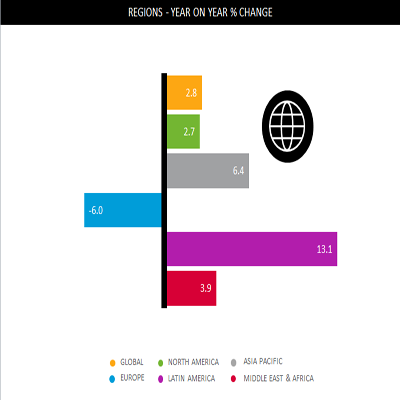
    NEW DELHI: Ad spends grew by a substantial 6.4 per cent in the first half of 2013, making it the largest growth among different regions of the world.

    Marketers continue to gradually increase their global ad spending, as expenditures grew 3.5 per cent in the second quarter of 2013 and 2.8 percent on a year-over-year basis for the January-June periods of 2013 and 2012, according to Nielsen’s quarterly Global AdView Pulse report.

    Although many marketers remain conservative with advertising budgets, those in Latin America continue to buck the norm, increasing their expenditures by 13.1 percent (to $13.5 billion) for the January-June period.

    All regions contributed to global growth for the first half of the year except Europe, where marketers remain modest with their ad budgets amid the regions’ continued fiscal crisis, resulting in a six percent decline for the period. Ad spend continued to recover after slumping during the economic downturn, with growth of 3.9 percent in the Middle East and Africa, and 2.7 percent in North America.

    Argentina contributed significantly to growth for the Latin America region with nearly 30 per cent growth. Indonesia, China and the Philippines all contributed to double-digit ad growth in Asia-Pacific for the first half of 2013, with expenditures reaching $51 billion. In Europe, ad spend increased in Norway, Switzerland, and Greece (2.5 per cent, 0.6 per cent, and 7.4 per cent respectively), while expenditures declined in all other countries in the region.


    Nielsen Global AdView Pulse measures ad spending for TV, newspapers, magazines, radio, outdoor, cinema and Internet display advertising. Ad spend is based mainly on published rate-cards. Some markets may exclude select media due to data availability.

    The external data sources for the other countries included in the report are:

    Argentina: IBOPE
    Brazil: IBOPE
    Croatia: Nielsen in association with Ipsos
    Egypt: PARC (Pan Arab Research Centre)
    France: Yacast
    Greece: Media Services
    Hong Kong: admanGo
    Japan: Nihon Daily Tsushinsha
    Kuwait: PARC (Pan Arab Research Centre)
    Lebanon: PARC (Pan Arab Research Centre)
    Mexico: IBOPE
    Pan-Arab Media: PARC (Pan Arab Research Centre)
    Portugal: Mediamonitor
    Saudi Arabia: PARC (Pan Arab Research Centre)
    Spain: Arce Media
    Switzerland: Nielsen in association with Media Focus
    UAE: PARC (Pan Arab Research Centre)

  • OTT video services dominate US network traffic

    OTT video services dominate US network traffic

    MUMBAI: The latest internet traffic trend report from Sandvine has reported that the network traffic in the US is dominated by over the top (OTT) video services.

    Tracking of the fixed and mobile networks across the globe shows that peer-to-peer file sharing has fallen below 10 per cent of the total traffic in North America. This is starkly different from the 60 per cent share it consumed 11 years ago in the heyday of Napster and other P2P services. Even five years ago, it accounted for over 31 per cent. The figure was reported in the six-monthly survey conducted by the broadband network solutions provider, Global Internet Phenomena Report 2H2013.

    The report has also found that the OTT leader Netflix (31.6 per cent) held its ground as the leading downstream application in North America, and together with YouTube (18.6 per cent) accounts for over 50 per cent of downstream traffic on fixed networks.

    Average monthly mobile usage in Asia-Pacific now exceeds 1GB, driven by video, which accounts for 50 per cent of peak downstream traffic, more than double the 443MB monthly average in North America.

  • OTT revenues to reach nearly $8 billion in 2017

    OTT revenues to reach nearly $8 billion in 2017

    MUMBAI: SNL Kagan’s Multimedia Research Group (MRG) is predicting the OTT SVOD market to record significant growth worldwide in the coming years, with North America leading the pack, followed by Western Europe.

    MRG predicts that revenues will reach nearly $8 billion on more than 120 million subscribers globally by 2017. North America, which has more than 25 OTT SVOD service providers as of 2013, is the most developed market. Subs are estimated to have increased by more than 50 per cent in 2012, reaching nearly 50 million.

    North America is followed by Western Europe. Last year, Western Europe accounted for 11 per cent of the worldwide market with 7 million subscriptions and annual revenue of $575 million. Asia, which has the largest internet population in the world, accounted for nearly five million OTT SVOD subs in 2012 and $255 million in revenue.

    Eastern Europe had seven per cent of the market in 2012 and more than four million subscribers and revenue of $253 million. The OTT SVOD service markets in Latin America, Asia and Eastern Europe collectively comprised 20 per cent of the worldwide subscribers in 2012. These regions are poised for immense growth in the next five years, according to MRG. The Middle East and Africa had a negligible share of the market last year. Though it is expected to grow in the coming years, its contribution will only increase to one percent by 2017.