Tag: Nirmala Sitharaman

  • Budget ’22: India to roll out 5G services in FY23, says FM Nirmala Sitharaman

    Budget ’22: India to roll out 5G services in FY23, says FM Nirmala Sitharaman

    Mumbai: Finance minister Nirmala Sitharaman on Tuesday announced that the 5G telecom services will be introduced within the financial year 2022-2023. The minister in her union budget 2022 speech said that the auctions will be held in the next fiscal year (FY2022-23), after which private companies are expected to roll out the service.

    The contracts for laying optical fibres will be done through public-private partnerships, Sitharaman further said.

    The minister added that five per cent of the annual collections Universal Service Obligation Fund will be allocated to enable affordable broadband and mobile penetration in rural and remote areas.

    Sitharaman also announced the inclusion of design-led initiatives for 5G and other technologies in the production-linked incentive (PLI) scheme.

  • Budget2022: Govt to set up task force to promote animation, video gaming industry

    Budget2022: Govt to set up task force to promote animation, video gaming industry

    Mumbai: The government has proposed to set up a specialised task force for the promotion of the animation, visual effects, gaming and comics (AVGC) industry. The announcement was made by finance minister Nirmala Sitharaman while presenting the annual budget 2022 on Tuesday.

    “Animation, Visual Effects, Gaming and Comics (AVGC) sector offers immense potential to employ youth. An AVGC promotion task force with all stakeholders will be set up to recommend ways to realise this and build domestic capacity for serving our markets and the global demand,” said Sitharaman.

    The announcement was welcomed by the industry, with Federation of Indian Chambers of Commerce and Industry (FICCI) hailing it as a big win for the sector.

    FICCI chairman – AVGC XR Forum and Punnaryug Artvision founder Ashish SK said that the budget announcement of the formation of task force for AVGC Promotion has come at the most appropriate time. “After setting a strong foundation in the last two decades the Indian AVGC – XR is poised to grow phenomenally in coming decade. The creative skills from India needs nurturing to a great extend to enable the growth of the sector. Setting up of a task force will definitely bring in a great focus on positioning Indian AVGC sector for services exports, co-productions, growth of Indigenous intellectual property and its consumption patterns within India and overseas,” he said.

    According to industry representatives, the Indian AVGC – XR sector is expected to have a major share of the media and entertainment industry. The horizon and use cases of AVGC – XR verticals have expanded beyond its day-to-day defined utility in architecture, life science, legal, education, industrial, urban planning, sports, digital universe, metaverse etc apart from media & entertainment.

    “The AVGC task force is a huge step by the government to promote the sector. We wholeheartedly welcome it and FICCI AVGC-XR Forum will continue to work closely with the government on various policy initiatives to realise the growth potential of the Industry. This industry vertical has tremendous scope for employment generation and exports,” said FICCI co-chairman – AVGC- XR Forum, and Graphiti Studio founder Munjal Shroff.

    In its latest report released last month, the Confederation of Indian Industry (CII) and Boston Consulting Group (BCG) had also projected that India’s media and entertainment industry which is currently valued at around $27 billion is all set to grow at 10-12 per cent CAGR to become a $55-70 billion industry by 2030. The report had also highlighted that the industry’s next phase of growth will be led by OTT, gaming, VFX and animation.

    The finance minister said the union budget seeks to lay a foundation and give blueprint of the economy over the next 25 years – from India at 75 to India at 100.

  • “We have to take care that businesses which have been built by the sweat and toil of Indians and which have had a great brand value cannot be picked up by people who are just looking for an opportunity”

    “We have to take care that businesses which have been built by the sweat and toil of Indians and which have had a great brand value cannot be picked up by people who are just looking for an opportunity”

    The Wuhan virus is taking lives and bleeding economies and the leaders of the world have a double challenge now, to save lives and to save livelihoods. WION, India’s first International news channel took an exclusive interview with a leader who perhaps has the most difficult job in the world right now, the Finance Minister of the world's largest democracy – Nirmala Sitharaman on the show ‘Straight Talk’.

    On being asked about the task at hand, she said, “At the very least challenging and as it is in India every issue or every policy decision has its own complexity when in comparison to any other country. India because of its diversity, because of the uneven spread of wealth and because of the levels of literacy, every policy becomes all the more complex when you try to implement it here.

    About going through four rounds of lockdown and may be looking at a fifth. Where do we stand today and have we been able to achieve what we set out to and at what cost? 

     “As I said it was first lives of people we wanted to be sure at a time, when we had about just a hundred cases. The approach and the clarity with which one had to deal with this kind of a pandemic was unclear to many.

    India went through without a break one, two, three lockdowns and so on whereas there are some countries which have lifted the lockdown and then gone back to it all over again.

    At what cost is a very big relevant question. Yes, it it has meant that the economy had to take a big beating. How much is it, we'll have to wait and see but whatever it is the government is very clear that we'd stand by our industry stand by our entrepreneurs stand by our farmers we need our economy to be supported and we should support them for your job in this situation” the Finance minister explained to WION’s executive editor, Palki Sharma Upadhyay. 

    On positive growth projections likely only for India and China.

    The Finance Minister said, “If there are engines of growth for the global economies all across – emerging, developed, not so developed economies, it's only two countries and they are India and China. What gives me the confidence to say that this holds good even now are our macro-economic fundamentals and it is on the fact that our fundamentals are strong we are able to face a lock down which is fairly severe.”

    About the budget estimates and the plan of a 5 trillion dollar economy 

    Sitharaman started out, “Let me put it this way, the budget estimates of first February 2020 will now have to be relooked. None of my assumptions will hold good I don't think any one of us understood to what extent and even now I think we are not very clear to what extent this pandemics impact will be on the economy. I'm not going to be stuck on my assumptions of 1st February 2020 and now every option is kept open because ultimately we want the economy to be up and going so yes things are changed from the last budget we have to see how it goes 

    On the talk of hostile takeovers does she see a threat of hostile takeovers of distressed assets in India by foreign firms

    The Finance minister said, “That's certainly a worry in that with the valuations being cut so badly and with the lockdown and the entire world being upset because of the way in which demand some drastically fallen movement of people being affected 

    There is definitely this risk of companies getting into a distress mode and the market being market that'll be the best time for people with deep pockets who want to come and buy and that's a reality. We have to take care that businesses which have been built by the sweat and toil of Indians and which have had a great brand value cannot be picked up by people who are just looking for an opportunity so that is a factor which all of us are worried about. We will certainly do something to ensure that Indian industries don't get picked up at a throwaway price because we want them to be able to run their business once everything is normally”

    On FDI norms being changed recently to prevent hostile takeovers and what are the steps if any are being looked

    “We are also making sure that the regulators will be able to look at various existing options through which they can ensure that distress companies are not going to be picked up easily. Regulators will also keep a watch in fact they have been fairly active in getting to know about even the secondary market operations through which companies are getting picked up or or their shareholdings are getting drastically changed. I would think it'll be a combination of the government and the regulators to keep an eye on the developments.” the finance minister explained. 

    On countries practicing economic distancing from China and creating an ecosystem for companies to shift from China to India.

    The Finance Minister said, “it is certainly an opportunity, but it cannot be a reactive thing alone. I think it should be a larger approach of anyone shifting from anywhere should find India attractive and your attractiveness is not dependent purely on the taxation incentives. I think the compliance burden the unpredictability of policy fear of what respective taxation fear of you know of tax men these are all factors which either vitiated or help the kind of environment which can draw investments and I would want to play a lot on them to make sure that it need not always be a targeted incentive based approach to drawing industry. It should be a blanket approach. 

    So the GDP figures for the last quarter of last financial year have come 3.1 percent and the coal industry’s data for April is a 38 percent decline in growth, is this what you expected? 

    “3.1 for the last quarter, a quarter where we thought we started seeing green shoots because the way in which through the bank's credit was pushed between September, October, November and that is one of the reasons why the budgetary estimates were made the way it was made but if the contraction that you're talking about in core sectors about 35 percent that is in April, which is into this financial year, by which time the coronavirus hit us. So the 3.1 is actually given the fact that by February we started having some kind of an impact of the pandemic, therefore gives me the feeling that revival was happening but unfortunately the hand of God started playing.” she said.

    Most agencies projecting a contraction of 5% what's your estimate?

    “I said I shall not do an estimate I shall wait to see how it pans out I am

    watching and hearing agencies tell us about what extent to which this

    contraction is going to hit India as I said it's my duty to be prepared to face the situation and be ready to help, rather than spend time now on what will be the expected contraction.” the finance minister concluded.

    The entire Interview will be available on Wionews.com and on WION’s YouTube and social media channels. 

  • News Broadcasters Association seeks GST relief on ads

    News Broadcasters Association seeks GST relief on ads

    MUMBAI: The News Broadcasters Association (NBA) has requested the government to either remove or reduce the goods and services tax (GST) on advertisements in par with the print media industry as part of the stimulus package, amid the COVID-19 pandemic in India.  

    NBA president Rajat Sharma, in his letter to union finance minister Nirmala Sitharaman, said, “Advertisements are an integral and essential part of the business and the main source of revenue for the news broadcasters which has come under severe pressure during this lockdown due to the virus pandemic.”

    The NBA statement mentions that ad agencies are putting huge pressure to defer the payments to broadcasters and to allow more time over 60-day credit period; the recovery of bills is going to be hugely challenging, while facing an even bigger task of almost zero income in the next 30-90 days.

    “While the news broadcasters are coping with the financial problems of dues’ recovery, we are also facing serious problems of advertising inventory/release orders being cancelled and inventory bookings being than 50 per cent for even the top-rated news channels,” said Sharma.

    News channels have gained all-time viewership in recent weeks, as per Broadcast Audience Research Council (BARC) India. However, the exponential rise in viewership has failed to get the ad and inventory sales.

    The statement also read, “The news broadcasters have had to take various steps, make alternate arrangements within and outside the premises for newsgathering, reporting purposes. This has resulted in an increase in the operating costs of the news channels during the lockdown.”

    Moreover, “Poor recovery and lack of future income would mean that the news broadcasters would have to weather the storm for two-three quarters and hope for a partial recovery towards the end of the financial year,” mentioned the association.

  • Fevicol bags CNBC-TV18’s IBLA brand campaign of the year award

    Fevicol bags CNBC-TV18’s IBLA brand campaign of the year award

    MUMBAI: Fevicol has been conferred with Brand Campaign of the year at the CNBC-TV18’s 15 Indian Business Leader Awards (IBLA), for its new ad campaign celebrating Fevicol’s 60 years milestone.

    Conceptualized by Ogilvy, Pidilite’s creative agency, TVC reinforces the brand idea of ‘unbreakable bonds’, with the tagline ‘Barson se Barson Tak’. The film beautifully highlights Fevicol’s journey over the years in its typical human and humorous fashion. It further showcases the strength of Fevicol, while drawing parallels with the changing paradigms of Indian social and cultural scenario.

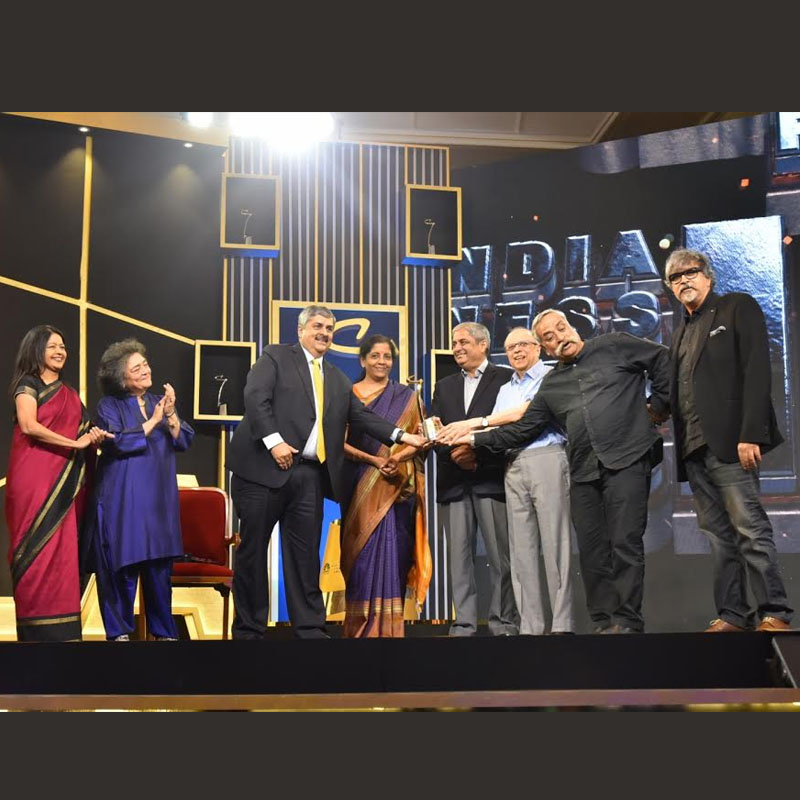
    The award was presented by Minister of Finance Nirmala Sitharaman to Pidilite Industries chairman M.B. Parekh, Bharat Puri, Pidilite Industries managing director Piyush Pandey, Ogilvy worldwide and executive chairman India chief creative officer Prasoon Pandey, Ad Filmmaker, Corcoise Films.

    Pidilite Industries managing director Bharat Puri said: “We are delightful and honoured to receive such a prestigious award. Fevicol, over 60 years has been one of the most trusted brands in Indian households. The brand is loved by consumers for its reliable performance as well as contemporary advertising and the 60-year campaign salutes this long-standing relationship with consumers and contractors.”

    The campaign that won a million hearts also received phenomenal engagement on social media. The 90-second creative received 113 million completed views on various digital platforms apart from the innumerable shares on WhatsApp groups. The innovative usage of digital channels to propagate the campaign creative as content on OTT platforms such as Hotstar, Zee 5 struck a chord with the netizens.

    The award sought to recognize the most impactful mass media/ advertising campaign and the jury members shortlisted the nominees based on criteria such as campaigns/communication that has been acknowledged and featured at industry forums, panels, and awards.

  • News viewership grew by 60% during budget speech

    News viewership grew by 60% during budget speech

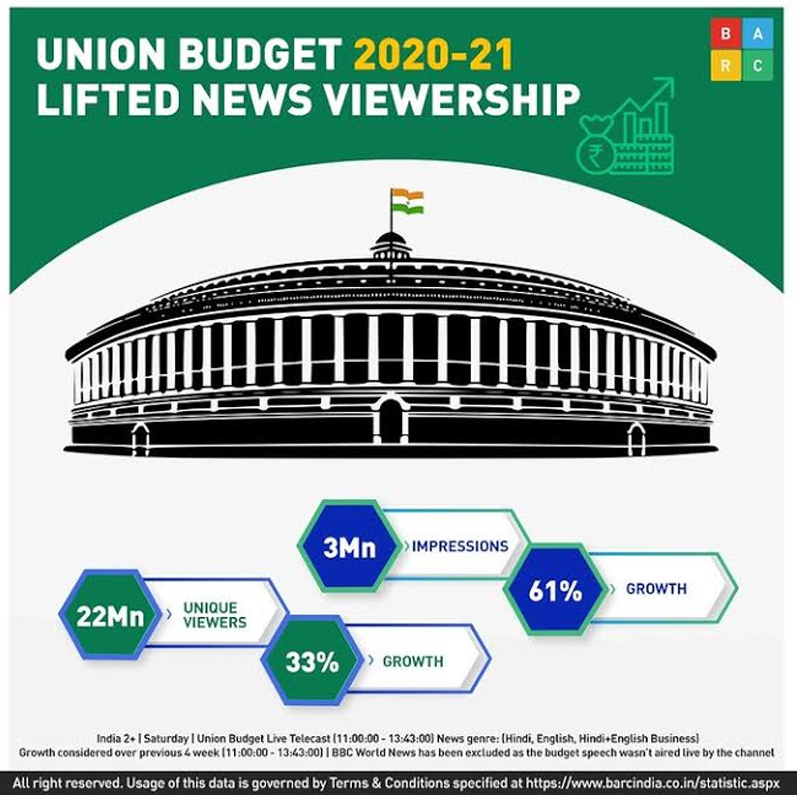
    MUMBAI: The biggest financial event of the country—Budget 2020 — has helped news channels, especially business news channels across segment to increase their viewership substantially, a data from Broadcast Audience Research Council (BARC) says.

    Union finance minister Nirmala Sitharaman gave the longest budget speech from 11 am to 1.43 pm on 1 February. The Hindi, English and Hindi+English business news channels recorded a rise of over 60 per cent to 3 million impressions during these 2 hours and 43 minutes.

    Moreover, at least 22 million eyeballs of unique viewers were glued to the screen of business news channels across genre, which posted growth of over 30 per cent.

    BARC on its official twitter handle mentioned: “During #Budget2020, Indian news viewership saw an impressive growth with regards to impressions and unique viewers!”

    The budget viewership was recorded during week 5 of BARC that was compared to the same time slot of week 4 of the weekly impressions. BARC in its Twitter post said: “The growth in impressions were considered over the previous week 4 during the same time period from 11 am to 1.43 pm.”

    The audience measurement body also said in its micro-blogging post that BBC World News has been excluded as the budget speech wasn’t aired live by the channel.

    Despite Budget 2020, the viewership of general news channels across genre were slowed down in week 5 (1-7 February) as compared to week 4 (25-31january), the BARC mentioned on its website.

    However, the budget being the most important event for the business news channels, both CNBC TV18 of Network18 group and ET Now of Times News Network, in the English category, grew by over 100 per cent to 727 and 266 weekly impressions in week 5 respectively.

    The Reliance group-owned business news channel, CNBC TV18 being the leader in the business news channel in week 4 had garnered 275 weekly impressions. On the contrary, ET Now had received 123 weekly impressions in week 4.

    In the Hindi business news category, both Network18’s CNBC Awaaz, and Zee Entertainment Enterprise’s Zee Business grew by 21 per cent and 41 per cent respectively during Budget week. The former garnered 2492 weekly impressions, whereas the latter settled at 2131 impressions in week 5 as compared to 1965 and 1249 impressions in week 4 respectively.

    Week 5 was considered to be weak compared to week 4, as it had no major important event for news channels to keep viewers engaged except for the Budget 2020 and Delhi poll campaigns that concluded on February 6. Whereas, week 4 had seen many national importance events such as Republic Day, Delhi Assembly poll campaigns, and the Shaheen Bagh firing. 

  • Budget 2020: I&B Ministry allocation raised by over Rs 310 crore this fiscal

    Budget 2020: I&B Ministry allocation raised by over Rs 310 crore this fiscal

    MUMBAI: Union finance minister Nirmala Sitharaman in her second budget announced Rs 4375.21 crore for the Ministry Of Information And Broadcasting (MIB) for the financial year 2020-21, Press Trust of India report said. The revised budget estimate for the last fiscal was Rs 4064.76 crore.

    The finance minister has increased the funds to MIB by Rs 310 crore over the previous fiscal year. The allocation for Prasar Bharati has remained at Rs 2889.36 crore, same as the revised estimate of last financial year.

    The allocation, in the budget, for broadcasting under the social services has been upped to Rs 3218.56 crore from Rs 3067.26 crore in FY20. Meanwhile, a total of Rs 967.29 crore is allocated for information and publicity.

    The minister raised the allocation for the Film and Television Institute of India (FTII), Pune to Rs 49.4 crore from Rs 30.87 crore in 2019-20, and has doubled the Indian Institute of Mass Communication (IIMC) funds to Rs 61.30 crore in FY21 from Rs 25.69 crore in the last fiscal.

    Hailing the budget 2020 as most pragmatic, union information and broadcasting minister Prakash Javadekar said that India has not only managed a good growth rate but is also marching towards a better rate, adding that the budget will usher in all-round development.

  • Union Budget 2020 great for digital India but falls short

    Union Budget 2020 great for digital India but falls short

    MUMBAI: The Union Budget for the fiscal 2020-21 announced by finance minister Nirmala Sitharaman had a prominent focus on further strengthening the digital infrastructure of the community.  The budget allocated Rs 6,000 crore for BharatNet and dedicated Rs 8,000 crore to national mission on quantum technologies, emphasising on the importance of leveraging artificial intelligence, data analytics, and internet of IoT for digital governance. The digital patrons of the marketing world welcomed the move with open arms and lauded the government for empowering the ecosystem. 

    Delighted about the increased investments into the digital sector 121XP managing partner Alvin D'Souza said, “This budget makes me optimistic about the growth of the digital ecosystem. Firstly, the Rs. 6000 crore allocation towards Bharat Net will give last mile connectivity the impetus that it needs and pave way for digital transformation at all levels. Allowing private players to build data centers and encouraging production of mobile and network devices will all compliment each other in growing the ecosystem. Being an experiential marketing company, we believe any initiative taken to strengthen the business sentiments on ground – to jumpstart economic growth will impact us positively.”

    D’Souza also added that this Union Budget had a tough ask to revive business confidence and the government has pursued the right path towards strengthening the core pillars – aspirational India, economic development and caring society. “As a start-up, it is heartening to see the Government’s commitment to address core issues – be it in empowering businesses financially or improving new technology ecosystems or offering tax relaxations. We feel, although there is still a long way to go to achieve the $10 trillion economy dream, but definitely the Union Budget is directionally on point.”

    One Impression CEO Apaksh Gupta said, “We are absolutely thrilled that the government has recognized data as one of the driving forces of the economy. The digital industry thereby requires a solid approach towards data centres, allowing to create incredible content and streamline/automate processes. This policy will create tremendous benefits for the digital growth of the nation.”

    Tonic Worldwide co-founder and CEO Chetan Asher added, “This budget makes me optimistic about the growth of the digital ecosystem. Firstly the Rs. 6000 crore allocation towards BharatNet will give last mile connectivity the impetus that it needs and pave way for digital transformation at all levels. Allowing private players to build data centers and encouraging production of mobile and network devices will all compliment each other in growing the ecosystem.” 

    Elaborating more on the benefits that the advertising and marketing industry can reap from the budget, NeoNiche CEO and MD Prateek N Kumar noted, "The brands and advertising industry will gain momentum due to the announcement on  Analytics, IoT and AI being key contributors in the growth story of India, and will change the way Indian consumers are absorbing the information provided.  The new policy that will be rolled out by the government to enable the private sector to build data centre parks throughout the country will enable brands to improve their reach and connect with masses and will also enhance data and consumer insights for brands.”

    White Rivers Media CEO and co-founder Shrenik Gandhi elucidated that moving beyond jargon and marching towards embracing digital technology is a strong positive move. He was positive that the new budget will lead to higher disposable income in the hands of the consumers thus enabling more consumption. He said, “New age technologies, keeping data and digital at the heart of it shall lead to big reforms. Focus on IoT, Data Parks, AI shall make India a strong contender amongst the top digital economies, globally. The ambitious fibre to home proposal shall get the next 100M in the Digital universe soon. All in all, it’s a very positive budget for digital by the government which has always vouched for the power of digital. The same coupled with reduced tax slabs and abolition of DDT shall lead to higher disposable income; thus enabling more consumption."

    Resulticks co-founder and CEO Redickaa Subrammanian said that she is excited about the government's support for India's technological advancement and the entrepreneurial spirit it promotes. She also welcomed the setting up of the investment clearance cell. She was hopeful that the proposed revisions in the income tax structure should lead to increased consumer demand and provide an overall impetus for economic growth in India.

    Subrammanian added, “Digital disruption has transformed India’s business landscape and the announcement for building more data center parks will further aid in laying a strong foundation for a digitally connected country. INR 8000 crore allotment for developing quantum technology is impressive, and this in tandem with the grassroots level skilling initiatives, make for a strong technology ecosystem. Engineering students will also gain real-world experience through the new internship programs, creating a digitally skilled talent pool equipped to work in a digital economy.”

    Bobble AI founder and CEO Ankit Prasad noted, “A good thing about the #budget2020 is that they have kept StartUps in mind w.r.t. Income tax deduction, deferred taxation on ESOPs and all other policies which are adopted. However, that said, we as an industry are jaded by the past – there have been issues when it comes to implementation and have been at the receiving end of the IT Department courtesy misinformation of angel tax, for example. Here’s hoping that this year will be different and that there will be no friction whilst implementing and executing the proposed policies.”

    However, the industry is not completely satisfied with the overall budget. 

    Mediacom South Asia CEO Navin Khemka felt that the budget is status quo for the short-term. He said, “What is required is more purchasing power to the Indian middle class. This will help boost demand in the sluggish economy. I hope the investment in infrastructure and kisan express helps in achieving this objective in the long run. Short term, however, I think this budget is status quo. Demand growth could be sluggish and this could continue to impact media investments by corporates."

    Dentsu Aegis Network CEO APAC and Chairman India Ashish Bhasin shared that compared to the expectations that the industry had from the budget, this seemed like a lost opportunity. He expected more on the rationalisation of direct taxes, particularly the cess introduced over and above the tax rates. However he was happy to see that the dividend distribution tax has been abolished. 

    Bhasin rated the overall budget as “mixed” saying, “I think this is a good budget in some ways because it has attempted to put money in the hands of the middle class through rationalisation of tax rates as well as has concentrated on looking after the agricultural sector, including introduction of best practises like storage for producers and other measures.  It is good to see efforts being made to encourage new-age skill development as well as helping the start-ups and what's particularly interesting is the proposal to set up data centre farms all over the country. This will prepare India for the economy of tomorrow. It is also good to see attempts at simplification of taxation through digitisation but the proof of the pudding will lie in seeing its implementation on ground.

    It would be fair to say that at best it is a mixed budget and while there are some encouraging decisions, enough does not seem to have been done for the situation the economy is in.” 

    DAN India CEO Anand Bhadmakar said, “The budget has provided relief to the middle class with lower tax rates which is a welcome move, as it will provide more liquidity. On direct taxes, abolition of DDT and also introduction of tax dispute resolution scheme is a welcome step alongside tax reliefs for start ups. The budget is focusing on ease and simplification of compliance, with changes in corporate laws as well as in GST and direct taxes. However, I was expecting further simplification re. cess and surcharges beyond tax rates across slabs etc.”

    He added, “The proposals regarding development of road infrastructure, setting up data centre parks and skill development initiatives are welcome steps in addition to allocations for social welfare schemes. However, the expectations from the budget were high on the background of current economic slowdown, and as such seems to be short on matching those expectations, with no specific industry sector focused sops providing the stimulus. While the budget is focusing on long term growth and social development, overall in the current scenario looks like a mixed budget, falling a bit short of market expectations of more corrective measures.”

  • Industry’s expectation from union budget 2020

    Industry’s expectation from union budget 2020

    MUMBAI: Amid ongoing economic tension in the country, finance Minister Nirmala Sitharaman is all set to present her second Union Budget on 1 February 2020.

    It is expected that Budget 2020-21 will put the economy back on track. One of the biggest challenges before the Modi government is to have a plan of action to combat the decreasing growth rate of the country. As the nation waits for the announcements, we spoke to industry experts, strategists and financial experts to know what they expect from the union budget.

    Although there won’t be any direct impact of union budget on the television industry, the economic boost in other sectors like FMCG, automobiles, retail, etc., could add to the pocket of consumers to spend more and lead to more advertising. Experts are expecting some kind of relief in these sectors so that there could be better ad growth.

    Apart from this, experts are also expecting some reduction in GST on cable and internet bill. Currently, 18 per cent GST is added on cable and internet bill and industry wants that to be brought down to 5 per cent.

    Read what people have to say:

    Maharashtra Cable Operators Federation president Arvind Ramesh Prabhoo 

    “We are expecting a reduction in the GST that is being levied on cable television because under the new NTO what we have seen is that the rates have not decreased which was envisaged by TRAI. According to the new NTO, they are expecting the cable operators and the DPOs to give a discount of 60 percent to the second television set but nowhere has the government said we will reduce the GST. We have been stating this now for a very long time that the GST should be reduced from 18 percent to 5 percent. Also what we are expecting is that on the goods of cable television and equipments of fiber to the home (FTTH)  if it is imported there should be a duty deduction or if it is being manufactured in India then there should be a reduction in GST for at least five years. So overall on the entire equipment required for fiber to the home to be incentivised there should be less taxation.”

    Zee Media Corporation Limited former managing director Ashok Venkatramani

    “The biggest worry for everyone is whether the government will use this opportunity to seek some of the issues in the Indian economy so that business starts picking up. The overall industry is feeling the effects of economic slowdown because people are not spending. So it is not what the budget does for the television industry as much as it does for the overall economy to bring income flow. I am not expecting a huge structural change in the media industry because the largest part of our issues is governed by TRAI. However, television industry will gain a lot mainly when the revenue starts pumping in and for that to happen we will have to look at how consumption grew, whether it is FMCG or retail and for that. If government could do something to put more money in the pocket of average Indian to spend the consumption will grow up and automatically brands will start advertising more.”

    UCN Cable Network head  of operations Debashis Mohanty 

    “We need GST to be 5 per cent flat. Apart from the GST, I don’t think so there is going to be an exemption in NTO and NTO 2.0. The industry is in a dilemma as the changes proposed in NTO and NTO 2 have not been implemented yet.”

    SBICAP securities head of institutional equity research Rajiv Sharma

    “I don’t think so there is going to be any direct announcement because you have separate regulators and separate policies for it but what has happened is any cut in income tax or any measures to boost the economy will have a positive impact on the ad growth which has taken a toll in the last 18 months. Any measure to boost tourism or give any announcements on the film making side if possible will result in a lot of employment directly and indirectly. Any policy that could bring down the cost of production of films or some relaxation to shoot outdoors will help in revenue generation. Beyond this I am not expecting anything from the media industry perspective.”

    GTPL Hathway  vice president Yatin Gupta

    Hope that government sometime soon should cut down GST on the cable industry. There should be relaxation in customs which impacts our industry.

    Elara Capital vice president- research analyst media Karan Taurani

    "The economy is already in a dry state, there are no major expectations from the budget as such. However, for the television industry, there could be some financial stimulus that can boost the consumer derivative. There is also the expectation in the GST cut as FMCG market place almost 35 percent of the overall aspect of the entire pie and for TV it is around 55 per cent which is quite a sizeable number. So, there should be some kind of relief for the FMCG sector that can lead to better sales growth and then it could turn into a better advertisement growth. This year FMCG TV advertising has been low on the television portion. There is a contribution of nearly 50 percent from the FMCG vertical so some kind of a revival there will lead to better ad growth. Because next year industry ad growth is expected to rise by 8 per cent for the TV industry so if some funds are diverted towards that segment, certain relaxation or some GST cut will certainly help. Rural demand is taking a major hit; it has seen a sharper volume decline as compared to urban decline. So some kind of measures to bring rural demand on track will have a big impact on advertisement growth.”

    Enterr10 Television co-promoter Fakt Marathi Shirish Pattanshetty 

    “If there is q deduction in the personal income tax maybe there should be additional flow in the market in terms of improving business. It might help FMCG companies and other companies to start spending on advertising which will help the industry to get out of the current scenario. While there is the discussion on NTO and NTO 2.0 what government can look at is how they can reduce the 18 per cent GST in the base price of Rs 130 to get it to 5 percent of tax. So, that while we are working so hard to get the consumer pricing down why not the GST pricing also should be reduced on cable and DTH base subscription. On the free channels, they are welcomed to charge 18 per cent but at least at the base price if they can amend anything it might help the cable industry. Also, I believe corporate taxes have already been reduced as a boost but none of the companies are using the corporate tax reduction for outflows. They are using this tax benefit to be more profitable so that they can get a better dividend. The ultimate solution could be the reduction in personal income tax which might help the end-user to use the additional funds for consumption purposes.”

    Madison media vice president Vandana Ramkrishna

    “My expectation from the union budget 2020 will be being dynamic reforms to increase consumption and drive demand. Simplify and liberalise laws that help companies source international funding. Also, educational tax benefits need to be enhanced so that the country is able to upskill. Over and above this rationalisation in GST for electronic media is something that has been in the ask for a while.”

    White Rivers Media chief executive officer and co-founder Shrenik Gandhi

    "India maintained its tag of being the world’s fastest-growing economy, despite grim global projections in 2019 as per IMF, which also projected India’s growth rate at 7 per cent in 2020. This bears testimony to its potential of spearheading global economic growth. Budget 2020 is, therefore, Sitharaman’s opportunity to make a difference not only to Indian but also the global economy. One of the key accelerators to this will be enhancing the net disposable income, which is directly proportional to the income tax cuts, affecting the demand for goods and services, finally snowballing into economic growth or slowdown. Budget 2020 should therefore, focus on expenditure boost by lowering the personal tax rates, leading to higher savings, to pump the economy."

    Alchemy Group CEO Karan Gupta

    "With Modi government 2.0 we hope to see support for Digital 2.0, after significant growth in digital penetration and digital literacy in the country, it's now time for the government to focus more on Tier 2/3 and rural sectors. From more internet penetration to better IT Infra and connectivity empowering the new consumer with content and commerce across categories. Working towards a Digital India dream we hope to see some support for digital-first businesses and other ones that are focused on making the life a consumer more convenient and fulfilled no matter where they are based."

    Digitalabs CMO Agam Chaudhary

    “It’s a near ritual for every industry to expect measures for monetary relief from the annual budget. However this year I’d want to make an exception and expect measures that revive the economy as a whole. Our revenues are tied with both demand and supply ends of consumption. If they have robust growth, so shall we.”

    Pixel Pictures  founder and CEO Prashanti Malisetti

    "Production industry is a labor-intensive field. The entrance of OTT platforms like Netflix and Amazon Prime have changed this industry drastically. We have an opportunity to create new forms of content and explore new genres. It would help to have some incentives to create a different kind of awareness content. The consumption of video content is increasing at a rapid rate and we need to encourage more talent in this industry. Incentives to film schools and students of visual arts would be encouraging."

  • Corporates welcome reduction in tax rate; positive about impacts

    Corporates welcome reduction in tax rate; positive about impacts

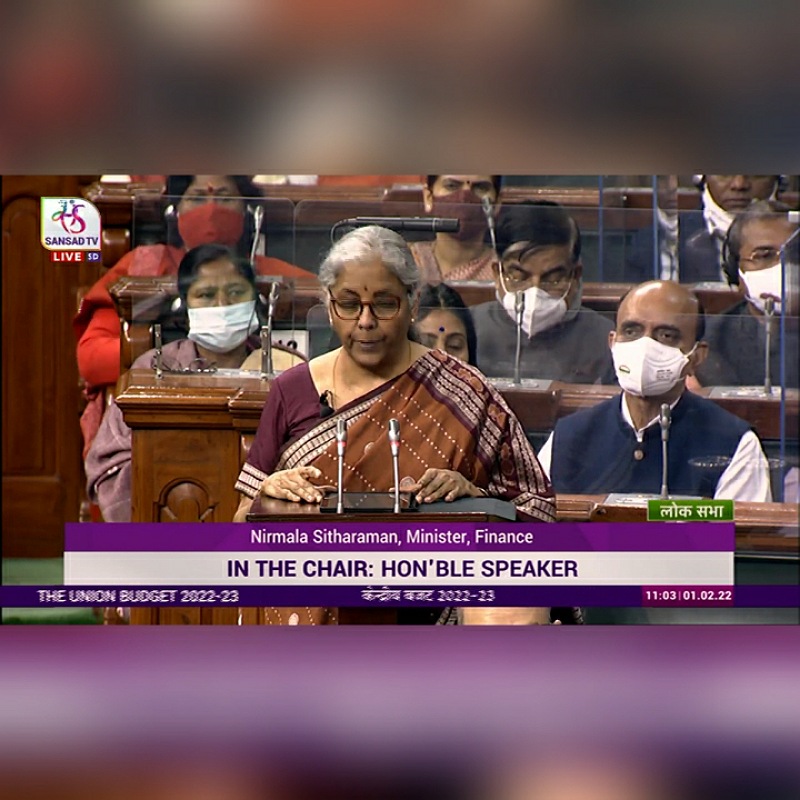
    MUMBAI: Finance Minister Nirmala Sitharaman, on Friday, announced the slashing of corporate tax from 30 per cent to 22 per cent, sending tremors of joy and positivity across the industry. The revised tax rates will be applicable to companies that do not avail of any tax incentive. Effective corporate tax rate after surcharge will be 25.17 per cent. She also announced that new manufacturing companies will have to pay only 15 per cent corporate tax.

    Welcoming the move Diageo India managing director and CEO Anand Kripalu said, “We welcome the bold changes introduced by the government, which will strengthen India Inc’s role as the nation’s job and wealth creators. The increased tax savings will boost cash flows, spur domestic and foreign investment, provide competitive tax rates and act as an economic driver towards ‘Make in India’.”

    Stating that the new move will have a good impact on the travel and tourism sector, SOTC Travel vice president and chief financial officer Farroukh Kolah said, “Travel and Tourism industry is a vital contributor to the country’s growth. The announcement on lowering the corporate tax from 30 per cent to 22 per cent, which is now at par with the South Asian countries, will have a significant and positive impact on the economy. The reforms undertaken by the government will help businesses with higher post-tax profits hence incentivising investments into the country and will boost the current economic growth rate.”

    Kalyan Jewellers chairman and managing director T S Kalyanaraman also praised the move as he said, “It is very positive to see the government move pragmatically and provide the much-needed liquidity boost to the economy. Lower tax rate will increase transparency in the gems and jewellery industry which will ultimately lead to a shift from unorganised to organised sector. We welcome this dynamic decision implemented by the government.”