Tag: Nirmala Sitharaman

  • Business Today rings in new market shows with opening and closing bell

    Business Today rings in new market shows with opening and closing bell

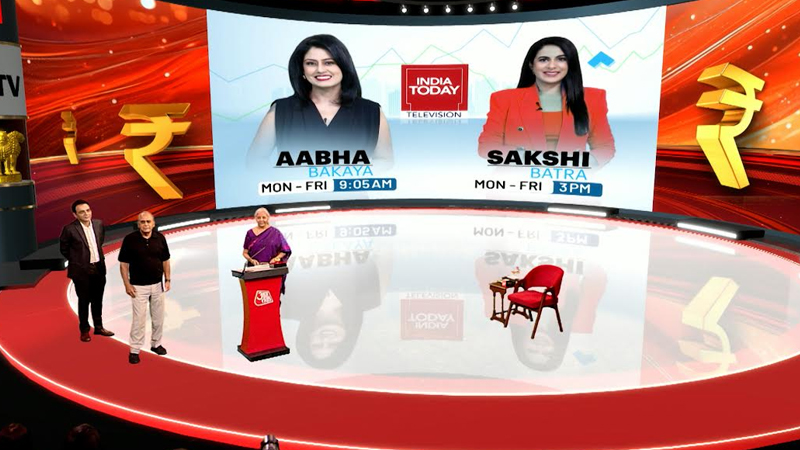
    MUMBAI: Markets may thrive on numbers, but sometimes it takes a sharp story to make sense of the swirl. finance minister Nirmala Sitharaman today struck the gong on a new phase of Business Today Multiverse, launching two dedicated market shows designed to keep investors ahead of the curve at the opening bell and right through to the close.

    The Market Opening show, airing 9:05 am to 9:30 am, promises a crisp 25-minute scan of overnight Wall Street movements, Asian market trends, and the first stirrings of Dalal Street. With early reads on the Sensex, Nifty and stock-specific triggers, the segment distils the noise into clarity giving professionals a cheat sheet for the business day ahead.

    Come 3:00 pm, the baton passes to Market Closing, a half-hour wrap that does more than just flash the ticker. Expect deep dives into sectoral trends, top gainers and laggards, institutional flows and macroeconomic sparks, all explained with context, not clutter. For investors, it’s the day’s financial screenplay neatly tied up before the curtains drop.

    Together, the twin programmes expand the Business Today Multiverse, an omnichannel media ecosystem that blends print depth, digital speed, broadcast punch and social conversations. For an audience hungry for credible financial information in uncertain times, the shows are positioned as trusted guides to navigate not just numbers, but narratives.

    Calling the new launch a “collab that matters”, Business Today vice chairperson and executive editor-in-chief Kalli Purie said: “What people need most is clarity backed by expertise. That’s where the authority of Business Today, a 35-year-old brand built on integrity and independence from vested industrial interests becomes invaluable. These new shows carry forward our promise to give audiences news that impacts their money, delivered with trust.”

    In an age where a single market ripple in New York can send tremors through Mumbai’s trading floors, the launch underscores how timeliness and transparency are no longer luxuries but essentials. By pairing editorial authority with real-time precision, Business Today Multiverse is betting that investors will tune in not just for numbers but for the story behind them.

  • News broadcasters press Sitharaman for GST relief on ads and credits

    News broadcasters press Sitharaman for GST relief on ads and credits

    NEW DELHI: India’s news broadcasters have taken their tax fight to the top. The News Broadcasters & Digital Association (NBDA), led by president Rajat Sharma, has written to finance minister and GST Council chair Nirmala Sitharaman, warning that the current goods and services tax regime is throttling the financial health of television and digital news outlets.

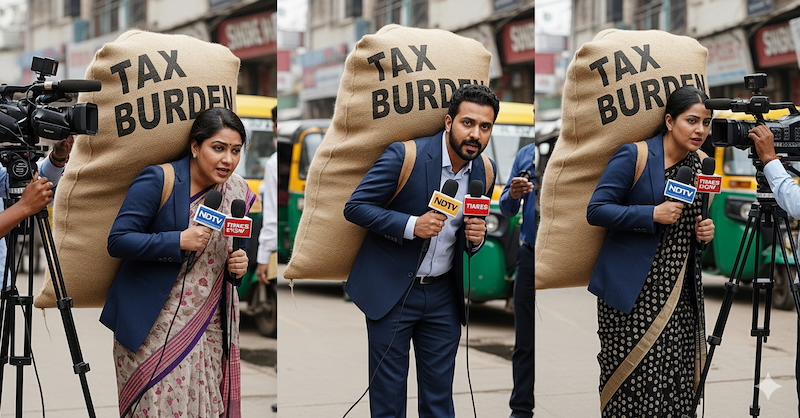
    In its 28 August representation, NBDA said the system of taxing advertising sales at the point of invoicing, rather than when payments are actually received, is crippling cash flow. Broadcasters, it noted, are often left waiting months for money from government departments, state agencies, PSUs and even the government’s own ad-buying arm DAVP. Yet GST has to be coughed up immediately, leaving newsrooms to carry the burden of taxes on income not yet in hand.

    The association also demanded a rethink of Section 17(5) of the GST Act, which denies input tax credit on everyday operational spends such as vehicle hire, catering, employee insurance and even routine services like beauty treatments required for on-air talent. NBDA argues these restrictions make little sense for an industry that runs on people, mobility and presentation.

    Sharma said the relief sought is not a handout but a rational correction. “The changes will align taxation with actual revenue flow and remove arbitrary blocks on legitimate business costs,” the letter states.

    The news business, already squeezed by weak advertising growth, digital disruption and rising costs, says it can ill afford such tax distortions. NBDA’s blunt message to North Block: fix the GST rules, or risk further erosion of an industry vital to India’s democracy.

  • India Today – Business Today Budget Round Table 2025: Big bets & bold claims

    India Today – Business Today Budget Round Table 2025: Big bets & bold claims

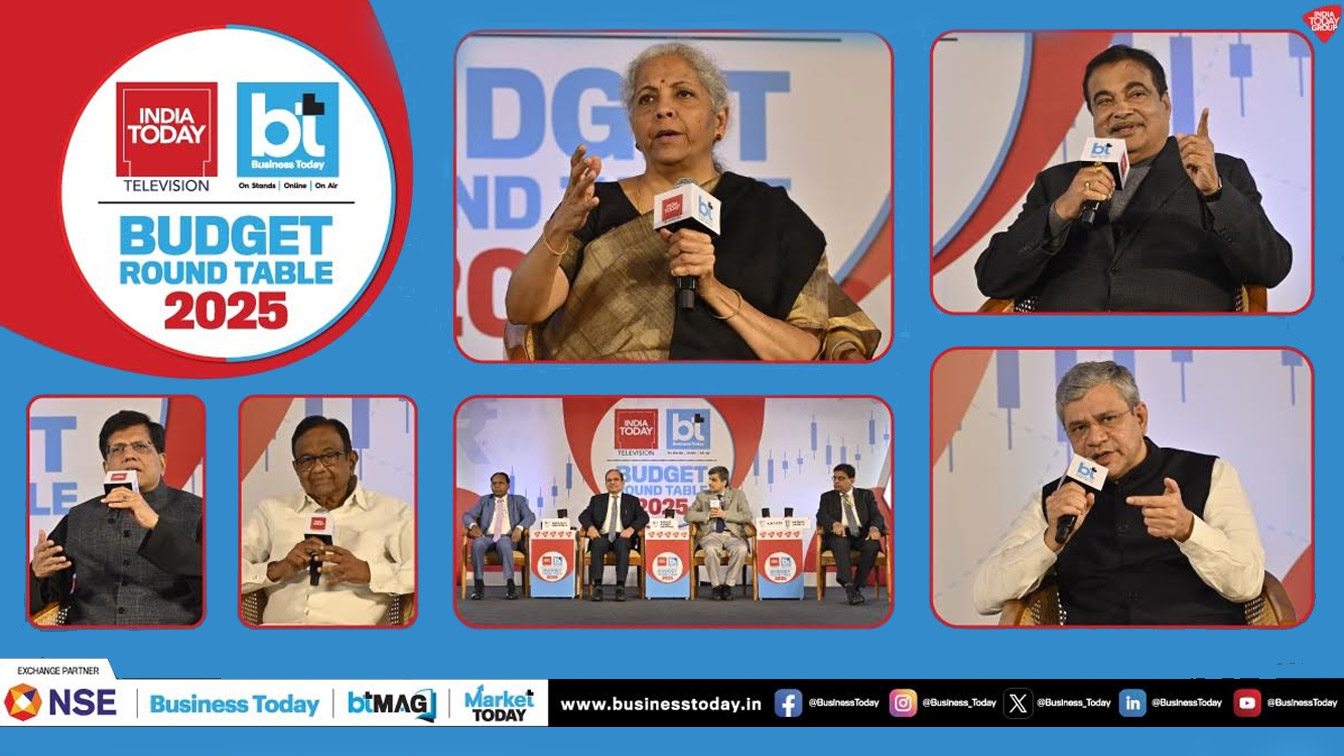
    MUMBAI: If Budget discussions were a high-stakes poker game, this year’s India Today – Business Today Budget Round Table saw ministers going all in with big bets and even bolder claims. From Finance minister Nirmala Sitharaman’s tax relief assurances to Piyush Goyal’s firm rejection of a BRICS currency, and Nitin Gadkari’s ambitious Rs 15 lakh crore infrastructure monetisation vision—this was no ordinary policy talk.

    Sitharaman set the tone early, brushing aside concerns of a structural slowdown while underscoring the government’s commitment to taxpayers. “In every Budget, there is a clear sense that we respect taxpayers,” she declared, championing income tax rebates and relief measures under the new tax regime. She also expressed confidence that higher disposable incomes would fuel consumption and savings, giving sectors like FMCG and banking a much-needed boost.

    Meanwhile, Commerce minister Piyush Goyal wasted no time in dismissing the idea of a BRICS currency. “We don’t support any BRICS currency… It is impossible to think of a BRICS currency,” he said, leaving no room for ambiguity. He also addressed rupee depreciation, maintaining that India must work towards a stronger currency to reduce import dependence.

    Transport minister Nitin Gadkari, always one to bring numbers to the table, outlined his Rs 5 lakh crore plan for highway monetisation while acknowledging roadblocks like land acquisition and environmental clearances. His projections were ambitious—toll income hitting Rs 1.4 lakh crore in two years, scaling up to Rs 15 lakh crore with further monetisation—but execution remains the challenge.

    Beyond taxation and infrastructure, the event also dived into global economic headwinds. Finance and Revenue secretary Tuhin Kanta Pandey flagged rising trade disruptions and protectionist policies, reassuring attendees that India remains committed to open markets. Meanwhile, Electronics & IT minister Ashwini Vaishnaw had exciting news on the tech front—India’s foundational AI model will be ready by the end of the year, with 10,000 GPUs already deployed for research.

    For investors, the insights kept coming. Market veteran Vijay Kedia predicted continued market consolidation, advising investors to focus on government-driven themes like tourism. Value Research CEO Dhirendra Kumar urged a gradual investment strategy, while Mosaic Asset Management’s Maneesh Dangi remained bullish on IT and services.

    With 10 power-packed sessions, 15+ industry leaders, and over 200 corporate executives and experts in attendance, the India Today – Business Today Budget Round Table 2025 delivered high-impact discussions and valuable takeaways. With NSE as an exchange partner, the event ensured that the country’s economic pulse was taken with precision.

    As India steers through global uncertainties, the discussions reinforced the government’s commitment to taxpayers, economic stability, and infrastructure growth—while also highlighting challenges like trade tensions, currency fluctuations, and policy roadblocks that remain very much in play.


  • Sitharaman stuns with her Union budget 2025

    Sitharaman stuns with her Union budget 2025

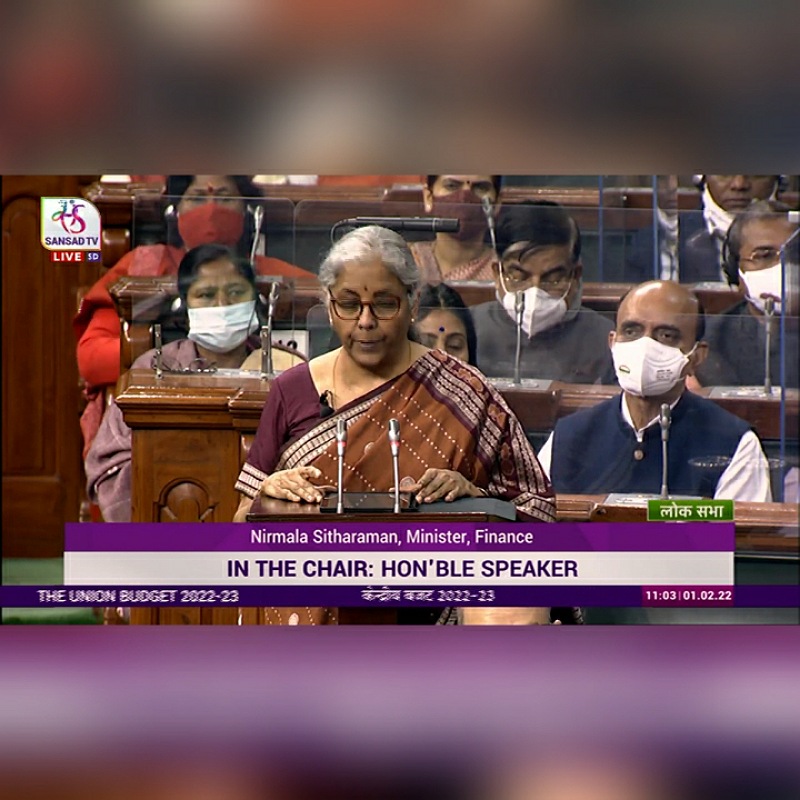
    MUMBAI:Should finance minister  Nirmala Sitharaman  be hailed  or should she be nailed? 
    The jury is out – as were the stock markets.

    One faction has been stunned in a negative sense and  is pretty morose that the government is not pumping in enough capital spending behind infrastructure to make up for the loss of revenue courtesy the tax reforms. Hence, they pulled down all the infrastructure stocks. 

    They will change their minds quickly should the government make some interim extra-budgetary announcements on infrastructure spends which it most likely will.

    Another faction is singing Sitharaman’s hosannahs for her tax reforms making government levies on personal  income nil upto Rs 12 lakh. They believe that the repressed middle class will run to the malls and markets and buy more groceries and garters (read: items of luxury) now that it will more money in its  pocket rather than given away to the government by way of taxes. Customers  will premiumise, go after articles of conspicuous consumption.

    This lot of the jury can’t stop praising Ms Sitharaman. They sent the stocks of FMCG, retail firms, entertainment outlets screaming up on the bourses. 

    Should they be proved right, then advertising spends will rise, sales will soar, and boy will it be party time for all. 

    On the whole, however, the Union Budget is being seen as growth oriented introducing significant measures aimed at stimulating economic growth and addressing key societal concerns.

    In a bid to bolster the middle class and enhance domestic consumption, the government has raised the income tax exemption threshold from Rs 8 lakh to Rs 12 lakh per annum. Additionally, tax rates for higher income brackets have been reduced, a move anticipated to increase household spending and savings. 

    The budget unveiled a six-year programme to boost the production of pulses and cotton, aiming to reduce dependence on imports. This includes state agencies purchasing pulses at guaranteed prices to support farmers. Furthermore, a “national mission” has been announced to develop high-yielding seed varieties, addressing challenges posed by shrinking farmlands and erratic weather. 

    Revised MSME criteria will double investment and turnover limits, benefiting over a  crore enterprises.
    Credit guarantee cover for micro and small enterprises will increase from Rs 5 crore to Rs  10 crore, with start-ups eligible for up to Rs  20 crore.

    A customised credit card scheme with a Rs  5 lakh limit will benefit 10 lakh micro-enterprises registered on the Udyam portal.

    A Fund of Funds with a fresh government contribution of Rs 10,000 crore will support start-ups. A scheme offering loans up to Rs  2 crore will target first-time women, Scheduled Caste, and Scheduled Tribe entrepreneurs.

    Labour-intensive sectors like footwear, leather, and toys will be promoted to boost employment and exports
    The government plans to modestly increase capital spending to offset revenue losses from tax cuts. This includes investments in infrastructure development, manufacturing, and exports. A high-level committee for regulatory reforms and the creation of an investment friendliness index have been proposed to improve the ease of doing business. 

    Measures benefiting the poor, youth, farmers, and women have been incorporated into the budget. The allocation for food, fertiliser, and rural employment subsidies remains nearly flat at Rs 4.57 trillion, with the rural job guarantee programme retaining its budget of Rs 860 billion. These steps aim to support the rural economy and provide a safety net for vulnerable populations. 

    Infrastructure ministries will outline three-year project pipelines under PPP mode. States can leverage the India Infrastructure Project Development Fund.

    The government has allocated Rs 1.5 lakh crore as interest-free loans to states for capital expenditure. The second Asset Monetisation Plan (2025-30) aims to unlock Rs 10 lakh crore for new projects.

    The Jal Jeevan Mission will extend until 2028 to achieve universal rural tap water access.

    Urban sector reforms will be incentivised, with a Rs 1 lakh crore Urban Challenge Fund supporting city redevelopment and sanitation projects.

    India Post will evolve into a logistics hub for MSMEs, with NCDC supported for cooperative lending.

    A National Manufacturing Mission will bolster clean tech production, including solar PV, EV batteries, wind turbines, and grid-scale batteries.

  • How CNBC-Awaaz managing editor Anuj Singhal sees Budget 2025 panning out

    How CNBC-Awaaz managing editor Anuj Singhal sees Budget 2025 panning out

    MUMBAI: Hindi business news channel CNBC-Awaaz  has budgeted oodles of programming and innovations as it seeks to give its viewers a simplified rendition of the Union  Budget when it is presented by finance minister Nirmala Sitharaman. 

    The channel’s managing editor Anuj Singhal shared his views on the upcoming Budget 2025 and detailed the channel’s comprehensive programming strategy to decode its impact on the economy and markets.

    Reflecting on the previous year’s budget, Singhal noted, “The 2024 Budget was essentially a vote-on-account, but significant announcements like the rationalisation of capital gains tax stood out. We expect the government to continue streamlining the tax structure and closing existing loopholes.”

    Singhal emphasised CNBC-Awaaz’s audience-focused approach under the theme Make or Break, aimed at day traders and investors closely tracking budget announcements. He highlighted the inclusion of expert panels, such as the Budget Editors, featuring CEOs and market specialists dissecting budget impacts on stocks and investments. The Budget Jury will cover tax, mutual funds, and broader market trends from both common investor and market perspectives. Additionally, a Tech Panchayat  will provide real-time stock trading insights based on budget developments.

    Addressing the challenge from digital-first competitors, Singhal revealed plans for a digital-exclusive stream featuring prominent anchors and experts on YouTube and other platforms. “We are fully leveraging our position as the number one digital business news platform in terms of reach,” he said.

    Singhal assured viewers of CNBC-Awaaz’s capability to track market reactions in real-time. “Our anchors live and breathe markets. We’ll keep one eye on the budget and the other on live stock movements, ensuring our audience doesn’t miss a single detail.”

    Special formats, including interactive charts and live market check-ins, will further enrich the coverage.
    On anticipated policy changes, Singhal was cautious: “We do not foresee a significant policy shift. The government’s prudent fiscal approach has served it well. Any major change would indeed be surprising.”

    With a robust line-up of expert opinions and digital innovations, CNBC-Awaaz aims to provide unmatched coverage of Budget 2025, empowering traders and investors with actionable insights.

  • CNN-News18 Town Hall brings together political bigwigs

    CNN-News18 Town Hall brings together political bigwigs

    Mumbai: The much-anticipated CNN-News18 Town Hall is set to make a grand comeback on 27 September in Mumbai. Renowned for its dynamic and thought-provoking discussions, CNN-News18 Town Hall has previously hosted editions across Delhi, Mumbai, Chennai, and Bengaluru. Over the years, the platform has seen key figures from politics, business, and entertainment converge to debate national issues and the country’s key policies.

    The theme of this edition, ‘Road to Delhi via Mumbai?’, arrives at a pivotal moment as India navigates its political landscape in the lead-up to assembly elections in Maharashtra. Previously, CNN-News18 Town Hall has featured prominent figures such as Nirmala Sitharaman, S. Jaishankar, Nitin Gadkari, Shashi Tharoor, MK Stalin, Aaditya Thackeray, along with entertainment actors like Kartik Aryan and Sameer Nigam.

    This year’s event continues this legacy with a series of engaging sessions focused on critical political and cultural topics. Maharashtra chief minister Eknath Shinde will lead a conversation on ‘Mahayuti’s Maharashtra Test’, discussing the coalition’s future in the state. Aaditya Thackeray, MLA, Maharashtra (Shiv Sena UBT), will delve into his party’s strategy in a session titled ‘Matoshree to Prove Its Might?’, while Deputy Chief Minister Devendra Fadnavis answers the question ‘Can BJP Get Its Math Right?’, as he examines the party’s electoral calculations. Supriya Sule MP, NCP (SP) will outline her party’s vision for the upcoming Assembly elections in a session titled ‘Pawar-Play: Maha ‘Binding’ Factor?’. On the other hand, Aditi Tatkare, State Minister and MLA, NCP (AP) will also share her views on the same topic. The CNN-News18 Town Hall would also see Milind Deora, MP, Rajya Sabha (Shiv Sena) and Priyanka Chaturvedi, MP, Rajya Sabha (Shiv Sena UBT) weigh in on ‘Who is the Real Shiv Sena?’ in back-to-back sessions. From the entertainment sphere, Sonakshi Sinha and Zaheer Iqbal will address “The New Reality of Theatrical vs OTT”.

    Network18 CEO – English & Business News Smriti Mehra said, “CNN-News18 has been the number one English news channel for over two consecutive years. This achievement is a testament to our commitment to delivering impactful, relevant content to our viewers. Given its stellar lineup of speakers, I have no doubt that CNN-News18 Town Hall will once again captivate our viewers and set the stage for essential conversations that will shape the nation’s future.”

    CNN-News18 managing editor Zakka Jacob added, “The CNN-News18 Town Hall was born out of a need for candid, unfiltered exchange of dialogue that goes beyond the usual political discourse. Now in its seventh edition, it remains a crucial space where the country’s most pressing issues are addressed by a diverse mix of leaders and influencers. As we bring together voices that shape policy, culture, and society, we continue to lead the national debate on what truly matters to India.” 

  • MIB pushes for GST exemption on digital news subscriptions

    MIB pushes for GST exemption on digital news subscriptions

    Mumbai: The Ministry of Information and Broadcasting (MIB) has urged the Department of Revenue to either exempt digital news subscriptions from the Goods and Services Tax (GST) or reduce the tax rate from 18 per cent to 5 per cent, as per media reports. In a letter addressed to Revenue Secretary Sanjay Malhotra, Information and Broadcasting Secretary Sanjay Jaju emphasised that newspapers are exempt from GST due to the importance of providing “correct and factual information” to Indian citizens.

    A note attached to the letter warned that the current higher tax burden could hinder the growth of the online news sector, potentially pushing it towards an advertising-based model, which could negatively impact the quality and credibility of news content.

    “With the growing internet penetration in India and the nascent stage of the online news industry, it is requested that the disparity between GST on printed newspapers and digital/online news subscriptions be addressed by either exempting the GST on the latter or reducing it from 18% to 5%, aligning it with the rate on e-books,” the letter stated.

    Digital publishers have been advocating for this change even before finance minister Nirmala Sitharaman presented the budget for the fiscal year 2024-25 on 23 July. MIB referred to a 29 September 2023, office memorandum that recommended exempting online news subscriptions from GST to create parity with printed newspapers. However, the revenue department’s office memo dated 5 June 2024, noted that the GST Council had discussed this proposal during its meeting on 11 July 2023, but did not endorse it.

    The MIB also cited a similar issue resolved in 2018 when the GST Council reduced the GST rate on e-books from 18 per cent to five per cent through a notification dated 26 July 2018. The 54th GST Council meeting is scheduled for 9 September, following the last meeting held on 22 June.

    In the attached background note, the MIB highlighted that very few internet users in India pay for online news. A higher GST rate on digital news subscriptions could push the online news sector toward an advertising model, potentially affecting the quality and credibility of content through practices such as clickbait, sensational headlines, and fake or misleading news.

    The MIB also pointed out that the 18 per cent GST on online news subscriptions generates approximately Rs 21.6 crore in revenue from a total revenue of Rs 120 crore. The MIB argued that reducing the GST to either nil or 5 per cent “may not lead to substantial revenue forgone by the government exchequer.” Online news subscriptions fall under the category of services for the “supply of images, text, and information and making available of databases.” The MIB stressed that providing “credible and factual information in the nature of news” is distinct from other online content services, as it “empowers citizens to make informed decisions and be aware of their rights and responsibilities.”

    Currently, printed newspapers, journals, and periodicals are exempt from GST. Under the IGST Act, online news subscriptions are taxed at 18 per cent as Online Information Database Access and Retrieval (OIDAR) services, which are internet services lacking a physical interface between the supplier and the recipient.

  • Times Now claims leadership during union budget week

    Times Now claims leadership during union budget week

    Mumbai: Times Now is claiming supremacy in the English news channel category during budget week with a 34.3 per cent viewership share (Source: BARC| 10L+| NCCS AB 22+| Wk.30 2024) and an impressive 12,48,000 reach (Source: BARC| 10L+| NCCS AB 22+| Wk.30 2024).

    A press release issued by it states that its budget coverage “stood out for its extensive and comprehensive programming, featuring detailed infographics highlighting key economic indicators, sector-wise expectations, and significant announcements.”

    The channel has also stated that it was  “No 1 on budget day, dominating the genre with a 33.7 per cent viewership share (Source: BARC| 10L+| NCCS AB 22+| 23 July 2024).”

    Times Now has further claimed that it became the preferred choice amongst viewers for budget-related news thanks to its seasoned journalists and strategic content. During finance minister Nirmala Sitharaman’s speech, it said that it registered a 34 per cent viewership share, “the highest in the genre” (Source: BARC| 10L+| NCCS AB 22+| 23 July 2024, 11 AM – 12 Noon),  Real-time graphical analysis of the speech kept viewers informed on the budget’s implications, making this the most crucial hour of the day with a reach of 44,000 (Source: BARC| 10L+| NCCS AB 22+| 23 July 2024, 11 AM – 12 Noon).

    Times Now’s union budget programming featured examinations of the Indian economy and its challenges during pre-budget discussions. Key panel discussions offered crucial insights into the budget, with tax experts Rohinton Sidhwa and Saloni Roy decoding its significance for various sectors, industries, and the middle class.

    Former chief economic advisor KV Subramanian provided perspectives on expected reforms, while representatives from industry bodies like CII outlined their demands from the government.

    Prominent government personalities, including union minister of commerce and industry Piyush Goyal, minister of petroleum and natural gas Hardeep Singh Puri and minister of railways and information & broadcasting Ashwini Vaishnaw, along with top departmental secretaries and opposition voices, shared exclusive insights on the budget.

  • CNBC TV-18’s expertise and specialization on tracking, analyzing and decoding the Budget has consistently evolved over the past 25 years: Shereen Bhan

    CNBC TV-18’s expertise and specialization on tracking, analyzing and decoding the Budget has consistently evolved over the past 25 years: Shereen Bhan

    Mumbai: Finance minister Nirmala Sitharaman’s seventh budget is anticipated to navigate delicately between stimulating consumption and boosting investment. While there might be a focus on immediate results through consumption-driven economic growth, achieving sustainable long-term prosperity demands a prioritization of investment. Investment not only fosters innovation and enhances infrastructure but also generates lasting employment opportunities, thereby fortifying economic resilience.

    CNBC-TV18, India’s leading English Business news brand, under their Budget special “Go For Growth” theme and campaign, launched a special initiative called the ‘CNBC-TV18 Budget Box – Share Your Budget Wishlist for the FM’, that aims to resonates with the nation’s sentiment, providing a platform for citizens to express their expectations leading up to Budget 2024.

    The Budget Box journeyed to multiple locations across Mumbai and Delhi, including various PVR cinema venues, prominent colleges such as KJ Somaiya Institute, Welingkar Institute of Management, New Delhi Institute of Management, JIMS, New Delhi, and 7/11 convenience stores. This extensive outreach also aims to engage with viewers in real-time, encouraging them to voice their budget wishlist.

    Additionally, their virtual budget box on the website allowed their social media followers to participate by sharing their wishlist for this budget. People also had the opportunity to interact with CNBC-TV18 by using an interactive AR filter, thus enhancing their engagement. Through these efforts, they have successfully garnered over 3000 responses as part of the audiences’ budget wishlist from diverse demographics across cities.

    Indiantelevision.com reached out to CNBC-TV18’s Managing Editor Shereen Bhan where she shared her insights, excerpts, and details on what one can expect from the upcoming union budget.

    Edited excerpts

    On CNBC-TV18 preparing for the upcoming budget and witnessing any significant changes in terms of tax policies or fiscal measures

    Our preparation remains the same, ensuring we deliver timely and comprehensive analysis to our viewers in real-time. We decode the fine print and its implications with top voices and expert analysis, which continues to be our unique selling proposition (USP). We also ensure a diverse range of influential opinion makers from industry, policy, and politics contribute to our platform.

    Regarding the upcoming budget, I do not anticipate any significant deviation in terms of fiscal math present during the interim budget. If anything, the government may improve the fiscal deficit number, buoyed by robust tax collections and substantial RBI dividends. While there’s speculation about populist schemes, we believe this expectation is somewhat exaggerated. Instead, the government is likely to introduce measures aimed at alleviating sector-specific challenges. Overall, we do not foresee a deviation presented during the interim budget by the government.

    Key portfolios remain in the hands of the same ministers, signaling a consistent direction. This theme of continuity is expected to extend into the upcoming budget. Specific states like Andhra Pradesh and Bihar, crucial allies seeking assistance, may receive special considerations. With important elections in Maharashtra and Haryana looming, political factors could also influence budgetary decisions. Moreover, enhancing manufacturing and improving the ease of doing business are likely focal points for this budget.

    On sectors you think will receive the most allocation in the budget

    In recent years, the government has notably been specific with the investment in infrastructure through increased public spending, reaching historic highs. Expectations are high for this trend to continue, with calls from bodies like CII for even more substantial allocations than those in the interim budget. Manufacturing remains a key focus area, especially with existing PLI schemes in place. Anticipations include potential new policies aimed at attracting investments, particularly in sectors like medical device manufacturing. Overall, the government is set to prioritize further developments in the manufacturing sector.

    Regarding consumption, industry stakeholders are urging the government to increase disposable income for consumers, possibly through tax relief—a move not recently seen. Whether such measures will feature in this post-election budget remains uncertain. Overall, stability and continuity are expected, with a renewed focus on established priority sectors such as semiconductors and initiatives like the AI roadmap. The allocation for electric vehicle mobility is eagerly awaited, highlighting key areas to watch in the upcoming budget.

    On the budget addressing the common citizen’s concerns related to inflation and cost of living

    The prices of goods, which are now more influenced by GST rather than the budget. However, expectations are high for the government to provide tax relief or revise tax slabs, offering benefits to taxpayers. Industry recommendations include increasing installments under schemes like PM Kisan Yojna for farmers. Overall, there is consensus that the budget must address the overarching issue of stimulating growth. A robust growth rate of 8-8 per cent or higher is seen as pivotal in addressing various economic challenges. Both industry and government messages emphasize a commitment to fostering growth, encapsulated within CNBC-TV18’s Budget special theme of “Go for Growth.” It is hoped that the budget will sustain and enhance the current growth momentum, leveraging India’s relative economic strength amidst global uncertainties.

    On salaried class keeping high expectations from the budget over the years since last few budgets have been quite disappointing in terms of opportunities to optimise tax and potential for long term savings with higher returns

    Considering historical trends, expectations for substantial tax relief should be moderated. The government has highlighted a shift away from exemptions towards a cleaner and simpler tax regime, possibly with lower tax rates. However, the challenge lies in convincing taxpayers to embrace these new schemes enthusiastically. The upcoming budget may aim to address this by introducing measures that make the new tax regime more appealing. This strategic approach reflects the government’s goal of encouraging widespread adoption of the revamped tax framework.

    On the budget addressing issues related to foreign investment and global market integration

    Once more, the government aims for continuity, particularly through initiatives like the PLI scheme, to integrate Indian industries into the global supply chain. The objective is to attract foreign direct investment, capitalising on the global trend of diversifying away from China. India seeks to position itself as a viable alternative, appealing to global companies looking to mitigate risks. Efforts will likely focus on bolstering specific industries based on recommendations, reinforcing India’s attractiveness for both manufacturing and servicing, and emphasising its role in global supply chains.

    On the evolution of CNBC TV18′ approach to analysing critical areas of the budget

    Our expertise and specialisation on the Budget have consistently evolved over the past 25 years, I think we have institutionalised the Budget coverage in the country. With vast experience garnered and muscle memory developed from covering numerous budgets, we bring real-time analysis that adds immediate value to our viewers. While others may publish insights hours later, our ability to provide timely perspective sets us apart. With our team collectively amassing hundreds of years of experience in live event tracking, particularly in budget analysis, we offer a unique and comprehensive perspective.

    Every year we try to do something different. Every time we try to scale up our efforts. So through innovation, even the look and feel of our budget coverage has also evolved and transformed over the years. We don’t want to be another channel that covers the budget. We want to be the nation’s Budget Headquarters and we have been. If you look at our ratings in the last many years, you can see an unprecedented 90 per cent+ kind of dominance share and so we continue to take that job of bringing the budget headquarters to our audience very seriously and put our best put forward on air as well as off air. 

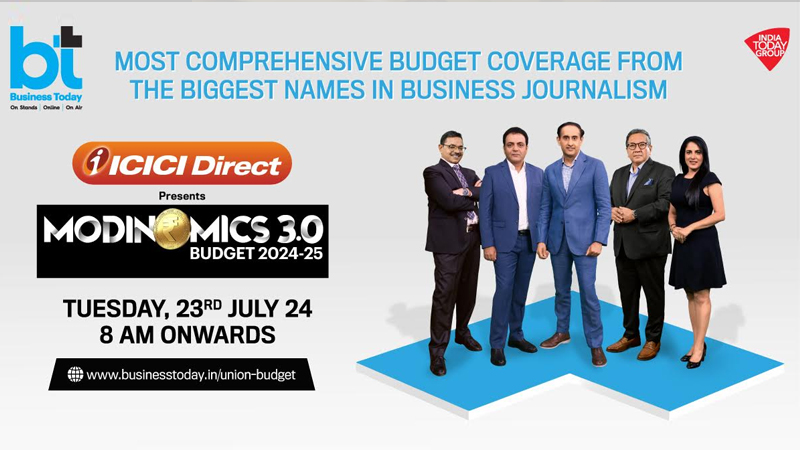
  • Modinomics 3.0: All set for Budget 2024-25 with Business Today

    Modinomics 3.0: All set for Budget 2024-25 with Business Today

    Mumbai: The stage is set for the first Budget of prime minister Narendra Modi’s third term. Union finance minister Nirmala Sitharaman will deliver her seventh Union Budget on Tuesday, 23 July. As anticipation builds up for this crucial event, Business Today has geared up to provide an in-depth analysis of the Budget fine print.

    Business Today’s ‘Modinomics 3.0’ coverage focuses on the expectations in a time of changed political alignments, around issues like the need for tax breaks, prudence versus populism, and the need to boost jobs and ensure growth. Supporting India’s Aatmanirbhar stock market and helping people earn, invest and prosper is also part of the detailed coverage.

    From changes in direct taxes to pushing infrastructure and manufacturing, from a new deal for agriculture to social welfare—this Budget has many expectations rising.

    Business Today will be there to track the nuances of the Budget. BT also welcomes its Presenting Partner ICICI Direct for its high-impact Budget Special Modinomics 3.0.

    I-Sec operates www.icicidirect.com, a virtual financial supermarket, meeting the three needs sets of its clients—investments, protection, and borrowing. Through its four lines of businesses—broking, distribution of financial products, wealth management, and investment banking—I-Sec serves customers ranging from retail and institutional investors to corporates, high net-worth individuals and the government.

    Business Today’s 360° offerings span print, digital, livestream, VoD, social media, OOH, and brand partnerships to ensure its exclusive content reaches a wider audience and offers insights for decision-makers.

    It’s the most comprehensive Budget coverage from the biggest names in business journalism, ensuring a thorough understanding of the fiscal landscape and its implications.

    Tune in to all the action across the Business Today multiverse and get in-depth information as the budget starts and ends with BT.