It‘s a reality show that‘s been unfolding behind the Indian TV screens for quite a while now.
While the booming industry makes strides on the technology front in India, human resource management remains a low priority area.
Beneath the glamorous costumes, the impressive sets and colourful imagery, are long hours of hard work under harsh arc lights. An unorganised industry ensures that most work contracts with artistes, technicians and allied staff do not include insurance cover or damages in case of emergencies
Indiantelevision.com‘s assistant editor Aparna Joshi examined the issues involved in some detail and prepared this report.
While most of those who survive on the industry prefer to bury or whitewash such incidents to safeguard their survival, Niki Aneja is one TV actor who chose to come out into the open in 2001.
|

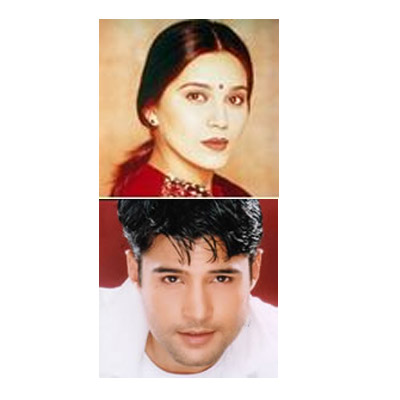
Niki with Mukul Dev in Gharwali Uparwali
|
In June this year, Niki was hit by a car during a routine episode of the slapstick comedy Gharwali Uparwali, aired on Star Plus. She was shooting for the Prime Channel production in Film City, Goregaon, when a junior artiste driving the car for a shot accelerated instead of applying the brakes. The actress was bruised badly and spent the next three weeks in hospital. It took another three months for her to recuperate and get back to what was earlier routine for her: facing the camera. An embittered Niki is however, outraged at the alleged indifference of the production house, which she claims refused to take her calls or offer medical expenses.
Prime Channel, on the other hand, says it offered an initial medical reimbursement of Rs 50,000 immediately and would have paid all her hospital expenses if Niki had agreed to arbitration rather than file an FIR with the Aarey colony police station.
This, in essence, is the norm for the Indian film industry. Most such cases, say sources, are settled informally. Recourse to the police and the judiciary is perceived as going against the grain of the industry, and invites scorn, even boycott.
The production house is still willing to settle her dues if she withdraws her complaint that has resulted in a legal wrangle, says Cine & TV Artistes‘ Association president Dharmesh Tiwari. Tiwari says the association is unable to mediate so long as the case is pending in court, and says it has offered to help negotiate if Niki withdraws the complaint. She has, however, refused to do so.
(Click here for Niki Aneja‘s interview)
Shrey Guleri, head of Prime Channel, on the other hand, maintains that the production house is willing to shoulder the medical expenses on humanitarian grounds although the contract with the artistes states expressly that the company is not liable to pay any compensation in case of mishaps.
For the Indian film industry, it doesn‘t pay to invest in HRD
A few days before Niki‘s accident, assistant film director Kuljinder Singh Gill died when a water tank burst over him in one of the studios in Film City. A platform he was standing on collapsed, drowning him in the swimming pool below. Gill was not a member of any association, and was compensated by the film producer Sibte Hasan Rizvi, art director Nitin Desai and lead actor Govinda. Actor Avtar Gill, Kuljinder‘s brother, says: “The amount was not negligible, but not adequate for the family either,” adding that perhaps the benefits might have been better if his brother had been part of an association.
The entertainment sector in India is now officially an ‘industry‘, but section 13 C [2] of the IDBI Act, 1964, evoked to give it such status has no provisions that protect labour interests or ensure proper infrastructure, say industry sources. A mere handful of film producers have gone in for insurance cover for employees, contractual and otherwise. TV production houses however, lag sadly behind, despite churning out many more hours of software than the moviemakers.
The Western India Cine Employees Federation takes up the cause of the employees, permanent or contractual, whenever there is a complaint. A fee of Rs 25 per month entitles the members to a personal accident insurance of a hundred thousand rupees, says Tiwari. Individual producers, working on tight budgets from television channels, are unwilling to shell out funds for an apparently unnecessary overhead. Consequently, when an accident does occur, the employee usually gets the minimum amount stipulated by the Workmen‘s Compensation Rules. This amount is usually derived after taking into account factors like his daily wage, his productive life span and the extent of injury. Which usually does not amount to more than Rs 100,000 in most cases. Very often, the surviving victim or his kin have to depend on the largesse of producers, film stars and the association.
The Star experience
Television channels, which commission the programmes to private producers claim they are not concerned with the expenditure of the budget allotted to the producers. Says Star India communications head Shola Rajachandran: “The entire KBC (Kaun Banega Crorepati) set was insured by us but it is not a rule that we insure every production that is to appear on our channels. Also, we have no say in how the production houses are managing their funds.”
Star, incidentally, got the first 130 episodes of KBC and eight test matches between India and Australia earlier this year, insured for over Rs 1 billion and Rs 10 billion respectively, through the Delhi-based Oriental Insurance Company (OIC).
KBC also got a second phase of risk cover with the launch of Junior KBC, and with it, Star got itself a good discount on the premium as the initial 130 episodes were totally risk-free. Industry sources say the KBC deal opened up vast business potential for insurers in the Rs 600 billion entertainment industry.
Identifying the possible risks of the programme, bringing about a consensus between the insurer and the party and putting a premium on the set of identified risks were challenges OIC reportedly had to overcome before persuading Star to buy the cover.
For KBC, a prime consideration was the well-being of anchor Amitabh Bachchan and his family – the “central risk” for both the insurer and the channel. The other primary peril factored in is the normal operation of equipment during the shooting and the post-production stages. The insurer has to pay for the shooting if any of the equipment fails in the production stages. Other perils such as litigation, natural calamity and safety of the participants also reportedly featured prominently in the deal. While KBC‘s premium for the 130 episodes is at around Rs 1 million, the eight cricket matches have earned OIC around Rs 6.3 million.
No rules bind production houses to offer cover to artistes
One of the few production houses that has consistently insured sets as well as artistes is Mumbai based Creative Eye. The company, which started producing software for DD in 1986, says it insures every member of the unit before commencing shooting. “Safety is a prime concern for us, no matter what the cost,” says executive director D Dass.
Others like Tracinema Productions have come up with their own solutions for unforeseen incidents. According to creative head Vinta Nanda, the entire unit of the serial Tara paid a month‘s pay every year of the duration of the serial to Bashir Khan, one of the actors, who suffered a paralytic stroke during its making. Nanda, who says Tracinema is now planning to get general insurance for forthcoming projects, admits: “In this industry, we all have to derive and devise your own system.”
Production hotshop Balaji Telefilms CEO Sanjay Dosi says his company had initiated talks with insurance companies earlier, but no scheme has been worked out. The Balaji sets located in the company headquarters are insured, he says. He added that it would be a good idea to cover artistes and allied workers on a set.
Admits Sameera Kohli, head of business development at In House Productions: “Insurance cover is sought when someone is willing to bear the additional cost.” She says that the decision to provide insurance cover for shoots is taken keeping in mind the project. “Unless it is a high-risk shoot no cover is required.” The scene is quite different in most developed countries though. A variety of associations which safeguard artistes‘ interests exist, in tandem with producers‘ guilds. Often its a question of bargaining power, but its an organised industry out there in many countries. (Click here for the International Scene)
If there‘s a will, for a minor consideration, there are options aplenty
Production houses have a number of choices if they are willing to provide for the safety of those who work on their projects.
? Insurance companies say they can provide personal accident cover to artistes, either directly employed or through a contractor.
? A second option offers cover under the Workmen‘s Compensation Rules for the number of unspecified artistes who are employed through contract.
? There is also a third option of a Public Liability policy that covers the general public, which is at risk near erected sets.
The premia on these policies are not prohibitive, says a New India Assurance spokesperson, except in cases where stuntmen and dummy artistes are involved. He, however, admits that there are hardly any production houses that opt for these policies unless shooting locations owned by utilities like the Indian Railways insist on insurance cover before filming commences! Most producers admit that the major hitch is the difficulty in submitting detailed project reports and commitments to banks and financial institutions.
It‘s been done before?
Insurance policies for film sets do not always spell bad news for producers. A producer of a motion picture, being made for Rs 30 million, has to pay around Rs 500,000 as premium, at a rate of 1.5 per cent.
But the tab may well be worth it in case of a mishap. Film producer Yash Chopra claimed a compensation of Rs 3.5 million from United India Assurance when Aishwarya Rai had an accident, her shooting schedules were disrupted and a set put up for her had to be dismantled, according to newspaper reports. Several insurance companies, taking the lead from their western counterparts, have agreed to compensate for delays and losses due to cyclones, bandhs, weather and strikes, as well as harm to persons involved in the filmmaking.
Generally, film sets are insured for the main cast, important support cast, directors and technicians. This includes properties, sets, production equipment, negatives, public liability, money insurance, workmen insurance and accident insurance.
The road ahead
A strict regulating body will go a long way in ensuring the presence of supervisory personnel on sets to see that safety measures are adhered to.
Producers, to keep down wages and do away with benefits, exploit lack of security among those seeking work with film production units. Representative bodies with a strong bargaining power to take care of interests of the varied crafts in the film business are needed to ensure that accidents do not remain just a bad memory for artistes like Niki Aneja.
Stringent legislation requiring insurance cover for the safety of unit members is also needed. While a few TV channels and production houses have taken the lead in ensuring the wellbeing of unit members, others will probably need government coaxing to follow suit.
This also requires that the industry as a whole be more organised. Payments made to artistes and highly paid technical personnel will have to be regularised, and comprehensive contracts drawn up to avoid unscrupulous exploitation.
It‘s a long road ahead for the Indian television industry; better organisation will certainly make for a smoother ride.