Tag: Nikhil Kumar

  • Measuring the Impact of DOOH Advertising: Metrics and Tools for Success

    Measuring the Impact of DOOH Advertising: Metrics and Tools for Success

    Mumbai: Out-of-Home (OOH) advertising, is a long-standing pillar of marketing, and has maintained its presence through attention-grabbing billboards and posters at various locations. Its versatility across formats and settings has allowed marketers to connect with audiences beyond conventional media. Recently, digitalization has transformed this landscape, infusing digital technology into physical spaces and creating a bridge between the offline and online worlds. Digital Out-of-Home (DOOH) advertising leverages digital displays, interactive interfaces, and data-driven insights for a new level of engagement and impact.

    With its ability to deliver dynamic content, optimize creative messaging, provide real-time buying metrics, and accommodate various budget perspectives, DOOH has become an indispensable part of modern advertising strategies. The fusion of offline and online elements presents both opportunities and challenges in terms of measuring the impact and effectiveness of advertising efforts. According to industry projections by IMARC group released earlier this year, the DOOH market in India is expected to be about $3.2 billion by 2027 and that presents valuable opportunities to advertisers.

    DOOH: Integrating Consumer Journeys for the New-Age Consumers

    The pandemic has highlighted the importance of programmatic & omnichannel marketing and it has compelled marketers to be more creative in finding cost-effective ways to implement strategies that offer better ROI. One of the key benefits of programmatic DOOH for brands is the flexibility to deliver ads more efficiently and cost-effectively than traditional advertising methods.

    Programmatic DOOH allows advertisers to automatically implement various targeting and creative options based on geography, weather, venue/screen types, or even time of day. This personalized approach helps to customize campaigns for the user and deliver the right messaging with higher accuracy. Not to mention that, with the right technology partner synchronization with other devices is possible, achieving true omnichannel strategies. By taking advantage of the impact of out-of-home screens and using dynamic content, programmatic DOOH is empowering advertisers to create engaging campaigns and connect deeper with their audiences, at the right stage of the customer journey.

    This ensures that their ad spend is being used effectively and that they are getting the most value for their investment. In addition, with the integration of Mobile, CTV, and DOOH campaigns, marketers can provide a seamless and synchronized experience for consumers, enhancing brand engagement. DOOH campaigns have, thus, picked up as a missing piece of the puzzle to close the gap between online and offline worlds.

    Making Outdoor Advertising More Measurable

    In the past, brands have struggled to measure the effectiveness of OOH campaigns. Who saw the ad? Where has it been displayed? Is it a high traffic area? DOOH with its location data accuracy and tailored KPIs: ad plays, impression multipliers and actual impressions covers what was lacking in OOH.

    However, in the realm of DOOH, measuring the impact goes beyond mere visibility. While reach remains a fundamental metric, programmatic DOOH is also able to make marketers understand high value impact such as interaction with the screens through QR code scanning, NFC tags or the most convenient option for the end user: synced campaigns on personal devices like the smartphone.

    Let’s dive into a practical example: you are a retailer with a seasonal promotion across certain neighbourhoods that you are advertising with impactful DOOH ads. Imagine being able to serve a map to the mobile of the people that saw your DOOH ad and bring them to your store. Not just a map with directions, but one that is tailored to point the consumer to the closest store. And not only serve the ad, but measure the footfall to the store. It might sound like magic, but it is reality in 2023. How is that possible? The real-time data and geolocation sapience allows advertisers to synchronize campaigns across multiple channels to achieve holistic campaigns. Additionally, weather-based targeting and creative optimization allows to automatically adapt ads and campaigns to weather conditions, making the reach in real-time more effective.

    Launching a DOOH strategy

    DOOH is an interesting medium for both advertisers and consumers because of the nature of the screen – the screen is not owned and used by a person or group of people, unlike a mobile or CTV. The screen is in an outdoor setting like a street and what the advertisers can measure with DOOH advertising is dependent on other impression multipliers, ad plays, or bid offers.

    By partnering with the right technology providers, DOOH can achieve so much more! To maximize the impact of DOOH campaigns, a smart retargeting strategy that syncs ad campaigns to take action on mobile can make a difference. Track conversions and attribute them to specific campaigns. For example, a campaign promoting an app that includes a DOOH ad that syncs with the mobile phones of the people around those screens and even the CTV within their household can track the number of app downloads or even purchases made by viewers who were exposed to the advertisement.

    Embracing DOOH’s Impact

    The rise of DOOH, deeper integration with other channels, smarter data utilization, increased digitization, and a continued focus on media for good will collectively result in a creative re-set as digitally-minded brands seek to capitalize on untapped opportunities. In an era where consumers crave authentic and meaningful interactions, DOOH advertising stands as a powerful tool, and the ability to measure its impact ensures that brands can continually evolve and connect with their audiences at the right moment.  As DOOH continues to evolve and integrate with emerging technologies, like the synchronization with other screens, its potential to captivate audiences and deliver impactful advertising experiences will only grow.

    The author of this article is mediasmart Affle VP Nikhil Kumar.

  • Connected TV set to majorly boost digital viewership and advertising spends this IPL

    Connected TV set to majorly boost digital viewership and advertising spends this IPL

    Mumbai: The latest edition of the IPL is just around the corner and Indian audiences are abuzz about what to expect from it with a new digital destination for the league in JioCinema. What spices up expectations this year even more is the advent of Connected TV which is bound to heighten the IPL viewing experience. JioCinema’s offering of free streaming of the IPL has made this year a bonanza both for cricket enthusiasts and advertisers. We will also see the viewership of the games reach record levels.

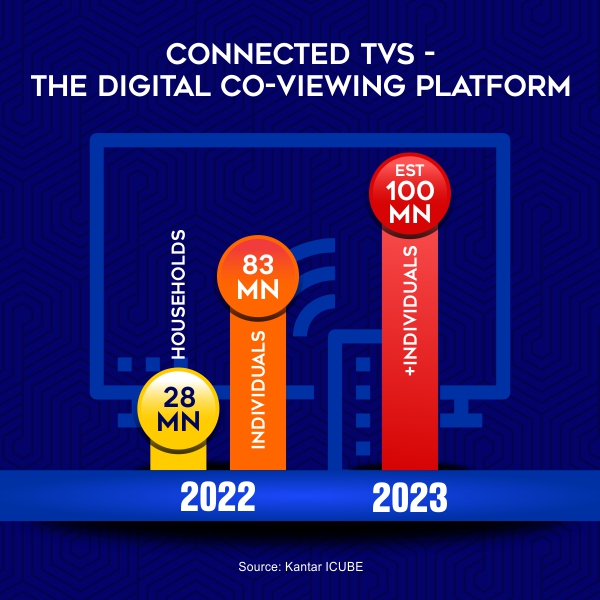
    The latest Kantar ICUBE report states that the number of CTVs in India stands at a staggering 28 million in the last year alone. In terms of individuals watching content on CTV, the report pegs that number at a whopping 83 million. This could only go up multi-fold once the IPL is available for free streaming on CTVs, with an estimated 100 million+ viewers watching content on their CTVs later this year.

    In recent years connected TV (CTV) has seen growth not only in urban but also Tier II and III markets. And that’s for a good reason. CTV offers viewers an enhanced, and technologically unparalleled viewing experience. Fans opting to catch the IPL on CTV get access to the blockbuster league with the whole family for free on JioCinema, and the 4k streaming offering makes the live sport viewing experience friction-free.

    The penetration and demand of IPL on CTV would likely be accelerated further given the recently introduced ‘Jio Media Cable’ in households that don’t own a smart TV yet or do not wish to pay for cable or DTH. The device enables people to connect their phones to their regular TVs and convert them into smart TVs. This will add to the already existing CTV viewer base that will be watching IPL this year on Connected TV. In effect, this is expected to rake in more brands to consider digital as an advertising medium for the IPL for its larger base and potential for brand messaging.

    Reports earlier stated that JioCinema is offering IPL in 12 regional languages this season, effectively meaning the average viewer will not just have the option to watch coverage in English or Hindi but in many other languages too. The benefits of this are also passed on to the advertiser that will have the flexibility not only to advertise in Hindi and English but also in regional languages.

    IndianTelevision.com spoke to a few experts to understand what the wider reach and use of never-seen-before tech on CTV means from an ad standpoint. mediasmart Mobile vice president India & SEA Nikhil Kumar said, “With India’s largest sporting property around the corner, we are witnessing 2 schools of thought existing in parallel- one evangelizing continued growth within linear TV and the other rooting for the meteoric rise in CTV user base and continued mobile digital penetration for OTT platforms.”

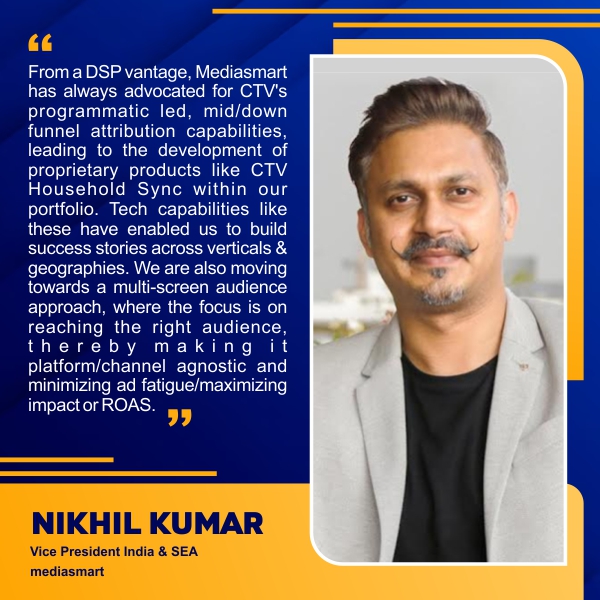
    He further goes on to add, “From a DSP vantage, mediasmart has always advocated for programmatic led, mid/down funnel attribution capabilities of CTV, leading to the development of proprietary products like CTV Household Sync within our portfolio. Tech capabilities like these have enabled us to build success stories across verticals & geographies. We are also moving towards a multi-screen audience approach, where the focus is on reaching the right audience, thereby making it platform/channel agnostic and minimizing ad fatigue/maximizing impact or ROAS.”

    Efficacy Worldwide Pvt Ltd co-founder and chief operating officer Sapna Sharma stated, “With digital adoption overtaking the Linear TV reach, Connected TV and digital are becoming the most preferred media options for the audience to consume any content as the user experience and audience comfort is unparalleled to other mediums.”

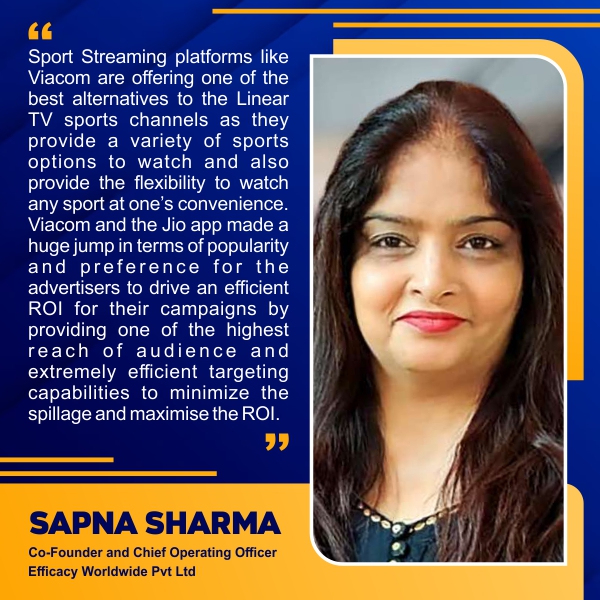
    She also added, “Sport Streaming platforms like Viacom are offering one of the best alternatives to the Linear TV sports channels as they provide a variety of sports options to watch and also provide the flexibility to watch any sport at one’s convenience. Viacom and the Jio app made a huge jump in terms of popularity and preference for the advertisers to drive an efficient ROI for their campaigns by providing one of the highest reach of audience and extremely efficient targeting capabilities to minimize the spillage and maximise the ROI.”

    Finecast India (GroupM) national head – client development Rajiv Rajagopal says, “India is set to be the 3rd largest TV market by 2024. The rise in online streaming & consumers’ preference to watch content on the big screen has fuelled the growth of Connected TV. The accuracy at which CTV can serve an ad at the household level plays a crucial role in building an addressable TV ecosystem.

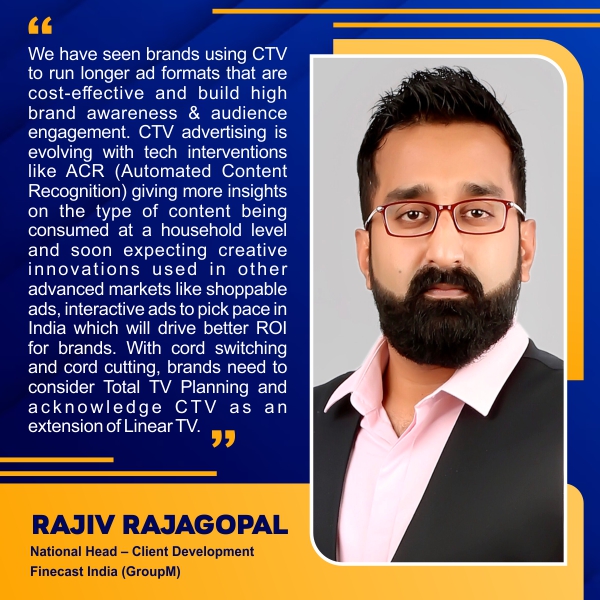
    We have seen brands using CTV to run longer ad formats that are cost-effective and build high brand awareness & audience engagement. CTV advertising is evolving with tech interventions like ACR (Automated Content Recognition) giving more insights on the type of content being consumed at a household level and soon expecting creative innovations used in other advanced markets like shoppable ads, interactive ads to pick pace in India which will drive better ROI for brands. With cord switching and cord cutting, brands need to consider Total TV Planning and acknowledge CTV as an extension of Linear TV.”

    Amplifi India chief investment officer Sujata Dwibedy mentions, “In today’s hyper-linked, data-heavy world, consumers want brands to offer more focused, relevant messaging. As a result, advertisers now realize that if they want to make a meaningful impact, they must shift from simply competing for eyeballs to designing meaningful, engaging experiences. Mobile-first Indian consumers are rapidly shifting towards connected TV (CTV) and over-the-top (OTT). While CTV viewing has increased by more than 80% globally, CTV adoption in India is still at a nascent stage but did grow hugely in 2021 and then in 2022. By 2025, it is estimated that there will be 100 Mn households in India, earlier this estimation was in the range of 45-50 Mn households.”

    She goes on to add, “Many Indian consumers are replacing their traditional TV units with connected TV. One of the primary reasons for this change is the increasing preference towards OTT platforms, as India’s OTT market is one of the fastest growing globally. Another prime factor for the growth of CTV in India is the affordable, low-priced smart TV brands available in the market.”  

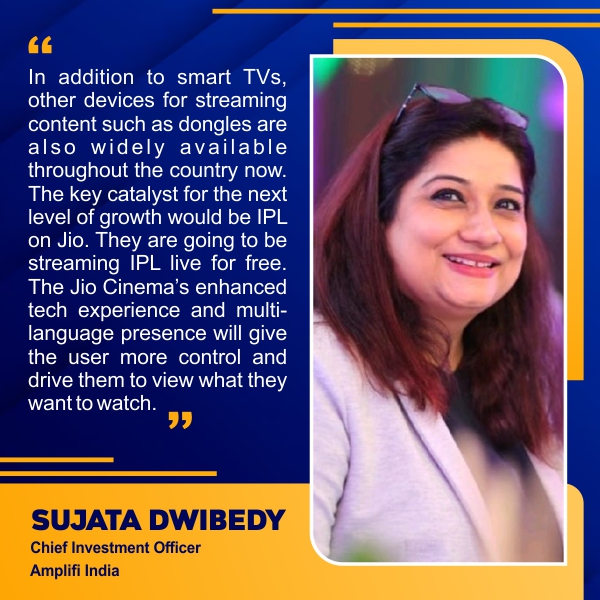
    “In addition to smart TVs, other devices for streaming content such as dongles are also widely available throughout the country now. The key catalyst for the next level of growth would be IPL on Jio. They are going to be streaming IPL live for free. The Jio Cinema’s enhanced tech experience and multi-language presence will give the user more control and drive them to view what they want to watch. “

    She says,” Their streaming device which is priced very low (Rs 400 – Rs 500) can mirror the mobile on-screen converting any TV to a CTV! CTV will become a mass access entertainment platform & audience will widen for IPL. Growth should come from tier II and tier III markets. The only thing that could delay this process is the speed of the internet beyond the metros.”

    Dwibedy asks how brands are getting value/ROI for the money spent. “Till now the CTV has not been very efficient as it came at a premium. The pricing was always 2x, or 3x of the normal buys. With IPL and an increase in mass reach, it will change the dynamics. We have started working with OEM partners like Samsung, etc. They will lead in the next few years, as the Smart TV price has been dropping and the ease of connectivity is paramount for entertainment. Advertisers have started testing these platforms very well.”

    According to her, “The key metric on CTV that works well is Incremental reach; it could be used as an extension of linear TV campaign reach. It also enables more interactivity. CTV gives advertisers the ability to earn more stickiness, which increases brand awareness and opportunities for conversions. Hence Clients are willing to park certain budgets on CTV even if it is at a premium today. It is great for co-viewing & multi-screen audience to reach. There is a lot still to be done in this space, especially in terms of data measurement/ attribution and ROI, the journey has only begun.”

    CTV is here to stay and one cannot deny the convenience it offers. It offers the flexibility of watching matches on any device anywhere and at any time. This IPL is going to be very exciting not only for the viewer but also for the advertisers.

  • TimesPro onboards L&K Saatchi & Saatchi India to develop its brand campaign

    TimesPro onboards L&K Saatchi & Saatchi India to develop its brand campaign

    Mumbai: EdTech platform TimesPro announced the appointment of L&K Saatchi & Saatchi India to create and launch its brand campaign.

    The agency won the business as part of a multi-agency pitch. The agency has been invited on board to actualize TimesPro’s efforts to build brand visibility across all learner categories, and the project will be managed by the Mumbai team of L&K Saatchi & Saatchi.

    TimesPro head of brand marketing & communications Gaurav Barjatya said, “We look forward to collaborating with L&K Saatchi & Saatchi on this important project. Their creative approach, built on consumer insights and business effectiveness, is exactly what the brand requires during its growth phase.

    Sharing his views, L&K Saatchi & Saatchi joint national creative director Rohit Malkani said, “This has been a particularly rewarding win! The education space is ripe with innovation and new thinking. And TimesPro is poised to create an extraordinary product. We’re delighted to partner them on a journey that promises to be exciting, uncharted and rewarding all at once.”

    L&K Saatchi & Saatchi EVP & business head Nikhil Kumar commented, “We are truly proud to have won the TimesPro mandate after a multi-agency pitch. With the edtech boom in the country and the private sector playing a pivotal role in facilitating this, we felt it was an opportunity to not only scale up this vertical of the Times Group, but also partner with them in defining its core purpose and reason to exist.”

  • India’s smart TV market grew 74 per cent YoY in Q2’ 22: Report

    India’s smart TV market grew 74 per cent YoY in Q2’ 22: Report

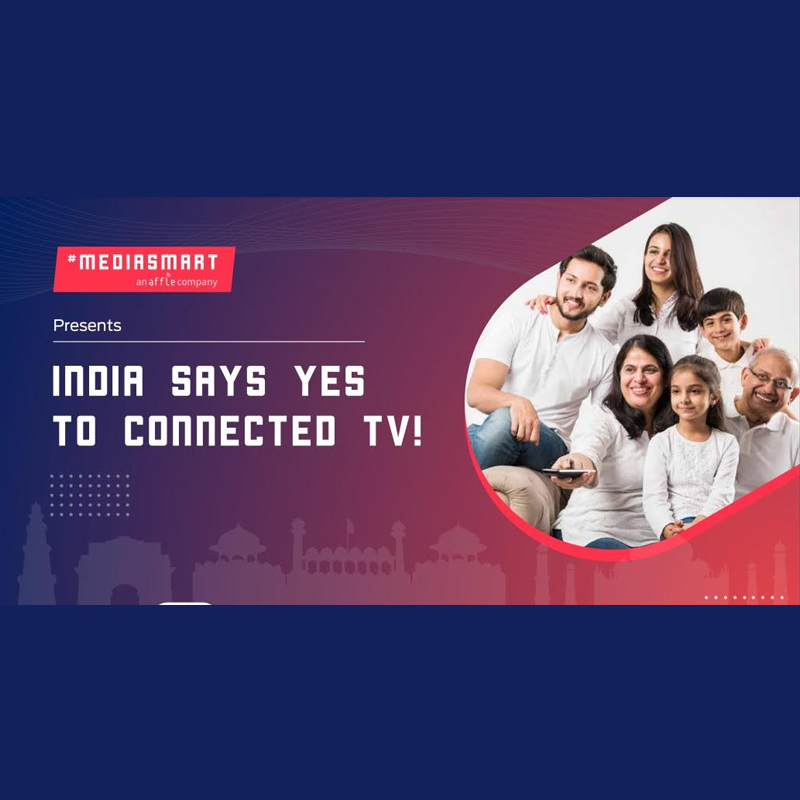
    Mumbai: mediasmart, an Affle company, has published the second edition of its India CTV Report 2022, titled “India Says Yes to Connected TV!” The report stated that India’s smart TV market grew 74 per cent YoY in Q2’22.

    The report focuses on consumer adoption trends in metro and non-metro areas, as well as a significant shift in CTV ad potential for brands and marketers. According to its report, CTV viewing is a part of the daily routine and a preferred source of entertainment. CTV consumption is driven by adults, including grandparents. 78 per cent had a smart TV, of which 93 per cent used the internet to consume content.

    TV subscriptions stood at merely five million subscribers in 2020, but quickly doubled to 10 million in 2021. By 2025, this figure is expected to become 4x.

    mediasmart vice president (India & SEA) Nikhil Kumar said, “Our report this year goes deeper into the reach and impact of CTV. It is interesting to see how far CTV has grown into the metros and non-metros. It’s a stark revelation to see CTV’s growth into a family viewing phenomenon that is bringing people back to their living rooms. The audience for CTV is fairly well spread across the diversity of content offered by multiple OTTs and is now beginning to explore newer genres like games and live news as other top choices. This consumption shift has also led to significant growth in co-viewing, which is not restricted to a certain demographic or geographic segment either. This holds huge potential for advertisers who can leverage emerging technologies like mediasmart’s CTV Household Sync to connect the worlds of TV & mobile and drive impact.”

    The report highlighted that viewers spend an average of four hours daily watching CTV content, as opposed to three and a half hours in 2021. 69 per cent spend  one to four hours/day watching CTV.

    72 per cent of respondents above 35 years of age consume CTV content after 6 p.m., indicating that CTV is a preferred source of entertainment for people to wind down after work.

    50 per cent of respondents said they prefer Smart TVs for watching content at home, while only 36 per cent prefer mobile devices. 84 per cent of households have more than one person watching CTV, and 64 per cent of respondents claimed to prefer watching CTV together with their families, unlike the solo viewing experience.

    The covid-19 pandemic accelerated the adoption of wired broadband connections in homes. As the country enters the holiday season, more users are discovering CTV as a new way to consume content at home with their families. Adults, including users from older demographics, drive the co-viewing phenomenon on CTV in many Indian households.

    On-demand content on OTT continues to remain the preferred choice for most viewers (41 per cent) with music (17 per cent), games (11 per cent), news (10 per cent) and user-generated content (21 per cent) being other options. 66 per cent have a subscription to more than one OTT app.

    The reports stated that people use multiple OTT apps across global, national, and regional apps and switch between multiple apps based on the content genre of their preference. 82 per cent of CTV devices generate active bid requests from more than four OTT platforms.

    Marketers are using CTV for high-impact storytelling, increased brand engagement, and driving action and conversions on mobile globally and in India. With CTV’s ability to provide measurable advertising on television and to connect users’ journeys both online and offline, CTV presents remarkable opportunities for brand impact during the current holiday season.

    Nine out of ten CTV viewers recall being exposed to advertisements, and 81 per cent of those exposed to advertisements claim that the advertisements influenced them. Nudging the users on their mobile devices within 24 hours helps improve the purchase intent for users who have seen ads on connected TV.

    VTION chief business officer Shailesh Varudkar said, “Our partnership with mediasmart in 2021 was the first-of-its-kind research on CTV viewers in India and their habits, sliced-and-diced by various demographics, and came at a time when there was little industry knowledge about this category. This year, as we go deeper and wider into the country, the newer learnings from our CTV2.0 report will further give an impetus to the growing appetite and enthusiasm for CTV among consumers and advertisers.”

    Elaborating on India’s potential as a robust market for CTV adoption, Interactive Avenues co-founder & CEO Amardeep Singh said, “CTV has the potential to truly democratise TV advertising by allowing even low-budget advertisers to connect with audiences on TV. This edition of mediasmart’s report will help advertisers understand the nuances of the medium better along with changing consumer behaviour and also instil confidence regarding CTV’s role as an impactful advertising medium through measurable technologies like mediasmart’s CTV Household Sync.”

    mindshare head of digital (South Asia) Gopa Menon added, “India is a young market with tremendous potential for CTV adoption and offers great opportunities to advertisers where they can get strong consumer insights on viewing habits and also target specific cohorts to drive the brand message effectively and efficiently.”

    Madison Digital CEO Vishal Chinchakar added, “We have come a long way from last year, when the ecosystem in India was just beginning to explore the CTV opportunity, to now when top clients are insisting on the inclusion or better understanding of CTV in their media plans.”

    Commenting on CTV’s impact for brand lift, Havas Media Group India CEO Mohit Joshi said, “CTV ecosystem creates meaningful exposures to reach the target audience. The platforms and the formats have opened up a vast opportunity for us in terms of innovation, strategy, and creating best practices for CTV advertisers.”

    PivotRoots founder & managing director Shibu Shivanandan said, “The good thing about CTV advertising is that, unlike traditional TV, advertisers get to choose their potential audience. Hence, a complete shift from spot buys to audience buys on a large screen is now possible with digital targeting capabilities and can be bought and served programmatically.”

  • The CTV India market maybe small, but it surely packs a big punch: mediasmart’s Nikhil Kumar

    The CTV India market maybe small, but it surely packs a big punch: mediasmart’s Nikhil Kumar

    With the changing digital landscape, consumers are warming up to connected TVs (CTVs) like never before. As Indian audiences increasingly embrace OTT content while gradually making the shift from traditional linear TV viewing, the change also presents an untapped advertising goldmine for brands and advertisers alike.

    On the sidelines of the Indian Digital Brand Fest organised by Indiantelevision.com, we caught up with mediasmart vice-president of India & SEA Nikhil Kumar, an Affle company, to understand how advertisers can buckle up to face this new beast in advertising. Last year, mediasmart commissioned research that helped understand the CTV behaviour patterns in India to provide greater market understanding. With mediasmart recently releasing its latest industry report on the CTV ecosystem in India that would help fast-track the growth of this industry, we take a deep dive into some of the underlying challenges and come away with some key takeaways.

    Kumar, a consumer marketing professional with over a decade of experience working in FMCG , retail, F&B, and ad-tech set-ups with global brands like TikTok, Puma, L’Oreal, Cafe Coffee Day, and InMobi, is extremely bullish about the current and future role of CTV as a medium for delivering impact for brands. He believes that CTV consumption today goes beyond the inhibitions of individual consumption on mobile screens and probably also brings back the family-viewing phenomenon of linear television, but with very measurable metrics of targeting and delivery.

    In an in-depth interaction with Indiantelevision.com, Kumar also talks about his journey from primarily marketing brands spread across the consumer goods sector, food retail, and sports & wellness, to now navigating the ad-tech space. While managing marketing for multiple brands, there were great learnings towards understanding consumer behaviour and sentiments, advertising objectives, media channel goals and analysis, and so forth. What I have really enjoyed after switching sides and working within ad-tech/mar-tech set-ups is the understanding of how each dollar spent is effectively reaching or not reaching the intended consumer. More importantly, the journey from ad exposure to intended purchase & the continued lifetime journey are built on strong data tech stacks with due diligence on consumer privacy. So for me, the whole journey from the brand side to now the adtech side has been an immense learning curve.”

    My learning, which I often share with my team, is—”Never sell the product, sell the insight—sell the solution to the problem that the marketer is intending to solve—that’ll bring better adoption for your offering,” shares Kumar.

    Edited excerpts:

    On why advertisers are cautious adapting to the CTV medium, despite the rapid adoption of it by consumers

    We live in an era that can be defined as pre-covid and post-covid. Covid played a huge catalyst in the growth of connected TVs as people realised that they could view the same content they see on their mobiles on a bigger screen via connected TV , thereby providing a better experience.

    For advertisers, the caution is actually natural, primarily because of the newness of the medium—connected TV & the scale/reach it brings from a planning lens. I think the hesitancy could also be derived from not understanding whether CTV reach spend should be bucketed under offline or digital spend, because it’s still TV and that’s well covered by most large spenders.

    Most large traditional advertisers feel they are already advertising on TV to a much more mass audience on broadcast, so why do they need to spend extra to advertise on CTV?

    When CTV started getting sold in India as an inventory for monetisation, it was being talked about as a digital medium. But then they are doing enough advertising for OTT already on mobile. And suddenly there’s this new accessibility for users via CTV. So you have to educate them that OTT is not CTV. The subset of CTV can be OTT, but that’s not the totality of it. There’s so much more that you can do on CTV, like play games, watch live news, etc., which led to its phenomenal growth. I think brands and advertisers, rather than being hesitant, are becoming more inquisitive.

    A year back, there was hesitancy, which has turned to inquisitiveness, and today, if you look at it, it’s a Fomo (Fear of missing out) created for every media planner or agency owing to the scale of CTV growth globally. If they don’t have CTV as a top priority, clearly it’s a miss. Even the agencies catering to smaller brands from tier II and tier III categories feel the need to hop onto the CTV bandwagon. More so because of the sheer pressure that the clients are creating on how to get their brand’s ads on the medium. Because that is where their audience is, watching their content.

    On whether the decline of DTH and linear TV viewing is leading to the spurt in CTV or vice versa

    It’s important to understand that sometimes users weren’t even contributing to DTH for them to decline from the database. These are the cord-nevers beyond the cord cutters.

    Suddenly, people are realising that the decline of DTH doesn’t mean the growth of CTV. Yes, it does imply that. But connected TV by itself as a base is growing. There’s a section of consumers who have never had a cable/DTH connection (cord-nevers), who bought a smart TV and immediately connected it to the internet and started watching it.

    Advertisers are also understanding that some of the audiences they want to reach out to are not there on TV. Thus, more than being hesitant, I think they are convincing themselves that this is a medium that’s creating more impact and providing a way to reach audiences they can’t reach otherwise on TV.

    Around 2.5 million DTH and cable subscribers have declined in the past two years or so, while comparatively, nine million wired broadband subscribers have increased. According to these two data points, the home wifi/broadband ecosystem is growing. There’s an accessibility to TV, while at the same time, there’s a decline in DTH, and last but not least, there’s suddenly a growth pattern in the availability of content. The number of OTTs that are available in the market is not just restricted to Hotstar, Netflix, Amazon, Sony, Zee, and Mx Player. There are 40 plus OTT players today—vernacular, regional, multi-lingual, event dialect-specific OTTs—there’s so much happening in the space.

    We have recently released a report titled “India CTV Report 2022,” which is one of the most comprehensive reports on this subject. Last year, when we first released it, it became a bespoke reference point for most avid marketers and media houses. This year, we did a very interesting comparison of the prices that you are paying. A comparison of the cost of these OTTs versus the average price of a DTH plan has not been put into perspective . If you compare the prices, it is actually not that expensive. So you can have all the content from around the world that you want to see at a price that is affordable. These are some of the factors that are really contributing to the growth of the connected television market in the country.

    And it’s not restricted to Gen-Z or millennial users, as we realised from our survey report. In our first-party survey covering a diverse audience segment across metros and non-metros, we realised more than 84 per cent claimed to be watching CTV with someone in the household rather than alone, similar to the TV broadcast era, in which family viewing was the dominant form of consumption. The TV broadcast era was followed by the era of mobile phones, which meant we went from a family viewing/co-viewing to a personalised content consumption experience on our mobile devices. This received a huge boost with the Jio revolution from 2016 onwards. And now, in a post-pandemic era, the connect TV experience has brought everybody back together for co-viewing, implying we have come full circle, but now with a way to answer the question: what happened after the TV ad was served?

    On how can agencies & advertisers overcome the lack of standard industry metrics- one of the key reasons limiting faster advertiser adoption of CTV

    There are always challenges related to a new medium in how measurability is going to happen. In fact, globally, one of the reports released recently claimed that there’s massive ad fraud happening already within the CTV space globally. If you see, most of the OTTs are owned by large broadcast networks. The OTT, or the platform, is evaluating the user reach and where your ads were served, along with who saw them. How does one evaluate ad fraud, which is obviously a difficult area?

    This is where programmatic advertising is becoming more and more important for advertisers, because for them it’s not important where the ad is shown, it’s more important to whom the ad is shown. The idea is to target audiences as opposed to targeting platforms where your ad is running, and hence, targeting the same user across multiple platforms becomes possible.

    Additionally, programmatic advertising provides transparency. You can access the dashboard. You can see the ads getting served, what time they were served, how they were served, which audience segments they were served to, and which audiences are engaging with them. Today we have technology where you can map a TV to a device id on a mobile phone. Hence the intuitive understanding that “this is the guy who has a TV at home; this is the device ID so I can continue the lifetime journey of engaging with that consumer either on his TV or on his mobile.”

    Technologies like ours are building that trust so that while currently there’s no measurement for what can happen on TV, you can link that journey to a user on their mobile where all possible mobile measurement options exist.

    And you can control it because it’s digital. So we know who saw the ad. Because you can track it down to a TV, to a location, to the size of a TV, to a certain household. So many data points can come up. You can target users by the size of the screen, by location, etc.—so many targeting options are available because of the digital nature of the medium. Hence, the trackability of success is also there. And hence, it’s clearly an impactful medium.

    On some of the underlying challenges & emerging trends in advertising on CTV in the domestic market

    So challenges can also be opportunities, and some of them we saw were in education, as India is still a market with high spending on traditional platforms like TV and print. We need to focus on educating advertisers and agencies on how CTV, as a digital medium, is a growing channel and an incremental reach medium at that. For instance, the festive season this time is all going to be about going back to retail, OOH, a massive print spend, and a big burst on television across brands. But, was your brand able to reach the users on CTV where they are most engaged and spend close to 4 hours a day? If not, you have clearly missed an opportunity. So that’s the first challenge in the ecosystem’s education.

    If we talk about trends, the growing trend is that gaming has grown by leaps and bounds on CTV and is going to become a destination. Another major trend is programmatic advertising via CTV to avoid spillovers. We are a country that does almost 60 per cent of media buying directly as opposed to 40 per cent programmatically. But how do you integrate the user’s journey across multiple ecosystems and screens that he operates on into one experience? That’s where programmatic advertising comes into the picture, which can help you build a unified view of the consumer.

    On how can marketers maximise viewer engagement on ads and improve the ad viewing experience for users on CTV?

    That’s an interesting premise because on CTV there are multiple ecosystems that clearly users spend time on—there is the OTT or on-demand content ecosystem, and the other is user-generated content (UGC) platforms. Beyond this, we also have news, gaming, and music, which are growing very fast.

    What does a user tend to do when they see an ad on a UGC platform? They are more likely to skip it since the 20-or 30-second ad in a three-minute video is more of a distraction.

    The user’s behaviour on on-demand OTT is observed to be very different, where on average they spend anywhere between 30 mins and an hour watching their favourite on-demand show or movie. The user is committed to spending a longer time there and hence doesn’t mind watching a 20-second ad here. Another thing to note here is that, as per the Ormax OTT Audience Report: 2022, only 31 per cent of India’s digital video audience is paid users, while the remaining 69 per cent is an advertising-based video-on-demand (AVoD) audience. Clearly, a huge chunk of the audience is reachable via ads on OTT and CTV.

    Also, CTV, with its immersive brand storytelling on the large screen, along with the ability to connect the journey from TV to mobile, can create an ecosystem that enables a user to retain the ad better for all kinds of segments like beauty, cosmetics, auto, FMCG, e-commerce, app-first etc. Ad retention and a CTA (call to action) created via omnichannel audience targeting, CTV household sync, and drive-to-store technologies enable users to act upon the ad that they have seen. Because at the end of the day, what is advertising for if not to act upon it?

    On how does the India market differ from the US and European markets in this aspect

    From a CTV advertising standpoint, I think the US and Europe are more evolved markets. They saw the trend almost three to four years ago. In the US, almost 90 per cent of households have at least one CTV device—clearly, it is a highly evolved CTV market. Besides, non-pay TV households are set to exceed pay TV households by 2023, indicating cord cutting and cord nevers are on the rise in the US.

    The European Union is very similar, though it obviously has GDPR (General Data Protection Regulation) laws and other regulations that affect how users are tracked. But in both global markets, the share of CTV impressions is growing really fast. In fact, in the US, the share of CTV impressions has exceeded the share of mobile, which has skewed the global average as well, in favour of CTV. If you look at the US, CTV ad spending will touch almost 10 per cent of the total ad spending by 2024. And within that high share, most ads are being transacted programmatically, not even direct buys. They have moved from a system dealing with multiple publishers. So, that’s the evolution and mindset that we are moving towards.

    If you compare it to India, it’s a very small market in terms of adoption. It’s been just two years since we started CTV advertising. So it’s early days, but last year we grew almost 30-40 per cent. We have seen the CTV reach go from six million to nine million and now to 14 million, and the pace is only increasing Q-o-Q. So, while the size of the market is small today, the adoption rate is very high in the domestic market. CTV penetration is growing really fast, and we predict that it will be 40–50 million by 2025. So, even though the Indian market is small, it is surely packing a big punch. CTVs are here to stay and grow.
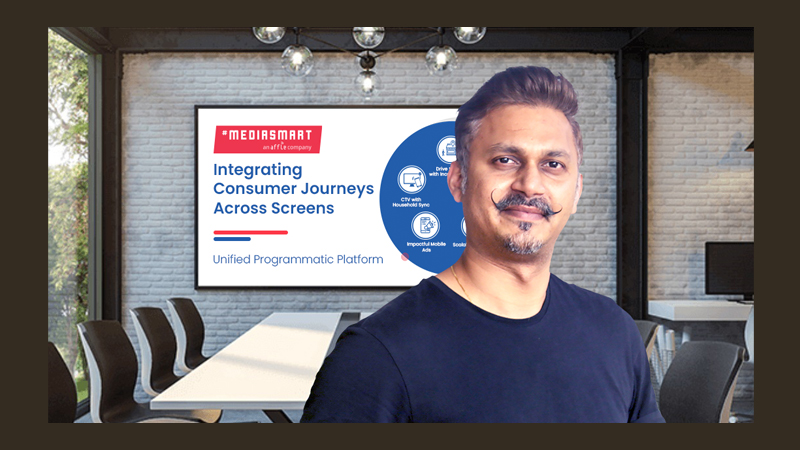

  • Advertisers are closing the gap between TV and mobile advertising: mediasmart’s Nikhil Kumar

    Advertisers are closing the gap between TV and mobile advertising: mediasmart’s Nikhil Kumar

    Mumbai: The growth of Connected TV adoption in India fuelled by affordable internet and smart TVs and availability of a range of streaming devices has opened the floodgates for newer technologies of content monetisation, digital/programmatic advertising and viewership measurement.

    In our continued effort to unravel the complexities of this space, this interview with Nikhil Kumar, who is currently heading the business of India and Southeast Asia for mediasmart – an Affle company, throws light on the Household Sync technology pioneered by the organisation and emerging digital advertising trends in the country.

    Kumar is a consumer marketing professional with over a decade of experience working in FMCG, retail, F&B and ad-tech set-ups with global brands like Puma, L’Oreal, Cafe Coffee Day and more recently Bytedance and InMobi. He was recognised as one of India’s Most innovative Mar-Tech leaders in 2019 by World Marketing Congress. With a career spanning over 14 years, he has worked across multiple functions with his domain expertise primarily being brand marketing (digital & offline), business strategy/ sales and go-to market plan/ execution across consumer goods, retail and start-up ecosystem.

    In his recent roles, Kumar has spearheaded business functions across India, SEA, and EU.

    Edited Excerpts

    On the adoption of CTV viewing in India viz-a-viz global CTV landscape

    Connected TV and CTV advertising are both fairly well-known and penetrated categories in the western markets, especially the United States. India has started well on consumer adoption of CTV and cheaper Smart TVs, Dongles and data plans together with compelling content propositions of leading OTT players are only going to accelerate this change going forward. As consumers have started to spend more time on this device or content format, ad dollars should also eventually move in this direction.

    The India market is expected to see growth for both subscriber-funded SVOD content and advertiser-funded AVOD content on CTV. We thus remain bullish on this opportunity and see India as a key market for the CTV business.

    On CTV opportunities for brands in India and the segments that will benefit the most

    The world is moving towards immersive watching experiences and CTV is an exciting space to be in. Industry observers are keenly following how India’s multi-screen viewing habits are shaping up. CTV has already made a significant impact on the digital advertising industry in the western part of the world and India is following suit. It is interesting to watch leading advertisers across verticals within the country adopt CTV advertising as a critical new addition to their media mix. It is here to stay. While CTV advertising is relevant for all categories active on TV and/or Digital, we expect the maximum impact of our interactive Household Sync augmented CTV advertising to be for categories looking for instant engagement like mobile apps led categories, consumer electronics, fashion etc. 

    On Household Sync Technology and how it can help brands with their digital ad campaigns

    Though programmatic CTV ads have been available in the industry, advertisers can drive interactivity with follow-up household synced mobile ads. This is where mediasmart’s advanced industry-first Household Sync technology helps in taking the advantage of CTV even further. It makes ads more engaging by syncing CTV ad campaigns with ads on other connected devices in the same household. CTV ads can thus be made significantly more relevant by personalising them for specific audiences within the household. This brings together the twin strengths of engaging storytelling associated with TV and CTV advertising and brands can launch CTV campaigns to a specific audience in the same household, measure results, and drive them to the nearest store. It uses fresh data for each campaign and is based on IP addresses, which undergo several layers of validation.

    On the reach and user base of CTV in India

    CTV, which was until recently seen as an alternative to linear TV, has emerged from the shadows and into the spotlight on how audiences consume content. The pandemic has further accelerated the shift in viewing habits as more and more people stayed indoors accepting the “new normal” and taking to CTV as a common entertainment source for families to enjoy together. Of course, the increasing internet speeds and better access to internet-enabled devices have also contributed in many ways to the recent growth of CTV.

    As per the India CTV Report 2021, CTV viewing in India is on a significant uptick and increased by 31 per cent. Globally, while CTV viewing increased by 81 per cent, India is still a young market with tremendous potential for CTV adoption by consumers. In April 2020, 21 per cent of CTV viewing households were cord-cutters (households who cut the cord within the past five years), whereas 22 per cent were cord-nevers (households with no cable/satellite subscription in the past five years).

    On emerging digital advertising trends in India

    Connected TV & OTT – CTV & OTT apps across devices, which were until recently seen as an alternative to linear TV, have emerged from the shadows and into the spotlight on how audiences consume content. The pandemic has further accelerated the shift in viewing habits and contributed to its recent growth due to an increase in internet speeds and better access to internet-enabled devices.

    Multi-screen audience targeting and attribution – Advertisers are closing the gap between TV and mobile advertising by targeting ads and taking advantage of multi-screen environments.

    Privacy and personalisation – There is an increasing demand for data privacy and for a more personalised ad experience, so brands have to play a balancing act to offer relevant experiences through data-driven advertising while also respecting privacy choices at the same time.

    Digital Out of Home (DOOH) – DOOH with its programmatic capabilities, which can automate OOH advertising, is expected to grow because COVID-induced confinements have accelerated the adoption of digital and programmatic methods in the OOH space.

    Mobile measurement – It has been defined this year by the changes in privacy settings announced by Apple with the launch of iOS 14. Incremental app marketing has been a buzzword in the industry for some time, but as advertisers lose access to attribution level data in a considerable percentage of their target audience, measuring the incremental impact of advertising actions should become a reality to more and more advertisers.

  • mediasmart elevates Nikhil Kumar to VP, India and SEA

    mediasmart elevates Nikhil Kumar to VP, India and SEA

    Mumbai: mediasmart has elevated Nikhil Kumar to the role of vice president, India and Southeast Asia region. He was previously senior director of brand and strategy, India and SEA.

    Kumar is a marketing professional with 14 years of experience. He joined mediasmart in November 2020. He was previously associated with Bytedance as business head – global business solutions. His prior stints include InMobi as director brand strategy and industry head CPG and AlcoBev, Housejoy as head of marketing, Puma India and SEA as senior marketing manager and L’Oreal.

    He is an alumnus of the Indian Institute of Management, Lucknow.

  • OACT2021: The evolution of Connected TV in India

    OACT2021: The evolution of Connected TV in India

    Mumbai: The addressable connected TV (CTV) advertising universe is estimated at six to eight million, according to mediasmart, an Affle company, India and SEA, senior director- brand and strategy Nikhil Kumar.  The CTV evolution has arrived in India. Today, you can easily join the CTV ecosystem via a smart TV, dongle, gaming console, or connected set-top-box (STB).

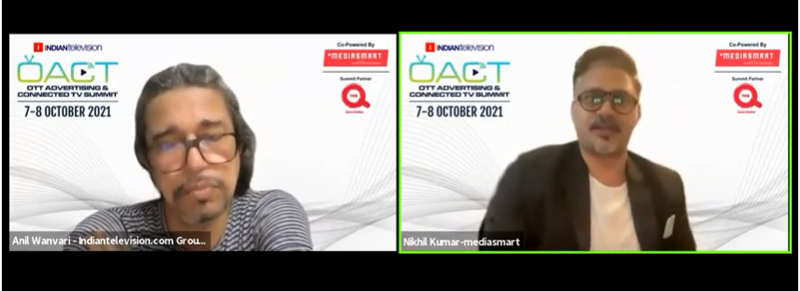
    Kumar was addressing the ‘OTT Advertising and Connected TV Summit 2021’ organised by Indiantelevision.com on 7 October. The two-day event is co-powered by mediasmart, an Affle company and summit partner – The Q. Stakeholders across the industry engaged in insightful discussions on the dynamics of OTT and CTV advertising.

    The growth of CTV in India is driven by several factors. Chinese manufacturers have played a pivotal role by introducing low-cost smart TVs for as much as Rs 15,000. Low-cost dongles like Amazon Firestick and Google Chromecast are popular ways to access web content. Jio has led the adoption of connected STBs. These technologies have driven the penetration of the CTV market to a point where you don’t necessarily have to be from a metro or Tier-1 city to be a part of the CTV ecosystem. According to a report by Counterpoint Research, India’s smart TV market saw 65 per cent year-on-year growth in Q2 2021 due to increasing demand.

    Some may conflate over-the-top platforms with CTV but they are completely different ecosystems. While OTT can be seen as a subset of the CTV ecosystem, its journey began almost two decades back with Netflix. Certainly, a majority of the usage on CTV is driven by OTT viewing. A report indicates that 91 per cent of users watch movies on CTV, there is also a small but growing audience that is listening to music, playing games, and catching up on the news.

    “CTV is reaching an incremental base of evolved users who have come into the ecosystem to enjoy everything that the internet has to offer,” said Kumar, adding that the pandemic has played the role of a catalyst for CTV.

    “People confined at homes realised that linear TV was mundane because of repeated content and were looking at new ways to entertain themselves,” he added. It helped that India has the cheapest data costs in the world at $ 0.09 per Gb. A survey showed that 78 per cent of smart TV users were accessing the internet via direct apps instead of search and discovery platforms.

    Even though the base of CTV was nascent compared to other media, mediasmart was excited to tap into the opportunity. “We’ve always been a platform that’s believed in strong digital ownership of the consumer journey,” said Kumar.

    The company did not look at CTV in isolation. When it targeted a CTV household, it assumed that there were three to four members in the household who owned a smartphone. They developed a technology system called ‘Household Sync’ that maps the user journey on CTV and mobile.

    Marketers have always bifurcated between brand and performance, opined Kumar. “Here’s a technology that puts your brand advertising on the largest screen possible but also delivers middle and bottom-funnel conversions, so it takes you across the entire funnel. At mediasmart, we’ve always valued metrics such as cost per conversion and verticalisation approaches.”

    mediasmart’s solutions looked at delivering immediate action-oriented feedback to advertisers on the brand impact. Their platform allowed them to look at completion rates on TV followed by retargeting on mobile devices. It also let them measure click-through rates to analyse if the brand was reaching the last mile. “Ultimately, what every brand is concerned about is the bottom-funnel,” opined Kumar.

    The CTV market is growing in double-digits month-on-month that will lead to an increase in users, advertising penetration, and reach. In markets like the US, the share of video impressions on CTV is as high as the share of video impressions on mobile. While the US was never a major mobile market, unlike India, Kumar explains that the opportunity is still attractive because even though the base is small, the impact is large.

    He added, “There is a lot of headroom for CTV to grow in India. There is still a significant base of box TV users in India who may potentially migrate to low-cost smart TVs. Apart from cord-cutting, there is a whole new generation of ‘affluent cord nevers’ who are opting for CTV systems over DTH and cable connections.”

    (Source: India CTV Report 2021 by mediasmart, an Affle Company, VTION, and Interactive Avenues)

    For more information: https://indiantelevision.com/events/oact-summit-2021/

  • Nikhil Kumar joins Publicis India as VP

    Nikhil Kumar joins Publicis India as VP

    MUMBAI: Publicis India has announced the appointment of Nikhil Kumar as vice president. Based out of Mumbai, Nikhil will focus on both organic and inorganic growth for the agency. 

    Nikhil Kumar will report to Publicis India COO Paritosh Srivastava. 

    Nikhil joins Publics India from Bennett Coleman & Co Ltd where he was the chief manager for The Economic Times (ET), looking after the brand performance and brand health of ET while heading the Brand Equity product portfolio.

    Speaking on his appointment, Srivastava says, “We are happy to have Nikhil Kumar on-board the agency. Nikhil has donned multiple hats and comes with rich experience of both sides across organisations. We’re confident that his vast exposure in the realm of marketing and advertising will play a distinctive role in offering meaningful solutions to clients and further strengthening the agency relations.”

    An MBA in International Business Management from University of Maryland, USA, Nikhil has a decade-long experience in building brands. In the past, Nikhil has worked both in a marketing role as well as had a fair share of exposure to the advertising world. His experience across diverse brands & agencies including Jet Airways, MullenLowe Lintas Group, Bosch & Siemens and ET will be key in translating the client’s business needs into distinctive brand strategies. In addition, his exposure within the product development domain and his ability to gauge the profitability of brands will further assist agency partners in creating a sustainable impact for their brands. 

    Nikhil Kumar adds, “Publicis India has been in the news lately for putting out a plethora of good work and key people appointments. I was impressed by the vision and direction that Paritosh and the team had for the future of the agency and how I would play a key role in shaping it. I’m excited to begin this new chapter and help achieve bigger milestones for the agency.”

  • CNN International announces Nikhil Kumar as New Delhi bureau chief

    CNN International announces Nikhil Kumar as New Delhi bureau chief

    MUMBAI: CNN International has announced Nikhil Kumar as the New Delhi bureau chief. Based in the country’s capital, Kumar will be responsible for the strategic planning of the network’s multi-platform news coverage from India and the region.

    “I am delighted to announce the appointment of Nikhil Kumar as we reaffirm our deep commitment to India,” said CNN International SVP and managing editor Ellana Lee. “Nikhil brings with him a deep understanding of this dynamic and diverse region and his expertise will be invaluable in this critical leadership role as we continue to strengthen our editorial operations in the country,” Lee said.

    Kumar was most recently the South Asia bureau chief for Time magazine based in New Delhi. Before moving to India in early 2015 he was a senior editor based in New York, editing and managing Time’s international editions, as well as foreign coverage in Time’s U.S. edition. Before joining Time, Kumar was New York correspondent for both The Independent newspaper and the London Evening Standard.

    Kumar has reported on several key regional and global political, economic and social stories including the devastating Nepal earthquake in 2015, the global financial crisis, the Eurozone sovereign debt crisis and the Boston marathon bombings. He has also interviewed leaders from the region including the Indian prime minister Narendra Modi, Afghanistan’s president Ashraf Ghani, Sri Lanka’s president Maithripala Sirisena and Bangladesh’s prime minister Sheikh Hasina.

    Kumar graduated with honors in philosophy from University College London. He starts his new position with CNN International in September.