Tag: Nielsen

  • Philips India adds celebrity quotient to its male grooming category

    Philips India adds celebrity quotient to its male grooming category

    MUMBAI: Macho man is passé; metrosexual is the current breed of men who with a high disposable income is the most promising consumer today.


    They don’t mind filling their shopping carts with make-me-look-good goodies. And this is the reason why a bunch of male grooming products have sprung up in the last few years.


    The male grooming segment which was projected to be Rs 1,500 crore market in 2012 is expected to reach Rs 5,300 crore by 2016.


    According to a Nielsen study on the Indian male grooming segment, there is a rising aspiration among Indian men to look groomed, which has led to the Indian men’s grooming market’s rapid growth of more than 34 per cent.


    The Nielsen study further stated that this growth is faster than the growth rate of the total personal care and beauty industry in India. The research company believes time is ripe for beauty and grooming brands to make the most of this growing male attention.


    The segment can be divided into sub categories: beauty range of products and grooming gadgets (manual and electronic).


    As per a report by Euromonitor International on male grooming sector in India, Gillette India lead men’s grooming with a value share of 28 per cent in 2012. The company has a strong horizontally diversified portfolio of razors and blades, with brands such as Mach, Vector, 7’O clock and many more, enhancing its long term sustainability. Hindustan Unilever was second, accounting for a 15 per cent share. These products fall in to the manual sub category.


    On the other hand, in the electronic sub-category, Philips with a range of grooming gadgets for men including trimmers, shavers and stylers, is ruling the market share, claims the company.


    To take a step further, the brand is set to roll out an extensive marketing campaign.


    The brand has decided to add celebrity quotient to its communication and has roped in actor Arjun Kapoor to be its face in the country. It can be noted that earlier John Abraham was its brand ambassador.


    The TVC which went on air on 10 July has been conceptualised and created by Ogilvy & Mather. The brand will also splash its communication on other media platforms. About 15-20 per cent of its marketing budget is expected to be invested on digital.


    The business of electronic brands of this segment is growing at 30-40 per cent year on year, mentions Philips India director marketing-personal care Anurita Chopra.


     “The Indian market is fast adopting this particular category. The reason to bring Arjun on board is mainly because he brings in positivity which we as a brand are trying to promote through our communication,” says Philips India president consumer lifestyle ADA Ratnam.


    However, the pricing strategy of the brand is to make it affordable.
  • Nielsen’s seven-step Media Compass

    Nielsen’s seven-step Media Compass

    MUMBAI: Imagine spending all your time and effort on a project, which doesn’t even give a chance for a second glance? Well, this is what is happening in case of advertising, as per Nielsen’s insights.


    The research goes on to say that in the highly volatile market today, marketers face tough competition to make a customer choose a certain brand out of many available to them.  In India, marketers spend over $5 billion each year out of which up to 30 per cent i.e. $1.5 billion is wasted as it misses its mark.


    One might look at various media landscapes to reach out to its TG but the report says that the fragmented media landscape isn’t helping anyone. According to it, companies are finding it progressively difficult to capture mind share in the segments they serve.


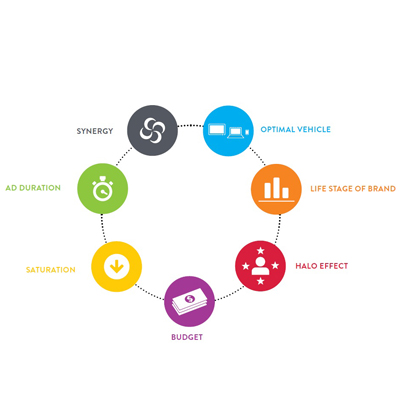
    To make things easier and to guide marketers on their budget allocations to increase their returns on investment, Nielsen has developed a seven-step framework to help them battle today’s challenges.


    The framework, christened as media compass, shares uncommon ways in which one can optimise seven steps that helps determine a marketer’s choice of media, timing of exposure and the size of investment. While every brand has its own unique dynamics, the research agency designed the framework to provide clear guidance for any brand. The framework is based on nearly 1,100 studies across 98 categories carried out globally in the area of marketing mix.


    Choosing the optimal media mix


    Marketing spend varies across industries and regions depending on where messaging resonates most with consumers, so evaluate current ROI for your brands across media platforms.


    Supporting new brands beyond early launch


    Adequate support for a new launch is required even in the second year of the launch in order to generate incremental trials and ensure repeat purchase behaviour. Ideally a new product should be thought of as ‘New’ for two years.


    Maximising the halo effect


    Advertising drives volume for the brand being directly promoted. However, such advertising may also drive volume for a sister brand if there is a connection between the two brands in the consumer’s mind. Such indirect effects are called Halo Advertising Effects, contrary to what one might expect, the halo effect from parents to the portfolio is much lower than the halo effect from extensions to the parent. Shifting a larger portion of the media support to extensions would result in higher total impact for the portfolio.


    Brand budgets – incorporate sponsorship for building equity


    Bigger budget brands can afford higher levels of advertising spend. If the budget allows, they should consider sponsorships as part of their media plans. Gross Rating Points (GRPs) spent on sponsored programmes, or impact GRPs, generate very high sales volume, and are generally three times as effective as regular GRPs. However, there’s a high cost involved in sponsorships. Brands with smaller budgets should maximise efficacy of their spends by executing within optimal GRP ranges, considering shorter length copy and ensuring good copy quality.


    The flighting opportunity


    The economic principle of diminishing returns exists in media planning too. The volume response due to TV advertising is not linear, and shows a pattern of diminishing returns beyond a certain point, leaving considerable scope for GRP optimisation.


    Timing it right


    Longer-duration ads are needed to convey a new or complex message, while shorter ones can suffice as reminder messages. The most critical question for the marketer therefore is – which parts of the copy can be cut out, and which parts are essential to the message?


    Synergy


    Synergy is the improved effectiveness of various drivers when executed together. A study conducted to test synergies between ATL & BTL activities among 25 categories revealed that a vast majority of companies do not integrate their ATL and BTL efforts. The 20 per cent companies who do integrate ATL and BTL efforts witnessed about 5-8 per cent extra sales growth. Integrate your marketing and sales efforts to benefit from synergies.

  • Missed call? It might be Facebook calling India

    Missed call? It might be Facebook calling India

    MUMBAI: Missed call: most of us have used it at some time or the other to connect with our friends when we are low on our mobile phone balance on our low end feature phones. Now Facebook is hoping to rake in the moolah courtesy this quirky habit amongst India’s light walleted mobile users.

    It announced a new ad format based on the missed call habit this morning through a post by its emerging markets ad products specialist Kelly MacLean.

    Describing it she writes:   “When a person sees an ad on Facebook they can place a “missed call” by clicking the ad from their mobile device. In the return call, the person will receive valuable content, such as music, cricket scores or celebrity messages, alongside a brand message from the advertiser — all without using airtime or data.”

    Facebook says 66 per cent of the 100 million or so of its users in India access the social networking site on their low-end feature phones using 2G services. Despite India being its second largest market, it contributed only Rs 75 crore to its top line last year, according to online site Quartz.

    “That’s a teeny-weeny fraction of its total global revenues of $5.49 billion (around Rs 33,000 crore),” says a media observer. “And it clearly needs to get India to generate more greenbacks.”

    Facebook says it has been testing the missed call ad product in India for sometime now and it has generated some success. It expects to give it a further push in the next few months as it rolls it out to advertisers.

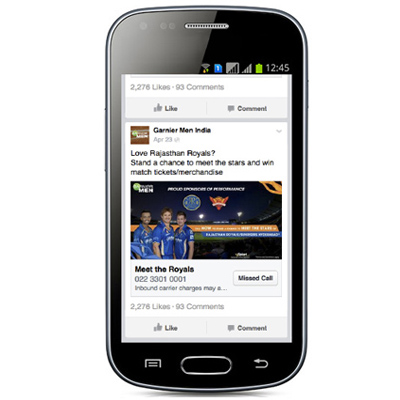
    Among the advertisers which have used it is Garnier Men- a L’Oreal brand –  during the recently concluded cricket mega success, the IPL, from April to May 2014, says Facebook in  a case study it has published online.

    As part of the campaign, photo ads were placed on News Feed, targeting men between15-35, asking them to click to call for a chance to meet players from the Rajasthan Royals and win match tickets or official merchandise.

    “When someone clicked on the ad unit, a number was auto-populated in their phone dialer and a number was called. The call then dropped after a couple rings and the caller received an SMS with trivia questions to answer to enter the contest. The caller was also presented with a Flipkart link to purchase products,” Facebook says in the Garnier case study. It had partnered with Bengaluru based missed call services provider ZipDial for the promotion. 

    The social networking platform says the campaign saw Garnier achieve its goal of reaching 15 million of the target audience. 16 times more calls were generated from the Facebook missed call ad unit  than all other digital and print media combined, and its sales rose a claimed two and a half times year on year.

    Garnier general manager Rupika Raman had this say about the test: “When we were approached by Facebook to become the first brand globally to take part in the click to missed call innovation, we were excited to try it out. It has reaped rich dividends and has been highly impactful.”

    Facebook has partnered with India’s largest mobile phone service provider Airtel, and missed call platform provider ZipDial, as it begins rolling out the new ad unit in India.

    The site says that it will soon start offering features such as life-stage targeting (new moms and dads, graduation moments) to advertisers, while it has already started offering geo-targeting options wherein advertisers can target people by state or even multiple states in India without having to list multiple cities.

    And to get around the doubting Thomases about its efficacy as an ad medium it has partnered with Nielsen to serve polls to people on feature phones. “Our new measurement solution provides advertisers with greater tools to measure brand sentiment, purchase intent and ad recall for the first time on mobile as well as desktop,” Facebook has highlighted in the post.

    The announcement of the new ad format has come at a time when Facebook COO Sheryl Sandberg is visiting India hobnobbing with government officials, and small and medium business owners.

    (Pix courtesy: Facebook)

  • ABP-Nielsen poll: BJP and Congress gain from AAP’s loss

    ABP-Nielsen poll: BJP and Congress gain from AAP’s loss

    MUMBAI: News channel ABP that carries out its election poll in association with research agency Nielsen India has come up with its latest prediction on which party’s shares have dropped or gained in the recent past.

    The opinion poll conducted between 9 March-16 March 2014 with 456 respondents claims a margin of error of ±5 per cent.

    The new poll predicts that Aam Aadmi Party (AAP) led by Arvind Kejriwal is set to lose a few vote shares in Delhi. “It is likely to get around 34 per cent vote share and three seats in the upcoming Lok Sabha polls as compared to 55 per cent vote share in the opinion poll conducted in January 2014,” says the poll statement.

    Congress on the other hand is predicted to be putting on a few extra vote shares which is an improvement from the poll prediction in January. According to the ABP News-Nielsen poll, ‘Congress is likely to benefit by AAP’s loss and is predicted to get a vote share of 28 per cent and one seat as compared to 14 per cent in February 2014 and nine per cent in January 2014’.

    Bharatiya Janata Party (BJP) is expected to get 32 per cent vote share and three seats which is higher than the 30 per cent vote share and one seat that was predicted in February 2014 and 29 per cent share in January 2014.

    The ‘Kaun Banega Pradhanmantri’ (KBP) poll has also been launched as an application for android users that will allow subscribers to get updates about the 2014 Lok Sabha elections. The app has sections such as top news, city polls, KBP show videos and live TV.

  • Hearing on Kantar petition adjourned till 11 July

    Hearing on Kantar petition adjourned till 11 July

    MUMBAI: The Delhi High Court today adjourned hearing on a petition by Kantar Market Research Services challenging the government’s cross-shareholding norm for television rating agencies till 11 July.


    The court had earlier stayed operation of the cross-shareholding norm till the case is disposed of. And in accordance with the court’s directive, TAM Media Research, which is jointly owned by Kantar and Nielsen, last month applied to the Ministry of Information & Broadcasting for its registration as a television ratings service.


    The cross-shareholding norm, which came into effect from 15 February, debars shareholders owning more than 10 per cent of a television rating agency from having stakes in broadcasters and advertising agencies.


    TAM has also been allowed to continue publishing its television ratings till the court decides on the Kantar petition.


    Kantar had today sought adjournment of the case to April but the court decided to have the next hearing only in July.


    The election commission on Wednesday announced the dates for the 9-phase polling for Lok Sabha elections and the results would be announced on May 16.


    With the announcement of the election schedule, the election code of conduct came into effect which bars governments from taking any policy decisions.

  • There  is no Plan B for TAM if we lose our appeal in court: Kantar’s Eric Salama

    There is no Plan B for TAM if we lose our appeal in court: Kantar’s Eric Salama

    The Indian television industry is possibly heading towards a crisis of an audience ratings blackout. TAM Media Research, a joint venture between Nielsen (India) and Kantar Media Research, is currently the only agency that provides television audience viewership measurement services to advertisers and broadcasters.


    TAM has hit a roadblock in India with the government issuing policy guidelines for television ratings agencies in mid-January. It has an impossible deadline of mid-February to ensure that the shareholding in TAM is in accordance with the new policy guidelines.


    Apart from having substantial (more than 10%) stakes in TAM, the joint venture partners in the Indian television ratings provider also own advertising agencies in India, which is prohibited in the policy guidelines’ cross-holding norms.


    Nielsen appears to have taken a back seat and decided to let Kantar lead the challenge against the government’s new regulations and  let TAM face the situation as it develops


    Kantar has filed a petition in the Delhi High Court to get a stay on the shareholding norms specified in the guidelines or at least get an extension on the deadline for meeting meet the norms. There’s less than a fortnight left for TAM to comply with them, and it does not like its shareholders will be able to do so in the short time that was given to them.


    The launch of television audience measurement by Broadcast Audience Research Council (BARC), an initiative of advertisers, advertising agencies and broadcasters in India, is likely only by October this year.


    If Kantar fails to get some relief from the court, TAM will have to stop releasing audience ratings by mid-February which will obviously result in the absence of viewership being metered and measured till BARC is ready with its own services. And that is something which is giving both advertisers and agencies palpitations. Television audience ratings is a key input based on which advertisers base their advertising plans on.


    In order to understand what the situation is and what could unfold, indiantelevision.com’s Vishaka Chakrapani spoke to Eric Salama, chairman and CEO of the Kantar group since 2007. Salama has been with global advertising agency WPP, the owner of Kantar, since 1996.


    During the interaction, Salama rued that television ratings has become a matter of public debate and a “cricket ball” for everyone to hit. Excerpts:


    How different is it operating in India as compared to other countries when it comes to television ratings?


    We operate in most countries with the exception of Iran, Cuba and North Korea.  We’ve never had problems in India before, IMRB is the oldest research agency in Asia and we see India as a key market for us going forward.  We have some of our most talented people here.  The TV ratings market is very different to other markets in that it has become a source for public debate and a cricket ball for people to hit.


    How do you see TV ratings agencies progressing in India?


    We’ll know soon enough!


    Do you believe a ratings blackout is likely to happen? What could happen in such a scenario and how will the industry respond?


    Unless the court rules in our favour on cross ownership, we are heading for a blackout which will be extremely damaging to broadcasters, programmers, agencies, advertisers and everyone who cares for the Indian media industry.


    Do you think there is space for two ratings agencies to coexist?


    It happens in some markets such as Philippines but it’s extremely rare as the industry generally wants one currency for trading.


    I believe TAM has also applied to BARC for panel management in the industry-driven television ratings service. How do you see your relations with BARC taking shape?


    Once BARC is established, TAM will either be a supplier to them for some services or not.


    Should the sample size for arriving at television ratings be far bigger?


    If people wanted us to expand our sample to 20,000 we would.  When BARC is established it will be up to them to decide what they do.


    Accusations have been hurled at TAM and its credibility has been questioned. Do you think TAM has been judged wrongly?


    Some of the comments have been libellous. Many of them have been poorly informed.  TAM has performed extremely well for a long period in a very difficult environment and under huge pressure.


    What is the plan B if TAM is not allowed to function?


    There is no plan B.

  • TV grows by 57.6 per cent, Internet saw 4.5 per cent increase in ad spends: Nielsen report

    TV grows by 57.6 per cent, Internet saw 4.5 per cent increase in ad spends: Nielsen report

    MUMBAI: Nielsen has released its Global Adview Pulse for the Q3-2014. The report puts out the latest figures on the state of the advertising market across traditional and new media platforms, globally.


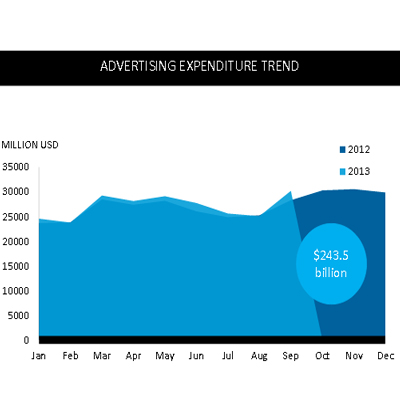
    The biggest take away from the report was that the Asia Pacific ad spend picked up speed in Q3. Global advertising spending rose 3.2 per cent in the third quarter of 2013, closing the first three quarters of 2013 also at 3.2 per cent. Asia Pacific’s powerhouse ad market expanded further, growing by 7.0 per cent for the period January to September. China (up 16.7 per cent), Indonesia (22.1 per cent), and Malaysia (15.7 per cent) contributed to the growth, with the largest decline within the region seen in Australia and South Korea (both down by 2.9 per cent for the year – to date).


    As per the report, Television continues to be the favorite medium through which advertisers attempt to reach their consumers, commanding a 57.6 per cent share of all spending and growing 4.3 per cent. Display Internet, though representing a smaller share of spends at 4.5 percent grew significantly by 32.4 percent. Nielsen points out that the one area in which Internet shows its might is in that of multi-screen advertising, which involves media buys that extend across web, mobile and more.


    Outdoor too saw an increase of 5.1 per cent while newspapers, magazine, cinema and radio saw a dip in the ad spend figured. Newspapers saw the biggest dip with 2.2 per cent followed by cinema with 1.3 per cent. The reason for the same is that advertisers increasingly continue to move their ad budgets to both television and display Internet.


    Industry & Services and FMCG advertising continued their reign as the macro sectors with the highest percentage growth during the first three quarters of 2013. The Industry & Services macro sector, driven by advertising in the Property category, saw an impressive 33.9 percent increase in the Asia Pacific, while the sector dropped by  5.7 per cent in North America (mostly due to US election advertising, which took place in Q3-2012).


    Automotive advertisers put on the brakes globally, cutting ad spend by 1.9 per cent for the year-to-date. Automotive advertisers in Europe cut budgets by 11.2 per cent, while advertisers in the Asia Pacific reduced spending by 6.8 per cent.


    As global economy stabilises and sees a better prospect and Asia Pacific’s ad market continues to gain momentum, the information and measurement company plans to keep a check on the global advertising market and its growth trajectory.

  • AsiaPac leads global ad growth: Nielsen

    AsiaPac leads global ad growth: Nielsen

    MUMBAI: Global advertising expenditures were up 3.2 per cent in the third quarter of 2013 for year-over-year period, driven largely by Asia Pacific’s expanding powerhouse ad market, as well as a bottoming out of Europe’s contracting ad market.


    According to Nielsen’s latest Global AdView Pulse report, Asia Pacific ad revenues surged seven per cent in the first nine months of 2013. China was up 16.7 per cent, Indonesia 22.1 per cent and Malaysia 15.7 per cent. The gains offset declines in Australia and South Korea.


    Television continues to be the favourite medium through which advertisers attempt to reach their consumers, commanding a 57.6 per cent share of all spending and growing 4.3 per cent. Display Internet, though representing a smaller share of spends at 4.5 per cent grew significantly by 32.4 per cent.


    Macro sectors contributing to the growth include FMCG, which saw a 5.9 per cent increase in ad spending for the year-to-date, and Industry & Services, which grew 11.3 per cent.


    The period also saw a slight improvement in Europe, with the market down just 0.4 per cent in Q3. Nielsen notes that the region’s ad market appears to be bottoming out. Indeed, Italy and Spain, among the hardest hit, may have the worst behind them, the report notes, and Greece saw its ad revenues gain 10.3 per cent.


    In the US the market was up 1.7 per cent by the end of September, even though it fell 1.3 per cent in the third quarter itself. And in Latin America, the year-on-year change was 13 per cent.

  • Facebook prepares to insert video ads into users’ news feeds

    Facebook prepares to insert video ads into users’ news feeds

    MUMBAI: According to media reports the social network giant Facebook plans to let marketers insert 15-second video ads directly into people’s news feeds. This step needs to be taken with caution as it may not go down well with its users.

    Buyers could target the age and gender of the users who’d find the ads in their feeds reports claim citing “two people familiar with the matter.” Ads could sell for as much as $2.5 million a day depending on how many people watch them.

    Execs appear to appreciate the possibility of a backlash: CEO Mark Zuckerberg has delayed the plan “at least twice” as he considers ways to minimise user ire over the ads, for example by offering them in high-def and ensuring that people won’t see the same pitch more than three times a day. But the sales opportunity apparently is too lucrative to resist.

    Advertisers likely will spend nearly $64 billion in the US this year on TV ads vs $36 billion on the web. That’s why digital powers including Google, Yahoo, and AOL are gunning for TV advertising – including by staging their own NewFront sales pitches to ad buyers as they also gather for television networks’ upfront presentations.

    Last week Facebook COO Sheryl Sandberg told analysts that her company has “a massive and engaged audience around the world that brands can use to build awareness and drive sales. Every night 88 million to 100 million people are actively using Facebook during primetime TV hours in United States alone.” Nielsen has been working with Facebook to come up with ratings for online videos that would be similar to TV ratings.

  • LatAm, Asia lead global ad growth

    LatAm, Asia lead global ad growth

    MUMBAI: Global ad revenues rose just 1.9 per cent to $76.6 billion in the first quarter of 2013 as compared with the year-ago period, according to Nielsen‘s quarterly Global AdView Pulse report, as gains in Latin America and Asia were offset by a reduction in Europe and flat spending in North America.

    Latin America showed particularly strong growth of 11.9 per cent in Q1, with increases reported in all countries across the region. In Asia, there was 5.8 per cent growth, led by China, Indonesia and the Philippines, all up by about 20 per cent. There were gains across all Asia markets except for Japan, which reported a 1.1 per cent decrease.

    Europe was down by 4.4 per cent, with Nielsen noting it is unlikely there will be any improvements in the short term. North American ad revenues were stable. In the Middle East and Africa, meanwhile, there was a 2.9 per cent improvement. Problems persist for the region though, with Egypt‘s ad revenues dropping 20 per cent in the past year.