Tag: niche channels

  • TV Brand Fest 2021: GEC space remains unchallenged in building mass reach, say marketers

    TV Brand Fest 2021: GEC space remains unchallenged in building mass reach, say marketers

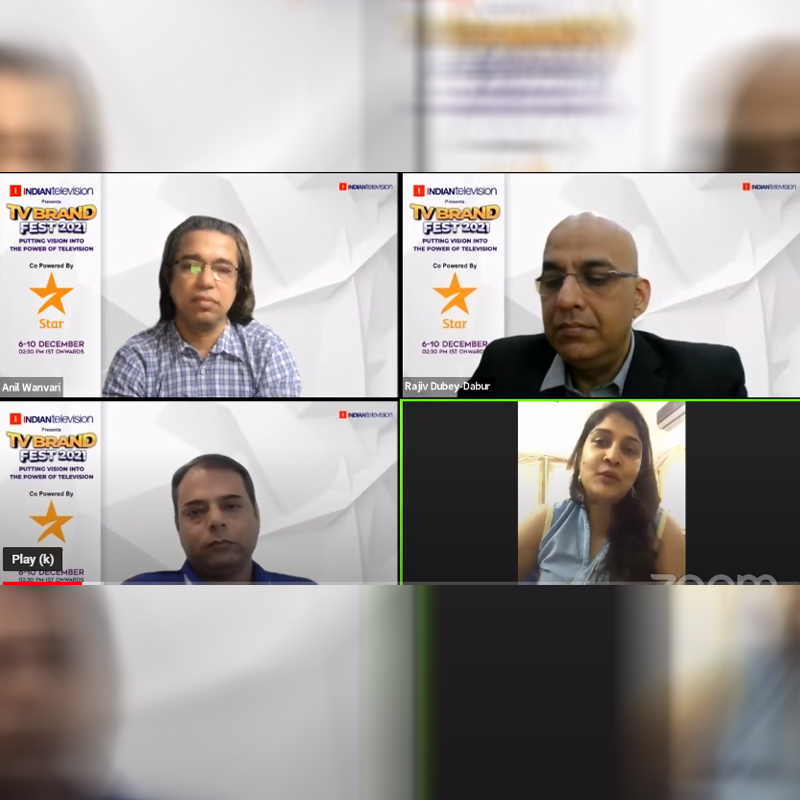
    Mumbai: On day three of the TV Brand Fest 2021, media and marketing heads of prominent organisations discussed the merits and challenges of fiction and nonfiction content as a vehicle for brand messaging. The five-day event being organised by Indiantelevision.com is co-powered by Star India.

    The panel consisted of Dabur head of media Rajiv Dubey, Yamaha Motor India head – marketing Vijay Kaul, and Dr Reddy’s Laboratories marketing head – OTC, emerging markets Prachi Mohapatra. The session was moderated by Indiantelevision.com Group founder CEO and editor-in-chief Anil Wanvari.

    The discussion began with trying to understand the relevance of GECs which remain unchallenged despite the existence of a plethora of niches. Last year they had almost 50 per cent genre share as far as weekly viewing minutes were concerned, and therefore, any brand looking for a mass reach cannot afford to miss out on them.

    “GECs are cost effective, and they give high reach for businesses like us who want to communicate to the masses repeatedly. Niche channels, on the other hand, are not consistent performers,” said Dabur’s Dubey.

    EMBED: Panel image

    Sharing her experience of using GECs, Mohapatra added, “They are a great way to build trust for your brand. GECs work extremely well when you have to change the brand imagery and also with tactical campaigns where the objective is to reach out to the right kind of consumers in a time-bound manner.”

    Even though the auto category uses quite a balanced mix of fiction and non-fiction content, GECs are a staple in the media plan for mass or unisex products such as scooters. Elaborating further, Kaul stated, “GECs are the right choice for mature brands with a country-wide footprint. That’s where we expect a lot of sales volumes. When the idea is to launch a new brand, the media plan depends on the sales target being huge as in case of unisex or mass commuter brands.”

    Mohapatra shared a similar opinion on the kind of products (based on the life cycle stage) that are best-suited for fiction content. “GEC are trust builders with a huge reach, and hence apt for mature brands as well as brand extensions. Taking a new brand/product directly to GECs is not feasible due to the high costs involved,” she observed.

    For Dabur though fiction/GECs is the medium of choice for all kinds of brands barring a few like a men’s hair removal crème. This is because of the female-centric nature of content.

    This insight from Dubey steered the conversation towards the importance of the content (message) and brand ethos being in sync with each other. While ratings and minimisation of duplication are Dabur’s primary concerns, Yamaha’s Kaul asserted that “in the automobile segment it becomes necessary to evaluate the nature of content because one is looking at a long association with a brand/product whose ticket value is huge.”

    Non-fiction content on niche channels has thus been integral to Yamaha’s media plans. Sharing the example of Yamaha YZF R15, the brand that was built on one niche sport brand – MotoGP – alone, Kaul added, “MotoGP complemented the (high) price (Rs. 1.8Lakh) and the DNA of the brand perfectly. We went for live programming as well as repeats with bundled deals on EuroSports, never using any GEC for it.”

    He cited another example, that of Yamaha Fascino Miss Diva Universe where the “fashionable scooter was embedded in the fashion property one year before its launch.” “Longevity is key here; one can’t have big-ticket integrations for six months, it needs at least four-five years for the association to build.”

    Concurring with Kaul, Mohapatra noted, “With such high-decibel programs consistency is extremely important, otherwise even as you work on creating the brand image, recall fades out very quickly.”

    As regards non-fiction on GECs such as ‘KBC’, and ‘Bigg Boss’. the panel believes that it brings in a fresh set of viewers, and a large number of eyeballs at the same time. It also offers more scope and solutions in terms of brand integrations and product placements.  “Used in combination with fiction, weekend non-fiction properties are a great source of incremental reach,” stated Dubey.

  • TRAI tariff order impacted uptake of niche channels: KPMG

    TRAI tariff order impacted uptake of niche channels: KPMG

    MUMBAI: Even as TRAI is mulling over changes to its existing tariff order, a report by KPMG, India’s Digital Future, highlighted that niche channels were affected especially due to lesser focus on such channels in broadcaster packs.

    “The uptake of niche channels has suffered in the new regulatory environment as broadcasters focused on creating packs that ensured pick-up of their GEC and movie channels with DPOs building on top of them with FTAs at their disposal. While niche channels belonging to larger broadcasters are likely to do better than others in the long run owing to the network effects enjoyed by their parent company, they will still need to be innovative in order to survive and remain relevant in the long run,” the report read.

    According to the report, niche genres on TV in this new era are expected to be under pressure from rival offerings on digital platforms. It also added the English channels are also likely to encounter challenges in terms of viewership and subscription in the new regime. But the uptake of pay regional channels, especially top GECs and movie channels, has remained firm in the regional markets in the new regime, particularly in the Southern markets.

    Despite the tariff order giving consumers options to choose channels, the report noted that initial trends indicate that the monthly bills of viewers wishing to watch the same number of channels as earlier has gone up significantly. However, the ARPUs have increased across all the markets with phase III and phase IV markets witnessing massive growth of 30-35 per cent in average realisations.

    “This choice of channels has come at a dearer price for individuals at the lower end of the ARPUs who are either paying more for watching the same number of channels or are content with lesser number of channels at their disposal. As per industry discussions, some choice is taking place at the higher end of the subscription pyramid, leading to lower TV bills, however, the same is definitely accompanied by a lower number of viewable channels at the disposal of the consumers,” the report added.

    It went on to say that viewership and reach for the TV universe is likely to change as the effects of NTO start to play out. But it also added that the broadcasters will need to renew focus on content quality to ensure survival and pick-up of their channels.

  • Gemporia targets revenue of Rs 60-100 crore; to launch on Tata Sky

    Gemporia targets revenue of Rs 60-100 crore; to launch on Tata Sky

    MUMBAI: Digitisation of cable television in India has opened up the space for many a niche channels. And taking advantage of this are brands and companies operating in diverse fields. One such company is Gemporia – jewellers from the United Kingdom, which forayed into India with the launch of a television channel back in September 2015. The channel, which is already available on direct to home (DTH) platforms like Dish TV and Videocon d2h, is all set to launch on Tata Sky in the next fortnight.

    What’s more, the channel is eyeing revenue between Rs 60 – 100 crore by the end of 2016. With the ethos of ‘Janiye aur Kharide’ (Know and Buy), the channel has a marketing budget of over Rs 25 crore, which it will strategically dish out with time. “The end goal is to be the largest selling jeweller in terms units and to reach that goal we will need to have an interactive marketing campaign. We are moving ahead towards that, the medium will depend on the marketing strategy, but we will innovate across platforms,” said Gemporia India co-founder Manuj Goyal.

    With the proliferation of the e-commerce space, there are a number of online stores selling jewellery in India. However, the online retailing of original jewels is yet to pick pace. Keeping the scenario in mind, Gemporia has taken TV route and has over 14 hours of live programming.

    The channel’s distribution and operation cost is predicted to be over Rs 50 crore. Goyal informs that the channel’s initial target is to be available on DTH platforms and then gradually move having a presence on cable.

    Gemporia has over eight per cent market share when it comes jewellery in the UK. “Majority of the jewellery shopping happens online across the globe. And I believe the same can happen in India too,” says Goyal.

    The venture has a target set to reach 100 million television audiences. Set up in Jaipur, Gemporia has 160 employees, of which 30 are equipped with GIA certificate.

    “All our products are hallmarked and we don’t sell imitation jewellery. We are the first dedicated jewellery channel with live programming. We stand by the purity of our jewellery and hence give our consumers the option of returning the jewellery within 30 days with full refund. Since we cannot offer consumers the touch and feel of our products, we create 360 degree videos of the product that consumers will eventually invest in,” informs Goyal.

    In a bid to stay ahead of online jewellery marketplaces, Gemporia decided to take the TV route. “Next to touch and feel is video and that’s where we have an advantage. Additionally, in most online stores, the products displaced are not ready and hence the delivery time is way more than us. Ours is a dedicated jewellery company and the product displayed is available for consumers to buy. The moment they buy a piece of jewellery, we can ship it and hence the logistics are way faster than the existing online stores,” says Goyal.

    A home shopping channel media expert says on condition of anonymity, “The jewellery space can pick up as it has the potential. But the product pricing has to be lower than traditional physical stores. All across the globe, the products that sells on home shopping channels are unique and priced lower than those in brick and mortar stores. Putting common products up will go no where. Gemporia’s biggest challenge and competition will be from the channels selling imitation jewellery. The first year will be challenging and will define the fate.”   

    Besides TV, Gemporia also has an online presence. Through the website, an on-screen anchor addresses consumers’ questions. Additionally, Gemporia also has a mobile app to sort out size issues. The Gemporia Ring Sizer app enables consumers to asses the ring size by just putting it up on the mobile screen. “We send ring sizer with our every order to sort out the size issue,” informs Goyal.

    With innovation, novel offerings and customer service being the key factors for success for a venture, it now remains to be seen how this one of a kind television channel orchestrates its voyage in the cluttered and unpredictable Indian market.

  • Gemporia targets revenue of Rs 60-100 crore; to launch on Tata Sky

    Gemporia targets revenue of Rs 60-100 crore; to launch on Tata Sky

    MUMBAI: Digitisation of cable television in India has opened up the space for many a niche channels. And taking advantage of this are brands and companies operating in diverse fields. One such company is Gemporia – jewellers from the United Kingdom, which forayed into India with the launch of a television channel back in September 2015. The channel, which is already available on direct to home (DTH) platforms like Dish TV and Videocon d2h, is all set to launch on Tata Sky in the next fortnight.

    What’s more, the channel is eyeing revenue between Rs 60 – 100 crore by the end of 2016. With the ethos of ‘Janiye aur Kharide’ (Know and Buy), the channel has a marketing budget of over Rs 25 crore, which it will strategically dish out with time. “The end goal is to be the largest selling jeweller in terms units and to reach that goal we will need to have an interactive marketing campaign. We are moving ahead towards that, the medium will depend on the marketing strategy, but we will innovate across platforms,” said Gemporia India co-founder Manuj Goyal.

    With the proliferation of the e-commerce space, there are a number of online stores selling jewellery in India. However, the online retailing of original jewels is yet to pick pace. Keeping the scenario in mind, Gemporia has taken TV route and has over 14 hours of live programming.

    The channel’s distribution and operation cost is predicted to be over Rs 50 crore. Goyal informs that the channel’s initial target is to be available on DTH platforms and then gradually move having a presence on cable.

    Gemporia has over eight per cent market share when it comes jewellery in the UK. “Majority of the jewellery shopping happens online across the globe. And I believe the same can happen in India too,” says Goyal.

    The venture has a target set to reach 100 million television audiences. Set up in Jaipur, Gemporia has 160 employees, of which 30 are equipped with GIA certificate.

    “All our products are hallmarked and we don’t sell imitation jewellery. We are the first dedicated jewellery channel with live programming. We stand by the purity of our jewellery and hence give our consumers the option of returning the jewellery within 30 days with full refund. Since we cannot offer consumers the touch and feel of our products, we create 360 degree videos of the product that consumers will eventually invest in,” informs Goyal.

    In a bid to stay ahead of online jewellery marketplaces, Gemporia decided to take the TV route. “Next to touch and feel is video and that’s where we have an advantage. Additionally, in most online stores, the products displaced are not ready and hence the delivery time is way more than us. Ours is a dedicated jewellery company and the product displayed is available for consumers to buy. The moment they buy a piece of jewellery, we can ship it and hence the logistics are way faster than the existing online stores,” says Goyal.

    A home shopping channel media expert says on condition of anonymity, “The jewellery space can pick up as it has the potential. But the product pricing has to be lower than traditional physical stores. All across the globe, the products that sells on home shopping channels are unique and priced lower than those in brick and mortar stores. Putting common products up will go no where. Gemporia’s biggest challenge and competition will be from the channels selling imitation jewellery. The first year will be challenging and will define the fate.”   

    Besides TV, Gemporia also has an online presence. Through the website, an on-screen anchor addresses consumers’ questions. Additionally, Gemporia also has a mobile app to sort out size issues. The Gemporia Ring Sizer app enables consumers to asses the ring size by just putting it up on the mobile screen. “We send ring sizer with our every order to sort out the size issue,” informs Goyal.

    With innovation, novel offerings and customer service being the key factors for success for a venture, it now remains to be seen how this one of a kind television channel orchestrates its voyage in the cluttered and unpredictable Indian market.

  • RIO to affect Star’s sports and niche channel distribution: MPA

    RIO to affect Star’s sports and niche channel distribution: MPA

    MUMBAI: Star India’s new distribution approach has been the talking point for the industry. And now highlighting the same is Media Partners Asia (MPA) in its new report.

    Post the announcement of Reference Interconnect Offer (RIO) deals by Star, most multi system operators (MSOs)in order to keep both content cost and churn under check, opted to carry Star’s key Hindi channels on the base pack, along with free-to-air channels and lower RIO rate channels such as Nat Geo. In certain markets, 1-2 relevant regional channels have been bundled in the base pack.

    Not only this, many of the niche channels (English cluster) have been moved to higher or expanded basic tiers or available on a-la-carte basis.

    “This will adversely impact channel reach and viewership. However, the revenue losses on these channels will be partially compensated by reduction in carriage fee costs,” says MPA in its report.

    MPA, however sees a bigger risk, potentially to Star’s sports channels, as sizeable investments have already been made to creating non-cricket sports leagues leveraging Indian soccer and badminton.

    “These leagues are still in their infancy and require maximum distribution reach,” points out MPA.

    It further goes on to say that in cricket too, Star will broadcast the ICC World Cup in February 2015. However, according to MPA, with all India matches, semis and finals also available to viewers on public broadcaster Doordarshan, Star may have to rethink its incentive schemes in order to maximise its distribution of sports channels.  

    MPA estimates that the commercial rollout of package could take at least two to three months (completing in the early half of Q1 2015) and in the meantime, the delay will put pressure on the distribution of Star’s niche channels.

    “New channel launches for Star could also become equally challenging as it loses the luxury of having 100 per cent sampling on the cable platform,” it reports.

    In conclusion, Star’s new distribution strategy, will be a true acid test of consumer demand for its portfolio of channels. Viewership trends over the coming weeks will reflect such demand.

    “On a positive note, the outcome will help Star to prioritise and rationalise its content budgets, which have swelled across multiple genres, in recent years,” opines MPA.

  • BARC assures that its TV rating system will be credible

    BARC assures that its TV rating system will be credible

    MUMBAI: Television ratings agencies seem to be the flavour of the season. On the one hand, Kantar Research, one of TAM Media’s major shareholders, has moved the Delhi HC against the Union Government’s new guidelines on cross holding restrictions. While on the other, up-and-coming ratings agency Broadcaster Audience Research Council (BARC), slated for a 1 October launch, has announced a tieup with France-based Mediametrie for technology services and licensing of a TV metering system.


    BARC CEO Partho Dasgupta and BARC Technology Committee member Paritosh Joshi spoke to CNBC TV18 about what to expect in the new set up.


    “The ratings agency is the one which will own the data and put it out – which is BARC in our case. So there will be ways of getting the information such as technology, panel etc. but it will all be owned and put out by BARC,” said Dasgupta, implying that the final agency will have to be free of cross ownership although its suppliers could have any type of ownership.


    Joshi revealed that  two big chunks of work had already been completed – that is assessing panel homes and technology within them. “The panel will emerge out of the Indian Readership Survey (IRS), which is out now. The people meter devices will be built on retail hardware that can be bought from Mumbai’s Lamington road and not proprietary equipment. Now, we only need a panel management agency,” said he, pointing out they had already received offers for the same.


    Asked about the credibility of BARC, Dasgupta said they have an adequate system in place. “We have broken the piece up into panel management people, who know homes but don’t have the visibility of data that comes through GSM lines straight to our servers. We have technology people, who have visibility to data but they don’t know the homes, just the ID. What we are trying to achieve is that the right hand does not know what the left hand is doing. From the integrity point of view, we are not taking any chance,” he clarified.


    However, BARC has not yet got a system to address the issues of niche channels. “The World over niche channels have not been measured like we do it here. But we may do it differently,” said Dasgupta ambiguously in the interview to CNBC TV18.


    As things stand, the industry has been yelping and running for cover fearing  a ratings’ blackout. But Information and Broadcasting Minister Manish Tewari says that a ratings-dark period should not be a cause for alarm. 


    “This isn’t the first time that ratings have been suspended. Even before, it has happened because the industry wanted it,” said the minister candidly when probed on this during an interview to CNBC TV 18.


    He pointed out that one of the main reasons for digitisation was to reduce dependency on advertising revenue and increase subscription revenue. “With the technology now, the STBs have the capability. A little engineering is needed and then you can reach 15 crore homes by putting a small chip that will let you know who is watching what in real time; be it satellite, IPTV, DTH or terrestrial,” he informed.


    Tewari was also critical  of the way TAM has been operating. “The way the arrangement was working – where you are the advertiser as well as the broadcaster and you are also taking out ratings. This conflict needed to be addressed,” he stressed.

  • IBF, AAAI, ISA and TAM reach consensus on TV audience measurement

    IBF, AAAI, ISA and TAM reach consensus on TV audience measurement

    MUMBAI: Advertisers, agencies and broadcasters have worked closely and diligently over the last couple of weeks with TAM and are pleased to jointly announce their agreement.

    In layman terms, the media and public will now get to know television viewership in thousands, colloquially referred to as TVT. TVT captures and reflects growth in TV audiences in the country in absolute numbers. TVT will be the sole rating available in the public domain.
    For internal evaluation including planning and buying, %TVR weekly and all other data will be available to advertisers and advertising agencies as in the past. Broadcasters will also have access to this information, should they so desire.

    In addition an option of TVT as a four-week rolling average will be provided every week. The rolling average is statistically more stable data on viewership, especially for smaller audiences in niche channels, regional languages, English language programs and news.

    The three constituents have also agreed that TAM will make all future audience measurement changes based on inputs from the joint-industry BARC Technical Committee.

    Commenting on the changes IBF President Man Jit Singh said, “We are delighted to have reached this agreement. We believe it is important for the industry, and from the perspective of our social responsibility, we must reflect both the growing television audience and the data in a more stable and useful manner. We want to thank AAAI and ISA in collaborating and working out a solution acceptable to all constituents”.

    “As three concerned constituents who believe in working together, we have decided to refer all future currency related changes to the BARC technical committee. I am glad we will now have an effective guide and monitor for ratings in the country”, said Hemant Bakshi, Chairman of Media Committee and Managing Committee of the Indian Society of Advertisers.

    “Getting weekly TVR% is important for media planners and buyers to effectively plan and buy ad-spots and do mid-plan course corrections and post-facto analysis. We are glad that we have been able to agree that the agencies and advertisers will have access to this data as in the past. From tomorrow, we look forward to being able to focus back on our clients’ businesses and effective planning and buying for their brands”, said Arvind Sharma, President of the Advertising Agencies Association of India.

    The Indian Society of Advertisers represents advertisers. The Advertising Agencies Association of India represents advertising agencies and the Indian Broadcasting Foundation represents television broadcasters. The three sector representatives have jointly agreed to take this forward.
    ISA

    The Indian Society of Advertisers, ISA, has been the peak national body for advertisers for 60 years and represents the interests of organisations involved in Indian advertising, marketing and media industry. It aims to protect consumers by ensuring advertising and marketing communications are conducted responsibly.
    AAAI

    The Advertising Agencies Association of India, AAAI, is the official national organisation of advertising agencies. It has a very large number of small, medium and large-sized agencies as its members, who together account for almost 80% of the advertising business in the country. It is recognised as the apex spokesperson for the advertising sector.
    IBF

    The Indian Broadcasting Foundation, IBF, represents television broadcasters. It promotes and safeguards the interests of television broadcasters in an unbiased, non-partisan and relentless manner. It represents more than 85% of the total television broadcast viewership and revenues and in this responsible position, engages in meaningful dialogue toward consensus on contentious issues involving different stakeholders and providing incisive direction.

  • ‘Peak fragmentation affecting rev growth’ : Zeel executive director revenue and niche channels Joy Chakraborthy

    ‘Peak fragmentation affecting rev growth’ : Zeel executive director revenue and niche channels Joy Chakraborthy

    There are early indications that the advertising economy is slowing down. With many parts of the world awash in economic gloom, there are forecasts that guide India‘s television advertising revenue market to a below double-digit growth this fiscal.

    Zee Entertainment Enterprises Limited (Zeel) executive director revenue and niche channels Joy Chakraborthy believes the sports segment will see a degrowth while the Hindi general entertainment channels (GECs), caught in a four-horse race, will lose their pricing power.

    Though advertisers are exercising caution in spending, rate hikes are taking place in certain genres like movie and regional channels. Even in case of Hindi GECs, certain programmes can get rate hikes.

    In an interview with Indiantelevision.com‘s Sibabrata Das, Chakraborthy talks about peak fragmentation affecting revenues and what the industry needs to do to beat growth blues.

    Excerpts:

    Zeel posted a measly 0.5 per cent rise in first-quarter ad revenue over the year-ago period. So are we heading for an ad slowdown due to stresses in the global economy or is it is due to a fall in ratings of the flagship Hindi general entertainment channel Zee TV?

    Advertisers are exercising caution in spending. They are entering into quarterly and shorter term deals; not too many annual deals are happening. We will be hit both by a possible slowdown and a fall in viewership of Zee TV. But at the same time, we have the highest GRP-to-revenue conversion.

    Major spenders like FMCGs have said that they will be slashing their ad budgets as their profit margins are getting squeezed. How deep will the television advertising economy be hit?

    There is a concern, but at the same time many of the FMCG companies are launching variants. If HUL states that it is slashing its ad budget, frankly speaking it is no more a scare. But what could be disturbing is that we are seeing a drop in high-yielding inventories filled by telecom, banking and finance and real estate companies. We are hoping that like telecom which came in a big way a few years back, we will see a new category emerge. India being an emotional country, a single strong wave can lead to a turnaround.

    But don‘t FMCGs account for 55 per cent of the total TV ad pie?
    It is not that FMCGs are going to retreat. They are redeploying their ad monies. While their spends on cricket and Doordarshan are getting reduced, they are increasing their allocations to GECs, regional markets and other genres. And if HUL and Marico cut their spends, ITC and others will up them. There is too much competition in the category.

    Will broadcasters be able to implement effective ad rate hikes?
    Broadcasters have almost filled up their ad inventories. Perhaps, what has increased is ‘float deals‘ (whenever inventory ia available, channels give them to clients at a marginal discount rsate) given to FMCGs. Rate hikes, however, are taking place in certain genres like movie and regional channels. Zee, for instance, will see ad revenue growth in Marathi, Bangla, Kannada and Andhra Pradesh markets. Even in case of Hindi GECs, certain programmes can get rate hikes. Celebrities, for instance, attract a premium.
    ‘Advertisers are exercising caution in spending. But if HUL states that it is slashing its ad budget, frankly speaking it is no more a scare. What could be disturbing is that we are seeing a drop in high-yielding inventories filled by telecom, banking and finance and real estate companies‘

    In case of Hindi GECs, we are moving from a three-horse race last year to a fight among the four at the top with the resurgence of Sony Entertainment Television. How is this going to affect the genre?

    As we move to a four-horse race, Hindi GECs will lose their pricing power. The genre will see growth but there will be revenue fragmentation. Media agencies will be in a better bargaining position.

    How hard will Zeel be hit considering that its flagship channel Zee TV will most likely continue to be placed No. 4 during the festive season?

    It does worry us. But in case of a slowdown, advertisers like to hedge their bets. The comfort zone for them could be that Zee TV wouldn‘t fall further; it can only go up. And the difference between the top-rung GECs is mainly one show. After Jhansi Ki Rani fared well during its run at the 8 pm slot, its replacement Shobha Somnath Ki has not been doing well. We are relaunching that show.

    Let‘s also not forget that advertisers and agencies are not opportunists; they do not dump the ship but value long term relationships and the network strength.

    Will Zee TV, which contributes about 40 per cent of the network‘s ad earnings, see a degrowth?

    We are seeing strong growth in many of our channels. In fact, eight of our channels have posted peak monthly revenues in August. But, yes, there will be some impact if Zee TV loses GRPs.

    Considering that there is a slowdown and the GECs are caught in a fight among four at the top, what is the growth forecast for the television sector?

    Television will grow at 10-12 per cent this year, faster than print which will crawl at 2-3 per cent. But there is still a lot of ground to cover. We believe the television ad revenue size is Rs 107.50 billion compared to print‘s Rs 119 billion.

    Another abnormal thing this year is that the Dussehra and Diwali festive season falls in the same month (October). Television has limited inventory. If this would have stretched over two months, the sector would have gained.

    A proper picture of the growth pace will, however, emerge after we get the trends in November and December.

    Sports was a big revenue driver in FY‘11. Will it sustain that momentum this fiscal?

    Sports will see degrowth. Sports broadcasters earned a combined ad revenue of Rs 15 billion in FY‘11, buoyed by the World Cup and the Indian Premier League (IPL). But this fiscal their ad revenue will be under attack because of India‘s debacle against England. The India-West Indies series was affected as some of India‘s stars were not playing. Seeing the performance of the Indian team, the Champions League Twenty20 is obviously facing the music.

    Sports broadcasters only focus on property-based selling. They should also strategise on RODP (run of day part) and ROS (run on schedule) selling. We are doing that in a big way.

    How difficult is it to push hard for revenue growth in such a cluttered television market even for niche genres?

    The biggest problem in the television industry is that fragmentation is peaking. There are 18 music and 15 English entertainment channels. Where is the money going to come from? Revenue gets affected because of fragmentation.

    Zee is in a fortunate position as it has the largest bouquet of channels. The niche channels have also built a brand equity over the years. We are seeing 10-15 per cent growth in this segment. But for new channels that are to come up, there is no bandwidth on both analogue cable networks and DTH platforms.

    You are not happy with the way distribution is evolving?

    The underreporting of subscriber numbers is hurting the industry. Broadcasters are feeling the pinch with content costs climbing, as ad sales is still funding the television business. Whatever a broadcaster earns as pay revenue goes out as carriage fees. The cable TV sector needs transparency.

    Is slowdown good in that sense as it will act as an entry barrier for more launches?

    Slowdown is good in a way as it will ensure that networks with sustaining power will gain. The No. 1 and No. 2 players will take away most of the monies. Costs will also get corrected as companies try to protect their bottom lines.

    But at the same time there is one player every year who spoils the market. In the movie channel space, for instance, Viacom18 drove the acquisition price insane last year. This year Star is doing it.

    Do you see an opportunity for leading broadcasters like Zee to get smaller networks outsource their ad sales?

    Personally, I feel there will be media-selling consortiums, led by big networks. We are evaluating partnerships in markets where we do not compete.

    The time has also arrived for us to dig deep into the regional markets. We have formed a retail team and they are tapping such clients.

    How beneficial has it been from a growth perspective as you have been handling the ad sales of television as well as print with DNA under your belt?

    Print is very scheme-led, there are too many hidden deals, and no timely research is available. The circulation gains can‘t be monetised immediately. But in print you can do a lot more innovations. Print and television buyers are totally different in mindset but the basic business principle remains the same.

    DNA has benefited from Zee‘s deep relationship with media agencies. Zee, on the other hand, has been able to gain access to a wider breadth of clients. We would have benefited more from the synergies if we had not lost GRPs (gross rating points) and our channel positions were healthier.

  • “What‘s On” in 2011 . . . And What‘s Not -By Zeel chief revenue officer & head niche channels Joy Chakraborthy

    “What‘s On” in 2011 . . . And What‘s Not -By Zeel chief revenue officer & head niche channels Joy Chakraborthy

    With macro-economic indicators – like a high growth GDP rate and a steady increase in consumer spending – expected to propel media into a 20 per cent plus growth trajectory in 2011, the television advertising industry couldn‘t have asked for a more conducive environment as it embarks on its last leg to become the largest media. As such, 2011 promises to be a defining year, with television expected to grow at above 20 per cent and thereby significantly narrowing the gap with print. 

    So, what are key trends that will fuel this growth:

    •The Hindi GEC genre will continue to be the primary source of audience engagement & entertainment. The reasons behind its popularity have been innovative programming, differentiated content and well thought-out distribution processes. These strategies synchronized well with the unarticulated desires of the viewers who were looking for fresh contents instead of the tedious “saas bahu” sagas.

    •Nonetheless, soaps – which have been the mainstay of television advertising – have experimented with certain innovations in the content area and which have yielded positive results. The good news is that content based around social issues are expected to take the viewers engagement quotient to a much higher level. Also, the PLC of soaps has drastically reduced from being an unending saga extending into 5 years plus into a much crisper & shorter version (not lasting beyond 18 months to maximum of 2 years). All these continuous re-inventions will help enhance the interest level of the audience.

    •Moreover, to complement regular soaps, celebrity-based reality content is emerging as a tried and tested content formula to develop “impact properties” that engender high audience involvement with regular appointment viewership and also result much higher ad yields. Also, constant experimentations on the various types of “reality” have drastically expanded the width of such content, which – over a period of time – will emerge as an independent genre itself.

    •Another form of “impact properties” is the airing of movies by GECs which, by attracting large scale viewership, has emerged as an absolutely high value advertising proposition for clients as well as the GECs. As such, channels are racing towards blocking new releases that have the potential to be monetized.
    With all the Hindi GECs now being available across the globe, a new source of international revenue will emerge as a focus area for most multinational clients.

    •Regional GECs are neck-to-neck with Hindi GECs, when it comes to viewership share. With the number of regional channels having increased to 150+, ad revenue growth across regionals will gallop at 30 per cent plus, which is well above that of other genres.

    •The English niche genre is set to expand with a proliferation of new channels creating a high demand for differentiated content, which will not only boost the television industry into a propitious phase of rapid growth, but also result in an exponential increase in ad rates.

    •2011 will be a mega year for sports with the World Cup and IPL being one-after-the-other. With the ad spends being swerved towards cricket – during this period – what remains to be seen is the impact that it will have on the fortune of other genres.

    •The music genre – a crowded, highly fragmented and low viewership genre – is all set to expand on the back of rising music acquisition cost which will help create differentiation in content, thereby resulting in channel preference. Nonetheless, as it goes through this process of developing individual channel preferences, the going will be tough for pure music channels as we are likely to see a lot of shuffling in the content and programming to attract the audience.

    •Pay TV household is expanding at a faster pace (led by DTH). The greatest opportunities naturally lie in the development of digital distribution platforms for TV such as DTH, digital music, digital media advertising (internet, mobile, digital signage) & global cinema content. Rapid growth in the digital addressable platforms, leading to targeted viewing, will fuel ad revenues to grow at a fast pace.

    •With the imminent launch of 3G, content distribution will take a huge leap through a series of co-opetitive advertising initiatives, all of which will create new sources of revenues.

    •Sectorally speaking, on the back of a stable economic growth, lifestyle products (like high-end cosmetics, auto consumer durables, etc.) along with financial are expected to be the high growth drivers for the next year.
    Not only do the above represent a huge scope of growth but, more importantly, given the ability of the industry to not only leverage emerging opportunities but also to ride series of disruptions (be it technological or economical) – that it may face in the coming year – there surely is no stopping on its march to media dominance.