Tag: NGC

  • NGC prez Howard T Owens to step down in June

    NGC prez Howard T Owens to step down in June

    MUMBAI: The National Geographic Channels US president Howard T Owens has decided to move on from the network post June, 2014.


    Owens has been with NGC since late 2011. He was previously a longtime exec at Reveille and an agent at William Morris Agency. During his tenure at NGC he launched the franchise series Wicked Tuna, Brain Games and Ultimate Survival Alaska, among others, and led the move into event productions like SEAL Team Six and The ’80s: The Decade That Made Us. He also introduced original scripted programming to the channels for the first time. Owens also served as president of Nat Geo Wild.


    “Howard injected remarkable energy into the National Geographic Channels brand,” said NGC US CEO David Lyle in a press statement. “He has been an invaluable member of our leadership team and we wish him nothing but the best in his future business endeavors.”


    “We have truly benefited from Howard’s zeal for bringing audiences innovative programming that underscores the uniqueness and depth of the National Geographic Channels brand,” added Fox Networks Group chairman and CEO Peter Rice. “From a creative and programming perspective, Howard’s work consistently broke new ground, and National Geographic Channels are uniquely positioned for the future as a result of his efforts.”


    Owens stated: “As I get ready for my next adventure I can’t help but reflect on what has been an incredible experience for me, both personally and professionally. National Geographic Channels have some of the brightest minds in the television business, and I’m proud of the work we have accomplished together – specifically in defining the National Geographic Channels as a destination for innovative, original and brand-defining creativity. I am deeply grateful to Peter, David and the entire National Geographic family for their collaboration and support, and look forward to working with them in new ways in the future.”

  • Relive Indias 80s with NGC

    Relive Indias 80s with NGC

    MUMBAI: The 1980s was one of the most ‘happening’ decades in the history of India. It wasn’t just in one segment that the country witnessed change. While Indira Gandhi’s assassination was one of the biggest events of the decade leading to communal violence and political turmoil, there were other interesting events like India’s victory in the Cricket World Cup. The introduction of national telecast and colour TV in 1982 was one of the biggest events of the country.

    Now, National Geographic Channel as part of its series The 80s is giving its viewers an opportunity to revive the memories of the 80s with a special feature on India. So far, the series according to the channel officials has got a pretty good response. While the whole series has been received well, the episode titled Tear Down These Walls which focuses on the many literal and cultural walls brought down globally during the decade, has had the highest viewership.

    NGC VP and Fox International, marketing Debarpita Banerjee says that across six weeks, the series has managed to revisit some of the most significant global events of the decade. “What I think genuinely worked was the fact that every viewer could relate to it, in their own personal way. Whether you were an 80s child or not, you are sure to have been left with some or the other lasting impression of the decade,” she says and adds that with a fairly good response to the series, it just made more sense to have one episode exclusively dedicated to India.

    Indira Gandhi and Kapil Dev after India won the cricket world cup

    “The decisions, the tragedies, the fads…this was the decade that was responsible for paving the path ahead for a young, middle-class India, with a liberal perspective. This episode will give the viewer both an analytical, as well as a nostalgic viewpoint of the ‘80s,” she says.

    To make the episode interesting and content-oriented, the channel has got on board many eminent people like established journalists, culturists, film-makers and eminent researchers, such as Vinod Dua, Anurag Kashyap, Mark Tully, Mahesh Bhatt, among others, whose anecdotes and commentary are strung in the feature to give the viewers a better perspective of the era.

    However, since there was a time restriction of just one hour duration, the channel had to make some tough choices in terms of the topics that would be covered. It had to ensure that the focus remains on events that were frontrunners in changing the course of India’s history. “Keeping this in mind, we chose personalities, who are not only stalwarts in their own fields, but served as eye-witnesses, as well as fans of this fascinating decade. Once they got to know that it was the 80s they were to talk about, the rest was easy,” says Banerjee.   

    Rajiv and Sonia Gandhi

    Filmmaker Mahesh Bhatt, who was at the helm of his career during the 80s, recalls the era with a lot of fondness. Talking about the TV set, to which the Indian common man suddenly got an access to, he says: “Well, an Indian suddenly realised there was a way to amuse himself by staying at home…and community viewing – the family. India woke up to this thought that television was consumed by the entire family and that was the beginning of what is called ‘the great television revolution’ which was going to take place with the satellite age. I think the Indian loves to be at home with his family and listen to the stories which his father and grandfather told him, but nuanced in a modern way.”

    However, Ogilvy & Mather executive chairman & national creative director India, Piyush Pandey explains it in a better way. He says: “It’s not that in the late 70’s, people were not watching Doordarshan, but with the coming of colour television and its availability in households, one was very clear that this medium was going to go a very long way. We are a very audio-visual country anyway, we love our movies, we love story telling and we love emotions. TV was the best medium that was just waiting to be unleashed. And, it got unleashed in ’82. I think everyone, every marketer; every advertiser knew that this was the medium that was going to be the most powerful one in the days ahead.”

    The Indian audience was introduced to colour TV in 1982

    Since the episode is packed with many such info and interesting stories from the era, it made more sense for the channel to go all out to promote it and thus it has activated a digital campaign across Facebook and Twitter for the episode. “There is a radio campaign across Delhi, Mumbai and Bangalore as well taking the listeners on a retro ride of ad jingles from the 80s and Mile Sur Mera Tumhara…,” says Banerjee.

    Nokia Lumia 1020 is the presenting partner and Hindware Italian Collection is the co-presenting partner of the series.

  • Nat Geo airs docu on air traffic controllers

    Nat Geo airs docu on air traffic controllers

    MUMBAI: Ever wondered about the ease with which we travel by air, without the added concern of traffic or safety? Ever wondered how some of the busiest airports in the world bid farewell and simultaneously welcome thousands of people in the same breath? Ever spared a thought for the person responsible for the safety of millions? Well there’s more to the mere thoughts than meets the eye. National Geographic Channel (NGC) takes its viewers on an eye-opening journey into the world of Air Traffic Control with its half-an-hour special show titled Inside ATC that premieres on 10 November at 6:00 pm.


    National Geographic and FOX International Channels VP marketing Debarpita Banerjee said: “With each of our shows, we try to get our viewer to reflect on the world around them with a fresh perspective – a perspective that challenges them to think more, know more, engage more. With Inside ATC, the viewer gets a never-seen-before insider’s access to the hectic world of Air Traffic Control. With this half-an-hour special, our viewers would catch a glimpse of the time and effort that goes into guaranteeing the safety of all those who are air-bound.”


    Known for its innovative content and programming that inspires viewers to broaden their imagination and think out of the box, NGC, in association with the Airport Authority of India, gives viewers yet another riveting show that captures the world of Air Traffic Control in India. The half-an-hour special coverage tells the story of a dedicated team of controllers, stationed at 80 control towers across India, with a single agenda on their mind – avoiding mishaps at any given point of time, be it in air or on the ground.


    AAI chairman V P Agrawal said: “The Airports Authority of India (AAI) is entrusted with the responsibility of creating, upgrading, maintaining and managing civil aviation infrastructure, both on the ground and air space in the country. With Inside ATC, we are glad to provide viewers a close look at the functioning of the ATC; and showcase the dedication and precision with which these controllers function. AAI is proud to be associated with the country’s leading infotainment channel – National Geographic Channel – to develop and present this special show.”

  • Time of the yore, once more

    Time of the yore, once more

    MUMBAI: She must have raised many eyebrows for her provocative choices. But nobody could match Madonna’s style at her vixen-esque best. She inspired almost all the young girls in the eighties and most of the guys were awestruck by her sheer screen presence. Now, the viewers have a chance to know all about Madonna and a lot more about the 80s with a new show on NGC.

    Retro never really goes out of fashion, and when one looks back on this era through the yellow window, amazing content is assured, says John Abraham

    Since the era has had its own glory with neon pop colours, Diego Maradona’s ‘Hand of God’ punching Argentina to footballing glory, the launch of the first personal computer, the rise of Bollywood’s very own “Disco Dancer” and Jennifer Beal’s “Flash” dance, the channel gives an opportunity to explore that.

    “National Geographic Channel provides factual entertainment that strives to give people something new and fascinating. The 80s is, at the very least – fascinating and quite trend setting. Trends that are still impacting our lives – in terms of fashion, gadgets, sports, music, etc. This not just makes for rich and interesting content, it is extremely refreshing for the whole genre as well,” says National Geographic and FOX International Channels, VP, marketing, Debarpita Banerjee.

    However, since the show would feature multiple domains – from fashion, gadgets and sports to media and politics, the channel has done a great deal of legwork. To recreate the entire decade across various arenas wasn’t easy. “Legitimacy and accuracy had to be ensured, since every story is told through a string of first-hand interviews and accounts,” remarks Bannerjee, further adding that the 80s icons and newsmakers like high-tech titan Steve Wozniak, media mogul Ted Turner, renowned director Oliver Stone as well as Jane Fonda, Calvin Klein, Michael J Fox, Joan Collins, David Hasselhoff and Bruce Weber have been brought on board to share their insights about the decade. “While on the Indian front, Piyush Pandey, Mahesh Bhatt, Vinod Dua, Mark Tully and Subhash Ghai are a few of the big-wigs that have been roped in,” she adds.

    “Retro” always interests people and that is what has got the channel interested in the concept. “Plus, this was the decade that witnessed the emergence of legends such as Sachin Tendulkar, rise of Rajiv Gandhi and the era that gave Madonna, in all her avatars, a manic fan-base and when the world was privy to a modern day fairytale – the wedding of Prince Charles and Princess Diana,” says Banerjee.

    The 80s, according to the channel, has the best of ‘infotainment’ to offer to the discerning viewer, in way of fashion, technology, sports and some of the biggest moments in history. “So, while the decade may not be top of mind now, and may have acquired some dust, there is definitely a lot of sheen beneath it. We are quite confident that it will make a great watch,” she adds.

    To promote the series well, it is being supported by an extensive online campaign which has been activated on social media and across websites. The channel is hosting a #Flashback80s week from 21 till 25 October on the Nat Geo Facebook page for the three million plus fans. “The week will also see an ‘80s Music Quiz’ contest hosted on Twitter, Facebook users can hashtag #Flashback80s and tell us any three things that made the 1980s a memorable decade for them, whether fun or emotional or plain nostalgic. Also, we will be sharing videos, pictures, faux pas, gadgets, sporting events from the decade for people to relive a slice of the 80s,” says Bannerjee.

    Besides, actor John Abraham, the face of the channel, has also been going gung-ho about the concept. “The cherry on the cake would definitely be the show’s overriding theme! ‘Retro’ never really goes out of fashion, and when one looks back on this era through the yellow window, amazing content is assured. It was the decade that throbbed to the sounds of the Boombox, witnessed the death of Indira Gandhi and rise of Rajiv Gandhi and also the decade that saw the world holding its breath as the Chernobyl nuclear reactor went up in flames. I have no doubt that the show would appeal to people across all age-groups and is just as relevant today, as it ever was.”

    The show will air on Thursday and Friday at 10 pm every week.

  • NGC to premiere documentary on making of Buddh International Circuit

    NGC to premiere documentary on making of Buddh International Circuit

    MUMBAI: Chequered flags, pit girls, more than 95,000 fans, revved up engines…while the frenzy surrounding the Indian Grand Prix is already palpable, National Geographic Channel (NGC) is all set to take viewers at home, on a rollercoaster of a ride with their one-hour special documentary titled Buddh International Circuit: A Race Against Time.

    Premiering 25 October at 8 pm, NGC through the documentary, takes a look back at a crew of around 8000 people, as they battle adverse natural forces, strong winds, dust storms, heavy rains, and extreme heat, to make the daunting and inflexible deadline of building India’s first ever Formula 1 racetrack – The Buddh International Circuit.

     “It has been our endeavor at NGC to entertain as well as inform, through our key franchises. In some, we showcase some of the best mega-structures of the world, taking the viewers, not just into the splendor but also the challenges of putting together such a mammoth project. The Buddh International Circuitstands as a symbol of one of the most awe inspiring Indian infrastructure projects in recent history,” said NGC Network and Fox International Channels VP – marketing Debarpita Banerjee.

    “Against the backdrop of the upcoming Formula 1 season, documenting the resurrection of this world class racetrack has been a privilege for us. In sync with our brand philosophy ‘Unlock’, here is yet another special that will open up a lot of aspects about a subject India is getting increasingly passionate about. The Buddh International Circuit: A Race Against Time documentary in association with Jaypee Sports, allows us to showcase the making of India’s first ever formula 1 racetrack. And it has been one thrilling ride,” she added.

  • Infotainment & lifestyle genre in a new wave of evolution

    Infotainment & lifestyle genre in a new wave of evolution

    The infotainment and lifestyle genre is going through a new wave of evolution as more entrants, channel launches and regional-language feeds marked the whole of 2011. While challenges dogged the year, digitisation threw open opportunities. With the four metros having a sunset date of 30 June 2011, channels are looking at sprucing up their content and preparing for differentiated offerings to tap into audience segmentation as about one-fourth of their viewership comes from there.

    Clearly, defined brands will hold the edge and distribution revenues will have to look up for the genre to grow. The overall ad revenue market for infotainment and lifestyle is estimated to be around Rs 3 billion and with so many channels in the fray, the pie is not large enough for all of them to dig into.

    The focus in 2011 was on increasing investments in content and expanding reach and time spent on all the networks. Said Discovery South Asia senior VP, GM Rahul Johri, “We made ingenious innovations on all fronts: programming, language offerings, availability and marketing.”

    Discovery upped the ante launching over 100 series across its seven channels with the aim to offer Indian audiences multiple new hosts and entertaining formats. “We brought brand defining programmes like ‘Curiosity’ on Discovery Channel, ‘Oh My Gold’ on TLC and ‘Taking on Tyson’ on Animal Planet. We introduced a number of interesting new formats and engaging hosts,” said Johri.

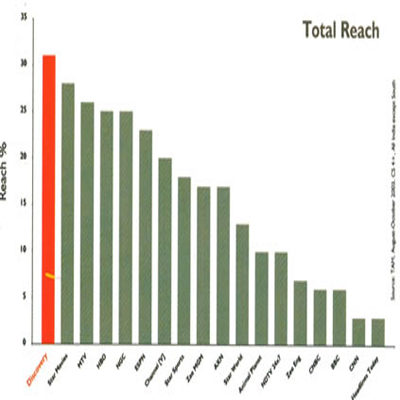
    The result was telling. While feeling the heat from competition, Discovery maintained its lead among the infotainment channels. According to Tam data (C&S 15+, All India), it had a share of 53 per cent in 2011, though it fell to 49 per cent in the second half of the year from 57 per cent in the first half. In 2010, Discovery had a share of 57 per cent.

    Arch-rival NGC is behind with a share of 25 per cent, slightly up from 23 per cent in the earlier year, while Animal Planet’s share has gone down from 18 per cent to 15 per cent. New entrant History TV18 has an average share of 9.9 per cent ever since it launched in October 2011.

    Discovery has a monopoly on the top 10 shows, both in 2011 and in 2010. Episodes of ‘Man Vs Wild’ were the top shows in both years. Other shows that rated include ‘Destroyed In Seconds’ and the special ‘Death of Bin Laden’.

    National Geographic Channel went through a global rebranding. Said National Geographic Network, Fox International Channels India MD Keertan Adyanthaya, “2011 has been a very important year for National Geographic Channel. We have completely changed the way we look and are perceived by our audience. The ‘This is who we are’ campaign, launched in December, showcased the range of experiences, passion and adventure that lies within the channel. NGC has always been dynamic, experimentative and larger than life and this campaign helped articulate this appropriately; it gave us a sharp spike in viewership.”

    Maintaining the genre share remains a huge task in the wake of increased competition. Said Adyanthaya, “ Our mix of diverse series, a new theme every month and having best-rated shows will ensure that our viewer base remains unshaken.”

    The preference is to have daily striped programming. Said Adyanthaya, “If viewers like a show, then they are more comfortable if that series is made available to them as a daily stripe rather than being showcased once a week. As a result, we have striped the popular promotable series on our grid, and we’re seeing daily sampling for these shows recording higher numbers than previously when they were available just once a week.”

    The Regional Language Push: 2011 was a year when players in this genre tried to boost viewership by launching regional-language feeds. Discovery, for instance, increased the reach of the channels on both digital and analogue platforms, launching the Bangla and Telugu language feeds and expanding lifestyle channel TLC’s Hindi feed. “Supplementing our regional strategy, we launched a dedicated 24-hour regional channel – Discovery Channel Tamil catering to Tamil speaking viewers,” averred Johri.

    NGC launched channel feeds in Tamil, Telugu and Bengali. “We feel that our content is universal in its appeal and, hence, language should not be a barrier to viewership. We have seen very strong results with these feeds. The introduction of regional feeds has seen the channel penetration and reach numbers improve significantly in these states,” said Adyanthaya.

    New entrant History TV18, launched last year as a JV between AETN and TV18, has taken the lead in regional languages by being present in as many as seven languages. “We launched with six languages and we have just added Gujarati to our portfolio. Going regional does two things – it helps us to penetrate geographies and SECs, thus helping us aggregate audiences; it will also help us monetise the GRPs.”

    Incidentally, Fox History and Entertainment had exited the space last year and became a lifestyle channel, thus making it easier for a new player to come in. History TV18 aims to change people‘s perception of history by making it contemporary; it also shows action and adventure.

    A+E Networks TV18 JV GM marketing Sangeetha Aiyer believes the Indian market is ripe for alternative formats. “That is one of the reasons for the Network18 group to foray into the factual entertainment space. Factual entertainment as a genre competes with general entertainment or fiction-based entertainment and unscripted formats in evolved markets like the US. It is also emerging as the new preferred choice across other markets in Europe and South east Asia. We believe that the trend will continue and the genre has the potential to become a relatively mainstream option for entertainment in India as well.”

    History hopes to break-even in three years and has invested close to Rs 150 million in 2011. “Going forward, we will be looking at creating innovative clutter-breaking marketing concepts, along with exploiting synergies within the network,“ said Aiyer.

    The Lifestyle Genre: Activity intensified in the lifestyle space as well. Fox History and Entertainment rebranded as Fox Traveller, learning from the experience that travel shows were performing well.

    “2011 was about rediscovery and revamping. Since the travel shows were doing well for us, we started a dedicated Traveller band in January 2011; the shows were well received by our viewers as the band witnessed a significant increase in ratings. In May 2011, Fox History and Traveller was reborn with increased focus on travel-based programming and local productions. The channel was renamed Fox Traveller in October 2011,” said Adyanthaya.

    According to Tam data (C&S4+ All India), TLC leads with a 35 per cent share in 2011. Fox Traveller enjoys a share of 28.7 per cent share while NDTV Good Times has 28.7 per cent. Travel XP follows with a share of 7.6 per cent. The top shows for 2011 are well distributed among the players.

    Lifestyle is an evolving genre. Said Johri, “TLC brought lifestyle programming in India, offering a wide variety of series in the travel and cuisine genre. It later added new genres like makeover, grooming, health, fashion and home. It further created new trends in India by its brand defining programmes on subjects like tattoo and yoga.”

    TL went a step further last year by adding another layer with programming under the jewellery and high-life genre. Most noted amongst them was ‘Oh My Gold!’ with model and actress Lisa Ray.

    “The channel’s success in lifestyle is due to its ability to identify the global and India trends and present entertaining programmes,” said Johri.

  • History TV18’s challenge will be to build a profitable revenue scale

    History TV18’s challenge will be to build a profitable revenue scale

    MUMBAI: Faced with severe competition from strong rivals like Discovery and NGC channels in the infotainment genre, late entrant History TV18’s strategy of offering the most number of regional feeds will attract a wider range of advertisers but the challenge will be to build a profitable revenue scale.

    Madison Media Group CEO Punitha Arumugam pegs the infotainment genre ad market at Rs 1.5 billion and believes that regional is still a developing space. The major chunk of the revenue, however, is taken away by the two big league players, leaving most of the others in the genre struggling.

    For History TV18, the best approach was to have an alternate strategy. Already available in seven languages (Gujarati, Bengali, Tamil, Telugu, Marathi, Hindi and English), the plan is to launch two more regional feeds.

    Arumugam favours such a strategy. “The future for not only infotainment channels but for every channel in the market is to have regional feeds. As more and more advertisers are exploring better targeting of audiences and localisation of messaging, the need of the hour is for regionalisation of national telecast beams,” she says.

    Several media experts agree that channels up against much bigger rivals should woo advertisers by creating a viable local alternate to the national option.

    Says Lodestar UM COO Nandini Dias, “Infotainment channels have had regional language feeds for quite a while now. Whenever a channel adds a language feed, the ratings in the state increase. This is more evident in the south of India rather than markets like Gujarat or West Bengal. But an increase in viewership is always welcome, however marginal. I am sure the channel would have done a cost-benefit analysis before going ahead with this strategy.”

    The success of regional feeds also depends on the region where the feed is launched. And of all of History TV18’s language languages, Gujarati seems to be the most debatable. Gujarat remains largely a Hindi TV-viewing market.

    Says Spatial Access joint CEO Nikhil Rangnekar, “Having a Gujarati feed will not affect the viewership much.”

    Some even question the profitability of starting a feed in so many regional languages.

    “When Discovery started a feed in Hindi, its viewership experienced a huge leap. But now, if you notice, most of the audiences are attuned to watching infotainment channels in either Hindi or English. These two languages cover most of the TG. Having so many regional language feeds will not really make a difference in the ad market share,” says Rangnekar.

    Also Read:

    History TV18 plans to add two language feeds, boost rev

  • NGC goes in for a new look, feel

    NGC goes in for a new look, feel

    MUMBAI: With more competition entering the infotainment space National Geographic Channel (NGC) has refreshed its product, packaging and proposition.

    The aim of the new look, themes, new shows and a new campaign is to showcase the range of experiences, passion and adventure that lies with NGC.

    The channel‘s campaign thought is “this is who we are” and the brand promise is to give young India a television experience that is fourth dimensional, larger than life and experimentative enough to push a viewer‘s definition of entertainment and bring forth the true NGC.

    Shows like ‘Man Vs Monster‘, ‘Dangerous Encounters with Brady Barr‘, ‘Trapped‘, ‘Indestructibles‘, ‘Banged Up Abroad‘ are part of this month‘s theme of Deadly December. Besides the show line-up, the whole look of the channel aims to be more striking and energetic with colours in a brand new packaging.

    A part of the global rebranding exercise, the ‘This is who we are‘ campaign will cater to a vibrant young India‘s love for all that is larger than life, colourful, fascinating and uninhibited. The new look and shows will help viewers connect directly to the great legacy of Nat Geo‘s daring and passionate explorers, the channel said.

    NGC Network India, Fox International Channels MD Keertan Adyanthaya said, “The Indian youth is a big segment of the television viewing audience today and they are constantly searching for content which caters to their entertainment needs and aspirations. With the ‘This is who we are‘ campaign, we bring forth television viewing that packs a powerful punch of pure adrenalin keeping viewers on the edge of their seats. Now only the best of action, adventure, wildlife and exploration will be showcased on the channel in a pulsating, energetic new look that we know and already feel, is addictive enough”

    The campaign is being promoted across the Star network and other mass viewership channels, and other platforms like outdoor and on-ground initiatives. 

  • ‘We have seen double digit revenue growth’ : Rajesh Sheshadri – NGC India senior VP content and communication

    ‘We have seen double digit revenue growth’ : Rajesh Sheshadri – NGC India senior VP content and communication

    With DTH growing in the country and cable addressability expected to spread more channels, special interest broadcasters are looking to increase their offerings. One of these is the National Geographic Channel (NGC). The broadcaster is looking to bring four more channels in the near future.

    Indiantelevision.com’s Ashwin Pinto caught up with NGC India senior VP content and communication Rajesh Sheshadri to find out about the network’s growth plans in India.

    Excerpts:

    NGC is looking to launch more channels in India. Could you shed light on this?
    The four new Nat Geo channels that we plan to launch in India have already proven to be popular in countries where they are currently available. Nat Geo Music, Nat Geo Wild, Nat Geo Adventure and Nat Geo HD allow us to expand our commitment to quality programming and to create specialist channels in genres which are at the very heart of the National Geographic brand.

    The core channel will continue to expand its successful contemporary science, technology and exploration strands and will be clearly differentiated from the specialist Nat Geo Channels.

    Our aim is to offer compelling programming across genres and we feel that this is the right time to launch new channels that will cater to the growing public appetite for high quality television viewing.

    When is the launch happening?
    We have applied to the government for the licenses. We are looking to launch these channels within a month after we get the approval. We would look to launch all four of them together as the impact would be much more.

    Is there a gap that these channels are looking to fill in an environment where audience expectations are growing exponentially?
    Absolutely! All the channels are unique in their category. There are no other channels that compete with them. We need to create channels to cater to the maturing taste of our audience.

    Will local content play a key role in these new channels like it does for NGC and THC?
    Yes! 15 per cent of content on our existing channels is local. We want to hit this mark as soon as possible for our new channels as well. It could happen within the first quarter of launch. Local content will allow us to connect in a very effective manner with our TG.

    Distribution is going to be a huge problem for the new channels with cable networks demanding high carriage fee. How do you plan to tackle this?
    We will have to plan our distribution strategy carefully and see that we are present with those operators and platforms who best serve our TG. There is no need for us to be present en masse.

    What is the core TG for these channels?
    The programming on these new channels is targetted at audiences eager to stretch the boundaries of their knowledge about the world they live in. In some cases, the channels will target the same demographic but clearly a different psychographic.

    Nat Geo Wild will appeal to the entire family: men, women, children, from 6-60 years old.

    Owing to the technology involved, Nat Geo HD will attract premium, affluent households in the bigger cities. With the enhanced picture frame composition, sharper picture quality and surround sound system, National Geographic Channel HD will deliver more intimate, closer to life and theatre-like experiences. The channel will feature explorers and cutting-edge filmmakers. It will showcase documentary programmes, stories and credibility that viewers expect from us.

    Nat Geo Adventure, whose DNA is around travel, adventure and culture, will be targeted towards the 18+ age group while Nat Geo Music is targetted at an older audience above 25 years.

    As far as your two existing channels go, what kind of revenue and viewership growth are they seeing?
    Both the channels have grown significantly in terms of viewership and revenues over the last few years. They have registered double digit growth in revenue over the last year. We are also seeing an increase in viewership and in time spent on the two channels.

    What prompted the rebranding of The History Channel?
    In its two years of existence in India, The History Channel had established itself as a credible authority and owner of the theme of history. The strategic shift allowed us to move the channel to the next phase of evolution and broad base its appeal.

    The History Channel’s fresh and stylishly packaged look and feel has been created and designed internally to reflect a much more distinctive on-air presence. The primary objective behind this makeover was to make history entertaining for our audiences. The look is more edgy and young.

    What are the major tentpole properties coming up for it?
    History Rocks, one of our biggest properties this year, is currently on air and will go on till September. A 17-part series, it brings together concerts, documentaries and interviews featuring rock icons of yester years and offers a glimpse into the life of these rock legends.

    We organised a series of rock concerts across Delhi, Mumbai and Bangalore featuring some of the best Indian rock bands including Parikrama (they performed at the first History Rocks concert held on 23 May in New Delhi), Galeej Gurus (performed on May 30 in Bangalore) and The Works (performed on 5 June in Mumbai)

    Going forward, you will see more big-ticket activities. We will air Warriors, a new series from 4 July every Friday night at 9 PM, which will comprise spectacles based on the lives of eight men who shaped the world around them, either by sheer force of will, genius, courage or even greed.

    Another series that is in the pipeline is an eight-week show called Human Weapon, starting 21 August every Thursday night at 10 pm. This new series features two martial arts adventurers, who embark on a journey to reveal the history behind the different forms of combat.

    Chinese Whispers is a series wherein each episode will challenge an accepted fact to uncover the truth behind history’s most intriguing topics – using the latest DNA and underground technology and new archaeological evidence. This new series will be aired every Wednesday night at 10 pm starting 3 September.

    Is THC also creating TG specific slots like for women and kids?
    Yes, we have specific slots for women and children as well. We have a band in the afternoon that caters to women. For the children, we have a weekly slot on Sundays called THC Classroom. THC classroom showcases curriculum relevant content for school children. We believe that this band will help make history more entertaining and engaging to children.

    Fifteen per cent of content on our existing channels is local. We want to hit this mark as soon as possible for our new channels as welle
    In what manner has THC grown its community outreach programmes like Save Your History over the past few months? How important is it from a brand building perspective?
    Save Your History is a concept that we believe in since it brings history closer to an individual. However, last year there was an internal realisation that we had to make this concept into a much bigger initiative than initially planned.

    Such platforms are important for us as The History Channel is committed to making history entertaining. Initiatives such as these allow people to share and collaborate on entertaining facets of the genre. Currently, we are revising our plans for this initiative. We’ll be able to share these plans once we firm up the details.

    In terms of local shows, are you talking with local production houses to explore ideas?
    Yes we are. We are always looking at ways to localise the channel. We believe that local content always has that additional traction with viewers.

    The Mission properties have been key for NGC. What have the learnings been from doing this over the years?
    Over the years, Mission properties have become synonymous with NGC, which I think is a great achievement given the clutter in the market and the absence of clearly differentiated content. From our perspective, the largeness and the uniqueness that is associated with it puts a lot of responsibility on us too.

    We don’t want to commoditise that positioning and hence we are very careful when it comes to using the ‘Mission’ name for any property. We, therefore, need to ensure that the topic being covered is also unique and a first.

    Before deciding on a subject, what are the key elements that you look for? How much research goes into it?
    A Mission property by definition is a ‘by India, for India‘ property. Through the Mission property, we look forward to reach out to a larger segment of people. The idea, therefore, should have a broad based appeal, should be locally relevant and above all should be in sync with our philosophy of making viewers ‘Think again‘. The idea here is to take viewers to places where no one else can. It has to, therefore, be unique and an unparalleled 360-degree experience.

    What is next in this regard?
    There are always a lot of ideas but a Mission property is a big initiative. It requires a lot of planning and background work. We are planning to launch a Mission this year and will share the details soon.

    Are there any changes going to be made in terms of how NGC is programmed like time slots, genres?
    Right now, we are focussed on building specific nights. We have our existing slot of Megastructures on Thursdays at 8 pm, which is performing extremely well. We plan to build that slot. Later this month, we will be premiering a new series Super Factories on that slot. Super Factories takes viewers inside the shop floor of iconic brands like BMW, Corvette, etc.

    We also have Brand New Sunday, which showcases our newest and best programmes. We are looking at renewed product and communication to strengthen these slots.

    Over the next three months, we have an exciting and interesting line up. We have Long Way Down featuring Hollywood superstar Evan Mcgregor, World’s Deadliest Animals and Food Lover’s Guide to the Planet. All these are extremely informative and entertaining shows and we believe that these properties will get the requisite traction from the viewers.

    On the advertising front, how are the two channels faring?
    We had an inventory growth of 15 per cent on NGC and 30 per cent on THC. We also had a 10 per cent increase in the number of active clients on the channels. These I think are great indicators of how the revenue is shaping up.

    What are the kinds of solutions that long term clients can avail of that go beyond just the 30-second spot?
    At Nat Geo, we take pride in seeing each brand as a unique entity and offering innovative solutions that best suit the advertiser’s needs. Our association with brands like Godfrey Phillips Bravery, Lufthansa, Titan and Makemytrip.com are examples of our ability to go beyond the brief and delivering out of the box solution for our partners.

    With our latest initiatives ‘Lufthansa Nat Geo Genius‘ and ‘Trapped‘, we went way beyond the conventional 30-second spot and incorporated our sponsors’ messaging in a simple yet effective manner without it looking like a forced fit for viewers.

    Godfrey Phillips Bravery has been honouring the brave since 1990 and we found there was a natural fit between their mission and the essence of our series ‘Trapped‘, which was to showcase and salute the strength of human endurance, will and determination. Similarly, our internationally acclaimed game show’s Indian edition, Nat Geo Genius was a perfect platform for Lufthansa to reach out to its target audience.

    As part of the innovative tie-up with Titan, we created an exclusive commercial for their new Aviator range using the exclusive footage on fighter planes from our ‘Top Gun’ series. For makemytrip.com, we created a special adventure zone on their website by sharing assets such as Nat Geo adventure wallpapers and screensavers to boost their adventure travel segment.

    These associations demonstrate our ability to provide integrated marketing solutions to our partners and going beyond the conventional commercial time.

    Abroad, broadcasters have started to create separate channels for the mobile and Internet. Content is specifically tailored for them. How far away are NGC and THC from doing this?
    For NGC, we have mobile-ready content. We have a complete range of short form virals (30-45 seconds), mobisodes (3-4 minutes), ringtones, wallpapers, text based content, etc. We are in talks with both mobile service providers and handset providers to launch NGC on the mobile.

    We are already present on the Plus application on 57827. We run regular SMS contests on the channels to engage with our viewers. In addition to the mobile space, we are also making significant investments in the online space. We are redesigning the NGC website and the new version should be launched in the next couple of weeks. The NGC website, going forward, will function as a full fledged destination in itself.

    The English entertainment space will see new entrants over the next two years. Do you see this growing viewership for the genre or will it simply increase fragmentation?
    Today, every brand must make that additional effort to connect with the consumer whose needs and wants are changing by the day. As long as a channel owns a clearly defined space in the mind of the consumer, fragmentation wouldn’t really matter.

    National Geographic Channel and The History Channel have a clear and distinct positioning in the mind of the viewer. All initiatives by the channels are to reinforce this distinct positioning, and as long as we keep doing that, the launch of other channels will not affect us.

  • ‘We look at the IPL as a business and a media investment’ : Hiren Pandit- GroupM ESP managing partner

    ‘We look at the IPL as a business and a media investment’ : Hiren Pandit- GroupM ESP managing partner

    Being a regional player in the media business, Deccan Chronicle saw an opportunity in IPL to grab the national platform in line with the company’s strategy to step into new markets. It bought the Hyderabad team franchise which was named as Deccan Chargers while GroupM ESP played the consultancy role.


    Indiantelevision.com’s Ashwin Pinto caught up with GroupM ESP managing partner Hiren Pandit to find out about the plans for IPL, its usefulness as a brand-building exercise and the progress that has been made so far.


    Excerpts:

    What progress has GroupM ESP made since launch?
    We work in the areas of entertainment, sports and partnerships. We have broken the entertainment business into two spaces – film and TV content. We have done over 250 hours of branded content programming on TV. One of them was for NGC’s Genius where we got in Lufthansa as a partner for that show.


    In the film space, we help with in-film placements and also with partnerships. We do 25-30 in-film placements and partnerships a year. We got Reebok involved with Goal. Reebok launched a range of Goal products in their stores.


    Another innovation was helping Virgin Mobile partner with Channel (V) for the first live movie shot. Richard Branson actually danced on stage. We also worked with the Johnny Walker Golf tournament. Now we are working on the IPL with our partner Deccan Chronicle. We act as a consultancy for them.

    What is the aim when you are providing solutions to clients?
    We look for long-term strategic solutions. It is about creating a consumer connect in an increasingly fragmented market. Consumers spend time on different things at the same time. The effectiveness of the 30-second spot is reducing. Spends are going towards non-traditional media. We need to be present in this space. We give clients solutions that are out of the box and go beyond conventional media buying. Media is anything that consumers relate with and our aim is to provide solutions to clients that consumers can relate to. The Goal deal was one such example.


    In the partnership space we have deals for content creation, sales. We partner companies with implementation capabilities. The thinking, planning is what we do. The implementation is sourced. We are looking at a partnership for the marketing of sporting events and sports products. We also work with production houses. We worked with Miditech for the NGC show. The client requirement is our priority. A partnership is driven by a client need.

    What role does the IPL play in the overall scheme of
    things?

    We look at the IPL as a business opportunity. The intention was to see if we could do something substantial in that space with a partner. Deccan Chronicle loved the idea. We helped them bid for the team, players, seating, corporate boxes. We believe that it is a team that we also own.


    There are two poles of thinking. Some feel that it will not work. We feel that it will work. It is already a $2 billion industry straight away. The industry has been created overnight. The way the top players come in shows that the boards back it strongly. IPL is about cricket first and then entertainment. You cannot let the two merge. If it does, then the event will not do well. The cricket element should not be touched. As long as the quality of that is high, everything will fall into place.

    How does IPL help Deccan Chronicle from a brand
    building perspective?

    It gives Deccan Chronicle a platform on the national stage. It has two editions – in Andhra Pradesh and Tamil Nadu. They are looking to launch in other markets. They are also looking at a business daily. The IPL gives them visibility across the nation.


    While Deccan Chargers is a separate business, it can be used as a platform to build awareness for Deccan Chronicle. Markets like Delhi and Jaipur will get to know of Deccan Chronicle through the IPL which otherwise would not have been possible. It makes it easier for them to enter new markets.


    At the same time they have put in a lot of money to get the team and we have to make sure they get their money back.

    What was the strategy you followed in bidding for
    Hyderabad and the players?

    Initially we wanted to launch two to three teams. However the IPL rules did not allow that. So we decided to have a franchise in either Hyderabad or Bangalore or Chennai. Hyderabad was our first priority. We did a lot of homework in terms of different revenue streams. We predicted the kind of revenue television would bring in. We also predicted local revenues.


    We were, thus, able to figure out the bidding range we should be at. There were other players like GMR who are Hyderabad-based and so we needed to ensure that we came out on top to keep them out of Hyderabad. We got what we wanted. As far as the team is concerned, it took us two weeks of work to form a strategy. We gave ourselves five options of teams each of which were unique by themselves. They took into account the IPL rules as well as the local talent available in Orissa, Hyderabad and Andhra Pradesh.


    There was $5 million available. $17 million was the total base bid price of all players. Since the total purse that could be spent was $40 million, $23 million was the possible variation. We listed what we believed players would be bought at. Some players were given at 25 per cent or 50 per cent or 80 per cent depending on their availability to play. So you had more money to play with. VVS Laxman was graceful enough not to take icon status so that we would have more money. We followed a batting order process to select players we wanted. Some players were got reasonably but we did not overprice ourselves with any player.


    We looked at it from a T20 perspective. We wanted players who can bat up and down the order like Afridi. Gibbs can also do the same. Gilchrist has a dual role of a batsman and wicketkeeper. Symonds is also a match winner.


    Ladbrokes has rated us as one of the top teams to win the IPL. The onus is for the players to make sure it happens. The job of delivering a good side has been done. It is now a question of on-field delivery.

    Could you talk about the team’s positioning?
    The name of the team is Deccan chargers. We are not a team of stars. We are a unit and this needs to come across. We are there to play hard and win. We do not want superstars. We want players who will operate as a team. We are a bunch of individuals playing as a team. Deccan Chargers are all about Deccan. Hyderabad Deccan is associated with royalty. The charging bull, red eye, gold colour all stand for certain attributes.

    What plans are there to attract women and children?
    We have certain plans. One of them is a school programme. In the stadium, we are looking to create a family enclosure so that women can come. We had thought about having a women’s only enclosure but that may be some time way. We are trying to create a family entertainment atmosphere. You need to make it pleasurable outing for the family. The venue has to be comfortable.


    We started communicating with people from the day that we got the Hyderabad franchise. We ran an ad asking what people would want the team to comprise of. The build up started from there. We are doing activities in malls and multiplexes in Hyderabad. We have made a huge bat so that people can sign wishing the team good luck.

    What about creating a fan base? How long will it take
    to create one like say a Manchester United following?

    It will take at least two to three years. This is our second task. We need to make sure that fans know that it is a privilege for us to be associated with them. This year time has been too short to start the process of building a fan base. The only fan following we have as of now is on our website where half the hits come from the US.


    They already want a T-Shirt and so build up is happening. We are looking at privileged dinners, special ticketing offers, T-shirts, player interaction as time goes by. People at the moment are not used to a city-based team that has players from different loyalties. That connection has to be built up by the franchisees. Today fans relate to cricket with the country but over time people will root for their city. They will believe that an Andrew Symonds can play with VVS Laxman in the same time. This is when fans will start to bond with teams.

    IPL gives Deccan Chronicle a platform on the national stage. It makes it easier for them to enter new markets

    How is the team doing in terms of sponsorships?
    We have structured our deals differently from other franchises. Everybody is selling logos on T-shirts – front and back.


    We will have a team partner. That partner will have ownership of the team. The logos on the team will go to the partner.


    The second partner is entertainment. Anything to do with entertainment from cheerleaders to fours and sixes hit goes to that party. The third partner is the performance partner. This is for things like man of the match, six sixes in an over etc. Then there is a partner for pre game entertainment. The fifth partner is the apparel partner. Each association is distinct and has clear value. We do not want to be like a F1 car.


    The entertainment partner has to be related to entertainment. The performance partner has to be known for performance. Otherwise you mix things and brands get associated with things that do not fit with what they stand for. We have structured our partnerships so that we leverage the value. We will announce deals in this regard next week, as that is when our players will be together.


    Since we are a newspaper we advertise in it. Other teams would have to buy ads. SRK uses the PR route and has also tied up with Telegraph locally. Our media costs come down since we are a media owner. We look at the IPL as a business and a media investment. If someone is losing money it could be that he is using it as an investment for his own benefit. In this case you need to look at it as a media investment and not as a revenue opportunity.


    If you treat it as a business you can make money in the first three years. In three years we expect to make money and it could be for our pocket and also for media investment opportunities.

    One of the challenges is to keep the brand alive after
    the event ends. What plans does Hyderabad have?

    It is not just about a fan base for us. It is also about giving back to cricket. Deccan Chronicle wants to be associated with cricket at the grassroots level. We will start coaching camps, academies. Our partners will also be involved here. This is the difference between just being a sponsor and being a partner.


    Our involvement with cricket is not just about IPL. We will tie up with the Hyderabad Cricket Association, Orissa Cricket Association to see how we can get involved with their tournaments and bring value. We are also looking to get involved with other sports.

    What about taking the team abroad for matches?
    That might be an option as long as the sanctity of the on field play is not compromised. If it is a charity game for instance, then it has to be clear.

    If a team fares poorly in the IPL and finishes eighth,
    will the franchise suffer?

    It depends on the quality of play. If the matches were close and hard fought, then fans will not mind. If, however, the team consistently played badly and failed to compete, then not only will the fans ask questions but so too will the sponsors. It will also be a challenge to fill up the stadium as you go forward. There will be a chain reaction.


    As far as players are concerned, if one plays badly then the news will travel and the player will be dropped. It is about delivery. A lot of money has exchanged hands on account of expectations. The effort needs to be put in.

    What on-air and mobile plans do you have?
    Our site is already up and running. There are lots of forums and debates. On the mobile we will look at it in terms of ticketing and SMS. But the real fun will come when 3G applications come in and they will impact how people view cricket. This will be in the form of streaming video.
    What about tying up with channels for content related
    to the Hyderabad team?

    We are in talks with channels that want to do off-cricket coverage of our team. We will do this in conjunction with our players.
    With the IPL trying to attract women and children, do you see this helping other forms of the game in expanding the viewer base?
    I don’t see it affecting test cricket. It might help ODIs after a period of time. T20 means a faster rate of scoring which will be transferred to ODIs. If you score six to seven an over in T20, you will see the same rate in ODIs. When a lot of action is going on in terms of high scoring, we have noticed that more women tune in.
     

    On the negative side the kind of stroke play that takes place should not deviate from what quality cricket is. Technique should not suffer due to T20.

    GroupM ESP also has a tie up with John Abraham. What
    is the nature of this deal?

    We have got into the celebrity endorsement and management space. We look after his sponsorships and endorsements. We are looking at other celebrities. The celebrity space has blown apart with Dhoni and Yuvraj and MGs (minimum guarantees) being the norm. We are not sure about taking that route.
     

    The celebrity management space is different in India. Abroad, companies manage this sphere. In India, though, individuals manage it. The Indian model must evolve. There is no valuation process in place to see if the return on investments are good. It has to be a win-win situation between the celebrity and the client. Right now, this is a cluttered space.


    The brands that John has endorsed like ESPN and Wrangler stand for values that fit John. You need to keep in mind the sentimental values of individuals. Many celebrities, though, endorse brands where there is no fit. The association is unreal and nobody believes it. Consumers are not dumb.

    How do cricket and Bollywood stack up against each
    other?

    Celebrities have to be careful about the brands they endorse. If they make a mistake, then they pull their own brand value down. Bollywood is less risky. If an actor has a flop, his value does not go down. If a cricketer, however, gets dropped from the national side, there is a huge difference. Brands that he is endorsing will not get full value. The young cricketers are coming in at scary price points. I am not sure how many brands can afford them. If he is not in the team six months later due to in injury, the
    brand is in trouble. The valuation equation should make sense.