Tag: NextGenTV

  • Why NetxGenTV is not the panacea for Indian TV broadcasting

    Why NetxGenTV is not the panacea for Indian TV broadcasting

    Mumbai: A new transmission technology, direct-to-mobile (D2M) broadcasting or NextGenTV, despite enjoying coverage in media platforms such as this one, is struggling to gain TV industry traction. D2M transmits audio-visual content on a terrestrial (earth-based) spectrum and any device with a receiver can access it, just like FM radio transmits audio content. Prasar Bharati and IIT-Kharagpur conducted limited trials of the technology last year, and reports suggest that the Telecommunications Engineering Centre may issue a technical report. It is worth exploring why D2M has almost no takers.

    The first time Indians saw audio-visual content on TV, it was a science experiment to test the capabilities of satellite-based communications. The Satellite Instructional Television Experiment (Site), jointly designed by the National Aeronautics & Space Administration (Nasa) and India’s Department of Atomic Energy demonstrated the potential to disseminate audio-visual content via satellites in 1975. 2,400 villages spread across 20 districts received educational and instructional content that the All India Radio (AIR) had prepared.

    Later in 1991, strong demand for coverage of the Gulf War pushed satellite and TV dish manufacturers and cable operators to work overtime to create infrastructure for TV distribution. Market-led shifts from analog to digital transmission and the evolution of newer transmission technologies like direct-to-home (DTH) and Headend in the Sky (Hits), led the way and created new value and supply chains. In the case of D2M, no supply chain participant – content services, device makers and infrastructure providers – wants a hard mandate for adoption. At least at the time of writing.

    Content Services

    First, it is unclear if D2M can offer better content to consumers. The shift to digital broadcasting enabled more content to flow through the same frequency channels and made more content available. D2M offers no such efficiency. Prasar Bharati, India’s public broadcaster transmits a few Doordarshan channels in 16 cities in India through digital terrestrial transmission technology. Presumably, content made available on D2M would be the public broadcaster’s content.

    D2M is not lucrative for private broadcasters because they are likely to face monetisation challenges. For instance, D2M fragments the existing ad market for free-to-air TV channels, diminishing the value of TV advertising real estate. A TV channel would need to invest in packaging content for D2M distribution without any assurance of new eyeballs. PayTV providers are apprehensive of content protection standards as they may lose out on subscription revenues because of last-mile signal piracy. Anyone with a D2M receiver can view pay TV content and the transmission technology does not account for strong access controls.

    There is also an apprehension that the ministry of information &  broadcasting (MIB) may use anti-siphoning frameworks to source content for D2M. Prasar Bharati receives the live feed of expensive IP rights acquisitions like the Cricket World Cup for free as a result of the Sports Broadcasting Signals (Mandatory Sharing with Prasar Bharati) Act, 2007. If the public broadcaster makes this content available for free on D2M, rights holders cannot monetise their IP and recoup their investment. Consequently, the value proposition of investment in sports broadcasting diminishes and it will have an adverse impact on the sports ecosystem.

    Device Makers

    Second, the device ecosystem is neither prepared nor incentivised for D2M adoption. Like the shift to digital-required set-top-boxes (STBs) and DTH-required satellite dishes, D2M adoption requires transmission and receiver equipment. Saankhya Labs, the government’s partner in D2M trials, produces transmitters but India does not indigenously produce receiver equipment.

    If the government mandates original equipment manufacturers (OEMs) to install D2M receiver equipment they will resist on account of cost concerns. OEMs highlighted a similar challenge when the ministry of electronics & information technology (MeitY) issued an advisory and asked mobile phone manufacturers to include FM radio receiver functions in April 2023.

    Conversely, if consumers buy receiver equipment at their own cost, it is likely that cheaper products from jurisdictions like China will flood the market. This leads to privacy and security concerns and exacerbates underreporting and signal piracy. A D2M receiver in border areas can receive content and possibly communicate data on the mobile handset across the border.

    Distribution

    The Prasar Bharati-led trials proved the technology can work, but it does not speak to its feasibility and impact on the distribution ecosystem. D2M receivers received transmissions in a controlled environment in metro cities Delhi and Bengaluru. But, does that prove that it can work anywhere in the country? And can it coexist with other use cases?

    Spectrum is a scarce resource and many communication technologies need the resource to operate. Allocation of a spectrum for new technology requires a comparison of deploying D2M in this frequency range with competing use cases or assessed potential interference with existing services. D2M broadcasting uses spectrum in UHF frequency bands 526 – 582 MHz. Eventually, the 470 – 698 MHz would be key for D2M adoption. Telecom operators require the same band for 5G deployment, and accommodating D2M will reduce bandwidth. Further, radio microphones, in-ear monitors, wireless cameras, talkback systems used during live events, content production, political rallies, news broadcasts, and press conferences also use the 526 – 582 MHz frequency range.

    D2M will compete with audio-visual transmitted via data services of telecom and internet service providers. Airtel reported a 27 per cent increase in its revenue from mobile services in the first quarter of FY23, attributing it to growing consumption of mobile data.  Reliance Jio also reported similar growth in June 2022, with total data traffic in the quarter growing by 27.2 per cent. D2M does not offer a value proposition for telcos to diversify their offerings and build infrastructure for D2M broadcasting.  

    Where and when to use D2M

    D2M will not herald a new era of content dissemination or transform broadcast distribution as many claim it will for the reasons stated above. However, it can serve a public interest objective like the Site experiment did in 1975, that is, to disseminate educational and informative content. D2M also has the unique ability to disseminate locally which can be utilised for localised content dissemination, like community radio stations that broadcast audio content within a local range. In terms of content, D2M can provide an additional avenue to disseminate public interest content and spread awareness through localised transmissions in disaster situations. The government would still need to address device ecosystem and spectrum concerns before it can rollout and scale the technology.

    D2M holds potential for a revamp of public broadcasting in India, but it is unlikely to find any takers in the private sector. D2M’s unique proposition is its ability to localise transmission which Prasar Bharati can utilise for dissemination of content on themes of national importance and emergency transmissions during disaster events.

    Varun Ramdas is manager Koan Advisory Group. The views expressed in this article are entirely his own and Indiantelevision.com neither endorses nor supports them in any way.

  • Long live linear TV, courtesy of NextGenTV

    Long live linear TV, courtesy of NextGenTV

    MUMBAI: Las Vegas. Normally labelled as Sin City. But in April it was all about the future of entertainment technology with the NAB Show opening with a bang. And what a bang it was. It is a hard knock for those who continue to resist the frenetic pace of technological evolution. One of these is ATSC 3.0 which is coming. Yes, even as it is spreading gradually in the US, it is being planned to come to India. That is if Sankhya Labs, Sinclair Broadcast, Doordarshan and Prasar Bharti succeed in its rollout.

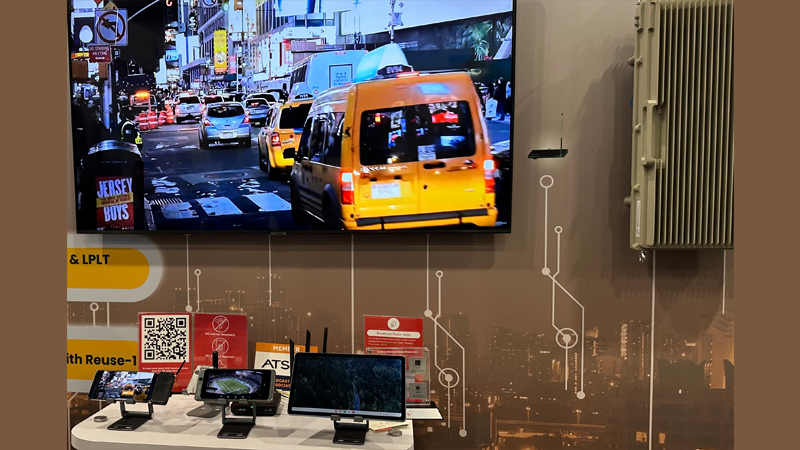
    I happened to see some trial broadcasts in the Las Vegas Convention Centre and it was awesome.

    At early stages yet, ATSC 3.0 endeavours to wirelessly transmit data, video and audio, over the air without using the traditional terrestrial frequencies or the 4G, 5G or 6G spectrum. Also known as NextGen TV, it is a digital television standard developed by the Advanced Television Systems Committee (ATSC), offering features such as ultra-high-definition video, high-efficiency video coding (HEVC), high dynamic range (HDR), immersive audio, and interactive capabilities.

    Sankhya Labs has been working on developing semiconductor solutions and software for ATSC 3.0-enabled devices. These solutions encompass various aspects of ATSC 3.0 technology, including receivers, modulators, demodulators, and related software stacks. Sankhya Labs aims to offer cost-effective and scalable solutions to enable the deployment of ATSC 3.0 infrastructure and consumer devices in India and other markets. Currently, it has developed – and continues to develop –  the PCB, the software, the receiver and dongle, and set-top box designs which will then be farmed out for local manufacture.

    I happened to see the transmitter developed by Sankhya at the NAB Show which will be mounted – when the service is ripe and ready to be rolled out – next to the cellular towers which dot Indian building terraces in urban and rural India. Then there is the dongle (looking like the early device we used to get connected to the internet) which will act as the receiver and can be attached to an ordinary smartphone with basic video capabilities and receive the transmitted video at almost no cost to the customer. (Remember there are more than 500 million smartphone users in this country and even if 10 per cent of them opt for ATSC 3.0 that will be a humungous base of 50 million viewers) For the home, users will have a set-top box (which Sankhya hopes to gradually decrease in size)  that will sit next to the TV set to receive the signals for family viewing.

    As it does for FreeDish, DD is likely to auction channels to private broadcasters who can reach viewers with another linear service, thus giving traditional TV a new lease on life and advertisers another medium to target the vast masses of television viewers.  This is at a time when YouTube video, Instagram reels, free-to-air TV, and streaming services have totally disrupted satellite and cable pay TV services in India with cord-cutters, cord nevers reaching record highs. The streamers need help to retain clever viewers who are sharing passwords as well as churning when they finish watching shows that interest them in one service or another.

    How long will ATSC 3.0  take to become a reality? Broadcasters, handset manufacturers, telcos have all blackballed it saying that it is a needless platform that is being created. 

    But Sankhya Labs and the NextGenTV committee would like it to spread tomorrow itself. Work has been going on for at least the past three to four years and it might take as much time for the government-owned broadcaster to give it a clear green signal. (I’m crossing my fingers DD moves fast once a government is formed at the Centre post the elections or a private company is given the responsibility of spreading ATSC 3.0 services in a public-private partnership.)  One can be optimistic and only hope that this exciting technology which can lead to the creation of zillions of local channels monitoring local traffic conditions, weather conditions, long-distance medicine, education, etc etc comes quickly enough.

    When it does arrive, it will come with the potential to revolutionise the way we consume our entertainment once again. And oodles of other services.