Tag: news genre

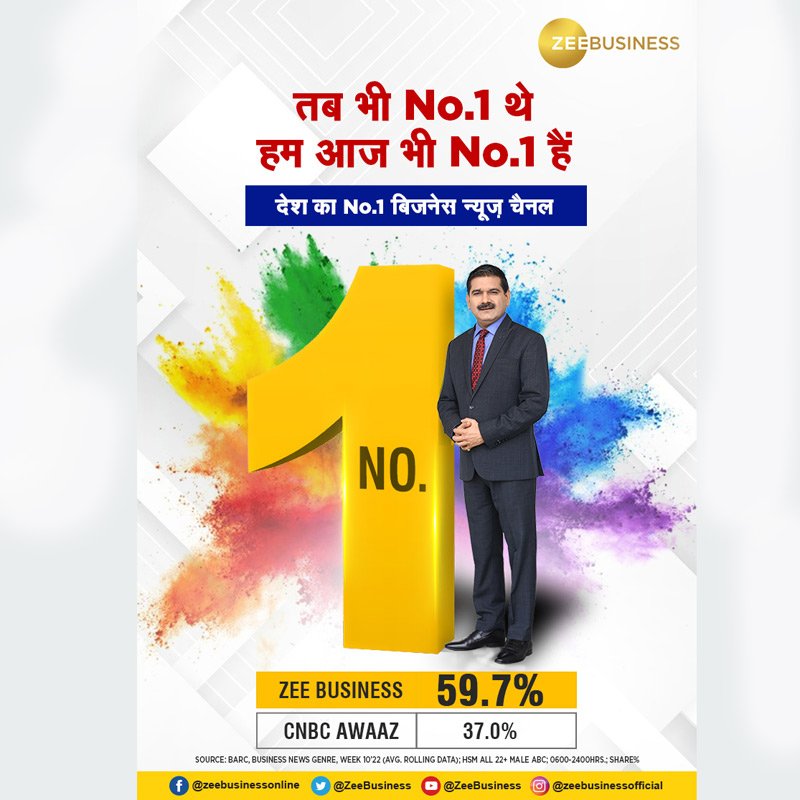
  • Zee Business races ahead of its competitors in Barc news ratings

    Zee Business races ahead of its competitors in Barc news ratings

    Mumbai: Zee Business has grabbed the position of top business channel in India in the critical broadcast segment, according to data provided to the business channel by Broadcast Audience Research Council (Barc).

    According to the relative share data released by the association (Business news genre, week 10 of 2022 (avg rolling data) HSM all 22+ male ABC, 0600 – 2400 hrs), Zee Business scored the top place with 59.7 percent relative share, while the rest of the business news channels combined have 40.3 per cent relative share.

    “A big thanks to the viewers of Zee Business as we continue to be the top choice and the voice of the consumers,” commented Zee Business managing editor Anil Singhvi. “We will continue to empower our viewers on smart investment decisions that can help them make profits. This feat has now become a habit for the channel. We are the only channel that provides jargon-free information to the viewers in the simplest language possible which helps them make sound investment decisions.”

    “I take this opportunity to thank our viewers for their continued confidence in our channel Zee Business and this has helped us to be in the top position,” stated Zee Media Corp Ltd head of marketing Anindya Khare. “Zee Business is always educating and explaining the viewers on the nuances of the stock market. We are always trying to find new ways to help and educate our audiences on various matters related to finance and share our expert views on the channel.”

  • Broadcasters cheer, as TRPs for news channels to resume after regulatory reboot

    Broadcasters cheer, as TRPs for news channels to resume after regulatory reboot

    Mumbai: After a year-long wait, the ministry of information and broadcasting (I&B) on Wednesday finally gave its go-ahead to Broadcast Audience Research Council (Barc) India to immediately resume ratings for TV news channels, giving broadcasters a reason to cheer in the new year.

    As per the order, Barc India will have to release ratings for news and niche genres on a ‘four-week rolling average concept’ with immediate effect. But first, it will be required to share the last three months’ data which is expected to give some direction to news channels, and advertisers who had been taking a shot in the dark.

    “I welcome the government’s decision to finally resume ratings for the news genre,” said TV9 Network CEO Barun Das, terming the monthly ratings as the need of the hour. “I have for long been advocating the need to restore ratings while questioning the suspension decision in the first place. News Broadcasters Federation’s (NBF’s) efforts in this direction have been exemplary.”

    In February 2021, over 50 TV news channels had written to the then I&B minister Prakash Javadekar questioning the decision to single out the news genre for suspension.  “News genre commands 12 per cent of the total viewership and 18 per cent revenue of the industry. So, why is that the rating system which is bad for roughly 12 per cent of the TV industry, good for the rest 88 per cent?” Das had written in a separate letter.

    Also read: “Lakhs of livelihood at stake,” TV9 urges MIB to resume TRPs

    Also read : Over 50 TV news channels write to MIB over suspension of TRPs

    In a bid to restore confidence in Barc ratings, the I&B ministry also assured channels that the TV measurement body has undertaken revision in its processes, protocols, oversight mechanism and initiated changes in the governance structure. “The reconstitution of the Board and the Technical Committee to allow for the induction of Independent Members have also been initiated by Barc.  A permanent Oversight Committee has also been formed. The access protocols for data have been revamped and tightened,” the ministry stated.

    Taking a step further, MIB has also set up a ‘Working Group’ under the chairmanship of the Prasar Bharti CEO Shashi Shekhar Vempati for the consideration of leveraging the Return Path Data (RPD) capabilities for the use of TRP services, as recommended by Telecom Regulatory Authority of India (Trai) and the TRP Committee Report. The group will submit its report in four months’ time.

    “Happy that exactly a year later, the recommendations of the TRP committee report have been accepted by MIB India. Thankful to fellow members of the committee for the hard work put in. Looking forward to achieving cross-industry consensus on the use of Return Path Data (RPD) for TRPs,” tweeted Prasar Bharati CEO.

    Also read: I&B ministry forms Joint Working Group for audience measurement sampling

    The announcement was also welcomed by the News Broadcasters Association (NBA). In a statement, one of the members of the association, who is CEO of a news channel said, “NBA’s stand is vindicated as ministry stamps the room for improvement, acknowledges the deficiencies, and puts a timeline to ratings’ release and systematic corrections.”

    The news broadcasters also gave a thumbs up to the transition from weekly to monthly ratings. “I’m very much in favour of monthly ratings. I think news channels’ content cannot be moulded on the basis of ratings, like the way GECs content can be moulded,” said a senior representative from a national news channel. “The sole purpose of ratings is to give a measuring base to advertisers, and they take a minimum of two to three months to establish a fair and equitable representation of true trends. So, we don’t need ratings on a weekly basis.”

    According to industry representatives, the new ‘four-week rolling average concept’ will also be better equipped to deal with inconsistencies related to inadequate sample size.

    While the decision to scrap out weekly ratings got a positive response, some industry veterans also suggested that releasing news ratings quarterly or twice in a year would be a better proposition. “The global news industry is transforming itself into a “news product” that people can pay for. Ideally, the news genre should be subscription-oriented, as most newspapers are now these days. Globally too, that’s the trend – shifting to an advertising-driven, pay-TV model,” he said.

    The ministry’s go-ahead comes just weeks ahead of an intense election season in five states, including an electoral battle for India’s most populous state. With news channels, all geared up to grab maximum eyeballs, it will be interesting to see how the latest system of news ratings will change the game, especially with several new channels entering the race. “We will have to see whether the scenario has actually changed over the last year or not. But, hopefully, it will only get better from here,” said a senior representative from a news channel.

    The overhaul in the television rating system in India kickstarted in October 2020 when Mumbai Police claimed in a press briefing that they probed a case of manipulation of TRPs and found some incriminating evidence. The police said the accused were allegedly bribing the households to keep a particular channel running, leading to several arrests, and FIRs against three news channels.

    The controversy had forced Barc India to temporarily suspend the publishing of weekly data for news channels, which remained in limbo for over 1.3 years. “A pause was necessitated to enable the industry and Barc India to work closely to review its already stringent protocols and further augment them,” the then Barc India chairman Punit Goenka had said.

  • NBF demands BARC to urgently release news genre ratings

    NBF demands BARC to urgently release news genre ratings

    Mumbai: The News Broadcasters Federation (NBF) has demanded BARC to resume the release of audience measurement data for the news genre which has been unilaterally withheld for almost a year.

    While registering its demand in a letter addressed to BARC CEO Nakul Chopra, the NBF said, “As the only industry body the representing the business interest and editorial freedom of news TV channels, NBF strongly iterate to be included and consulted on all issues surrounding the release of TRP data for news genre.”

    Listing major concerns on the issue, it stated that there was no legitimate reason or rationale for a pause in ratings for one specific genre. “If the process of BARC is faulty and is being reworked, the entertainment and other genres which contribute 88 per cent continue to get the rating data. However, the news genre which constitutes only 12 per cent has been victimised; though the metering boxes and data collection is common for all genres,” the federation said.

    The NBF also alleged that vested corporate interests are overshadowing industry welfare, and this has caused a loss of credibility and revenue to the news genre. In addition, news broadcasters are losing the trust of the viewers and the advertisers are increasingly suspicious about the genuine performance of the channels.

  • It is time for Good News Today

    It is time for Good News Today

    Mumbai: Over the last year, people across the world have faced unprecedented challenges caused by the pandemic. All through this, television served as a window into the world, providing news of everyday events happening across the globe. The coverage across news channels documented the unsurmountable toll that the pandemic took on every aspect of our lives.

    Amid the gloom, there were stories of human sacrifice, hardships, and challenges that inspired people to step up and help others. Stories of Good Samaritans who delivered food to patients kept under isolation and mobilised oxygen supply to those who needed it the most. There were human-interest stories of dhabas that had been deserted during the pandemic and bounced back with the support of their ardent patrons.

    For the longest time, coverage of politics has taken precedence over other subjects for news channels. At a time, when the country is limping back to some sort of normalcy, perhaps it is these stories, that need to be told more than ever.

    “The trend in news media worldwide is to have a strong point of view and take a ‘stance’ in the country’s social-political scenario. That’s a classic way to get more eyeballs from the constituency the stance represents,” said renowned ad sales trainer and Marcom advisor to challenge brands, Shripad Kulkarni.

    There has always been a debate between giving what the audience wants over what you think they need. However, the chase for higher TRPs has led news channels into a rush for ‘breaking news’ and ‘sensationalist headlines’. Experts concur that over a long term, the content of news channels is largely responsible for attracting/ repelling audiences.

    The focus on negative stories also tends to create a bias towards a certain kind of worldview. Swedish statistician Hans Rosling demonstrated through tests that people believe the world is poorer, unhealthier, more dangerous than it actually is. He attributes this bias not to random chance but to a one-sided view of the world that is depicted in the media.

    “In-depth coverage and over the top coverage are not the same thing. There is a point by which too much becomes way too much. Honestly, I think Dilip Kumar (referring to his death) deserved more bandwidth than Raj Kundra – the young people need to know more about his story, from many different angles,” opined Social Access Communications’ founder Lynn De Souza.

    While the news genre continues to play the role of incremental reach builder/ frequency driver as per the structure of different markets, experts highlight that the recent changes in the news ecosystem have somehow diluted its attractiveness. Also, it is this nature of engagement with the news channels that the advertisers are also re-evaluating. 

    “Undeniably, content associations deliver the maximum value for advertisers but, the uncertain nature of content has made advertisers wary of associating with news as sponsors or as on-screen associates,” said Wavemaker India, chief strategy officer, Premjeet Sodhi, emphasising the need for more “regionalisation and localisation” in news coverage, as well as a need to appreciate the changes in mindsets of the small town/ rural consumers with their increased access to media.”

    In the era of the “attention economy,” each channel has created its own unique way of bringing news to the consumers and that may impact the viewers’ choice of channels. Maybe, it’s time, they explore good news as that differentiating factor to connect with their audiences.

    This also explains why the latest launch of channels like Good News from The India Today group offers a chance for the TV news genre to reinvent itself to bridge this widening gap. This also augurs well for brands and advertisers who are keen to invest in the news genre for maximum returns on value.

    “The ultimate product is the content and it is for the news channels to re-discover and re-define News and built their own unique approach to delivering news and analysis. And, this is something that has been done by these very channels in the past. The consumers’ expectations have changed; the market dynamics have changed and the news channels have to tune their strategic direction to the new reality,” added Sodhi.

    The latest example of that has been the coverage of India’s historic feat at the 2020 Tokyo Olympics. Stories that uplifted the morale of the nation in tough times, and gave them something to cheer about. It also drew attention towards the dreams and aspirations of Young India. There were so many backstories not just about Indian athletes but other treasured moments like the first joint gold that has not been properly featured on most of the news channels.

    “With respect to ROI for brands and advertisers, I think TV news is the genre that gives maximum return on value. News works out much more effectively because you can have a lot of frequency- and even in terms of CPR efficiency, nothing can come close to news so far. The only downside perhaps, is that a lot of planners think that you have reached stagnancy with the news. But we have experimented in the past that if you take the right path and expand your choice you can get an optimum reach with news,” says a senior media planner.

  • Agencies should add news genre to regular planning: Network18’s Karan Abhishek Singh

    Agencies should add news genre to regular planning: Network18’s Karan Abhishek Singh

    MUMBAI: The news genre should be included by agencies for its impact as a full planning platform and not just an add-on. This was the view echoed by News18 Network CEO-languages Karan Abhishek Singh at Tele-Wise Tamil 2019 organised by Indiantelevision.com on 6 August 2019.

    At the event, Singh spoke on the relevance of the news genre in the Tamil Nadu market which is dominated by GECs and movies. He said that news as a genre has grown fastest in the past one year.

    Mapping the growth of regional news channel in the state, Singh urged advertising agencies to add the news genre to their regular planning. He explained that in the last one year the peaks in news are significantly higher from the demise of Tamil Nadu former CM M Karunanidhi to cyclone Gaja to the national election to Article 370. The peak has been breached around 18 to 19 times. “These are the big event days which create an impact on the viewers and the advertisers. Two or three impacts in a month is an opportunity for the advertisers,” he said.

    The top categories on news channels are largely retail outlets. Apart from male-targeted products, news genre is delivering to response-driven categories like retail, film, real estate etc. and these categories have been using the genre consistently. The genre also has the potential to drive long term brand imagery for brands- auto, travel and tourism and insurance.

    He also mentioned that auto categories have started advertising on regional channels. Travel and tourism has also become a critical mass category on news. “So the news genre on its own needs to be looked at very differently and not just a frequency builder as part of an advertising campaign because it is the platform that delivers impact consistently month after month,” he said.

    Singh believes that news is the fastest growing genre in the country and a large part of this is because of regional news channels. “The genre is growing largely across regional channels and partly in Hindi but not so much in English which was the traditional forte of news consumption,” he said.

    “In regional space, the south market is extremely news intensive. When it comes to news consumption, Tamil Nadu out-consumes some of the states by as much as 2:1 ratio,” he said.

    Within the South, the interesting part is that Tamil Nadu has very unique pattern of consuming news. The Tamil Nadu audience watches more news in the early morning. About 55-56 per cent of the day’s viewership comes from the time band of 6 am to 2 pm. “Tamil Nadu news has given a completely new definition to news primetime. There is no other market which has this kind of pattern,” opined Singh.

    Singh also said, “At overall TV level, Tamil Nadu is one of the largest viewership markets in the country based on the component of early morning and mid-day news viewership and traditional primetime viewership on GECs and movies. And with every spike in the news cycle, the overall TV viewership increases. News is consistently among the top three genres in the state and continuously reducing the gap with the second genre i.e. movies.”

    Singh concluded, “A few years ago, the reach of news was 52 – 53 per cent and today news reaches 70 per cent of the viewership on a weekly basis. The news genre is rapidly growing in Tamil Nadu because of its sticky content. Regional news channels have the opportunities to build and by this I don’t mean by sensationalising the news but going deeper into what matters in that particular region. We need to engineer the revise brain drain from the larger national platform into the regional platform.”