Tag: news channels

  • Is blaming the watchdog politicos’ new defence matra?

    Is blaming the watchdog politicos’ new defence matra?

    MUMBAI: The countdown to the general elections has well and truly begun, what with political parties and their prime ministerial hopefuls engaging in an unending game of one-upmanship.


    What is surprising though is that this time round, the fourth estate, otherwise hailed as ‘the watchdog of democracy’, is at the receiving end of this mud-slinging match.


    For starters, two years after an Indian Express report about the controversial movement of two army units towards the national capital, General VK Singh, who was the then army chief, opted to call the reporters ‘presstitudes’ while dismissing the article as ‘the fable of a sick mind’.  


    Then, Arvind ‘Aam Aadmi’ Kejriwal, during his recent speech at Rohtak in Haryana, alleged that Mukesh Ambani had bought some TV channels and newspapers and asked them to give extensive coverage to Rahul Gandhi and Narendra Modi.


    Just the other day, at a Congress function in Solapur, Union Home Minister Sushil Kumar Shinde threatened “to crush elements in the electronic media spreading false propaganda” although he clarified the very next morning that he was targeting “social media, not journalism”.


    And while on the subject of social media, readers will recall how West Bengal Chief Minister Mamata Banerjee, known for her stiff stance on most issues, got a Jadavpur University Chemistry Professor arrested for allegedly circulating ‘anti-Mamata’ cartoons on the Internet in 2012.


    The same year, a similar fate befell a small scale industrialist who was arrested for allegedly posting ‘offensive’ messages on social media targeting Union Finance Minister P Chidambaram’s son Karti.


    Yes, social media can often be a double-edged sword but what is equally important is that it has given the aam aadmi a voice.


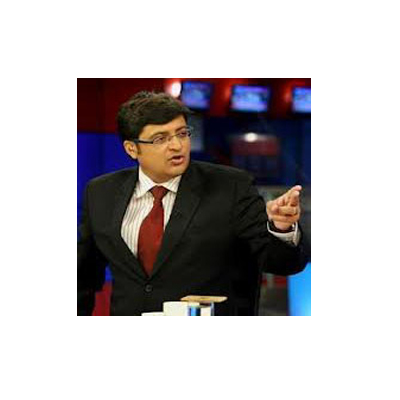
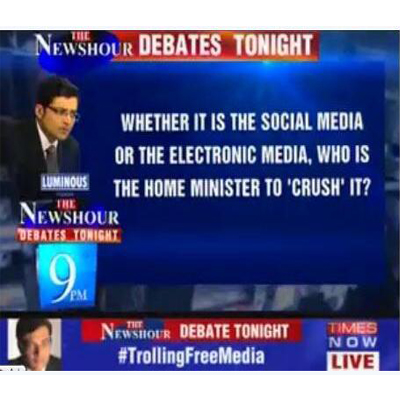
    Times Now Editor-in-Chief Arnab Goswami puts it correctly when he says that the media is variously termed as good or bad depending on whether it praises or bashes politicians. Indeed, politicos trolling media to suit their purpose was the subject of a News Hour debate not so long ago while #Trollingfreemedia had the Twitterati debating the issue endlessly.


    So much so, the Editors Guild came out in protest with a statement that read: “Ironically, leaders who built up reputations and support by engaging the public through the media are now turning on the very media when they come under critical scrutiny.”


    The News Broadcasters Association (NBA) too issued a press statement saying: “A news channel’s endeavour is to cover news-worthy events across all segments of national and international life and to present news to viewers, which is current and relevant. The media provides a service that is essential for any democratic society. This is particularly important when the most fundamental aspect of a democracy, the elections are round the corner. At such a time, the media plays an indispensable role in enabling citizens to stay well informed and make important choices. There can be no acceptable reason for attacking the media on frivolous, unsubstantiated grounds. Intimidation and preventing the media from performing its duties amounts to interfering with the freedoms enshrined in and guaranteed by the Constitution.”


    The NBA specifically appealed to political leaders across parties and public figures not to level baseless charges against the media and keep the discourse civil and sane.


    Somehow, now media has become everyone’s punching bag. Nonetheless, journalistic maturity is needed without losing the enthusiasm, energy and insightfulness.


  • NBA asks politicians to keep political discourse civil and sane

    NBA asks politicians to keep political discourse civil and sane

    MUMBAI: New channels normally throw the spotlight on politicians. As the ensuing elections to the Lok Sabha are turning out to be the most bitterly fought, it is the new channels that are coming under attack from politicians.


    Former Delhi chief minister Arvind Kejriwal recently lashed out at TV news channels. He accused the news channels of being biased towards BJP’s prime ministerial candidate Narendra Modi and Congress’ poll campaign chief Rahul Gandhi.


    On Monday, home minister Sushil Kumar Shinde shocked the media fraternity when he claimed that the intelligence wing had been keeping a tab on news channels and that the government would ‘crush’ the elements in electronic media engaged in spreading false propaganda.


    In the wake of these attacks, the News Broadcasters Association (NBA) has decided to hit back. It has objected to the kind of unwarranted criticism news channels are faced with.


    A statement issued by the NBA said:


    “News Broadcasters Association (NBA) objects to the unverified, unsubstantiated and highly defamatory charges being levelled against news channels by Mr Arvind Kejriwal of Aam Aadmi Party (AAP) and their members attributing corrupt motives and accusing the electronic media for not giving enough coverage or ignoring this or that party, without specific details to substantiate such charges. It is shocking to note that the very parties that gained immensely from media coverage are today turning against the electronic media, when they are under scrutiny on issues of governance.


    NBA is equally shocked by the statement of the Home Minister of India that he would crush the electronic media and that a “close watch” was being kept on them.


    NBA categorically states that a news channel’s endeavour is to cover news worthy events across all segments of national and international life and to present news to viewers, which is current and relevant. The media provides a service that is essential for any democratic society. This is particularly important when the most fundamental aspect of a democracy, the elections, are round the corner. At such a time, the media plays an indispensable role in enabling citizens to stay well informed and make important choices. There can be no acceptable reason for attacking the media on frivolous unsubstantiated grounds. Intimidation and preventing the media from performing its duties amounts to interfering with the freedoms enshrined in and guaranteed by the Constitution.


    NBA appeals to political leaders from all parties and public figures not to level baseless charges against the media and keep the discourse civil and sane.”

  • Avian Media further strengthens leadership team in Mumbai

    Avian Media further strengthens leadership team in Mumbai

    MUMBAI: With an aim to further strengthen its consumer practice in Mumbai, Avian Media has appointed Shalmana Tendulkar as Group Business Director, Consumer practice.


    Shalmana brings wealth of knowledge and domain experience of over 17 years. Having worked as an independent consultant and with agencies, Shalmana has in-depth knowledge of the media and broadcast industry having consulted general entertainment channels (GEC), news channels, radio channels, as well as niche channels in the action, movie, music and kids genre. Shalmana has also led publicity of feature films and managed celebrity brands.


    Over the years, Shalmana has also worked on consumer brands, having handled campaigns for large FMCG companies like HUL, Kellogg’s and Colgate. Adding to her dynamic portfolio, Shalmana has a number of special events like the tours of Def Leppard, Ricky Martin and Elton John to her credit.


    Nitin Mantri, CEO, Avian Media, said: “We are very pleased to have Shalmana join our growing Mumbai office. With her vast experience and expertise, we hope to boost the capability of our already successful consumer practice. Over the years, while working with some of the leading consumer brands, we have built the right talent and expertise to deliver successful PR campaigns for our clients. Under Shalmana’s tutelage, we will continue to accelerate this growth and deliver impactful campaigns for our clients.”


    Commenting on the appointment, Shalmana Tendulkar, said, “I am really excited to be a part of Avian Media and its talented team that has a proven track record of delivering successful PR campaigns and servicing standards. Avian Media is currently well positioned to write a new chapter in the growth story and I look forward to contribute to the augmentation of the firm by expanding the Consumer practice offerings.”


    In her role as the Group Business Director of the consumer practice at Mumbai office of Avian Media, Shalmana will bring in a renewed focus and direction to the existing client campaigns, harnessing the in-house talent and growing client base in the vertical.

  • Television’s Independent Film Channel now just IFC

    Television’s Independent Film Channel now just IFC

    MUMBAI: In a small bit of news that may come as a surprise to many, Independent Film Channel has officially changed its name to just IFC.


    The regular viewers might have probably figured that out by now. But the recently announced that the corporate paperwork has been signed to change the network’s name to IFC.


    It’s just another example of how networks evolve over time with their names and images sometimes catching up to them; in recent times a channel that pops up in the head is The Learning Channel becoming TLC as its programming changed dramatically.


    Closer home we have witnessed such changes among news channels and sports channels in recent times.


    The changeover began in 2010 when IFC began airing its first original comedy, The Increasingly Poor Decisions of Todd Margaret.


    The network now produces six original comedies. The most recent, a spoof of prime-time soaps titled The Spoils of Babylon, starring Will Ferrell, Kristen Wiig and Tobey Maguire with several other famous names making cameos, began past week. Reruns of Arrested Development were also a key part of the transition.


    While there are plenty of places to find broad-based comedy on TV, IFC managers figured they could fill a niche with shows that are ‘slightly off’ – as IFC says in its tagline.


    IFC, owned by AMC Networks Inc, has also acquired movies that are anything but independent; over the holiday season it ran installments of the National Lampoon ‘Vacation’ comedies.


    Financially, it’s always detrimental for a network in creating its own original programming than in relying on movies that were originally produced for other venues.


    IFC has some surprises in store later this year with a new series, Garfunkel & Oates, starring the comic duo Riki Lindhome and Kate Micucci, and a second season of Maron, about the comic Marc Maron.


    Though IFC’s transition had been long time due, signing the documents striking off the name Independent Film Channel was still a significant move for the channel. Now what’s left to be seen is does it have an impact on its reach and viewership, only time can tell.

  • Broadcast Editors’ Association elects 15 member editorial panel

    Broadcast Editors’ Association elects 15 member editorial panel

    MUMBAI: The Broadcast Editors’ Association (BEA), the apex body of editors of news TV channels, elected its office bearers recently. The election process took place at an AGM held in New Delhi. The BEA decided to retain the status quo and unanimously took the decision and re-elected Shazi Zaman (ABP News) as the president of the body while Arnab Goswami (Times Now) was re-elected as vice president.  Deepak Chaurasia from India News was elected as the vice-president of BEA .

    Live India’s editorial boss NK Singh  was elected general secretary. There was good news for the India Today Group as well with  Supriya Prasad of Aaj Tak  being  elected treasurer of BEA.

    The 15-member executive committee of the BEA comprises: Shazi Zaman (ABP News), NK Singh (Live India), Arnab Goswami (Times Now), Deepak Chaurasia (India News), Ashutosh (IBN7), Sonia Singh (NDTV), Ajit Anjum (News 24), Vinay Tewari (CNN-IBN), QW Naqwi (India TV), Shailesh Kumar (News Nation), Supriya Prasad (Aajtak), Vinod Kapri (News Express), Dibang (senior journalist), Satish K Singh (senior journalist), and Pranjal Sharma (senior journalist).

    The BEA also constituted a credentials committee for inducting new members as the news industry has been proliferating with channels seeking to become members . The committee consists of: :  Shailesh Kumar (News Nation), Sanjeev Paliwal (IBN7) and Supriya Prasad (Aajtak).

  • Reports on TV news channels in DSP murder case impartial, opines NBSA

    Reports on TV news channels in DSP murder case impartial, opines NBSA

    NEW DELHI: The News Broadcasting Standards Authority has rejected the complaint filed by Lucknow-based social activist Dr Nutan Thakur regarding news relayed by various News channels about the role of Raja Bhaiya in DSP Ziaul Haq’s murder.


    The Authority (NBSA) has concluded that no impropriety was done in broadcast of these news items.


    NBSA Secretary General Annie Joseph informed Thakur through letter dated 16 October that the NBSA in its meeting on 18 September considered the response of four broadcasters and concluded that no further action needs to be taken on this matter.


    Thakur had said that the news presented by various news channels in DSP murder case came as being some kind of Media trial. She presented various highlights like “Will Raja Bhaiya Be Arrested?”, “Who is saving Raja Bhaiya” “Why is Raja not being arrested” etc, broadcast between 9.00 am to 10.00 am on 5 March 2013 to state that these were not factual reporting but mere speculations which is against neutral and unbiased reporting.

  • Q2-2014: ZMCL holds ground despite economic downturn

    Q2-2014: ZMCL holds ground despite economic downturn

    BENGALURU: Zee Media Corporation Limited (ZMCL) unaudited results for Q2-2014 reveal that though advertising revenue for Q2-2014 at Rs 59.92 crore showed a growth of 20.5 per cent as compared to the Rs 43.92 crore for Q2-2013, it kept pace with the Rs 59.9 crore for the immediate preceding quarter (Q1-2014). ZMCL’s advertising revenue in Q4-2013 was Rs 52.19 crore.


    “The economy may have sputtered a bit but it is expected to be on track soon. What is important is that we continue to base our strategy on a sound understanding of our consumers and provide them with relevant and unique content experiences in the news domain,” said ZMCL non executive chairman of the board Subash Chandra.


     Let us take a look at ZMCL’s other Q2-2014 figures


    Operating revenue for Q2-2014 grew by 18.5 per cent to Rs 83.02 crore from Rs 70.03 crore in Q2-2013 and by 6.9 per cent from the Rs 77.68 crore reported in Q1-2014 (immediate preceding quarter).  


    ZMCL’s subscription revenue for Q2-2014 at Rs 24.9 crore grew by 11.9 per cent y-o-y from the Rs 22.26 crore in Q2-2013, and by 18.6 per cent from the Rs 18.6 crore in Q1-2014. Revenue from Other Sales and Services for Q2-2014 at Rs 5.2 crore grew more than a third (35.1 per cent) as compared to the Rs 3.85 crore in Q2-2013 and by 37.6 per cent as compared to the Rs 3.78 crore in Q1-2014.  


    Total expense at Rs 75.54 crore for Q2-2014 was 21.5 per cent more than the Rs 62.17 crore for Q2-2013 and 10.5 per cent more than the Rs 68.37 crore in Q1-2014.https://mail.google.com/mail/u/0/images/cleardot.gif


     ZMCL’s recorded a fall in PBT of (-7.8 per cent) to Rs 6.47 crore in Q2-2014 from Rs 7.02 crore in Q2-2013. However PBT of Rs 14.99 crore for the half year ended 30 September 2013 was higher by 35.8 per cent as compared to the PBT of Rs 11.04 crore for the corresponding period of the previous year. Q2-2014 EBITDA also fell by (-4.8 per cent) to Rs 74.8 crore from Rs 78.6 crore reported in Q2-2013. However, ZMCL says that its existing news channels grew their EBITDA by 25.2 per cent on YTD basis at Rs 30.83 crore improving their EBITDA margins from 18.6 per cent to 21 per cent.


    Added Chandra, “Our company has embarked to consolidate our news media presence by bringing together our television, print and internet content under a single umbrella. This will enable us to reach out to our consumers in seamless and anytime, anywhere mode. Our commitment to grow larger in size, impact and shareholder value remains as is and we continue to take steps towards the same.”


    ZMCL group CEO news cluster Bhaskar Das said, “We launched Zee Rajasthan Plus in Rajasthan in early July and will soon launch in other regional markets. Furthermore with sustained push for cable digitisation, we expect more and more of our viewers to get associated with us. New media, which has been another focus area for us, has continued to show strong growth numbers.”


    ZMCL whole time director Alok Agarwal said, “Our network wide initiative Bharat Bhagya Vidhata has received tremendous feedback and social media engagement from the viewers, thinkers and the political fraternity alike by reaching a sum total of over 100 million television viewers cumulatively  and having over 11.5 million reach for #BBV  for the campaign. In addition we continue to leverage our network synergies to create further operational efficiencies in gathering and packaging our content and at the same time grow our revenues by providing creative sales solutions to our clients.”

  • Digital media pips news channels at the post

    Digital media pips news channels at the post

    NNES: News is a hard business and it’s only set to get tougher with the proliferation of digital and social media.

    Till recently, the 250 news channels across the globe were faced with the task of offering factual news and engaging with their audiences. As if that wasn’t enough, they have to now contend with stiff competition from digital players as well. 

    So the big question confronting them is: “How to innovate in order to keep both television and online audiences?”

    Day two of Mipcom saw a session titled ‘Programming and engaging in the digital age’ where speakers threw light on new methods and tools of audience engagement. 

    The session was moderated by the Association for International Broadcasting chief executive Simon Spanswick with speakers including BuzzFeed president and COO Jon Steinberg; CNN International VP and general manager, digital Peter Bale; Facebook director of partnerships Andrew Mitchell; Al Jazeera Media Network, new media department manager Moeed Ahmad; and Winther Productions creator and producer of Dining with the Enemy Gry Winther.

    Spanswick kicked off the session saying: “Almost a third of all UK adults use the internet for news, and similar statistics are coming out from other territories.” 

    Mitchell stressed the importance of Facebook and Instagram as platforms to share content produced by broadcasters. “We introduced API here in Mipcom. This will allow more meaningful content and facilitate communication. Facebook is a great tool for growth, allowing people to connect and share content. Facebook has more hard news than soft news. We tend to remember the funny stuff, but it’s the more meaningful stuff that sticks with you,” he said.

    Forty per cent of BuzzFeed’s traffic comes from Facebook, said Steinberg, adding: “In all, 70 per cent of people come to us through various social networking sites. We have 120 full-time writers, doing original content.” Speaking of BuzzFeed’s partnership with CNN, Steinberg said: “The channel gives us video footage which is then remixed and re-cut in shorter, shareable format for YouTube and a younger audience.”

    Steinberg opined that social platforms have made things easier for international news organisations. “The stories spread fast as well as powerfully on social networks,” he said.
    While Ahmad echoed Mitchell’s sentiments saying hard news was being shared more than soft news. “The lack of sharing for particular verticals is not because of that vertical, it’s because of poor journalism,” he said.

    Speaking of Al Jazeera’s online news channel AJ+, he said: “Even today, YouTube has more entertainment than news content. However, AJ+ is an independent destination. We are building teams at a number of locations including New Delhi and Doha among others. The new channel aims at providing clarity through content.”

    As for CNN’s digital strategy, Bale said: “The channel will give the background for breaking news rather than simply breaking the information. You will hear the story from the real people.”

    A common observation was that no one wanted to read an old story on social media which is why something new and catchy had to be written. Mitchell said: “Channels will also have to think, ‘Why will someone share content?’. Consumers will not share old and boring news. They will share what is heartwarming, new and fresh content or something which they feel is important for friends.” He informed that Facebook was now crunching data to spot linkbait and ensure that they don’t appear in people’s news feeds. “We are now tracking how quickly people return to Facebook after clicking on the news link. We are also trying to cut down on spammers,” he said.

  • News Broadcasters case on adcap to be heard by TDSAT on 31 October

    News Broadcasters case on adcap to be heard by TDSAT on 31 October

    NEW DELHI: The petition by the News Broadcasters Association (NBA) challenging the constitutional validity of the regulations of Telecom Regulatory Authority of India (TRAI) enforcing the ad cap is to come up for hearing on 31 October.


    The fresh date was fixed on a mention by counsel A J Bhambani for the NBA to the effect that the cases relating to general entertainment channels could not be clubbed with news broadcasters who had challenged the authority of TRAI to take decisions in the matter.


    Earlier on 30 August, the Telecom Disputes Settlement and Appellate Tribunal (TDSAT) had listed the matter for 11 November.


    However, when some general entertainment channels including music channels approached TDSAT in various petitions, the Tribunal decided to club all the cases together and hear them on 21 October after counsel for TRAI told TDSAT during a hearing earlier this month that an anomalous situation had been created with some channels having accepted the adcap with effect from 1 October. It was therefore requested that the matter be resolved once and for all.


    It remains to be seen whether general entertainment channels will seek a change in date in view of the new date for the NBA case. However, counsel for some of the GECs told indiantelevision.com that TDSAT was expected to hear all matters together on 31 October.


    Meanwhile, TRAI had been forbidden on 30 August from taking any ‘coercive action’ against news channels who are not abiding by the agreement relating to advertisement time on news channels.


    The Tribunal also said that while the news channels will maintain weekly records of the advertising time per hour on a weekly basis, they will not be required to submit this to the regulator as being done at present and will only submit these to TDSAT at the hearing of the case.


    Bhambani had said on 30 August that a delegation of the Indian Broadcasting Foundation (IBF) had submitted a formula to the regulator but that did not preclude the broadcasters from challenging the validity of the Regulations. He also said that this was only a compromise reached between the broadcasters and the regulator and could not form the basis of penal action since it was not a regulation or legal provision. He had added that there were many members who were common to both the IBF and the NBA, and therefore the IBF had submitted a ‘proposal’ on 29 May this year, which the TRAI accepted. But this could not be construed as a regulation.


    Even otherwise, he argued that TRAI was only empowered by its own Act to make ‘recommendations’ on issues like advertisements and not bring about or enforce regulations and resort to prosecution.


    When the law was invoked by the Authority in May 2012, it was disputed by television broadcasters which had also challenged the jurisdiction of TRAI in this regard before the Tribunal.

  • TRAI ad cap: Why news channels want concessions?

    TRAI ad cap: Why news channels want concessions?

    MUMBAI: News channels have been rather miffed with TRAI’s ruling that advertising air time should be restricted to just 12 minutes per hour. And they have been seeking some succor from government. Two weeks ago they got a lifeline when the Telecom Disputes Settlement Appellate Tribunal (TDSAT) allowed them to appeal against the TRAI mandate.


    And apparently, if sources are to be believed that appeal was filed with the TDSAT today, the hearing for which will be on 19 September.


    “In a democracy you have the legal right to approach the court against injustice and that is what we are doing,” says one of the broadcasters who wished to remain unnamed.


    Certain issues that news providers are grappling with are high carriage fees, falling advertising revenues, an unfavourable economy and low subscription rates. These have already nearly crippled the broadcast news industry with all of them being forced to cut back ad time per hour to 20 minutes from 1 July.


    Those in the know say the News Broadcasters Association (NBA) perspective is that other genres can cope with the ad restriction better because their shows are pre-produced. News-based and news-oriented shows which are live are unpredictable.


    “In news, generally there are discussions. What will we do if a discussion ends a minute early or a minute late?” asks the news broadcasting executive. “Sometimes, news channels cover incidents without even a break. In such cases, it puts a lot of strain on news channels as they either violate the rule or fall short of fulfilling it. Also in the case of natural disasters where death has occurred we find it difficult to carry advertising. And this could continue for days. What about the loss of air time then?”


    Lowering of advertising air time will work better in a digitised cable TV universe, is the news broadcasters view, as substantial subscription revenues will kick in (most news channels run as free to air services now) and carriage fees will drop to almost zilch. But that is in the future, they say, as digitisation has still some way to go nationally and has happened in only a limited number of cities.


    “We had asked TDSAT to phase it out in such a way that it comes into effect at the same time that digitisation takes place in the country,” says another broadcaster.


    Sources indicate that TRAI is unlikely to relent on allowing any increases in air time as chairman Rahul Khullar is pretty clear that quality of services is something which is the regulator’s responsibility. But they add that one area where he may give concessions is when round the clock news reportage is forced upon news channels by natural or manmade disasters or events.


    “We believe there has been an informal agreement with the TRAI agreeing to the news broadcasters’ demands that if they don’t consume the air time within the day because of live coverage they will be allowed to consume it in the next 24 hours,” says a source.”Now that has to be written into law.”


    It’s over to the two Ts – TDSAT and TRAI – now.