Tag: News Broadcasting

  • Zee News brings ‘Change Maker Awards’

    Zee News brings ‘Change Maker Awards’

    MUMBAI: One of the leaders of the Hindi news channels Zee News has come up with an initiative to recognise creative talents across the country. ‘Change Maker Awards’ will be held in March 2014 to highlight areas where change is required in various sectors of society such as environment, social issues and civic issues.


    Online entries are being invited for print, television, radio, digital and out of home categories from creative talents across India.


    An official statement from the company says that the awards have been created to ‘salute and reward such creative ideas that revolve within when it comes to make things better for everyone’.


    Speaking on this initiative,Zee Media Corporation Limited (ZMCL) VP-marekting Rohit Kumar said, “Zee News has always read the nerves of its audience and change itself according to demand and environment. Our constant endeavor has been to recognize and facilitate change makers to substantiate a positive India. Change Maker Award is to promote and to provide a platform to such individuals.”


    The jury will consist of names such as Creativeland Asia Founder and Creative Chairman Raj Kuru, Havas Worldwide India managing partner and chief creative officer Satbir Singh, Flipkart Sr. VP- Marketing Ravi Vora, Raymond Director – Marketing Mrinmoy Mukherjee, BITM Managing Partner & Chief  Creative Officer Prathap Suthan.


    Bang In The Middle Managing Partner & Chief Creative Officer Prathap Suthan said, “There cannot be a better time than now for these awards. The nation is on full boil as far as the youth, energy and change is concerned, especially with the elections drawing near. More importantly, I believe that inviting, including, and involving creative people from advertising to take a shot at change just might fire some big ideas. I really hope that all our talent finds and uses this opportunity to bring up braver ideas. Our country needs all the help and hope it can get.”


    Ex Chief Election Commissioner Dr SY Qureshi said, “I am glad that Zee News is using its preeminent position to encourage an effort towards positive thinking. The Change Maker Awards is a well intentioned initiative that should unearth innovative ideas that can change people’s lives.”


    Previous initiatives of Zee News include ‘My Earth My Duty’, ‘Aapka Vote Aapki Taqat’, ‘Gift a Life’ etc. The last date of submission is 15 March 2014. 

  • NewsX launches ‘Decode India with MJ Akbar’

    NewsX launches ‘Decode India with MJ Akbar’

    MUMBAI: NewsX, India’s New News leader has launched a unique show ‘Decode India with MJ Akbar’. The show will be the first of its kind where the guest will lead the questions and discussions. The show will see MJ Akbar taking up current issues of national significance and demystifying them for the viewer with an investigative and informative show that is backed by the expertise, knowledge and journalistic experience of the host.


    The weekly show will be aired on NewsX on Sundays at 10:00 am and 10:00 pm. Each episode will feature an illustrious, well experienced and high profile guest along with Akbar who plays the role of a well-informed viewer. The guest will question, argue, give his opinion and probe MJ Akbar on the topic. The inaugural episode of the 30 minute weekly show featured Indian lawyer and politician Ram Jethmalani who discussed if there should be a referendum in Kashmir on the Indian Army.


    MJ Akbar, a top notch journalist and author, comes with an experience of more than 40 years. Currently the Editorial Director of The Sunday Guardian newspaper, Akbar is the Founder Editor of The Asian Age and The Telegraph newspapers. Besides being the Editorial Director of India Today magazine and The Deccan Chronicle newspaper in the past, he has written several non fictional best sellers in own rights.


    About NewsX


    NewsX is India’s New English News Leader. With ‘News Not Noise’ as its positioning, the channel’s editorial philosophy is to present news in an un-biased, non-partisan manner, with an emphasis on facts, not opinions. NewsX brings to viewers hard core news and stays away from hysteria and sensationalism. The channel’s constant endeavor to engage viewers, not enrage them has been the hallmark of the emergence of NewsX in recent times as India’s # 1 English news channel. As per TAM ratings, NewsX emerged as the # 1 choice of the young, aspiring and the urbane in 2013. The leadership story continues with NewsX emerging as the # 1 English news channel with a whopping market share of 34 percent across six metros as per the latest TAM week 2’14 ratings in the 25-44 age group.

  • India TV getting serious about news?

    India TV getting serious about news?

    MUMBAI: Frequent allegations of sensationalist journalism notwithstanding, India TV has managed to stay at the top of its game, what with veterans like Rajat Sharma associated with the Hindi news channel.


    And now when the channel is in the middle of a refresh to let people know it has become serious about the news business, what better than ‘Brand Sharma’ to lend credibility to the exercise.


    As India TV MD and CEO Ritu Dhawan puts it: “Till recently, audiences were more interested in non-political and ‘popular’ content, so we were catering to that. Now with elections and various other news events, the flavour of hard news is back, so we have refreshed our programming completely. Today, the number of news stories on India TV is more than that on any other news channel. With Rajat Sharma leading the pack and Q W Naqvi at the helm of affairs, our viewers can be assured of the most accurate and responsible news reporting, which will further cement our leadership position in the Hindi news genre.”


    In fact, the channel’s reliance on Sharma’s popularity emanates from a position of knowledge wherein it actually commissioned research to find out how best it could highlight its repositioning. “One thing that came out very clearly is that ‘Brand Rajat Sharma’ riding on the credibility it brings in, will have a towering effect on ‘Brand India TV’. It further suggested that people may like to see that connect personified both in terms of communication and programming. And so, not only is the editor-in-chief back on prime time news with his daily analysis show, Aaj Ki Baat Rajat Sharma ke saath, he is also the face of the brand campaign,” reveals Dhawan.


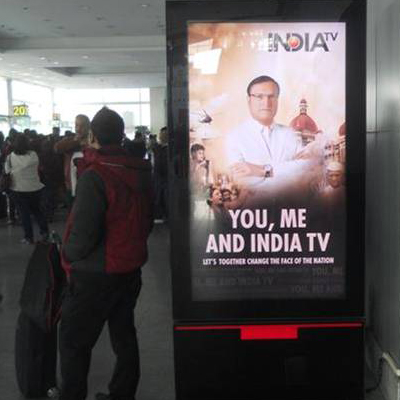
    Indeed, as part of the revamp, India TV has embarked on an ambitious, six-week-long marketing campaign which leverages Sharma’s popularity with the audience. The first leg of the campaign will run for 21 days across Hindi speaking markets like Mumbai, Delhi, Agra, Lucknow, Allahabad and Gorakhpur. Life-size images of Sharma will adorn hoardings and billboards across these cities as well as digital ports at arrival and departure terminals in Mumbai, Delhi and Kolkata.


    The banners focus on Sharma’s pensive expression along with the words, ‘You, me and India TV – let’s change the face of the nation’ and have been designed by Saints & Warriors, one of the three creative agencies that were short-listed for the job.


    “Three agencies made it to the final short-list for the job, basis what they had presented in response to the brief given. Eventually, Saints & Warriors was chosen for the assignment, basis further discussions with them. Their credentials, clarity of thought, and extended execution sampling helped us clearly decide in their favour,” informs Dhawan.


    Working on ad placement on news websites by geographically targeting them to suit audiences is Agency Ecosystem by Amar Ujala, which has a target to reach 35 million impressions through websites like Dainik Bhaskar and Amar Ujala. “We have tried to keep a close leash on expenditures. The first leg of 21 days of the campaign is to the tune of Rs 5.5 crore,” reveals Dhawan.


    It is learnt that the revamp is not only to tone down sensational news but also because of the increase in the number of news channels which has led to severe fragmentation of viewership. While India TV was launched at a time when its competitors could be counted on one’s fingers, it now has several competing channels swimming in the same pond. “With so many new and small channels taking up a large percentage of the market, it has become a highly competitive space so the brand refresh was done to mainly maintain our viewership,” a source from India TV tells this website.


    Whatever the reasons for the refresh, it’s just two days since the campaign has kicked off and people are getting used to the posters of Sharma in his signature pose with folded hands. What remains to be seen however is to what extent Sharma will help change people’s hitherto perception of India TV.

  • Zee News unveils new colours and dynamic energy through TVC

    Zee News unveils new colours and dynamic energy through TVC


    NEW DELHI: Weeks after it decided to get the youngsters of the country hooked on to its Hindi news channel, Zee News, Zee Media Corp (ZMCL) has launched a new television commercial unveiling the channels’ new look.


    A set of vibrant colors are being used to promote their philosophy that ‘News is never black and white; there are many shades, many hues to news’. The new TVC that has been created by the agency Bang in the Middle at a cost of nearly Rs 20 – 30 lakh will run for a month across multiple platforms like GECs and multiplexes besides leveraging its own networks to target the masses.

    In a press release, Zee News said it was committed to provide viewers with various aspect of news, which has been highlighted through the TVC.


    Speaking on this occasion ZMCL marketing and distribution VP Rohit Kumar said, “Under the revamp, the focus is on the youth. As always, we have striven to stay focused and relevant. With this new campaign the objective is to influence youth and their conscience. Our attempt is to strike a chord with them, their thoughts and attitude through this campaign.”


    The channel underwent a brand name change last year as Zee News changed to Zee Media Corp and saw a 15 per cent rise in viewership. For this new gamble they have taken, it will take three to six months for the effects to be seen.

  • Al Jazeera Sport rebrands as beIN Sports

    Al Jazeera Sport rebrands as beIN Sports


    MUMBAI: Qatar based network Al Jazeera has rebranded its sport channel from Al Jazeera Sport to beIN Sports. The move will see Al Jazeera Media Network uniting its global sport channels under one name ahead of the 2014 World Cup in Brazil.

     “As excitement builds ahead of the FIFA 2014 World Cup Finals, beIN SPORTS guarantees front row seats to all the live action in Brazil as well as live coverage from other popular worldwide sporting events,” beIN said in the statement.

    Subscribers will now have access to 19 HD channels with 12 in Arabic that were formerly called Al Jazeera 1 to 10 and will now be called beIN Sports 1 to 10. The rebranding will provided viewers more opportunities to watch their favourite sports across the globe.

  • The Business of News

    All of us in the business will agree that 2009 was not the best of years. But the good thing about it was that the world of business learnt the hard way that business is not just about excel sheets and that the valuation on those excel sheets does not attract attention in a hurry.

    Media was possibly one of the worst hit sectors across the world. Quite logically so; one of the first cost cutting steps, if not the first, is usually, if not always, slashing of advertising expenses. More often than not, in recessionary circumstances, advertising is no more considered as an essential investment.

    News industry in India, however, was not that badly hit as the country went through a General Election. But there’s much more in the news on TV News industry! Read on…

    News television is supposed to have two distinct identities. As the fourth estate, it is supposed to inform and empower the viewers, work as a watch dog to the policy makers and implementers. It is supposed to perform the role of a facilitator for our citizens, many of whom are disadvantaged and aggrieved, or for those groups which believe they have a legitimate and justifiable grievance against the powers that be. All this requires us to act as custodians of public interest. The other identity is as private sector organisations we are bound by the rules of the big bad market of balance sheets and ROI.

    Most people seem to think that these two distinct identities are at conflict, but I‘m willing to take a bet that they are not. But we sure have a lot to worry about – both our public and private interests.

    First about our reducing role in the public interest space. The viewership (GRP) figures of news television in India paint a disquieting picture. The GRPs slipped from 236 in 2007 to 221 in 2008 and to 166 last year, a 30 per cent shrink in just two years. I am at a loss to pinpoint a particular reason for the slide. However, regional channels are robustly augmenting. As a thumb rule, a regional news channel should have 70 to 80 per cent local news. Are audiences then more interested in closer home realities than the larger canvass?

    Are viewers deserting news channels? Is there a significant change in rating base which has caused this decline? Does our gut-feel endorse these slipping numbers?

    Let me cite a small anecdote. Once when former US president Lyndon B Johnson was asked his views about the media, he had quipped: “If one morning I walked on top of the water across the Potomac River, the headline that afternoon would read: “The President Can‘t Swim.”
    He may have said this decades ago but it captures to a great extent how Indian media too can influence or draw interferences from a simple and straightforward piece of news. In the spider-web of competition, the truth sometimes gets strangled. But is that all? I wish, it was.

    Like for instance, what would you call “Breaking News” in today’s context? Before that, how would you define “News” ? In my own understanding, reporting of any incidence that is “topical” and “relevant” is news. Tabloid journalism possibly compromises with the relevance factor, but still remains topical. And thus “breaking news” would be an initial (ideally first!) reporting of an incident or development which would be relevant for a certain section of audience.

    But the Indian news media has redefined “Breaking News”. It could be anything from what the babas and tantriks have to say to what the astrologers’ take on eclipses is, what the cats, dogs, snakes and the likes are engaged with! This unthinking, wavered ways of the news channels has taken the sheen away from the respect we used to command as organisations with social responsibility.

    Thankfully, we in our ( Zee News Limited) news channels do not have such wide canvas for “Breaking News” and our editors still stick to the literal translation of the two words under reference. And it was thus with some sense of concern, as also with an equal feeling of social responsibility, that in May 2008 Zee News took a conscious decision to break free from the trend of hype and hoopla. Respecting the intellect of Indian audience, we brought our focus back to facts, analysis, perspective, reportage and the likes. I can say today, with some satisfaction, that we have not wavered from our path since, despite pulls and pressures from the policies of competition. We held steadfast in dishing out for our viewers news that was accurate and relevant, across all bands and in all languages that we deal with. Clearly, our guiding principles worked and we witnessed all-round growth across channels.Let’s now look at the business of news. Did you notice that the sole criterion that a media brand or organisation is evaluated in India is nothing but the TRP numbers? Logically there’s nothing wrong in it as higher TRP would lead to higher advertising. Advertising is still about 80 per cent of the broadcast sector‘s revenues in India and hence that should lead to higher profitability. However, in India, as known to most by now, profitability is not just TRP numbers. Rational cost structure, innovative strategy, network economy of scale etc have significant influence on the way business is done and hence on the bottom-line of any business. Thankfully, the economic recession has brought the attention back to current bottom-line. Valuation is no more the buzzword. Current deliveries are at the core of all decisions with respect to a business outfit. While the marketing and programming departments still get credit for the TRP numbers, the business leaders would have to wake up to serious questions on returns and profitability from those who are funding the businesses. I assure you that the TRP rankings and profitability do not always have a direct corelation. At least in our case the latter far out-performs the former.

    Yet, I‘m not without hope. As an eternal optimist, I feel that the future of news TV is far more promising than what seems on the surface. The industry body, the News Broadcasters Association (NBA), has come up with commendable achievements in its effort to self-regulate. It is encouraging for NBA to get significant acknowledgement from the Ministry of Information and broadcasting.

    I firmly believe that the most potent regulator has always been the “market”. Here in our case, finally the audience has the last say on what they want from news TV and they would make their verdict loud and clear, eventually. And then digitisation would ease out the distribution bottle neck and the news genre would experience explosive growth. As I have always mentioned, regionalisation of TV would be a primary growth driver.

    As I debate the minutiae about dropping viewership trends in my mind, I feel that there is no one distinct phenomenon for the present exodus and it is possible that it just a matter of perspective.

    So I leave it to you to mull it over as well.

  • That day mustn’t come again

    That day mustn’t come again

    I flew back in Delhi after an exhausting day of work at the B.A.G’s Mumbai office. I sat to pursue my daily unwinding ritual of channel surfing. Least did I expect to see the dastardly act that was shaking the city and draining blood of the country.

    I immediately got on the phone to connect with the News 24 Mumbai and Delhi team. The channel had already dispatched reporters who were already present and reporting from ground zero. I watched the news feeds as they came in and as they were being relayed then on the channel. The terrorists had entered the heritage Taj Hotel- the most esteemed and loved landmark of the city, and taken the staff and guests hostage. They had grounded themselves at the Oberoi Trident firing at unsuspecting people and horrifying people like an untold unheard nightmare. They had sprayed bullets on unsuspecting people at the Chattrapati Shivaji Terminus and Leopold Café. AK-47s had been used and we got news of 20 people being murdered at the busy CST station and hundreds wounded.

    At the popular hang out Leopold Café, news came in of five people being killed and many more injured. The terrorists were still on the loose prolonging the tragedy. Any person familiar with Mumbai knows the mad rush the CST station witnesses every single day, clamouring on to trains that accommodate hundreds of people more than capacity. Every person who goes to Mumbai has the Leopold Café on their tourist destinations, for its quaint feel and heritage. I was numb as an Indian with the thought of the havoc the act would have caused at the sites and how many more would suffer in this mindless war that had been waged on us.

    Minute by minute more news kept coming in. News 24’s resident editor Hemant Sharma stood organizing his whole team and simultaneously giving piece to cameras one after the other. From the youngest of reporters to the most experienced, all set out to report the horror. The police had cordoned off the Taj and the other attacked sites and rescue operations were ensuing. Additional Commissioner of Mumbai Police had received information that a colleague had been injured in the gunfire at the Cama and Albless Hospital for women and children. They took a Toyota Qualis and proceeded in that direction. Two terrorists stepped out from behind a tree and opened fire with AK-47 automatic rifles. Priti Sompura, News 24’s reporter, was present with the cameraperson steps away from the site. Kamte had managed to retaliate, wounding a terrorist in the arm. In few minutes, news of them having succumbed to their wounds infuriated and saddened the nation.

    At the Taj, India witnesses that the Anti Terror Squad Chief Hemant Karkare had arrived and looked set to lead his team to bring the nightmare to an end. He geared up in moments in his helmet and bullet proof jacket. Was there hope for the nightmare to end shortly, reporters asked…

    It was through the live reports that we saw him go… Through the ropes and into the hotel, braving the threat he faced in his line of duty. Within seconds, the terrorists eliminated him. Their bullets pierced his so called bullet proof outfit. News 24’s anchor Sayeed Ansari told the nation of the death of one of the finest police officers to his audience. Such was the rush of blood and the magnitude of the tragedy, that his voice choked and eyes watered as he stood speaking to the camera. Another blow to efforts to end the disaster burning…another irreplaceable loss that had engulfed us all.

    Every moment was a shocker, every second a life changer. News 24’s Managing Editor Ajit Anjum, Director News Supriya Prasad and Input Head Rahul Mahajan rushed back from where they were to the news room to bring the shocking incident to their audience. Rahul Mahajan caught the first flight to Mumbai to bring the intensity and magnitude of the attack to the television screen. Supported ably by Shadab Alam, Mukul, Arun Pandey, Manish, Shashi Shekhar, Vikas, Preeti Sompura and Santosh Tiwari, the teams ensured reports relayed on the channel without any interruption.

    Raman Kumar and Amit Kumar, handling Delhi bureau, spent their night alternating between the Prime Minister’s Office and the Home Minister’s office seeking their reactions and responses to the tragedy. Manish Kumar and the whole fleet of reporters coordinated with Hemant Sharma on a minute to minute basis to bring news as it happened. Naveen Bisht, Adarsh Rastogi and their teams packaged all reports non stop in tandem with the reports.

    The Taj Hotel was totally under siege, and the freaks inside were firing randomly at staff and guests. Chefs, servers, attendants, people out for tea and dinner, foreigners out on vacation… There was only a number attached to the men and women who were falling dead with each aimless bullet being fired by the mad men inside. Bombs went off in two taxis close to where Vivek Gupta was reporting for News 24. Saved by a hair’s distance, it was all a joke to the men who had planned it all. To those suffering, to the ones reporting, to those witnessing – just an indescribable feeling raging within.

    Bullets were in an arms reach and terror was striking one the same plane on which stood the men and women reporting development, moment after moment. From News 24, cameramen Murganathan, Prahlad Singh, Vijay Chaudhary, Jitendra Singh, Imteyaz Khan and Akhilesh Singh positioned themselves at various points around the Taj, and the other sites. Reporters Priti Sompura, Vivek Gupta, Bhupendra Singh, Ankur Tyagi, Pravin Mishra and Vinod Jagdale stood, lay down, squatted – like the hundreds of other reporters from various news channels to report what was the worst terror attack on the nation.

    News came in that the CST station and Leopold Café had been taken over by security forces. 52 people had been killed at CST and 109 injured. 10 people had been killed at Leopold and many other were left maimed and bleeding. Hospitals were bustling, trying to aid the injured. Meanwhile, a one-sided war was raging at the Taj, Oberoi and Nariman house – all a stone’s throw away from each other. India watched as the moment by moment account was brought to them live by those standing at arm’s length with death. India united as news of the tragedy their compatriots faced stared them in their face.

    Amidst reports and the madness of bringing it all live from the newsroom, I called my friends in Mumbai enquiring about their safety, several of them including Sabina Sehgal Saikia. I could hear the numbness of their family members as they spoke flatly about their loved ones.

    Day after day, worse news kept coming in. And the fact that ten men had held the country to ransom for 24, then 48, then 72 hours exposed the helplessness of the common man and infuriated us all as never before. And for all the four days, Resident Editor Hemant Sharma relayed developments second by second in coordination with the Delhi team. Anchors Sayeed Ansari, Anjana Kashyap and Akhilesh Anand reported the minute by minute developments on all days non-stop. Reporters like Ankur Tyagi, Sanket Pathak, Anuja Karnik, Aarti Dani, and Anshul Agrawal along with camerapersons Dilip Rawani, Naveen Pandey, Mintu Singh, Kanti Parmar, Sameer Sherke and Babaji Nanaware continued to report and bring live second by second developments. Supplement reporters who had been flown in to support the Mumbai team included Satyendra Upadhyay and Nalini Rajput.

    Amidst the humdrum, one wondered why when we are surrounded by enemies, can we not have a centralized anti terror agency to ensure that such an incident doesn’t reach the proportions it reached? Why did our heroes have to die so arbitrarily while protecting us? Could there be no concerted effort to end the nightmare? Why was New Delhi at such a loss after the death of three fine officers and why could it not garner a unit to end the ensuing disaster? No one seemed to be in command; no one seemed to be leading the way to end the nightmare.

    A year later, the Chief Minister of Maharashtra has honoured Priti Sompura, Vivek Gupta and Ankur Tyagi with the Maharashtra Congress Committee award for their efforts in reporting the horrific day in the face of acute danger. News 24 recounts the horror of this day last year with its show, Morche Par Reporter, that also commemorates the men and women from across news channels who reported the days of horror for their compatriots and helped unite the country into one in the hours of grief and mourning.

    We all asked a hundred questions, vented our fury, wrote, debated, argued and fought…and then fell silent. Like we always have done…like we always do…A year later, there is yet no unified command in place with the anger, sorrow and helplessness that engulfs me like the billion people of India.

    (Anurradha Prasad is News24 Editor-in-Chief and BAG Films & Media CMD)

    (Disclaimer: The views expressed here are those of the author and Indiantelevision.com need not necessarily subscribe to the same)