Tag: New Tariff Order

  • BARC week 33: DD India returns to second rank in English news

    BARC week 33: DD India returns to second rank in English news

    BENGALURU: Pubcaster Doordarshan’s English news channel DD India has been ranked second or better for 10 weeks across 21 weeks starting week 13 to week 33 of 2019 (Saturday, 10 August 2019 to Friday, 16 August 2019, week or period under review). According to Broadcast Audience Research Council of India (BARC) weekly data for top 5 English news channels in terms of viewership ratings, initially DD India was in a dingdong struggle for top slot with the Arnab Goswami-led Republic TV, a slot that the latter managed to wrest. During and post the weeks in which the National Election results were announced, DD India acceded second rank to Times Now and maintained third rank for seven weeks in a row after week 25 of 2019.DD India has returned to rank 2 after a hiatus of seven weeks in week 33 of 2019. 

    To allow for viewership to stabilise after the implementation of TRAI’s new tariff order, BARC India had stopped publishing ratings data in the public domain from week 6 of 2019. On the urging from TRAI, the ratings agency recommenced putting up data starting week 13 of 2019, hence that week has been used as a starting point in this report. Subsequently, BARC changed the manner in which it viewed landing pages and outliers – these actions in concert with other factors have been pulling down viewership numbers of the English news genre.

    Please refer to the figure below:

    The combined weekly impressions of the top 5 English news channels declined by 11.7 percent in week 33 of 2019 to 2.547 million weekly impressions as compared to 2.885 weekly impressions of the previous week as the interest about the events around the erstwhile state of Jammu and Kashmir (J&K) started to peter out. The average combined weekly impressions of the top 5 English news channels on analysing BARC data between week 13 and 33 are 2.466 million. The present week (week 44) has seen some more events around J&K as well as the taking into custody of former finance and home minister P Chidambaram. Whether these events will be enough to grow or at least sustain English news viewership has to be seen. Please refer to the figure below for combined viewership of top 5 English news channels in thousands (000s).

    Let us see how the top 5 English news channels performed in week 33 of 2019

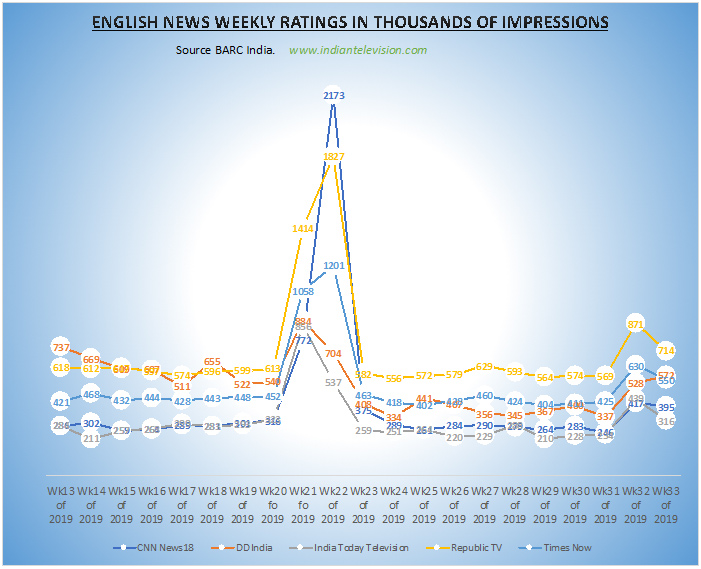
    Except for DD India which saw a surge in viewership, the other channels in BARC’s weekly list of top 5 English news for week 33 of 2019 saw weekly impressions drop. The channels in the list in week 33 of 2019 were the same as in week 32 with a shuffling of ranks. DD India moved up to second rank, as did CNN News18 which moved up to fourth place.

    Republic TV retained its first rank with 0.714 million weekly impressions in week 33 of 2019 as compared to 0.871 million weekly impressions in week 32. DD India moved to second rank during the week under review with 0.572 million weekly impressions as compared to third rank and 0.528 million weekly impressions in the previous week. Times Now slid a place to third rank with 0.550 million weekly impressions in week 33 of 2019 as compared to second rank and 0.630 million weekly impressions in week 32. CNN News18 moved up to fourth rank with 0.395 million weekly impressions as compared to fifth rank and 0.417 million weekly impressions in week 32. India Today Television slipped to fifth rank in week 33 of 2019 with 0.316 million weekly impressions as compared to fourth rank and 0.439 million weekly impressions in week 32.  Please refer to the figure below:


  • TRAI tariff order impacted uptake of niche channels: KPMG

    TRAI tariff order impacted uptake of niche channels: KPMG

    MUMBAI: Even as TRAI is mulling over changes to its existing tariff order, a report by KPMG, India’s Digital Future, highlighted that niche channels were affected especially due to lesser focus on such channels in broadcaster packs.

    “The uptake of niche channels has suffered in the new regulatory environment as broadcasters focused on creating packs that ensured pick-up of their GEC and movie channels with DPOs building on top of them with FTAs at their disposal. While niche channels belonging to larger broadcasters are likely to do better than others in the long run owing to the network effects enjoyed by their parent company, they will still need to be innovative in order to survive and remain relevant in the long run,” the report read.

    According to the report, niche genres on TV in this new era are expected to be under pressure from rival offerings on digital platforms. It also added the English channels are also likely to encounter challenges in terms of viewership and subscription in the new regime. But the uptake of pay regional channels, especially top GECs and movie channels, has remained firm in the regional markets in the new regime, particularly in the Southern markets.

    Despite the tariff order giving consumers options to choose channels, the report noted that initial trends indicate that the monthly bills of viewers wishing to watch the same number of channels as earlier has gone up significantly. However, the ARPUs have increased across all the markets with phase III and phase IV markets witnessing massive growth of 30-35 per cent in average realisations.

    “This choice of channels has come at a dearer price for individuals at the lower end of the ARPUs who are either paying more for watching the same number of channels or are content with lesser number of channels at their disposal. As per industry discussions, some choice is taking place at the higher end of the subscription pyramid, leading to lower TV bills, however, the same is definitely accompanied by a lower number of viewable channels at the disposal of the consumers,” the report added.

    It went on to say that viewership and reach for the TV universe is likely to change as the effects of NTO start to play out. But it also added that the broadcasters will need to renew focus on content quality to ensure survival and pick-up of their channels.

  • TRAI tweaking new tariff order could trigger turmoil in broadcasting sector

    TRAI tweaking new tariff order could trigger turmoil in broadcasting sector

    MUMBAI: The latest consultation paper (CP) from the Telecom Regulatory Authority of India (TRAI) has created quite a stir in India’s broadcasting sector. Titled ‘Tariff-related issues for broadcasting and cable services’, the CP is essentially an admission from the regulator that its new tariff order (NTO) failed to deliver the desired results.

    Mulling amendments to the existing regulatory framework, TRAI has sought stakeholders’ views on 27 questions, with a focus on discount cap for bouquets, ceiling price of channels in bouquets and the concept of a channel bouquet itself.

    Interestingly, TRAI had on numerous occasions, post NTO implementation, stated that consumers’ cable bills had in fact reduced and transparency been injected into the sector. Reality on ground, however, has been quite different with cable bills shooting up for most households and several complaints landing up at the chairman’s desk.

    “Now post NTO, subscribers realise that they are forced to pay more for fewer channels. This is only because TRAI, as regulator, forgot its original role of working for the sector in a balanced manner. It wanted to either side with consumers or DPOs thereby harming the sector in the process,” said an industry watcher on the condition of anonymity.

    Industry estimates suggest 80 per cent of TV consumers have made their channel selection under the new tariff order. It is also evident from analyst calls post Q1 results for FY20 that broadcasters believe the industry has settled down post the NTO implementation.

    In such an environment, experts feel, changes to the existing tariff order could cause more disruption than the previous occasion creating an ‘existential crisis’ for a large section of the industry.

    With 10 million subscribers having dropped off from cable and DTH services post NTO implementation, further changes to the order will only multiply that number.

    The CP, lacking an evidence-based approach, relies on assumptions, say critics. On numerous occasions it takes a position without referring to or alluding to any interactions with consumer groups or making public complaints received by TRAI against DPOs.

    ·       TRAI’s CP highlights misuse of flexibility in pricing but overlooks the fact that India is a price sensitive market and that broadcasters have priced their channels keeping content costs in mind.

    ·       There is an illusionary concept of popular and non-popular channels, which TRAI seems to have used to justify that consumers are not making informed choices.

    ·       TRAI does not acknowledge the fact that under the NTO, DPOs have gained the most by charging maximum NCF (i.e. Rs 130) to consumers which is evident from the increase in their profits and the power they enjoy in terms of billing consumers.

    ·       For instance, DPOs charge Rs 130 NCF for 100 SD channels and Rs 20 for the slab of next 25 SD channels. If a subscriber even opts for a single channel above mandatory 100 channels, the bill then increases by Rs 20. This also highlights the fact that a DPO doesn’t incur any additional cost whether he carries a single channel or 25 channels.

    ·       The comparison of the wholesale price of channels in previous regime and retail price of the new regime in Annexure I, clearly demonstrates that overall a-la-carte prices of approximately 82.8 per cent channels have decreased. TRAI has not factored in the rate (i.e. DRP) of a-la-carte channels that DPOs offered to consumers in the earlier regime.

    ·       TRAI has talked about skewed a-la-carte and bouquet pricing whereas it is evident from the CP that discounts on bouquets in the previous regime ranged between 80-90 per cent, while they have been reduced to as low as 33 per cent in the current framework as can be seen in Table 3.1.

    ·       TRAI seems to have made the assumption that a-la-carte is the preferred choice and thus talks about their poor uptake. There is no substantial evidence to suggest that consumers prefer a-la-carte over bouquets.

    ·       TRAI views TV channel viewership numbers in terms of consumers wanting to subscribe to watch a channel or not.

    ·       TRAI assumes that the right of consumers to select and pay for what they want to view is elusive and the reason behind it is huge discounts in bouquets.

    ·        TRAI asserts that the sheer number of bouquets offered has created confusion in the minds of subscribers. However, a large chunk of these bouquets from each broadcasters cater to different geographical regions.

    ·       TRAI assumes that subscription data obtained from DPOs indicates that almost all the channels have been made available to subscribers as part of bouquets using skewed mechanism, undermining the fact that consumers have made informed choices and selected bouquets containing the channels they want at a discounted rate. Also, those who wanted channels on a-la-carte have also made their choices.

    ·       TRAI gave flexibility to broadcasters to form bouquets so that they can make small bouquets of same genre or some popular channels to make selection of channels easier for consumers, which is again contradictory.

    ·       TRAI’s CP uses terms such as “unwanted channels”, “niche/premium channel”, “popular channels”, “non-driver channels”, “driver channels”, “piggyback” which do not hold any legal basis.

    There is also a section within the industry that believes TRAI should conduct a household survey to understand the implementation of NTO and its impact before altering the current tariff order. There are those that predict TRAI’s move will boost telecom companies putting them in a position to provide triple play resulting in both call shifting and cord cutting.

    Over the years, one of the fundamental problems plaguing India’s broadcast sector has been regulatory overreach. In a sense, TRAI has always approached this sector with the mind-set of a telecom regulator. TRAI has gone from freezing price of channels for 10 years to overhauling the framework in the last two years. The new regime, which finally kicked in on 1 February 2019, resulted in disrupting the entire ecosystem causing value erosion. Another radical move to the existing system will only trigger more chaos.

  • Broadcasters, DPOs misused new tariff order to throttle market discovery of channel prices: TRAI

    Broadcasters, DPOs misused new tariff order to throttle market discovery of channel prices: TRAI

    MUMBAI: Telecom Regulatory Authority of India (TRAI) on Friday issued a consultation paper on tariff related issues for Broadcasting and Cable services.

    The paper primarily discusses issues related to discounts given in the formation of the bouquets, ceiling price of channels for inclusion in bouquet, need for formation of bouquet by broadcasters and DPOs, variable NCF and discounts on long term plan.

    TRAI believes that the new regulatory framework has brought the transparency in TV channel pricing, harmonised business processes in the sector and reduced disputes among stakeholders. However, adequate choice to select TV channels has not been given to the consumers.

    “In all fairness, a lot was expected from broadcasters and DPOs to use flexibility given under new regulatory framework to address the concerns and aspirations of the consumers. However, given flexibility was misused to throttle market discovery of TV channel prices by giving huge discounts on the bouquets. It has been observed from the tariff declared by broadcasters under new regulatory framework that they are offering bouquets at a discount of up to 70 per cent of the sum of a-la-carte rates of pay channels constituting those bouquets,” reads TRAI’s latest notification.

    “It indicates that in absence of any restriction on the discount on the offering of bouquets, broadcasters are making prices of a-la-carte channels illusory thereby impacting the a-la-carte choice of channels by consumers. Further, no restriction on number of channels has created another problem wherein broadcasters and DPOs are offering too many bouquets,” the note further states.

    TRAI has observed that too many bouquets are formed by the broadcasters/DPOs and many of them contain very similar set of channels, with very few changes. This, according to the sector regulator, is not only creating confusion among consumers but also becoming a hurdle in choosing the channels.

    With too many bouquets of broadcasters and DPOs, consumers get confused and as a result are forced to adopt some suggested packs of TV channels, killing the freedom given to consumers to choose desired TV channels, feels the sector regulator .

    TRAI had extensive interactions with  stakeholders including consumers and consumer organizations, at various forums, wherein stakeholders have also raised certain issues such as variable NCF for different regions, NCF for Multi TV home, discount on long term plan, DD channels as part of one hundred channels etc.

     In order to deliberate upon above issues that have come post implementation of the new regime, the latest consultation paper has been floated seeking stakeholders' views.

  • TRAI issues draft regulation to facilitate consumer choice of TV channels using API

    TRAI issues draft regulation to facilitate consumer choice of TV channels using API

    MUMBAI: The Telecom Regulatory Authority of India (TRAI) on Friday issued the draft (Second Amendment) to the Telecommunication (Broadcasting and Cable) Services Standards of Quality of Service and Consumer Protection (Addressable Systems) Regulations 2017. Through this draft regulation (second amendment), TRAI is seeking the comments of stakeholders on the issue of developing of app by third parties and consequent sharing of information using Application Program Interface (API) between DPOs and consumers.

    The new tariff order rolled out in the beginning of this year put power in consumers’ hand to select television channels they want to watch. To ensure proper implementation of the new framework, the authority has made a number of efforts such as series of meetings with DPOs, publicity in electronic and news media, interactions with customer groups etc. Despite all the efforts, it has been brought to notice of the authority that consumers are not able to make real choice of TV channels.

    “It was noticed that quite a few DPO platforms were not providing adequate freedom and choice to consumers. Customers also complained that the call centre of DPOs are also not helping to facilitate consumer choice of the channels,” TRAI said in a release.

    To resolve the issues, the authority felt need to have channel selection system developed by third party to facilitate easy channel selection by consumers. As per TRAI, since the third party app will be accessible by every customer of Broadcasting & Cables Services sector,  it will facilitate easy choice to consumers.

    To facilitate functioning of third-party apps, TRAI created channel selection system API specifications document which prescribed common APIs with all distribution platform operators (DPO). TRAI intends to mandate all the DPOs to compulsorily share information with the apps after authenticating the subscriber so that such apps can help in easy selection of the required TV channels.

    The newly issued draft regulation (second amendment) issued shall be open for comments of the stakeholders up to 22 August. 

  • Dish TV management on new tariff order, subscriber addition, content cost

    Dish TV management on new tariff order, subscriber addition, content cost

    MUMBAI: The last quarter of financial year 2018-19 was not very smooth for any player in the cable and broadcast industry due to the implementation of the new tariff order (NTO). India’s largest direct-to-home (DTH) operator also saw few bumps on the way but the entire transition process has now settled down. Dish TV India group CEO Anil Dua noted the positive change and also highlighted that the NTO has created level playing field between cable operators and DTH players.

    After last quarter, Dish TV pointed out that consumers were in a state of transition, trying to understand how to create their new packaging. While the company gave them a lot of options to select packages under new regime, those also led to a certain amount of time taken by the customer to settle down with new choices.

    “Consumers are now watching the packs that they want to watch. It's a combination of à la carte channels that they have chosen, the DPO packs that we have provided and, of course, also the broadcaster bouquets, which are part of those packs. So, the customers are taking a combination of various things to their liking, to their choice, to their price point,” Dua said in an earnings call after Dish TV’s quarterly result.

    The implementation of NTO was followed by speculations and several studies whether consumers are paying more than the pre-NTO era. Dua said there are Dish TV customers, a little less than half, who have gone for a price point lower than what it was earlier and a little more than half have gone for a price point which was higher than earlier. He also mentioned that with cricket and election season and other things during the quarter, consumers also added channels.

    Dish TV India chief financial officer Rajeev Dalmia said the consumer level average revenue per user (ARPU) was around Rs 270-275 in the new regime. According to Dalmia, it varies on a month-on-month basis, because things are still not completely settled at the consumer’s end. He also added that the second half of this year would give an idea what is going to be the run rate as far as the consumer ARPU is concerned.

    “If I remove the effects of cricket, we definitely see it (ARPU) going up. But because of cricket, customers come and go, and they add packages, they remove packages. So, the steady state figure will emerge. This is the first quarter with the new accounting, and first time we are talking of a figure like Rs 116. I think we will have to wait and watch. But fundamentally, the way we have planned things and the way we see things during the first quarter, the underlying growth in ARPU should be there,” Dua commented.

    “As far as licence fee is concerned, now that will be on the basis of Rs 926 crore, rather than the earlier regime where it was including the content cost. So, it will go down to the extent of the content cost. To give you an example, like we paid say Rs 2,000 crore last year, so this year license fee will be less by Rs 200 crore,” Dalmia said.

    There has been a delay by Dish TV in terms of making payments to broadcasters like ZEE and Star. Dalmia blamed certain issues in terms of how the billing would be done and how the incentive would be allocated to the company for the delay. He also added that all the outstanding dues would be cleared by the month of September giving a fresh start from 1 October as the things are more or less settled now.

    EBITDA in the earlier regime was Rs 476 crore which is now Rs 536 crore. But the expenses were higher in the first quarter compared to the fourth quarter because of selling commission, service payout, and overall marketing costs as the number of subscribers added were quite high as compared to the fourth quarter.

    “But if I go line-by-line, then we have saved on general administration expenses, we have saved on collection cost, and we have also saved on the personnel cost, because personnel cost used to be Rs 65 crore to Rs 70 crore per quarter, which has gone down to Rs 45 crore. And we further see some Rs 1 crore or Rs 2 crore going forward saving on account of personnel costs. So, overall line-by-line it has gone down. But of course, because the savings and service is linked to the number of new installations, that has gone up in the first quarter,” Dalmia added on expenses.

    Content cost for the first quarter, which was a cricket-heavy one was around Rs 610 crore. On the other hand, the capex was Rs 205 crore for the quarter and for the full year  it will be in range of Rs 650 crore to Rs 675 crore. The company reset the guidance of net subscriber addition for the year which is to the tune of 8 lakh.

  • Tamil Nadu CM drops minister from cabinet due to cable TV tariff spat

    Tamil Nadu CM drops minister from cabinet due to cable TV tariff spat

    MUMBAI: While Tamil Nadu’s state-run cable operator Arasu Cable revised down its subscription rates recently, the move has led to a political crisis in the state. Chief Minister Edappadi K Palaniswami has dropped former IT minister Dr Manikandan from his cabinet.

    After the recent announcement of price revision, Manikandan accused Palaniswami of unilaterally taking the decision of reducing the cable TV monthly subscription as per a report from The Hindu. “I was not consulted. The chief minister announced it. A meeting will happen soon,” Dr Manikandan said. He also alleged that the government declined to fund the government cable network Arasu Cable.

    “When we approached the government to bear the cost of STBs, the then finance secretary and present chief secretary K Shanmugam declined to accept. As a result, we repaid ₹400 crore of the total debt (towards providing free STBs) of Rs 619 crore from our (TACTV) revenue. When we were in distress, neither the government nor anyone came to our rescue. If the government comes forward to provide the balance of Rs 219 crore or gives the amount as loan, we can even fix the Arasu Cable tariff at ₹100 a month,” he said.

    On July 22, Animal Husbandry minister Udumalai Radhakrishnan was appointed as the chairman of the cable network which did not make Manikandan happy either. He also pointed out the conflict of interest by saying that the latter should first shift two lakh subscribers who are currently under his cable TV network Akshaya Cable to Arasu Cable.

    Radhakrishnan recently said that the 11 lakh STBs provided by Arasu Cable which had been switched off, needed to be brought back online as Arasu Cable had now lowered its tariffs.

  • Is there a slow but steady decline in English news ratings?

    Is there a slow but steady decline in English news ratings?

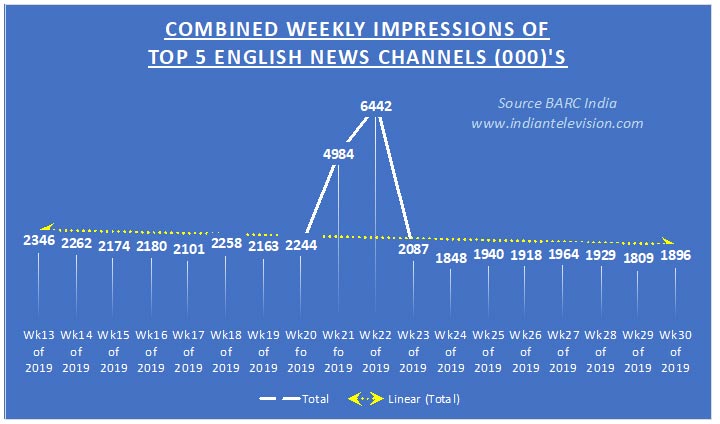
    BENGALURU: Is viewership of the English news genre dipping? Broadcast Audience Research Council (BARC) India recommenced publishing limited viewership data in the public domain on TRAI’s coercion in week 13 of 2019 after it had ostentatiously stopped doing so to allow ratings to stabilise after implementation of TRAI’s new tariff order from week 6 of 2019. Then in week 23 of 2019, BARC announced that it was reverting to an older method of treatment of the landing pages and outliers. The weeks following week 13 of 2019 have seen two major cricket tourneys being played – the twelfth season of the Indian Premier League in India and the ICC World Cup in England and Wales. Both the tourneys involved matches that overlapped primetime in India. Many parts of the country have been hit by bad weather over the past few weeks. Or is it just that there were a number of weeks that were just too hot before the torrential rains that inundated many parts of India? A BARC paper in the past suggested that weather affects television viewership. The implementation of the new regulatory framework and BARC’s treatment of outlier data are two other factors that also need to be kept in mind when analysing the scenario. One can also make a case for greater viewership interest in the run up to the elections, which now seems to be on the decline. It would be interesting to study if other genres have also been adversely affected.

    Please refer to the figure below for the combined weekly impressions of the top five English news channels between weeks 13 and the week under review – week 30 (Saturday, 20 July 2019 to Friday, 26 July 2019). The dotted yellow trendline indicates a slow but steady decline in viewership of the top 5 English news channels between weeks 13 and 30 of 2019. As is obvious, weeks 21 and 22 are the anomalies in the decline – news viewership peaked because of the announcement of the results of the national elections.

    It is interesting to note that since the entry of pubcaster Doordarshan’s English news channel DD India into BARC’s weekly list of top 5 English news channels, the channels appearing in the list have been the same, with a slight tweaking in the ranks sometimes. Over the past few weeks, there seems to have been some stabilisation in ranks one, two and three with the Arnab Goswami-led Republic at first place, Times Now at second place and DD India at third place. The jostle for ranks four and five is still on between CNN News India and India Today Television. Please refer to the figure below:
    Please refer to the figure below for ratings of the top 5 English news channels.

    Ratings of English news channels for week 30 of 2019

    The combined ratings of the top five English news channels increased 4.8 percent in week 30 of 2019 to 1.896 million weekly impressions from a low of 1.809 million weekly impressions in week 29. The list of channels and their ranks were the same in week 30 as week 29 of 2019.

    Republic TV led the English news genre with ratings of 0.574 million weekly impressions in week 30 of 2019 as compared to 0.564 million weekly impressions in the previous week. At second rank, Times Now scored 0.411 million weekly impressions during the week under review as compared to 0.404 million weekly impressions in week 29 of 2019. At third rank was DD India with 0.400 million weekly impressions in week 30 of 2019 as compared to 0.367 million weekly impressions in week 29. At fourth rank was CNN News18 with 0.283 million weekly impressions in week 30 of 2019 as compared to 0.264 million weekly impressions in week 29. Completing the quintet at fifth rank was India Today Television with 0.228 million weekly impressions in week 30 of 2019 as compared to 0.210 million weekly impressions in the previous week. 

  • Arasu Cable revises subscription rates

    Arasu Cable revises subscription rates

    MUMBAI: Tamil Nadu’s state-run cable operator Arasu Cable has revised down its subscription rates, with effect from 10 August. Under the new subscription rate, package of 190 channels will be available for Rs 154.

    “Based on requests from the people, the cable television tariff for Tamil Nadu [except Vellore] under Arasu Cable has been fixed at Rs 130, plus GST,” Tamil Nadu Chief Minister Edappadi K Palaniswami said.

    After the new price regime kicked in at the beginning of this year, Arasu Cable had to revise its packages. It had three packages — a basic package at Rs 120 plus GST with all free-to-air (FTA) channels, a package at Rs 200 plus GST and another that offered 191 channels at Rs 220 plus GST.

    The state-run operator has distributed 35.12 lakh set-top boxes free of cost to its subscribers till date. But recently, it found that out of the 35 lakh STBs that were distributed, only 24 lakh were active. The sudden increase in pricing caused the churn in customers. To prevent the churn, the new move has been taken.

  • New tariff order helped ZEEL’s strong domestic subscription revenue growth in Q1 FY20

    New tariff order helped ZEEL’s strong domestic subscription revenue growth in Q1 FY20

    MUMBAI: Zee Entertainment Enterprises Ltd (ZEEL) experienced strong growth in domestic subscription revenue in the first quarter of FY 2020 where the new tariff order played an important role. The leading broadcaster has guided for domestic subscription revenue for the overall year to grow in mid-twenties.

    “The implementation of the new tariff order has allowed us to price our channels in line with their popularity, thereby leading to a sharp improvement in monetisation. Additionally, uniformity in pricing across platforms and increased transparency have led to a step jump in this quarter’s subscription revenue growth,” ZEEL MD and CEO Punit Goenka said in an earnings call after Q1 results.

    The broadcaster also witnessed sharp growth in subscription revenue in the southern market too. Apart from the digitisation of the Tamil market, the new tariff order also played an important role here.

    Goenka, talking about the growth in the Southern market, mentioned that either ZEEL channels were free in certain markets or their pricing was not proportionate with their viewership share while the new pricing regime gave them the opportunity to re-price content.  He pointed out that the tariff has been frozen since the last 16 years and no price change was done since then for any of the channels after launch.

    “Despite having built significant viewership over the last several years, our channels were really not priced in line with their popularity. Under the old tariff order, it would have been a long journey but the new tariff order gave us a chance to reset this pricing. So, that has allowed us to significantly improve our monetisation,” ZEEL corporate strategy and investor relations head Bijal Shah commented on the overall subscription growth.

    “And on top of this, in this tariff order, discrimination between the platforms is not possible, which has also led to an improvement in subscription revenue growth. So, this is much more on expected lines. In fact, for the last 2-2.5 years, we have been guiding that tariff order will allow us to properly monetise the viewership which we have, and we are seeing that evolving the way we had envisaged,” he added.

    However, the broadcaster did not outline any clear guidance in terms of advertising growth but Goenka did mention that ZEEL would beat the industry growth.

    Goenka said this fiscal year also will not be very high on free cash flow generation despite slight improvement. But next year onwards, there will be a lot more cash conversion from the company’s bottom-line to cash with an actual ramp-up in free cash flows.

    “It is the first quarter right now, so a bit difficult to give you an exact amount, but total working capital investment in FY20 will be in the range of Rs 500-700 crore, that is the kind of increase we will see in total in working capital in full year FY20. It could be closer to the lower-end of the range but we just want to keep some buffer for ourselves right now,” Shah noted.