Tag: New Tariff Order

  • BARC week 42: Three Zeel channels in across genres on all platforms list once more

    BARC week 42: Three Zeel channels in across genres on all platforms list once more

    BENGALURU: Three channels from Zee Entertainment Enterprises Ltd (Zeel), two channels each from Sony Pictures Network India (SPN) and Star India, and one channel each from Enterr 10 Television, the Sun Tv Network and Viacom18 were present in Broadcast Audience Research Council of India (BARC) weekly list of Top 10 Channels Across Genres on All Platforms in week 42 of 2019 (Saturday, 12 October 2019 to Friday, 18 October 2019). Over the past few weeks, only one channel from the Zeel stable was present in BARC’s weekly list of Top 10 Channels Across Genres on All Platforms. Zeel’s Kannada GEC Zee Kannada and Telugu GEC Zee Telugu joined its flagship Hindi GEC Zee TV at the cost of Star India’s Star Vijay and Viacom18’s Kids channel Nick.

    Six of the channels were Hindi GECs, two were from the Telugu genre and there was one channel each from the Kannada and Tamil genres in the list.

    Of the 10 channels in the list, nine were on the pay platform, while the lone FTA entrant was from the Hindi GEC genre from Enterr 10 Television Network’s Dangal that managed to retain its numero uno rank in week 42 of 2019, as it has over the past few weeks.

    Two channels – Enterr 10 Television’s free to air (Free or FTA) Hindi GEC Dangal and the Sun Tv Network’s flagship Tamil GEC Sun TV having been vying for the top slot in Broadcast Audience Research Council of India (BARC) weekly lists of Top 10 Channels across genres as mentioned by us earlier. Ultimately, Dangal retook the numero uno mantle in BARC’s Across Genres on all platforms weekly list. In general, Dangal has been the most-watched channel across genres on all platforms also as mentioned by us earlier.

    Please refer to the chart below:

    Top 10 Channels Across Genres on Pay Platform

    BARC’s weekly list of Top Channels Across Genres on Pay Platform had three channels from Zeel, two channels each from SPN, Star India and Viacom18 and one channel from the Sun Tv Network in week 42 of 2019. There were five channels from the Hindi GEC genre, two channels from the Telugu genre and one channel each from the Kannada, Kids and Tamil genres which made up BARC’s weekly list of Top Channels Across Genres on the Pay Platform in week 42 of 2019

    Two channels were replaced in BARC’s weekly list of Top Channels Across Genres on Pay Platform in week 42 of 2019. Zee Kannada and Zee Telugu re-entered the list at the cost of Star Vijay and SPN’s Hindi movies channel Sony Max.

    As was the case in the past few weeks, the most watched pay channels were not Hindi GEC – they were Tamil and Telugu GECs at ranks one and two respectively in the list.

    Please refer to the chart below:

    Top 10 Free Channels Across Genres

    Four channels from the B4U Network, three channels from Enterr 10 Television, two channels from Zeel and one channel from SkyStar made up BARC’s weekly list of Top 10 Free Channels Across Genres for week 42 of 2019. Four of the channels were from the Hindi Movies genre, three were from the Bhojpuri genre, two were Hindi GECs and one channel was from the Marathi genre in week 42 of 2019. One Sports channel – Star India’s FTA Star Sports First exited BARC’s weekly list of Top 10 Free Channels Across Genres in week 42 of 2019, while Enterr 10 Television’s Hindi Movies channel Enterr 10 re-entered the list in week 42 of 2019.

    Please refer to the figure below:

  • Most-watched regional news channels

    Most-watched regional news channels

    BENGALURU: Regional news is has more per capita consumption in respective languages than Hindi or English news . Further, the consumption of all regional news channels is larger than Hindi news.

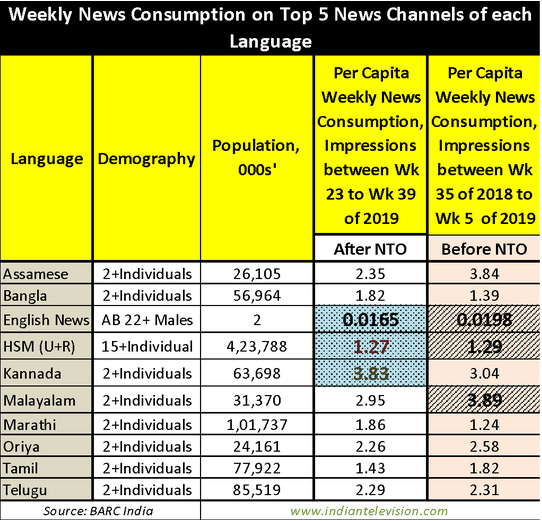
    Data across three separate periods has been considered in this paper – For the current period, data for a 26-week period, starting week 13 of 2019 until week 39 of 2019, has been used. For the pre-NTO period, data across 23 weeks between week 35 of 2018 and week 5 of 2019 has been considered. For the post-NTO period, due to BARC’s adoption of an earlier method of treatment of landed pages and outliers, data across 17 weeks between week 23 and 39 of 2019 has been considered.To arrive at the per capita viewership or consumption, the author has considered the 17 weeks average (post NTO) and the 23 weeks average (pre NTO) number divided by the respective population of the respective market as per BARC India, Households and Individuals Universe Estimate – 2018 (BARC Population Estimates 2018).

    Why these specific periods?

    BARC started publication of viewership data in the public domain of news channels in the four South Indian languages in week 1 of 2019. Four additional regional news channels besides the four South Indian languages in the public domain were added in week 35 of 2018. Later, BARC had stopped publishing data in the public domain between weeks 6 and 12 of 2019 to enable viewership to stabilise. Hence the only stable data available in the public domain before the implementation of NTO was between weeks 35 of 2018 and week 5 of 2019, or for a 23-week period. After recommencement of publishing data in week 13 of 2019, BARC reverted to an older method of treating landed changes and outliers in week 23 of 2019.The latest data available at the commencement of writing of this article was week 39 of 2019, hence average viewership for this period of 17 weeks has been considered. For overall viewership trends in the current period, data between weeks 13 and 39 or for 26 weeks (roughly half a year) has been considered.

    Markets and Demography

    BARC has specified the following demographics of the news channels for the data that it releases in the public domain:

    Hindi news: Hindi Speaking Markets, both urban and rural or HSM (U+R): NCCS All: 15+ Individuals.

    Telugu news: Andhra Pradesh or AP/Telangana (U+R): NCCS All: 2+ Individuals

    Kannada news: Karnataka (U+R): NCCS All: 2+ Individuals

    Tamil news: Tamil Nadu/Puducherry (U+R): NCCS All: 2+ Individuals

    Malayalam news: Kerala (U+R): NCCS All: 2+ Individuals

    Oriya news: Odisha (U+R) : NCCS All : 2+ Individuals.

    Assamese news: Assam / North East / Sikkim(U+R): NCCS All: 2+ Individuals.

    Bangla news: West Bengal or WB  (U+R): NCCS All : 2+ Individuals,

    Marathi news: Mah/ Goa (U+R) : NCCS All : 2+ Individuals.

    English news: All India (U+R): NCCS AB: Males 22+ Individuals.

    BARC considers HSM or Hindi Speaking Market as All India without the four South Indian markets. Hence, the author has subtracted the NCCS 15+ population of the four South Indian markets from the All India NCCS 15+ population to arrive at the HSM 15+ population numbers. In the case of per capita consumption for South India, the author has taken the sum of average weekly impressions of the top 5 channels for each language and then added the four sums to arrive at the total average weekly impressions for South India, this total average has then been divided by the 2+ population figures for each of the four languages/six states as per BARC Population Estimates 2018. In the case of English news, the author has calculated the NCCS 22+ Males population by extrapolating the overall male and female ratio and the ratio of the 22+ individuals with the all India population with the sum of BARC numbers for NCCS A 22+ and NCCS B 22+. To arrive at the per capita consumption of news on the top 5 channels for the country, the 23 week average of the 10 languages has been divided by the 2+ population of India as per the above mentioned BARC Universe estimates. Individual HSM (R) and HSM (U) viewership numbers have not been considered to arrive at the per capita consumption of news on the top 5 channels for the country.

    Per Capita news Consumption post and pre implementation of NTO

    Please refer to the chart below for per capita news consumption of the top 5 channels of each language.
    Current Status

    The charts below covers data between weeks 13 and 39 of 2019, the last week for which BARC data was available at the time of writing of this report. This report covers approximately six months of calendar year 2019. BARC had stopped publication of data in the public domain after week 5 of 2019 to enable ratings to stabilise after the implementation of TRAI’s new tariff order and recommenced publication of the same in week 13 of 2019. Hence, here onward this paper looks at news-watching trends of top 5 news channels across 10 languages.

    The unit of viewership measure in all cases in the charts below is thousand weekly impressions. Please refer to the figure below:
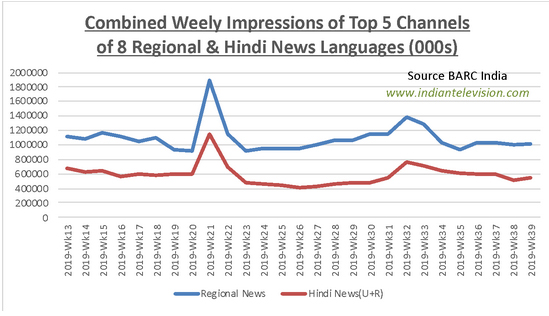
    As is obvious from the chart above, viewership of the top 5 regional news channels of 8 languages is far higher, by an average of about 46.33 percent,than the viewership of Hindi news channels in HSM (U+R) during the 26 weeks under review).

    Most-watched regional news channels

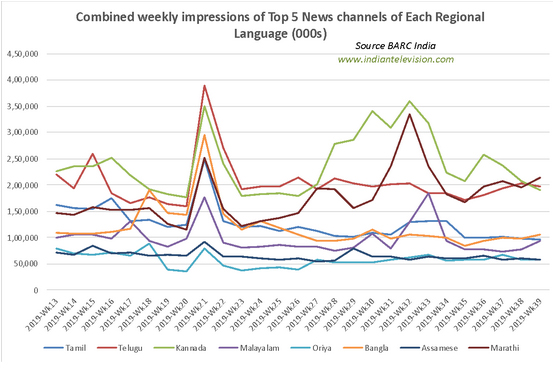
    Here below is a chart showing the viewership data for news channels in the eight languages mentioned above in their respective markets. As is obvious, Kannada news has a much bigger viewership even in absolute numbers than other languages.
    Most-watched Assamese news channels

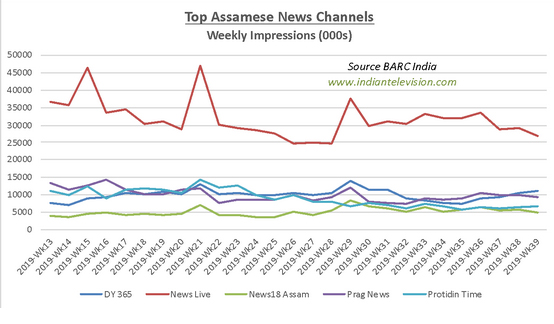
    Five channels were present in BARC’s weekly list of Top 5 Assamese news channels during all the weeks between weeks 13 and 39 of 2019. News Live was the most-watched Assamese news channel by far.
    Most-watched Bangla news channels

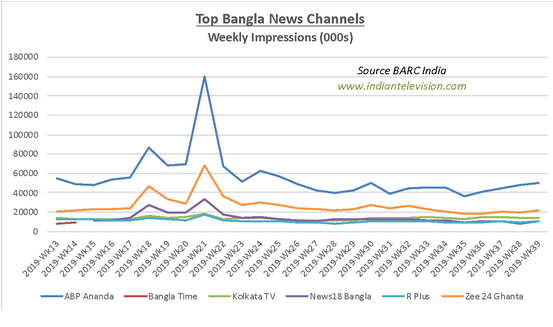
    There were five channels that have consistently appeared in BARC’s weekly lists of Top 5 Bangla news channels during all the 26 weeks under review in this paper. As is obvious, ABP Ananda was the most-watched Bengali news channel, followed by Zee 24 Ghanta. Please refer to the figure below:
    Most-watched Kannada news channels

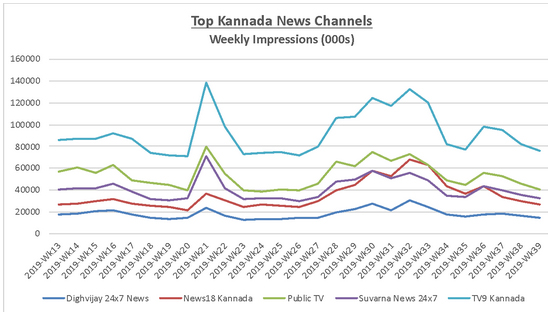
    BARCs weekly lists of Top 5 Kannada news channels between weeks 13 and 39 also had five channels that were consistently present during the entire period. TV9 Kannada was by far the most-watched Kannada news channel followed by Public TV during the period under consideration in this paper. Please refer to the figure below
    Most-watched Malayalam news channels

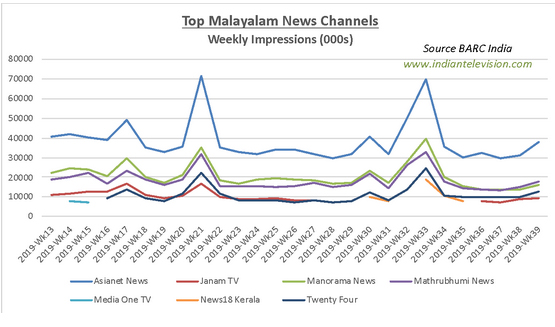
    Seven channels, each of them at least once, appeared in BARC’s weekly lists of Top 5 Malayalam news channels during the period under consideration. Of these 7, three have consistently appeared in the Malayalam news channels lists during all the 26 weeks under review. These three channels were – Asianet News, which is by far the most-watched  Malayalam news channel, followed by Manorama News and Mathrubhumi News. Please refer to the chart below:
    Most-watched Marathi news channels

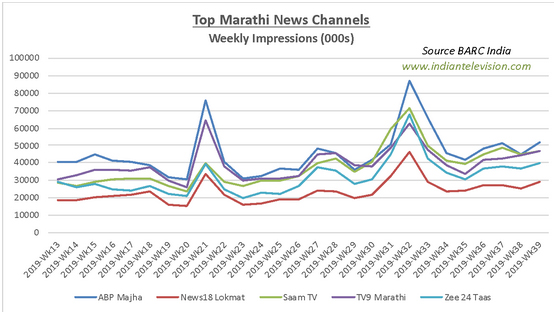
    In the case of Marathi news also, five channels consistently appeared in BARC’s weekly lists of Top 5 Marathi news channels. ABP Majha was the most-watched Marathi news Channel. During 15 of the 23 weeks under consideration, TV9 was the second most-watched Marathi news channel. However, since week 32 of 2019, Saam TV has been ranked second in BARC’s weekly lists of Top 5 Marathi news channels. Please refer to the chart below.
    Most-watched Oriya news channels

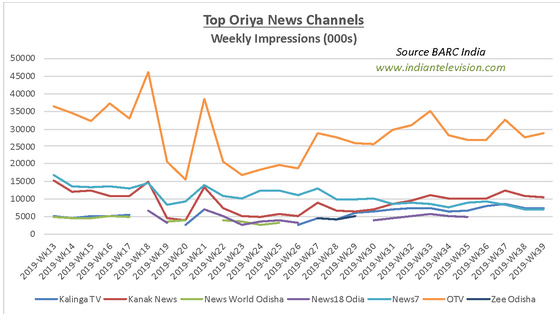
    Seven channels, each of them at least once, appeared in BARC’s weekly lists of Top 5 Oriya news channels during the period under consideration. Of these 7, three have consistently appeared in BARC’s weekly Oriya news channels lists during all the 26 weeks under review. They are OTV, which was the most-watched Oriya news channel, followed News7 and Kanak News at second and third place respectively. Please refer to the figure below:
    Most-watched Tamil news channels

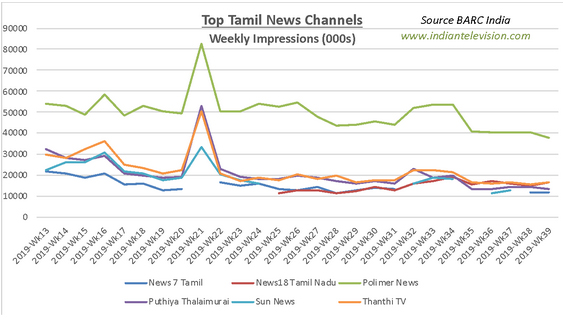
    Six channels appeared in BARC’s weekly lists of Top 5 Tamil news channels at least once. Three of these channels have consistently appeared during all the 26 weeks under consideration in BARC’s Top Tamil news channels list. Polimer News was the most-watched Tamil news channel by far and was followed by Thanthi TV and Puthiya Thalaimurai at second and third place respectively. Please refer to the figure below:
    Most-watched Telugu news channels

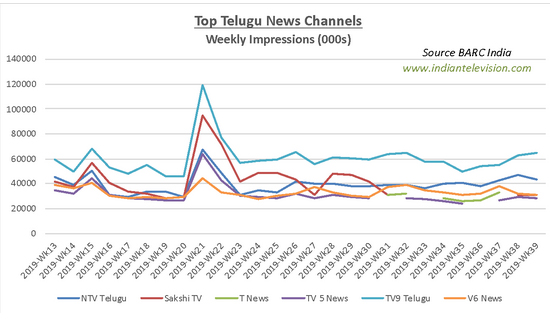
    Six channels appeared in BARC’s weekly lists of Top 5 Telugu news channels at least once between weeks 13 and 39 of 2019. Three of these channels have consistently appeared during all the 26 weeks under consideration in BARC’s Top Telugu news channels list. TV9 Telugu was the most-watched Telugu news channel during the 26 weeks under consideration in this paper. NTV news was at second place followed by V6 news at third place. Please refer to the chart below:
    Closing Remarks

    Media groups and news networks such as the ABP Group and Associated Broadcasting Company Private Limited (TV9) have channels in more than one language that are among the Top 5 channels in that market or language.  Many of them have news channels in other languages/markets also.

    Television news is an important genre. India has multiple languages and small and big networks, independent channels – television broadcasters to be more precise – cater to viewers’ tastes by beaming in content that they prefer. News is an important genre, and there are news channels galore across languages – some of them have even been crowned as ‘views’ channels. The FICCI M&E 2019 report says that 43 percent of the 885 private TV channels in India were ‘news channels’. The FICCI report says that news, which commands a 7 percent share of viewership garnered a disproportionately high share of advertising volumes. The lion’s share totaling 77 percent of the viewership was taken by escapism – or movies and GECs. Yet, Hindi regional news was amongst the top 10 genres and had 5 percent of the advertisement share in terms of volumes of advertisements or insertions.The report also says that contrary to popular perception, TV viewership is high amongst youth (15-30 years) even in the digital age. Youth contribute 32 percent to total viewership with a 30 percent and 32 percent split between urban and rural India.

    An earlier BARC report says that news events cannot escape the lure of drama. And drama includes elections and election results, deaths of celebrities, high court and supreme court verdicts on celebrities and sensitive issues, major changes such as demonetisation announced by the central government, major public holidays such as Independence and Republic days, important events such as the Uri surgical strikes that pertain to terrorist attacks and counter-attacks, etc. Data for election results week – week 21 of 2019, could not be considered in this paper for analysis of per capita consumption because of the change in BARC’s methodology two weeks after election results week. However, week 21 data has been considered in other parts of the report.
  • BARC week 40: Dangal most watched channel across genres

    BARC week 40: Dangal most watched channel across genres

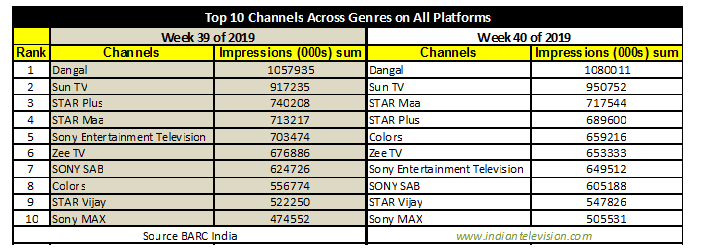
    BENGALURU: Two channels – Enterr 10 Television’s free to air (Free or FTA) Hindi GEC Dangal and the Sun Tv Network’s flagship Tamil GEC Sun TV having been vying for the top slot in Broadcast Audience Research Council of India (BARC) weekly lists of Top 10 Channels across genres as mentioned by us earlier.
    During the Indian cricketing bonanza tourney, the IPL, it is Star India Hindi Sports channel Star Sports 1 Hindi that often held onto the numero uno status. Between week 13 and week 40 of 2019, it is Dangal that has held first rank in BARC’s weekly lists for 16 of the 28 weeks. Dangal has held on to first place for four consecutive weeks until week 40. Further, since B4U Movies exited BARC’s weekly list across genres on all platforms in week 38 of 2019, Dangal is the only FTA channel in its fold. The other 9 channels have been pay channels. Dangal retook the numero uno mantle in BARC’s Across Genres on all platforms weekly list.

    It must be noted that BARC had stopped publishing viewership data in the public domain since week 6 of 2019 to allow ratings to stabilise after the implementation of Telecom Regulatory Authority of India (Trai) New Tariff Order. BARC recommenced putting up ratings in the public domain only in week 13 of 2019.

    BARC’s weekly list of Top 10 Channels Across Genres on All Platforms in week 40 of 2019

    Six Hindi GECs, two Tamil channels and one channel each from the Hindi Movies and Telugu genres comprised BARC’s Weekly list of Top 10 Channels Across Genres for week 40 of 2019 (Saturday, 28 September 2019 to Friday, 4 October 2019, week or period under review). From the networks’ perspective, there were three channels each from Star India and Sony Pictures Network India (SPN), and one channel each from Enterr 10 Television, Sun Tv Network, Viacom18 and Zee Entertainment Enterprises Limited (Zeel) in BARC’s weekly list of Top 10 Channels Across Genres on All Platforms in week 40 of 2019.

    The list of channels in BARC’s weekly list of Top 10 Channels Across Genres on All Platforms in week 40 of 2019 was the same as in week 39 with some shuffling of ranks. Please refer to the figure below:

    BARC’s weekly list of Top 10 Pay Channels Across Genres in week 40 of 2019

    Except for Dangal, BARC’s weekly list of Top 10 Pay Channels Across Genres in week 40 of 2019 had the same nine channels as the above across genres on all platforms list. The tenth channel in week 40 of 2019 was different from week 39 – Zeel’s Kannada GEC Zee Kannada exited the list to be replaced by Viacom18’s Kids genre channel Nick in week 40 of 2019.

    BARC’s weekly list of Top 10 Pay Channels Across Genres in week 40 of 2019 had five Hindi GECs, two Tamil channels and one channel each from the Hindi Movies genre, Kids genre and Telugu genres. From the network’s perspective, there were three channels each from Star India and SPN, two channels from Viacom18 and one channel each from the Sun Tv Network and Zeel.

    Please refer to the figure below

    BARC’s weekly list of Top 10 Free Channels Across Genres in week 40 of 2019

    BARC’s weekly list of Top 10 Free Channels Across Genres in week 40 of 2019 had the same channels as in week 39 with some shuffling in ranks. 

    Three channels each from Hindi Movies genre and Bhojpuri genre, two channels from the Hindi GEC genre and one channel each from the Marathi and Sports genres made up BARC’s weekly list of Top 10 Free Channels Across Genres in week 40 of 2019. There were three channels each from B4U and Enterr 10 Television, two channels from Zeel and one channel each from SkyStar and Star India networks.

    Please refer to the figure below.


  • DPOs say broadcasters misusing TRAI tariff order with heavy discounts

    DPOs say broadcasters misusing TRAI tariff order with heavy discounts

    MUMBAI: Distribution platform operators (DPOs) believe that broadcasters have misused the flexibility available to them to give a discount on the sum of a-la-carte as high as 90 per cent. The operators have shared their views on Telecom Regulatory Authority of India's (TRAI) consultation paper (CP) on ‘Tariff related issues for Broadcasters and Cable services. The industry has also given mixed views over the implementation of the 15 per cent cap on discount for a-la-carte by broadcasters.

    TRAI had released the consultation paper seeking responses from stakeholders to review the new tariff regime on 16 August 2019. In its consultation paper, the authority informed that it has observed that broadcasters are offering bouquets at a discount of up to 70 per cent of the sum of a-la-carte rates of pay channels constituting those bouquets. “It indicates that in absence of any restriction on the discount on the offering of bouquets, broadcasters are making prices of a-la-carte channels illusory thereby impacting the a-la-carte choice of channels by consumers and giving huge discounts on bouquets to push even those channels which are not the choice of subscribers,” said TRAI.

    Tata Sky in its responses to TRAI expressed disappointment of not revisiting the entire new regime. It said, “We are glad that TRAI has finally acknowledged these misgivings, however, to our  disappointment, TRAI, instead  of conducting a  holistic exercise of revisiting the new regime in entirety has chosen to selectively focus only on  few issues thereby limiting the scope of the exercise.”

    “Having acknowledged the serious misgivings in the regulations, the current consultation is a piece-meal and isolated effort and not the appropriate way forward,” opined Tata Sky.

    It also suggested that TRAI should allow the price forbearance models at the wholesale and the retail level. Further, the channel pricing framework and methodologies should be left to the parties involved, allowing the market forces and negotiation between the parties to decide the same.

    Tata Sky also informed the authority that it is against implementation of any kind of cap overpricing. It suggested, “The DPO bouquet is much more subscriber-friendly as it caters to the needs of the subscriber for availing channels from multiple broadcasters within a pack rather than having to subscribe to multiple bouquets/ or channels.”

    However Bharati Telemedia, in its responses, said, “We are of the view that at this stage, no changes should be made to any of the provisions of the tariff order including the provision w.r.t discount on sum of a-la-carte channels forming part of bouquets offered either by the broadcaster or the DPOs. Any changes at this stage will be equivalent to migration and this may not be the ideal time to cause any interference as it will also lead to unnecessary disturbances and customer dissatisfaction.”

    DEN Networks said that some broadcasters are indulging in heavy discounting of bouquets by taking advantage of non-implementation of 15 per cent cap on discount which has created a non-level field vis-à-vis other broadcasters.

    DEN Networks also expressed that popular channels are being unnecessarily clubbed with non-popular channels to push their uptake. It said, “The broadcasters who have large number of channels in their repertoire, are engaging in a practice of forming large number of heavily discounted bouquets (with minor changes) to push popular channels with non-driver channels. It can be seen that the channels which were FTA before the implementation of the new regulatory framework have been converted into pay channels with the price range of Rs 0.10-0.50/- just to push them with in a bouquet with popular channels of the broadcaster.”

    The operator believes that the non-implementation of 15 per cent cap on discount clubbed with the ceiling of Rs 19/- on the price of MRP of a-la-carte channels forming part of such bouquets is responsible for pushing unwanted channels along with popular channels.

    All India Digital Cable Federation (AIDCF) in its responses to TRAI said, “The non-implementation of the said proviso has given leverage to the broadcasters to offer their bouquets at discount which is as high as 70 per cent of the sum of a-la-carte channels forming part of such bouquets. This flexibility of giving discounts without a cap, created a non-level playing field for the distributors because the bouquets were priced on a discriminatory basis.”

    Sharing similar views, AIDCF and GTPL Hathway said, “The flexibility available to broadcasters to give discount on sum of a-la-carte channels forming part of bouquets has been grossly misused by the broadcasters. The same has also been acknowledged by the authority. It is pertinent to mention that the broadcasters have not only offered huge discounts as high as 90 per cent on their bouquets but have also created confusion in the minds of consumers, by offering  numerous bouquet(s) comprising of few popular  and bulk of non-popular channel(s) with a clear intent to push their non-popular channels.”

  • BARC’s Elbert D’Silva on kids’ viewership trends, NTO impact & category growth prospects

    BARC’s Elbert D’Silva on kids’ viewership trends, NTO impact & category growth prospects

    MUMBAI: According to BARC India data, Kids’ segment is only three per cent of the overall advertising space on television, with GEC and News channels accounting for the larger pies. However, with Kids’ segment contributing 20 per cent of total viewership on television, there is a great opportunity for creators to produce localised content and advertisers to explore this category.

    BARC India head product leadership and excellence Elbert D’Silva gave a presentation at KAM Summit organised by Animation Xpress on 30th August. D’Silva spoke on the market trends, Kids viewership trends and data, NTO impact on genre, and industry growth.

    “There is a myth that viewers are moving towards digital but according to data viewership on television is still holding strong. 20 per cent of total viewership is contributed from Kids viewership. The time spend on television by kids from 2 years to 14 years is around 3 hours 32 minutes. Kids in urban Indi spend more time watching TV than rural. In Urban area the time spend on TV is around 3 hours 58 minutes and in rural is 3 hours 15 minutes. 2 to 14 years old kids in urban India contributes 59 per cent of kids viewership,” said BARC India head product leadership and excellence Elbert D’Silva at the recently concluded Kids Animation and more (KAM) Summit KAM organised by Animation Xpress.

    According to a FICCI report, he pointed out, animation, VFX and post production industry grew by 18 per cent in 2018 and is expected to reach Rs 127.6 billion by 2021. Currently the industry is growing at 30 per cent. There is huge demand for kids content not only on OTT but also on TV. Domestic demand over digital and other platforms for animation is also growing.

    “90 per cent of viewership is on animated content be it movie, serial or any other form. Animation is dominant player in the kids segment on television. Within that movies tend to have higher affinity towards viewership while serial falls in second bucket,” said D’Silva.

    When it comes to gender, BARC data also states that boys show greater affinity towards kids channels. In the viewership of kids genre, boys contribute 59 per cent and girls 41 per cent of total viewership.

    Delhi, Maharashtra, Gujarat and Assam are states clocking high consumption of kids content, with a large share of viewership being accounted for by central India. In the south language market, Tamil Nadu spends a lot of time on TV and that holds for kids viewership as well. As a genre, kids is the third most dominant after GEC and movies.

    In terms of the new tariff order’s impact, D’Silva said, “During the NTO, there was some amount of disruption in terms of consumption in kids genre. But the genre redesigned with the increasing trends lead by summer vacation. Post NTO we are seeing upward moment in kids viewership.”

    BARC data also offered an understanding in terms of age group and time spent. 2 to 8 years olds spend more 25 to 30 minutes more on kids channels as compared to 9 to 14 years olds on a daily basis. 9 to 14 year olds have a more diverse taste in terms of TV viewership. The ‘prime time’ in a sense for kids viewership is between 8 AM to 12 PM and before GECs’ primetime i.e. 6 PM to 8 PM.

    “Kids is an important segment and in India we have large population operating in that space. But unfortunately the segment is only three per cent of the overall advertising market. Most of the ads that are telecasted are on GECs and News channels on television,” D’Silva stated.

    He further opined that there is there is scope for more advertisement on kids channels, with a great opportunity for content creators to cater to both young and older kids’ audience.

  • Sun TV Network focusing on achieving pre-NTO viewership in every single market

    Sun TV Network focusing on achieving pre-NTO viewership in every single market

    MUMBAI: While new tariff order (NTO) had brought down viewership of several pay channels initially across the country, Sun TV Network channels are bouncing back from the initial effect in key markets. As the channels are coming close to the pre-NTO regime viewership, the largest broadcaster is now focusing on every single market to get back to the reach percentage it was providing prior to the NTO implementation.

    “We are making all efforts in terms of ensuring that the channels are carried by all DTH and cable operators and it is placed in the appropriate MCM so it is accessible to a majority of the subscriber universe. So, that is why you are also seeing a good improvement in the rating numbers,” Sun TV Network CEO R Mahesh Kumar commented in an earnings call after its Q1 results.

    Kumar also added while inquired about a-la-carte adoption that very few subscribers have opted for a-la-carte. He noted that the majority of service providers and the customers have opted for the entire bouquet of channels. Notably, many broadcasters and DPOs have highlighted this trend of subscribers going for bundled packages after NTO implementation rather than selecting individual channels.

    While the group also has a large DTH business, Kumar is optimistic about the growth rate of DTH. He added that he witnessed a huge growth in private MSOs in the marketplace at a time when churn is happening from state-run Arasu Cable to other operators. Moreover, there is a significant portion of analogue which is also incrementally getting digitised.

    “In our estimate, upwards of 35 per cent is still analogue in this market. And in terms of seeding of STBs, it's being pushed both by private cable operators and DTH. Like even our own group company, Sun Direct has been extremely well in Tamil Nadu. Their numbers have grown from an average of 1,000, 2,000 to 5,000, and 6,000 a day,” Sun TV Network group CFO SL Narayanan commented.

    He also added that everything is happening across the system in Tamil Nadu based on NTO only. According to him, the only issue has been the difficulty of getting the reports from some of the smaller players because of their own inability to have new programs. He added that it's only a transitional phase and there would be lesser problems once things get streamlined and good software is available. While he added that most of them are adapting it also, the reporting levels have increased considerably in June or July.

  • Discovery Communications questions transparency, objectivity of recent TRAI consultation paper

    Discovery Communications questions transparency, objectivity of recent TRAI consultation paper

    MUMBAI: Discovery Communications India along with others filed a petition against the Telecom Regulatory Authority of India (TRAI) in the Delhi High Court for quashing the consultation paper floated on tariff-related issues for broadcasting and cable services.

    “The petitioner submits that the impugned consultation paper is marred by judicial impropriety in as much as the impugned consultation paper fails to conform to the fundamental tenets of transparency and objectivity, by proceeding with a pre-determined notion that channel broadcasters have distorted the broadcasting market and consumer choice through perverse pricing and deep discounting, and have therefore called for suggestions on the ways and means to remedy the situation,” it said.

    “Being aggrieved by the pre-conceived and pre-determined approach of the respondent that is writ large on the face of the impugned consultation paper, the petitioners are constrained to approach this Hon'ble Court under its extraordinary writ jurisdiction to challenge the validity and legality of the process initiated under the Impugned consultation paper by the respondent, which clearly lacks objectivity, transparency and fairness of approach,” it added.

    One of the basic grounds for the petition is that the process of consultation is flawed as well as lacks objectivity. It has also been said that the consultation paper on the new tariff order issued by the respondent demonstrates a pre-determined approach of TRAI with respect to the broadcasters, which defeats the very purpose of such consultation. The petitioner has also submitted that the consultation paper contains serious allegations against the broadcaster.

    It has also been claimed that the consultation paper lacks objectivity, transparency and fairness in approach while 'transparency' is the basis of any consultation process. Hence, the impugned consultation paper fails to conform to the fundamental tenets of transparency and objectivity by asking leading questions in a public consultation exercise.

    “It is submitted that the respondent has vitiated the process of consultation by issuing leading questions along with conclusive statements making allegations against the petitioner. The petitioner submits that the respondent has approached with a close-mind at the stage of consultation process itself,” the petitioners said in the petition.

    Moreover, it also states that the consultation paper has the effect of interfering with the right of the broadcasters with reference to the manner in which, they would want to offer their product in bouquets and to such extent it is a direct infringement with the content of the broadcaster.

  • BARC week 34: DD India drops to fifth place in English news genre

    BARC week 34: DD India drops to fifth place in English news genre

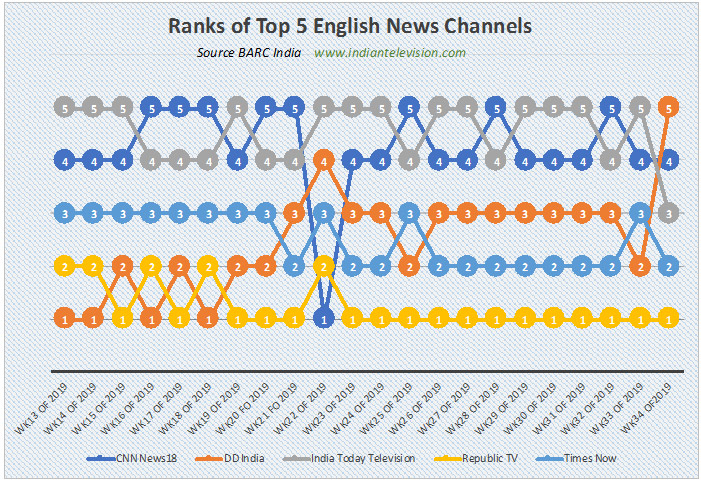
    BENGALURU: PubcasterDoordarshan’s English News channel DD India dropped to its lowest rank ever in week 34 of 2019 since Broadcast Audience Research Council of India (BARC) recommenced publishing viewership data in the public domain. Earlier, the ratings agency had stopped publishing data in the public domain starting week 6 of 2019 allow ratings to stabilize on implementation of Telecom Regulatory Authority of India (TRAI) New Tariff Order. BARC restarted putting up data on its website in week 13 of 2019 on coercion from TRAI.

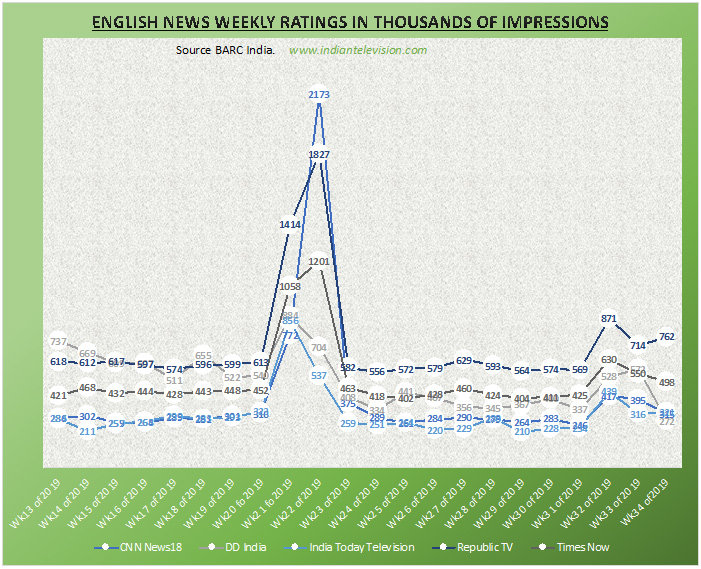
    During the 22 weeks(including weeks 13 and 34 of 2019) since, DD India has been ranked first in BARC’s weekly list of top 5 English News channels four times, has been ranked second 6 times, has been ranked third ten times, and has been ranked fourth and fifth once each. Hence, DD India’s ranking in week 34 (Saturday, 17 August 2019 to Friday, 23 August 2019) has been its lowest ever in 22 weeks. Please refer to the figure below

    All the five channels in BARC’s weekly lists of top 5 English News channels have been the same during the 22 weeks (weeks 13 to 34) under consideration in this paper, except that there has been a shuffling of ranks.

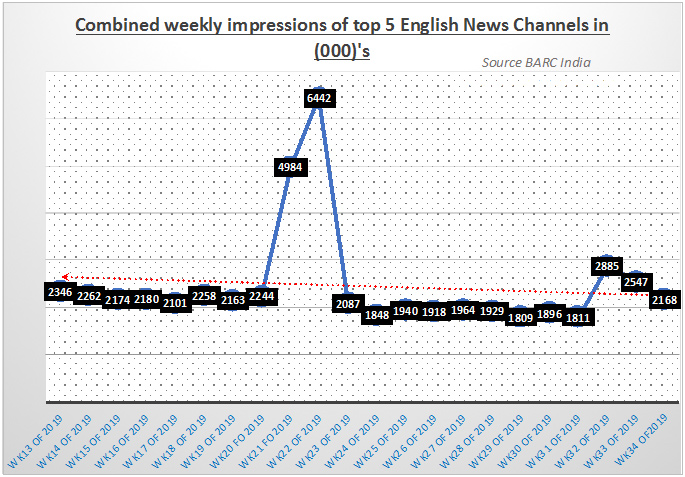
    The combined weekly impressions of BARC’s top 5 English News channels dipped once again in week 34 of 2019 as compared to week 33. This time the week-on-week dip in ratings was even higher at 14.9 percent (0.379 million impressions) as compared to the dip of 11.7 percent (0.338 million weekly impressions)  between weeks 33 and 32 of 2019.In week 34 of 2019, three channels – DD India (52.4 percent drop), CNN News18 (20.3 percent drop) and Times Now (9.5 percent drop) saw ratings fall. Two channel in BARC’s weekly list of top 5 English News channels in week 34 witnessed growth in ratings. They were Republic TV (increase of 0.048 million weekly impressions) and India Today TV (increase of 0.005 million weekly impressions) . Please refer to the figure below:

    Let us see how the top 5 English News channels performed in week 34 of 2019

    The Arnab Goswami led Republic TV retained its first rank with 0.762 million weekly impressions in week 34 of 2019 as compared to 0.714 million weekly impressions in week 33. Times Now climbed up a place to second rank in week 34 of 2019 with 0.498 million weekly impressions as compared to rank three and 0.550 million weekly impressions in the previous week. Climbing up two places to rank three in week 34 of 2019 was India Today Television with 0.321 million weekly impressions as compared to rank five and 0.321 million weekly impressions in week 33. Retaining its previous week’s rank four was CNN News18 with 0.315 million weekly impression in week 34 of 2019 as compared to 0.395 million weekly impressions in week 33. DD India completed the quintet with less than half of its week 33 viewership. At fifth rank,DD India garnered 0.272 million weekly impressions in week 34 of 2019 as compared to second rank and 0.572 million weekly impressions in week 33.

    Please refer to the figure below:


  • TRAI sends directive to 5 major MSOs for non-compliance of NTO provisions

    TRAI sends directive to 5 major MSOs for non-compliance of NTO provisions

    MUMBAI: The Telecom Regulatory Authority of India (TRAI) has directed five major multi system operators to comply with all provisions of its the new tariff order (NTO). After receiving scrutiny of the reply of earlier notice from the MSOs, TRAI found violation of rules of NTO.

    Following issues were found by the regulator for Induslnd Media and Communications Ltd   :

    ·         LCOs are not  providing  the itemised invoices to  the  consumers.  Some LCOs  are providing their  own  Cash memo bills.

    ·         Consumer portal provided by IMCL is not  working

    ·         IVRS facility of IMCL does not  have  any  provision for complaint registration.

    ·         LCOs without GST Registration are collecting tax  amount from  the  subscribers but not  depositing it.

    Following issues were found by the regulator for Hathway Digital:

    • Facility of Bill generation is available in LCO portal, but the customers are  not able  to get itemised billing in most cases even  after the request of the  subscriber,

    •LCOs without GST Registration are collecting tax  amount from  the  subscribers but  not  depositing it.

    Following issues were found by the regulator for GTPL Hathway:

    •IVRS facility of M/s GTPL Hathway Ltd.  does not  have provision for  complaint registration

    •The consumer portal of GTPL KCBPL has very  limited facilities. The facility ofupgradation and modifications in  subscription is  not  available on  consumer portal.

    •LCOs without GST Registration are  collecting tax  amount from  the  subscribers but not  depositing it.

    Following issues were found by the regulator for SITI Networks:

    •LCOs can  provide itemized invoices to consumers but most of the  LCOs are  not providing the  same. Some LCOs are  providing their own  cash memo bills;

    •IVRS facility of Siti  Networks Ltd.  does  not   have any  provision for  complaint registration.

    Following issues were found by the regulator for DEN networks:

    • LCO are  providing their own  cash memo bills  using card system for  payment receipts, while  the  subscribers are  not  able to get itemized bills

    • Facility of  upgradation  and  modification in  subscription is not   available on consumer portal.

    •LCOs without GST registration are  collecting tax  amount from  the  subscribers but  not  depositing it.

    All the MSOs have been directed to report compliance as per the new regulatory framework within seven days from the date of issue of this direction.

  • TRAI does not intend to revise NTO, aims to fine-tune it

    TRAI does not intend to revise NTO, aims to fine-tune it

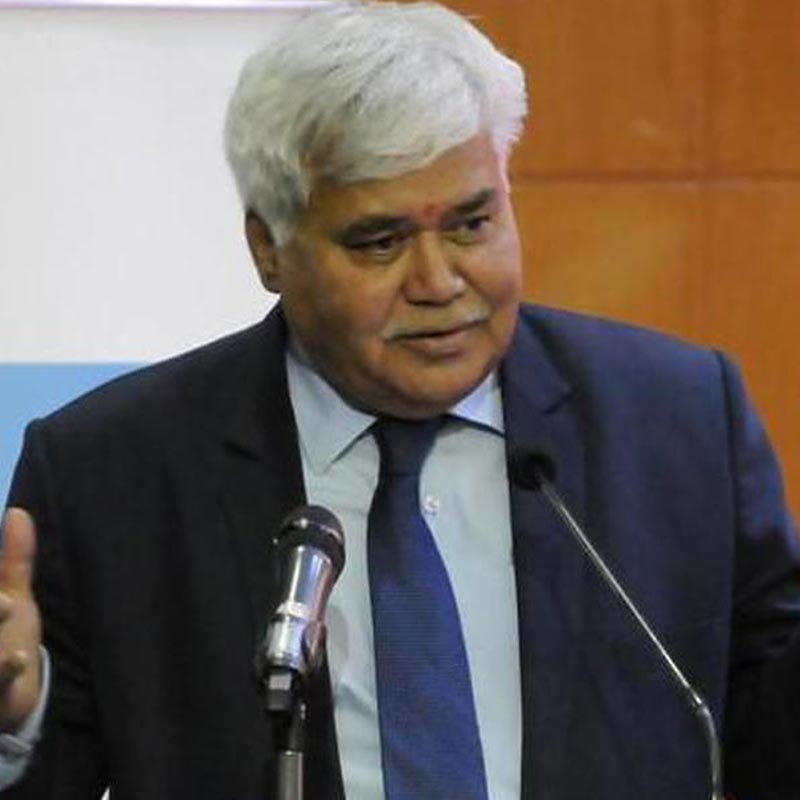
    MUMBAI: Amid several ongoing speculations on changes in the new tariff order (NTO), Telecom Regulatory Authority of India (TRAI) chairman RS Sharma clarified that the regulatory body does not have any plan to revise the pricing framework. He also added that it is only trying to fine-tune it due to certain issues consumers are facing.

    “The framework is already fixed. There is no proposal to change any component of that framework, and if somebody is making a point that we (TRAI) are changing the framework, it is absolutely false. Since this framework has started operating, we have observed that certain issues largely related to consumers have cropped up. We are only trying to fine-tune it,” Sharma said in an interview with the Economic Times.

    He also added that the consultation paper which stirred the recent controversies is not about changing the framework but it is bringing perfection in the phenomenon observed in the last few months. After finding certain issues, it brought the consultation paper on the table. But it may tweak a few parameters if it finds that all parameters are not working fine.

    “We are ensuring that consumers have a choice and are empowered to exercise their choice. Our objective is not to increase or decrease ARPU. Our aim is to enable the consumers to choose channels and safeguard them against any obstacle in their path,” he said.