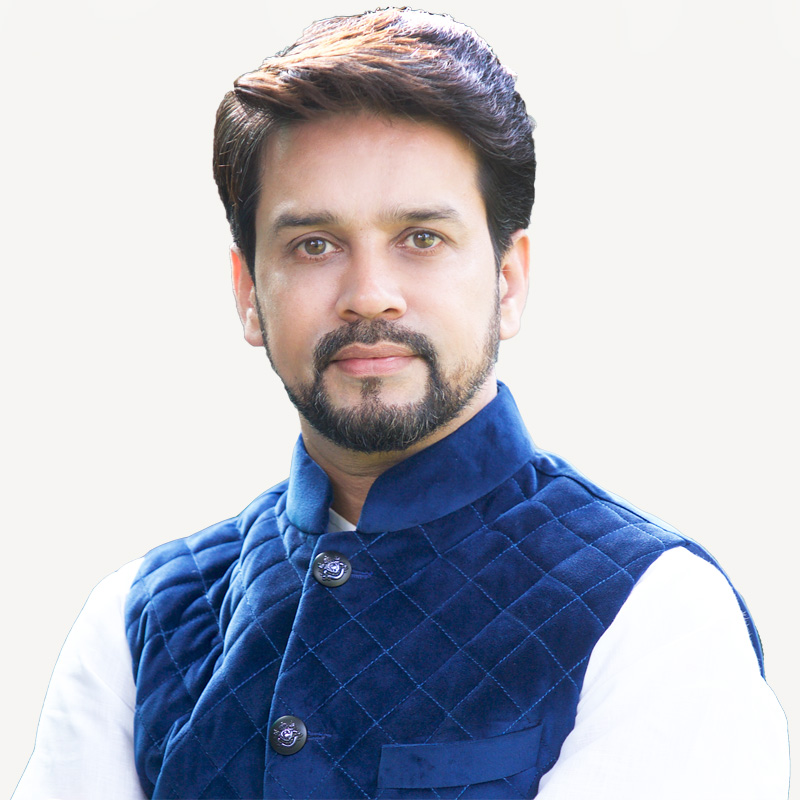
Mumbai: The union minister of information and broadcasting Anurag Thakur stated at the 47th annual gathering and 20th meeting of the Asia-Pacific Institute for Broadcasting Development (AIBD) that the biggest threat to mainstream media is not new age digital platforms, but rather the mainstream media channel itself.
He went on to say that true journalism was about confronting the facts, telling the truth, and giving all sides a platform to express themselves.
The minister stated that inviting guests who are divisive, spread false narratives, and shout at the top of their lungs undermines a channel’s credibility.
“Polarising debates pull down the credibility of the channel. Journalists are duty bound to report the news without fabrication,” he added.
He further shared, “Your decisions regarding the guest, the tone, and visuals define your credibility in the eyes of the audience. The viewer may stop for a minute to watch your show, but will never trust your anchor, your channel, or brand as a trusted and transparent source of news.”
Thakur urged the presenters not to let the narrative be defined by soundbites, but to redefine it themselves and set the terms for the guests and the channel.
He prodded the audience, asking, “Are you going to watch as the younger audience switches and sweeps through the shrill on TV news, or are you going to bring back the neutrality in news and debates to stay ahead of the game?”
Speaking on the theme of the event, “Building a stronger future for broadcasting in the post-pandemic era,” the minister remarked that, “though broadcast media is and has always been in the mainstream of journalism, the Covid 19 era has shaped its structure in a more strategic way. The Covid pandemic has taught us how the right and timely information can save millions of lives. It is the media which brought the world on one platform during this difficult phase and reinforced the spirit of one global family.”
Presenting the role of the Indian media during the pandemic as a success story, he said that the media ensured that Covid-19 awareness messages, important government guidelines, and free online consultations with doctors reached everyone in the nook and corner of the country.
Thakur also prodded the member countries to set up cooperation in the area of good quality content exchange. Program exchanges through such cooperation bring world cultures together. Such media partnerships between the countries help in building strong people-to-people bonds, he commented.
In conclusion, the minister underlined that the media, in all its forms, has an immense ability to shape public perceptions and perspectives as an effective tool of empowerment. “It is imperative to create an enabling environment for our journalists and broadcasters to make the space of the media more vibrant and rewarding,” he added.
At the event, the union minister of state for information and broadcasting (I&B) Dr. L Murugan, secretary of MIB Apurva Chandra, Prasar Bharati chief executive officer & AIBD president Mayank Agarwal, and AIBD director Philomena Gnanapragasam were present at the event.
Agarwal highlighted that with an increase in the use of the internet in broadcasting, the training of journalists in cyber security journalism has become imperative. He added that AIBD is the first set up to take this up as part of its training programs.
Philomena Gnanapragasam said that content is going to determine the future of media and how the content is shared and monetised will determine the future of broadcasting. She also thanked all the delegates and representatives of various organisations for their presence.
MUMBAI: Consumers’ viewing habits are changing, and it’s landed a clear impact on the overall broadcast sector. Despite the challenges posed by the Covid2019 pandemic and other setbacks, broadcasters are seeing virtue in launching new channels. Even during the lockdown, people turned to television to keep themselves engaged and entertained, with BARC reporting a 43 per cent increase in India's TV viewership during this period, compared to the pre-Covid2019 figures.
The rise in TV consumption signifies viewers’ appetite for content – and clearly, the time is ripe to green-flag new channels catering to different tastes and smaller sub-segments across geographies. Let’s have a look at all the new channels that arrived on the idiot box in 2020.
ZeeL
ZeeL’s first lifestyle channel Zee Zest started airing 1 October 2020. The channel presents content that is a perfect encapsulation of food, travel, lifestyle, home improvement, wellness, culture, and DIY. Zee Zest brings some original shows like 100% South Indian, India’s 50 Best Dishes, Ghar Sa Yummy – Swaad Familywala, Food Veda, and Meetha toh Banta Hai. Also in the pipeline are popular global shows making their debut in India, such as Anthony Bourdain Parts Unknown Season 5, Jaime: Keep Cooking & Carry On, Far Flung with Gary Mehigan, MasterChef Australia – Season 9, MasterChef USA Junior Season 5, and more programmes across various genres.
Hopping towards a wonderland of delicious experiences, the junior chefs have signed up for an adventurous and a fun filled ride!
Are you ready to join?
The broadcaster forayed into the regional music space with the launch of its Marathi music channel – Zee Vajwa. It will offer 3,000+ playlists, and also have a non-fiction show in the comedy genre, a category first. The network has already captured 57 per cent viewership share in Maharashtra with Zee Marathi, Zee Yuva and Zee Talkies.
ZeeL chief consumer officer Prathyusha Agarwal said, “With Zee Vajwa, we identified a need gap in the lifestyle genre to serve a holistic entertainment experience to the focused Sec A target audience. These viewers seek experiences from around the world but from the comfort of their own homes. That’s where Zee Zest seamlessly comes in, with diverse lifestyle content themes such as wellness, travel, lifestyle, food, home improvement, and culture.”
Another offering, Zee Thirai was launched on 19 January 2020. The channel offers the latest blockbuster Kollywood movies and premieres.
Agarwal stated that all of Zeel’s new launches not only established themselves strongly in their respective markets but also aided market growth. Zee Punjabi captured a third of the viewership pie in the first four weeks of its debut, and consumption of Punjabi language content grew by 23 per cent compared to the one per cent growth in total TV viewership in Punjab/Chandigarh. Even during the lockdown, Zee Punjabi capitalised on the surge in demand for content as viewership grew by nearly 60 per cent (BARC data: weeks 12-15). The network’s new movie channels – Zee Biskope, Zee Picchar and Zee Thirai – captured a significant share in the movie genre, which rose by 28-29 per cent in a growing TV pie. (BARC data: weeks 12-15).
Enterr10 Television Network
The network expanded its footprint in south India with Dangal Kannada, close on the heels of its Bhojpuri offering, Enterr10 Rangeela.
Dangal Kannada underlines the network’s aggressive expansion into the growing regional broadcast entertainment space. Armed with dubbed versions of shows such as Ramayan, Mere Sai, Phir Laut Aayi Naagin,Tenali Rama, etc, the channel started airing from 30 September. Kannada film and TV actress Hariprriya is the brand ambassador for the channel and plays an integral part in its marketing campaigns.
After Bhojpuri Cinema, Enterr10 Rangeela is the network’s second offering for Bhojpuri audiences. The channel has launched a strong mix of fiction and non-fiction content ranging across series and reality shows, awards, and blockbuster films and world television premieres. Ramayan (Bhojpuri) is the channel’s launch pad serial.
Star Vijay, owned by Disney-Star, came out with Tamil music channel Vijay Music. Priced at Re 1 per month, Vijay Music hopes to compete with other channels in the segment such as Raj Television Network’s Raj Musix, Sun Network’s Sun Music, Jaya TV Network’s Jaya MAX.
Star India has also postponed the launch of three new channels, Star Movies Select, Star Sports 3 HD, and Disney Channel HD. It is also rebranding Movies OK as Star Gold 2. It has not provided a new date of release.
The broadcaster has decided to add Star Movies Select to cater the audiences in standard definition (SD) category as a premiere movies channel, in addition to Star Movies Select HD (high definition).
To give larger-than-life experience to customers, the broadcaster will offer Star Sports 3 HD at a price of Rs 5 per month, in addition to existing Star Sports 3 in the SD category. Meanwhile, it plans to launch a second HD kids’ channel, Disney Channel HD, that will cost around Rs 10 per month.
With the revamping of Movies OK to Star Gold 2, the broadcaster will end the ‘OK’ branding. Previously, it had renamed the Life OK channel to Star Bharat. Star Gold 2’s SD version will cost Rs 2 per month, while for its HD variant customers will need to shell out Rs 5 per month.
DD Free Dish
The state broadcaster run free-to-air DTH platform DD Free Dish added three new channels – ANB News, Aryan TV National, and News India 24×7 hese channels won the bid during the forty seventh e-auctions held on 26 August. They are allotted slots for the period between 1 September 2020 to 31 March 2021.
All three channels have a presence on other DTH platforms and fall under the news category – ANB News is a Punjab-based Hindi news channel, Aryan TV National caters primarily to Bihar, and News India 24×7 is a Hindi news channel focused on Rajasthan.
Tata Sky
In a move to further strengthen its regional slate, the DTH operator launched Tata Sky Malayalam Cinema, for which it joined forces with leading Malayali GEC Asianet.
Tata Sky Malayalam Cinema offers an uninterrupted movie-viewing experience to film enthusiasts, across the content spectrum – action, romance, drama, and comedy on television. The service will showcase the biggest blockbusters of Mollywood with exclusive movie premieres before television. The channel is now available to all subscribers on #1805 (SD) at a minimal cost of Rs 1.5 per day. With this, Tata Sky has regional cinema offerings in all four major south Indian languages – Tata Sky Telugu Cinema, Tata Sky Tamil Cinema, Tata Sky Kannada Cinema, and now Tata Sky Malayalam Cinema.
In10 Media Network
The network recently ventured into the kids’ entertainment space on Children’s Day with a new premium Hindi channel, Gubbare — Masti Ke Phuwarre. The current programming includes a mix of Indian animation such as Appu – The Yogic Elephant, Love U Ganesha, Chhota Hatim and Seven Monsters, and has introduced Billa Jasoos, Marcus Khiladi, My Bhoot Friends, Leo and Tig, The Dabangg Girls, Atchoo to Indian audiences on the channel. Apart from cartoon shows, animated movies are telecast on weekends. Gubbare, a pay channel, is available on all major DTH and cable operators across India.
In10 Media Network MD Aditya Pittie shared that the network is focused on building scalable businesses and strategically expanding its footprint in the industry. He added, “In our country, television continues to be a primary viewing platform for kids’ entertainment among most households.”
Prior to this, the IN10 Media Network launched its first regional movie channel – Filamchi – Filman Ka Laalchi, a 24×7 linear broadcast channel for Bhojpuri cinema fans across the country. With an extensive collection of over 250 Bhojpuri blockbusters, the channel is available on DD FreeDish and will soon be accessible across all major cable operators and platforms.
Shemaroo Entertainment Media Network
On 1 May 2020, Shemaroo Entertainment Media Network launched Hindi GEC Shemaroo TV. CEO Hiren Gada mentioned that the network is always keen to experiment and set milestones in the media and entertainment space. With this industry-first initiative allowing viewers to tune into Shemaroo TV live on Facebook, Gada hopes to reach out to a new and wider set of audience and offer content that they would like to watch and enjoy in their free time.
Other channels that debuted in 2020 include Fun TV, Blue (Naaptol), Satya Movies, Surya Cinema, BDM Bhojpuri, Surya Bhojpuri, 9X Jalwa, Maha Punjabi, C7 and Lord Budhha TV.
MUMBAI: The Covid2019 pandemic was an unforeseen catastrophe for the broadcast industry. With the months-long lockdown, ad revenues troughed, and as content dried up, viewers started migrating en-masse to the greener pastures offered by OTT platforms. But thumbing their collective noses at these setbacks, the broadcasters are seeing the virtue in launching new channels. Television is now starting to mirror the online content space and deliver to the evolved consumer needs around content.
Even during the lockdown, people turned to television as a means to keep themselves engaged and entertained, with BARC reporting a 43 per cent increase in India's TV viewership during the lockdown compared to the pre-Covid2019 period. Recent BARC data suggests a 17 per cent increase in India’s TV viewership compared to pre-Covid2019 period (week 38 vs weeks 2-4 ’20). The rise in TV consumption signifies the viewers’ appetite for content – and clearly, the time is ripe to green-flag new channels catering to different tastes and smaller sub-segments across geographies.
ZeeL has debuted two new channels, lifestyle channel Zee Zest and Marathi music channel Zee Vajwa. Enterr10 Television Network has expanded its footprint in south India with Dangal Kannada, close on the heels of its Bhojpuri offering, Enterr10 Rangeela . Star Vijay, owned by Disney-Star, has come out with Tamil music channel Vijay Music. In10 Media Network has recently ventured into the kids’ entertainment space on Children’s Day with a new premium Hindi channel, Gubbare — Masti Ke Phuwarre. On 1 May 2020, Shemaroo Entertainment Media Network launched Hindi GEC Shemaroo TV.
ZeeL chief consumer officer Prathyusha Agarwal said, “With Zee Vajwa, we promise to provide our audiences with a platform to enjoy some great music deep-rooted in our rich culture. We also identified a need gap in the lifestyle genre to serve a holistic entertainment experience to the focused Sec A target audience. These viewers seek experiences from around the world but from the comfort of their own homes. That’s where Zee Zest seamlessly comes in, with diverse lifestyle content themes such as wellness, travel, lifestyle, food, home improvement, and culture.”
Media experts highlighted that these are part of long-term plans to strengthen a network’s overall portfolio and expand into new segments. With viewers confined to their homes, it’s the best time to launch new channels. Broadcasters now have more time on hand to try out new content.
In10 Media Network MD Aditya Pittie shared that the network is focused on building scalable businesses and strategically expanding its footprint in the industry. He added, “In our country, television continues to be a primary viewing platform for kids’ entertainment among most households.”
Shemaroo Entertainment Ltd CEO Hiren Gada mentioned that the network is always keen to experiment and set milestones in the media and entertainment space. With this industry-first initiative allowing viewers to tune into Shemaroo TV live on Facebook, Gada hopes to reach out to a new and wide set of audience and offer content that they would like to watch and enjoy in their free time.
Carat media director Grashima Sahni pointed out that broadcasters are bringing in an element of personalisation into the television space and hence, discouraging migration to other avenues and sources. “The vernacular flavour in this expansion is a crucial ingredient too. Zee Vajwa, Dangal Kannada, Enterr 10 Rangeela, Vijay Music are all offerings in local languages of each region, appealing to the “local-masses” or “micro-masses” of each region. With this step, broadcasters are also building immunity for themselves to the challenges of NTO by TRAI. A customised appeal will make sure that the channel remains a part of the selected channel basket by its viewers,” Sahni explained.
She further highlighted that these channels are a stepping stone for broadcasters to work towards a TV+online content ecosystem. The success of Hotstar has reflected a clear learning that the primary audiences of the content on the channel can and will remain within the ecosystem given their needs are met. When the unstoppable migration from TV to the online screen does happen – due to time flexibility needs or choices (cross-selling the content with a bigger online library) – the audience can be successfully made to migrate internally if the TV hook is present in that household.
With NTO also setting in and consumers able to pay per channel than a group offering, channel choice mix will be an intricate balance of content on TV & digital.
Agarwal stated that all of ZeeL’s new launches have not only established themselves strongly in their respective markets but have also aided market growth. Zee Punjabi captured a third of the viewership pie in the first four weeks of its launch, and consumption of Punjabi language content grew by 23 per cent compared to the one per cent growth in total TV viewership in Punjab/Chandigarh. Even during the lockdown, Zee Punjabi capitalised on the surge in demand for content as viewership grew by nearly 60 per cent (BARC data: weeks 12-15). The network’s new movie channels – Zee Biskope, Zee Picchar & Zee Thirai – have also aided growth by capturing significant share in the movie genre, which rose by 28-29 per cent in a growing TV pie. (BARC data: weeks 12-15).
The launch of a new channel provides brands an opportunity to create competitive advantage as they reach sharper audience cohorts that are culturally connected. “For instance, Zee Vajwa, a category first, will allow advertisers to reach to a new audience cohort and hence offers a new opportunity for brand outreach. Zee Zest will use a dual strategy to reach consumers across TV and digital platforms, further making it an attractive proposition for advertisers. The advantage with the launch of a new lifestyle genre/ destination channel is that it opens doors to various new brands to associate with the channel. Therefore, it’s a clear driver of mutual growth,” elaborated Agarwal.
Multiple projections suggest a recovered economy by mid-2021. Demand is a critical aspect of this recovery and advertising plays a crucial role in this demand generation. BARC has already reported TV ad volumes to be at a five year high. Sahni remarked that with festive season and big-ticket properties, the sentiment is relatively positive and reflects that the business is working hard to gain back its shares or capture newer opportunities in the market due to a refresh and reshuffling in buying cycles.
She added that the dip in advertising by some mature categories will be neutralised, if not positively overcome, by increased spending from relatively newer and now bullish categories like ed-tech, pharma-tech, etc.
Agarwal noted that the steady revival in the economy and increase in consumer spending is sparking demand and brands are being both conscious and cautious about the right ROI for the money they are spending. Agarwal shared that the network works very closely with all its partners across the value chain to help deliver a holistic solution to influence their business KPIs and not just address their communication objectives. She concluded, “We will continue to focus on consumer centricity to drive mutual business growth, that will continue to garner leadership and currency for us.”
In contrast, Sahni was of the view that each channel is in a unique position of its own, in context to market standing, core audience profile, and competition. While some channels are expanding and increasing footprint in regional space, or even niche genres (Zee Zest); others like HBO and WB are soon going off-air and online only to manage increased pressures from digital content sources in their core territory of English speaking and digitally adoptive audiences.
However, the road to recovery remains a long and winding path, and the question that arises is: will the broadcasters reach a breakeven point where they are able to maximise profit?
Sahni opined, “With newer channels and hence, wider owned original content by broadcasters, we foresee long term content solutions becoming an important element in the revenue stream. What the broadcasters will need to do is push their limits on creativity, flexibility and timelines. Future thinking brands have already moved towards creating a larger impact and solutions beyond reach & frequency planning, which will benefit the content owners in the coming years.”
NEW DELHI: Pubcaster Doordarshan is working towards launching four channels in the north east in the near future.
Three of these channels will be in Guwahati, Imphal, Arun Prabha (Itanagar), and “Ma-Mi-Na” (Aizawl).
While presenting his budget in February, Information and Broadcasting Minister Arun Jaitley who also holds the Finance Portfolio had said Prasar Bharati was actively working on a 24×7 television channel for the north-east, for which the clearance of the Standing Finance Committee headed by the I&B secretary had been forwarded to the pubcaster on 24 September.
The channel was expected to provide a strong platform to rich cultural and linguistic identity of the region.
However, Prasar Bharati has proposed that the existing north east channel be trifurcated by launching two additional 24X7 satellite channels for north eastern region designated as Arun Prabha Itanagar and “Ma-Mi-Na” Aizawl.
The proposal is under finalization for circulation to appraisal agencies.
The proposed Arun Prabha channel will cater to the states of Arunachal Pradesh and Sikkim and the second channel will cater to the states of Nagaland, Mizoram and Manipur and the third to Assam and Meghalaya.
While applauding this move, the Parliamentary Standing Committee on Information Technology which also examines I&B said recently that these projects are needed to be implemented on a priority basis and specific time-frames be prescribed within which the channels would be operationalised. The Committee wanted to be apprised of the progress.
It can be noted that at present there is a single 24X7 north east channel which is inadequate to meet the aspirations and needs of the vast north eastern region of the country, comprising eight states where multiple languages and dialects are followed.
MUMBAI: It’s rare that a private body appreciates the government whole-heartedly. But recently The Electronic Media Forum Assam (EMFA) appreciated the State government’s decision to hike government-sponsored advertisement rates for newspapers by 60 per cent over the existing rate. The forum announced it in a statement.
However, the Forum has also urged the Assam government to enhance government- sponsored advertisement contributions to the State-based satellite news channels.
Earlier, the representatives from the State government and newspaper owners’ association in presence of State information & public relations minister Basanta Das met to get an assurance from the government to hike the advertisement rates with effect from January 1, 2014.
The news channels in Assam are registered as ‘free to air’ and are more dependant on advertisements for their survival. And thus, the forum has been asking the government to consider improved rate of advertisements for news channels too.
In the release, EMFA mentioned: News channel managements should use the enhanced fund for the benefit of their employees with structured salaries, other allowances, PF and ESI benefits.