Tag: netizens

  • Netizens step into Covid warriors’ shoes through VMate

    Netizens step into Covid warriors’ shoes through VMate

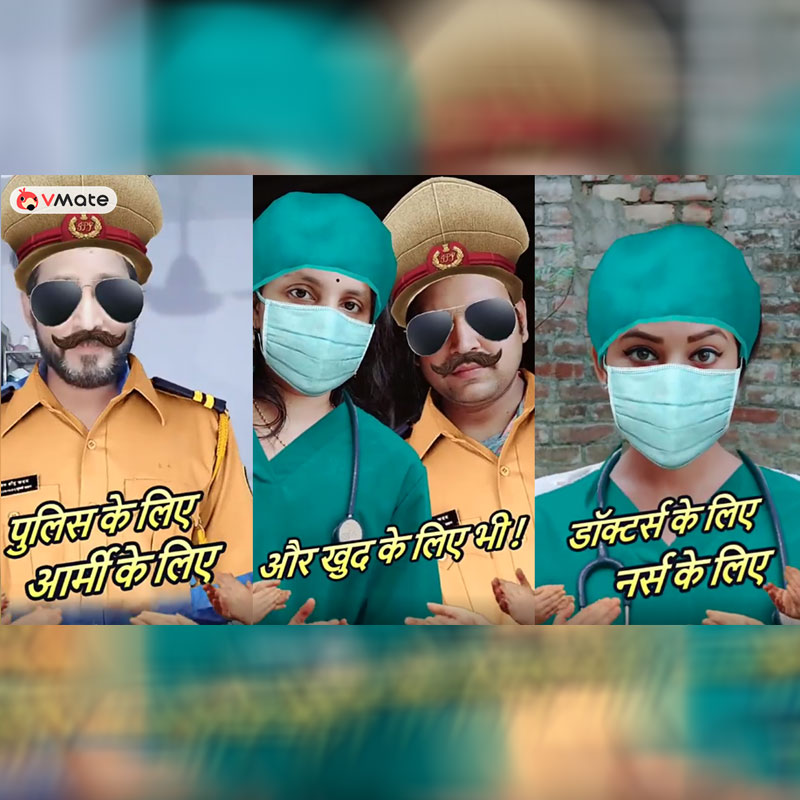
    MUMBAI: The Internet’s new-found sensation are people disguised as policemen and doctors to express their gratitude towards and pay respect to the frontline corona warriors. Several such videos have appeared across social media boards wherein users have extensively used a new virtual sticker, launched by trending short video app VMate – one of the most downloaded social media apps globally, in the honour of the corona warriors, who have put their lives at risk to ensure that people stay safe during the novel virus outbreak.

    When a user accesses the sticker, he appears dressed as a policeman, with uniform and sunglasses that have become synonymous with cops, and then as a doctor, with surgical robe, mask and stethoscope. Also part of the sticker is some hands that appear at the bottom of the screen and clap in the honour of the frontline warriors.

    Link – https://www.facebook.com/603006289860852/videos/258225705558653/

    The text appearing along with the sticker urges all to clap so that the policemen, armymen, doctors and nurses can be felicitated. It further makes a reference to the users themselves, suggesting that even those who are adhering to the lockdown norms are helping in the ongoing fight against the novel virus. The voiceover in the backdrop of the sticker says, “Bharat aur Bharat-vasiyon ki rakshha karna hamara param kartavya hai. Har Bharatiya swasthya rahe yeh hamari zimmedari hai. Hum hamesha aapke saath hain (It is our prime duty to safeguard India as well as all Indians. It is our responsibility that all Indians remain healthy. We are always with you)”.

    This comes even as several doctors and policemen have converged to VMate in the wake of the lockdown to raise awareness and dispel misinformation concerning Covid-19. Besides, some of the reputed media groups, such as Punjab Kesari and Dainik Jagran, too joined VMate in bolstering the front against the novel virus. Recently, Indian government’s citizen engagement platform MyGovIndia also launched a profile on VMate to provide real-time official information to people and promote Aarogya Setu, a mobile application developed by the government to connect essential health services with the people of India. The 64th edition of Prime Minister Narendra Modi’s radio show ‘Mann Ki Baat’ was also streamed live through the profile.

  • Delhipedia helps events & brands reach Netizens

    Delhipedia helps events & brands reach Netizens

    MUMBAI: While leveraging influencers is a common practice abroad, India is still experimenting the various ways in which an audience can be tapped using influencer marketing. This is where we would like to bring your attention to Delhipedia!

    This community engagement platform is an influencer for all brands which aim to reach out to Delhi’s audience. With an envious following of 600,000, Delhipedia has emerged as a key marketing partner for eight organisations in just two months. Delhipedia has positioned itself as one of the most appropriate platforms for brands to partner in order to drive their marketing and sales. Brands like Le Eco have launched key social media campaigns through Delhipedia, and travelled on the strength of its followers.

    Delhipedia, the leading community engagement platform emerged as a key marketing partner for eight organisations in just two months. The online platform has already partnered with clients like LeEco for its campaign Festive Mirfie, the Green Wheels Bike Festival, Krackerjacker Karnival Delhi, Hindol Sengupta, author of The Modern Monk and Jeffrey Archer, author of the book ‘This was a Man’, to name a few. Delhipedia has successfully been able to promote these brands with key digital tools like online video stories, social media contests and announcements. With an envious following on social media platforms like Facebook, Delhipedia has positioned itself as one of the most appropriate platform for brands to partner in order to drive brand engagement and sales.

    Elaborating on the successful partnership with Delhipedia, Le Eco marketing communications director Meera Krishnan said, “We were looking to drive a campaign activation encompassing social, offline activations and print for Mirfie – our unique version of a selfie contest. Delhipedia team worked proactively and ensured the deliverables and ROI far exceeded our expectations. The campaign was a huge success, and we experienced significant engagement among audiences, with a good number of entries for the contest and positive impact on brand image.”

    Similar was the experience of Great Indian Literature and Film Festival (GIFLIF) co-founder Karan Kukreja, “For the promotion of GIFLIF, we were looking for a partner through which we could reach out to the Delhi’s movie lovers and literati. By partnering with Delhipedia, we were able to reach out to its nearly six lakh followers, which generated interest among many film and literature lovers, and led to a great response for the festival.”

    “Delhipedia’s use of video content to draw audiences helped us build and grow community of followers, both during and post the event”, he added.

    Delhipedia founder Arjun Pandey says, “We have seen tremendous demand for leveraging the close to six lakh strong Delhipedia community, consisting of Delhi’s internet elite.” Pandey added, “According to a recent data released by Oxford Economics, Delhi has India’s highest per capita income in India, pegged at Rs 2,80,000. This is about three times above the national average, and community engagement sites like Delhipedia offer a one-of-its kind interactive platform to reach out to the internet and e-commerce elites amongst them.

  • Post Ola Micro and Amazon.in, industry opinions on social media backlash

    Post Ola Micro and Amazon.in, industry opinions on social media backlash

    MUMBAI:  The digital marketing era warrants brands, advertisers and creatives churn out advertisements that go viral. But they better toe the line very carefully in the process. The recently released campaign by Ola for its new super cheap Ola Micro service certainly had people talking online – but they weren’t talking about the things the company wanted to hear. Netizens by the thousands took to Twitter and Facebook to express how disgruntled they were with the TV spot which they found ‘sexist’. So much so, that the company had to take off the spot from TV.  A similar situation occurred in Kerala where a public hoarding by eCommerce giant Amazon.in spurred an angry agitation on the social networks.

    While it isn’t the first time that people have expressed their displeasure over an ad film, seldom has public reaction gotten such a quick and effective response from the brands. The question these incidents raise is how are brands, creative agencies and planners to handle this new breed of trigger happy consumers who are armed with social media?
    People have always discussed campaigns that leave a mark on them, while there were some that were praised, there were also a few that were criticised. With social media coming into the picture, the issue isn’t that people are expressing their view; more often these views are a knee jerk reaction rather than a well-considered opinion. “Everything has become like an instant poll if you ask me. An individual having an opinion over something can immediately share that, and several others with a similar voice can add to that. People have suddenly discovered that their voice too has power and they want to put it out in the public domain as much as they can. Sometimes it can be justified, but sometimes it is not,” opined Ogilvy and Mather creative director Sumanto Chattopadhyay. He however stressed the fact that brand communications have to be sensitive to consumers, “At the end of the day advertising exists to appeal a broad spectrum of people. So one has to take cognizance of that, especially now that people’s opinion is a part of the public domain almost instantaneously,” he expressed.

    When asked, as a creative what his reaction would be if one of his own works was pulled down, Chattopadhyay quipped. “As a creative person when I do a piece of work I obviously believe in it, I stand by it. There is no negative intent in it. But I have to also keep in mind that as an agency, we work for a brand, so sometimes we have to respect public opinion and go with the call the brand is taking so that the brand doesn’t suffer.”

    J. Walter Thompson Delhi managing partner and head Sanjeev Bhargava also advised creatives and agencies to tread carefully when it came to public opinion. “We are becoming a reasonably trigger happy nation when it comes to protesting now that we have the tools in our hand.  It started off with a political thing but now it’s transcending into the corporate world as well. At the same time, brands are getting increasingly sensitive about the chatter online as they have the measuring tools that gauge the impact of such negative comments online”.  

    While Bhargava suggested that brands, advertisers and agencies be extra careful so as not to ruffle any feathers he admitted that this would affect the creative process to a certain extent. “It is hard to be politically correct and have the freedom of expression in creating something. There is a fine line between meaning well based on consumer insights etc., and at the same time hurt sentiments. For example in the case of Amazon’s #WeIndians campaign, things might not have triggered this way had Amazon not been a foreign company. So it’s hard to say what will offend someone or not. In this increasingly wired world, industry needs to be careful till this frenzy wears off.”

    Bhargava cited an example of an old Naukri.com advertisement to add perspective, “Years back when Naukri’s Hari Sadu campaign came out, someone with the same name had filed a defamation case against the brand in court, saying his employees thought him to be a bad boss because of the ad. He lost the case. But in today’s day and age, that same person could make it go viral, as virality does not follow predictable metrics. He wouldn’t have needed a court of law.”

    Since public backlash is easy to create in today’s day and age, how does an industry body, tasked to self-regulate and monitor such offensive ads, react to such the public opinion? ASCI’s secretary general Shweta Purandare said, “I agree that social media is a very powerful tool. In fact, ASCI has consistently paid heed to it and followed the chatter by being active on social networks. If there is a negative chatter about brands or a particular campaign, many times, unaware that ASCI exists, they vent their feelings on social media. One is if an advertiser listens to that and takes action on its own, and another is that we guide such consumers to register a complaint and then take it up as per ASCI’s policies”.

    But there are also situations when a simple opinion may blow out of proportion and affect the brand. “Without taking any brand’s name, I would mention that there was a case when a brand came under fire on the social media, but when the complaint was taken up in ASCI, it was found that the advertisement was not against the ASCI code. Apart from taking voluntary calls to pull down ads, which the brands are free to do, if brands want a fair hearing of their argument they can approach ASCI for a proper analysis,” Purandare asserted.

    Whether it is right to target a brand over a cause or not, the fact remains that social media metrics matter to brands, and playing with public opinion is like playing with fire for them. And sometimes that means to bow down to public opinion and take off the ad at the cost of brand value.

    Not to mention the fact that creatives are also taking risks with edgier brand communication to draw more eyeballs to themselves.  “We are seeing a positive move from a mundane to more strategic insightful work in the creative industry.  In process they work around the delicate edge of safe versus edgy communication. Sometimes with such creative push things do go haywire. But these few instances must not hinder the positive moment in creativity.  So, brands have to do what was expected – self-censor and self-discipline.  It is their responsibility that the ad does not discriminate or offend any sensitivities,” explained Intradia world, brand and marketing advisor, Sanjeev Kotnala.

    “Brands always have two choices. If they feel they have really gone beyond the edge, they must withdraw. And they must do that gracefully with due apologies. If this is the strategic action, then it must be swift. The other option is they can stand by their communication and let the social media movement fizzle out,” he added.

    Kotnala also advised that while finding a fine balance between edgy and offensive content maybe like walking on a tightrope. Brands and creatives can be on the safer side if they do a concept research to determine if the ad is offending.  “Surprisingly and unfortunately many forget to do so. It may then be possible to shoot or create an alternative flow which can be integrated as a part of the campaign to kill a reaction without compromising on communication.”

    After all, brand value is created over time but it can be destroyed very fast. It can be protected with a swift response rather than silence, advises Kotnala in parting.

  • Post Ola Micro and Amazon.in, industry opinions on social media backlash

    Post Ola Micro and Amazon.in, industry opinions on social media backlash

    MUMBAI:  The digital marketing era warrants brands, advertisers and creatives churn out advertisements that go viral. But they better toe the line very carefully in the process. The recently released campaign by Ola for its new super cheap Ola Micro service certainly had people talking online – but they weren’t talking about the things the company wanted to hear. Netizens by the thousands took to Twitter and Facebook to express how disgruntled they were with the TV spot which they found ‘sexist’. So much so, that the company had to take off the spot from TV.  A similar situation occurred in Kerala where a public hoarding by eCommerce giant Amazon.in spurred an angry agitation on the social networks.

    While it isn’t the first time that people have expressed their displeasure over an ad film, seldom has public reaction gotten such a quick and effective response from the brands. The question these incidents raise is how are brands, creative agencies and planners to handle this new breed of trigger happy consumers who are armed with social media?
    People have always discussed campaigns that leave a mark on them, while there were some that were praised, there were also a few that were criticised. With social media coming into the picture, the issue isn’t that people are expressing their view; more often these views are a knee jerk reaction rather than a well-considered opinion. “Everything has become like an instant poll if you ask me. An individual having an opinion over something can immediately share that, and several others with a similar voice can add to that. People have suddenly discovered that their voice too has power and they want to put it out in the public domain as much as they can. Sometimes it can be justified, but sometimes it is not,” opined Ogilvy and Mather creative director Sumanto Chattopadhyay. He however stressed the fact that brand communications have to be sensitive to consumers, “At the end of the day advertising exists to appeal a broad spectrum of people. So one has to take cognizance of that, especially now that people’s opinion is a part of the public domain almost instantaneously,” he expressed.

    When asked, as a creative what his reaction would be if one of his own works was pulled down, Chattopadhyay quipped. “As a creative person when I do a piece of work I obviously believe in it, I stand by it. There is no negative intent in it. But I have to also keep in mind that as an agency, we work for a brand, so sometimes we have to respect public opinion and go with the call the brand is taking so that the brand doesn’t suffer.”

    J. Walter Thompson Delhi managing partner and head Sanjeev Bhargava also advised creatives and agencies to tread carefully when it came to public opinion. “We are becoming a reasonably trigger happy nation when it comes to protesting now that we have the tools in our hand.  It started off with a political thing but now it’s transcending into the corporate world as well. At the same time, brands are getting increasingly sensitive about the chatter online as they have the measuring tools that gauge the impact of such negative comments online”.  

    While Bhargava suggested that brands, advertisers and agencies be extra careful so as not to ruffle any feathers he admitted that this would affect the creative process to a certain extent. “It is hard to be politically correct and have the freedom of expression in creating something. There is a fine line between meaning well based on consumer insights etc., and at the same time hurt sentiments. For example in the case of Amazon’s #WeIndians campaign, things might not have triggered this way had Amazon not been a foreign company. So it’s hard to say what will offend someone or not. In this increasingly wired world, industry needs to be careful till this frenzy wears off.”

    Bhargava cited an example of an old Naukri.com advertisement to add perspective, “Years back when Naukri’s Hari Sadu campaign came out, someone with the same name had filed a defamation case against the brand in court, saying his employees thought him to be a bad boss because of the ad. He lost the case. But in today’s day and age, that same person could make it go viral, as virality does not follow predictable metrics. He wouldn’t have needed a court of law.”

    Since public backlash is easy to create in today’s day and age, how does an industry body, tasked to self-regulate and monitor such offensive ads, react to such the public opinion? ASCI’s secretary general Shweta Purandare said, “I agree that social media is a very powerful tool. In fact, ASCI has consistently paid heed to it and followed the chatter by being active on social networks. If there is a negative chatter about brands or a particular campaign, many times, unaware that ASCI exists, they vent their feelings on social media. One is if an advertiser listens to that and takes action on its own, and another is that we guide such consumers to register a complaint and then take it up as per ASCI’s policies”.

    But there are also situations when a simple opinion may blow out of proportion and affect the brand. “Without taking any brand’s name, I would mention that there was a case when a brand came under fire on the social media, but when the complaint was taken up in ASCI, it was found that the advertisement was not against the ASCI code. Apart from taking voluntary calls to pull down ads, which the brands are free to do, if brands want a fair hearing of their argument they can approach ASCI for a proper analysis,” Purandare asserted.

    Whether it is right to target a brand over a cause or not, the fact remains that social media metrics matter to brands, and playing with public opinion is like playing with fire for them. And sometimes that means to bow down to public opinion and take off the ad at the cost of brand value.

    Not to mention the fact that creatives are also taking risks with edgier brand communication to draw more eyeballs to themselves.  “We are seeing a positive move from a mundane to more strategic insightful work in the creative industry.  In process they work around the delicate edge of safe versus edgy communication. Sometimes with such creative push things do go haywire. But these few instances must not hinder the positive moment in creativity.  So, brands have to do what was expected – self-censor and self-discipline.  It is their responsibility that the ad does not discriminate or offend any sensitivities,” explained Intradia world, brand and marketing advisor, Sanjeev Kotnala.

    “Brands always have two choices. If they feel they have really gone beyond the edge, they must withdraw. And they must do that gracefully with due apologies. If this is the strategic action, then it must be swift. The other option is they can stand by their communication and let the social media movement fizzle out,” he added.

    Kotnala also advised that while finding a fine balance between edgy and offensive content maybe like walking on a tightrope. Brands and creatives can be on the safer side if they do a concept research to determine if the ad is offending.  “Surprisingly and unfortunately many forget to do so. It may then be possible to shoot or create an alternative flow which can be integrated as a part of the campaign to kill a reaction without compromising on communication.”

    After all, brand value is created over time but it can be destroyed very fast. It can be protected with a swift response rather than silence, advises Kotnala in parting.

  • Dentsu Creative Impact creates digital campaign for Hitachi

    Dentsu Creative Impact creates digital campaign for Hitachi

    MUMBAI: In a category that strives on differentiation and innovative features to draw eyeballs, brands need to constantly bring refreshed news. For Hitachi, the clear task was not only to get this critical attention but also establish clear leadership in the minds of the affluent, young  digital savvy ‘netizens’.

    The opportunity identified was the revolutionary ‘I Clean’ feature that cleans the filter of the air conditioner automatically. But the idea was not merely to tell a story of innovation and technology. Dentsu Creative Impact believed that the story needs to be re-told to the consumers who are already facing a barrage of features, choices and options every day.

    And the disruption came in the form of not only the product and the message, but also the medium. In a category, where traditional media rules the roost, Dentsu Creative Impact and Hitachi took an unconventional approach. And the idea Hitachi #NothingDirty with Badshah was born. Just as the ‘I-Clean’ feature automatically cleans up the dirt, the ruling sensation of India also cleans up the lyrics for the ultimate summer party anthem.

    The attempt is a powerful integration of the brand within the content. Delivering the message of ‘automatic cleaning’ by the king of rap Badshah himself, the song is cool, fun and upbeat.

    Watch how India’s coolest rapper turn something dirty into the coolest and cleanest song of the summer, just like how Hitachi’s iClean Plus technology cleans the AC’s filter automatically.


  • Dentsu Creative Impact creates digital campaign for Hitachi

    Dentsu Creative Impact creates digital campaign for Hitachi

    MUMBAI: In a category that strives on differentiation and innovative features to draw eyeballs, brands need to constantly bring refreshed news. For Hitachi, the clear task was not only to get this critical attention but also establish clear leadership in the minds of the affluent, young  digital savvy ‘netizens’.

    The opportunity identified was the revolutionary ‘I Clean’ feature that cleans the filter of the air conditioner automatically. But the idea was not merely to tell a story of innovation and technology. Dentsu Creative Impact believed that the story needs to be re-told to the consumers who are already facing a barrage of features, choices and options every day.

    And the disruption came in the form of not only the product and the message, but also the medium. In a category, where traditional media rules the roost, Dentsu Creative Impact and Hitachi took an unconventional approach. And the idea Hitachi #NothingDirty with Badshah was born. Just as the ‘I-Clean’ feature automatically cleans up the dirt, the ruling sensation of India also cleans up the lyrics for the ultimate summer party anthem.

    The attempt is a powerful integration of the brand within the content. Delivering the message of ‘automatic cleaning’ by the king of rap Badshah himself, the song is cool, fun and upbeat.

    Watch how India’s coolest rapper turn something dirty into the coolest and cleanest song of the summer, just like how Hitachi’s iClean Plus technology cleans the AC’s filter automatically.


  • Tata Motors invites netizens to name its new hatchback

    Tata Motors invites netizens to name its new hatchback

    MUMBAI: A couple of months after announcing its next new product and rolling out extensive marketing campaigns, it is indeed a risk to rebrand the product itself right before the launch — a risk Tata Motors is willing to take. Yes, India’s largest automaker Tata Motors has decided to do away with the name Zica for their soon to launch new hatchback. The reason being to empathise with the victims of the ZiKa virus, which has an identical sounding name.

    “We are making a conscious effort towards being the most customer-centric company. This translates not only into products but everything that we do in the market, be it services or marketing the products. Yes, we have decided to re-brand the car as that is the right thing to do,” shared a Tata Motors spokesperson.

    What is even more interesting is that the automaker has opened doors for their consumers to suggest a new name for their hatchback.

    “While we have showcased this car but not launched, so we decided to offer our customers to also participate in this endeavour and suggest a new name for this cool hatchback. We announced the #Fantastico Name Hunt a global crowd sourcing contest,” added the spokesperson.

    The contest is based on social media and mobile platforms where the marketers are engaging with the users and influencers to spread the word. To execute the this massive online campaign the automaker has roped in Maxus and LBi Digital.

    Aimed at the netizens, this new initiative by Tata Motors has received an overwhelming reception and serves as a very effective marketing campaign that prompts active participation from the consumers. After all, who wouldn’t want to see their chosen name on a brand new Tata Motor car? Which brings us to the criteria for choosing the name from the crowd sourced ones.

    “Through this contest, #Fantastico Name Hunt, we were looking for suggestions from our fans and audiences around the world to share what they think should be the name of the car. The company will further shortlist these entries for viewers to vote for their favourite name. One of the lucky contestant whose selection matches the final name, stands a chance to win the car (if within India) or win a reward of equal value, if located outside India,” a Tata Motor executive explains.

    In short, the contest will pan out in two steps — first that provides an incentive for the netizens to take part and the later naturally draws in those whose suggested names are in contest.

    With the initial marketing efforts for Zica already in place, re-branding the car can be a difficult move. Tata Motors thinks otherwise. “What will also work for us is that the car is not yet launched and we have time to make changes to our plan and come up with new creative ideas to sustain the buzz for the car. We are determined to place it in the market addressing all relevant needs of the target audience,” shares the spokesperson.

  • Tata Motors invites netizens to name its new hatchback

    Tata Motors invites netizens to name its new hatchback

    MUMBAI: A couple of months after announcing its next new product and rolling out extensive marketing campaigns, it is indeed a risk to rebrand the product itself right before the launch — a risk Tata Motors is willing to take. Yes, India’s largest automaker Tata Motors has decided to do away with the name Zica for their soon to launch new hatchback. The reason being to empathise with the victims of the ZiKa virus, which has an identical sounding name.

    “We are making a conscious effort towards being the most customer-centric company. This translates not only into products but everything that we do in the market, be it services or marketing the products. Yes, we have decided to re-brand the car as that is the right thing to do,” shared a Tata Motors spokesperson.

    What is even more interesting is that the automaker has opened doors for their consumers to suggest a new name for their hatchback.

    “While we have showcased this car but not launched, so we decided to offer our customers to also participate in this endeavour and suggest a new name for this cool hatchback. We announced the #Fantastico Name Hunt a global crowd sourcing contest,” added the spokesperson.

    The contest is based on social media and mobile platforms where the marketers are engaging with the users and influencers to spread the word. To execute the this massive online campaign the automaker has roped in Maxus and LBi Digital.

    Aimed at the netizens, this new initiative by Tata Motors has received an overwhelming reception and serves as a very effective marketing campaign that prompts active participation from the consumers. After all, who wouldn’t want to see their chosen name on a brand new Tata Motor car? Which brings us to the criteria for choosing the name from the crowd sourced ones.

    “Through this contest, #Fantastico Name Hunt, we were looking for suggestions from our fans and audiences around the world to share what they think should be the name of the car. The company will further shortlist these entries for viewers to vote for their favourite name. One of the lucky contestant whose selection matches the final name, stands a chance to win the car (if within India) or win a reward of equal value, if located outside India,” a Tata Motor executive explains.

    In short, the contest will pan out in two steps — first that provides an incentive for the netizens to take part and the later naturally draws in those whose suggested names are in contest.

    With the initial marketing efforts for Zica already in place, re-branding the car can be a difficult move. Tata Motors thinks otherwise. “What will also work for us is that the car is not yet launched and we have time to make changes to our plan and come up with new creative ideas to sustain the buzz for the car. We are determined to place it in the market addressing all relevant needs of the target audience,” shares the spokesperson.

  • Skip Maurice

    Skip Maurice

    MUMBAI: Recording a holiday message for his employees is a tradition for Publicis Groupe CEO Maurice Lévy. And complying with the tradition, that’s just what he did this year too… ’cept this year’s holiday greeting video from Lévy found a wider audience amongst netizens, with its witty take on skippable advertisement.

    To the television audience, advertisement breaks are an excuse to flip through channels and look for a different entertaining program. When Video On Demand (VOD) platforms gained traction amongst digital audience, the ‘Skip Ad’ feature soon became a popular one, with YouTube taking the lead.

    Being an advertising agency itself, it is ironic how the company’s CEO took to ‘Skippable Ads’ to deliver his message to employees. The idea was to bank on everyone’s habit of skipping ads to go to the content and do exactly the opposite! Confused? Don’t be… Read on…

    “Times are too tough to play around so don’t expect anything funny or any technological tricks. I’ve long suspected that only a handful of you are actually paying attention to what I have to say. Although it’s often tempting to skip the ads and get to the content, this time you should be glad to skip me and watch some ads,” says a poker faced Lévy in a YouTube video.

    However, 28 seconds into the video the humour quotient is just about to hit the roof as instead of the traditional ‘Skip Ad’ button that one is used to seeing on the video screen, there’s a… wait for it… ‘Skip Maurice’ button! However, this is “just a ploy” as Lévy continues his speech while crashing each ad spot and it must be said that for a septuagenarian, he totally rocks and how!

    Should you choose not to skip Maurice, he’ll continue his address from behind his desk. But if you’re the inquisitive kind (like us) then you would’ve definitely ‘skipped Maurice.’

    And therein lies all the fun! Watch him play cameo, especially in a shampoo advertisement, which adds to the comic relief of the entire concept. From spoon feeding yoghurt to a woman, washing his shirt, starring in a shampoo commercial a la L’Oreal (touché), cleaning his teeth in a toothpaste ad to appearing inside a sink for a liquid cleanser ad, Lévy enthrals the audience while also highlighting the company’s plans to enhance the power of one in the coming year. 

    In this 2:55 minute video titled ‘The Skippable Wishes,’ Lévy takes us through the agency’s benchmarks in 2015, through a series of advertisement, which he spontaneously crashes in. 

    “2015 has been a kind of bumpy ride. It’s been kind of tough for us. Nevertheless, we’ve fared pretty well in some of our operations and the most difficult part is behind us. More importantly, we have set ourselves up for a promising future,” he starts, as he talks about the company’s expectation from their Sapient acquisition, the “media palooza of which we have won more than we have lost,” the Cannes Lions wins and the highlights of the agency’s San Francisco seminar.

    It must be added here that Publicis recently lost Procter & Gamble’s media planning and buying account in North America to Omnicom as well as the L’Oréal media account in North America to WPP. Hence, for Lévy to say that 2015 has been a “bumpy ride,” would be nothing but an understatement.

    But these losses aside, Lévy goes on to say that 2016 will be a great year and that the agency has all the ingredients for it. “We will leverage the power of one across the group and our teams are excited about it. 2016 will the year of no silo, no solo, no bozo,” he says emphasising that there will be more transparency within the different departments and implementation of united effort within the company.

    “All the group’s leadership is in line and is already putting this into action. We have seen the fruit of this approach through the outstanding creative achievements and campaigns. I’m counting on you. I can’t wait to fast forward to 2016 to show our clients the potential of the transformed Publicis Group and the power of one,” he says.

    As was reported earlier by Indiantelevision.com, Publicis recently undertook a major client-centric restructuring for 2016, wherein the agency will be breaking down its disciplines into four distinct ‘solution hubs’ with each client that will be led by a chief client officer. And that’s exactly what Lévy speaks about here.

    He concludes the video by dedicating his wishes to the victims of Paris terrorist attacks on 13 November.

    At the time of filing this report, the video on Publicis’ website was almost nearing 50,000 hits. If innovation and disruption is the name of the game, then this latest salvo from the agency’s CEO himself wins it hands down.

    PS: There’s a strategically placed coffee mug on his desk, which says, “Yes I am the BOSS!”

    Well, Mr Lévy, after watching this video, we have absolutely no doubts about that!

  • Senior netizens well adapted to Internet: IAMAI study

    Senior netizens well adapted to Internet: IAMAI study

    BANGALORE: As more successful senior citizens in India enjoy living life to the fullest, they have also adopted and adapted to the Internet space. A new report from the Internet & Mobile Association of India (IAMAI) takes a comprehensive look at what senior netizens do online, irrespective of whether retired, salaried or entrepreneurs.

    Senior netizens above the age group of 61 years were targeted for this research. It was observed that the senior citizens were a fast growing group of online users. With India’s Internet population poised to reach 100 million by 2007-08 from the current 38.5 million, the absolute numbers of senior netizens are expected to rise to 3 million by 2007-08. The percentage penetration is expected to remain the same or increase marginally from the current 2.7 per cent to 3 per cent.

    This dipstick research was conducted by the IAMAI in collaboration with Crosstab Marketing Services that surveyed 101 respondents in December 2005. The research was undertaken with a view to understand usage of Internet by senior netizens with a primary focus on understanding their activities online giving marketers a better perspective while designing their marketing and promotional programs to cater to a defined online target audience.

    Commenting on this interesting finding, IAMAI president Preeti Desai said, “It is encouraging to see senior netizens as enthusiastic as youngsters in a variety of activities that define online life and show an online maturity in transacting online that surpasses the general population. Senior netizens will cross the three million mark by 2007-08. The report showcases that 15 per cent of senior netizens access the Internet from cyber cafes with 81 per cent using the Internet for more than five hours a week.

    The findings of report highlight that 62 per cent use the Internet for looking up news online and 2 per cent read news on their mobile, a changing paradigm since it is this demographic that is the backbone of the newspaper and magazine readership. When it comes to matters of confidence of transacting on the Internet, senior netizens are well ahead of the general population with 26 per cent of senior netizens having looked up stock quotes and do stock trading as compared to 15 per cent of all Internet users with 38 per cent using the internet for online banking services and 21 per cent for online shopping.”

    Executive Summary

    Gender of senior netizens: 87 per cent of senior netizens are male and 13 per cent of senior netizens are female. With India’s Internet population poised to reach 100 million by 2007-08, the online senior netizen currently at 2.7 per cent is expected to rise marginally to 3 per cent by 2007-08.

    Marital status of senior netizens: 91 per cent of senior netizens are married with kids and 8 per cent are married without kids.

    Regional Representation:

    The top nine cities make up for more than 77 per cent of senior netizens audience. The top five cities include – 23 per cent of senior netizens access the Internet from Delhi+, 22 per cent from Mumbai, 12 per cent from Chennai, four per cent from Hyderabad and Kolkatta. three per cent from Bangalore, Lucknow and Cochin; two per cent from Ahmedabad and Jaipur.

    The top five states include 24 per cent of senior netizens access the Internet from Delhi, 23 per cent access from Maharashtra, 17 per cent are from Tamil Nadu, 10 per cent from Karnataka; and six per cent from Andhra Pradesh. Four per cent from Kerala; four per cent from West Bengal; three per cent from Uttar Pradesh; two per cent from Gujarat and Rajasthan.

    Educational qualifications of senior netizens

    Four per cent of senior netizens have an education up to SSC/HSC, 10 per cent have some college (Including. Diploma) but not a graduate, 37 per cent have a graduate / post-graduate general (BA, BSC. MSC, B.com etc.) and 35 per cent have a graduate /post graduate professional degree.

    Occupation of senior netizens

    Two per cent of senior netizens are mid level executives and nine per cent of senior netizens are senior executives while 16 per cent are self employed/professional, four per cent of senior netizens are businessman / industrialists, four per cent are housewives and 54 per cent of senior netizens are retired.

    Plastic ownership and usage

    80 per cent of senior netizens online own an ATM Card; 65 per cent own a credit card and debit card. 31 per cent of senior netizens use their credit cards online; 16 per cent of senior netizens use their debit cards online; nine per cent of senior netizens use both credit & debit cards online.

    Internet Access by Senior Netizens

    94 per cent of senior netizens access the Internet from home; 20 per cent of senior netizens access Internet from the office; 14 per cent of senior netizens access the Internet from cyber cafes.

    Internet Savvyness of Senior Netizens

    45 per cent of senior netizens have been using the Internet for more than six years; 44 per cent of senior netizens have been using the Internet for three to five years; seven per cent have been using the Internet since one – two years; one per cent of senior netizens have been using the Internet for six – eleven months; two per cent of senior netizens have been using the Internet for less than six months.

    Senior Netizens use the Internet for varied purposes – Online Activities:

    The top Internet activities among seniors who go online: 99 per cent of wired seniors have used email; 70 per cent surf for information online; 66 per cent use search engines; 62 per cent have read the news online; 47 per cent chat online; 38 per cent bank online; and 26 per cent have stock traded online.

    Email: 99 per cent of senior netizens use the Internet for emailing.

    Chatting: 47 per cent of senior netizens use the Internet for chatting.

    Surfing: 70 per cent of senior netizens use the Internet for surfing.

    Search: 66 per cent of senior netizens use search engines.

    Research: 23 per cent of senior netizens use the Internet to research.

    Senior Netizens didn’t grow up with the personal computer and are fervent readers of the printed word. They are the backbone of newspaper and magazine readership. It’s a remarkable achievement for both the interactive mediums to attract this demographic as stated by below mentioned statistics.

    News Online: 62 per cent of senior netizens look up news online.

    News on Mobile: 2 per cent of senior netizens read news on their mobile.

    Matrimonial Purposes: 17 per cent of senior netizens use the Internet for ‘Matrimonial Search”.

    Jobs: 20 per cent of senior netizens use the Internet to search for jobs.

    Astrology: 22 per cent of senior netizens use the Internet for astrological predictions

    Religious & Spiritual Information: 19 per cent use the Internet for spiritual information.

    Financial Transactions Online:

    Online Auctions: 12 per cent of senior netizens use the Internet to participate in online auctions

    Online Stock Trading: When it comes to finances, wired seniors are much ahead of the general Internet population’s enthusiasm for trades online. 26 per cent of seniors have looked up stock quotes and do stock trading as compared to 15 per cent of all Internet users.

    Online Bill Payments: 21 per cent of senior netizens use the Internet for online bill payments

    Online Banking: While seniors appear comfortable managing online portfolios, they are more comfortable dealing with their bank accounts in cyberspace as 38 per cent use online banking services.

    Online Shopping: 21 per cent of senior netizens use the Internet for online shopping

    Donating or Charity Online: 5 per cent of senior netizens donate online.