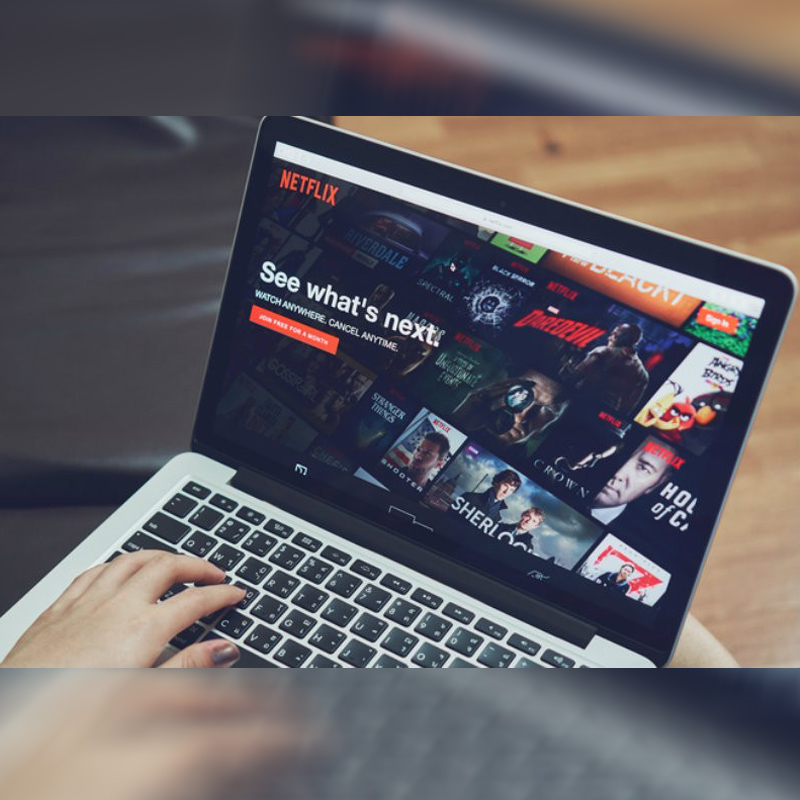
Tag: Netflix

  • ACT Fibernet partners with Netflix

    ACT Fibernet partners with Netflix

    MUMBAI: Broadband service provider ACT Fibernet has entered into a partnership with streaming giant Netflix. Under the partnership, "Entertainment" plan users of ACT Fibernet would be able to pay for their monthly Netflix subscription through their ACT Fibernet bill with an assured cashback of up to Rs 350 per month. The offer will be available for ACT Fibernet customers Delhi, Chennai, Bengaluru and Hyderabad in the beginning.

    "In line with our brand philosophy  ‘Feel the Advantage’, we are excited to partner with Netflix, one of the most preferred choice of entertainment for our customers, and provide exceptional benefits and convenience to our users who will now be able to stream and enjoy the best of 4K and HD content seamlessly. Further, under our advantage entertainment promise, we are delighted to launch a unique assured cashback program for all our customers who choose to subscribe for Netflix via  ACT,” Atria Convergence Technologies Ltd marketing head Ravi Karthik commented.

    In Bengaluru, the ACT Entertainment variants are available on ACT Storm, ACT Lightning, ACT Incredible and ACT GIGA broadband plans. Likewise, in Hyderabad, ACT Entertainment variants are available on A Max-1050, A Max-1299, ACT Incredible and ACT GIGA. In Chennai, the ACT Entertainment variants are available on ACT Blast Promo, ACT Storm, ACT Lightning, ACT Thunder, ACT Incredible and ACT GIGA. Similarly, in Delhi, the ACT Entertainment variants are available on ACT Platinum Promo, and ACT Diamond broadband plans.

    The offer would be effective from 7 March and later will be expanded to other markets. Earlier, ACT Fibernet also entered partnership with another OTT platform SonyLIV to strengthen entertainment content offering.

    “Rising video consumption is at the heart of the growing broadband internet ecosystem in India. We are delighted to partner with ACT Fibernet to enable their customers to pay seamlessly for their Netflix subscription as part of their ACT bill and enjoy our incredible catalogue of content on any internet-connected screen,” Netflix India business development director Abhishek Nag commented.

  • SVoD subscribers to touch 743 mn globally by 2023

    SVoD subscribers to touch 743 mn globally by 2023

    MUMBAI: Subscription based video on demand (SVoD) is rising persistently and will draw a level with broadcast TV globally by 2023 in terms of viewing hours per day. According to a report from Rethink TV research, SVoD will surpass traditional TV viewing soon after.

    The report forecasts SVoD usage in all the regions as well as highlights the differences between AVoD dominated Asian market and SVoD-crazy US and European market. The research sees 478 million SVoD subscribers today growing to 743 million by 2023.

    China will have the most SVoD subscribers by 2023 although North America will still drive the largest dollar volume. The report also forecasts the US market reaching 236.6 million subscriptions by the end of 2023, from a base today of some 146.5 million.

    “Europe and Asia will be neck and neck in SVoD revenues by 2023, but with far fewer subscribers in Europe, each paying significantly more than those in Asia, a region dominated by frighteningly large Advertising VoD streaming numbers,” it said.

    Outside China, Netflix will continue to lead in SVoD in subscribers numbers. The streaming giant will make up 194 million SVoD customers out of 743 million globally by 2023, some 26 per cent of overall global subscribers.

    The report has also predicted that WarnerMedia, under its new AT&T defined, freemium strategy will emerge as the new leader in the US Market. It is predicted to reach 29.6 million SVoD homes by 2023. Disney is also likely to have multiple SVoD service types, but may struggle outside the US.

    While the Asia Pacific market is highly skewed with China expected to gather 245 million SVoD subscribers, the average spend will be just $2 to $3 a month. Latin  American market will see competition among Netflix, America Movil’s Claro TV and Televisa’s Blim.

    “Europe will be a mishmash of different approaches with pure-play US operators like Netflix and Amazon now established, US studios beginning to stake a claim, and local broadcasters ganging up to challenge them. The region has its own pure play SVoD players also such as Maxdome, Sky, Zattoo, and Rakuten TV,” it stated.

  • Netflix releases official trailer for cricket fever: Mumbai Indians

    Netflix releases official trailer for cricket fever: Mumbai Indians

    MUMBAI: Cricket Fever: Mumbai Indians follows the Indian Premier League’s superstar team Mumbai Indians on the road through the course of the 2018 IPL season, as they sought to defend their 2017 IPL crown. The first look of the series highlights the tough backroom story of the then-defending champions and how they coped with the weight of expectations from all around, including from the passionate fans of the franchise from the Maximum City, Mumbai. This story of hard work, resilience and dedication will launch worldwide exclusively on Netflix on March 1, 2019.

    Yuvraj Singh the latest addition to the team and Rohit Sharma the team captain took to Twitter to talk about the docu-series. See conversation here.

    The docu-series showcases unseen action, both on and off the field, starting with the 2018 IPL auction, when the entire team was re-organised, and closes with the end of their IPL campaign. It charts the emotional arc of the team, including the intense pressure the team faces with the weight of Mumbai’s millions of citizens on their shoulders. The docu-series reveals highly personal and never-seen-before journeys of the young and talented team, led by captain Rohit Sharma, owners Nita and Akash Ambani and their coach Sri Lankan legend Mahela Jayawardene.

    The trailer showcases the ups and downs of the team during the tournament, captain Rohit Sharma reflecting upon the challenges of leading the team, owner Akash Ambani speaking out on not tolerating any leaks from within the confines of the war room and the God of cricket, Sachin Tendulkar delivering a pep talk to the team within the dressing room.

    The eight-part series will launch on Netflix worldwide on March 1, 2019.

  • Broadcasters split over rising production cost of GEC content

    Broadcasters split over rising production cost of GEC content

    MUMBAI: The rise in over the top (OTT) platforms has also led broadcasters and production houses to drive up the investment into its TV shows. The same companies are now even producing for both TV and digital.

    TV still has more headroom for growth, despite the OTT hype. India has 64 per cent TV home penetration and much room for growth. Data also shows that 86 per cent of Indian homes still watch TV on CRT sets and only 3 per cent are multi-TV homes. TV viewing in India has grown from 3 hr 14 min (2015) to 3 hr 36 min (2017) but it is still lower than the US, which boasts of an ATS of 3 hr 54 min. This gives a clear indication that there is immense scope for TV and it will further rise. According to FICCI 2018 report, TV viewership has grown by 21 per cent and it has grown across all age groups. On the other hand, even giants like Netflix and Amazon Prime Video are finding it tough to crack the OTT market here. The country’s online video market, valued at over $700 million, is expected to grow to $2.4 billion by 2023.

    According to Zee TV business head Aparna Bhosle, production cost will not increase. Whereas, Sony Sab, Pal business head Neeraj Vyas believes it will definitely increase. Viacom18 youth music and English entertainment head Ferzad Palia said that the cost of production will not be affected massively but will see a win-win situation for broadcasters, production houses and consumers.

    Viacom18 Hindi mass entertainment and kids TV network head Nina Elavia Jaipuria made her point by saying that a GEC needs fresh episodes every day, unlike OTT where the concept is of limited episodes and seasons with intervals. She added that there could be inflation and there could be little talent cost going up but there would not be that kind of inflation where the cost of production will go up.

    Vyas said, “Content house is constantly growing and this is the time where good, differentiated and innovative content is really needed, and that’s not going to be cheap." Whereas, Bhosle said, “The cost of production will not increase. It largely depends on the kind of story, where you set it and how much you want to spend on it. So you can make a story in Rs 40 lakh or you can also make a story in Rs 5 lakh. It all depends on the quality.” She differentiates that OTT viewing is individual in nature while TV here is more family-oriented. So even if shows are being watched on OTT, it does not mean that it’s eating away from television.

    Moreover, Palia said that there have been cases where the cost of production for digital is higher than what one would pay for television. He said that he has also heard about the instances where the bigger production houses had limited bandwidth and had chosen to do a digital show over a television show. According to him, it is a great opportunity for them because they can now monetise it across different screens and also for the production houses who could earlier make content for television to now broaden its base to mobile screens as well. “So I think it’s a win-win and I don’t think it will massively affect the cost of production. The consumers will also have a broader choice for the content that they want to watch and at a time and place where they want to watch,” he said.

    Indian broadcasters produce over 100,000 hours of content annually across languages and formats while newer players are investing higher amounts per episode and are tying up with leading talent. The increase in cost is expected to impact cost of film acquisition more than costs of episodic content. The overall cost of content rose by almost 2-3 per cent of their top line. With OTT companies refusing to take their foot off the pedal, broadcasters have no choice but to pay up. However, if their bid for quality programming fails to generate higher viewership which can be monetised better, broadcasters may not pursue quality, and stick to current cost metrics, according to a report. 

    Jaipuria said that TV needs to be supplied with 10 episodes a day and to meet such demands, the supply has to be at an affordable rate. While there is always inflation, I’m not sure there is going to be so much inflation in the cost of content per se when the demand is so high. "There has to be a demand and supply which will always even out. Even if there is an increase in cost, we are hoping that in the long term, we better our subscription revenue with the tariff order and that means we will invest more in content," she added. 

    Production houses have a similar story to tell. For Peninsula Pictures, led by Nissar Parvej and Alind Srivastava, the cost of production will not observe a hike. On the contrary, Swastik Productions writer, director, and producer Siddharth Kumar Tewary felt the opposite.

    Parvej said that the money is definitely more in the OTT space, but that doesn't make TV insecure.  “TV will be TV. I feel it will go down because I think the advertising money that they used to get before is not the same. The kind of cost we used to get five years is not seen anymore, it has come down and that is why the competition has become stiff. Reliance etc. are pumping in money but how much of it works, we will have to wait and see. There might be a cut-down or might take 4-5 years for OTT to settle,” he said.

    Srivastava chipped in and said, “I don’t think cost of production will go up. It also depends on the storylines like mythological shows can be made in Rs 10-50 lakh per episode.” Since consumers are exposed to global content now, local players, as per Tewary, will have to work on the content quality.

    Twisting it around, Carat India SVP Mayank Bhatnagar gave a different perspective to the mushrooming trend. He said that in 2019, the production quality has to be good but it will all depend on marketing. “People will only watch this content if there is enough awareness. Here, marketing spends will play a major role. If you look at the overall cost, it includes all the marketing expenses plus the production expenses then definitely the cost of production will go up because the kind of clutter that is there in the market, one needs to invest money behind promotion otherwise nobody will notice it,” he concluded.

    According to the KPMG FICCI report 2017, on an average, 20–30 minutes of fictional digital content can cost anywhere between Rs 12–15 lakh, which is higher than content costs on television. Despite significant beliefs from the broadcasters, production houses and media planners, OTT content is equally or more expensive than producing TV shows.

  • Delhi HC dismisses PIL on OTT content regulation

    Delhi HC dismisses PIL on OTT content regulation

    MUMBAI: The Delhi High Court has dismissed a plea that sought for framing of guidelines for the working of OTT platforms like Netflix, Amazon Prime Video and Hotstar, according to a Press Trust of India report.

    The Ministry of Information and Broadcasting told the bench that online platforms do not need a licence to operate after which the petition was rejected.

    According to a PTI report, the petitioner NGO Justice for Rights Foundation claimed that the platforms show "uncertified, sexually explicit and vulgar" content that aren't for for public viewing. It mentioned shoes like Sacred Games, Game of Thrones and Spartacus as having vulgar, profane, sexually explicit, pornographic, morally unethical and virulent content which often objectify women.

    The petitioner also wanted the court to get the ministries to frame guidelines for the platforms and their content and even make them remove such restricted content.

  • Cricket fever: Mumbai Indians to start streaming on Netflix from march 1, 2019

    Cricket fever: Mumbai Indians to start streaming on Netflix from march 1, 2019

    MUMBAI: Netflix announced today that its unscripted sports docu-series, Cricket Fever: Mumbai Indians will premiere on the streaming service on March 1, 2019. The docu-series will follow the Mumbai Indians on the road through the course of the 2018 IPL season, as they sought to defend their 2017 IPL crown. The docu-series is produced by Condé Nast Entertainment and the executive producers are Al Edgington, Joe LaBracio, Jeremy Finn, Jamie Stewart and James Maby.

    The series documents the unseen action, both on and off the field, starting with the 2018 IPL auction, when the entire team was re-organised, and closes with the end of their IPL campaign. It charts the emotional arc of the team, including the intense pressure the team faces with the weight of “Maximum City”, Mumbai’s millions of citizens on their shoulders. The docu-series documents highly personal and never-seen-before journeys of the young and talented team, led by captain Rohit Sharma, owners Nita and Akash Ambani, as well as the brilliance of their coach- Sri Lankan legend, Mahela Jayawardene.

    The series launches worldwide exclusively on Netflix on March 1, 2019.

  • New TRAI’s tariff regime unlikely to reduce TV bills for most subscribers: Report

    New TRAI’s tariff regime unlikely to reduce TV bills for most subscribers: Report

    MUMBAI: The network capacity fee (NCF) and channel prices announced by broadcasters and distributors as per the Telecom Regulatory Authority of India’s (TRAI) new guidelines could increase the monthly bill of most subscribers of television channels as per the CRISIL report.

    TRAI’s new regulatory framework for broadcasting and cable services industry is intended to usher in transparency and uniformity, and will afford far greater freedom of choice to viewers.

    More than 90 per cent of TV viewers flip 50 or fewer channels, and the new rules will let them subscribe to what they want and not be saddled with channels they are not interested in.

    The regime, which came into effect on 1 February 2019, will benefit popular channels and hasten adoption of over-the-top (OTT); or content providers who stream media over the internet, such as Netflix and Hotstar) platforms, and will be a mixed bag for viewers and distributors.

    Ratings senior director Sachin Gupta said, “Our analysis of the impact of the regulations indicates a varied impact on monthly TV bills. Based on current pricing, the monthly TV bill can go up by 25 per cent from Rs 230-240 to ~Rs 300 per month for viewers who opt for the top 10 channels, but will come down for those who opt upto top 5 channels.”

    The new regime could drive consolidation in the broadcasting industry because content will clearly be the king and key differentiator. Subscription revenues of broadcasters would rise ~40 per cent to Rs 94 per subscriber per month compared with Rs 60-70 now. With viewers likely to opt for popular channels, large broadcasters will have greater pricing power. Conversely, broadcasters with less-popular channels will find it tough to piggyback on packages, and the least popular ones will hardly have a business case and could go off air.

    For distributors (DTH and cable operators), the new regulations are a mixed bag. While content cost will become a pass-through, protecting them from fluctuations, they may lose out on the benefits of value-added services such as bundling content across broadcasters, customisation, and placement revenue.

    Currently, most distributors are charging NCF at the cap rate of Rs 130 per month. Similarly, broadcasters have priced subscription for the most popular pay channels at the cap rate of Rs 19 per month.

    But these are early days and the situation may evolve with prices charged by broadcasters and distributors declining depending on market forces, viewership and competitive intensity.

    Ratings director Nitesh Jain “In all this, OTT platforms could emerge as the big beneficiary because many viewers could shift because of rising subscription bills. And low data tariffs also encourages viewership on OTT platforms.”

  • Delhi Crime to premiere exclusively on Netflix on march 22 around the world

    Delhi Crime to premiere exclusively on Netflix on march 22 around the world

    MUMBAI: Delhi Crime, a seven-part series written and directed by award-winning Indo-Canadian filmmaker Richie Mehta, will be available to Netflix members worldwide from March 22, 2019. The police-procedural thriller, produced by Golden Karavan and Ivanhoe Pictures, will premiere worldwide at Sundance Film Festival on January 29 in the Indie Episodic category.

    Season 1 of Delhi Crime is inspired by and follows the notorious December 2012 investigation by the  Delhi Police into a devastating rape of a young woman that reverberated across India and the world. Throughout seven hour-long episodes, Delhi Crime captures the complexities of the scrutiny, the emotional toll on the investigating team, and their determination to bring the perpetrators to justice in a fraught environment.

    The police officer (Vartika Chaturvedi in the series) is sensitively portrayed by Shefali Shah (Monsoon Wedding, Juice), who leads a critically-lauded cast that includes Adil Hussain (Life of Pi, Hotel Salvation), Denzil Smith (The Best Exotic Marigold Hotel), Rasika Dugal (Qissa, Manto), Rajesh Tailang (Siddharth, Selection Day) and Yashaswini Dayama (Dear Zindagi, The Odds).

    Over six years of research went into the making of the series, which was shot on location in New Delhi. Richie Mehta (Amal, Siddharth), conceived the show during a conversation with Neeraj Kumar, a former Commissioner of the Delhi Police, who introduced him to the investigating team, and offered access to hundreds of pages of legal documents that were prepared as part of investigation. Overwhelmed by the brutality of the incident, and determined to bring to light the details of the investigation, Mehta realized that the zeal and passion of the police in providing closure to a nation would be best portrayed in the form of a series.

    Mehta said, “The making of Delhi Crime has been a personally transformative journey; speaking to every individual involved, retracing the paths that the police took during the course of the investigation, and hearing of the determination that it took for the case to be closed, despite severe limitations. I hope that we’ve been able to provide context, catharsis and open once again a difficult conversation that must be had about the forces that enabled this brutality.”

    Simran Sethi, Director, International Originals, Netflix, said,  “Delhi Crime is an important story told with sensitivity and responsibility, and we are honored to help bring this series to Indian and global members.  It is honest and emotional and powerful. Shows like this bring a much-needed lens to the lived reality of women around the world.  Watching this series is an affecting experience, and we are sure it will be as meaningful of an experience for Netflix audiences as it was for us.”

    Serving as Executive producers for Golden Karavan are Aaron Kaplan, Jeff Sagansky, Florence Sloan, Apoorva Bakshi, Pooja Kohli and Sanjay Bachani. Executive producers from Ivanhoe Pictures are John Penotti, Kilian Kerwin, and Michael Hogan. Producing are Robert Friedland, Sidney Kimmel, and Brian Kornreich for Ivanhoe Pictures.

    The deal was negotiated by Robert Jesuele on behalf of Golden Karavan and Brian Kornreich on behalf of Ivanhoe Pictures.

  • Inside ZEEL’s ambitious new bet on Zee Studios Originals

    Inside ZEEL’s ambitious new bet on Zee Studios Originals

    MUMBAI: 20 years of traversing across television networks and production houses, Ashima Avasthi now finds herself saddled in the hot seat at Zee Studios as head of its digital content arm. She's been quick off the blocks, equipping herself to be battle-ready within two months of her arrival at the company's office in Andheri, Mumbai's entertainment hub. In her last gig, Avasthi crafted award-winning content for BBC Studios as its senior creative director and head of branded content.

    “This was actually the perfect time to move into digital. The year will mark the start of the transformation for OTT and digital content,” she says rationalising the reason behind the switch. 

    In 2018, two words 'digital' and 'content' reverberated more powerfully than ever before. In all likelihood, we'd probably be saying the same in 2028 as well. Avasthi likens the current content creation craze to running a marathon. 

    "There's an excitement when you see loads of other people running. Everybody wants to reach the finish line. So, everyone is driving and inspiring the other one. It's the same for this market," she points out.

    With ZEEL now ready to produce content in a new avatar, Indiantelevision.com caught up with Avasthi in the first instalment of The Content Hub 2019 for an insight into how she intends to drive the media conglomerate’s ambitious plans.

    As head of Zee Studio Originals, what’s your mandate?

    We would work like a studio that produces content, which gets commissioned by various platforms and not just ZEE5. We’ll be working with everybody. We'll also be investing a lot in IPs and make the content we believe in. It’s going to be a two-pronged approach. IP is going to be a huge thing for us.

    All the platforms, international or domestic, are seeing the real potential of this market and have committed so much of investment. They are all spending Rs 500-600 crore a year. That’s a huge, huge amount for originals. For content makers and content producers it’s the best time.

    How is your content creation philosophy different from that of ZEE5 Originals?

    ZEE5 will be basing everything, I’m assuming, on what their audience wants. We are not going to be creating anything for a particular audience. We are going to see the digital audience in a larger perspective. We are going to keep creating content by anticipating who the audience is going to be in the next few months.

    OTTs are going to have a much higher subscription in tier 2 and 3 cities. It’s no more just a tier 1 town syndrome.  If you see, the demographics of the audience is changing. So, we are going to cater to the world at a large as opposed to a particular audience. Each platform is probably going to have its own strategy on what they want to produce. So, we’ll be creating content that suffices the need of a consumer wherever he or she’s watching.

    Shouldn’t OTTs adopt a content creation mindset similar to yours instead of focusing on a particular audience?

    With digital, content makers are not within the shackles of audience and ratings. So, you go and make content that’s going to be a benchmark, break clutter, cut across various people, and travel outside India. Sacred Games is actually something that was viewed more outside of India. You make content that is going to be considered world class by any consumer sitting across the world. While OTTs too shouldn’t restrict their offerings to a particular audience, there is bound to filtering and a direction taking that will happen. Everyone’s experimenting.

    At some point, every platform will figure out who they want to narrow it for. There are platforms that are already doing it, for instance, Viu is focussing on regional. Some are looking at sports content, some are only looking at tier 2. So, they will take their own direction and there will be some larger players who will say ‘we’ve got it all’.

    In the next five years, this [OTT] is going to penetrate a lot into tier 2 and tier 3, and in villages. It’s going to get big in rural at some point. All of us are television converts to digital. The new kids on the block are not, as they’ve grown up in a digital world. In the next two or three years, that’s going to happen to rural. Some platforms could take a direction wherein they focus on rural. Eventually, there’s going to be three apps on every user’s phone. But for content producers, you cannot have that filter.

    You used the world 'benchmark'. Do you think Netflix is the benchmark in terms of content creation?

    I think what Netflix has done, particularly for India, is show that digital content doesn’t have to be mediocre and cheap in terms of production quality. The benchmarks they have set are more on the quality of production. And to be fair, everyone’s followed. We just needed someone to come in and say that 'it’s okay to spend that kind of money on digital'. Netflix has redefined ‘premiumness’.

    In terms of vision, what are the pillars on which your content strategy will hinge on?

    Two adjectives we want associating with our content are world class and unexpected. 'Good' doesn’t cut it for us. We want audiences across the world to think of us as great content producers.

    What are the challenges for a digital content studio in today’s environment?

    I think right now content studios are in a good place. All the problems they have are good problem to have. For us, I think the advantage is that we are not a pure producer. We are also IP creators. So we are investing in our IPs and content. So we are not in the race vying only vying for commissions. Our main game is going to own our content. When I say own, I mean purely Zee Studio Originals.

    Netflix, ZEE5 among others have signed a self-censorship code. Amazon hasn't. Where do you stand on the censorship debate?

    Censorship is not a hindrance for me. I think it’s the responsibility of content creators to use that freedom intelligently. I don’t think there should be censorship. Creativity should never have censorship. However, we have to be responsible creators.

    Can you delve deeper into your plans for 2019?

    We are definitely looking at getting a good number of series. We are looking at direct-to-digital films and I know that OTT platforms are very open to it. They are looking for digital films. We are also doing some regional work. Right now we are in the process of signing up some really good directors to kick-start our slate which we should be ready to announce soon. We should be ready with some of our content by the third or fourth quarter.

    How do you intend to leverage the synergies of Zee Studios and ZEE5?

    We are a part of ZEE Studios. ZEE5 is a platform like any other independent platform. There is always an advantage of a being part of a larger family because there’s going to be synergies there. But we walk our own paths and focus on our respective targets.

    Have you identified any digital content consumption trends?

    I don’t think there’s a trend. The trend changes before you can call it a trend. What’s happening is we are creating content left, right and centre. It’s a windfall for consumers. They themselves haven’t figured out what they want. We’ve got loads of people who are subscribing. We have OTTs that have committed really high spends to create content and now we are ready to make things for all audiences. So, now will be the time that you’ll start seeing audience trends.

    As someone who has the final say, how do you greenlight projects?

    Gut. It’s pure gut. In a very creative world, you have to go with your gut. You have to observe and not live in a box. You have to understand the market and consumer, but finally, you go with your gut.

    How do you keep evolving as a creative professional?

    To be very honest, I keep trying to learn. This [digital content] is such a new thing for everybody. Consuming global content is an obvious way to keep oneself updated. I also keep learning from different age groups. It’s such a great time to listen.

    What’s a typical day at the office for you?

    My entire day is spent listening – to scripts, ideas, and people – which is brilliant. Listening is the best way to trigger ideas.

    What are you currently watching?

    I’m actually enjoying Rangbaaz right now. I'm mostly very critical of content but I think it’s well made. Funnily, I’m enjoying Narcos Mexico a lot more than Narcos.

    Any particular series or show that you watched recently and wished you'd made it?

    There’s a lot. I have to say I’m waiting for the time when Indian platforms starting buying really high-end documentaries. I’d love to make aWild Wild Country. I’d like to make an absolutely world class, cutting edge documentary.

    Interesting. Are Indian audiences lapping up documentaries as much as other content?

    No, not really. Even globally, the skew is too wide. Even the greatest of docu makers like Errol Morris have a fixed audience set. But the fact that a Wild Wild Country made an impact in India is a good sign to suggest that the consumers are open to anything. This audience is discerning yet open-minded unlike the television audience, which is set in its ways. 

    Do you see Indian content traveling anytime soon?

    I think it will. A lot will definitely depend on the OTT platform and the importance that it gives. Television series were made at some other level internationally versus what we were making here. However, in digital that’s all changed. We are making content at the same level. Is Mirzapur or Rangbaaz any lesser than Narcos Mexico? No it's not. So, I think it's a question of time and a bit of marketing for sure. It’s going to get there. This is going to be the defining year. Netflix wants all Indian Originals now commissioned out of India as opposed to Los Angeles. So, everyone’s seeing the merit in what we’re creating and the level that it’s being created at.
  • Netflix adds 8.8 million paid subs in Q4; stock falls as spending weighs on profits

    Netflix adds 8.8 million paid subs in Q4; stock falls as spending weighs on profits

    MUMBAI: Netflix in its Q4 earnings beat Wall Street expectation in terms of international subscriber growth but the same in its domestic market remains tepid. For the quarter, the online video platform reported 1.5 million domestic subscriber addition and 7.3 million new subscribers internationally.

    Netflix posted mixed result in terms of revenue also. The company beat Wall Street estimates on earnings per share (EPS) but fell a bit short on the total revenue. It posted EPS of 30 cents versus 24 cents consensus estimate. On the other hand, against Wall Street's estimation of 4.21 billion revenue, the online video player reported $4.187 billion in revenue.

    As a result, Netflix stock fell 4.31 per cent thanks to slower domestic subscriber addition and revenue growth. The most closely watched stock gave the hope of bigger boom among investors. Notably, the copman beat its own projection in terms of subscriber addition. On the back of new 8.8 million global paid memberships in Q4, the subscriber addition went up to 29 million paid subscribers for the full year of 2018. It is clearly 33 per cent higher if compared to 22 million paid subscribers addition in 2017.

    “We added a record 8.8 million paid memberships (1.5 million in the US and 7.3 million internationally), higher than our beginning-of-quarter expectation for 7.6 million paid net adds and up 33 per cent year over year. For the full year, paid net adds grew 33 per cent to 29 million versus the 22 million we added in 2017,” the company commented in a letter to shareholders.

    Few days ago, Netflix announced its increase in US prices for the first time since 2017. The hike in subscription rate will be applied also to subscribers in Latin American and the Caribbean, where Netflix bills in US dollars. The most popular subscription plan will see the largest hike costing $13 a month, up from $11. Wall Street showed high enthusiasm by sending the stock shooting skyward after the announcement.

    “We change pricing from time to time as we continue investing in great entertainment and improving the overall Netflix experience. We want to ensure that Netflix is a good value for the money and that our entry price is affordable. We just increased our US prices for new members, as we did in Q4 in Canada and Argentina, and in Japan in Q3. The new pricing in the US will be phased in for existing members over Q1 and Q2, which we anticipate will lift ASP,” the company added in the letter.

    Apart from its well-known and critically acclaimed shows, Netflix is expanding its film market also. As claimed by the company, its films drew bigger attention in the last quarter. Netflix has also mentioned the relevance of international productions again as good ones enjoy viewership both inside and outside the country. “We’re making significant investments in productions all over the world because we have seen that great stories transcend borders,” the OTT platform commented.

    For the first quarter of 2019, Netflix forecasts global paid net additions of 8.9 million, with 1.6 million in the US and 7.3 million internationally. The revenue forecast for Q1 19 represents 21 per cent year over year growth.

    Next year is going to be a tough one for Netflix as its rivals like Disney, AT&T, NBC Universal, Apple are gearing up for their own online services. Given the strength of Disney’s scale, AT&T’s reach, anyone can assume the intensity of the challenge.

    “There are thousands of competitors in this highly-fragmented market vying to entertain consumers and low barriers to entry for those with great experiences. Our growth is based on how good our experience is, compared to all the other screen time experiences from which consumers choose. Our focus is not on Disney+, Amazon or others, but on how we can improve our experience for our members,” Netflix said.