Tag: Netflix

  • Netflix rides Japanese anime wave with original content

    Netflix rides Japanese anime wave with original content

    MUMBAI: Netflix has found a way to stave off competition from upcoming streaming giants Disney and Apple. The company is betting on Japanese anime such as Ultraman and Eden. According to a report in Mint, Netflix is also eyeing award-winning anime from Studio Ghibli such as Spirited Away and My Neighbor Totoro. It may even get the entire streaming rights for Studio Ghibli in Japan.

    Mint quoted Netflix director Japan and anime John Derderian as stating that Japan is among the “top two creators of stories in the world with Hollywood”. Studio Ghibli has resisted the move to OTT and still prefers to release in theatres and physical format. However, with streaming becoming more popular, Netflix has grabbed a chunk of viewers from the country and hopes to do the same in other parts of Asia.

    Netflix has seen increasing popularity for Japanese anime outside its home country and aims to fuel that. Southeast Asia, Europe and Latin America are the key markets.

    Disney+ is expected to offer more content for a lower price given its huge library. Netflix will have to invest in original anime if it wants to retain and grow its subscribers. It has tied up with five animation studios. OTT also gives the animation industry more control over the content. The idea is to make five or 10-year deals so that studios can invest in content and people.

    But it has competition since Amazon also released an anime Blades of the Immortal. Netflix’s Ultraman was an animated reboot of a classic Japanese show. It was developed along with Kenji Kamiyama. 

  • I&B Ministry to meet industry leaders to discuss online video content regulation

    I&B Ministry to meet industry leaders to discuss online video content regulation

    Amidst reports of government considering certification/censorship of online video content, the I &B Ministry will hold a second round of consultation next week with industry players, who are determined to oppose any pre-censorship on digital platform.

    The I&B Ministry has invited all  online curated content providers (OCCPs), including Netflix, Amazon and Hotstar, through industry association, the Internet and Mobile Association of India (IAMAI) for consultation on the issue of regulation of online video content, as per a report in ET.

    The meeting, slated for next week in Chennai, comes close on the heels of a similar consultation in Mumbai last month.

    In October, PTI had quoted union minister for information and broadcasting Prakash Javadekar as saying that there should be some kind of regulation of OTT platforms on the lines of print and electronic media and films.

    “I have sought suggestions on how to deal with this because there are regular feature films coming on OTT — good, bad and ugly. So how to deal with this, who should monitor, who should regulate?. There is no certification body for OTT platforms and likewise news portals also,” Javadekar was quoted as saying.

    Earlier in September, Live mint has reported that I&B Ministry was looking to finalize a model for the certification of online video streaming content soon after Diwali.

    However, any government attempt to regulate content on OTT, is bound to face stiff opposition from the industry, who believe that the existant IT Act 2000 and a voluntary self-regulatory code signed by major OTT players in January this year, are sufficient in dealing with any untoward situation.

    Online vidoe streaming players like Netflix, Hotstar, Jio, Voot, Zee5, Arre, SonyLIV, ALT Balaji and Eros Now have signed a self-censorship code in January that prohibited these platforms from showing certain kinds of content and set up a redressal mechanism for customer complaints.

    The self-regulation code, bars video players from showing content that’s banned by Indian courts, disrespects the national emblem and flag, outrages religious sentiments, promotes terrorism or violence against State and shows children in sexual acts. Amazon, however, is not part of the self-regulatory code signed under the aegis of IAMAI.

    “We should publish a list of all the laws that apply to OCCP platforms so that there is no is perception that OCCPs are not regulated,” Gowree Gokhale, head of Telecom, Media and Technology practice at Nishith Desai Associates, which is part of the consultation process, was quoted as saying by ET.

    However, despite the presence of a self-regulatory code, there have been an array of PILs in court demanding regulation of online video content.

    In May, the Supreme Court had issued a notice to the Centre on an appeal to regulate content on online streaming platforms.

  • Inside Netflix India’s growing post-production infrastructure

    Inside Netflix India’s growing post-production infrastructure

    MUMBAI: Netflix has always shown supremacy in content quality. After entering the Indian market in 2016, the Reed Hastings-led streaming service has created several high-quality originals including Sacred Games, Bard of Blood, Leila, Delhi Crime and Lust Stories. While emphasising on writing, direction, production, Netflix is not overlooking the oft-ignored segment in the industry – post-production. Currently, the over-the-top (OTT) platform is in the process of expanding its post-production team and growing the infrastructure.

    “There have been some very big shifts in the industry and how we look at post-production. In the film days it was that transition going from black and white to colour. After that, we went digital from film. That was the next big shift. Now we are completely almost 99 per cent in the digital space. And that next big shift is the change in discipline going from feature films to episodic series of higher production value,” Netflix India post-production director Vijay Venkataramanan said in a recent interaction with Indiantelevision.com.

    Talking about the big shift, Venkataramanan said that earlier people spent about a year or higher time making a feature film but with the series it needs to be delivered at an even better quality at the same time. Moreover, in contrast to typical feature films which typically would have one director, one editor and one visual effects facility, some shows have three directors, multiple editors and multiple visual effects teams working in parallel to meet timelines.

    He also added that Netflix has an extensive deliverables list because the platform future-proofs its content to stand the test of time. The platform archives everything carefully so it can remaster and update it whenever the technology changes. Venkataramanan added that to be able to get that, the process has to start even before the script is written, putting a plan together of the workflow needed to be followed and how to budget.

    “It’s not about how much time you get, it’s about how you use the time. Often we might get the same amount of time as a film, but then if you are structuring your crew better, hiring more people and hiring specialists for each genre, if you are not trying to economise by eliminating specialists or having one person to do the job of three persons, having dedicated specialist for each genre, you can use that time better. We get the same start date or delivery date but what we change is the factors in-between,” he also pointed out.

    “In India, the post-production team is growing fast. We are nine people now. But if you look at the support teams of our operations, we have QC teams, our visual effects management team and then we have production technology support. So, we are close to 14. We are in the process of expanding the team because for us it’s important to have sufficient support within Netflix and it’s important to hire leaders in the industry,” he added further.

    Notably, Netflix recently organised its first-of-a-kind workshop on post-production in Mumbai to train industry professionals on international standards and practices. It has brought in trainers from APostLab, Netflix professionals from the US and Korea and industry experts from India. The training was aimed at enhancing creative digital skills for the internet entertainment industry.

    Venkataramanan said that while Netflix is a platform with the ability to stream content in 4K high dynamic range and Dolby Atmos in homes, the next step for the international streaming giant is to implement that same technology and finish its Indian content at that standard, format and specification. According to him, post-production is 50 per cent technical, 50 per cent creativity.

    “Typically what we push for the budget is a minimum ten per cent of below the line budget for post-production. But this does not include visual effects cost because visual effect budgets change depending on the creative of the show. There is a huge difference in the scope of visual effect in a Bard of Blood and Bahubali. So the budget of visual effects is significantly high in Bahubali than Blood of Bard. That will also not include the budget for in-licensed music that you are taking. You can’t put pressure on post-production budget,” he added.

    “When you are talking about post-production, you are specifically talking about those functions that tie into post-production and all the crew that are connected to post-production. But these are people who start operating even before you go into production. How do you set up editors, multiple teams of editors, having proper edit facilities, not a stadalone iMAC in the corner of production office but properly set editing rooms, budgeting for the DIT, sound mix, come under that ten per cent,” he added.

    He also added that they keep working with the partners to make sure that money is spent wisely. But when there are savings, they don’t allow that money to go back to production, they put that money back into post-production to create a better product. He also gave an example of a feature film that they are working on for which they had a lot of savings. Instead of taking back that money, they used that money for the highest quality of delivery possible including going to 4K HDR from initially planned 4K SDR.

    “Right now our post-production infrastructure is growing. One year ago, we had only two to three facilities that were capable of delivering to Netflix. After we engaged with the industry and gave them confidence that we will pay fairly and you can fearlessly go and invest in creating your pipeline and we are here to making this content, today we have 11 facilities across India that can deliver to us. It's growing even faster and the industry is responding to the content we are making. Our philosophy towards post-production is different and when people see that, the iwAndustry gets confident and then they partner,” he commented.

    According to him, the challenge is not in terms of technology but how you are planning and budgeting for it. “The technical staff we can teach, our technicians are great. We have people who go to facilities and work with Technical staff and the entire team dedicated to facilities and helping guide them on how to upgrade their infrastructure. We have all these resources but it's important how we manage it efficiently. That’s the culture shift and we are making producers aware of how to use post-production properly respecting their skill set and making them aware of various stages of post-production,” he signed off. 
  • Netflix, Dharmatic Entertainment to bring documentary on Ma Anand Sheela

    Netflix, Dharmatic Entertainment to bring documentary on Ma Anand Sheela

    MUMBAI: Netflix in association Dharmatic Entertainment will produce a documentary on Ma Anand Sheela. The documentary is named as Wild Wild Country will focus on Bhagwan Shree Rajneesh, Ma Anand Sheela, and their community of followers in Oregon.

    Ma Anand Sheela is the Indian-born American–Swiss spokeswoman of Bhagwan Shree Rajneesh from 1981 through 1985. Sheela pleaded guilty to attempted murder and assault for her role in the 1984 Rajneeshee bioterror attack in Oregon.

    Along with revealing facets of her that have thus far never been seen, a highlight of the documentary is a candid conversation between Ma Anand Sheela and director-producer Karan Johar, Netflix said in a statement. In this no-holds-barred chat, Karan asks questions that have been on viewers’ minds, which have been answered by her, in quintessential Ma Anand Sheela style, it added. The feature will be directed by documentary makers, Shirley Abraham and Amit Madheshiya.

    “Netflix has been a pioneer in bringing documentaries to Indian audiences and at Dharmatic, as we take a step towards producing newer formats, we're so pleased it starts with this. Wild Wild Country was a fascinating story and we’re excited to be producing a peek into the life and journey of the feisty Ma Anand Sheela. Non-fiction content is a dynamic space in India and we’re thrilled to be exploring it with a partner like Netflix," says Dharmatic CEO Apoorva Mehta.

    "Some believe she’s the epitome of feminism, a pop icon, and others view her as the criminal mastermind behind one of America’s biggest scandals. But does anyone know who she really is? The documentary will attempt to peel the layers of her personality to unveil the real Ma Anand Sheela and show the world an inside glimpse of a woman whose antics and statements cause a stir wherever she goes," showrunner and executive producer Shakun Batra said in a statement.

  • Top Netflix executive dismisses reports on meetings with RSS

    Top Netflix executive dismisses reports on meetings with RSS

    MUMBAI: Top Netflix executive has denied the rumoured meeting of the streaming service and representatives of the Rashtriya Swayamsevak Sangh (RSS). Netflix India International Original film director Srishti Behl Arya termed the reports as “fake news”.

    A few days ago, media reports floated on the meetings of RSS representatives with officials of online streaming platforms such as Netflix and Amazon to restrict ‘antinational’ and ‘anti-Hindu’ content on shows and urge them to show content that “represents real Indian culture and ethos.”

    “It’s not a true story. There was no meeting at all. It’s a fake news,” Behl Arya said at a panel titled “Artistic Freedom: Mapping Out The Entertainment Story” at the ongoing Jio MAMI 21st Mumbai Film Festival Dismissing the report as “completely false,” PTI reported.

    Amazon Prime India Originals head Aparna Purohit said, "We will continue to comply with the law of the land." 

    "The law is the law. It's not like, 'I don't like you, so I'm going to stab you.' Whatever is permitted by the law, we would go into those spaces and the rest is all about the stories that creators want to tell," Behl Arya elaborated.

    Recently Reuters also reported quoting a government official that the government might impose censorship on streaming platforms which may cause censorship threats  for services like Netflix, Amazon Prime Video, Hotstar. 

  • OTT content comes under govt scanner

    OTT content comes under govt scanner

    MUMBAI: OTT platforms such as Netflix and Amazon Prime Video might face a censorship threat in India. Recently a senior government source told Reuters that the government might impose censorship on streaming platforms.

    The government official, who has direct knowledge of the deliberations was quoted by Reuters as saying, “The government's concern has been sparked by several court cases and complaints filed to the police in recent months, alleging that some content was obscene or insulted religious sentiment.”

    The government official also raised concern on OTT platforms not carrying the mandatory anti-tobacco textual warnings on smoking scenes in Bollywood movies.

    As per the earlier report, MIB’s secretary said that there is a need to rethink regulating OTT platform due the voice raised by certain sections of the society but the ministry does not have any plan to impose any regulation yet.

  • Netflix’s mobile-only plan in India exceeds expectations; to help invest more in content

    Netflix’s mobile-only plan in India exceeds expectations; to help invest more in content

    MUMBAI: Netflix has bounced back in its Q3 2019 financials by posting revenue of $5.245 billion, which was almost in line with analysts’ prediction of $5.25 billion and was up by 31 per cent y-o-y. While the expected earnings per share were $1.04, Netflix boosted that by delivering $1.47. This is almost double the 89 cents that it had delivered a year ago.

    While the global subscriber addition was expected to be around 7 million, Netflix came in slightly short of that giving 6.8 million additions taking its total to 158.33 million. Average streaming paid memberships and ARPU grew 22 per cent and 9 per cent year-over-year, respectively.

    In a statement to shareholders, Netflix said that the company was focused on expanding its non-English language original offerings to help penetrate international markets. The quarter saw the debut of Sacred Games S2 which Netflix said has become its most-watched show in India.

    The company also spoke about how it is making it easier for people to sign up to Netflix, including the ambitious low-priced mobile plan in India in July. It said that it was pleased with the results. “Our approach with pricing is to grow revenue and so far, uptake and retention on our mobile plan in India has been better than our initial testing suggested. This will allow us to invest more in Indian content to further satisfy our members. While still only a very small percentage of our total subscriber base, we’re continuing to test mobile-only plans in other markets,” it said.

    Netflix also admitted that while it had been competing with Amazon, YouTube and Hulu as well as linear TV for over a decade, upcoming services like Disney+, Apple TV+, HBO Max, and Peacock are also increased competition. But Netflix said, “While the new competitors have some great titles (especially catalogue titles), none have the variety, diversity and quality of new original programming that we are producing around the world. The launch of these new services will be noisy. There may be some modest headwind to our near-term growth, and we have tried to factor that into our guidance. In the long-term, though, we expect we’ll continue to grow nicely given the strength of our service and the large market opportunity.”

    It also added, “In our view, the likely outcome from the launch of these new services will be to accelerate the shift from linear TV to on demand consumption of entertainment. Just like the evolution from broadcast TV to cable, these once-in-a-generation changes are very large and open up big, new opportunities for many players.”

    Netflix said it has been preparing for this new wave of competition since 2012 when it began investing in originals and started international expansion aggressively. “We have been moving increasingly to original content both because of the anticipated pullback of second run content from some studios and because our original content is working in the form of member viewing and engagement,” it mentioned.

    “With so many firms now looking to provide premium video content to consumers, it’s a great time to be a creator of content. Amazing content can be expensive. We don’t shy away from taking bold swings if we think the business impact will also be amazing. We don’t close every deal we chase and we don’t chase every deal on the table. And while not all projects that we do pursue will work out, our large and growing subscription base helps enable us to try many approaches,” the company said.

    For Q4, Netflix is expecting consolidated revenue to increase 30 per cent year over year with 9 per cent streaming ARPU growth. It has given a forecast of 7.6 million global paid net adds with 0.6 million in the US and 7 million for the international segment.

  • Netflix’s dependence on India for growth may see more innovative experiments

    Netflix’s dependence on India for growth may see more innovative experiments

    MUMBAI: In the course of its three-year journey in India, Netflix has recognised that the rule to win Indian consumers is different. After foraying into the Indian market in 2016, the California-based streaming giant gradually reshaped its business model deviating highly from the one it follows in the US. From announcing a mobile-only subscription package to making the first episode of the newly-launched series Bard of Blood available for free for non-members viewing on Android devices, the streaming giant is not leaving any stone unturned to woo Indian consumers.

    Back in 2018, Netflix CEO Reed Hastings, in his India tour, said that the streamer’s next 100 million subscribers will be "coming from India" given the fast growth of internet connectivity and usage. Although the progress for that statistic has not been revealed, the platform has created an impressive local content slate over the year. But with the amount of cash it’s burning every year, the company needs a higher number of subscribers from India, especially at a time when its domestic subscriber growth is reaching a saturation point.

    In a market dominated by AVOD and freemium models, this free-like model of offering an episode of Bard of Blood for free is definitely an interesting move. It will not only help more viewers to taste the platform but also to attract them towards paid subscription. However, it is not clear yet if they will consider doing the same experiment for other films and series in future.

    While the Indian over-the-top market is growing quickly, Netflix has strong local competition here. Among Indian viewers, Hotstar seems the most popular platform according to several reports. Sports content available on the platform has largely driven its popularity but it also has a special package of Hotstar VIP for newly-launched original content which is priced at a lower rate. Two other popular services, ALTBalaji and ZEE5, have struck various content deals. Moreover, most of the domestic players work on the freemium model with a massive catch-up content library. Netflix’s international rival Amazon is also investing highly in local content with its existing prime benefits. Hence, the way to the next 100 million subscribers is not an easy game.

    Netflix has done another unusual experiment in terms of pricing recently. The platform unveiled its cheapest plan – Rs 199 a month only for smartphones and tablets – to penetrate deeper into the market. Studies have found that India prefers smartphones to laptops more than any other country in the world. It seems the platform has started focusing on bigger audiences going beyond the tier I premium segment. In its Q1 earnings call also, Netflix added that a lower price tier will be important to adding members in India.

    "We've been seeing nice steady increases in engagement with our Indian viewers that we think we can keep building on. Growth in that country is a marathon. So we're in it for the long haul," Netflix chief content officer Theodore Sarandos said in an analyst call after publishing the Q2 results.

    In addition to that, Netflix is also expanding its team with Indian executives who already have knowledge of the market. Netflix recently hired Monika Shergill as head of its Indian original programming, who was associated with Viacom18’s Voot and Star India. The platform also tapped another Voot executive Tanya Bami very recently. Last year, Netflix appointed two experts with vast knowledge of the Indian market, Shrishti Behl and Swati Mohan.  

    In the second quarter, Netflix saw its first major loss in US subscribers last and a mere 2.7 million paid customers added globally. While the platform added almost all new subscribers from international markets this quarter, it believes there’s still plenty of room to grow there. Netflix executives also emphasised on the importance of India, where the company expects significant growth. Moreover, when its domestic market is seeing the entry of streaming services from the house of Disney and Apple, more innovative measures can be expected in India.

  • Netflix offers first episode of ‘Bard of Blood’ free for non-members

    Netflix offers first episode of ‘Bard of Blood’ free for non-members

    MUMBAI: Netflix is offering the first episode of Bard of Blood for a limited time to non-members of leading OTT platform. The strategy behind this move is to attract as many viewers as possible to the platform.

    According to the ET reports the episode is currently accessible through Netflix homepage and the Bard of Blood show listing on the platform and can be viewed across all web browsers on desktop and Android devices. Support for iOS devices seems missing, although those users will be able to generate a link by entering their email address and watch it on supported devices.

    For the rest of the episodes viewers will be made to subscribers to Netflix. The offering of initial episode by Netflix is made to hook the viewers on the story of Bard Of Blood.

    "At Netflix, we try different ways to bring people closer to great stories. We believe many people will find the thrilling story of spy Kabir Anand very appealing and are excited to make the first episode of the series available to everyone for a limited time. In the future, we will consider if we will do this for other films and series,” the company said in a statement.

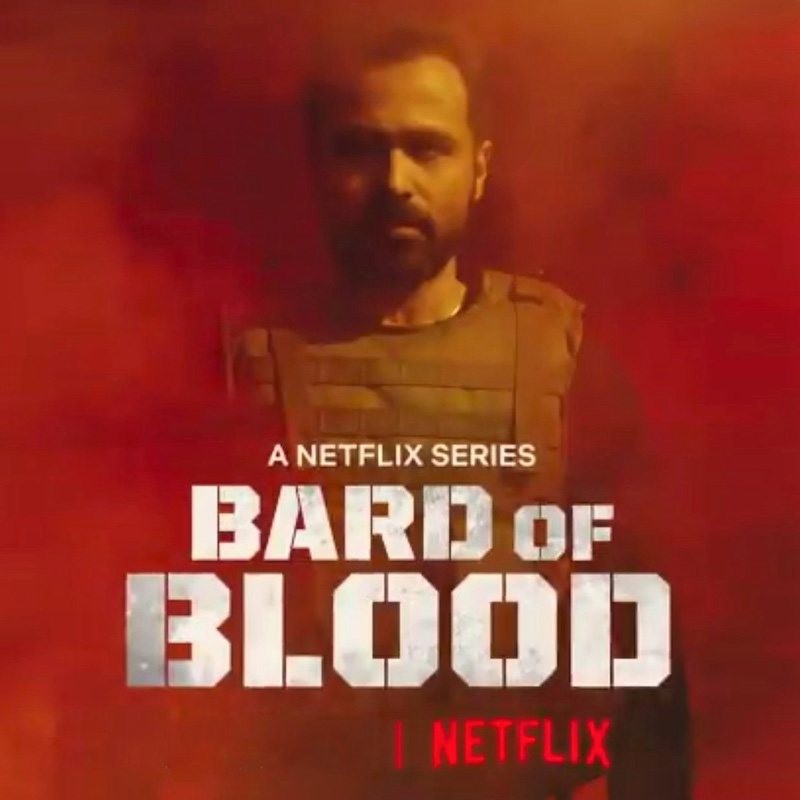
    Bard of Blood is an Indian fictional spy thriller web television series based on the 2015 espionage novel of the same name by Bilal Siddiqi. Directed by Ribhu Dasgupta and produced by Red Chillies Entertainment, the series stars Emraan Hashmi in the lead role along with Kirti Kulhari, Vineet Kumar Singh, Jaideep Ahlawat and Sobhita Dhulipala.It is a seven-episode series that revolves around the story of an ex-RAW agent. The series premiered on 27 September 2019 on Netflix.

  • Netflix announces ‘Drive’, first original film with Dharma Productions

    Netflix announces ‘Drive’, first original film with Dharma Productions

    MUMBAI: Netflix announced that Dharma Productions’ Drive will premiere as a Netflix Film exclusively on the service around the world. Directed by Tarun Mansukhani, the action-thriller heist film is Netflix’s first original film with Dharma Productions.

    The fast-paced film, high on action, stars Jacqueline Fernandes, Sushant Singh Rajput, Boman Irani, Pankaj Tripathi, Vibha Chhibber, Sapna Pabbi and Vikramjeet Virk. The film’s edgy car chases, interspersed with high octane music, make Drive a thorough entertainer.

    "At Netflix, we want to be a home for films across genres that delight our viewers in India and around the world. As we rapidly build our diverse film catalogue, we are excited to work on our first-ever film with Dharma Productions and bring Drive to Netflix. It is a complete entertainer led by a brilliantly talented cast and crew and is filled with foot tapping music and pulse-pounding action and drama. We can't wait for our members globally to enjoy it," Netflix India international original film director Srishti Behl Arya said.

    “Our vision for Drive was to make a film that elevates the genre of action-heist films. With nail-biting chases and action sequences, fronted by a spectacular cast, Drive combines the best of Bollywood storytelling with international production quality. I’m thrilled to partner Netflix once again in bringing this incredibly fun film to millions of fans of the action genre around the world,” Dharma Productions’ Karan Johar said.