Tag: Netflix

  • Big growth in viewing in India led by originals: Netflix’s Ted Sarandos

    Big growth in viewing in India led by originals: Netflix’s Ted Sarandos

    MUMBAI: Last year, Netflix rolled out a mobile-only plan in India to suit the country's preference for smartphones over laptops. Moreover, it was a way to delve deeper into a market where its basic Rs-500-a-month subscription plan was sharply expensive compared to homegrown OTT giants. The bet got the success it hoped for and Netflix followed the footprint in other markets as well. After nearly a year, the streaming service seems satisfied in the uptake of mobile-only plans as well as its overall growth here.

    “It's a plan (mobile-only plan) that we've tested for a while and we have rolled it out now in a bunch of countries: India, Malaysia, Indonesia, Thailand and the Philippines. And it's consistent with the broad theme and goal that we have which is why we're seeking effective ways to make the Netflix service more accessible to more and more people around the world,” Netflix chief product officer Greg Peters said in an earnings call.

    This strategy has helped Netflix witness a significant increase in acceleration and addition of new members. From a revenue perspective, it's also helping the company go from "neutral to positive", which Peters says will be good in the long term for the business.

    While all streaming players have witnessed magical growth in users during this COVID-19 lockdown, everyone is keen to know about Netflix’s growth in the period. Peters said he would not draw any strong contrast between India and other countries around the world. He mentioned that it is putting high effort to make the offering more competitive and attractive to members.

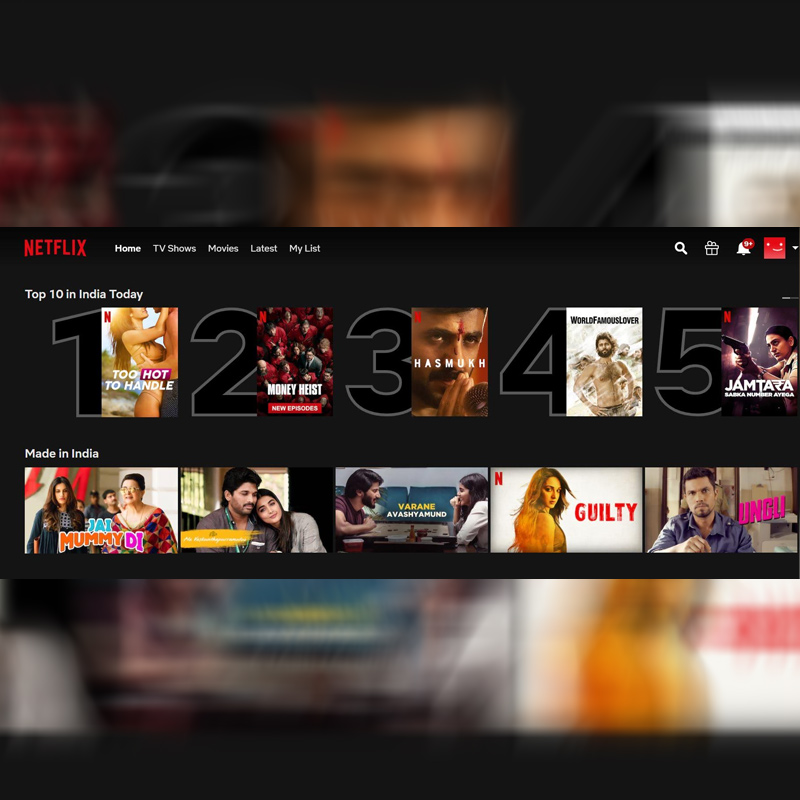
    “We've seen a big growth in viewing in India and have had great success for our local originals. Most recently was She andGuilty and a few others have been driving a lot of engagement in local content on our India service and they also are big fans of our global original content like Lacasa de Papel. So we're growing the business of licensed originals, international and domestic, across the board,” Netflix chief content officer Ted Sarandos said.

  • Netflix adds whopping 15.77 mn subscribers during lockdown, warns of future growth decline

    Netflix adds whopping 15.77 mn subscribers during lockdown, warns of future growth decline

    MUMBAI: Netflix has brought good news for its investors with a high jump in subscriber growth. The streaming service added a net 15.77 million paid streaming customers in the first quarter of 2020, much higher than the previous guidance, due to the worldwide lockdown. However, it has also warned of a decline in viewing and growth further down the road as governments will lift the home confinement orders with progress against COVID-19.

    “Our internal forecast and guidance is for 7.5 million global paid net additions in Q2. Given the uncertainty on home confinement timing, this is mostly guesswork. The actual Q2 numbers could end up well below or well above that, depending on many factors including when people can go back to their social lives in various countries and how much people take a break from television after the lockdown,” the company stated in a letter to its shareholders.

    “Some of the lockdown growth will turn out to be pull-forward from the multi-year organic growth trend, resulting in slower growth after the lockdown is lifted country-by-country. Intuitively, the person who didn’t join Netflix during the entire confinement is not likely to join soon after the confinement,” it added.

    Netflix founder-CEO Reed Hastings later said in an earnings call that the long-term implication is still tough to predict as the world is grappling with uncertainty. But he also added that they are certain about "internet entertainment's" growth in people's lives and it will be gradually more important in the next five years.

    In its first quarter report, the streaming service reported revenue along the line of guidance despite nearly double growth of subscribers as sharp rise in dollar has offset international revenue. The revenue for the quarter was at $5.77 billion, while net income stood at $709 million with EPS of $1.57. 

    As it has paused most of its productions across the world in response to the crisis, the impact will be less cash spending this year as some content projects are pushed out. This will shift out some cash spending on content to future years. Netflix hopes this dynamic may result in more lumpiness in its path to sustained free cash flow profitability. 

    “The one thing that's not widely understood is that we work really far out, relative to the industry, because we launch our shows all see all episodes at once, and we're working far out all over the world. So our 2020 slate of series and films are largely shot, and we are in post production remotely in locations all over the world. So, and we're actually pretty deep into our 2021 slate. So we're not anticipating big moving things around,” Netflix chief content officer Ted Sarandos commented in an earnings call on the production stoppage’s impact on Netflix.

    However, the streaming giant remains equally uncertain about when production will resume. But it has emphasised that it will look for the ability to test for the virus, work with production partners and local governments. It will also try to learn from its current experiences in Iceland and South Korea where productions are still on and will apply the same to other geographies, as Sarandos shared.

  • Neestream bets big on Malayali diaspora

    Neestream bets big on Malayali diaspora

    MUMBAI: Neestream, a streaming platform targeted at the Malayalam-speaking population across the globe, was launched earlier this month. The premium service is limited to the US and Canada, with a basic version available in Kerala. But it will soon be available across the world. The OTT platform seeks to reach the Malayali diaspora across the world. It hopes to accomplish that by the end of 2021, says Neestream Chairman Dr Javad K Hassan during an interaction with Indiantelevision.com.

    Neestream, owned by Virginia-based conglomerate JKH Holding Co, bets big on the Malayalam-speaking diaspora spread all over the world. According to the chairman, as much as 20 per cent of the Malayali population lives outside of Kerala, which is a captive market that can be tapped. “Apart from an occasional movie based on an NRI in the United States or Gulf, there is not enough content on this important demography. We want to address that,” he says.

    Going forward, it plans to launch more regional OTT platforms. Asked when the full version will be made available, Javad said, “We hope to make that call in the near future. Right now, because of Covid-19, our expansion plans are on hold. Our basic package is available in Kerala and other parts of the world.”

    In a market flooded with OTT platforms of various kinds, what prompted it to launch a Malayalam streaming service? “A lot of factors were instrumental in us focusing on Malayalam,” he says. “The Indian OTT market is very crowded, with the presence of major international players such as Netflix and Amazon, and Indian heavyweights such as Hotstar. Many of these companies already have presence in the Malayalam market, but only in a limited way. While all these streaming services have solid Malayalam content, their primary focus is elsewhere.”

    “Kerala has a huge diaspora, which, our studies have shown, consumes a lot of Malayalam news and entertainment content on a regular basis. It’s also a market very familiar to us, with most of our leadership having close ties to Kerala. In fact, our technology base is in Kochi, the commercial capital of Kerala,” he adds.

    The company has ambitious future plans in the streaming segment. They include plans to launch similar streaming services in other regional languages.

    “We do have long-term plans to enter other regional languages, but not at this point. Right now, our focus is to grow Neestream in the North American market and then globally,” he informed.

    The future plans include platforms focused on current affairs. In the second half of the year, it will be launching a companion current affairs platform in English, targeting the Indian diaspora in North America. Another platform for the global Indian diaspora is also in the pipeline. Both will be more current affairs-heavy than news and entertainment.

    With regard to the sourcing of content, Neestream has a multipronged approach for sourcing content. “We have acquired a lot of third-party content and are still doing it. We have also launched a modest production setup, which we plan to grow gradually. In the long run, we will also focus on unearthing talent and creators in Kerala and from within the global Malayalee diaspora.”

    Neestream has a number of shows in the pipeline, including a lot of content on and from the diaspora.

    Neestream follows a mixed content strategy, comprising a mixed bag of original and the old evergreen content. “It is a mix of originals and existing content. The experiences of all OTT players show that while originals are the key to the kingdom, evergreen content from the past is also very popular among viewers. We will be acquiring a fair deal of existing content. At the moment, we are in talks with a number of producers and content creators in Malayalam,” he explains.

    The streaming platform has adopted a robust marketing plan, combining both offline and online campaigns. “We are also planning a number of events, including concerts and entertainment events, as part of our marketing campaign. At the moment, most of the offline campaigns are halted as a result of the Covid-19 lockdown. But we are continuing online campaigns, which are delivering great results,” he says.

  • Will COVID-19 help Netflix repeat 2019 subscriber gains?

    Will COVID-19 help Netflix repeat 2019 subscriber gains?

    MUMBAI: As Netflix is about to unveil its all-important quarterly results amid expectations that the ongoing pandemic will boost subscriptions, Futuresource Consulting reflects on 2019 as being its best ever year for net subscriber additions (net adds), highlighting countries which are showing significant momentum.

    Netflix gained nearly 28 million subscribers in 2019, driven by many countries which saw the highest yearly net adds since the service launched, indicating that they remain in an accelerating phase of growth. In Germany, Futuresource estimate there was an additional 2 million net sign ups, as Netflix continues to challenge incumbent Amazon Prime Video for the top spot.

    Japan grew by 1.7 million subscribers, significantly beating its previous highest additions. South Korea increased by 1.5 million, double the net adds of the year before, and we also saw Italy, Spain and India, among others, all posting their best year yet.

    With the ongoing COVID-19 pandemic shows no signs of abating, increasing the quantity of leisure time spent indoors, Futuresource expects to see Netflix’s next quarterly reporting to indicate how its library of fresh content, provided at good value for money, has driven strong uptake of both new and returning subscribers.

    What is impressive is that many of these countries, particularly Japan, South Korea and Germany have had a relatively long gestation period, during which the global streaming giant experimented with the content length, type and format which appealed most. Subscriber net adds growth reaching the highest level to date is typically indicative of key shows resonating with the audience and therefore becoming topics of discussion within society.

    It is this word-of-mouth and social media traction which inspires new consumers to sign up in order to “see what all the fuss is about”. This therefore creates a self-fulfilling prophecy, generating ever more attention and therefore translating to impressive growth figures, as we saw in 2019.

    Further subscriber growth has come from partnering with telcos and pay-TV operators. Combined billing and allowing consumers to remain within a Pay-TV user interface has added more access points to a growing list of connected devices and TVs it’s available on. Moreover, some operators such as Sky have taken this arrangement to a new level and provided slick integration of Netflix’s content into a carousel along with other premium third-party content, such as hit HBO shows.

    Furthermore, even within established markets such as Brazil, the UK, France, Australia and the Nordics, subscriber growth has continued, which highlights the broad appeal Netflix has. Once it has attracted subscribers, the voluminous content throughout and high quality of said content helps it maintain subscription growth. The UK for example saw subscriptions increase by 2 million in 2019, equal to its previous best ever year just one year prior, but arguably more impressive since it is now taken in 40 per cent of UK households.

    Country by country, Netflix continues to localise and work out what resonates with consumers. The continued momentum in Netflix subscriptions is now also against a backdrop of an increasingly dynamic and diverse competitive landscape. However, the high-profile new service launches are at least in the short term, complementary. In its key countries, Netflix remains the staple service, with the vast majority of SVoD households choosing to subscribe. As we head beyond the lockdown, the key objective won’t just be how many subscribers Netflix adds, but also how it will continue to retain existing subscribers.

  • Quibi hits 1.7 million downloads in its first week

    Quibi hits 1.7 million downloads in its first week

    MUMBAI: Short-form video streaming app Quibi has achieved 1.7 million downloads in its first week, says its boss Meg Whitman.

    The app, launched on 6 April, streams clips 10 minutes or shorter.

    The short videos, or quick-bite videos, are ideally suited for short breaks or commuting, the company advertised. The app streams shows that are 10 minutes or even shorter. Another feature of the app is that it streams movies that are broken into small segments.

    The company is making efforts to make Quibi available on TVs. As of now, the app is available only on tablets and smartphones.  

    Whitman, in an interview with CNBC, feels that the COVID-19 pandemic has not impacted the launch.

    "It turns out people have in-between moments at home. We don't actually think it hurt us," she said.

    A few experts were skeptical of the short-video app. They were of the opinion that it would be difficult for Quibi to get users due to the COVID-19 lockdown. They thought that people who are cocooned at homes would prefer watching long-duration videos on bigger devices.

    Quibi is now available as part of a 90-day free trial. While an ad-backed version is available in the US and Canada, an ad-free version has been made available in countries like Germany and the UK.

    Quibi aims to compete with TV and OTTs like Netflix and social media video platforms such as Tiktok and YouTube. 

  • ‘New doesn’t kill off the old but grows the industry’ – Phil Schuman

    ‘New doesn’t kill off the old but grows the industry’ – Phil Schuman

    MUMBAI: “One thing is always clear: those who embrace change consistently end up better off than those who can’t or don’t. All of this to say the entry of streaming into our industry is likely going to add more,” said  FTI Consulting senior managing director in business transformation and a leader of the media and entertainment practice globally Phil Schuman.  He was delivering a virtual keynote address "content strategies in the streaming era’  during the online version of  MIPTV 2020 earlier this month. MIPTV is normally held in the Palais des Festivals in Cannes, France every year, but was called off this year due to the Covid2019 pandemic, and the conference was streamed online.

    “New technologies emerge in consumer taste and demands always evolve but in the end the industry is still going to be here; and content will still be king. Again and again we have seen that the new doesn’t kill off and replace the old but grows the industry, creating more opportunities for everyone, and when I say more opportunity, I mean a lot more,” he says.

    “Let’s talk about the change in television. It’s been around as long as TV, but I have always found that my colleagues in the industry have the view that change is great, but just don’t change me! Every major change over the past 60 years in the television industry has been met with fear. Back in the 1970’s in the US when HBO started, people were concerned that it would kill theatrical, but it didn’t,” he said.

    “When multichannel pay TV broke out in the 1980’s as a mass medium people thought it would kill broadcasting. It didn’t at all. Now the fear is that Netlfix is killing television; but let’s look back and see how the industry fared among these changes in the past. PTV turned out to be a goldmine for studios, creating new rights windows for film libraries and syndication of popular broadcast series driving massive new incremental revenue streams,” he explained.  

    According to him, the innovation of pay television also paved the way for retransmission fees for free-to-air broadcasters an entirely new revenue stream that is projected to bring in over 12 billion dollars this year. Now I know hindsight is always 2020, looking back it’s hard to imagine what the broadcasters were so worried about the emergence of cable and pay television was probably the best thing that ever happened to them.

    “As we know the driver in television growth today has been the VOD segment and it’s been brisk at 15-plus per cent compounded annual growth rate since 2014. The number of scripted TV shows on TV now tops 500, growing 30 per cent in the last five years. And the diversity of channels and platforms has proliferated more in the last few years than in the previous 60. All this change has led to crazy stock valuations and huge mergers that have remade the landscape. Just five years ago, the capitalization of major players in the television landscape looked like this on the chart. With digital players being big but still close in scales of legacy players and they are being more major participants,” he said.  

    Today, he said, the major player comparative landscape looks quite different with major tech players with overwhelming capital size and fewer major legacy companies in pursuit and those legacy players are falling further behind in size to the digital players. “One point I would like to make though is that history tells us that today’s giants will not show all of the world they’d never seen. Let’s take a stroll down memory lane to emphasize that point.”

    “Do you remember when AOL met Time Warner they were going to be twice as big as their next rival and that spread fear in all the industry, and I don’t know that one worked out. How about when Comcast met Universal vertically integrating a major studio networks and distribution it was expected to be the end of non-exclusive network distribution. How about when AT&T met Warner Media. This deal also led to calls of doom that never happened and Disney and Fox? Looks to me these mergers generally add to the landscape after the integrations are completed. Now I will admit today is tricky. There is more competition, more diverse competition, than ever before. New guys have stormed the gates and everyone has had to adjust. Yes, Netflix can buy out Apple, so can Amazon, may be even Disney at this point,” he said.

    Streamers are also making huge investments in funding content production around the world, unlocking opportunities for storytellers everywhere. “By our count, content spent by Netflix, Amazon, Apple and Hulu in 2019 was over 30 billion dollars, much of it incremental increase in spend in the sector.

    The streaming sector itself continues to grow too. By our count, there are at least 15 sizable global or regional streamers, with more on the way.”

    Regarding the broadcasting sector, none of these legacy players have gone or going away. They may be a little smaller part of the overall puzzle, but there is clear tried and trusted demonstrated value in broadcasting that won’t be disappearing anytime soon.

    He asserts that broadcast is still unbeatable in reach. One major sporting event still brings an audience far larger than Netflix’s entire global subscriber base. Just look at the FIFA World Cup audience when compared to Netflix. This reach comparison remains true within local markets, too.

    “Take a look at the UK for example. As you can see the broadcast reach surpasses OTT service penetration. Today, the content creation market is crowded and competitive, but open. In the global category we have the major powerhouses such as Netflix, Amazon, Disney, and Apple. These are already flexing their muscles in buying global rights of the content; but let’s be clear. There are potential emerging global players as well, such as HBO Max and Peacock Hulu,” he added.  

    The landscape for buyers and sellers is drastically shifting with an influx of new entrants to the buyer market; buyers becoming sellers, and sellers becoming buyers.

    Creating organisations that are able to sell content tailored to their environment using an adaptive business model and varying return on investment. One related trend is to have in place financing for shows in advance for production as opposed to traditional deficit financing with later syndication.

    Another funding model is co-productions between US premium networks and other global networks with upside and risk shared across the partners.

    Go global in a local way. We have heard from streamers and broadcasters alike that the demand for locally produced content is very strong especially in Latin America. Local language content tops the most popular Netflix releases of 2019 in eight countries. So here’s the opportunity: while streamers may be building up internal development capabilities in the US and perhaps the UK, they have not yet built that capacity at scale in other countries, and when they do turn their focus to particular markets, they still need local production teams to satisfy content demand.

    Consortium content creation among various localised participants is the most common success tack that we have seen. This model has one major benefit: it allows for higher content cost shows to be acquired in any given market, but with the cost spread so that all parties can obtain the content within their respective budget. Atrium TV with member companies in Europe, Latin America and Asia is a private company trying to create consortium is just an example.

    There are also examples of ad hoc consortiums being created show by show where rights are shared.

    "With respect to streamers’ best practices, Netflix and Amazon, they will likely to need more local production access and all participants can work with them on this. With respect to the emerging global streamers such as Hulu, Disney+, Peacock, HBO Max, etc. They will likely need additional content above their own supply and can provide good partners for local broadcasters," he said. 
  • Netflix strikes first-look deal with BOOM! Studios

    Netflix strikes first-look deal with BOOM! Studios

    MUMBAI: Netflix has inked a first-look deal for live-action and animated series with BOOM! Studios, the publisher behind best-selling Eisner Award-winning and fan-beloved comic book franchises, including Lumberjanes, Something is Killing the Children, Once & Future, and Mouse Guard.

    BOOM! Studios CEO and Founder Ross Richie and President of Development Stephen Christy will produce all shows developed through the pact.

    This marks a brand new partnership between the two companies, though Netflix and BOOM! have always been close collaborators, including partnering on the upcoming feature film The Unsound directed by David F. Sandberg, based on the graphic novel by Cullen Bunn and Jack T. Cole. BOOM! also debuted a graphic novel series in 2019 tied into Jim Henson’s The Dark Crystal: Age of Resistance.

    “BOOM! characters are innately special, they’re colourful, diverse and varied and their stories have the power to ignite something in all of us,” said Netflix Original Series vice president Brian Wright. “We can’t wait to bring these stories from the page to the screen to fans in every corner of the world,” he added.

    “We generate 20+ new original series a year and are thrilled to partner with a company that is as prolific as we are,” Richie said. “BOOM!’s unique partnership model of controlling the media rights to our library benefits creators by positioning them to be packaged with high-end directors, screenwriters, and producers. We’re thrilled to continue our track record of translating our best-selling award-winning library with the best TV talent in the business but now with the undisputed leader of the new streaming era,”  he added.

  • Netflix emerges as largest OTT beneficiary during lockdown: report

    Netflix emerges as largest OTT beneficiary during lockdown: report

    MUMBAI: With the first phase of the lockdown coming to an end, it has become evident that the over the top (OTT) streaming industry has picked pace. It is, perhaps, one of the few industries that will emerge positively out of the economic impact of this pandemic. Streaming colossal Netflix has emerged as the largest beneficiary among OTTs.

    According to a report from KalaGato, which takes into account the lockdown period of 5 February to 29 March, Netflix users have been spending an average of eighty minutes a day on the platform by the time the lockdown was in place. Recently, the streaming service, which is still considered as a premium, has churned out original episodic content as well as digital movies which have gained word of mouth like Jaamtara, Taaj Mahal 1989 and Yeh Ballet. 

    “Juxtapose this with Hotstar that has experienced a thirty per cent decline in total session time. This could be a result of the different content libraries of the two platforms. Netflix creates the sensation of an endless well of content while Hotstar’s library feels much more limited. Netflix is built for binge-watching while the other feels more point and shoot,” the report added. 

    In the same period, the open rate of Netflix and MX Player went up by 68 per cent and 18 per cent respectively. Both platforms have seen an increase in daily active users as well. Netflix’s DAU has jumped by 102 per cent whereas MX Player has experienced a 14 per cent spike. Despite a falling open rate, Amazon Prime Video which has recently pushed some of its premium content before the paywall, has gained 83 per cent more DAUs.

    On the other hand, the leader in the Indian OTT space has witnessed a fall in both DAUs and open rates by 55 per cent and 43 per cent respectively. The report attributes the weaker performance of Hotstar to the absence of a sporting event, the USP of Hotstar’s popularity. However, the case may change soon with the launch of Disney+ in India as the rebranded Disney+Hotstar service already has around eight million subscribers.

  • Netflix launches improved parental controls for families

    Netflix launches improved parental controls for families

    MUMBAI: Netflix, based on feedback from its members, has launched new, improved controls on its service to help parents, guardians and elders make the right viewing decisions for their families. 

    Parents can now:

    ●      PIN protect individual profiles to prevent kids from using them;

    ●      Tailor their kids’ Netflix experience by filtering out titles that are not appropriate for their age;

    ●      Remove individual series or films by title. When this filter is used, the blocked title(s) won’t show up anywhere in that profile;

    ●      Easily review each profile’s setting using the “Profile and Parental Controls” hub within account settings;

    ●      See what their kids have been watching within the profile created for them; and

    ●      Turn off auto play of episodes in kids profiles. 

    These controls can be added to the Netflix profile by going to account settings on a laptop or a mobile browser.

    “Choice and control have always been important for our members, especially parents. We hope that these improved controls will help parents make the right choices for their families,” said Netflix kids product manager Michelle Parsons.

    Recognising that every family is different and to give them more viewing choices, Netflix is investing in a wide variety of kids and family films and TV shows from all over the world, including award-winning animated films like Klaus, interactive shows like Carmen Sandiego: To Steal or Not to Steal and kids’ series such as Boss Baby. The Indian kids series Mighty Little Bheem is the most-watched preschool series on Netflix globally, and the second-most watched kids’ series for Netflix worldwide. 

    Since its launch in April 2019, Mighty Little Bheem has been watched by over 27 million households worldwide, including in Latin America, Australia and New Zealand. Netflix has also announced Ghee Happy, an animated show about Hindu deities who, as children, attend a special daycare and discover their own powers.

  • Netflix to contribute $1 mn to the Producers Guild of India Relief Fund

    Netflix to contribute $1 mn to the Producers Guild of India Relief Fund

    MUMBAI: In response to the shutdown of film and TV production in the country since last month, which left thousands of crew and cast without jobs, streaming giant Netflix has announced a contribution of  $1 mn (approximately INR 7.5 crore) to the Producers Guild of India (PGI) Relief Fund.  

    The fund, set up last month by PGI, will provide emergency short-term relief to thousands of daily wage earners in the Indian creative community, who have been directly impacted by the closure of productions in the country due to the pandemic. This will include workers in lighting, and setting and electricians, carpenters and spot boys, many of whom are paid hourly wages and work on a project-to-project basis.

    In addition to the $1 mn contribution to the relief fund, Netflix has also committed up to four weeks of pay for all core below-the-line crew who were scheduled to work on Netflix’s productions in India. 

    Producers Guild of India President Siddharth Roy Kapur said, “In the past month with all productions grinding to a halt, thousands of daily wage earners associated with the Indian film and TV industry have seen their livelihoods disappear overnight. I am proud of and thankful to the entire fraternity for contributing to the fund we have created to support our colleagues at this difficult time. We value Netflix’s generous commitment to this fund and their resolve to help those who need our help the most.”

    A Netflix spokesperson said, “We’re proud to work with the Producers Guild of India to support the hardest hit workers in TV and film production – from electricians to carpenters, hair and makeup artists to spot boys. Crews in India have always been vital to Netflix’s success and now we want to do our part and help those who most need support in these unprecedented times.” 

    In March 2020, Netflix announced a $100 million fund to help with hardship in the creative community. The majority of this fund will go to support the hardest hit workers on Netflix’s own productions globally. To support the wider film and TV industry, $15 million of this $100 mn global fund will go to non-profits providing emergency relief to out-of-work crew and cast in the countries where Netflix has a large production base. The $1 mn contribution to the Producers Guild of India Relief Fund is part of this $15 mn fund.

    Netflix chief content officer Ted Sarandos while announcing the $100 mn relief fund, said, “What’s happening is unprecedented. We are only as strong as the people we work with and Netflix is fortunate to be able to help those hardest hit in our industry through this challenging time”.