Tag: Netflix

  • Netflix to cancel subscriptions of inactive members

    Netflix to cancel subscriptions of inactive members

    MUMBAI: Streaming giant Netflix has taken another step to make the service more user-friendly, by cancelling the membership of inactive subscribers. It will start asking customers who haven’t used its platform in the past year if they want to keep their subscriptions.

    “We’re asking everyone who has not watched anything on Netflix for a year since they joined to confirm they want to keep their membership. And we’ll do the same for anyone who has stopped watching for more than two years,” Netflix product innovation director Eddy Wu said in a statement.

    If they don’t confirm that they want to keep subscribing, Netflix will automatically cancel their subscriptions. These inactive accounts represent less than half of one percent of the service’s overall member base, only a few hundred thousand, and are already factored into its financial guidance. 

    “We’ve always thought it should be easy to sign up and to cancel. So, as always, anyone who cancels their account and then rejoins within ten months will still have their favourites, profiles, viewing preferences and account details just as they left them. In the meantime, we hope this new approach saves people some hard earned cash,” Wu added.

    Follow Tellychakkar for the consumer facing news & entertainment

  • Foxtel to launch streaming service on 25 May

    Foxtel to launch streaming service on 25 May

    MUMBAI: Australian pay TV company Foxtel will launch a new entertainment streaming service on 25 May, entering the crowded streaming market.

    The official announcement has ended all speculations regarding the launch that have been doing the rounds.

    The next-generation streaming service, which will offer more than 10,000 hours of content including movies and dramas, will be competing with giants like Netflix, Amazon and Disney+.

    Though there has not been any official announcement of the name, Foxtel had recently registered ‘Binge’ brand name and logo trademarks.

    It is still not known the kind of subscription model the new streaming service will adopt. Media reports say it could be similar to that of Kayo, Foxtel’s sports streaming platform, which works on a monthly subscription free model.

    The platform will be hosting content from Sony, BBC Warner Bros, and HBO Max. Over the last one-and-half years, Foxtel has been renegotiating content deals with studios to get SVOD rights for the new streaming service.

    “There has been a lot of speculation about our new streaming service and its name, and we are pleased to finally be ready for the big reveal to Australia next week,” says Foxtel Group CEO Patrick Delany.

    He termed the streaming service as Foxtel’s ‘growth engine’. The purpose of the new OTT, he said, will be to target consumers who seek to consume the premium content offered by the company.

    “We have been beta-testing the service for a few weeks and we are sure Australians will love everything about it. It brings an exciting new brand to younger streaming audiences with a very different and compelling product experience, and a distinctly curated mix of the best drama and movies from the world’s best entertainment brands,” he added.

    He said that the launch will be another milestone in the Foxtel Group’s strategy to transform itself and bring its unparalleled catalogue of entertainment and sports to even more viewers in Australia. “Our goal is to consolidate our position as Australia’s preeminent subscription television and streaming provider,” he said.

    Foxtel’s subscription television service has 2.5 million customers, providing premium experience – the best of television and on-demand services.

  • Global video streaming market forecast to reach $184.3 billion by 2027

    Global video streaming market forecast to reach $184.3 billion by 2027

    MUMBAI: The global video streaming market size is expected to reach $184.3 billion by 2027, registering a CAGR of 20.4 per cent from 2020 to 2027. Rising technological advancements such as the implementation of block-chain technology in video streaming and the use of artificial intelligence (AI) to improve content quality are expected to boost market demand over the forecast period. Furthermore, growing adoption of cloud-based streaming solutions to increase the reach is directly influencing market growth. This trend is observed in numerous parts of North America and Asia Pacific. Factors behind the growth of these regional markets include rapid digitalization, increasing use of mobiles and tablets, and growing popularity of online viewing.

    Globally, the rising demand for on-demand video and extensive growth of online video are key drivers of the market. Moreover, increasing demand for high-speed internet connectivity acts as an advantage for the market. The growing acceptance of smartphones in combination with an extensive range of high-speed internet technologies such as 3G, 4G, and LTE has substantially led to the trend of online broadcasts. In addition, the growing demand for devices that can support digital media is helping consumers' access media content anywhere in the world.

    Key findings from the report:

    Increasing usage of videos in corporate training and in the education sector are anticipated to drive the market

    The over-the-top (OTT) segment held the largest revenue share and is also expected to grow at the fastest pace over the forecast period

    Asia Pacific is expected to witness significant growth over the forecast period, majorly due to increasing demand for high-speed internet connectivity and on-demand video streaming

    Key players in the video streaming market include Akamai Technologies, Amazon Web Services, Inc., Apple Inc., Cisco Systems, Inc., Google, Kaltura, Inc., Netflix, International Business Machine Corporation (IBM Cloud Video), Wowza Media Systems, LLC, AT&T Intellectual Property, and Hulu.

  • How Covid2019 is affecting outdoor media

    How Covid2019 is affecting outdoor media

    Outdoor advertising had a fantastic 2019. Defying predictions, India’s OOH (Out Of Home) industry, grew at over 15 per cent. Driven by IPL, elections and a huge increase in the OTT industry’s outdoor advertising, the industry saw a big increase, enabled adequately by digitization. The industry itself has been seeing radical positive transformation over the years. From the rather primitive static format, it has now become a dynamic audiovisual one, with all kinds of creativity made possible by technology. Global giants like Google Maps and LinkedIn have used OOH to create an impact, in addition to Netflix, Amazon Prime and Hotstar. Events are a big money spinner for OOH, and last year KumbhMela was proof of this. Witnessing audiences in crores, the promotion of brands on-site contributed significantly. In the financial year 2019, the revenue generated from out-of-home advertising across India amounted to over Rs 34 billion. This was estimated to reach up to Rs 52 billion by the financial year 2024, and Rs 38 billion in 2020.

    But all this has now been severely affected by the pandemic Covid2019. Many organizations have slashed their ad campaign budgets and have left the advertisers reeling for their incomes. OOH has been acutely affected in this scenario.

    Looking at history does not help, as during the previous instances of recession or pandemic, digital media or ambient advertising (a variation of outdoor) were not as developed as it is today. 1918 was the year when the Spanish Flu hit the world, and at that point mass television broadcast was at least 25 years away. Much later, in 2008, when the financial crisis hit the world, digital marketing was just fledgling.  But today, it is hard to find a single household that is not reached through digital and/or outdoor advertising.

    Lockdown has changed the way we live and the way in which we consume media. Urging people to stay indoors has resulted in streets and roads being empty. Halting public transport has created a vacuum in bus shelters and train stations and the busy shopping areas are deserted. The familiar red colour of Coca-Cola or the bright branding of Samsung is no longer visible while walking down the busy areas of metros in India. Many hoarding sites are empty as there are no consumers to view these.

    In-home media has been the gainer during this period. Whether it is TV, which has increased reach in terms of viewers and duration of viewership, or web streaming, which has seen a significant climb in the household watching time, or even video games (where playtime has gone up), people staying at home has resulted in a sharp increase in in-home entertainment and viewing.

    Out-of-home also includes ambient advertising i.e., advertising in unexpected areas. Aimed at evoking an emotional response, ambient advertising includes placing products, models etc. in attractive locations like malls and restaurants in order to catch the consumer’s attention. It is also called ‘creative guerilla advertising,’ and that has also hit a new low now. Reduction in public traffic has done away with the need for this kind of advertising, at least temporarily. Cancelling events has also had a bearing on this industry. With no immediate need to promote new products on a mass scale, clients are cancelling these events, leaving the advertisers high and dry.

    So, how can the outdoor media industry buck the trend?

    Outdoor medium is an integral part of our cityscapes and our lives. It has always had a place in building trust with local communities. Located in proximity to where people live and commute, it ensures a special bond with the citizens of that geography. And in times such as the current crisis, the medium is all the more relevant in garnering faith and educating the public. The medium, therefore, needs to play to its strengths. There have been cases where governments have recognized this and placed their confidence in this medium. According to the Ad Council of the US, ‘Out Of Home’ media plays a critical part in informing local communities and residents on how to stay safe during times of uncertainty. As part of their ongoing efforts to address the growing Covid2019 pandemic, the US department of health and human services (HHS) and centers for disease control and prevention (CDC), have convened (OOH) industry leaders, to bring critical Covid2019 safety messaging to the American public. From mall kiosks to airport TVs to Uber car tops and billboards, the industry is leveraging their extensive networks to help slow the spread of the virus. The scenario in India is no different. The advertising giants – Lintas, Ogilvy, JWT, etc. – are all focusing efforts on their outdoor advertising arm to bring more awareness to the public on Covid2019.

    Already known for its novel campaigns in the ambient format, the OOH industry needs further innovations. Take the case of Ro, an American digital health company, that has both men and women health products. Situated in New York, they decided to use outdoor medium and came up with a public utility message on safety on billboards, while also announcing their website-based tele-health assessments. This dual-purpose innovation helped them gain consumer mind share while also doing public good.

    Flexibility is the other aspect that will enable OOH to flourish. Media agency outfits that have a digital or TV component should allow clients to trade their outdoor budgets for digital or TV campaigns during this lockdown period, thereby retaining clientele. This will give them the much-needed revenues and allow them to get back on track once the current crisis is over.

    Making advertising trustworthy has always been a challenge. The metric for measuring trust in advertisements – the AD TRUST Scale – highlights the reliability of source as the topmost. Outdoor medium scores significantly on that front. Seeing China rebound from Covid2019 gives hope to outdoor marketers that all will be well soon. Coincidentally, the Beijing Olympics of 2008 was one of the pioneer outdoor events which showcased what OOH was capable of, through spectacular creativity (and technology). Given that outdoor advertising touches people in a personal, topical way, it is important that the industry adopts a combination of the above-mentioned strategies of playing to its strengths, practicing innovation and retaining flexibility.

    (The author is senior associate professor (marketing), Great Lakes Institute of Management, Chennai.)

  • Covid2019 cuts back customer acquisition costs

    Covid2019 cuts back customer acquisition costs

    MUMBAI: Covid2019 has plummeted what was a skyrocketing cost of customer acquisition, according to a report that delves deep into the correlation between the pandemic and the entertainment industry. According to the special report, Navigating Covid-19, by Parrot Analytics, this is exciting for platforms launching in the middle of pandemic such as Quibi, HBOMax, and Peacock. Yet, as time stretches on, OTTs may lose subscribers whose free trials end or who churn due to the recession. After the lockdown, the demand for content may be even more important as out-of-home activities will pose greater competition.

    Under stay-at-home orders, OTTs are gaining subscribers due to consumers’ heightened perceived value of their catalogue offerings.  

    The report says that the global lockdowns, forcing everyone to be home, have led to increased content consumption (viewership, ratings, etc.). Yet, this increased consumption has been accompanied by the unique challenges of satisfying audiences while production of key tentpoles has been halted and delayed. Broadcasters and cable (Pay-TV) have additional hurdles compared to OTTs. They must also cope with reduced ad revenue within the industry, making their ability to optimize their airing schedules and to fill content gaps even more crucial. Nonetheless, OTTs and Broadcasters alike are looking to solve their challenges by acquiring and producing virus-proof content.

    Meanwhile, distributors have an opportunity to revisit and leverage their reserve of content. They can offer unique packages of titles that will allow platforms and channels to retain their viewers and subscribers. Producers are challenged with finding innovative ideas and formats as well as adapting existing ideas to new restrictions placed during and post-lockdown. Simultaneously marketers are left searching for fragmented and dispersed audiences, recalculating and holding on allocating budget.

    Pay TV

    In the short-term, Pay TV has similarly seen a surge in viewership and ratings. Yet, as industry analyst Rich Green- field points out, this bump has been underwhelming. Greenfield is not alone; many analysts expect networks to feel more repercussions due to their losses of advertising, their reliance on live TV, and their battle for a digitally orient- ed key audience: those between 18-24. When consumers are faced with hard choices, Covid2019’s impact long-term may accelerate cord-cutting, contributing to Pay TV’s decline. However, broadcasters can avoid this by capitalizing on audiences who are tuning in now.

    What qualities have created opportunity under stay-at-home measures?

    According to the report, there are a few characteristics of SVODs that have been advantageous during the lockdowns.

    •           Size of catalogue:  The lockdown conditions have temporarily increased the value of all content, making it easier to reach the threshold of demand needed to acquire a customer. Thus, the larger the catalogue the greater the likelihood of customer acquisition at the moment.

    •           Supply of originals:  As stay-at-home orders continue, boredom and loneliness is on the horizon for many consumers. This makes original content that connects people more important than ever.

    •           Flexible viewing: With families, roommates, and others forced to share living spaces, SVOD content avail- ability on multiple screens is an advantage. The flexibility to watch on TVs, laptops, and phones allows consumers to watch their preferred content wherever they want and with whomever they want.

    •           Ad-free: Declining revenue from advertising poses a unique challenge at the moment; many companies have cut their marketing teams, frozen budgets, and are limited in ad-production capabilities. Thus, SVOD’s diminished reliance on ad-revenue is beneficial.

    Netflix

    Consider Netflix. Its large catalogue, supply of diverse original content, flexible availability and lack of ad-reliance allows it to thrive at this moment. The crisis has also temporarily reverted Netflix to an earlier phase in OTT life-cycles, in which total demand for content dictates subscriber growth and retention.

    Netflix is not alone, Disney+ also exhibits similar qualities. Although it has a limited supply of originals, its flexible access, ad-free platform, and large catalogue of premium children’s and family-friendly IP support its ability to thrive. Amazon Prime Video and Hulu are also well positioned with large catalogues, many originals, and flexible viewership.

    For Pay-TV, channels with large catalogues of family-friendly content, such as Discovery and Disney, are fulfilling increased demand from kids who are home due to school closures. Other broadcasters which are experiencing holes in programming are employing repeats or flashbacks of favourite episodes, searching for foreign acquisitions, and considering moving exclusive content from their OTT platforms back

    The key for producers and distributors is therefore to capitalize on this need for a larger catalogue and greater supply of originals. They can solve the pains of an aching industry with innovative content that fulfils and attracts the audiences that platforms, networks, and marketers are seeking to find.

    What can the industry do to thrive moving forward?

    In the midst of uncertainty, data allows decision-makers to be agile, says the report.

    Covid-2019’s effects on the global TV industry have likely just begun to unfold. As new consequences emerge, the industry will need to adapt swiftly by combining the art of storytelling with the science of human behaviour.

    Content preferences

    Audience content preferences have shifted due to Covid2019, these include a desire for original content, especially content that fills holes left by cancellations or delays.

    OTTs have an opportunity for growth due to increased streaming volume, but in order to prevent churn they must optimize their release schedules and content acquisitions.

    Broadcasters are challenged with holes in programming schedules, but can adapt by reinvigorating fandoms and finding replacement titles that will attract target audiences.

    Distributors should optimize their content packages for broadcasters and OTTs in need.

    Producers, despite shutdowns, can be resilient by prioritizing projects that fulfil audiences’ shifting demand and finding new formats to create fresh content.

    Marketers may need to pivot their channel spends, but can find ways to maximize their audience reach and tap into emerging preferences.

    OTT solutions

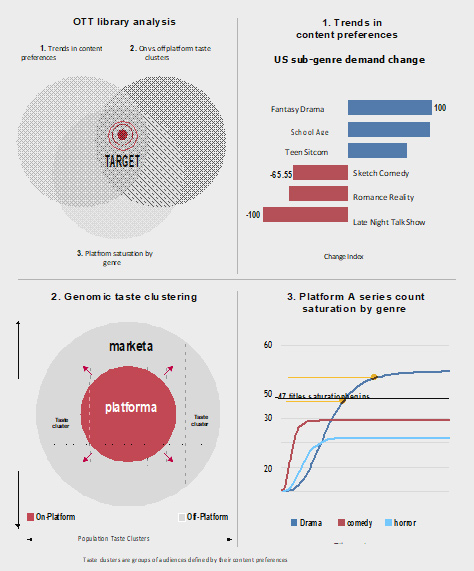
    Capture shifting preferences: By examining trends in content preferences, OTTs can prioritize speeding up releases or acquiring titles that may appeal to audiences’ shifting needs.

    Acquire vs. retain subscribers: Platforms must evaluate whether titles fulfil the preferences of existing subscribers or those yet to be acquired. Depending on an OTT’s goals, they may choose to prioritize a title that targets retention or to prioritize a title that targets acquisition.

    Ensure audiences are satisfied, but not overloaded:  Saturation is another term for diminishing marginal returns. Based on past data, OTTs can derive an optimal point or a point of saturation. To ensure audiences are not over- whelmed, OTTs should evaluate if there is headroom before speeding up releases or acquiring titles. Otherwise, due to genre saturation, titles may underperform.

  • Eros CEO Pradeep Dwivedi on the Eros-STX merger

    Eros CEO Pradeep Dwivedi on the Eros-STX merger

    “Nowhere in the history of Bollywood has any studio really merged with a Hollywood producer in a manner like this.” This statement by Eros International Media Ltd (EIML) CEO Pradeep Dwivedi succinctly sums up the significance of the recent Eros-STX merger. The new global entertainment company will leverage the 40-year-old legacy of Eros and the strength of STX as one of the prominent Hollywood producers. In an interview with Indiantelevision.com, Dwivedi dwells at length on the significance of this merger, its strategic intent, the financial nitty-gritty of the deal, how the new entity will find common ground and tap the combined market of India, China, and the US, the OTT business and the effects of Covid2019 lockdown on the entertainment industry, among other things.

    Edited excerpts:

    The merger deal comes at a time when the entire movie production sector is shut due to the Covid2019 pandemic. So how challenging is the situation for you?

    We have been working on this merger transaction for nearly six months. The timing with respect to the production stoppage is a bit odd; it happened during the last one month. We eventually believe that in the next couple of months as and when the lockdown is lifted in phases and people get back to production work, the work on the ground in terms of production slate and shoots will resume. We had, even before the lockdown, a significant inventory of content that we had built up. So, in a phased manner we are pushing it out to the digital platform. Obviously no studio releases are possible as theatres are completely shut down, not just here but in the US as well.

    In this merger, what we were always planning as a strategic fit was the fact that you have STX, which is a Hollywood studio, which has been doing decent movies with top-of-the-line stars. The bottomline is that they have successfully created a content machine which is delivering good content with top-built star cast into the US market. We have had a similar ecosystem in Eros for nearly 40 years now; look at some of our hits like Vicky Donor. We had our own range of success.  

    Nowhere in the history of Bollywood has any studio really merged with a Hollywood producer in a manner like this.

    Can you elaborate on the structuring of the merger?

    There is a structuring of the transaction. It takes about eight weeks for all regulatory approvals to come in and then the two companies become one. At the merger, only one company will survive, which is Eros STX Global Corporation. In the interim, all of STX will be moving into a subsidiary which is incorporated in the US. That subsidiary merges into a 100 per cent owned subsidiary of Eros PLC, and that subsidiary eventually merges back into Eros. Today, Eros is listed at the New York stock exchange. In fact, if you see the stock value right after the merger announcement, it jumped almost 60 per cent in terms of value. We are getting strong analysts’ support. Just now I was talking to an investor in New York. There is huge excitement in the US and the overseas investor community on this deal.   

    The transaction works like this: STX, an unlisted company, has merged into Eros, a listed company, and Eros STX is the surviving company. So essentially what is happening is that the shareholders of STX will initially get what is known as contingent value rights (CVR). So effectively, we will own about 43 per cent of the surviving company. STX partners will hold another 43 per cent. Put together, it comes to around 85 per cent.

    Now, let me speak about the strategic intent. We want to take the best of Hollywood and Bollywood and create a big impact in China. There, we will be looking at the creation of content, by leveraging the Chinese talent in areas like acting, directing, photography, VFX, production, post-production, music, sound, etc.

    In China, who will be the partner of STX?

    In China, STX has Tencent Films and Alibaba Films as the partners on the production side. On the investment side, Tencent Holdings has invested money. They were already investors in STX to begin with. Eros has two partnerships in China for distribution. Because as you know, we made serious returns on movies like Bajrangi Bhaijaan. Other Indian movies also did really well in China, for example Dangal or Andha Dhun, which we distributed in China and did a fantastic business. We have a huge distribution model, not a production/co-production model in China. We work with Shangai Film Corporation and China Film Distribution Corporation. These two are our distribution partners.

    So you are looking at the Chinese market in a bigger way. What will be the roles of STX and Eros there?

    It will be a combined entity; there is not going to be any difference. In fact, this merger has got nothing to do with the India business per se. Eros International Media Ltd (EIML), a Bombay Stock Exchange- and National Stock Exchange-listed company, is a subsidiary of Eros International PLC.

    Eros International PLC is the holding company, which is Isle of Man-incorporated and listed in New York Stock Exchange and has multiple subsidiaries all over the world. For example, whatever OTT business we do in India is housed within Eros now, which in turn is part of EIML. The worldwide business that we do is housed in Eros Worldwide Digital which is based out of the UAE. We have distribution subsidiaries in Australia called Eros International Australia, we have one in Fiji, one in the UK, and in the US called Eros Incorporated USA, which is a distribution arm. They do the distribution business in all of those markets.  

    Please give an idea about the post-merger entity and the changes at the top level.

    Kishore Lulla, who is currently the CEO and chairman of Eros International PLC, becomes executive co-chairman of the combined company. Robert Simonds who has done about 70-odd movies as producer will be the CEO of the combined company. He will be my boss in that perspective. He has done almost 13-14 Adam Sandler’s top-selling movies.

    I will run all of the India business and there is the worldwide studio business including the collaboration that we will do with STX. So at the base level, STX Studios continues to make movies for the US market and Eros continues to make movies for the Indian market, which covers almost 60-70 per cent of our production output.

    Kishore Lulla is the executive co-chairman of the new company. Rishika Lulla, part of the management, is the co-president at the global management team of Eros-STX Global. Rishika will continue to lead the entire digital business worldwide, including what is coming from STX. Bob Simonds is the co-chairman and chief executive officer of the company. Andy Warren is the CFO of the combined company. I am running India business plus global studio collaboration. Adam Fogelson is running a global studios business. Noah Fogelson is going to manage the entire business from a US perspective. Ridhima is currently head of content – strategy for Eros. She is going to work very closely with the content leadership of STX.

    About 20-25 production output will be Indo-US collaboration that Adam Fogelson, as the president of the studio business in the US, and I will collaborate and jointly work out. Then there is about a 10 per cent layer on top of that. That will be all the Chinese movies that we want to make, with a focus on mainland China; movies that reflect their ethos, culture, science fictions, action, contemporary issues, etc.

    At the end of this exercise, there is no difference between STX and Eros. That’s the whole concept of the merger. We are one team.

    What about Eros’ OTT business?

    Ali Hussein, the CEO for the OTT business, will run the OTT business worldwide. STX worldwide does not have an OTT play, but it has a large content play. So it will obviously be selling some content to Amazon Prime, Netflix, etc. Today, Eros Now OTT has the access to Amazon, Netflix and exclusive access to Apple TV. Any India-Bollywood content you see on Apple TV will be coming from the house of Eros. The advantage it allows is that whatever the STX content is getting produced afresh we have the ability to take a call on whether we should park it in Eros Now, monetise and increase our subscriber base or to part it for Amazon, Apple, or Netflix and monetise better there. It will really depend on the financial equation there. But it gives us a tremendous amount of flexibility to be able to do both. That is one of the advantages we have on the OTT side coming from this merger.

    Will there be more dubbed versions of Bollywood and regional language films for the Chinese audience?

    There is a two-pronged strategy in this regard. As far as the digital front is concerned, we already have partnership with Wuzhou, one of the largest distributors in China. We are looking at other teleco partnerships, too. All the existing content, with dubbed and subtitled versions, will be available to the Chinese audience.

    Then there are the originals and the new movies that we do, which will be done in collaboration with the Chinese studios. It depends on who we want to work with: Huayi Brothers, Tencent, Alibaba, etc. All of these are existing partnerships. We will take a call depending on a particular project idea, which studio or investor on their side is more comfortable with or most excited by the idea.

    To answer your question specifically, yes, we will make sure that our stories are presented as an opportunity to be remade for China. We will look at China's original stories and make movies around that. And we will also look at building strong distribution strategies. So, movie production is one, distribution is another and we want to make sure that we are doing well on both the fronts in the Chinese markets. If you look at the sheer size of the market we are addressing with this joint venture, India already has 1.4 billion people, America has another population of 38 crore, and then you add China on top of that: 1.2 billion people.  So close to 3 billion people in the world is the potential market. And I am not counting other markets like Europe. Essentially, half the population of the world typically will be covered by the footprint of what we are doing right now. And we intend to make sure that we create world-class content. We have a huge reserve of stories that are original and genuine to India. For example Ramayan and Mahabharat. These stories, while they are set in Indian cultural and social context, are universal in many ways, about challenges in family, difference between right and wrong, etc. These are universal values. We intend to do this Indo-US-Chinese collaboration with the best of technology on science fiction, visual effects, etc. to create world-class content. We also wanted to showcase the slate of some of the content that we are going to make, but due to the Covid2019 situation we don’t want to do that. However, by around the end of June, when the merger deal will be closed, we will present a slate of the movies that we are going to produce.

    We believe that we will get all the regulatory approvals in the next eight weeks.

    Theatres are not going to be opened until September or October. When do you expect the production to resume?

    We believe that by middle or end of May some level of production activities will resume. Whatever can be done inside studios, not outdoor shoots, can typically start in a controlled environment in sets with the right level of hygiene, control, safety and distancing, etc., for our studio-related works to start off. I’d expect it to stabilise only by the end of June or early July.

    We still can’t say definitely when theatres will reopen. My hope is that by the end of August or early September some theatre releases will start.  

    The merged entity will have half a billion in cash, right?

    We already have about $195 million cash with us. We have secured $125 million fresh equity capital investment. We have got a limited sanction from JP Morgan in the US, which is leading a syndicate of six banks, to get another 350 million on the debt capital side. In addition, we have close to $300 million of predicted revenue from the 2019 slate of STX.

    Now, let me explain the efficiencies in the deal. Manpower costs as a percentage of our overall costs are not outside the industry norm. What that means is that these efficiencies will come largely on account of financing integrations and on account of financing/ process integration. For example, there are a lot of VFX/post-production works that STX movies need to do. We have negotiated – because we have this typical Indian approach of doing things in a more efficient and cost-sensitive manner – we will be transferring a lot of post-production works from the US studios to the Indian studios. So, that has efficiencies in savings. There is a significant saving opportunity on the financial efficiency and post-production work side. And we believe that as we integrate some of our offices we will have some savings on that side as well. We don’t expect this merger to have any large impact on any kind of reductions simply because these are very diverse universes. In our case there is a strong fit in what we do and what they do, so it is complementary. To that extent, the two teams come together, the efficiencies can be better utilised on the operation side than on the manpower side.

    How will the OTT releases work? You can’t raise the kind of money from OTT like you do through theatre releases. How will you monetise in times of shutdown?

    The film and entertainment industry is going through a cataclysmic shift due to the Covid2019 situation. Theatres are likely to remain shut for the next six months, perhaps even longer in some markets.

    If you look at the value chain of any monetisation for any studio, theatrical release is the largest chunk, followed by television syndication, digital and then DVD, cable and local TV distribution, in-flight distribution, etc. For six to nine months, theatrical will remain zero; it is a hit all companies will take in the top line. The market valuations of companies like Disney, Comcast, Warner Brothers, etc. have come down only because the theatrical revenues are not going to be there and that is true for everybody.

    It is like an airline industry business. If you are not flying for two months, your revenues will be reduced next year and you can’t fly more in the coming time to make up for the flight that you have not done. So it is the same for the theatres; that loss is real; it is going to hit our current year financials. Fortunately, it happened in the last week of March, so we didn’t lose much from last year’s financial standpoint. So we didn’t see the impact in FY 19 books. But in 2021, all studios across the world at an industry level will be hit.

    So if you are investing $100 billion in a film, you can’t get $100 billion back unless you do theatrical?

    No, that is not true. That’s what I was trying to come to. The model itself is now going to shift significantly towards digital. So, as a first step, digital or OTT will overtake television as the second port of call. As and when the theatres come back next year, you will have the releases that are there. The standstill is there on both the fronts in terms of releases and production. If there are no new movies being produced you are creating a lag in the equation completely. Once the theatres start opening up, the existing, ready-to-release movies will first get released. And we are evaluating the release of the movies that we have. We have big, multi-language movies waiting to be released. We are already sitting on some content, which we will release as soon as the theatres open up. In the meantime, we will try and monetise them on OTT. Will there be any audience in theatres for the movies which have been shown on OTT? Perhaps there will be a decline. But that’s the risk you have to take. But none of our movies are mega budget movies where we need to worry about huge dependence on the theatrical.

    So will you release on OTT first and then on theatres?

    It’s a product-by-product call. Our current strategy is to ensure that whatever content is ready with us, we will release them in OTT, because what we want to do is to give fresh content to the OTT audience. Today, the OTT audience has increased exponentially because of the lockdown. You are stuck at home and you don’t have a choice. Old movies are now popular because there is a limitation on new content that is being produced. Here, we will release and promote our old movies in OTT.

    And monetisation will definitely go up. Between last month and this month our paid subscriber base has been growing at 20 per cent per week.

    Will you be selling to other OTT platforms?

    We currently have partnerships with Amazon, Netflix, etc. We market movies to them. In the US, we have an exclusive partnership with Apple TV for Bollywood content. Same goes for STX. Eros-STX combined entity will evaluate every movie, a financial call which will have one of the two factors. We will see whether we are getting good price by selling/marketing it to one of the OTT platforms like Amazon or Apple TV or instead of putting it on a competitor platform, it is better to put it on Eros Now and monetise.  So, that is the kind of financial call that we have to make on every single movie that we make.

    While OTT is definitely the flavour of the time and everyone is talking about it, television syndication is a big deal, which is the second largest revenue stream. Theatrical accounts for 30-35 per cent, television another 30 per cent, digital used to be 20 per cent and rest 10-15 per cent is DVD and local cable TV distribution. So, only the top 30 per cent is impacted. Rest of the 70 per cent is not impacted. And the third category, OTT, is actually expanding.

    Look at an adverse scenario. If theatres don’t open for the next two years, what will you do? You need to figure out a way for the industry to monetise the content. Two things are likely to happen: studios that are agile, nimble, and mid-sized that make budgeted movies will actually do well. Look at the impact. The situation is such that the larger your studio is, the bigger the risk is, because you are putting in tonnes of money and you can’t get the money back from OTT alone. But if you are making here in India, the chances of getting the money back are much higher.

    As far as OTT expansion is concerned, we have seen extraordinary growth in the last couple of weeks.

    Were any of your projects halted because of the ongoing lockdown? And how do you communicate in these times?

    We suspended productions by the end of June.
    As far as communication is concerned we use platforms like Zoom, etc. The positive side is that a rhythm is being set. Now it starts to feel natural with all the Zoom and Skype calls. We can plan, strategise, ideate, work on script ideas, script validations, find out which projects to work on, etc. Those kinds of work can go on. But the works that have physical execution on the ground is obviously held up.

  • Netflix reinforces focus on post-production, holds virtual Q&A session for editing community

    Netflix reinforces focus on post-production, holds virtual Q&A session for editing community

    MUMBAI: It's no wonder that streaming giants across the globe are trying to strengthen their business in India as the country has amongst the highest consumption of online video in the world. Streaming giant Netflix had hosted a first-of-a-kind workshop on post-production in Mumbai last October and recently it held a virtual Q&A session for the editing community in India with Emmy Award-winning editor Stuart Bass on 30 April. Netflix CEO Reed Hastings promised Rs 3000 crore for content in India in 2019-20. Hence, the streaming giant is not overlooking the training requirement of the local creative community as well.

    Bass, who has worked for iconic shows like The Wonder Years, Arrested Development, The Office, and Pushing Daisies along with his long-time assistant editor Preston Rapp, shared his insights with over 100 participants from India and South East Asia. Primarily editors were part of the session along with assistant editors, post-production supervisors, writers, showrunners and/or directors.

    The conversation focused on best practices in editing for complex episodic storytelling, how it differs from editing feature films, editing for different genres and the latest editing technologies. Even with the number of original content flooding the ecosystem, the country has limited experience in editing for series which requires a different approach from a creative, logistical, and management perspective. Hence, skills in editing for series will become increasingly relevant as India produces content at scale.

    “We’re seeing a flourishing of stories from India across multiple genres and for every mood and member of the family. As more episodic series are made in India, there is a desire for best practices in long format storytelling. We were thrilled to see the response to the session led by an editor as prolific and experienced as Stuart Bass. We are grateful to the Indian creative community who, despite this difficult time, joined us and made this an incredibly insightful session that ranged from in-depth creative discussions to the technical aspects of editing for series,” Netflix post-production director Vijay Venkataramanan said who also moderated the session.

    The streaming service has significantly upped its investment in Indian stories and storytellers. Netflix has announced over 50 productions in India. Its recent releases include Guilty, She, Jamtara- Sabka Number Aayega, Yeh Ballet has gained enough word of mouth. Even Chris Hemsworth-starrer Extraction was released on Netflix with dubs in Hindi, Tamil and Telugu indicating its ambition to engage viewers across the country.

    “We've seen a big growth in viewing in India, and have had great success on our local originals there as well. Most recently was She and Guilty and a few others that have really been driving a lot of engagement in local content on our India service, and they also are big fans of our global original content like Lacasa de Papel was a huge hit in India for us, as well as most of our other originals that we have out of the US. So we're growing the business of licensed original international domestic across the board content and content taste,” Netflix chief content officer Ted Sarandos said in an earnings call after q1.

  • Where’s Quibi headed for in the OTT world?

    Where’s Quibi headed for in the OTT world?

    MUMBAI: The streaming video landscape continues to fragment in 2020, as a growing number of streaming services join the fight for subscribers and users within an already competitive space. As a result, the global number of SVoD subscriptions is estimated to exceed 1 billion by mid-2020. Other streaming video services across social media players, esports and AVoD are also expected to show impressive growth.

    The subscription streaming market has been further amplified by the stay-at-home lockdown period, which is not only encouraging a rise in TV viewing but also a change in behaviour, as gaps in live TV scheduling, particularly sports, encourage consumers to look elsewhere for entertainment alternatives. Beyond SVoD, this is also expected to fuel uptake of premium AVoD services such as Pluto TV. According to Futuresource’s Living with Digital consumer research, at the end of 2019, one in seven American households were active monthly users of Pluto TV, with Tubi just a little lower.

    Quibi is a platform that sees a potentially rich corner for targeting millennial audiences with mobile-specific content. As the name indicates, ‘quick bite’ entertainment will consist of scripted and non-scripted content across a range of genres, including comedy, drama, reality and news updates. A-list creators, including Steven Speilberg, Ridley Scott and Catherine Hardwicke, are on board to produce and direct shows exclusively for the service, with Quibi’s new film-making technology ensuring a seamless experience, whether viewing in portrait or landscape.

    Its launch during lockdown presents itself as a double-edged sword. As mentioned, consumers now have more time to experiment with new services, but equally, solo mobile-viewing is based to fit around people’s lifestyles and “normal” routines: when arriving early to meet your friends at the bar, commuting to work or school, exercising at the gym – all of those activities that are now on hold for the foreseeable future. The marked increase in SVoD viewing on TV sets over the recent weeks ultimately comes at the expense of content viewing on mobile devices.

    Another key point here is: who are Quibi’s rivals? Its unique proposition addressing mobile viewing at a monthly price means that it is not only competing with major SVoD players like Netflix, Hulu, Amazon, and beyond, but other free services that also focus on mobile viewing. This includes the likes of Facebook Watch, Snap Originals, IGTV, Tik-Tok and of course, YouTube. Although YouTube is the market leader for short form content worldwide, people do not only watch its content on smartphones or tablets. In fact, Futuresource’s consumer research shows that just 42 per cent of YouTube watchers in the top five Western European countries and USA use a tablet or smartphone as their main viewing device to view the service. As the quality and professionalism of content on YouTube increases, consumers are finding additional value in watching on a larger screen. This means that Quibi faces potential competition from all sides, as it looks to exploit what it has identified as a gap in the market. However, Quibi has recently announced that it will enable casting to compatible TVs in May.

    Quibi launches with a free 90-day trial, a longer period than currently offered by Netflix, Amazon Prime, Apple TV or Disney+. This is highly unusual for such a service launch, and its major challenge will be converting these to paying subscribers. While the trial provides a valuable period to garner user behaviour and shape the future direction of the service, will most users have exhausted the content that interests them by the time the trial expires?

    Quibi will be judged on both the quality and originality of the content it provides, benchmarked against the key SVoD and AVoD players as mentioned above. Whether the service can command the attention it needs in a considerably fragmented market remains to be seen.

    The author is principal analyst at Futuresource Consulting
     

  • Delhi High Court to hear plea against Netflix web series ‘Hasmukh’

    Delhi High Court to hear plea against Netflix web series ‘Hasmukh’

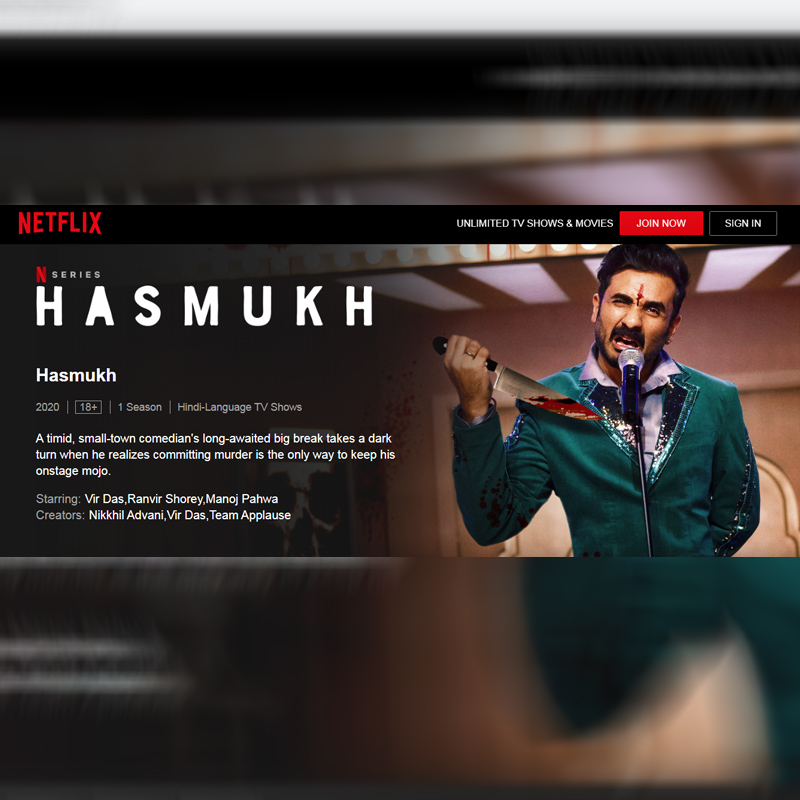
    MUMBAI: The Delhi High Court on Monday will hear a plea by a lawyer seeking to restrain Netflix from streaming a web series. The lawyer community has taken umbrage at the Netflix web series Hasmukh, because it “maligns their image and reputation.”

    The plea, moved by Supreme Court lawyer Ashutosh Dubey, points out that in episode 4 of the web series, lawyers have been branded as “thieves, scoundrels, goons and rapists.”

    The lawyer wants deletion of the contents from the series. He has also sought court directions to the producers, directors and writer of the series to tender an unconditional apology for “maligning the image of the lawyers' community.”

    "Statements (in the series) are highly disparaging, defamatory and bring disrepute to the profession of law, and lawyers and advocates in the eyes of the general public," said Dubey.

    While seeking a permanent injunction on airing the series, the advocate has maintained in his suit that the said remarks have “caused utmost damage to the legal profession and impugned the image of lawyers in the eyes of millions of viewers/subscribers, who visit the streaming website where the show is being streamed." 

  • Is it all gloomy for independent OTT players?

    Is it all gloomy for independent OTT players?

    MUMBAI: Though everyone is ravenous to take a bite out of India's rich streaming phenomenon, it's not all hunky dory for independent players. Consumer acquisition, retention and chalking out a sustainable monetisation plan are tougher than they seem. While deep-pocketed giants may survive, the road is rocky for independent platforms. 

    The downfall of two ambitious players

    Towards the end of 2019, Hong Kong-based over-the-top (OTT) platform Viu shut down its India business. The company cited highly competitive nature and the requirement of heavy investment without a path to sustained monetisation. Viu’s downfall was followed by Singapore-based telecom company, Singtel-backed, Singapore-based HOOQ. The service, available across Singapore, the Philippines, Thailand, Indonesia and India, which was also backed by Warner and Sony, filed for liquidation last month in Singapore. HOOQ said in a statement that it had been unable to grow fast enough to keep up with global and regional rivals and also noted “significant structural changes” in the OTT video market in the five years since its launch.

    The statements of both Viu and HOOQ show the inability to grow a viable business model amid stiff competition. While the wave of online content started with small independent creators in the country, it's time for them to either join hands with bigger players or exit. Especially, when players like Netflix and Disney+Hotstar are earmarking billions for this market. Homegrown players are also investing highly. The sheer amount of content library, production quality along with smart UIs speak in their favour. 

    What lies ahead for independent players?

    “There is a global recession right now and these OTTs are vouching on a lot of these global fundings, private equity fundings. COVID-19 has a big impact and there will be a recession in many countries and lot of the funding activities will slow down. Because of the current crisis, if their mtrics like success rate, viewership, time spent etc., are not good, many OTTs will also shut down in near to medium term despite being well-funded. India is an extremely fragmented market. We have 35 plus OTTs causing all the more chances of many more shutting down,” Elara Capital VP – research analyst (Media) Karan Taurani says.

    SBICap Securities institutional equity research head Rajiv Sharma brings up three aspects. He talks about customer acquisition which is becoming an expensive exercise for independent OTT platforms with more serious players coming into the picture. He also adds that Netflix can amortise content produced in India in 130 markets. Broadcasters have catch-up TV content, the movies which they had acquired for the broadcasting business as a source of basic traffic for engagement.

    “Independent platforms have a small library, no access to other content or market and moreover, they are working on a small budget. Their mortality rate is high because users will watch something and delete it. So low stickiness means higher customer acquisition cost and whatever they are producing, they are not able to amortise it over a higher set of users. So per unit content cost or production cost is higher. These are the reasons we are seeing independent platforms struggling,” Sharma explains.

    Is it all gloomy for smaller and independent players?

    Platforms like ALTBalaji, Hoichoi are thriving without funding from any big network, broadcaster or tech giant. These two platforms have witnessed good uptake in users with an attractive content slate. Moreover, they have collaborated with existing rivals also to increase their reach and find an alternative source of revenue. While we tried to find what are the factors that help them to survive, both of the platforms cited the parent company’s long-term experience of producing content, hence understanding of consumer preference.

    “I think understanding of the customers is very important and having control over content is very important. Twenty five years of understanding consumers is very important because as we make a show or acquire a  movie, we exactly know what a consumer might want. We have been in the business long. It's not a question of money only. Another thing what works well for SVF is that we  have made 150 plus movies till now. We have relationships with all the producers of the business. So, when we wanted to license a movie, we could do it from every person in the industry. We had production experience, key understanding of content, relation with the industry and talents,” Hoichoi co-founder Vishnu Mohta says.

    “Being from the house of Balaji Telefilms, who have been catering to the audiences ever-changing preferences for over 25 years now, ALTBalaji has an advantage unlike no other of having a deep understanding and familiarity with the viewer’s consumption preferences. With content being our biggest differentiator, we have been catering to all kinds of audiences through our diverse content offerings spanning multiple languages. Moreover, Indian originals have picked up pace in the past few days as audiences are on the lookout for local relatable content and are spending more time online. With content being king, there is a growing acceptance amongst consumers to pay for unique narratives and good story telling which keeps them hooked to their screens,” Balaji Telefilms group COO and ALTBalaji CEO Nachiket Pantvaidya states.

    Yupp TV, another OTT platform which is tuning its business towards ed-tech direction in India, thinks that being an early mover, consolidation has helped it.YuppTV and YuppMaster founder and CEO Uday Reddy acknowledges, “ All the players who are in space are big broadcasters. They are already in the content space. They are just evolving from linear to digital. I don’t think many independent players are left now. If they don’t invest in capital, they won’t be able to sustain.”

    With the COVID-19 crisis, things are bound to change once the situation normalise.