Tag: Netflix

  • Netflix plans to give free access for a weekend in India

    Netflix plans to give free access for a weekend in India

    KOLKATA: Netflix has been constantly innovating its marketing and promotion strategy in India to get more users to sign up. Now, it plans to give free access to the Indian audience for a weekend.

    “We think that giving everyone in a country to access Netflix for free for a weekend could be a great idea to expose a bunch of new people to the amazing stories we have and hopefully get a bunch of them to sign up. We will try that in India and we will see how that goes,” Netflix COO and chief products officer Greg Peters said in an earnings call after q3 results.

    Read more news on Netflix

    It is not easy to make a strong subscription base in India for Netflix. The competition is here not only with two-three services like Amazon Prime Video, Disney+Hotstar but with a number of homegrown services like SonyLIV, ZEE5, MX Player. Most of them offer their premium content at a much lower rate compared to Netflix. The service also started a mobile-only plan at Rs 199 last year to beat the odds which worked well for it.

    “We're constantly assessing and testing and trying to understand what's working, what's working best, how do we improve. And we do that with our marketing and promotion tactics as well. One of the most effective ways to introduce Netflix to people in different countries around the world, and based on that testing and that actual performance, we've shifted those tactics, as you note, in many, many countries, including the United States. But we also seek to innovate and come up with what are new ways that we can use to introduce Netflix to new members,” Peters also added.

    In a letter to shareholders, the service also acknowledged that it has much work to do in India to replicate the success in other APAC countries Japan and South Korea. Considerably, APAC has contributed mostly to the q3 growth of Netflix.

  • Netflix Q3 result: Continues to grow strong in APAC, much work to do in India

    Netflix Q3 result: Continues to grow strong in APAC, much work to do in India

    KOLKATA: Netflix fell short of global subscriber additions in Q3, albeit a slower growth was forecasted by the streaming giant. The company has added 2.2 million net subscribers in the quarter, even lower than its prediction of 2.5 million.

    In the first two quarters of 2020, Netflix added 15.8 million net in Q1, 10.1 million net subscribers in Q2. However, the streaming service already warned at the end of Q2 that there would be a decline in subscriber addition due to “pull forward” in the first half.

    “As we expected, growth has slowed with 2.2m paid net adds in Q3 vs. 6.8m in Q3 19. We think this is primarily due to our record first-half results and the pull-forward effect we described in our April and July letters. In the first nine months of 2020, we added 28.1m paid memberships, which exceeds the 27.8m that we added for all of 2019. In these challenging times, we’re dedicated to serving our members,” it stated in a letter to shareholders.

    Netflix posted revenue of $6.44 billion and earnings of $1.74 per share in the quarter while Wall Street analysts on average expected third-quarter sales of $6.38 billion and EPS of $2.13. For q4, it forecasts 6.0 million paid net adds which is much lower compared to 8.8 million in the corresponding quarter last year. If it achieves the forecast, it will create a record 34 million paid net adds for 2020, well above the prior annual high of 28.6m in 2018.

    “As the world hopefully recovers in 2021, we would expect that our growth will revert back to levels similar to pre-Covid. In turn, we expect paid net adds are likely to be down year over year in the first half of 2021 as compared to the big spike in paid net adds we experienced in the first half of 2020. We continue to view quarter-to-quarter fluctuations in paid net adds as not that meaningful in the context of the long-run adoption of internet entertainment, which we believe is still early and should provide us with many years of strong future growth as we continue to improve our service,” Netflix said.

    However, despite the pandemic effect on shooting, Netflix continues to expect the number of originals launched on the service to be up year over year in each quarter of 2021. It will continue to invest heavily in local language content.

    APAC, the largest contributor to q3 growth:

    While the quarter has seen a very tepid growth globally, the APAC story is somewhat different. This region was the largest contributor to paid membership growth this quarter with 46 per cent of overall subscriber addition. The revenue also rose 66 per cent year over year.

    “We’re pleased with the progress we’re making in this region and, in particular, that we’ve achieved double-digit penetration of broadband homes in both south Korea and Japan. While this is encouraging, we still have much work to do and we're working hard to replicate this success in India and other countries,” Netflix stated.

    Netflix is working with local partners like Reliance Jio in India, wherein it launched a bundle with the latter’s mobile and fibre broadband plans in Q3. As part of this broad partnership, it will integrate Netflix with two of Jio’s set top boxes. Netflix also mentioned that it partnered with financial institutions in India to make payment processing easier and more seamless, which it expects will have retention benefits. “All of these initiatives are important and work in concert with our big investment in local originals to improve the Netflix experience for our members,” it added.

  • Netflix releases Bad Boy Billionaires, albeit an episode short

    Netflix releases Bad Boy Billionaires, albeit an episode short

    KOLKATA: After months of legal tussles, Netflix has finally released its controversial docu-series Bad Boy Billionaires: India, although with only three episodes. 

    The Netflix original that dives deep into the stories of India’s most infamous billionaires – liquor mogul Vijay Mallya, fugitive diamantaire Nirav Modi, Sahara group chief Subrata Roy, and Satyam Computer Services founder B Ramalinga Raju – got embroiled in litigation due to its provocative content.

    “This investigative docu-series explores the greed, fraud, and corruption that built up — and ultimately brought down — India’s most infamous tycoons,” Netflix said in the show's synopsis.

    Read more news on Netflix

    The series was originally scheduled to release last month but was delayed following an order from a district court in Bihar, where the Sahara group argued that the show would damage Roy's reputation. According to reports, the injunction was lifted last Saturday.

    Currently, episodes based on Vijay Mallya, Nirav Modi and Subrata Roy are streaming. The digital platform, however, held back the episode on B Ramalinga Raju and his Rs 71.36 billion embezzlement scam. Raju and Gitanjali Group owner Mehul Choksi, whose name appears in the series, had also approached courts seeking a stay on the docu-series, claiming that it would affect their trials.

    Given the fact that Raju’s case is presently pending in Hyderabad court, it can be said that Netflix wisely chose not to release the episode on him till it gets the legal clean chit.

  • How Netflix is scripting India story?

    How Netflix is scripting India story?

    KOLKATA: This is an age of binge-watchers and Netflix is yet the undisputed king of the new era. Taking off with House of Cards to luring the audience to their screens with La Casa De Papel (Money Heist), the streaming giant has re-written the script of media and entertainment industry across the world. Once a US unicorn, it is now changing the reality of the industry across the world now. India indeed remains at the heart of its international expansion.

    As Netflix co-CEO and chief content officer Ted Sarandos says, “It's hard to say, how it (Indian market) could be more important. We have said from the beginning that India is a critical market in the world for us.” In a candid conversation with Film Companion editor Anupama Chopra at ET Global Business Summit Unwired 3.0, Sarandos shares insights on how Indian content is travelling outside the world, Indians are adopting global content and how the streaming giant itself is building up its understanding of the market gradually.

    Sarandos highlights that the Indian market is important not only for Netflix but for the global M&E industry. While it has been always adored for great storytelling and great cinema, the appetite for great TV content is also increasing. He says that they are very heavily invested in bringing out original stories from India. “But more importantly, we are not just growing it for India. We will grow these stories to be for the global platform so that people around the world are enjoying these stories,” he adds.

    Read more news on Netflix

    According to him, the Indian stories are travelling everywhere. Netflix’s first marquee content in India, Sacred Games played in every major market throughout Europe and Latin America. Mighty Little Bheem is now the most-watched non-English animated series in the US. On the other side, the reciprocal is true too as Indian subscribers are watching content from Spain, Korea, Japan at large scale. While the Indian stories are travelling globally, Sarandos mentions that the platform is mindful of local sensitivities.

    “It’s a very dynamic place. One of the things that I miss most since these travel restrictions of Covid2019 have been implemented is my opportunities to come to India. It's one of the most fascinating fast-moving dynamic places in the world. The energy on the ground is just you can feel it in your bones when you walk down the street,” Sarandos expresses his love for the market.

    The man who decides what the world will watch is fascinated with the consumption pattern of the Indian audiences. He is surprised by the way the Indian audience has embraced Roma and the overall diversity, breadth of programming. In the last year, more than 80 per cent of Indian subscribers have seen a film every week on Netflix.

    However, the streaming giant’s original movie slate in India is not qualitatively consistent compared to the global market. Sarandos thinks the inconsistency is due to the trial and error method as it has not been very long since when the platform has started building its Indian content library. He reassures that there will be constant improvement. “We're becoming much more ingrained in the creative culture of India,” he states.

    Streaming has been one of the very few businesses across the world which has not been crushed by Covid2019. More and more people have resorted to good stories. While the streaming services have been able to entertain the audience with fresh stories yet, the long pause in the shooting has been one of the main concerns of those platforms. Netflix is not an exception.

    Sarandos acknowledges that getting back to production safely tops the priority list to resist any interruption in the story. While it has been particularly challenging in India, it is also seeing very encouraging signs with more than 10 originals scheduled to be back for production in November. 

  • Netflix celebrates storytelling with its new campaign

    Netflix celebrates storytelling with its new campaign

    KOLKATA: The streaming giant Netflix has launched a new global campaign One Story Away. that focuses on the power of stories. The campaign running in 27 markets, which includes the Indian market also. The campaign is titled as Just a Story Away in the Indian market.

    Netflix in a statement, which appears to be the message of the campaign, says, “People have very different tastes and moods. But no matter who you are or where you are,  we’re all only just a story away from seeing, feeling and connecting more,”  

    While it is running across TV, radio, print, digital and out-of-home in some markets, the media mix is different in India. However, the Indian version of the campaign is running on digital platforms. 

    “Marketing, in general, would be about flat this year, which is still about $2 billion of spend, which is a tremendous amount of spend across our marketing channels. But it does look like it will be lower because of some of those things we're seeing in this kind of new world in terms of more virtual junkets and PR and actually not doing as much awards, marketing and those sorts of things. Now some of that is temporary in nature. Some of that is permanent learnings as to how we can be more effective going forward,” Netflix CFO Spencer Adam Neumann said in an earnings call earlier. 

    The Crown reminded us that all families are the same. Guilty told us about the good that can happen when you stop caring about what the world thinks of you and instead focus on what you believe in. 

    Sacred Games was a window into a world we knew so little of, and brought us closer to understanding some people’s need for power. We wanted to be a little bit more like Chris Hemsworth in Extraction and that probably motivated some of us to workout. The list is endless.

    This is the premise behind the new campaign.

    The streaming giant has been strategically spending its marketing dollars in India. They have always spent heavily to promote big launches such as Sacred Games, Ghoul, Selection Day and its subscription plans, especially the mobile only plan priced at Rs 199. The brand has extensively use outdoor media such as metro trains, hoardings and others to create a high recall for its lineup.

  • 65% millennials and Gen Z prefer OTT over TV, report says

    65% millennials and Gen Z prefer OTT over TV, report says

    KOLKATA: Urban India’s youth has relied on OTT platforms to kill monotony. Amid other options, the streaming services have emerged as the most popular source of entertainment as 70 per cent of the youth have turned towards OTT platforms in their spare time. Along with existing subscribers, new OTT subscription purchases during the lockdown period spiked throughout the country across demographics.

    According to a report from The Data Sciences Division of Dentsu Aegis Network (DAN) India, 65 per cent of millennials (25-39 years) and Gen Z (5-25 years) prefer consuming video content on an OTT platform over TV. The younger the audience is, the habit of consuming OTT is higher. The report also shows that daily OTT content consumption among Gen Z is higher than millennials. 

    While before lockdown 95 per cent of the respondents used to consume only two-three hours of daily content, during lockdown on average each millennial has consumed 1.66 hours of additional content and GenZ is consuming two-three hours of additional content too.

    As a result of having more time at hand, binge-watching is becoming a prime trait of popular culture. While five per cent of the research universe has claimed to consume between six-twelve hours of daily content on OTT platforms in pre-pandemic period, currently 20 per cent of the sample is enjoying binge-watching. Millennials and Gen Z’ s purchased two and three additional OTT platform subscriptions respectively since the start of the lockdown. The average daily consumption hours have remained around four hours.

    The international platforms with expanding local content library are becoming popular choices. 60 per cent of the sample has a subscription to either Amazon Prime Video or Netflix. Disney+Hotstar also has been able to attract nearly 19 per cent of the urban youth. Homegrown platforms like ZEE5, Voot are creating a buzz gradually. Comedy, thriller and action-based entertainment were the top three preferences of GenZ audiences while millennials were more inclined towards consuming a lot more Sci-Fi over thrillers. Money Heist, Breaking Bad, Paatal Lok, Narcos, Riverdale, Friends were all the rage among the episodic content. 

    Another interesting trend that has come out of the study is that OTT based gaming has gained significant popularity during the lockdown period. While the curve of heavy gaming remained constant, casual gaming saw a steep increase in popularity. However, millennial audiences were significantly less likely to consume OTT based gaming when compared to their GenZ counterparts.

    OTT platforms have traditionally been more favoured by the young audience for the nature of the content it produces. Surprisingly, 11 per cent of the respondents criticised OTT platforms of imposing, glorifying and promoting “Content disgracing a religion or a caste”. These criticisms were accompanied by a majority (73 per cent) criticising the depiction of anti-national sentiment, foul language and bold as well as smutty content.  “Pop up Ads” were also criticised for harming the seamless viewing experience. Despite the growth of broadband across the country, connectivity issues are prevailing until now.

    The OTT industry is anticipated to grow 45.5 per cent during the forecast period 2019 to 2026. Along with the humongous growth, increased collaborations between OTT platforms and pay up TV, further hybridization and evolution of OTT monetization models could be more noticed going forward. India is expected to emerge as the second-largest OTT market with 500 million users by 2020 itself. 

  • Netflix streamlines content team, Bela Bajaria to lead global TV

    Netflix streamlines content team, Bela Bajaria to lead global TV

    KOLKATA: Netflix has elevated Bela Bajaria as vice president global TV in order to streamline its content team. Cindy Holland, original content vice president quits as a part of the major shakeup at the organization. Holland has served for nearly two decades at the streaming giant.

    Bajaria joined Netflix in 2016 and she was given the mandate of unscripted programming and international content. Over the years, international content has been put at the heart of Netflix’s overall content strategy as the platform’s growth in the domestic market has become saturated.

    While several executives have led the different segment of Netflix’s TV programming, the film division was streamlined in the past. “Since becoming co-CEO, I’ve wanted to simplify the way our content teams operate,” Netflix co-CEO Ted Sarandos explained.

    "These kinds of changes are never easy, and I am enormously grateful to Cindy Holland for everything she has done over the last 18 years at Netflix — first licensing DVDs and then as the driving force behind our first eight years of English original series. Cindy’s been a great champion of creators and the power that comes from seeing more perspectives reflected on-screen — launching enduring dramas like Orange is the New Black, Stranger Things, and The Crown. Most important of all she’s been a fabulous colleague. We wish her all the best for the future,” Sarandos commented on Holland’s departure.

    According to reports, Bajaria was courted by NBCUniversal to oversee all entertainment programming across its several divisions. Now, she will oversee all original programming, scripted and non-scripted in both the English and non-English languages at Netflix. 

  • Leading OTT players agree to universal self-regulation code

    Leading OTT players agree to universal self-regulation code

    KOLKATA: The Internet and Mobile Association of India (IAMAI) has unveiled the Universal Self-Regulation Code for OCCPs (“Code”). The code has been adopted by 15 leading Online Curated Content Providers in India. The present set of signatories include Zee5, Viacom 18, Disney+Hotstar, Amazon Prime Video, Netflix, MX Player, Jio Cinema, Eros Now, Alt Balaji, Arre, HoiChoi, Hungama, Shemaroo, Discovery Plus, Flickstree.

    The goal of this industry-wide effort is to empower consumers with information and tools to assist them in making informed choice with regard to viewing decisions for them and their families, while at the same time, nurturing creativity and providing creators the freedom to tell the finest stories. By aiming to do what is best for both consumers and creators as guiding principles, the Code intends for India to be one of the most dynamic and fastest-growing entertainment industries in the world.

    To give consumers more choice and control, the Universal Self-Regulation Code includes a framework for age classification and content descriptions for titles as well as access control tools. The code also introduces a clear, transparent and structured grievance redressal and escalation mechanism for reporting non-compliance with the prescribed guidelines. As a part of this mechanism, each OCCP will set-up a consumer complaint department and/or an internal committee as well as advisory panel which will deal with complaints, appeals and escalations. The advisory panel will constitute a minimum of three members, including an independent external advisor and two senior executives of the respective OCCP. 

    IAMAI digital entertainment committee chairman Tarun Katial said, “The Universal Self-Regulation Code for OCCPs is built around a shared belief that consumer empowerment and creative excellence are key to the long-term success of the Indian entertainment industry. With the framework for age classification, content descriptions and parental controls in combination with a grievance redressal system, we’ve made it easier for consumers to make the right viewing decisions for themselves and their families.” 

    “The combination of empowering consumers and enabling creative excellence will help Online Curated Content Providers be at the forefront of taking the best stories from India to the world and bringing the finest stories from around the world to Indian consumers. Most of the major streaming services have adopted the Code and we look forward to others joining.” he added.

    The code is effective from 15 August and allows OCCPs to comply with all the guidelines in a timebound manner. Each signatory to the code has agreed to appoint an external advisor as part of the grievance redressal mechanism within 60 days from today.

  • Netflix offers free content sampling to viewers without signing up

    Netflix offers free content sampling to viewers without signing up

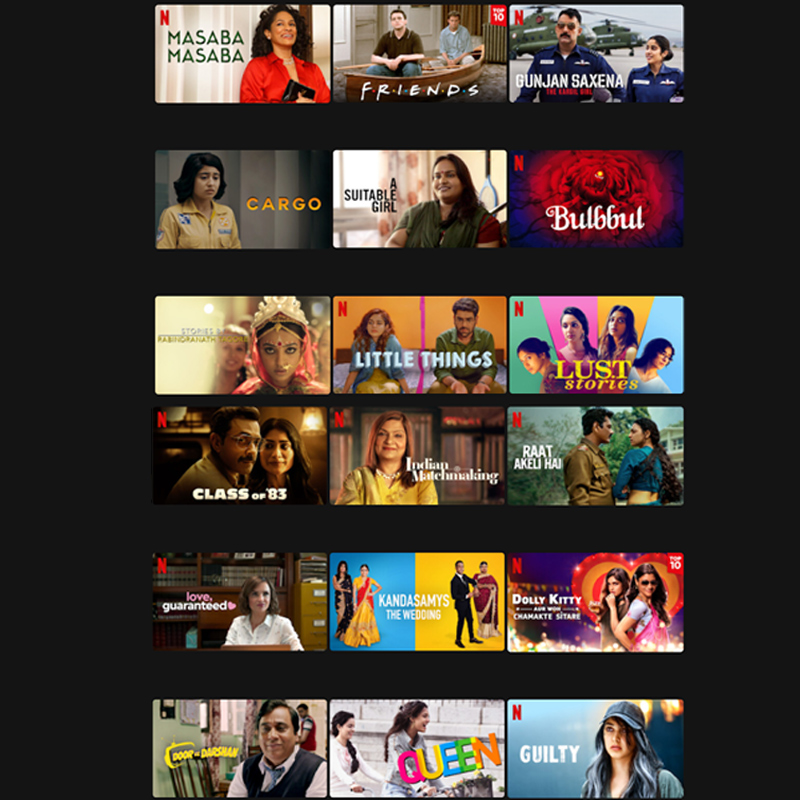
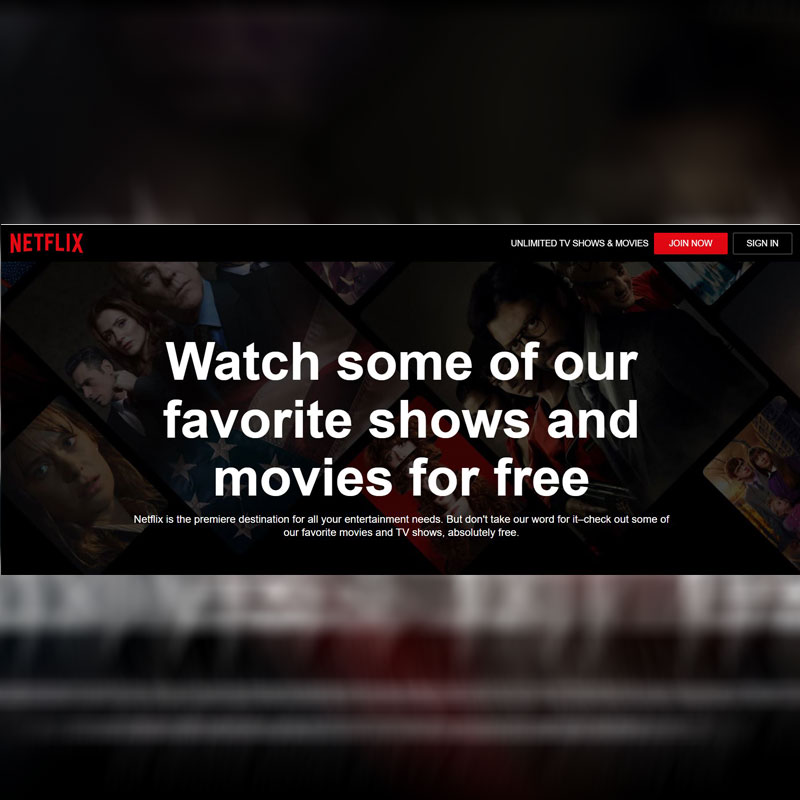
    KOLKATA: Netflix takes a new route to bring more consumers to the platform. It will now let viewers sample some of the most popular content without an account. It has launched a page dedicated to Netflix's original movies and TV shows that are free to watch globally. 

    It is offering the first episodes of popular episodic originals like Stranger Things, Our Planet, Boss Baby: Back in Business, When They See Us, Love is Blind, Elite, and Grace and Frankie. Films like Bird Box, Murder Mystery, The Two Popes. 

  • Netflix’s upcoming documentary ‘Bad Boy Billionaires: India’ gets into legal trouble

    Netflix’s upcoming documentary ‘Bad Boy Billionaires: India’ gets into legal trouble

    KOLKATA: Streaming giant Netflix has recently launched the trailer of upcoming documentary Bad Boy Billionaires: India. However, it has got into a controversy where fugitive businessman Mehul Choksi has moved to Delhi High Court against the show.

    “This investigative docuseries explores the greed, fraud, and corruption that built up — and ultimately brought down — India’s most infamous tycoons,” Netflix says in the description of the show which is slated for release on 2 September.

    According to media reports, Choksi’s advocate Vijay Aggarwal, sought postponement of the documentary’s release as it may hamper the investigation.

    “Thereafter, the petitioner (Choksi) discovered that one of the persons seen speaking in the trailer was one Mr Pavan C Lall who had written a book titled Flawed: The Rise and Fall of India’s Diamond Mogul Nirav Modi where also the petitioner’s name had been commingled with Nirav Modi’s,” the plea read.

    Tags: Bad Boy Billionaire, Netflix, Netflix India, OTT, Mehul Choksi, Delhi High Court