Tag: Netflix

  • Netflix tests ‘Mobile+’ plan in India priced at Rs 299 a month

    Netflix tests ‘Mobile+’ plan in India priced at Rs 299 a month

    KOLKATA: Over the last two years, streaming giant Netflix has been experimenting with its pricing model as well as marketing strategy in India. After seeing massive success of its first mobile only plan, the company is testing “Mobile+” plan at Rs 299 per month.

    “We launched the mobile plan in India to make it easier for anyone with a smartphone to enjoy Netflix. We want to see if members like the added choice Mobile+ brings. We’ll only roll it out long-term if they do,” a Netflix spokesperson told Indiantelevision.com.

    The Rs 299 plan lets users stream content in HD quality on one screen at a time, be it mobile, tablet, or desktop/laptop.

    India was the first country where the streaming service launched its mobile only plan at Rs 199 per month in July 2019. The existing mobile plan supports streaming in SD only on a single mobile device at a time. Notably, Netflix members in India watch more on their mobiles than subscribers anywhere else in the world. Post the launch, the streamer stated the ambitious low-priced mobile plan saw better uptake than the initial testing suggested.

    All markets or households don’t have wired broadband connection yet but most of them have a good smartphone and high-speed mobile data. Hence, the new plan, if launched, will give more options to consumers. However, if consumers don’t find value in it, Netflix will not roll it out more widely.

    Netflix recently unveiled its impressive 2021 line up of 40 plus originals. “Everyone has different taste, different preferences, different moods and they watch Netflix on different devices. Whether you are watching alone or with your family, whether you have 20 minutes or two hours, we work hard to make sure Netflix always has something great for you. This is exactly why we create so many stories across genres, languages, formats for you to choose. This year we are ready to take our next big leap to entertain India,” Netflix India vice president content Monika Shergill said.

  • Netflix India in step with global trend of nearly 50% female representation: Srishti Behl Arya

    Netflix India in step with global trend of nearly 50% female representation: Srishti Behl Arya

    KOLKATA: Netflix added inclusion as its cultural value in 2017. Recently, the streaming giant released its first ‘inclusion report’, which revealed that women comprised 47.1 per cent of its workforce. The company, a vocal proponent of gender equality, has featured women in the lead role in many of its original shows and films as well. The balance between an inclusive internal community and female representation on screen is being followed in India as well, Netflix India international original film director Srishti Behl Arya said.

    Since joining Netflix in 2018, Behl Arya has been front and centre in building the streamer’s local content library. She has seen the industry grow and evolve – from the time when there were only a handful of women on film sets, before streaming platforms had entered the scene. She used to be the only woman on set as an assistant director; things have come a long way since then, but there is still a lot to be done. For starters, said she, we need to reach a point when we stop referring to “women director” as something extraordinary.

    “As far as Netflix is concerned, we have even put out an inclusion report globally, we are showing that almost 50 per cent of our workforce is women and that’s the same thing we are seeing in India as well. Not just in the workforce but also in leadership positions,” Behl Arya shared during a virtual interaction. In 2021, the company will be working with 18 women directors and it is already collaborating with over 1,000 women creators in various roles.

    She further added that last year, 50 per cent of Netflix’s film titles had a woman producer or a woman director. Nearly half of its entire content had women playing central roles. Moreover, the company is giving equal opportunity to newer people as well, rather than riding on established names alone.

    “As you see all the members, you see all our subscribers are divided between male and female. When the population of the world is divided in such a way, it’s not right to not represent half the population of the world. That’s a very logical next step for us. And I think what has happened is more and more female members are also finding their voice now. That itself is giving rise to more and more stories about women and more stories, very importantly, from women’s point of view,” she noted.

    Behl Arya reemphasised how Netflix is committed to diversity of all types. According to her, it will come by including more and more voices and stories, as more people want to see themselves reflected on screen.

    The Netflix executive also said the change is also about giving women access to tools to aid their quest for equality and representation. The streaming giant recently created a $100 million global fund for creative equity aimed at more inclusive pipelines behind the camera. $5 million of that fund will be deployed for women all over the world. As part of the initiative, Netflix will be conducting screenwriting workshops for women over the course of a year. In India, the company had many first time female producers, writers, directors.

    “The idea is to enable women to come forward and provide comfort for them to share their stories and that is something that we are actively working on. In fact, right now, in one of our titles, we have a first-time female cinematographer,” she commented.

    There is a common notion that companies hire women leaders in tried and tested roles. However, the scenario is entirely different for Netflix. “We have great representation in the tech side at our Los Gatos office. We have lots of women working on our film side, all our regions, we have them in our production management, VFX, we have women working in marketing and different aspects of it. India office is also following the global trend of close to 50 per cent representation of females. There is no function we can say that is not touched by women,” she remarked.

    While many OTT platforms boast their ratio of female viewership, Netflix India takes a different approach. Behl Arya clarified that Netflix does not divide viewers on the basis of gender, age. It’s the viewing of the title that matters.

    “We have the same high bar for all the countries we are programming and for all the employees and the same standard, we want to maintain all our subscribers. It helps us think things a little differently from how other traditional players think,” she stated.

    Overall transformation in the industry, including at Netflix, was not easy to come by. Women have increasingly stepped up in uncomfortable circumstances to prove their competence. Along with that, men also frequently supported and enabled them.

    “As we break more and more bastions, we will find more and more opportunities to prove how good we are and we are here to entertain and do it really well and it just makes sense to work with more and more people bringing in the diversity,” Behl Arya shared on a confident note.

    Despite the positive changes, one may observe there are only a few women in the upper echelons, which applies to video streaming services too. However, Behl Arya begged to differ. She cited the example of industry leaders like Ekta Kapoor who runs the OTT platform ALTBalaji; Reliance media segment has Jyoti Deshpande at the top, south-based Annapurna Studios CEO Supriya Yarlagadda, ex-Sony Pictures Networks’ (SPN) film production division head Sneha Rajani. Having said that, she raised an important point.

    “There are women in the position but I think that we are still not used to seeing them so they stand out. That’s exactly my dream is that one day gender will not stand out because it will be so common,” she summed up.

  • Netflix India reveals 2021 line-up consisting 40+ originals

    Netflix India reveals 2021 line-up consisting 40+ originals

    KOLKATA: Netflix is upping the stakes when it comes to its streaming game in India, revealing its 2021 line-up comprising 40 plus originals. At a virtual event called ‘See What’s Next India 2021’, the streamer has given glimpses of its new content slate that cuts across genres.

    “Everyone has different taste, different preferences, different moods and they watch Netflix on different devices. Whether you are watching alone or with your family, whether you have 20 minutes or two hours, we work hard to make sure Netflix always has something great for you. This is exactly why we create so many stories across genres, languages, formats for you to choose. This year we are ready to take our next big leap to entertain India,” Netflix India vice president content Monika Shergill said at the event.

    Its newly announced 15 episodic series slate includes mystery thriller Aranyak, Bombay Begums, Decoupled, ray, Yeh Kalie Kalie Akhein. Along with the new releases, returning seasons of famous shows like Masaba Masaba, Jamtara, Little Things, Mismatched, and She will land on the platform soon.

    The fresh line-up also includes more than Netflix original movies, like the moving family drama Sardar Ka Grandson with Arjun Kapoor and Neena Gupta. Taapsee Pannu starrer Haseen Dillruba, the relationship drama Ajeeb Daastaans, and Ekta Kapoor production Pagglait are set to release on the streaming service tum the coming months.

    “In India, we love films, everything about films – stories, storytellers, starts, sometimes the songs, sometimes the action, thrill. But more than anything it’s the magic of cinema we love. Netflix has had the honour of bringing 30 Indian original films so far , including 17 films just last year,” Netflix India international original film director Srishti Behl Arya said.

    “Our upcoming line-up features more variety and diversity than we have seen before. From the biggest films and series, to gripping documentaries and reality, and bold comedy formats,” Shergill said in a blogpost. Netflix has also expanded its comedy library onboarding TV star Kapil Sharma, along with other known comedians like Sumukhi Suresh. The international streaming giant has content lined up in non-fiction genres like reality TV ( and documentaries.

    In India’s crowded streaming market, Netflix is still lagging behind Disney+Hotstar, the shining star with nearly 28 million subscribers in the country. According to a report from Media Partners Asia, YouTube (43 per cent), Disney+ Hotstar (16 per cent), Netflix (14 per cent), Amazon Prime Video (seven per cent) remained the top five platforms which accounted for a combined 80 per cent share of total revenues in 2020.

    The country's overall online video market is projected to grow at a compound annual growth rate of 26 per cent over 2020-25 to reach $4.5 billion. Netflix which has been widely perceived as a “premium” service compared to its contenders, putting all efforts to reach the critical mass. It even unveiled a mobile only plan to woo the users.

  • India online video opportunity to scale to $4.5 billion by 2025

    India online video opportunity to scale to $4.5 billion by 2025

    NEW DELHI: 2020 was a breakthrough year for over the top (OTT) streaming platforms. India’s online video industry generated an estimated $1.4 billion in revenue in the year, with advertising contributing 64 per cent and subscription 36 per cent, said Media Partners Asia (MPA) in its ‘India Online Video and Broadband Distribution’ report.

    India is currently the fastest growing OTT market. According to MPA, the country's overall online video market is projected to grow at a compound annual growth rate of 26 per cent over 2020-25 to reach $4.5 billion.

    There are around 60 platforms operating in the Indian OTT landscape. However, YouTube (43 per cent), Disney+ Hotstar (16 per cent), Netflix (14 per cent), Amazon Prime Video (seven per cent) remained the top five platforms which accounted for a combined 80 per cent share of total revenues in 2020.

    “Subscription based online video services benefited significantly in 2020 as the country went into the lockdown. Key players are investing in premium local content while leveraging sports, movie rights and aggressive consumer pricing to drive subscriber adoption. The subscription video-on-demand (SVoD) market will remain competitive as Disney+ Hotstar scales its direct subscription business while Netflix and Amazon Prime Video deepen partnerships with mobile and fixed broadband operators. These three platforms accounted for almost 80 per cent of the SVoD revenues in 2020,” said MPA India vice president Mihir Shah.

    YouTube remains the market leader in AVoD, accounting for 67 per cent of total online video advertising in 2020. But, its market share is expected to decline to 55 per cent by 2025 as domestic broadcaster-backed platforms and short form user-generated content (UGC) video players expand their presence. “Local premium content and sports rights will help broadcaster-backed platforms gain share. Increased reach and engagement with rural millennials will improve monetisation for short-form video platforms,” added Shah.

    According to its projections, the SVoD market could reach $1.9 billion by 2025, a 30 per cent CAGR from 2020.

    Online video advertising reached an estimated $909 million in 2020, a marginal decline of two per cent y-o-y as reduced demand has forced advertisers to recalibrate advertising budgets. The AVoD segment is expected to expand at a CAGR of 24 per cent over the next five years to reach $2.6 billion by 2025.

    India OTT content investment reached $700 million in 2020 as both domestic and global platforms are investing in the country’s burgeoning SVoD opportunity. The budgets for originals and local acquisitions continue to trend upwards. As a result, the OTT content costs are projected to grow at a CAGR of 18 per cent in the next five years to reach $1.6 billion, said the report.

    The 4G revolution drove the country’s mobile broadband penetration to 43 per cent as of December 2019. With commercial rollout of 5G expected to begin in 2021, India’s mobile broadband penetration is forecast to grow steadily to 66 per cent by 2025. India's fixed broadband market remains under-penetrated at merely six per cent of households, but fresh investments by private telecom players have renewed the market. According to MPA, the country's fixed broadband market is projected to grow at a CAGR of 18 per cent between 2020 and 2025 to reach 45 million subscribers with more than 82 per cent of subscribers through fiber.

    With the infrastructure upgrades, consumers are identifying new uses for the expanded broadband capacity including work from home, education from home, video conferencing, as well as online video streaming.

    Alliances and partnerships are emerging which facilitate the sale of VOD and data bundling packages. Jio has collaborated with all leading platforms, while Airtel has tied-up with Amazon Prime Video and Zee5 for its fixed broadband offering.

  • StreamFest brings cheer for Netflix

    StreamFest brings cheer for Netflix

    KOLKATA: In a unique promotional gimmick, Netflix offered Indian audiences all of its content for free over a weekend last month. The move seems to have yielded fine results for the streaming service, as it has witnessed a sharp rise in app installs, open rate, daily active usage during that period, according to Kalagato.

    After Netflix stopped offering a free monthly trial, the platform came up with this innovative marketing campaign to get more people to sample and subscribe to the service. On 5 and 6 December, non-users of Netflix could sign up with their name, email or phone number, and password and gain access to the content library without any payment. Following the overwhelming response, the streaming giant came back with round two on 9-11 December.

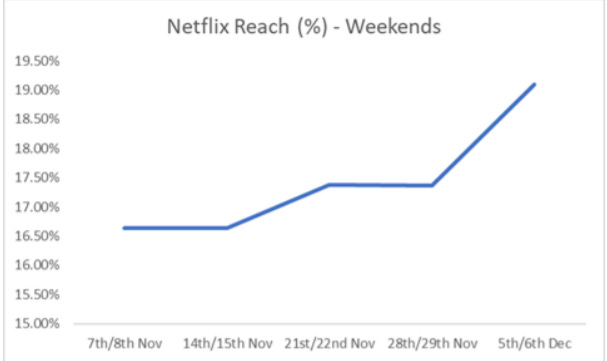
    One of the most obvious impacts of this campaign by Netflix was an increase in app downloads during the promotion period, with the reach seeing a spike of 13 per cent during the weekend of 5-6 December, compared to average reach of the previous four weekends. Notably, the spike of 15 per cent was sharper on Sunday, compared to 10 per cent on Saturday. All other apps excluding SonyLiv and Wynk remained more or less consistent with previous weeks’ performance.

    (Source: Kalagato)

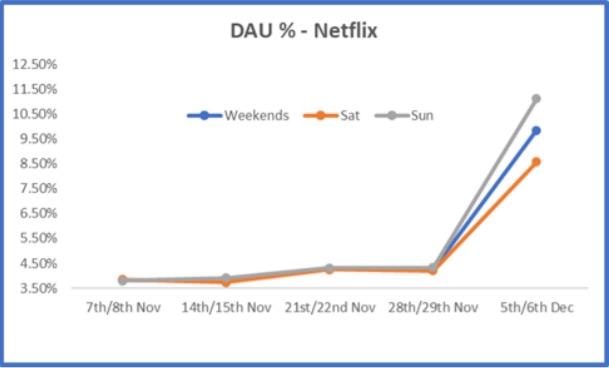
    Along with improved access, Netflix saw 243 per cent DAU jump during the weekend. Saturday saw a rise of 213 per cent whereas Sunday saw figures reaching 271 per cent over the previous four Sundays.

    (Source: Kalagato)

    This impressive uptick in activity on Netflix, however, did not have any discernible impact on the usage of platforms like Facebook, Instagram, Whatsapp, Twitter or YouTube. Among other OTT apps, Disney+ Hotstar and Amazon Prime Video saw drops of 11 per cent and 17 per cent respectively. SonyLiv and Wynk Movies also saw significant spikes in DAU — to the tune of 127 per cent and 148 per cent respectively.

    Open rates for Netflix saw a spike of 135 per cent on average compared to the previous four weekends, 128 per cent on Saturday, and 141 per cent on Sunday. Amazon and Disney+ Hotstar, on the other hand, witnessed drops of six-eight per cent in open rates during this period. Some of these apps also saw lower time spent on their platforms. According to the report, drops of 10-12 per cent were seen across OTT apps of Amazon Prime Video, Disney+ Hotstar, MX player, Vodafone Play and Voot. On the other hand, Netflix saw a rise of 18 per cent in time spent on Sunday.

  • #Throwback2020: Best brand tweets in India

    #Throwback2020: Best brand tweets in India

    NEW DELHI: Twitter is a reflection of what’s happening in the world and what people are talking about. Over time brands across categories have leveraged Twitter’s ad offerings and influence to strengthen their presence among audiences. This year, as businesses pivoted to digital-first campaigns, Twitter emerged as an indispensable partner to launch something new and to connect with consumers. The constraints of 2020 encouraged brands to be more creative, thoughtful and personal, resulting in campaigns that warmed the heart and left people wanting more. Let’s look back at some brands and campaigns that stood out and made a difference with their Twitter salvos: 

    Best brand for speaking out and standing up: Axis Bank for #ReverseTheKhata

    While nearly every industry was drastically impacted in 2020, the worst-hit were local vendors and small businesses, with many being pushed to the brink. Axis Bank took up the cause and asked people to #ReverseTheKhata, referencing the bond between customers and their corner shop through the maintenance of a ‘khata’. The khata is based on the trust and loyalty shared between the two parties. The campaign showed us different moments on the relationship between customers and small businesses, projecting the various emotions that bubble up from the simple statement – Khate mein likh do – urging people to reverse roles and support vendors who have continued to serve us while keeping our accounts. The campaign used a clever and relatable insight, connecting with its audience in an authentic way, making it the best brand for speaking out and standing up. 

    Best #OnlyOnTwitter campaign: Netflix India for #NetflixMatchmaker

    We love to watch our favourite series and films on Netflix and look for the best recommendations, including on Twitter. Netflix India built on this insight and launched #NetflixMatchmaker. This innovation allowed a customised bank of emojis to serve fans a personalised experience on Twitter, helping them decide what to watch. So, how does it work? When someone tweets an emoji with the hashtag #NetflixMatchmaker, they are rewarded with a content recommendation tied to that specific emoji. For example, tweeting a gift emoji might send a recommendation for a holiday movie. Netflix knew there would be an ongoing demand for recommendations, so #NetflixMatchmaker pops up every weekend to help people match their mood to what they could enjoy streaming. This is why they had the best #OnlyOnTwitter campaign this year.  

    Best brand that brought the stadium to the phone: Star Sports

    To make up for the lack of on-ground sports experiences, Star Sports turned to Twitter to bring fans closer to all the sporting action, especially on two key occasions – the Indian Super League (ISL) and the Indian Premier League (IPL). 

    During the ISL’s  #TrueLove campaign on Twitter, Star Sports invited football fans to send in tweets with messages for their favourite footballers. At the trophy-lifting ceremony of what was a thrilling finale between ATK FC and Chennaiyin FC, these love-filled tweets presented in a physical form as Twitter-confetti and were showered upon the winning team covering them with #TrueLove for this one-of-a-kind activation. 

    For the IPL, Star Sports cued people in for the opening match through reminders on Twitter, activated by the Heart-To-Remind functionality. The brand also changed their Twitter username to ‘Star Sports at 7:30 PM’ to mark the time slot as the viewing time for the IPL. 

    Their consistent usage of Twitter to connect fans to the games they love made Star Sports the brand that brought the stadium to the phone. 

    Best campaign celebrating fandom: Samsung India for #GalaxyS20PlusBTS edition

    While launching the #GalaxyS20PlusBTS edition, Samsung routed its campaign towards the massive BTS fandom on Twitter. The brand launched a custom BTS quiz to engage with the K-pop band’s ARMY on the service who could put their love to the test and even stand to win a pair of the Galaxy Buds+ BTS edition. This carefully targeted campaign not only reached its audience but also had them glued to their Twitter timelines through a series of promoted tweets with creatives featuring various members of the band. The BTS edition campaign was part of a sustained promotion plan for the S20+, with the global launch event achieving millions of views worldwide. Samsung India’s clever use of Twitter to connect with their consumers made it the campaign that best celebrated fans. 

    Best brand connection to the couch: Amazon Prime Video for #Mirzapur2

    #Mirzapur2 hype on Twitter was real, evidenced by the many tweets begging Prime Video for the second season. As the OTT service finally prepared to premier the series, it decided to count down to the launch along with eager fans, and host a watch party to finally answer everyone’s wishes and get people watching (and reacting) together. Through a carousel events page, the brand curated a timeline of all conversations around #Mirzapur2 and also rolled out exclusive content leading up to the big day. A ‘Mirzapur throne’ emoji was also launched to fuel excitement. 

    But that was not all, following the watch party, the show’s characters were leveraged to engage the audience via a personality test pairing people with their favourite #Mirzapur characters when engaged with the tweet. Their thoughtful end-to-end integration and celebration of such a popular show earned them the title of best brand connecting all of us to our couch. 

    Best brand for pivoting when it counts: Uber India for #MoveWhatMatters

    At a time when everyone was being encouraged to stay put, Uber India, a brand that is built on doing the opposite, responded in just the right way. Playing off their slogan to #MoveForward, they suggested we #MoveWhatMatters. The brand echoed what we were hearing from public health authorities, asking people to stay home and stay safe, while their drivers continued to serve India’s essential workers. Moreover, the ride-hailing app also urged people to come out in support of their driver-partners who had also been impacted by the pandemic and set up the Uber Care Driver Fund. In a time when people needed to be assured of their safety, Uber India made its priorities clear.

    Best virtual launch: Hyundai India for the TUCSON launch with #TheNextDimension

    Hyundai India moved ahead and launched its new TUCSON via a magnificent (virtual) event called #TheNextDimension. Hyundai adopted a three-phased strategy for the launch; it acquired an active viewership through the Heart-To-Remind functionality, which reminded people to tune-in for the launch; it took over the service’s premium real estate with a promoted trend and livestream to maximise visibility, and to wrap up the launch it tweeted highlight videos from the event which were injected into people’s timelines via promoted tweets, making sure nobody missed the action. Despite not taking place on-ground, this campaign by Hyundai proved that launches can be as successful virtually. The live event recorded over 1 million views in the first 12 hours itself, making it a winner in the best virtual launch category. 

    Best new brand on the block: Cred

    Fintech start-up Cred was all over Twitter timelines in the best way. Launching its first-ever campaign with a series of videos, the brand made a strong impact, reaching new customers. The campaign was spearheaded by some of the strongest voices in the public space, including the founder himself. Moreover, picking up on a trend around nostalgia, they worked with some of the most iconic talent from the 90s and early 00s including, Govinda, Bappi Lahiri, Madhuri Dixit Nene, Anil Kapoor, Udit Narayan, and others in a creative way, ensuring mentions of CRED on Twitter reached new highs.

    Best brand voice: Zomato

    Restaurants may have been closed to visitors earlier this year, but delivery services like Zomato made themselves indispensable. And maybe because Zomato was experiencing it themselves, they knew just what to say to keep people on Twitter engaged. Keeping up with cultural moments and trends, the food delivery app stayed connected with its audience through conversations that were fun, light-hearted, and more often than not, perfectly hilarious. From being excited about a cricket match to being grumpy because of hunger pangs, Zomato engaged with its audience in one-on-one banter, replying and engaging with tweets. Adopting a sensitive voice, yet full of personality, the brand built its own community of followers making it the best brand voice on Twitter this year. 

    Best brand Fleet: IndiGo

    Since the test launch of Fleets in June, several brands have embraced it with content designed especially for the format. IndiGo stood out by engaging with its followers through consistent and coherent messaging via Fleets. Adhering to the needs of its patrons, the brand has been using the format to keep passengers informed about flight schedules and other real-time updates. Their diving into this new Twitter format gives them the title of best brand Fleets! 
  • How brands are saying goodbye to 2020

    How brands are saying goodbye to 2020

    NEW DELHI: 2020 is probably the only year that the whole world was dying to bid adieu too. Inundated with crises from all sides on top of a global pandemic, when many a plan was cancelled and existence became a little lonelier for almost everyone, the year nonetheless made us realise the value of little joys in life. One of which was dear internet! Filled with content for our every mood, it kept us entertained via a number of stories, creatives, memes, and information. The brands, as usual, made it an interesting place to be at. And now as the year is ending, here’s how some brands are again displaying their quirky sides to say bye-bye! 

    Durex is strangely waiting for someone to come early


    A post shared by Durex India (@durex.india)


    Domino’s thanking the best friend of the year for all – pizza


    Netflix vibing with the “dukh” of everyone


    A post shared by Netflix India (@netflix_in)


    Amazon Prime putting the good and the bad all together


    Zomato giving the best meme rewind


    A post shared by zomato (@zomatoin)


    Google showing what we searched for 

    And Swiggy giving hopes for 2021


    A post shared by Swiggy (@swiggyindia)


  • Myleeta Aga quits Netflix

    Myleeta Aga quits Netflix

    KOLKATA: Following an internal realignment of the southeast Asia and Australia content teams, Myleeta Aga has moved on from Netflix. Aga joined the streaming service in 2019 after a decade-long stint at BBC Studios.

    She was mandated to head content operations for southeast Asia and Australia. “It’s been an amazing year! I am proud of the work that our team has done, putting Southeast Asia and Australia on the map for Netflix, and showcasing the phenomenal potential of the creative community across these countries to audiences at home and around the world. I believe in the power of great stories, and I am confident in the success that lies ahead,” she said as quoted by Variety.

    According to the report, Seoul-based Kim Minyoung will oversee content planning in the region. Aga’s departure is a result of Netflix’s country-specific focus in the region, rather than having a centralised control. The platform has also thanked Aga for her contributions.

  • Netflix’s Reed Hastings skims $225 mn in stock sale

    Netflix’s Reed Hastings skims $225 mn in stock sale

    MUMBAI: Netflix co-chief executive officer Reed Hastings has collected $225 million from a stock sale, the latest in a series of such transactions the billionaire has made this year, totalling $616 million.

    A Bloomberg Quint report states that Hastings has cashed in enough moolah in 2020 to produce all four seasons of marquee series The Crown, all six seasons of Peaky Blinders, or the equivalent of about 4.7 million annual Netflix subscriptions, based on average monthly subscription costs. The sales, the latest of which was on 21 December, were made as part of a trading plan believed to boost the streamer-producer’s content creation budget.

    Netflix stock has climbed 63 per cent this year as the streaming service has added 28.1 million new subscribers during the first nine months of 2020, accelerated by increased demand for at-home entertainment during the Covid2019 pandemic. In fact, Hastings has seen his wealth increase about $2.2 billion this year to $6.4 billion, going by Bloomberg Billionaires Index, which also pegs him as the 120th richest person in the US.

    Hastings sold 437,311 shares of Netflix stock on 21 December 2020 at an average price of $527.26 a share. The total sale was $230.6 million. Prior to this, he sold 213,346 shares on 23 November 2020 at the average price of $482.51. The price of the stock has increased by 9.29 per cent since.

    For the uninitiated, Hastings started his first tech business, Pure Software, in 1991, before going on to co-found Netflix with Pure colleague Marc Randolph in 1997.

    Another former Netflix director Anthony Wood, who is also the co-founder of Roku Inc, has made hay during the pandemic. Wood’s wealth has doubled in the last three months as sales of the firm’s streaming players increased 57 per cent in the third quarter from a year earlier.

  • MGM Studios explores prospect of sale

    MGM Studios explores prospect of sale

    NEW DELHI: Iconic Hollywood studio MGM has appointed two investment banks to explore the prospect of a sale, The Wall Street Journal has reported. For the record, there have been talks in the market about MGM being sold for several years now, all of which have failed to materialise.

    MGM, currently valued at $5.5 billion, has brought onboard Morgan Stanley and LionTree LLC as consultants on the process of a formal sale. The studio is owned by hedge funds Anchorage Capital, Highland Capital and Solus Alternative Asset Management, who acquired the company out of bankruptcy in 2010. The acquisition reportedly cost $10 billion but the onslaught of the novel Coronavirus has further devalued the legacy production company, which has a chequered history when it comes to its financial well-being. MGM also gave the pink slip to at least 50 employees and furloughed a third of its staff in April due to the economic fallout from Covid2019.

    In fact, the next instalment of its blockbuster James Bond franchise, No Time to Die, has been delayed several times due to the pandemic, and is now slated for an April 2021 release. However, industry pundits forecast the movie will be pushed back further because people are not going to theatres, as evidenced by the lukewarm response to the international release of Warner Bros’ superhero flick Wonder Woman 1984.

    As streaming gained rapid momentum, MGM held preliminary talks with Apple, Netflix and other global media companies about an acquisition earlier this year. It’s no secret that these OTT giants are continually looking to bolster their libraries to slake audiences’ thirst for more content, in their quest to dominate the streaming arena. And MGM, one of the oldest studios in Tinseltown, has a lot to offer.

    MGM owns the entire James Bond catalogue. On the TV side, the company's library includes popular police procedural Live PD, Vikings, Fargo and The Handmaid's Tale, which streams on Hulu. It also owns premium cable network Epix. The studio’s film reel is even more impressive, with over 4,000 titles including hit film franchises like Rocky and The Hobbit, as well as The Silence of the Lambs, The Magnificent Seven, Mad Max, and Four Weddings and a Funeral.